On May 31 and June 1, Maddie’s Fund sponsored a free pet adoptions event in various parts of the country. Research studies show animal welfare groups can increase adoption numbers without compromising the quality of the homes by waiving fees. People can use the money instead to pay for other substantial costs, such as vet care and pet supplies. In order to save lives now and encourage animal welfare groups to offer such promotions in the future, Maddie’s Fund pays these organizations a substantial per adoption subsidy. Specifically, shelters and rescues receive $500 for healthy younger animals, $1,000 for older animals or ones with certain medical conditions, and $2,000 for older pets with certain medical issues.
Three northern and central New Jersey animal shelter organizations participated in the event. St. Huberts, Liberty Humane Society and Associated Humane Societies’ Newark and Tinton Falls shelters ran the promotion. All three organizations should be commended for participating and choosing to save lives. However, we should also look at the experience and see what areas these shelters can improve upon to save more lives in the future.
Too Many New Jersey Shelters Did Not Participate
Unfortunately, the vast majority of the state’s animal shelters failed to take advantage of this opportunity. Frankly, people who donate to these shelters should question their leadership on why they chose to not take on this opportunity to save lives and receive significant grant money from Maddie’s Fund. Whether the low participation rate was due to not knowing about the event or ideological reasons (i.e. “free adoptions are bad”), the end result is less life saving. The low participation rate shows we need to promote this event better to shelters and hold shelter leaders accountable who choose not to sign up.
Adoption Numbers Increase Significantly
The following table summarizes the participating shelters performance during the Maddie’s Fund event. In order to provide some perspective, I compared each facility’s adoption rate during the two days to these shelters’ most recently available adoption rates. Additionally, I also estimated the percentage of each shelter’s animal population adopted during the promotion by using each shelter’s adoption numbers and the most recently available shelter population numbers. The actual adoption numbers may differ if the shelters revised their totals or did not report some adoptions on their Facebook pages, but the general trend should not be different.

Each shelter significantly exceeded their typical adoption rate during the event. St. Huberts and Liberty Humane Society adopted out animals at over 20 times their typical two day adoption rate. The two AHS facilities, which reported far fewer adoptions, also adopted out significantly more animals than normal.
AHS-Newark’s improvement may be better than these results indicate. Based on my experience with the shelter, I suspect transfers to rescues might be included in their 2012 adoption numbers. Also, the shelter’s reported 12/31/12 shelter population number seemed extraordinarily high. The shelter reported having 300 dogs and 225 cats (maximum claimed capacity), but a July 30, 2009 Office of Animal Welfare inspection report stated the facility was at full capacity with 325 animals. If we assume half of AHS’s 2012 adoptions were really transfers to rescues and the facility only had 325 animals, AHS-Newark would have adopted out 160% more animals than normal and 4% of its shelter population. Thus, AHS-Newark may have done a bit better than the table above suggests.
Types of Animals Impacts Adoption Numbers
St. Huberts large number of adoptions may be in part due to the types of animals it takes in. St. Huberts has largely shifted from being an animal control to a rescue shelter. Additionally, St Huberts remaining animal control contracts are in wealthier areas which tend to have easier to adopt dogs (i.e. fewer pit bulls). As a result, St. Huberts probably has more highly adoptable animals than the other three shelters.
Additionally, St. Huberts may have potentially rescued a larger than normal number of animals in preparation for the event. Shelters have a strong incentive to bring more dogs and cats in with the $500-$2,000 subsidy for adopted animals sourced from the local area.
Nonetheless, St. Huberts still did an excellent job during the event. Specifically, I noticed St Huberts adopted a good number of adult pit bull type dogs in photos posted to the St. Huberts Facebook page.
More Adoption Locations Results in More Adoptions
St. Huberts adopted out animals at numerous locations and provided more people the chance to adopt. St. Huberts adopted dogs out at its two shelters and cats were made available at the two facilities and eight off-site adoption locations. Six of the eight off-site locations were at pet stores in retail centers. These retail centers are in high traffic areas and therefore attract large numbers of potential adopters. Thus, St. Huberts made it convenient for people to go and adopt an animal.
Open Adoptions Process Verses Overzealous Screening Leads to More Adoptions
Open adoptions promote matching people with the right pet and providing excellent customer service. St. Huberts and Liberty Humane Society utilize an open adoptions process. The Humane Society of the United States, ASPCA, Petsmart Charities and of course most in the no-kill movement strongly advocate using open adoptions. Specifically, these groups note overzealous screening ends up turning people off from adopting and often doesn’t match people with the right pet or properly educate the adopter.
Open adoptions are even more important during a busy event with large numbers of people. Long and cumbersome adoption procedures can create long wait times for people to adopt which may make them leave. Additionally, shelters with a reputation for difficult adoption processes may attract fewer people to these events due to fear of a long wait time and/or an unpleasant experience. Thus, open adoption processes likely lead to more people coming to the event and more of those folks leaving with a new family member.
How AHS Can Do Better Next Time
While AHS adopted more animals than they typically do, AHS can adopt more animals at future events. Liberty Humane Society, which is an open admission shelter servicing an urban area in Hudson County, adopted out more than 3 times as many animals as both AHS shelters combined per the table above. Liberty Humane Society’s performance relative to its typical adoption rate was over 4 times and nearly 700 times as great as AHS-Tinton Falls’ and AHS-Newark’s results. Additionally, Liberty Humane Society has far fewer financial resource than AHS. For example, Liberty Humane Society’s and AHS’s net assets per their most recently available financial statements were approximately $197 thousand and $10.7 million (including $7.8 million of cash and investments). Thus, AHS performed far worse than another nearby inner city shelter with less financial resources.
AHS can promote this event better. Liberty Humane Society’s volunteers actively promoted the event, which included plastering the local area with flyers. Strangely, the very popular Associated Humane Popcorn Park Facebook page, which has nearly 50,000 likes, did not promote the event or participate for that matter. The Associated Humane Popcorn Park Facebook page often posts stories about the Newark and Tinton Falls shelters, but did not do so this time. This critical mistake likely resulted in much less foot traffic at AHS facilities during the event. Thus, AHS should promote the event heavily in the communities it serves and on the Associated Humane Popcorn Park Facebook page in the future.
AHS’s adoption process focused on vigorous screening and paperwork may reduce the organization’s ability to process large numbers of adoptions. AHS’s web site describes a pretty long adoption process, which includes not adopting puppies or small dogs to families with children under 5 years old. Additionally, the process involves significant paperwork and “screening” which suggests a cumbersome procedure. Adoption processes such as these often makes an adopter feel disrespected and may decrease their satisfaction with the shelter and adopting in general. Cumbersome adoption processes in an event like the Maddie’s free pet adoption weekend where adoptions must occur during the two days can create a significant bottleneck. For example, people may have to wait at the shelter a long time while veterinarians are called and paperwork is reviewed. Additionally in my past experience with AHS-Newark, the shelter did not alter most dogs until an adoption was approved. People typically would bring the dogs home at a later date after the shelter spayed/neutered the animal. If people met unaltered dogs or cats at AHS during the Maddie’s free pet adoptions weekend, the animals may not have been able to get altered until after the event. As a result of AHS’s adoption policies and procedures, the organization may not have been able to process adoptions fast enough to adopt as many animals as St. Huberts or Liberty Humane Society.
AHS should move away from its existing adoption process to a procedure focused on making excellent matches. Two great examples are the ASPCA’s Meet Your Match and the Center for Shelter Dogs Match Up II programs. Both programs offer lots of free materials online to help shelters implement these programs. KC Pet Project, which is Kansas City’s open admission shelter, provides an excellent example of how one shelter implements these types of programs. In fact, KC Pet Project has had tremendous success in similar events exemplified by its adopting 228 animals during a 3 day $25 dollar adoption promotion.
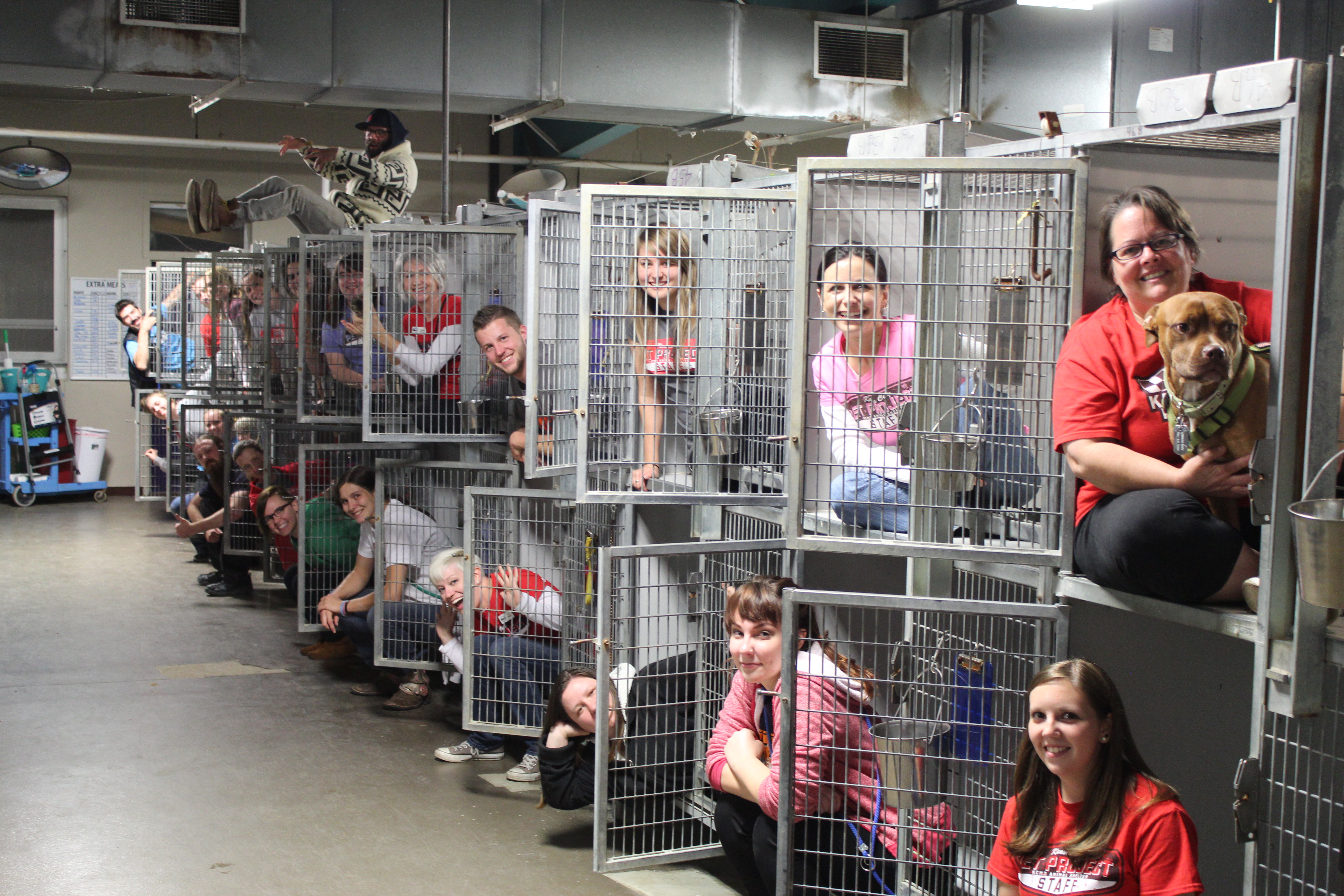
Thus, AHS has lots of available information to implement a more efficient and effective adoption process.
AHS-Newark needs more volunteers to better promote its animals. Until recently, AHS-Newark had virtually no volunteer program. Currently, the shelter has a small group of hard-working volunteers doing great things. For example, the volunteers run an excellent Facebook page, do offsite meet and greet events, pack walks with a few select dogs, dog behavioral evaluations and post animals to Petfinder. AHS-Newark needs additional volunteers or staff to post dogs onto Petfinder. As of today, AHS-Newark only had 60 dogs and cats on Petfinder which likely represents a small portion of the animals at the facility. For example, this would only be 11% of the shelter’s total population if the shelter currently has as many animals it reported having at December 31, 2012 per AHS-Newark’s 2012 Shelter/Pound Annual Report. Additional animals need to get onto Petfinder in order to properly promote all of the animals and not just a select few.
AHS-Newark needs to expand its volunteer program to make animals more adoptable and to facilitate adoptions. Currently, the shelter’s volunteer program is fairly limited. AHS-Newark should seek to emulate Nevada Humane Society whose volunteers contribute over 2,500 hours per month to the organization and conduct a variety of activities. AHS-Newark could greatly benefit by expanding its volunteer base to socialize more animals. Better socialized animals and volunteers knowing more animals well would facilitate adoptions at the Maddie’s event by properly matching families and animals. Furthermore, additional volunteers allows adopters to meet more dogs outside the kennels where the dogs show better.
While the shelter’s space is limited, the organization could find a way to create a playgroup program. Playgroups are a common theme for large shelters who save pit bull type dogs at a high rate. Specifically, these programs make the large dogs, which AHS has lots of, more adoptable and show better in kennels. During the Maddie’s free adoption weekend event, dogs regularly participating in playgroups would seem more attractive to adopters.
Finally, AHS should adopt animals out at multiple locations in future Maddie’s Fund events. Both the Tinton Falls and Newark shelters could increase cat adoptions by holding the event at multiple high traffic locations, such at various Petco, Petsmart, and Pet Valu retail stores. Additionally, AHS-Newark should adopt dogs and cats out at the Union Square adoption center location in New York City. AHS-Newark’s large amount of animals may overwhelm adopters based on recent research and some adopters may not want to visit an inner city shelter. Thus, AHS would likely increase adoptions by adopting animals out at multiple high traffic locations.
Animals Depend On Us Always Improving
Overall, all three organizations adopted more animals than normal during the Maddie’s Pet Adoption Days event. Each organization should evaluate their performance and see how they can better their performance at future events. At the end of the day, animal welfare groups should always strive to improve. Lives are at stake and the animals are counting on you doing the best you can.

 NJ Animal Observer