Role Model Shelter Saves Its Pit Bulls

DSC_0109

Earlier this year, I wrote a blog on how many progressive open admission animal shelters are saving all of their pit bull type dogs. One of these progressive facilities was Colorado’s Longmont Humane Society. Longmont Humane Society’s Executive Director, Elizabeth Smokowski, was kind enough to share some data with me showing how impressive this facility is.

Longmont Humane Society places all of its savable pit bulls in a very short period of time. Based on raw data provided to me, Longmont Humane Society saved 96% of its pit bull type dogs impounded in 2014 (through November 21). Additionally, pit bulls on average only stay at the shelter for 33 days. As a comparison, Longmont Humane Society saves 98% of its non-pit bull type dogs and non-pit bull type dogs stay on average around 9.5 days at the shelter. Both pit bull type dogs and other kinds of dogs are saved at rates far exceeding the typical 90% threshold required for no kill status. Thus, Longmont Humane Society does an amazing job for all of its dogs.

Longmont Humane Society impounds far more pit bull type dogs than New Jersey animal shelters. Through November 21, Longmont Humane Society impounded around 430 pit bull type dogs this year (483 annualized). This equates to 3.59 pit bull type dogs per 1,000 people in Longmont Humane Society’s service area. As a comparison, Associated Humane Societies – Newark, which many people believe impounds extraordinary numbers of pit bulls, only takes in 2.06 pit bull type dogs per 1,000 people in its service area assuming 50% of impounded dogs are pit bull type dogs. Thus, Longmont Humane Society impounds far more pit bull type dogs than New Jersey’s urban shelters “filled with pit bulls.”

Longmont Humane Society Performance with Pit Bull Type Dogs Dispels Many Excuses Shelters Use for Killing or Refusing to Rescue Pit Bull Type Dogs

Pit bull type dogs are adopted quickly at Longmont Humane Society. Assuming a similar percentage of pit bull type dogs and all dogs are returned to owners (i.e. 35.6% of all dogs with outcomes) and those dogs are returned to owners in 5 days on average (i.e. Longmont’s hold period policy), we can estimate pit bull type dogs take 48.5 days to get adopted. However, pit bull type dogs likely take less time to get adopted than 48.5 days due to fewer pit bull type dogs probably getting returned to owners. Restrictive landlord policies often force owners to surrender their pit bull type dogs to shelters and such dogs typically aren’t returned to owners. Furthermore, breed-specific legislation in nearby communities may also result in more owners surrendering their pit bulls. With such a high save rate, many dogs likely require physical and/or behavioral rehabilitation and Longmont Humane Society still successfully adopts its pit bull type dogs out quickly. Thus, Longmont Humane Society has a high pit bull live release rate and quickly adopts out its pit bull type dogs.

Longmont Humane Society has a high pit bull live release rate and quickly adopts its dogs out despite the shelter having lots of pit bulls. Many shelters argue they have to kill or can’t rescue pit bulls due to having too many pit bulls. Longmont Humane Society’s pit bulls and other breeds short lengths of stay prove this is a meritless claim. For example, we can estimate the percentage of pit bull type dogs in Longmont Humane Society’s shelter and foster care dog population by using pit bull and non-pit bull lengths of stay and standard shelter population equations. Based on this data, 45% of Longmont Humane Society’s dog population at the shelter and in foster care should be pit bull type dogs. Furthermore, the large number of pit bulls do not negatively impact adoptions of other breeds given the non-pit bulls length of stay only averages 9.5 days. Unlike many shelters who complain about too many pit bull type dogs coming in and being forced to kill or warehouse scores of them, Longmont Humane Society rolls up its sleeves and saves these dogs.

Winning Strategies Save at Risk Dogs

Longmont Humane Society actively tries to return lost dogs to their owners. Returning lost dogs to owners is often the quickest way to get stray dogs safely out of the shelter. While Longmont Humane Society does not disclose its return to owner rate (i.e. dogs returned to owners/stay dogs taken in), it likely has a high return to owner rate given 35.6% of all dogs received (i.e. strays and owner surrenders) are returned to owners. The shelter’s web site lists lost pets both at the shelter and found by private individuals in the community. The animals can be sorted by type of animal and/or sex to allow someone to quickly find their lost family member. Additionally, people can report lost pets electronically on the shelter’s web site which can help the shelter quickly match lost dogs with their families. Thus, Longmont Humane Society takes active measures to help families find their lost pets.

Longmont Humane Society makes huge efforts at rehabilitating dogs at the shelter and in the community. Amy Sadler instituted her Playing for Life program at Longmont Humane Society several years ago. This program uses playgroups to give shelter dogs much needed exercise, which reduces stress, and increases adoptability. Furthermore, the shelter has a world class behavioral rehabilitation program helping dogs overcome treatable issues and trains other shelters in these methods. All dogs adopted from Longmont Humane Society come with lifetime behavioral support from the people running this program. Even more impressive, Longmont Humane Society provides reasonably priced classes to the public to help their dogs become model canine citizens. For example, Longmont Humane Society only charges $10 for one hour supervised playgroups designed to socialize dogs. Additionally, the shelter also offers a free new adopter workshop for Longmont Humane Society adopters (adopters from other shelters only pay $10). Thus, Longmont Humane Society makes great efforts to help dogs become emotionally healthy and build strong community support.

The shelter put into place many other innovative programs to adopt animals into loving homes. Longmont Humane Society uses foster families to help animals become more healthy, both physically and mentally, and therefore adoptable. In 2013, 656 animals or around 19% of all animals taken in spent time in foster homes. Longmont Humane Society rightly adheres to breed-neutral policies at the shelter focusing on individual behavior rather than breed labels. Also, Longmont Humane Society walks dogs outside the shelter with “Adopt Me” vests and gives interested people information about adopting. The adoption section of Longmont Humane Society’s web site is very user-friendly and allows people to quickly sort dogs who are good with other dogs or cats. Finally, the shelter has 850 active volunteers who logged over 59,000 hours helping the shelter last year. Thus, Longmont Humane Society uses a variety of innovative programs to save lives of all types of dogs.

Longmont Humane Society is a goal oriented organization. The shelter has a strategic plan for 2012-2018 listed on their website laying out measurable goals with specific deadlines. For example, Longmont Humane Society is seeking to reduce its average length of stay for dogs from 18 days to 9 days and for cats from 28 days to 14 days while maintaining no kill level save rates by 2018. Frankly, most shelters would be ecstatic with the old lengths of stay and would sit on their laurels. However, Longmont Humane Society continues to improve and has made substantial progress towards achieving its goal by reducing its average length of stay for dogs from 18 days to 14 days and for cats from 28 days to 21 days in two years. Another goal, using a mobile outreach program to help adopt animals out to underserved communities by 2018, will likely significantly reduce average length of stay for pit bull type dogs even further. Longmont Humane Society also has a goal to maintain a 95% adopter satisfaction rating on surveys and another goal to measure customer satisfaction for other programs, such as training, by 2017. Finally, the shelter lays out specific goals for attracting the best employees and financial performance. This focus on excellence allowed the shelter to turn its financial performance around while it was in danger of bankruptcy and continue improving its service to the community. Thus, Longmont Humane Society’s success with pit bull type dogs is a function of a goal oriented organization focused on continuously improving.

Longmont Humane Society proves that focusing on excellence yields impressive achievements. For far too long, most shelters have not set standards or goals and unsurprisingly fail to save their animals. Longmont Humane Society saves its pit bull type dogs and places them quickly despite taking large numbers of these dogs in and facing a severe financial crisis. Shelters need to drop the excuses for killing pit bull type dogs and do the hard work necessary to save them. Ghandi once said “The true measure of any society can be found in how it treats its most vulnerable members.” Pit bulls are the most vulnerable dogs in shelters and we should judge shelters on how they treat these animals. We know these dogs can be saved. Will those with the power to save pit bull type dogs do so or will the killing and excuses continue to win out at most shelters?
Merritt Clifton Uses Manipulative Math to Try and Discredit Nathan Winograd and No Kill

Renowned no kill and pit bull hater, Merritt Clifton, recently wrote an article downplaying Nathan Winograd’s no kill success. Clifton uses manipulative math and logic to argue Nathan Winograd’s no kill equation leads to less lifesaving than spay and pray and other archaic shelter policies.

Analysis Focuses on Shelter Animal Deaths Per 1,000 People Rather than Save Rates

Clifton bases his entire argument on shelter animal deaths per 1,000 people rather than shelter save rates. Per capita shelter kill rates certainly are an important statistic as they provide a perspective to the amount of killing in a community. However, per capita rates of shelter killing tell us nothing about how shelters are doing. Per capita shelter killing may decrease due to spay/neuter rates in the community at large, which may be due to socioeconomic status of the population or access to affordable spay/neuter resources outside of the shelter, or other external forces having nothing to do with shelter performance. Additionally, per capita kill rates tell us nothing about an animal’s prospects once it lands in a shelter. In other words, a shelter can kill a large percentage of the animals coming though its doors, but still have a low per capita kill rate. People want their shelters to save most of the animals coming into their facility. Animals having little chance of making it out alive of shelters rightfully disturbs many people. Thus, any comparative analysis of shelter performance must include save rates.

Clifton’s Own Preferred Metrics Show Nathan Winograd’s and No Kill’s Superior Performance

Clifton’s entire argument using total change in per capita kill rates ignores basic logic of any intelligent analysis. In a stunning example of lazy or deliberately deceptive logic, Clifton takes gross changes in per capita kill rates to assert Nathan Winograd wasn’t very successful. Unfortunately, the per capita kill rates were much different in these analyses and they require percentage change analysis. Specifically, per capita kill rates were so much higher in Clifton’s counterexamples to Nathan Winograd’s work at the San Francisco SPCA and Tompkins County SPCA that these kill rates had far more room to decline. However, we clearly can see Nathan Winograd outperformed Clifton’s counterexamples on an apples and apples comparison using percentages.

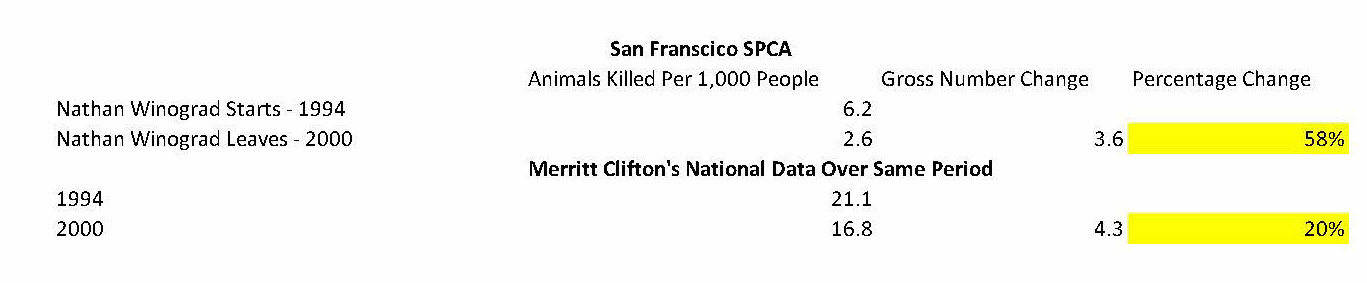
Clifton’s first misleading example compares Nathan Winograd’s performance at the San Fransisco SPCA with shelters nationally during the same period. As you can see, shelters nationally were killing far more animals than San Fransisco and therefore could decrease shelter killing in total more. However, we see on a percentage basis Nathan Winograd outperformed these shelters by nearly a 3-1 margin.

Merritt Clifton Nathan Winograd Analysis SF SPCA V1

Clifton’s second example is even more misleading. In this example, Clifton compares Nathan Winograd’s improvement in total per capita kill rate in San Fransisco with the period after he left. Clifton not only fails to use percentages, but uses a longer period to show Nathan Winograd’s results were not impressive. Once again, we clearly see the flaw in Clifton’s analysis when we compare the results on a percentage improvement per year basis. Specifically, Nathan Winograd’s save rate was 33% better per year. Additionally, Clifton fails to mention the per capita kill rate decrease at San Fransisco SPCA after Nathan Winograd left largely reflected lower intake, which has been a nationwide trend, and the save rate (percentage of animals impounded leaving alive) has not improved since Nathan Winograd left nearly a decade and a half ago. Clifton also failed to point out San Francisco’s save rate stagnated despite save rates nationwide dropping significantly during that same period.

Merritt Clifton Nathan Winograd Analysis SF SPCA V2

Clifton uses a similar misleading example comparing Nathan Winograd’s performance at Tompkins County SPCA with the period before he arrived. Once again, Clifton uses total rather than percentage improvement in per capita shelter killing rates and periods of differing length. After we adjust for these analytical errors, we see Nathan Winograd reduced per capita shelter killing at a rate over 6 times greater per year:

Merritt Clifton Nathan Winograd Analysis Tompkins

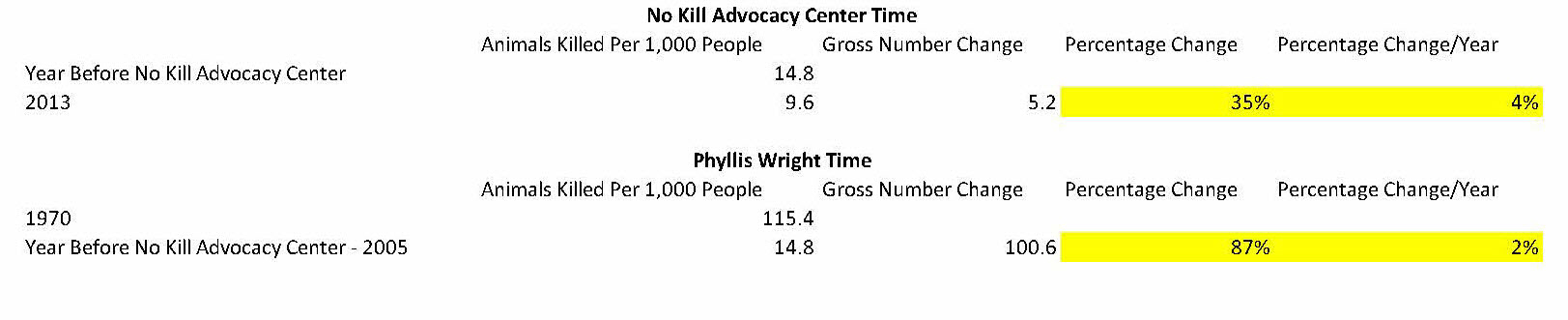
Finally, Clifton posts the most egregious of all comparisons. He compares the era of regressive kill shelter legend, Phillis Wright, with the era of Nathan Winograd’s No Kill Advocacy Center. In addition to the analytical errors above, Clifton also mistakenly assumes all shelters today are following the no kill equation. Even with this assumption stacked against no kill, the per capita kill rate decreased twice as much per year since the No Kill Advocacy Center’s arrival:

Merritt Clifton Nathan Winograd Analysis PW

Nathan Winograd and No Kill Had More Challenging Obstacles to Overcome

Nathan Winograd had to use new techniques to decrease shelter killing. In the previous periods, such as during Phyllis Wright’s era, spay/neuter rates were quite low. All shelters needed to do was point people where to get spay/neuter done and that alone would significantly decrease kill rates. For example, spay/neuter rates were quite low in the early 1970s, but currently dog and cat spay/neuter rates are up to 83% and 91% per nationally per the ASPCA. Additionally, shelters in Phyllis Wright’s era could easily adopt more animals out as massive numbers of highly adoptable animals were killed then. As a result, Nathan Winograd needed to enact innovative programs to further decrease killing. These policies required far more work, and hence met more resistance, from regressive and lazy shelter directors. Thus, Nathan Winograd decreased the rate of killing in a much more challenging environment.

Clifton makes another egregious error by claiming Tompkins County SPCA was doing great before Nathan Winograd arrived and achieving no kill was basically a piece of cake. Specifically, Clifton states the shelter had a below average per capita kill rate during that time. Based on Clifton’s per capita kill rate of 1.8 and Nathan Winograd’s 93% save rate at Tompkins County SPCA, that equates to an intake of 25.7 dogs and cats per 1,000 people. Tompkins County SPCA’s per capita intake during Nathan Winograd’s time was nearly twice the national per capita intake rate of 14 dogs and cats per 1000 people today per Clifton’s former newspaper. Assuming the per capita intake rate was the same during the year before Nathan Winograd arrived at Tompkins County SPCA, the Tompkins County kill rate would have been approximately 30%. Based on Austin Pets Alive’s data, most of the improvement from reducing the kill rate from 30% to 7% would have been due to saving more challenging animals, such as underage puppies and kittens, critically ill or injured animals and animals with behavioral problems. Thus, Nathan Winograd faced a far more difficult challenge if Tompkins County SPCA was doing as great as Clifton claims.

Finally, Clifton fails to mention the animals amazingly short average length of stay at Tompkins County SPCA under Nathan Winograd’s leadership. Nathan Winograd’s animals stayed on average 8 days at Tompkins County SPCA despite the facility being old and rundown when Nathan Winograd arrived. Clearly, getting nearly all of the animals safely out of your facility in 8 days on average would yield no kill results at almost any shelter.

Clifton Makes a 180 Degree Turn on Nathan Winograd

Merritt Clifton praised Nathan Winograd quite a bit not too long ago. In 2008, Clifton concluded his review of Nathan Winograd’s book, “Redemption, The Myth of Pet Overpopulation and the No Kill Revolution in America” by saying:

The loose ends barely matter. Winograd’s arguments would be only strengthened by using better data–and as it stands,  Redemption is probably the most provocative and best-informed overview of animal sheltering ever written.

Similarly, Clifton stated the following when Nathan Winograd ran Tompkins County SPCA:

Animal People, an independent publication, rated the Tompkins County Society for the Prevention of Cruelty to Animals as having the lowest number of animals euthanized per capita in the nation for the past two years. While the national average is 15 animals killed per 1,000 people, Ithaca had 1.9 in 2002 and 1.8 in 2003, said Merritt Clifton, editor of Animal People.

“It’s impressive to see an agency performing 10 times better than the national average,” Clifton said. “Knowing that the local SPCA is doing all it can to save the lives of the dogs or cats raises the level of the community’s satisfaction in the care for its animals.”

Clifton’s about face is quite telling. While we don’t know what is inside Mr. Clifton’s head, clearly Clifton has become anti-no kill. Most likely no kill is at odds with Mr. Clifton’s goal of eradicating pit bull type dogs. After all, numerous open admission shelters achieved no kill for pit bull type dogs alone. At the same time, Clifton has long been an animal welfare “journalist” and supporting outright killing of all pit bulls conflicts with that aspect of his career. Clifton’s play then would be the backdoor eradication through his vocal calls for pit bull sterilization using the bogus claims its for the protection of pit bulls. Thus, advocating only for spay and pray policies is how Clifton can reconcile his pit bull eradication position and his reputation as an animal welfare “journalist.”

Merritt Clifton’s donors for his new web site fit nicely into this ideology. Not surprisingly, Colleen Lynn, who runs the anti-pit bull dogbites.org website, donated to Clifton’s endeavor. The most telling donor is Ruth Steinberger, who advocates spay/neuter as the primary solution to shelter killing. However, Steinberger also believes shelters should NOT adopt out pit bulls using PETA like logic that all of them will be adopted by dog fighters:

“There is no other breed where people go to the shelter to victimize the animal,” said Steinberger.

As such, you just need to follow the money to see where Clifton’s positions come from. Luckily, Clifton no longer is the primary animal shelter commentator in the digital age. Additionally, Clifton’s sloppy and misleading analyses have further brought him to irrelevance. Thankfully, people finally see Clifton for what he truly is.

No Kill Success is Contagious

Recently Merritt Clifton argued Reno, Nevada’s no kill success came at the expense of surrounding communities. According to Mr. Clifton, the region’s open admission shelter stole adoptions from nearby areas resulting in little net life saving. Clifton used Nevada’s mediocre adoption rate outside the Reno area as the basis for his argument. Is Clifton correct or is this yet another one of Clifton’s meritless arguments? Alternatively, can successful no kill open admission shelters cause other nearby communities to save more lives?

Nevada’s Population Distribution Refutes Clifton’s Claims

Nevada’s primary population centers outside the service area of the Reno, Nevada shelter are very far away. Approximately 86% of Nevada’s population outside the Reno, Nevada shelter’s service area in Washoe County reside in the county where Las Vegas is located. Las Vegas is approximately 450 miles away and around a 7 hour drive from Reno. This is as about as far as Elizabeth City, North Carolina and Ottawa, Canada are from New York City. Do people believe adopters in New York City are regularly visiting shelters in North Carolina and Ottawa, Canada? As a result, Clifton’s argument is completely wrong.

The Las Vegas area’s primary shelter has a history of poor performance and depresses statewide adoption numbers. Recent statistics show roughly half of the shelter’s 40,000 impounded animals were killed. This high kill rate is even more astonishing given Washoe County, Nevada’s open admission shelter takes in nearly 80% more animals per capita and saves 90% of its animals. Thus, Nevada’s other primary shelter performs poorly and that is the reason for the state’s mediocre adoption rate.

Shelters Near the Highly Successful Reno, Nevada Shelter Are Doing Well

Several large shelters within reasonable driving distance of Reno, Nevada are succeeding. The Out the Front Door blog reports Carson City, Nevada’s open admission shelter is doing very well and is in the nearest large population center to Reno. Additionally, Douglas County, Nevada is another reasonably close population center and its open admission shelter saved 98% of its animals. Furthermore, Nevada County, California, which is one of the closest large communities west of Reno, saved 99% of its impounded animals over the last three years. Therefore, open admission shelters reasonably close to Washoe County, Nevada’s highly successful shelter are saving and not taking lives.

Austin, Texas’s Success Leads to More Nearby No Kill Communities

Austin, Texas is the largest no kill community in the country and several nearby cities are also saving lives. Austin, Texas has been a no kill community since 2011 and saved from 91%-95% of its animals each year since then. Shortly after Austin, Texas became a no kill community, Williamson County Regional Animal Shelter, which serves Williamson County, Texas and is located just north of Austin, achieved no kill status. Despite taking in nearly 7,500 animals a year, dogs and cats only stay 11 and 15 days at the shelter. Taylor, Texas, which is just northeast of Austin, saved 93% of its animals in 2012. Pflugerville, Texas, which is also located in the Austin metro area, saved 98% of its animals in 2012 despite the city prohibiting trap, neuter, release. Georgetown, Texas, which is also just north of Austin, saved 85-90% of its animals in recent years. San Antonio, Texas, which is about a 1 hour and 20 minute drive from Austin, recently reported an 81% save rate, which is up from 32% in 2011, and a 90% live release for cats in March and April 2014. This shelter services an area of 1.3 million people and took in over 32,000 animals during fiscal year 2013. Kirby, Texas, which is also in the San Antonio metro area, saved 94% of its animals in 2013. Thus, the success of Austin’s no kill effort led to high save rates in many other nearby communities.

Animal Ark Inspires Positive Change in Minnesota

Animal Ark’s high level of success led to significant improvements in nearby large cities. Animal Ark, which is located in Hastings, Minnesota, has an adoption guarantee arrangement with a local impound facility where Animal Ark takes animals not reclaimed by owners. Also, Animal Ark accepts owner surrenders subject to a waiting list. Animal Ark saved 99% of its 700 impounded dogs and cats in 2013 and takes in about 16 dogs and cats per 1000 people. Additionally, the shelter reports a length of stay of just over a month. Animal Ark’s short average length of stay is impressive given virtually all animals were adopted and no animals were reclaimed by their owners, which tend to have very short lengths of stay, due to the local impound facility holding animals during the stray/hold period. Also, Animal Ark gets its animals quickly out of the shelter despite it likely needing to rehabilitate relatively more animals due to the organization’s very high 99% save rate. The shelter’s director, Mike Fry, is a vocal no kill advocate and argues for positive change in Minnesota and beyond. Recently, Brooklyn Park, Minnesota’s Pets Under Police Security (“PUPS”) shelter reported a 98% save rate. Similarly, St. Paul, Minnesota’s animal control facility reported a 90% + save rate recently as well. Additionally, Minneapolis’s animal control shelter, which has a sordid history, recently hired new management and pledged to change its ways. As a result, Animal Ark’s success adopting out animals has not hurt, but helped nearby shelters.

San Francisco Area Success

San Francisco has a long history of no kill initiatives. In the 1990’s, Richard Avanzino, who now leads Maddie’s Fund, and Nathan Winograd nearly made San Francisco the nation’s first no kill community. During this time, innovative programs, such as an adoption guarantee agreement with the city’s animal control shelter and frequent off-site adoption events, were developed. Unfortunately, the city regressed after both men left the San Francisco SPCA.

The no kill spirit lives on in the San Francisco area and success is being achieved. Based on 2013 reported statistics, San Francisco Animal Care and Control and the San Francisco SPCA collectively reported an 85% save rate for local animals assuming all negative outcomes were for San Francisco animals. Berkeley, California, which is located on the other side of San Francisco Bay, saved 90% of its animals in 2013. Alameida, California, which also is on San Francisco Bay, reported a save rate of 91% in 2013. Thus, communities in the San Francisco Bay area are saving animals at a high rate despite their close proximity to each other.

Boulder, Colorado Region Shelters Save Lives

Open admission shelters in the Boulder, Colorado area are saving their animals at a high rate. Longmont Humane Society, which serves several communities in the Boulder area, saved 93% of the 3,536 dogs and cats impounded in 2013. The nearby Humane Society of Boulder County, which took in 7,669 animals in 2013, reported a save rate of 89% in 2013 (91% if owner requested euthanasia are excluded). The Humane Society of Platte Valley, which is also located in the same metropolitan area, saved 94% of its 1,475 dogs and cats impounded in 2012. Thus, large open admission shelters in close proximity to each other in Colorado are saving animals at a high rate.

Successful No Kill Communities Can Drive Significant Positive Change Elsewhere

No kill communities drive positive change elsewhere directly and indirectly. Successful no kill open admission shelters can directly help nearby communities by rescuing animals. However, these no kill communities help much more by inspiring and/or pressuring poorly performing shelters to improve. The following quote sums it up perfectly:

“Give a man a fish and you feed him for a day. Teach a man to fish and you feed him for a lifetime.”

By changing another shelter’s policies, you can save far more animals than you could rescue directly. The animals you can rescue is limited to your shelter’s excess physical space and foster homes. However, by improving other shelters’ policies you can help far more animals. For example, consider a shelter with a 100 animals and 10% excess capacity due to efficient life saving programs. This shelter would be able to directly pull 10 animals. However, what happens if that successful shelter’s efforts were replicated by two other similar sized shelters and the euthanasia rate dropped from 50% to 10%? The successful shelter would save 80 or 8 times as many animals by getting other shelters to do the right thing verses pulling animals directly. Thus, no kill communities can dramatically increase life saving by getting other communities to do the same.

Creating no kill communities, promoting your success, offering help to other communities, and challenging those shelters who refuse to do the right thing are key to saving the most lives. Austin Pets Alive is a great example of an organization leading its community to no kill and helping others do the same. In early 2012, Austin Pets Alive formed a new organization, San Antonio Pets Alive, to help San Antonio achieve no kill status. Subsequently, San Antonio’s live release rate increased from 31% to 81%. In most cases, poorly performing shelters are reluctant to change their ways. In these cases, more vocal advocacy, such as what Animal Ark has done in Minnesota, is needed. Such advocacy does the following:

  1. Puts direct pressure on government run shelters (and private organizations who operate government owned shelters through short term contracts) to improve through political pressure on elected officials
  2. Puts financial pressure on private shelters as donors become more informed and demand their money be efficiently used to save lives

Unfortunately, the animal welfare community generally prefers unity even when many shelters are clearly doing the wrong thing. At the very least, successful shelters should publicize their statistics and success. This puts subtle pressure on the under performing facilities to do the same. However, vocal advocacy and comparing and contrasting their shelter’s performance with poorly performing facilities who refuse to change is needed. While private citizens can advocate for change, the credibility of advocates is much greater when a reputable animal welfare organization is leading the effort. Thus, we need successful no kill communities and their animal welfare organizations to inspire, assist, advocate and pressure other communities to save lives.

Sometimes you need to fight for what you believe in. Saving lives is certainly one of those fights you should take one.

Disrespecting Your Shelter’s Hometown Leads You Down the Wrong Road

Associated Humane Societies – Newark’s Assistant Executive Director, who is the organization’s number 2 ranking person and representative in many media interviews, posted an insulting joke about Newark’s residents on his personal Facebook page recently. The photo is identical to the following image except “New Jersey” replaces “Ohio “and” “Newark” takes the place of “Michigan.”

Ohio Shadowy place

Additionally, several of Associated Humane Societies – Newark’s employees also commented about how much they liked the photo. Associated Humane Societies – Newark operates a large animal shelter in Newark and receives up to $632,000 in animal control contract fees from the city of Newark.

This behavior demonstrates a clear disrespect for Associated Humane Societies’ community. Telling your shelter’s hometown they live in a “shadowy place” and “you should never go there” is deeply insulting. If you lived in Newark, would you want to support this shelter? Perhaps, this attitude towards the city’s residents along with a past scathing investigation and poor performances in Office of Animal Welfare inspections in 2009 and 2011 led to the popular Cory Booker administration’s displeasure with Associated Humane Societies.

The remark sends the message to people outside of Newark to not visit the shelter since the facility is in a “shadowy place” that “you must never go” to. The “you must never go to Newark” message makes even less sense when you consider  Associated Humane Societies, to the best of my knowledge, does not adopt out dogs at its off-site events (i.e. you have to go back to the shelter in Newark to adopt the animal you meet outside of the shelter). As a result, the Assistant Executive Director of Associated Humane Societies’ Facebook post hurts the cause of his shelter’s animals.

Unfortunately, Associated Humane Societies’ attitude toward its hometown has an even more detrimental effect on shelter policy. In an article last year, the same Assistant Executive Director stated he wanted more stringent spay/neuter laws and backyard breeder bans to reduce Associated Humane Societies unacceptably high kill rates. KC Dog Blog, which is written by Kansas City’s no kill open admission shelter’s Board President, clearly demonstrates how Kansas City’s pit bull mandatory spay/neuter policy increased impounds and kill rates. Additionally, KC Dog Blog also documents most large animal welfare organizations, such as the ASPCA, Best Friends, Humane Society of the United States (via the California Sheltering White Paper), No Kill Advocacy Center and the American Veterinary Medical Association oppose mandatory spay/neuter laws. Such laws increase impounds and shelter killing and also waste limited resources which could be used more productively. The main barrier to spay/neuter is cost for poor folks and mandatory spay/neuter laws with their punitive fines simply exacerbate the problem. Similarly, breeding bans, which sound great, are also ineffective and drain limited resources as evidenced by Long Beach, California’s 30 year breeding ban’s failed efforts at achieving a no kill community.

The “irresponsible public” argument and resulting attitude communicated by Associated Humane Societies represents a huge obstacle to creating a no kill community. While the shelter’s personnel may have negative experiences with the public, those interactions are not representative of the entire population. Newark most likely is more responsible than the average American community. Associated Humane Societies – Newark took in approximately 8 dogs and cats per 1000 residents in its service area during 2012. Unfortunately, we do not know what the city of Newark’s per capita intake rate is since Associated Humane Societies impounds dogs and cats from numerous other communities. However, the nearby urban communities of Elizabeth, Paterson plus surrounding towns and Jersey City – Hoboken took in approximately 7 dogs and cats per 1000 people. Nationally, Maddie’s Fund states the average community impounds 14.5 dogs and cats per 1000 people. Thus, Newark likely impounds around half the number of animals as the average American community on a per capita basis. Therefore, “shadowy” Newark is likely more responsible than many less “shadowy” places.

Associated Humane Societies – Newark’s animals would benefit greatly from a significant change in attitude. While Associated Humane Societies prefers to blame the not so irresponsible public for killing shelter animals, the blame lands squarely with the shelter. Associated Humane Societies – Newark needs to stop fighting successful no kill policies and enthusiastically implement these programs to quickly move animals from the shelter into loving homes. Personally, I’d suggest following KC Pet Project’s model which made Kansas City a no kill community 18 months after taking over the shelter. As recently as 2008, this shelter killed more than 60% of its impounded animals. However, KC Pet Project now saves roughly 90% of its animals despite taking in around twice as many dogs and cats in total and per capita as Associated Humane Societies – Newark.  KC Pet Project accomplished this without Associated Humane Societies’ vast financial resources and with an undersized and outdated primary shelter having only one third of the recommended capacity.

Associated Humane Societies should also implement targeted spay/neuter and pet owner support programs to help struggling pet owners in areas with higher impound rates. For example, the ASPCA’s Operation Pit in New York City and Monmouth County SPCA’s Pittie Project programs offer free spay/neuter, vaccinations and microchips to pit bulls. Spay & Neuter Kansas City provides another great example of not only substantive programs, but a helpful and nonjudgmental attitude towards the people requiring help. This organization literally goes door to door in some of the poorest neighborhoods to help struggling pet owners. As a result of these programs and relationship with the community, Spay & Neuter Kansas City assisted over 15,000 people with spay/neuter surgeries, veterinary services, and pet outreach programs in 2013.

Let’s drop the “shadowy” jokes about people and get onto helping folks and their animals. That is how you save lives!

Jersey Animal Coalition Debacle Reveals Deep Rifts With The Community

The Office of Animal Welfare’s and South Orange Board of Health’s Jersey Animal Coaltion inspection report and related NJ SPCA investigation into possible animal cruelty unleashed a tremendous reaction from the local community. Maplewood Online has a message board which discusses local news and events. While the posters are anonymous and content cannot be verified, the sheer volume and passion of responses is quite telling in my opinion.  The negative reactions are also consistent with Jersey Animal Coalition’s Google Reviews. Clearly, many people had some very poor experiences with the shelter’s management.

Jersey Animal Coalition’s relationship with the town of Maplewood also has been rocky. Under Jersey Animal Coalition’s lease with South Orange, Jersey Animal Coalition only pays $1 to rent the facility in exchange for taking in all stray “house pets” brought in by South Orange’s and Maplewood’s animal control officers. “House pets” are defined as “cats, dogs and similar domesticated animals normally kept in the home.” Jersey Animal Coalition contends feral cats are not their obligation while Maplewood believes Jersey Animal Coalition must take in feral cats. Maplewood compromised and agreed to not bring in feral cats which couldn’t be safely handled. Under the arrangement, Jersey Animal Coalition agreed to take feral kittens since such kittens could be socialized and eventually adopted. However, in August, 2012, Jersey Animal Coalition changed course and refused to take these kittens in. In that same month, Maplewood instituted a stray cat feeding ban and a very regressive feral cat policy.

Jersey Animal Coalition’s feral cat policy is inconsistent with the no kill equation. Community involvement and trap, neuter release are two key no kill equation programs. While not accepting feral cats is preferable to impounding and killing them, the shelter should passionately fight to implement trap, neuter release (“TNR”) programs. Personally, I am concerned about the fate of feral cats under Jersey Animal Coalition’s policy. For example, do the towns animal control officers take feral cats who are injured, sick or subject to residents complaints to get killed elsewhere?  If TNR programs are illegal, the shelter should use barn cat programs to send feral cats to live outdoors as a substitute to trap, neuter, release. Based on Jersey Animal’s Coalition’s service area’s approximate population of 40,000 people and nearby Montclair and Union animal shelter’s per capita cat intake rates, I estimate Jersey Animal Coalition should take in approximately 140 cats per year. However, Jersey Animal Coalition’s 2012 “Shelter/Pound Annual Report” submitted to the New Jersey Department of Health only reported 40 cats impounded (given the shelter’s lack of impound records I’m not sure how they even came up with this number). If we assume the 100 cat difference between expected and actual impounds are feral cats, then Jersey Animal Coalition should be able to place this small number through a barn cat program. In reality, the number of feral cats needing placement would be smaller since some of those 100 cats would be kittens who could be socialized and adopted. Thus, Jersey Animal Coalition could have solved the feral cat problem if it simply implemented a barn cat program like other successful no kill communities.

Luckily, Maplewood may have had a change of heart. In February, 2014 Maplewood’s Township Committee voted unanimously for its Health Officer to work with a TNR group to develop a course of action. Unfortunately, Jersey Animal Coalition’s management does not appear to have a significant role in this effort. Additionally, South Orange apparently still has a regressive feral cat policy.

Jersey Animal Coalition’s handling of the feral cat issue also demonstrates poor management of the relationship with the municipalities. If Jersey Animal Coalition did not want to impound feral cats, then the organization should have clearly spelled that out in the lease. The towns health departments have a keen interest in managing feral cats. For example, the towns deal with residents complaining about large colonies of intact animals. Jersey Animal Coalition basically said “you are on your own” after signing the lease and accepting approximately $285,000 of funding to help build the shelter along with paying virtually no rent for a 5,400 square foot facility on a sizable property. To add further insult to injury, the shelter transported hundreds of dogs, most of which were out of state puppies, each year into the shelter per their “Shelter/Pound Annual Reports” while refusing to accept many of their own community’s cats.  As a result, the two towns would have every right to hold some ill will towards shelter management.

Most disturbingly Jersey Animal Coalition’s poor performance apparently decreased the community’s and the Maplewood Health Department’s support for no kill shelters. On Maplewood Online, several people pointed to Jersey Animal Coalition’s inspection report as proof no kill open admission shelters do not work.  Similarly,  Maplewood’s Health Department blamed Jersey Animal Coalition’s no kill policy for overcrowding at the shelter. Unfortunately, Jersey Animal Coalition caused confusion on what no kill is by asserting it is a “100% no kill shelter.” No kill simply means no killing and returns euthanasia to its true definition. No kill shelters do euthanize about 1%-10% of impounded animals for severe medical or behavioral reasons.  Apparently, Jersey Animal Coalition is confusing no euthanasia with no killing and a no kill shelter with a sanctuary. Proper sanctuaries provide refuge for unadoptable animals and offer large outdoor areas for the animals to enjoy. On the other hand, Jersey Animal Coalition’s long term residents spend years living in inadequate sized kennels with no documentation showing legally mandated exercise is provided. Thus, the community has every right to think no kill shelters are a bad thing if Jersey Animal Coalition is the only no kill shelter they know.

Jersey Animal Coalition’s debacle provides an important lesson to no kill advocates. We no longer can stand by quietly when shelters describing themselves as no kill fail to deliver. In my opinion, Jersey Animal Coalition did not properly implement all 11 no kill equation programs. No kill advocates need to develop some sort of certification program, such as peer review in the accounting and legal professions. Currently, the Out the Front Door Blog is the closest thing we have to this. Luckily, Jersey Animal Coalition never made it to the listing of no kill communities. Also, no kill advocates must push for frequent high quality inspections, such as those done by New Jersey’s Office of Animal Welfare. Unfortunately, shelters need more regulation and even self-described no kill shelters cannot always be trusted to do the right thing.