
Previously, I wrote about Humane Rescue Alliance-St. Hubert’s high kill culture. The Washington DC shelters quickly killed large percentages of their dogs and cats in 2020 and 2019. Similarly, St. Hubert’s killed large percentages of dogs when it had the Newark, New Jersey contract. Also, St. Hubert’s with its ASPCA partner killed scared and abused dogs at a rehabilitation center that was supposed to help these animals. Despite this poor performance, the CEO, Lisa LaFointaine, received $401,713 of annual compensation per the organization’s September 30, 2021 Form 990.
Humane Rescue Alliance has been intimately involved with Human Animal Support Services (“HASS”). Lisa LaFontaine was previously on the HASS executive leadership team and the HASS website lists Humane Rescue Alliance as a HASS partner shelter.
After much criticism about its performance, Humane Rescue Alliance got rid of several executives and hired younger ones that were heavily promoted by Austin Pets Alive and Maddie’s Fund. In Spring 2022, Humane Rescue Alliance brought in Bobby Mann as its Chief Programs Officer. Previously, he worked for Austin Pets Alive as its “Maddie’s Human Animal Support Services (HASS) Pilot Director.” In October 2022, Humane Rescue Alliance hired Ariel Zhang as its Vice President of National Programs. Both Bobby Mann and Ariel Zhang frequently host Maddie’s Fund weekly Community Conversation Zoom meetings that claim to promote progressive animal welfare practices and HASS.
Has Humane Rescue Alliance truly become a progressive shelter? Did its involvement with HASS and its hiring of Maddie’s Fund and Austin Pets Alive supported executives help Washington DC’s animals?
Animals Left to Rot in Crates
DCist/WAMU wrote a scathing article about volunteer allegations against Humane Rescue Alliance’s Washington DC shelters. Ten volunteers assert that the shelter is failing to provide humane care to its animals. Specifically, the volunteers state Humane Rescue Alliance understaffs its shelters and is relying too heavily on unpaid volunteers. Volunteers allege the shelter isn’t even taking care of the animals’ basic needs:
The very fact that there isn’t a system in place to ensure that the dogs are taken out in regular intervals is really problematic. I would say that the volunteers are starting to be the primary caretakers for a lot of the dogs in terms of enrichment and outside kennel time.
Humane Rescue Alliance’s spokesperson wanted the reporter not to worry. The spokesperson insinuated these conditions occur at shelters nationwide due to increased animal intake this year. While dog intake is higher this year, it is still significantly below the levels prior to the pandemic. The spokesperson also claimed it employed enough staff to provide the animals 30 minutes of care a day and hired a cleaning company.
However, one volunteer stated Humane Rescue Alliance’s staffing numbers are below the levels from before the pandemic and are insufficient to care for the animals. She stated staffing levels to feed, walk and medicate 70-80 dogs at the New York Avenue shelters decreased from 12-14 in pre-pandemic times to four currently. Volunteers at the Ogelthorpe shelter said sometimes only one worker was around to let out 60 dogs to go to the bathroom before their 7 pm bedtimes.
Volunteers stated the kennels are filthy. In fact, the volunteers said Humane Rescue Alliance would pursue “a neglect case” if the average person kept animals in these conditions and then try to fundraise off of it:
If we go to New York Avenue tomorrow morning, the kennels would be filthy, and it would be the volunteers that are running around trying to clean kennels and take dogs out.
If HRA found this somewhere out in the community, it would be a neglect case,” said one long-time volunteer, who asked not to be named because they want to continue volunteering with the organization “Like, [HRA] would be talking about it in the media, they would be fundraising around it.
While Humane Rescue Alliance denies it keeps animals in these poor conditions or fails to let animals go to the bathroom on a timely basis, volunteer photos taken over the last couple of weeks prove the shelter wrong:


Similarly, a volunteer video of the dogs warehoused in crates backup the allegations.
The volunteers allege the dogs in this video are in windowless warehouse, are sick and housed within feet of each other. While the DCist article states HRA’s crating policy says adopters should only keep dogs in crates for four hours at a time and for a maximum of 14 hours a day, volunteers allege the shelter has dogs in crates for days and they are only getting out about once per day. One long-term volunteer stated the following things about these conditions:
It is heartbreaking – some of the dogs can’t turn around in their crates, some of them have no linens in them. The ones that have a washcloth or a hand towel, it’s usually soaked in urine. It’s covered in feces, they don’t have water. It is impossible to take them outside on hot days because they’re surrounded by the parking lot.
So what was the esteemed Humane Rescue Alliance spokesperson’s response? Basically, don’t worry its part of our business.
We’re often over capacity, which means that we’ve had dogs living in crates, which is heartbreaking,” the spokesperson said. “And so one of the big problems that happens is that disease spreads the more animals you have.
Volunteers disputed that being at capacity necessitates cruelty:
It used to be, when I started…a much better-organized location,”Dogs were taken out regularly, they received behavioral treatment. Today, dogs do not leave their kennels. Maybe they get out once a week. These kennels are disease-ridden, they often live in their own filth.
Humane Rescue Alliances Kills on a Whim
The DCist/WAMU article also describes volunteer allegations about the shelter quickly killing its neglected dogs. One volunteer describes how the shelter uses its poor conditions as a reason to kill:
Not only is it a health issue – they completely deteriorate mentally, and they’re immediately euthanized because they’re deteriorating. That is the pattern that we’ve seen consistently.
One volunteer stated the shelter kills dogs for simply looking at a staff member the wrong way:
There have been dogs who have been euthanized for no bite incident, just for giving a behavioral manager a hard stare or growling.
In response, the esteemed Humane Rescue Alliance spokesperson, who appears to haven’t walked into the shelter for a very long time, denied the shelter killing for space and called itself “progressive” and better than most facilities:
We are really progressive when it comes to life-saving,” the spokesperson said. “We’re just going through what most shelters are going through in the country, and I would say we’re well-resourced enough that it’s not nearly as excruciating.
The spokesperson stated the shelter has a “rigorous” process for making “tough choices” (i.e. killing):
If a dog is struggling, we have a rigorous decision-making process to determine what interventions are needed,” the spokesperson said. “Most dogs who are struggling see improvements as a result of these interventions and we’re able to find them an adoptive home. For a very small number of dogs, our team must make extremely tough choices for the health and safety of community members and their pets.
Given the absurd reasons Humane Rescue Alliance used to kill before and in the early stages of the pandemic, such as killing an “easy to handle” and “friendly, but seems stressed” 11 month old puppy for failing a scientifically invalid temperament test, one should disregard everything the out of touch spokesperson says.
While the DCist/WAMU article was excellent, it mislead readers about Humane Rescue Alliance’s live release rate. The 94.7% live release rate cited for 2021 is incorrect for the following reasons:
- It combines dog and cat live release rates that obscure dog killing
- The figure excludes owner-requested euthanasia (which Humane Rescue Alliance has used to coerce owners into agreeing to) and animals who died in the shelter
- The figure counts animals rescued from other shelters, including the many St. Hubert’s transports in
- The figure counts animals St. Hubert’s transports in and quickly transports out to other shelters
My prior blog showed Humane Rescue Alliance killed massive percentages of Washington DC animals in 2020 and 2019. 29% of all dogs, 33% of pit bulls, 15% of all cats and 19% of cats 1 year and older lost their lives over those two years. When only looking at animals not reclaimed by an owner or neutered and released, 38% of all dogs, 41% of pit bulls, 18% of all cats and 22% of adult cats lost their lives. For dogs and cats 10 years and older, these death rate and nonreclaimed death rate figures were even more frightening: all dogs (63% and 76%), pit bulls (77% and 88%), cats (61% and 67%). To make matters worse, Humane Rescue Alliance killed most of its animals almost immediately: 64% of the dogs, 90% of the senior dogs, 76% of the cats and 87% of the senior cats lost their lives within two days of arriving at the facility.
HASS Fails the Animals
Austin Pets Alive and other shelter directors, including Humane Rescue Alliance’s Lisa LaFontaine, created the HASS sheltering model at the start of the COVID-19 pandemic to drastically reduce shelter intake. Under the model, shelters only take in emergency case animals (dangerous dogs, severely injured pets, etc.) and demand the public save all other animals (including strays). Austin Pets Alive claims HASS shelters support the public in these efforts on its website.
The DCist/WAMU article proves HASS shelters do virtually nothing to help the public save animals. One former employee stated Humane Rescue Alliance cut back on both its community cat and pet owner support programs, such as veterinary care assistance for impoverished pet owners, free vaccine and spay-neuter clinics and dog training assistance:
It was all designed to make sure that animals are happier, healthier, and staying in their homes – preventing them from needing to ever get returned to the shelter for behavior issues, for having too many puppies,” Cochran said. “These were awesome, progressive programs… and all of that has been cut back.
Humane Rescue Alliance’s spokesperson admitted HASS social services program do not work by stating the initiatives aren’t sufficient to offset increased animal intake at the shelter. While Humane Rescue Alliance has not made 2022 or 2023 data available, Humane Rescue Alliance and St. Hubert’s combined cat and dog intake from the local community was 25% lower in 2021 (7,479 dogs and cats) than in 2019 (9,941 dogs and cats). National animal sheltering data suggests animal intake increases in 2022 and 2023 do not come close to reaching 2019 levels.
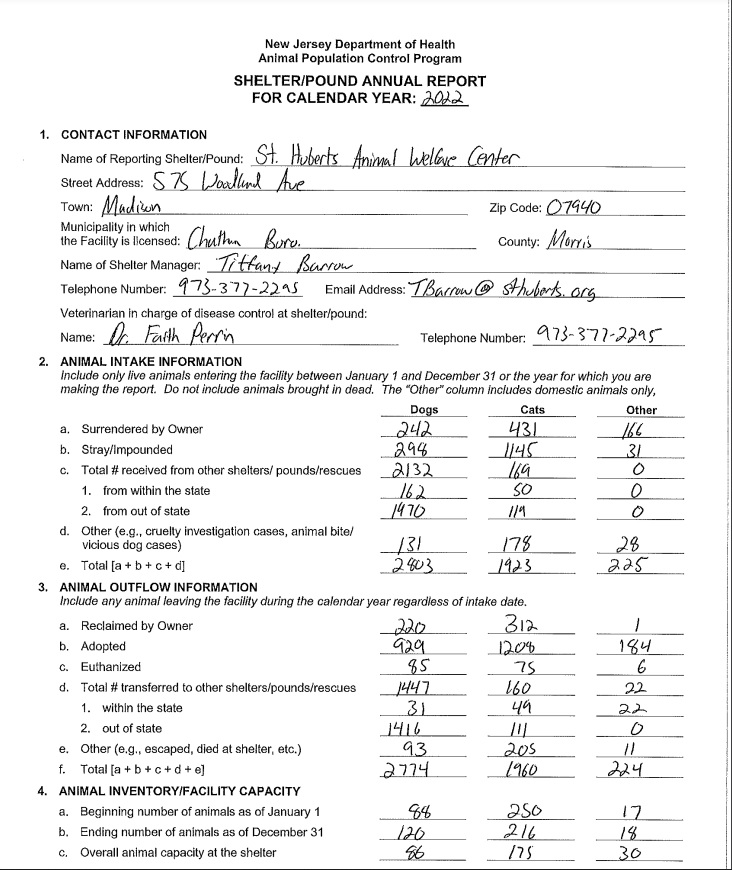
Even if Humane Rescue Alliance’s animal intake truly is higher than ever, its actions prove it is not serious about saving Washington DC’s animals. In 2022, Humane Rescue Alliance’s St. Hubert’s-Madison facility brought in 2,132 dogs (1,470 out of state transports) and 169 cats (119 transported in from out of state) from other shelters. Since St. Hubert’s other New Jersey shelters did not report 2021 data, these numbers could be even higher. While its possible some of St. Hubert’s out of state transports came from Humane Rescue Alliance in Washington DC, it is unlikely to be significant based on St. Hubert’s transport oriented business model.
At the beginning of this month, Humane Rescue Alliance’s St. Hubert’s shelters transported in 50 dogs and cats from the south on a flight. In other words, Humane Rescue Alliance was allowing its Washington DC shelter dogs to live in squalor at the same time it was transporting dogs and cats into its St. Hubert’s shelters. Thus, Humane Rescue Alliance tried to make money off transports (fundraising and high adoption fees) while its own dogs live in tiny crates with feces and are killed for looking at people the wrong way.
One Humane Rescue Alliance volunteer describes the Washington DC shelter situation as preventable:
This is just not the type of thing I would imagine in some place like D.C., where there is a lot of money, there are a lot of resources. There’s no way this should be happening.
In fact, the volunteers blame Humane Rescue Alliance’s management for the shelter’s problems:
But the management, the very senior management, I think are unfortunately pretty detached from what’s happening on a day-to-day basis in the shelter. If you were to look at [HRA’s] social media, you would think that every dog is just living a great life in there. It’s just not true.
Humane Rescue Alliance’s embrace of HASS and hiring of the new executives are political cover to maintain its current money making business model. At the end of 2022, Humane Rescue Alliance had $45 million of net assets ($26 million excluding its facilities) that could be deployed to help its animals. Instead, it skimps on animal care and key programs to save lives and wastes money on overpaid and inept executives. Simply put, Humane Rescue Alliance is a money making scam designed to enrich its executives while failing to adequately serve Washington DC’s animals and its people.
Washington DC officials must force Humane Rescue Alliance to fire Lisa LaFontaine or terminate its contract with the organization. The sooner the city moves on Ms. LaFontaine leadership, the sooner Washington DC’s animals and its people can get the service they deserve.










 NJ Animal Observer