Lessons Learned from Maddie’s Free Pet Adoptions Event

On May 31 and June 1, Maddie’s Fund sponsored a free pet adoptions event in various parts of the country. Research studies show animal welfare groups can increase adoption numbers without compromising the quality of the homes by waiving fees. People can use the money instead to pay for other substantial costs, such as vet care and pet supplies. In order to save lives now and encourage animal welfare groups to offer such promotions in the future, Maddie’s Fund pays these organizations a substantial per adoption subsidy. Specifically, shelters and rescues receive $500 for healthy younger animals, $1,000 for older animals or ones with certain medical conditions, and $2,000 for older pets with certain medical issues.

Three northern and central New Jersey animal shelter organizations participated in the event. St. Huberts, Liberty Humane Society and Associated Humane Societies’ Newark and Tinton Falls shelters ran the promotion. All three organizations should be commended for participating and choosing to save lives. However, we should also look at the experience and see what areas these shelters can improve upon to save more lives in the future.

Too Many New Jersey Shelters Did Not Participate

Unfortunately, the vast majority of the state’s animal shelters failed to take advantage of this opportunity. Frankly, people who donate to these shelters should question their leadership on why they chose to not take on this opportunity to save lives and receive significant grant money from Maddie’s Fund. Whether the low participation rate was due to not knowing about the event or ideological reasons (i.e. “free adoptions are bad”), the end result is less life saving. The low participation rate shows we need to promote this event better to shelters and hold shelter leaders accountable who choose not to sign up.

Adoption Numbers Increase Significantly

The following table summarizes the participating shelters performance during the Maddie’s Fund event. In order to provide some perspective, I compared each facility’s adoption rate during the two days to these shelters’ most recently available adoption rates. Additionally, I also estimated the percentage of each shelter’s animal population adopted during the promotion by using each shelter’s adoption numbers and the most recently available shelter population numbers. The actual adoption numbers may differ if the shelters revised their totals or did not report some adoptions on their Facebook pages, but the general trend should not be different.

Maddies Results Revised

Each shelter significantly exceeded their typical adoption rate during the event. St. Huberts and Liberty Humane Society adopted out animals at over 20 times their typical two day adoption rate. The two AHS facilities, which reported far fewer adoptions, also adopted out significantly more animals than normal.

AHS-Newark’s improvement may be better than these results indicate. Based on my experience with the shelter, I suspect transfers to rescues might be included in their 2012 adoption numbers. Also, the shelter’s reported 12/31/12 shelter population number seemed extraordinarily high. The shelter reported having 300 dogs and 225 cats (maximum claimed capacity), but a July 30, 2009 Office of Animal Welfare inspection report stated the facility was at full capacity with 325 animals. If we assume half of AHS’s 2012 adoptions were really transfers to rescues and the facility only had 325 animals, AHS-Newark would have adopted out 160% more animals than normal and 4% of its shelter population.  Thus, AHS-Newark may have done a bit better than the table above suggests.

Types of Animals Impacts Adoption Numbers

St. Huberts large number of adoptions may be in part due to the types of animals it takes in. St. Huberts has largely shifted from being an animal control to a rescue shelter. Additionally, St Huberts remaining animal control contracts are in wealthier areas which tend to have easier to adopt dogs (i.e. fewer pit bulls). As a result, St. Huberts probably has more highly adoptable animals than the other three shelters.

Additionally, St. Huberts may have potentially rescued a larger than normal number of animals in preparation for the event. Shelters have a strong incentive to bring more dogs and cats in with the $500-$2,000 subsidy for adopted animals sourced from the local area.

Nonetheless, St. Huberts still did an excellent job during the event. Specifically, I noticed St Huberts adopted a good number of adult pit bull type dogs in photos posted to the St. Huberts Facebook page.

More Adoption Locations Results in More Adoptions

St. Huberts adopted out animals at numerous locations and provided more people the chance to adopt. St. Huberts adopted dogs out at its two shelters and cats were made available at the two facilities and eight off-site adoption locations. Six of the eight off-site locations were at pet stores in retail centers. These retail centers are in high traffic areas and therefore attract large numbers of potential adopters. Thus, St. Huberts made it convenient for people to go and adopt an animal.

Open Adoptions Process Verses Overzealous Screening Leads to More Adoptions

Open adoptions promote matching people with the right pet and providing excellent customer service. St. Huberts and Liberty Humane Society utilize an open adoptions process. The Humane Society of the United States, ASPCA, Petsmart Charities and of course most in the no-kill movement strongly advocate using open adoptions. Specifically, these groups note overzealous screening ends up turning people off from adopting and often doesn’t match people with the right pet or properly educate the adopter.

Open adoptions are even more important during a busy event with large numbers of people. Long and cumbersome adoption procedures can create long wait times for people to adopt which may make them leave. Additionally, shelters with a reputation for difficult adoption processes may attract fewer people to these events due to fear of a long wait time and/or an unpleasant experience. Thus, open adoption processes likely lead to more people coming to the event and more of those folks leaving with a new family member.

How AHS Can Do Better Next Time

While AHS adopted more animals than they typically do, AHS can adopt more animals at future events. Liberty Humane Society, which is an open admission shelter servicing an urban area in Hudson County, adopted out more than 3 times as many animals as both AHS shelters combined per the table above.  Liberty Humane Society’s performance relative to its typical adoption rate was over 4 times and nearly 700 times as great as AHS-Tinton Falls’ and AHS-Newark’s results. Additionally, Liberty Humane Society has far fewer financial resource than AHS. For example, Liberty Humane Society’s and AHS’s net assets per their most recently available financial statements were approximately $197 thousand and $10.7 million (including $7.8 million of cash and investments). Thus, AHS performed far worse than another nearby inner city shelter with less financial resources.

AHS can promote this event better. Liberty Humane Society’s volunteers actively promoted the event, which included plastering the local area with flyers. Strangely, the very popular Associated Humane Popcorn Park Facebook page, which has nearly 50,000 likes, did not promote the event or participate for that matter. The Associated Humane Popcorn Park Facebook page often posts stories about the Newark and Tinton Falls shelters, but did not do so this time. This critical mistake likely resulted in much less foot traffic at AHS facilities during the event. Thus, AHS should promote the event heavily in the communities it serves and on the Associated Humane Popcorn Park Facebook page in the future.

AHS’s adoption process focused on vigorous screening and paperwork may reduce the organization’s ability to process large numbers of adoptions. AHS’s web site describes a pretty long adoption process, which includes not adopting puppies or small dogs to families with children under 5 years old. Additionally, the process involves significant paperwork and “screening” which suggests a cumbersome procedure. Adoption processes such as these often makes an adopter feel disrespected and may decrease their satisfaction with the shelter and adopting in general. Cumbersome adoption processes in an event like the Maddie’s free pet adoption weekend where adoptions must occur during the two days can create a significant bottleneck. For example, people may have to wait at the shelter a long time while veterinarians are called and paperwork is reviewed. Additionally in my past experience with AHS-Newark, the shelter did not alter most dogs until an adoption was approved. People typically would bring the dogs home at a later date after the shelter spayed/neutered the animal. If people met unaltered dogs or cats at AHS during the Maddie’s free pet adoptions weekend, the animals may not have been able to get altered until after the event.  As a result of AHS’s adoption policies and procedures, the organization may not have been able to process adoptions fast enough to adopt as many animals as St. Huberts or Liberty Humane Society.

AHS should move away from its existing adoption process to a procedure focused on making excellent matches. Two great examples are the ASPCA’s Meet Your Match and the Center for Shelter Dogs Match Up II programs. Both programs offer lots of free materials online to help shelters implement these programs. KC Pet Project, which is Kansas City’s open admission shelter, provides an excellent example of how one shelter implements these types of programs. In fact, KC Pet Project has had tremendous success in similar events exemplified by its adopting 228 animals during a 3 day $25 dollar adoption promotion.
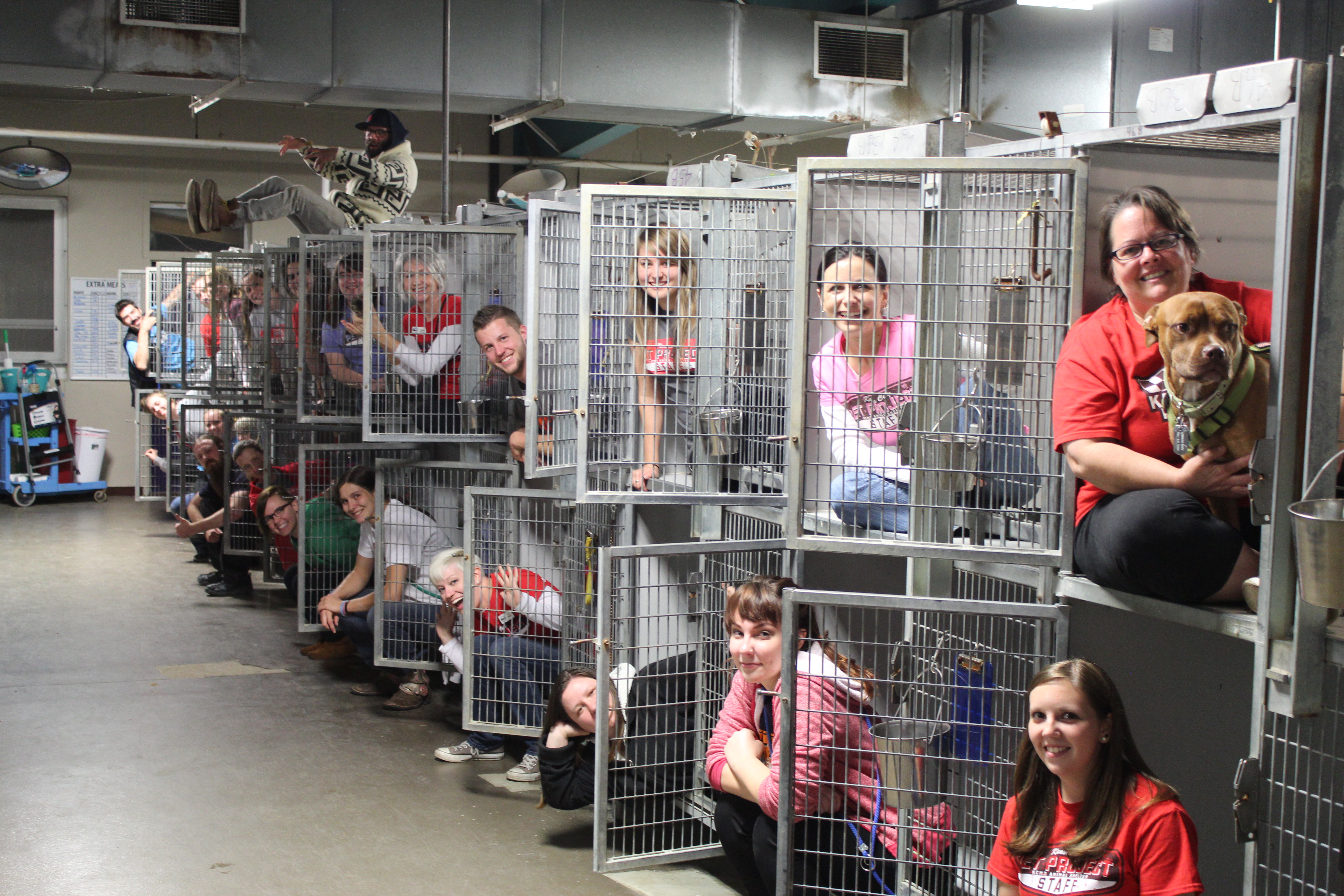
KC Pet Project Empty Kennels

Thus, AHS has lots of available information to implement a more efficient and effective adoption process.

AHS-Newark needs more volunteers to better promote its animals. Until recently, AHS-Newark had virtually no volunteer program. Currently, the shelter has a small group of hard-working volunteers doing great things. For example, the volunteers run an excellent Facebook page, do offsite meet and greet events, pack walks with a few select dogs, dog behavioral evaluations and post animals to Petfinder.  AHS-Newark needs additional volunteers or staff to post dogs onto Petfinder. As of today, AHS-Newark only had 60 dogs and cats on Petfinder which likely represents a small portion of the animals at the facility. For example, this would only be 11% of the shelter’s total population if the shelter currently has as many animals it reported having at December 31, 2012 per AHS-Newark’s 2012 Shelter/Pound Annual Report. Additional animals need to get onto Petfinder in order to properly promote all of the animals and not just a select few.

AHS-Newark needs to expand its volunteer program to make animals more adoptable and to facilitate adoptions. Currently, the shelter’s volunteer program is fairly limited. AHS-Newark should seek to emulate Nevada Humane Society whose volunteers contribute over 2,500 hours per month to the organization and conduct a variety of activities. AHS-Newark could greatly benefit by expanding its volunteer base to socialize more animals. Better socialized animals and volunteers knowing more animals well would facilitate adoptions at the Maddie’s event by properly matching families and animals. Furthermore, additional volunteers allows adopters to meet more dogs outside the kennels where the dogs show better.

While the shelter’s space is limited, the organization could find a way to create a playgroup program. Playgroups are a common theme for large shelters who save pit bull type dogs at a high rate. Specifically, these programs make the large dogs, which AHS has lots of, more adoptable and show better in kennels. During the Maddie’s free adoption weekend event, dogs regularly participating in playgroups would seem more attractive to adopters.

Finally, AHS should adopt animals out at multiple locations in future Maddie’s Fund events. Both the Tinton Falls and Newark shelters could increase cat adoptions by holding the event at multiple high traffic locations, such at various Petco, Petsmart, and Pet Valu retail stores. Additionally, AHS-Newark should adopt dogs and cats out at the Union Square adoption center location in New York City. AHS-Newark’s large amount of animals may overwhelm adopters based on recent research and some adopters may not want to visit an inner city shelter. Thus, AHS would likely increase adoptions by adopting animals out at multiple high traffic locations.

Animals Depend On Us Always Improving

Overall, all three organizations adopted more animals than normal during the Maddie’s Pet Adoption Days event. Each organization should evaluate their performance and see how they can better their performance at future events. At the end of the day, animal welfare groups should always strive to improve. Lives are at stake and the animals are counting on you doing the best you can.

No Kill Success is Contagious

Recently Merritt Clifton argued Reno, Nevada’s no kill success came at the expense of surrounding communities. According to Mr. Clifton, the region’s open admission shelter stole adoptions from nearby areas resulting in little net life saving. Clifton used Nevada’s mediocre adoption rate outside the Reno area as the basis for his argument. Is Clifton correct or is this yet another one of Clifton’s meritless arguments? Alternatively, can successful no kill open admission shelters cause other nearby communities to save more lives?

Nevada’s Population Distribution Refutes Clifton’s Claims

Nevada’s primary population centers outside the service area of the Reno, Nevada shelter are very far away. Approximately 86% of Nevada’s population outside the Reno, Nevada shelter’s service area in Washoe County reside in the county where Las Vegas is located. Las Vegas is approximately 450 miles away and around a 7 hour drive from Reno. This is as about as far as Elizabeth City, North Carolina and Ottawa, Canada are from New York City. Do people believe adopters in New York City are regularly visiting shelters in North Carolina and Ottawa, Canada? As a result, Clifton’s argument is completely wrong.

The Las Vegas area’s primary shelter has a history of poor performance and depresses statewide adoption numbers. Recent statistics show roughly half of the shelter’s 40,000 impounded animals were killed. This high kill rate is even more astonishing given Washoe County, Nevada’s open admission shelter takes in nearly 80% more animals per capita and saves 90% of its animals. Thus, Nevada’s other primary shelter performs poorly and that is the reason for the state’s mediocre adoption rate.

Shelters Near the Highly Successful Reno, Nevada Shelter Are Doing Well

Several large shelters within reasonable driving distance of Reno, Nevada are succeeding. The Out the Front Door blog reports Carson City, Nevada’s open admission shelter is doing very well and is in the nearest large population center to Reno. Additionally, Douglas County, Nevada is another reasonably close population center and its open admission shelter saved 98% of its animals. Furthermore, Nevada County, California, which is one of the closest large communities west of Reno, saved 99% of its impounded animals over the last three years. Therefore, open admission shelters reasonably close to Washoe County, Nevada’s highly successful shelter are saving and not taking lives.

Austin, Texas’s Success Leads to More Nearby No Kill Communities

Austin, Texas is the largest no kill community in the country and several nearby cities are also saving lives. Austin, Texas has been a no kill community since 2011 and saved from 91%-95% of its animals each year since then. Shortly after Austin, Texas became a no kill community, Williamson County Regional Animal Shelter, which serves Williamson County, Texas and is located just north of Austin, achieved no kill status. Despite taking in nearly 7,500 animals a year, dogs and cats only stay 11 and 15 days at the shelter. Taylor, Texas, which is just northeast of Austin, saved 93% of its animals in 2012. Pflugerville, Texas, which is also located in the Austin metro area, saved 98% of its animals in 2012 despite the city prohibiting trap, neuter, release. Georgetown, Texas, which is also just north of Austin, saved 85-90% of its animals in recent years. San Antonio, Texas, which is about a 1 hour and 20 minute drive from Austin, recently reported an 81% save rate, which is up from 32% in 2011, and a 90% live release for cats in March and April 2014. This shelter services an area of 1.3 million people and took in over 32,000 animals during fiscal year 2013. Kirby, Texas, which is also in the San Antonio metro area, saved 94% of its animals in 2013. Thus, the success of Austin’s no kill effort led to high save rates in many other nearby communities.

Animal Ark Inspires Positive Change in Minnesota

Animal Ark’s high level of success led to significant improvements in nearby large cities. Animal Ark, which is located in Hastings, Minnesota, has an adoption guarantee arrangement with a local impound facility where Animal Ark takes animals not reclaimed by owners. Also, Animal Ark accepts owner surrenders subject to a waiting list. Animal Ark saved 99% of its 700 impounded dogs and cats in 2013 and takes in about 16 dogs and cats per 1000 people. Additionally, the shelter reports a length of stay of just over a month. Animal Ark’s short average length of stay is impressive given virtually all animals were adopted and no animals were reclaimed by their owners, which tend to have very short lengths of stay, due to the local impound facility holding animals during the stray/hold period. Also, Animal Ark gets its animals quickly out of the shelter despite it likely needing to rehabilitate relatively more animals due to the organization’s very high 99% save rate. The shelter’s director, Mike Fry, is a vocal no kill advocate and argues for positive change in Minnesota and beyond. Recently, Brooklyn Park, Minnesota’s Pets Under Police Security (“PUPS”) shelter reported a 98% save rate. Similarly, St. Paul, Minnesota’s animal control facility reported a 90% + save rate recently as well. Additionally, Minneapolis’s animal control shelter, which has a sordid history, recently hired new management and pledged to change its ways. As a result, Animal Ark’s success adopting out animals has not hurt, but helped nearby shelters.

San Francisco Area Success

San Francisco has a long history of no kill initiatives. In the 1990’s, Richard Avanzino, who now leads Maddie’s Fund, and Nathan Winograd nearly made San Francisco the nation’s first no kill community. During this time, innovative programs, such as an adoption guarantee agreement with the city’s animal control shelter and frequent off-site adoption events, were developed. Unfortunately, the city regressed after both men left the San Francisco SPCA.

The no kill spirit lives on in the San Francisco area and success is being achieved. Based on 2013 reported statistics, San Francisco Animal Care and Control and the San Francisco SPCA collectively reported an 85% save rate for local animals assuming all negative outcomes were for San Francisco animals. Berkeley, California, which is located on the other side of San Francisco Bay, saved 90% of its animals in 2013. Alameida, California, which also is on San Francisco Bay, reported a save rate of 91% in 2013. Thus, communities in the San Francisco Bay area are saving animals at a high rate despite their close proximity to each other.

Boulder, Colorado Region Shelters Save Lives

Open admission shelters in the Boulder, Colorado area are saving their animals at a high rate. Longmont Humane Society, which serves several communities in the Boulder area, saved 93% of the 3,536 dogs and cats impounded in 2013. The nearby Humane Society of Boulder County, which took in 7,669 animals in 2013, reported a save rate of 89% in 2013 (91% if owner requested euthanasia are excluded). The Humane Society of Platte Valley, which is also located in the same metropolitan area, saved 94% of its 1,475 dogs and cats impounded in 2012. Thus, large open admission shelters in close proximity to each other in Colorado are saving animals at a high rate.

Successful No Kill Communities Can Drive Significant Positive Change Elsewhere

No kill communities drive positive change elsewhere directly and indirectly. Successful no kill open admission shelters can directly help nearby communities by rescuing animals. However, these no kill communities help much more by inspiring and/or pressuring poorly performing shelters to improve. The following quote sums it up perfectly:

“Give a man a fish and you feed him for a day. Teach a man to fish and you feed him for a lifetime.”

By changing another shelter’s policies, you can save far more animals than you could rescue directly. The animals you can rescue is limited to your shelter’s excess physical space and foster homes. However, by improving other shelters’ policies you can help far more animals. For example, consider a shelter with a 100 animals and 10% excess capacity due to efficient life saving programs. This shelter would be able to directly pull 10 animals. However, what happens if that successful shelter’s efforts were replicated by two other similar sized shelters and the euthanasia rate dropped from 50% to 10%? The successful shelter would save 80 or 8 times as many animals by getting other shelters to do the right thing verses pulling animals directly. Thus, no kill communities can dramatically increase life saving by getting other communities to do the same.

Creating no kill communities, promoting your success, offering help to other communities, and challenging those shelters who refuse to do the right thing are key to saving the most lives. Austin Pets Alive is a great example of an organization leading its community to no kill and helping others do the same. In early 2012, Austin Pets Alive formed a new organization, San Antonio Pets Alive, to help San Antonio achieve no kill status. Subsequently, San Antonio’s live release rate increased from 31% to 81%. In most cases, poorly performing shelters are reluctant to change their ways. In these cases, more vocal advocacy, such as what Animal Ark has done in Minnesota, is needed. Such advocacy does the following:

  1. Puts direct pressure on government run shelters (and private organizations who operate government owned shelters through short term contracts) to improve through political pressure on elected officials
  2. Puts financial pressure on private shelters as donors become more informed and demand their money be efficiently used to save lives

Unfortunately, the animal welfare community generally prefers unity even when many shelters are clearly doing the wrong thing. At the very least, successful shelters should publicize their statistics and success. This puts subtle pressure on the under performing facilities to do the same. However, vocal advocacy and comparing and contrasting their shelter’s performance with poorly performing facilities who refuse to change is needed. While private citizens can advocate for change, the credibility of advocates is much greater when a reputable animal welfare organization is leading the effort. Thus, we need successful no kill communities and their animal welfare organizations to inspire, assist, advocate and pressure other communities to save lives.

Sometimes you need to fight for what you believe in. Saving lives is certainly one of those fights you should take one.

We Can Save All The Pit Bulls

Most people in the animal welfare movement believe pit bulls are overpopulated and massive shelter killing is unavoidable. The ridiculously inaccurate “1 in 600 pit bulls make it out of the shelter alive” meme frequently appears on Facebook. Merritt Clifton, who is well-known for his discredited pit bull bite data, argues shelters can’t save any more pit bulls without banning breeding and 60% is the highest pit bull live release rate a shelter can hope for. Even certain pit bull rescue groups believe too few homes exist for pit bulls and adoption prospects are bleak. Are these claims true and should we just accept shelters killing pit bulls in droves?

Some Shelters Are Already Saving All of the Pit Bulls

Required save rates for no kill may be lower for pit bulls. No kill requires only irremediably suffering animals and dogs who present a serious danger to people be euthanized. The 90% save rate standard is the threshold for shelters to achieve no kill. In theory, pit bulls should have a lower save rate due to these dogs above average size. Simply put, an untreatable aggression issue may be forgivable in a small dog, but not a larger dog. Thus, no kill for pit bulls may potentially be achieved at a lower save rate than other dogs due to pit bull type dogs larger size.

Many open admission shelters are on the verge of, if not already, achieving no kill for pit bull type dogs. Over a decade ago, which was before many advances in shelter medicine and behavioral rehabilitation, Nathan Winograd saved 86% of all pit bulls at Tompkins County SPCA in upstate New York despite not adopting out pit bulls with dog or cat aggression. Lane County, Oregon’s Greenhill Humane Society saved 91% of the nearly 150 stray pit bulls taken in over the most recently available 12 month period (March 2013 – February 2014).  Salt Lake County Animal Services saved 90% of its impounded pit bull type dogs in both 2013 and the first four months of 2014. During KC Pet Project’s second year in control of Kansas City’s animal control shelter, the organization saved 86% of its over 1,000 impounded pit bull type dogs. Amazingly, the primary facility is small and outdated and Breed Specific Legislation (“BSL”) is prevalent in the area. Most importantly, both KC Pet Project’s and Salt Lake County Animal Services’ live release rates increased significantly in recent years and greater than 90% save rates for pit bull type dogs seem very possible in the near future.

Mathematically speaking, shelters with very high dog save rates and pit bulls comprising a reasonable percentage of dogs will save 90% plus of pit bulls. For example, shelters will automatically save 90% or more of pit bulls with the following statistics:

  • 99% dog save rate with pit bulls equaling 10% or more of dog impounds assuming all dogs euthanized are pit bulls
  • 98% dog save rate with pit bulls equaling 20% or more of dog impounds assuming all dogs euthanized are pit bulls

In reality, even the best no kill shelters typically euthanize 1-2% of animals for medical reasons which makes the pit bull 90% save rate even easier to achieve. Thus, open admission shelters with very high dog live release rates are likely automatically saving 90% plus of their pit bull type dogs.

Other open admission shelters are likely saving 90% or more of their pit bulls. Long Island’s Southampton Animal Shelter’s dog save rate is 97% and pit bulls make up 24% of impounded dogs. If Southampton Animal Shelter euthanizes only 1% of its non-pit bull dogs, the pit bull save rate will equal 91%. The pit bull save rate increases to 94% if 2% of Southampton Animal Shelter’s non-pit bull dogs are euthanized. Colorado’s Longmont Humane Society saves 97% of its dogs and pit bull type dogs made up 8.1% of impounds in the recent past. If Longmont Humane Society euthanizes 1.3% of its non-pit bulls, the pit bull save rate would reach 90%. Monmouth County SPCA states “over a third” of its impounded dogs are pit bull type dogs. Based on pit bulls making up 35% of impounds and assuming all euthanized dogs are pit bulls, the pit bull save rate would equal 96%. If we were to assume the 35% of impounded dogs only applied to local canines (i.e. excluding dogs transferred in from other communities) and all dogs euthanized were pit bulls, the pit bull save rate would be around 90%. Thus, many shelters are likely already saving 90% plus of pit bull type dogs.

Pit Bulls Can Leave Shelters Alive Quicker Than Advertised

The length of time an animal spends in a shelter is critical to saving its life. Reducing the average length of stay in a shelter increases the number of animals a shelter can save. Additionally, reducing the length of stay decreases the chance an animal becomes mentally or physically ill. Also, reducing length of stay decreases the cost of care, such as feeding, cleaning, veterinary treatment, etc. As a result, shelters must do everything they can to get animals out of shelters alive as quickly as possible.

Recent research detailed the length of stay of bully and other major breed groups. Brown, et al. conducted a study in the Journal of Applied Animal Welfare Science on factors impacting the time it took dogs to get adopted at two upstate New York animal shelters. Both animal shelters, Tompkins County SPCA and Humane Society of Yates County, serve as the animal control shelters for dogs and are no-kill. 84% of the data came from Tompkins County SPCA, which is the shelter Nathan Winograd used to run, and was collected from 2008-2011. Several major dog groups were evaluated, which included “bully” breeds (150 American pit bull terriers, 1 American Staffordshire terrier, 1 Staffordshire bull terrier, and 3 American bulldogs), as adults (12 months and older) and puppies (under 12 months).

The study’s results detailed below proved pit bull type dogs do not take that much longer to get adopted than other breeds. Adult pit bull type dogs only took a week longer to get adopted than adults of other breed groups. Additionally, pit bull type dogs length of stay until adoption fell into the medium of the range of dogs around their size (i.e. companion, sporting, hound and guard). Also, pit bull type dogs were adopted quicker than both hound and guard dogs. Similarly, pit bull puppies under a year old took only slightly more time to get adopted than most other breeds and were adopted much quicker than guard and terrier puppies. Furthermore, the 49.3 and 27.5 days it took on average to adopt pit bull adults and puppies is not a long time for shelters to care for dogs.

LOS Study Table

The pit bull adoption length of stay figures are consistent with Greenhill Humane Society’s performance with stray pit bulls. Over the most recently reported 12 month period (March 2013 – February 2014), Greenhill Humane Society’s stray pit bulls took 41 days on average to get adopted. Given most strays are likely not puppies, this figure probably contains mostly adult dogs. As a result, the 41 day pit bull adoption length of stay is actually 8 days shorter than the adult pit bull adoption length of stay from the two upstate New York open admission no kill shelters.

Pit bulls actual length of stay at shelters may be lower due to rescues/fosters and owners reclaiming lost pets. For example, dogs may get pulled by rescues or fostered by volunteers long before the normal time it takes to get adopted. Similarly, owners reclaiming their pets tend to do so shortly after the animal arrives at the shelter. Additionally, animals euthanized due to severe medical or behavioral issues may occur long before the typical time it takes to get adopted. Thus, pit bulls actual length of stay at shelters may be lower than the length of stay until adoption figures from the study above.

Pit bulls have short lengths of stay at several other high performing open admission shelters. Salt Lake County Animal Services adoptable pit bulls, which have a 100% save rate, average length of stay is 30 days. Longmont Humane Society’s pit bulls only stay 38 days on average at their shelter. Greenhill Humane Society’s stray pit bulls had an average length of stay of only 16 days over the most recently reported 12 month period. Southampton Animal Shelter’s pit bull length of stay was 65 days in 2011 and 73 days in 2012.

We can also roughly estimate the pit bull length of stay at other open admission shelters with high pit bull save rates. KC Pet Project reports pit bulls make up around 25% of impounds and 40% or more of the shelter’s population. Additionally, they report most dogs get into playgroups after their 5 day stray hold period and take 9 days on average to leave the shelter via adoption or rescue after entering playgroups. Given we know the following formula for estimating a shelter population size, we can use simple algebra and math to estimate the pit bull length of stay:

Shelter Population Size = Daily Intake * Length of Stay

Using this formula, we can determine pit bulls length of stay is approximately 2 times longer than other dogs assuming pit bulls are 25% of dog impounds 40% of the shelter’s dog population. Based on some basic math and knowing most stray dogs not returned to owners stay 14 days at the shelter, we can estimate stray pit bulls not returned to owners take around 22 days to leave the shelter. Assuming owner surrenders enter playgroups after 3 days and dogs returned to owners happen in 5 days on average, I estimate the KC Pet Project’s overall pit bull length of stay is around 19 days. This estimate assumes pit bulls euthanized and those not entering playgroups do not have significantly different lengths of stay. Additionally, the estimate assumes pit bulls and other dogs are similarly represented in strays not returned to owners, owner surrenders, and returned to owner figures. While this is admittedly a rough estimate, it does provide a reasonable view of how effective this shelter is at getting its pit bulls safely out the door.

Monmouth County SPCA reports “over a third” of its impounded dogs are pit bulls and pit bulls are around 50% of the shelter’s population. Based on the shelter’s reported 54 day average length of stay for dogs and assuming 35% of dog impounds and 50% of the shelter’s population are pit bulls, I estimate pit bulls stay 77 days on average at Monmouth County SPCA.

Pit bulls with behavioral issues can also have a relatively short length of stay at shelters. Austin Pets Alive, which pulls dogs off of Austin Animal Services kill list, reports a 52 day average length of stay for its large dogs with behavioral issues (pit bulls represent a significant portion of such dogs). In other words, Austin Pets Alive is able to rehabilitate and place many pit bull type dogs in a reasonably short period of time.

Successful Shelters Use a Variety Strategies to Save Pit Bulls

Playgroups are used by most of these shelters who successfully save pit bull type dogs. Aimee Sandler created playgroup programs to efficiently exercise dogs at the Southampton Animal Shelter and Longmont Humane Society. Subsequently, KC Pet Project and Salt Lake County Animal Service implemented Aimee Sadler’s program.

Playgroups improve the care of dogs at shelters and help get dogs adopted. In a large shelter, taking out and walking every single dog is time-consuming. Additionally, many pit bull type dogs are high energy and require a lot of exercise. Aimee Sadler estimates a 30 minute playgroup session equates to a 2 hour walk. Given large shelters may have over 100 large dogs, the cost savings becomes immediately apparent. Time spent walking dogs can be devoted to cleaning, marketing, off-site events, fundraising, etc. Additionally, dogs in playgroups tend to overcome many pre-existing behavioral issues, such as fear, anxiety, dog aggression, and reactivity. Playgroups also help dogs act calmer in kennels which increases adoption chances. People are frequently drawn to playgroups and are more likely to adopt a dog who is having fun. Also, dogs who play together are more likely to share a kennel peacefully which increases effective shelter capacity and the dog’s mental well-being at the facility. Finally, playgroups provide lots of information about the dogs and help shelters properly match dogs with adopters. Thus, playgroups are critically important to help pit bull type dogs live in shelters and safely get out of these facilities.

Greenhill Humane Society and KC Pet Project use differing strategies to save their pit bull type dogs. Greenhill Humane Society relies on a very high return to owner rate of 68% to achieve impressive pit bull live release rates and reduce these dogs length of stay. On the other hand, KC Pet Project uses a customer oriented, retail business philosophy, to promote adoptions. For example, KC Pet Project uses “open adoptions” which focuses on educating adopters and making great matches verses overzealous screening. Additionally, KC Pet Project set up adoption centers in a strip mall outlet and a local Petco. KC Pet Project also transfers some large dogs to colder rural areas, which have high demand for these dogs, due to local rescues not wanting to take such dogs.

Salt Lake County Animal Services uses a balanced approach for its pit bull type dogs. Several years ago the shelter formed the Salt Lake County Pit Crew program to increase the pit bull live release rate. The program utilizes a variety of programs, such as community support and education, and also promotes adoptions. Community support programs include free spay/neuter, microchipping and leash and collar exchanges. As a result of these programs, pit bull intakes decreased and the pit bull return to owner rate increased over the last several years. Additionally, the percentage of dogs adopted, fostered/rescued increased significantly since the Salt Lake County Pit Crew program started. The shelter uses an “open adoptions” process to make great matches for adopters. Additionally, the shelter adopts pit bulls out at a retail location called the Best Friends Sugar House Adoption Center and does many off-site events. Finally, the Salt Lake County Animal Services’ adoption fee for large dogs is only $50 and discounted adoption fee programs are also offered.

Longmont Humane Society, Southampton Animal Shelter and Monmouth County SPCA use other strategies to save pit bull type dogs. All three organizations invested in facilities which make the dogs stay at the shelters more pleasant and create an atmosphere where the dogs are more appealing to adopters. Additionally, all three shelters have qualified behaviorists to treat and rehabilitate dogs. Also, both Southampton Animal Shelter and Monmouth County SPCA provide free spay/neuter for pit bull type dogs.

Challenges Can Be Overcome

Recently, Dr. Emily Weiss of the ASPCA hypothesized high pit bull intake rather than too few pit bull adoptions results in large numbers of pit bulls killed in shelters. Dr. Weiss concluded shelters were doing a good job with pit bull adoptions due to pit bulls being the 5th most common dog admitted to Banfield Animal Hospitals (i.e. a measure of overall popularity) and the third most frequently adopted dog at animal shelters. The five major flaws in this analysis are as follows:

  1. Pit bulls tend to have more owners who are poor and lack resources to take dogs to animal hospitals (i.e. understating pit bull popularity)
  2. Most shelters do a poor job at adopting dogs so adoption potential is much greater than current level
  3. Pit bulls having more restrictive adoption polices
  4. Overly strict temperament testing for pit bulls reduces the number placed for adoption
  5. Pit bulls were the most frequently impounded dog which suggests the shelter adoption numbers are due to high intake rather than successful adoption efforts

That being said, pit bulls do tend to have above average lengths of stay at shelters. At the high performing shelters above, pit bull type dogs had a length of stay about 2-3 times the average of non-pit bull type dogs. However, these shelters non-pit bull type dogs length of stay is short so the 2-3 times longer length of stay for pit bulls is still reasonable. Also, the study above suggests pit bulls length of stay until adoption is not much different than other large breeds. As a result, pit bull adoption/foster/rescue efforts should be prioritized as these are the primary ways pit bulls not returned to owners leave shelters alive.

Over the longer term efforts to reduce intake and end BSL are key to saving pit bull lives. BSL restricts pit bull type dog ownership in some communities. However, the bigger problem are landlords and/or insurance companies preventing tenants from owning pit bull type dogs. Animal welfare groups need to advocate for legislation requiring landlords to allow pets. The New Jersey Animal Welfare Task Force Report issued a decade ago argued for this and used precedents of Federal Section 527 public housing and New Jersey subsidized senior citizen housing projects requiring landlords to allow pets.

Until the housing availability disparity between pit bulls and other dogs disappears, animal welfare groups should step up efforts to prevent pit bulls from ending up at shelters. Pet owner prevention programs are especially beneficial for pit bull type dogs where housing options are more limited. Downtown Dog Rescue in South Los Angeles is a great example as this organization prevented 2,622 pets from entering the shelter system over the first year of its pet owner support program. Similarly, increased efforts by animal control officers and shelters to return lost dogs to owners are particularly important for pit bulls. Additionally, free pit bull spay/neuter programs may help reduce pit bull intakes over the longer term.

At the end of the day, we can save all the pit bulls. We just need to enact proven successful policies and do the necessary hard work.

Disrespecting Your Shelter’s Hometown Leads You Down the Wrong Road

Associated Humane Societies – Newark’s Assistant Executive Director, who is the organization’s number 2 ranking person and representative in many media interviews, posted an insulting joke about Newark’s residents on his personal Facebook page recently. The photo is identical to the following image except “New Jersey” replaces “Ohio “and” “Newark” takes the place of “Michigan.”

Ohio Shadowy place

Additionally, several of Associated Humane Societies – Newark’s employees also commented about how much they liked the photo. Associated Humane Societies – Newark operates a large animal shelter in Newark and receives up to $632,000 in animal control contract fees from the city of Newark.

This behavior demonstrates a clear disrespect for Associated Humane Societies’ community. Telling your shelter’s hometown they live in a “shadowy place” and “you should never go there” is deeply insulting. If you lived in Newark, would you want to support this shelter? Perhaps, this attitude towards the city’s residents along with a past scathing investigation and poor performances in Office of Animal Welfare inspections in 2009 and 2011 led to the popular Cory Booker administration’s displeasure with Associated Humane Societies.

The remark sends the message to people outside of Newark to not visit the shelter since the facility is in a “shadowy place” that “you must never go” to. The “you must never go to Newark” message makes even less sense when you consider  Associated Humane Societies, to the best of my knowledge, does not adopt out dogs at its off-site events (i.e. you have to go back to the shelter in Newark to adopt the animal you meet outside of the shelter). As a result, the Assistant Executive Director of Associated Humane Societies’ Facebook post hurts the cause of his shelter’s animals.

Unfortunately, Associated Humane Societies’ attitude toward its hometown has an even more detrimental effect on shelter policy. In an article last year, the same Assistant Executive Director stated he wanted more stringent spay/neuter laws and backyard breeder bans to reduce Associated Humane Societies unacceptably high kill rates. KC Dog Blog, which is written by Kansas City’s no kill open admission shelter’s Board President, clearly demonstrates how Kansas City’s pit bull mandatory spay/neuter policy increased impounds and kill rates. Additionally, KC Dog Blog also documents most large animal welfare organizations, such as the ASPCA, Best Friends, Humane Society of the United States (via the California Sheltering White Paper), No Kill Advocacy Center and the American Veterinary Medical Association oppose mandatory spay/neuter laws. Such laws increase impounds and shelter killing and also waste limited resources which could be used more productively. The main barrier to spay/neuter is cost for poor folks and mandatory spay/neuter laws with their punitive fines simply exacerbate the problem. Similarly, breeding bans, which sound great, are also ineffective and drain limited resources as evidenced by Long Beach, California’s 30 year breeding ban’s failed efforts at achieving a no kill community.

The “irresponsible public” argument and resulting attitude communicated by Associated Humane Societies represents a huge obstacle to creating a no kill community. While the shelter’s personnel may have negative experiences with the public, those interactions are not representative of the entire population. Newark most likely is more responsible than the average American community. Associated Humane Societies – Newark took in approximately 8 dogs and cats per 1000 residents in its service area during 2012. Unfortunately, we do not know what the city of Newark’s per capita intake rate is since Associated Humane Societies impounds dogs and cats from numerous other communities. However, the nearby urban communities of Elizabeth, Paterson plus surrounding towns and Jersey City – Hoboken took in approximately 7 dogs and cats per 1000 people. Nationally, Maddie’s Fund states the average community impounds 14.5 dogs and cats per 1000 people. Thus, Newark likely impounds around half the number of animals as the average American community on a per capita basis. Therefore, “shadowy” Newark is likely more responsible than many less “shadowy” places.

Associated Humane Societies – Newark’s animals would benefit greatly from a significant change in attitude. While Associated Humane Societies prefers to blame the not so irresponsible public for killing shelter animals, the blame lands squarely with the shelter. Associated Humane Societies – Newark needs to stop fighting successful no kill policies and enthusiastically implement these programs to quickly move animals from the shelter into loving homes. Personally, I’d suggest following KC Pet Project’s model which made Kansas City a no kill community 18 months after taking over the shelter. As recently as 2008, this shelter killed more than 60% of its impounded animals. However, KC Pet Project now saves roughly 90% of its animals despite taking in around twice as many dogs and cats in total and per capita as Associated Humane Societies – Newark.  KC Pet Project accomplished this without Associated Humane Societies’ vast financial resources and with an undersized and outdated primary shelter having only one third of the recommended capacity.

Associated Humane Societies should also implement targeted spay/neuter and pet owner support programs to help struggling pet owners in areas with higher impound rates. For example, the ASPCA’s Operation Pit in New York City and Monmouth County SPCA’s Pittie Project programs offer free spay/neuter, vaccinations and microchips to pit bulls. Spay & Neuter Kansas City provides another great example of not only substantive programs, but a helpful and nonjudgmental attitude towards the people requiring help. This organization literally goes door to door in some of the poorest neighborhoods to help struggling pet owners. As a result of these programs and relationship with the community, Spay & Neuter Kansas City assisted over 15,000 people with spay/neuter surgeries, veterinary services, and pet outreach programs in 2013.

Let’s drop the “shadowy” jokes about people and get onto helping folks and their animals. That is how you save lives!