Paterson’s Pathetic Pound – Part 1: Deadly Statistics

When ones drives to the Paterson Animal Shelter, you find an unmarked road that looks more like a driveway to an abandoned warehouse. If you are brave enough to go down to the end of this road, you will be greeted at the shelter by a large security fence and various signs saying you are being filmed. Clearly, the City of Paterson placed its pound in a place few people would visit.

The Paterson Animal Shelter is in a time warp. This pound does not spay/neuter or vaccinate the animals it adopts out. The facility has no web site and social media pages. Volunteers, with the exception of a couple of rescues, are barred from helping the animals at the facility. In fact, one of the shelter’s key rescue partners that make pleas to save death row animals at the facility does not even name the shelter.

What kind of job does the Paterson Animal Shelter do at saving lives? Should we expect better?

Paterson Kills Healthy and Treatable Animals

To obtain a better understanding of the Paterson Animal Shelter’s performance, I obtained the shelter’s “Impound Animal Report” for each animal the facility took in during 2015. The Impound Animal Report provides various details about each animal, how they came in, the date they came in, their ultimate outcome, and the date of the outcome.

The tables below summarize the Paterson Animal Shelter’s 2015 statistics based on all the facility’s Impound Animal Reports the shelter provided to me. Overall, 19% of cats and dogs, 13% of cats, and 22% of dogs lost their lives during the year.

Paterson Animal Shelter’s death rate for animals actually requiring sheltering is even higher. Since many stray dogs have licenses and/or microchips allowing the shelter to quickly return these dogs to their owners, it makes sense to exclude these animals from the death rate calculation. If we calculate the death rate based off animals not reclaimed by owners, which are the ones the shelter has to work to save, 22% of cats and dogs, 14% of cats and 30% of dogs lost their lives. Thus, nearly 1 out of 3 dogs and 1 out of 4 cats requiring any amount of real work lost their lives at the Paterson Animal Shelter in 2015.

paterson-animal-shelter-2015-intake-and-disposition-records-final-9

Paterson Animal Shelter killed 28% of the 265 pit bull like dogs who had outcomes during 2015. If we exclude dogs reclaimed by owners, nearly 40% of pit bull like dogs lost their lives at the Paterson Animal Shelter.

Small dogs were not even safe at the Paterson Animal Shelter. 13% of all small dogs lost their lives and 18% of small dogs not reclaimed by owners did not leave the facility alive.

paterson-animal-shelter-2015-intake-and-disposition-records-final-10

Paterson Animal Shelter killed nearly 1 out of 3 adult cats it took in during 2015.

paterson-animal-shelter-2015-intake-and-disposition-records-final-8

Overall, Paterson Animal Shelter’s statistics are very similar to the Elizabeth Animal Shelter. Both pounds rely heavily on rescues and provide little care to animals. Due to these shelters’ minimal efforts at saving lives, their kill rates are significantly higher than many large no kill animal control shelters, such as those in Austin, Texas, Kansas City, Missouri and Jacksonville, Florida. Despite the shortcomings of these two pounds, their live release rates were significantly higher than those I calculated in similar analyses I did for Associated Humane Societies-Newark and Bergen County Animal Shelter.

Rescues Are Only Hope for Unclaimed Animals

Rescues saved virtually all the unclaimed animals that made it out of the Paterson Animal Shelter alive last year. Stunningly, rescues made up 97% of total dog and total cat adoptions and rescues in 2015. In other words, only 3 out of 317 cats and 15 out of 296 dogs finding new homes were actually adopted out by the shelter. To put it another way, Paterson Animal Shelter only adopted out 0.8% of the cats and 2.6% of the dogs who had known outcomes at its shelter in 2015. Thus, Paterson Animal Shelter has the lowest adoption rate of any shelter I’ve seen that allows people to adopt animals.

Two rescues pulled all the dogs and cats out of Paterson Animal Shelter. Second Chance Pet Adoption League took all 281 dogs and 171 or 54% of the 314 cats rescued from Paterson Animal Shelter during 2015. START II rescued 143 cats or 46% of 314 cats rescued from the facility. Unfortunately, Paterson Animal Shelter did not keep records of any rescues that subsequently took ownership of these animals. In the case of Second Chance Pet Adoption League, I’ve seen many of their pleas asking for rescues to take dogs from an unnamed pound that clearly is the Paterson Animal Shelter. Furthermore, Second Chance Pet Adoption League currently has mostly small dogs and no cats listed in its adoption listings suggesting that the organization transfers most of the animals it pulls from Paterson Animal Shelter to other rescues. Therefore, Paterson Animal Shelter’s records do not allow us to see which rescues are actually fostering and adopting out the most animals from the shelter.

Animals Quickly Leave Shelter Dead or Alive 

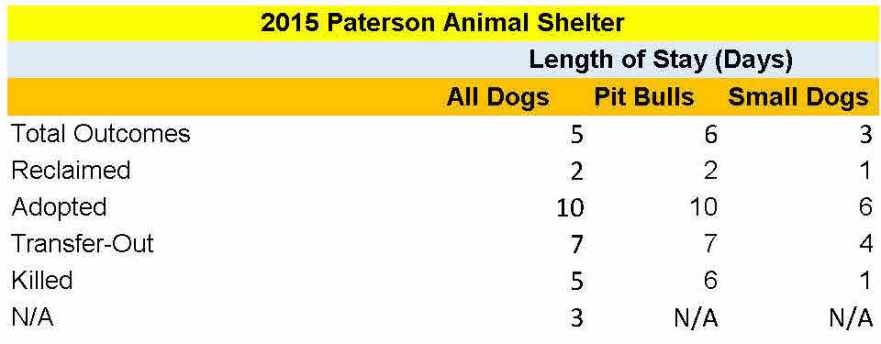
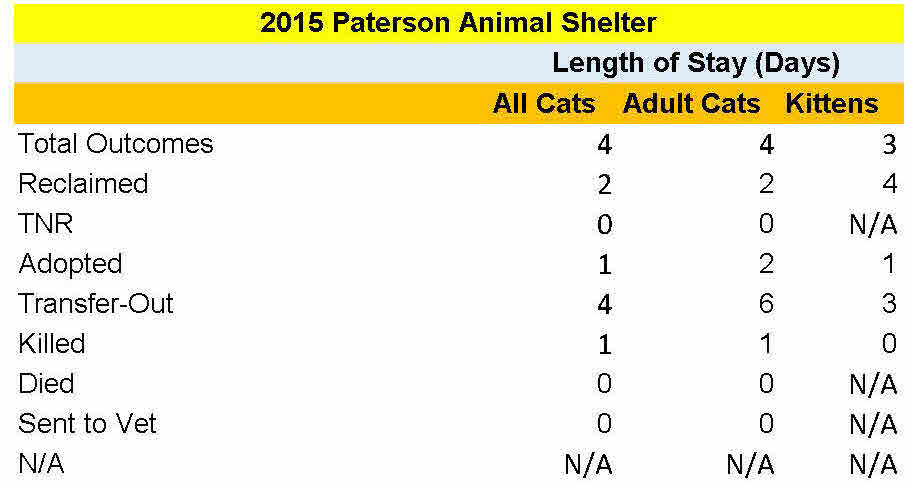
The Paterson Animal Shelter had a very short average length of stay (“LOS”) for animals having positive outcomes. Reducing length of stay in a good way is critical for shelters, particularly space constrained facilities like Paterson, to save lives. Additionally, shelters with short lengths of stay have lower disease rates and fewer animals developing behavioral problems. Typically, returning lost pets to owners is the fastest way an animal safely leaves a shelter. Overall, the Paterson Animal Shelter’s owner reclaim rate (number of stray animals returned to owners/number stray animals impounded) for dogs was 42%. While that number isn’t very high, owner reclaim rates generally are lower in poor areas. As a comparison, Paterson Animal Shelter’s owner reclaim rate for dogs was higher than Elizabeth Animal Shelter’s 2015 owner reclaim rate (36%), AHS-Newark’s reclaim rate for dogs primarily coming from animal control in Newark (10% in 2014) and Perth Amboy Animal Shelter’s rate for 2014 and the first half of 2015 (37%). Additionally, Paterson Animal Shelter’s average length of stay for animals sent to rescues was 4 days for cats, 6 days for adult cats, 3 days for kittens, 7 days for all dogs and pit bulls, and 4 days for small dogs. Thus, Paterson Animal Shelter quickly sent out the animals that left the shelter safely.

On the other hand, Paterson Animal Shelter quickly killed animals. On average, Paterson Animal Shelter killed all cats and adult cats after just 1 day, kittens on the day they arrived at the facility, all dogs after 5 days, pit bulls after 6 days and small dogs after 1 day.

paterson-dogs-los

paterson-cats-los

Paterson Animal Shelter’s length of stay data indicates the shelter kills with empty kennels. Based on standard animal shelter population equations, we can estimate the average number of animals at the shelter during the year as follows:

Daily capacity or population = Daily animal intake x average length of stay

Therefore, based on the shelter’s animal intake from the records it provided me and the facility’s average length of stay, we can estimate the facility housed 4 cats and 8 dogs on average during 2015. Based on these estimates and the shelter’s capacity disclosed in its 2015 Shelter/Pound Annual Report, Paterson Animal Shelter only used roughly 1/3 of its available animal holding space on average during 2015. Even if I used Paterson Animal Shelter’s higher reported animal intake figures in its 2015 Shelter/Pound Annual Report (see discussion below), the facility would only have used 47% of its cat and 37% of its dog capacity.

paterson-estimated-capacity-used

Paterson Animal Shelter only used a small portion of its capacity on several dates in 2015. Based on the facility’s 2015 Shelter/Pound Annual Report, Paterson Animal Shelter only used 57% and 50% of its dog capacity at the beginning and end of 2015. Similarly, Paterson Animal Shelter filled 50% and 33% of its cat spaces at the beginning and end of 2015. Furthermore, the Paterson Division of Health’s June 15, 2015 inspection report only found 5 dogs and 2 cats at the shelter. Despite June being a high intake month for most shelters, Paterson Animal Shelter only used 18% and 8% of its dog and cat capacity. Around the same times, the shelter killed many dogs and cats per underlying records I reviewed. Thus, Paterson Animal Shelter killed when it had empty kennels.

paterson-animal-shelter-2015-shelter-pound-annual-report

Inaccurate Records Raise Concerns Things Are Much Worse

Paterson Animal Shelter’s 2015 Shelter/Pound Annual Report submitted to the New Jersey Department of Health included many more animals than those that were in the underlying records provided to me. Specifically, the facility’s Shelter/Pound Annual Report had 130 more cats and 157 more dogs than those in the facility’s supporting records. Additionally, the shelter’s summary statistics included 48 fewer dogs reclaimed by owners and 175 more dogs rescued/adopted. Furthermore, Paterson Animal Shelter erroneously classified all of the animals sent to rescues as adoptions in its 2015 Shelter/Pound Annual Report. While the death rates based on the data in the Shelter/Pound Annual Report and the underlying records were similar, this discrepancy raises questions about the accuracy of both the summary statistics and the supporting records.

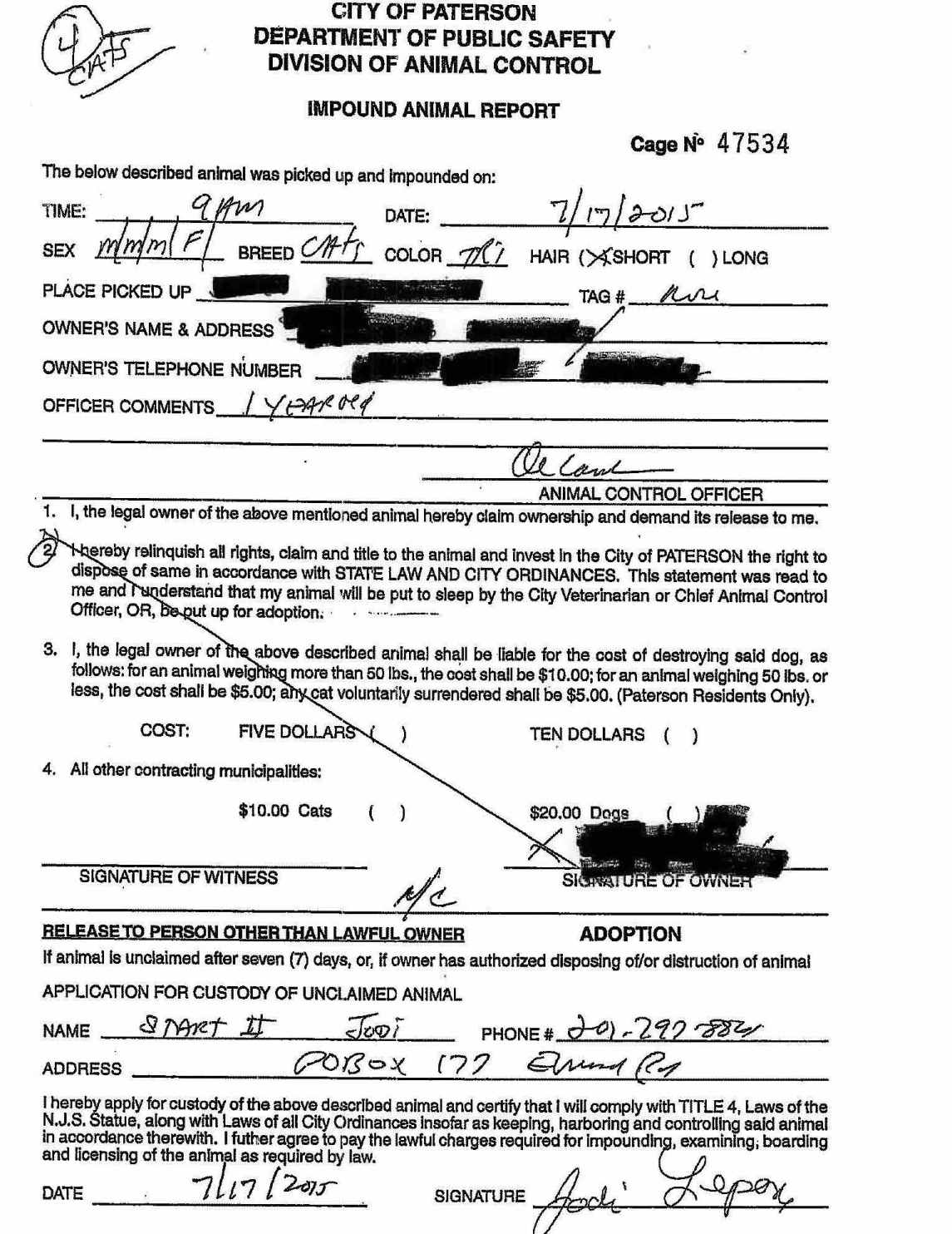
The shelter also included multiple animals on the same intake record in many cases. For these animals, the shelter used the same intake number and it is impossible in most cases to determine what happened to each individual animal. On some records, the shelter wrote the outcome of each animal, but this was the exception and not the rule. For example, the record below states the shelter took 4 cats in and the rescue, START II, saved the animal(s). However, one cannot determine if START II took 1, 2, 3 or all 4 of the cats.

For purposes of the statistics I tabulated, I counted all animals on the same record as having the outcome listed on the record. In total, 43 dogs, 15 pit bulls, 5 small dogs, 135 cats, 10 adult cats and 125 kittens had unknown outcomes, but were counted as live releases in my statistics. If I recalculate the statistics and count these animals having no known outcome as “N/A”, the death rates for dogs, pit bulls, and small dogs barely change. On the other hand, the cat death rate increases from 13% to 21%, the adult cat death rate increases from 30% to 33% and the kitten death rate increases from 2% to 4%. However, if Paterson Animal Shelter really killed these animals with unknown outcomes, the shelter’s death rate would be much higher.

47534

Paterson Animal Shelter’s many missing animal intake numbers raise serious questions as to whether more animals are dying at the shelter. Most animal shelters use a sequential numerical system to track each impounded animal. For example, a shelter would assign #1 to the first animal the shelter impounds, #2 to the second animal the shelter takes in and so on. During the year, the shelter had 277 missing animal intake numbers in the records provided to me. While the shelter may just have been sloppy in their record keeping or failed to provide me all the OPRA records (which is illegal), it could also mean that the shelter killed or lost 277 additional animals, people stole 277 animals, 277 animals escaped or some combination of these. Thus, Paterson Animal Shelter’s death rate may be much higher than the shelter’s records suggest.

Clearly, Paterson Animal Shelter kills many healthy and treatable animals. In Part 2, I will discuss whether the shelter complies with state laws and how it can end the killing.

Bergen County Animal Shelter’s No Kill Con Job (Part 1 of 3)

In 2015, Bergen County Executive, James Tedesco, and the Bergen County Board of Chosen Freeholders announced the approval of a resolution recognizing Bergen County Animal Shelter as a “no kill shelter by adopting the Asilomar Accords.” Mr. Tedesco went on to state the following:

As an animal lover, I believe formalizing this designation gives the residents of our county a better understanding of the shelter’s mission and helps us highlight what a great organization this is. Bergen County’s Animal Shelter is not only one of the best public animal shelters in the state, but arguably one of the best in the Northeast.

Furthermore, Bergen County Freeholder, Dr. Joan Voss, gave Bergen County Animal Shelter Director, Deborah Yankow, a “Women of Distinction” award in 2016 for Ms. Yankow’s achievements in “The field of Animal Compassion.”

Is Bergen County Animal Shelter a no kill shelter? Is Bergen County Animal Shelter one of the best public animal shelters in New Jersey and arguably in the Northeast? Should Bergen County Animal Shelter’s Director receive an award for animal compassion?

Asilomar Accords Do Not Equal a No Kill Shelter

The Asilomar Accords were a deeply flawed agreement. In 2004, the regressive shelter establishment, Maddie’s Fund and certain limited admission shelters created the Asilomar Accords to allegedly save more animals in shelters. In general, the Asilomar Accords did not require shelters to adopt any lifesaving programs. However, the Asilomar Accords required members to not criticize each other, even if such criticism was warranted. Additionally, the Asilomar Accords encouraged members to not use terms such as “no kill’ as it was “divisive.”

The Asilomar Accords require members to compile specific animal shelter statistics and report this data to the public each year. Animal shelters must report the numbers of impounded animals each year and the specific outcomes in an “Animal Statistics Table.” Euthanized animals are broken down into “healthy”, “treatable” and “unhealthy-untreatable” categories. Animals are considered “treatable” if a “reasonable and caring pet owner/guardian in the community would provide the treatment necessary to make the animal healthy” or “maintain a satisfactory quality of life.” However, animals that “pose a significant risk to human health or safety or to the health or safety of other animals” are not “treatable” per the Asilomar Accords. Shelters calculate an Asilomar Accords Live Release Rate excluding animals euthanized by request of their owners and classified as “untreatable” and dogs and cats who died or went missing. Shelters must share these statistics with the public by posting on their web site, in newsletters, etc.

The Asilomar Accords statistics often have been exploited by regressive shelters. For example, many poorly run facilities classify large numbers of animals as “untreatable” and then claim they are no kill (i.e. “we don’t euthanize healthy and treatable animals”).

Bergen County Animal Shelter fails to comply with the Asilomar Accords despite the county’s elected leaders claims. Bergen County Animal Shelter does not publicly share its “Animal Statistics Table” on its web site as required by the Asilomar Accords. In addition, Bergen County Animal Shelter is not listed as a participating organization on the Shelter Animals Count web site (current version of the Asilomar Accords data reporting standards). Even worse, Bergen County Animal Shelter fails to explain in its Standard Operating Procedures manual how its definition of “unadoptable” (i.e.”unhealthy-untreatable” per the Asilomar Accords) is consistent with Asilomar Accords requirement that the shelter provide care that a “reasonable and caring pet owner/guardian in the community” would give to the animal. The shelter simply uses a general definition of “unadoptable” for “animals with serious unmanageable health problems, or an aggressive bite history toward humans or other animals, or who exhibit unmanageable antisocial behavioral characteristics.” To fully comply with the Asilomar Accords, Bergen County Animal Shelter needs to state what specific health problems are “unmanageable” and why “a reasonable and caring pet owner/guardian” in Bergen County would not provide that care. Given Bergen County is in the top 1% of the wealthiest counties in the country, most residents would provide lots of care to their pets before deciding to euthanize a beloved family member. Thus, Bergen County Animal Shelter fails to comply with the weak and traditional shelter friendly Asilomar Accords.

Statistics Reveal Bergen County Animal Shelter is a High Kill Shelter

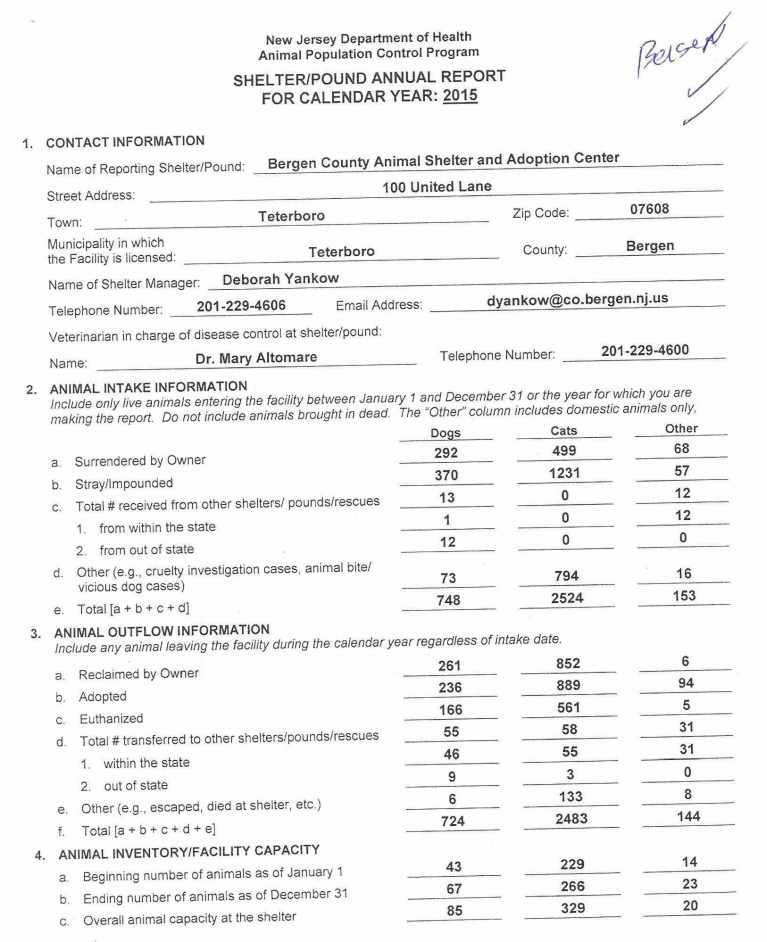
Bergen County Animal Shelter’s 2015 “Shelter Pound Annual Report” proves the shelter is far from a “no kill” facility. In 2015, 24% of dogs and 28% of cats were killed, died or went missing. Specifically, Bergen County Animal Shelter reported killing 166 dogs and 561 cats. On average, Bergen County Animal Shelter kills 2 dogs and cats each day of the year. The animal welfare community generally requires a shelter to achieve a 90% or greater live release rate to call itself no kill. However, no kill leader, Nathan Winograd, who created the 90% test, recently raised the standard to achieve higher live release rates. Clearly, Bergen County Animal Shelter’s 2015 reported statistics prove Bergen County Animal Shelter is a high kill shelter and not a no kill facility.

Bergen County Animal Shelter 2016 Shelter Pound Annual Report

Bergen County Animal Shelter’s 2015 statistics in its Asolomar Accords format were different from its 2015 Shelter/Pound Annual Report. While Bergen County Animal Shelter does not publicly report its Asilomar Accords Animal Statistics Table, I obtained each month’s table from 2015 under the New Jersey Open Public Records Act (“OPRA”) and tabulated the totals below. Bergen County Animal Shelter reported taking in significantly fewer cats in the Asiolmar Accords format. Similarly, Bergen County Animal Shelter reported fewer cats reclaimed by owners and more cats adopted, killed and died in the Asilomar Accords Animal Statistics Table. The shelter also reported taking in significantly more dogs in the Asilomar Accords Statistics Table. Furthermore, Bergen County Animal Shelter disclosed significantly more dogs who were killed in the Asilomar Accords Statistics Table. Additionally, a number of various other outcomes were different. Thus, Bergen County Animal Shelter reported different statistics in the two reporting formats indicating the numbers in one of the reports were incorrect.

2015 Bergen Asilomar Stats.jpg

Bergen County Animal Shelter’s Underlying Records Reveal Much Higher Kill Rates

In order to better understand the Bergen County Animal Shelter’s performance, I obtained the facility’s 2015 intake and disposition records under OPRA. Bergen County Animal Shelter sent me shelter software reports listing each dog and cat the shelter impounded in 2015, its outcome and its intake and outcome dates.

I tabulated all of this data and recalculated Bergen County Animal Shelter’s statistics. While the intake numbers are calculated the same way as the Shelter/Pound Annual Report above (i.e. all animals impounded in 2015), the outcome numbers are calculated slightly differently. In the Shelter/Pound Annual Report, only 2015 outcomes are counted. This could include animals impounded in 2014 who were subsequently adopted or killed in 2015. On the other hand, my data counts the animals who were impounded in 2015 and had outcomes in 2015 and 2016. However, the outcomes should be close as both methods calculate outcomes over a 12 month period and the overwhelming number of ultimate outcomes occur in the year the animals were impounded in.

The table below summarizes Bergen County Animal Shelter’s 2015 statistics using the shelter’s underlying records. The total number of impounded cats is significantly different than the “Shelter/Pound Annual Report.” The “Shelter/Pound Annual Report” had 578 more cats than the underlying records. Apparently, much of the difference is due to Bergen County Animal Shelter reporting more cats that the shelter neutered and released in its “Shelter/Pound Annual Report.” In a recent article, Bergen County Animal Shelter Director, Deborah Yankow, stated the shelter neutered and released 788 cats in 2015, which accounts for much of the difference between the 852 cats reclaimed per the Shelter/Pound Annual Report and the 71 cats reclaimed per the underlying records. However, the underlying records have a “Release” outcome as well and the shelter only recorded only 122 cats in this category. It is unclear to me whether that represents cats who were trapped, neutered and released or cats released to their owners. Thus, it seems Bergen County Animal Shelter overstated the number of cats that were trapped, neutered and released in its 2015 Shelter/Pound Annual Report or failed to record hundreds of these cats in its records as required by N.J.A.C. 8.23A-1.13.

The total numbers of impounded dogs and dogs killed are significantly different than the corresponding figures in the Shelter/Pound Annual Report. Specifically, the “Shelter Pound Annual Report” reported 104 fewer impounded dogs during 2015. Apparently, this is primarily due to Bergen County Animal Shelter excluding 103 dogs classified as owner-requested euthanasia from the Shelter Pound Annual Report’s total dogs taken in and killed figures. Thus, Bergen County Animal Shelter’s Shelter Pound/Annual Report clearly is incorrect.

Bergen County Animal Shelter’s intake and disposition records revealed it killed many more cats and dogs than it reported in its 2015 Shelter/Pound Annual Report. Specifically, Bergen County Animal Shelter reported killing 58 more cats and 97 more dogs in its underlying records than its Shelter/Pound Annual Report.

Additionally, Bergen County Animal Shelter reported sending 52 fewer cats and 54 fewer dogs to rescues in its intake and disposition records compared to its Shelter/Pound Annual Report. Most of the other outcome categories in the underlying records and the Shelter/Pound Annual Report were reasonably close.

Overall, Bergen County Animal Shelter’s intake and disposition records revealed a far higher death rate than that reported in its 2015 Shelter/Pound Annual Report. 42% of cats were killed, died or went missing per the facility’s underlying records compared to just 28% of cats per data from Bergen County Animal Shelter’s Shelter/Pound Annual Report. Similarly, 33% of dogs were killed, died or went missing per the facility’s underlying records compared to just 24% of dogs per data from Bergen County Animal Shelter’s Shelter/Pound Annual Report. Thus, Bergen County Animal Shelter’s underlying records reveal far more animals are losing their lives at this self-described “no kill shelter.”

Bergen County Animal Shelter’s death rate for animals actually requiring sheltering is even higher. Since Bergen County Animal Shelter serves a very wealthy county, most stray dogs have licenses and/or microchips allowing the shelter to quickly return these dogs to their owners. While the cat owner reclaim rate is low, it is still significantly higher than the nationwide cat owner reclaim rate. If we calculate the death rate based off animals not reclaimed by owners, which are the ones the shelter has to work to save, 44% of cats and 49% of dogs lost their lives. Thus, nearly half of all dogs and cats requiring any amount of real work lose their lives at this so-called “no kill shelter.”

Bergen County Animal Shelter also reported large owner-requested euthanasia figures. Specifically, the shelter’s records indicated owner-requested euthanasia represented 3% and 12% of all impounded cats and dogs. If we just count animals surrendered by their owners, Bergen County Animal Shelter classified 15% of cat and 32% of dog owner surrenders as owner requested euthanasia. While the cat numbers seem a bit high, the dog numbers are off the charts. The shelter asserts that nearly 40% of the dogs killed and around 1 of 3 dogs surrendered by their owners are owner requested euthanasia. Given Bergen County Animal Shelter largely serves a wealthy area, I find the number of dogs requested by their owners to be euthanized suspicious. I’m also concerned since some shelters coerce people to sign owner-requested euthanasia forms. Thus, Bergen County Animal Shelter’s large owner-requested euthanasia figures raise major red flags.

Even if we exclude owner-requested euthanasia, 40% and 23% of all cats and dogs lost their lives at Bergen County Animal Shelter in 2015. If we exclude owner-requested euthanasia from the non-reclaimed animal death rate, 41% and 37% of all non-reclaimed cats and dogs lost their lives at Bergen County Animal Shelter in 2015. Thus, Bergen County Animal Shelter is still a high kill shelter even if we exclude owner-requested euthanasia.

Bergen 2015 Intake and Disposition Records Summary (3)

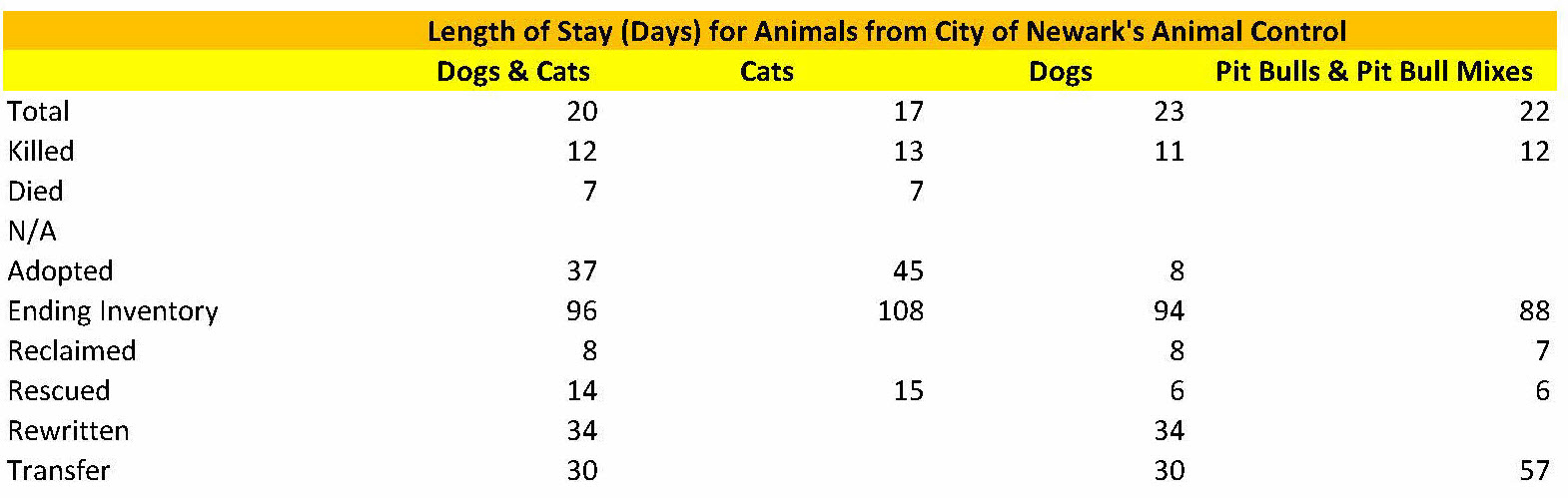
Bergen County Animal Shelter’s length of stay data reveals much about the shelter’s operation. On average, the shelter kills cats and dogs after 20 days and 16 days. However, these figures, particularly for dogs, are heavily influenced by the large number of owner surrendered animals that the shelter kills immediately. As expected, owner reclaimed animals go home quickly (10 days for cats and 3 days for dogs). On the other hand, the shelter takes way too long to adopt out cats (66 days) and dogs (47 days) particularly given the types of animals it adopts out (i.e. few challenging animals make it to the adoption floor due to the high kill rate).Bergen County Animal Shelter LOS All Dogs and Cats

Bergen County Animal Shelter’s length of stay data indicates the shelter kills with empty kennels. Based on standard animal shelter population equations, we can estimate the average number of animals at the shelter during the year as follows:

Daily capacity or population = Daily animal intake x average length of stay

Therefore, based on the shelter’s reported animal intake and average length of stay, we can estimate the facility housed 219 cats and 56 dogs on average during 2015. Based on these estimates and the shelter’s capacity disclosed in its 2015 Shelter/Pound Annual Report, Bergen County Animal Shelter only used roughly 2/3 of its available animal holding space on average during 2015. Thus, Bergen County Animal Shelter clearly kills dogs and cats when the shelter has room to house those animals.

Bergen County Animal Shelter 2015 Capacity Used

Adult Dogs and Cats Killed at an Alarming Rate

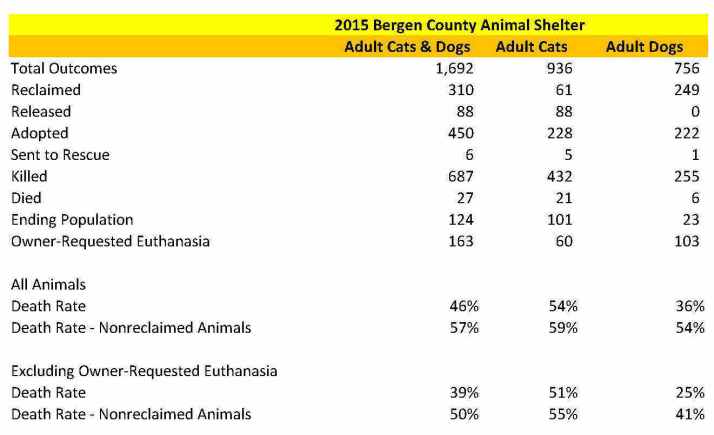
Bergen County Animal Shelter’s statistics are far worse when we focus on animals the shelter labels as “adult.” Generally speaking, the shelter classified cats and dogs over 1 year old as “adult”, but there were a few classification errors (i.e. older dogs classified as “adult”). However, the number of these animals were not large enough to significantly impact the outcomes below. 54% of adult cats and 36% of adult dogs were killed or died. Similarly, 59% of non-reclaimed adult cats and 54% of non-reclaimed adult dogs were killed or died per the facility’s underlying records. In other words, more than half of adult cats and dogs requiring actual sheltering lost their lives at this so-called “no kill shelter.”

Even if we exclude owner-requested euthanasia, 51% and 25% of all adult cats and dogs lost their lives at Bergen County Animal Shelter in 2015. If we exclude owner-requested euthanasia from the non-reclaimed animal death rate, 55% and 41% of all non-reclaimed adult cats and adult dogs lost their lives at Bergen County Animal Shelter in 2015. Thus, Bergen County Animal Shelter’s underlying records reveal this self-proclaimed “no kill shelter” kills tremendous numbers of adult cats and dogs.

Bergen Adult Animals 2015

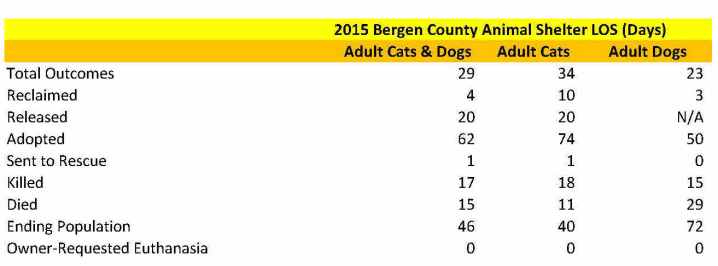
Bergen County Animal Shelter’s adult animal length of stay data revealed the shelter killed adult dogs and cats quickly and took too long to adopt out these animals. Specifically, Bergen County Animal Shelter killed adult cats and dogs after just 18 days and 15 days, respectively. In other words, the shelter generally seemed to make little effort to rehabilitate animals. Furthermore, the shelter took 74 days and 50 days on average to adopt out each adult cat and dog. These figures are even worse considering these are likely very adoptable animals since the shelter kills virtually all animals with any significant issues.

Bergen Adult Animals LOS

Pit Bulls Killed in Droves

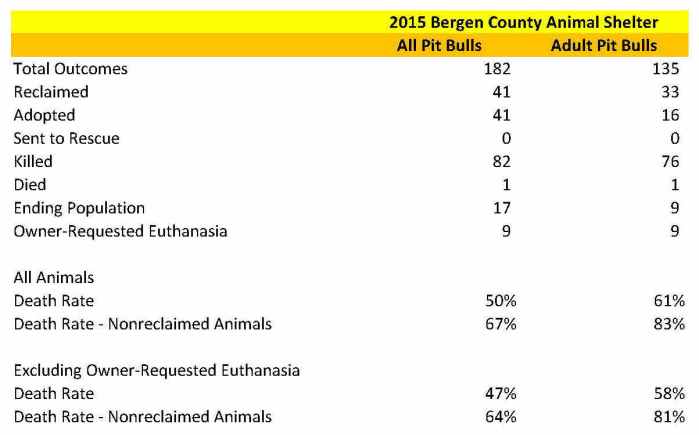
Bergen County Animal Shelter kills pit bull like dogs at an astounding rate. 50% of all pit bull like dogs lost their lives at Bergen County Animal Shelter in 2015. Even worse, 67% of non-reclaimed pit bull like dogs were killed or died at Bergen County Animal Shelter in 2015. If we exclude owner-requested euthanasia, Bergen County Animal Shelter still killed 47% of its pit bulls and 64% of its pit bulls not reclaimed by owners. Thus, Bergen County Animal Shelter kills around half of all its pit bull like dogs and around two thirds of those pit bull like dogs requiring actual sheltering.

Bergen County Animal Shelter kills most of its adult pit bull like dogs. 61% of adult pit bull like dogs lost their lives at Bergen County Animal Shelter in 2015. In fact, 83% of non-reclaimed adult pit bull like dogs were killed or died at Bergen County Animal Shelter in 2015. Even if we exclude owner-requested euthanasia, the shelter killed 58% of its adult pit bulls and 81% of its adult pit bulls not reclaimed by owners. As a result, adult pit bull like dogs virtually have no chance of making it out alive of the so-called “no kill” Bergen County Animal Shelter.

Bergen Pit Bull Data

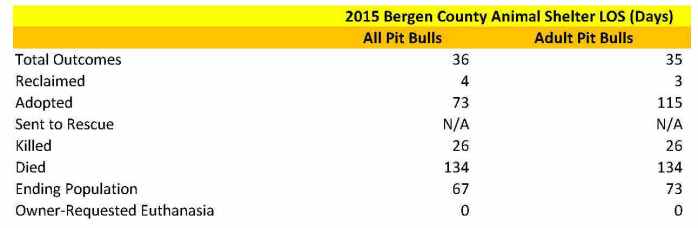
Bergen County Animal Shelter’s poor performance is exemplified by its pit bull length of stay data. While Bergen County Animal Shelter’s average length of stay of 36 days for all pit bulls is reasonable, the actual details uncover the true story. The shelter’s average length of stay is relatively low due to owners reclaiming and Bergen County Animal Shelter killing many pit bulls. Of course, we want owners to reclaim their lost pets. However, Bergen County Animal Shelter’s respectable number of reclaimed pit bulls is due mostly to the relatively wealthy people in its service area obtaining licenses and microchips (i.e. making it easy for the shelter to find the owner). On the other hand, Bergen County Animal Shelter kills its pit bulls relatively quickly (26 days on average). These two factors mask the horrendously long time it takes to adopt out pit bulls (73 days for all pit bulls, 115 days for adult pit bulls). As a comparison, data from recent years showed no kill animal control shelters adopting out pit bull like dogs within around 20-40 days. Given the pit bulls Bergen County Animal Shelter adopts out are likely easier to place (i.e. Bergen County Animal Shelter quickly kills many of the types of pit bulls these other shelters spend time to rehabilitate), this performance is even more disappointing. Thus, Bergen County Animal Shelter quickly kills its pit bulls and takes way too long to adopt out the few pit bulls it allows to live.

Bergen Pit Bulls LOS

Small Dogs Are Not Safe at Bergen County Animal Shelter

At most New Jersey animal shelters, small dogs fly out the door to rescues and adopters. For example, Perth Amboy Animal Shelter, which has little space and serves a poor area, saved 97% of 116 small dogs it took in during 2014 and the first half of 2015 per records I reviewed last year. Even the regressive Elizabeth Animal Shelter saved 95% of the 144 small dogs it impounded in 2015. Thus, “no kill” shelters should save 95% or more of the small dogs they take in.

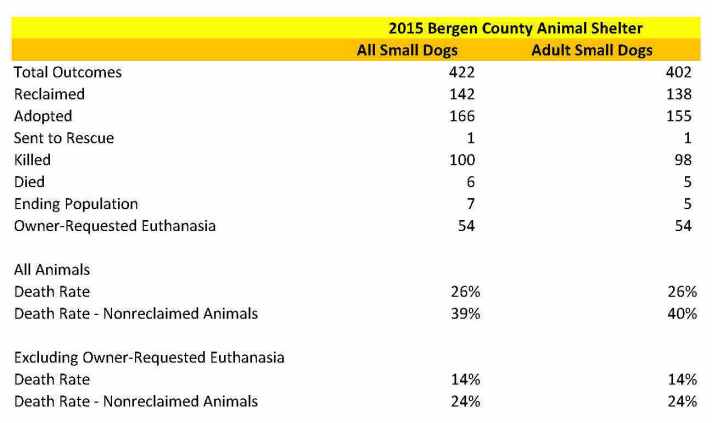
Bergen County Animal Shelter’s killing even extends to large numbers of small dogs. 26% of all small dogs lost their lives at Bergen County Animal Shelter in 2015. Even worse, 39% of non-reclaimed small dogs were killed or died at Bergen County Animal Shelter in 2015. Additionally, the shelter labeled an extraordinary large number of these dogs as “owner-requested euthanasia”, which raises questions about whether these animals were truly hopelessly suffering. If we exclude owner-requested euthanasia, Bergen County Animal Shelter still killed 14% of its small dogs and 24% of its small dogs not reclaimed by owners. Thus, Bergen County Animal Shelter fails to achieve “no kill” status even for small dogs.

Bergen Small Dog Data.jpg

Bergen County Animal Shelter’s length of stay data shows how poorly the facility handles small dogs. Overall, Bergen County Animal Shelter killed small dogs after just 10 days on average. On the other hand, Bergen County Animal Shelter took an astonishingly long 42 days on average to adopt out its small dogs. As a comparison, Perth Amboy Animal Shelter took 14 days on average to adopt out its small dogs based on data from 2014 and the first half of 2015. Similarly, Elizabeth Animal Shelter took 5 days on average to safely get non-reclaimed small dogs out of the shelter in 2015. Thus, Bergen County Animal Shelter quickly killed small dogs and took way too long to adopt out these highly desirable animals.

Bergen Small Dogs LOS

Wildlife Slaughtered

Bergen County Animal Shelter killed wildlife at an alarming rate. Based on over 450 records of wild animals I reviewed, 46% of all wild animals impounded during 2015 lost their lives. In fact, this figure would be even higher if I counted the many animals who died on their way to Bergen County Animal Shelter after being picked up by the shelter’s animal control officers.

Bergen County Animal Shelter’s wildlife kill rate was much higher for some species. Specifically, Bergen County Animal Shelter killed 65%, 62% and 69% of all the opossums, raccoons and skunks it impounded during 2015. While raccoons and skunks are considered “rabies vector species”, it is virtually impossible that most of these animals were exhibiting signs of the disease or bit someone. Furthermore, the shelter killed a similar percentage of opossums, which are not rabies vector species. Thus, Bergen County Animal Shelter appeared quite content to kill common wildlife species without even sending the animals to a wildlife rehabilitation facility.

Bergen Wildlife 2015

Clearly, Bergen County Animal Shelter is a high kill shelter rather than a “no kill” facility. Despite Bergen County’s highest elected officials boasting, the shelter kills large numbers of all types of animals and the Director does not deserve any award for “animal compassion.”

In Part 2 of this series of blogs, I will examine the reasons why Bergen County Animal Shelter kills large numbers of animals.

2015 New Jersey Animal Shelter Statistics Show Significant Improvement and Prove Advocacy Works

Recently, a number of people and organizations in the no kill movement slammed animal advocates for demanding shelters save more animals. Susan Houser, who is the author of the Out the Front Door blog and Facebook page, repeatedly denounced animal advocates for criticizing regressive high kill shelters that allegedly were improving. Ms. Houser has also claimed strong advocacy was driving good leaders out of the shelter industry resulting in potentially less lifesaving. Best Friends Co-Founder, Francis Battista, wrote an article comparing President Obama’s recent statement on getting things done in a democracy to no kill movement tactics. While the article denounced people who say nasty things about high kill shelters, it also criticized people who act with “moral purity” and call out those regressive facilities. In a nutshell, Mr. Battista stated people should shut up and not try to win over hearts and minds with principled stands and instead try to work with bad actors.

Does strong advocacy that is highly critical of shelters reduce or increase lifesaving?

Data Reviewed

Each year, licensed animal shelters in the state submit animal shelter data to the New Jersey Department of Health for the previous year. For the last several years, I’ve tabulated this data and calculated various metrics. You can view the 2015 data at this link. After compiling the 2015 data, I compared the results to the 2014 statistics I tabulated last year.

2015 Statistics Show Significant Increase in Lifesaving

The table below summarizes the dog statistics in 2015 and 2014. To see how I calculate the various metrics, please review the footnotes in this link and my blog analyzing the 2014 statistics.

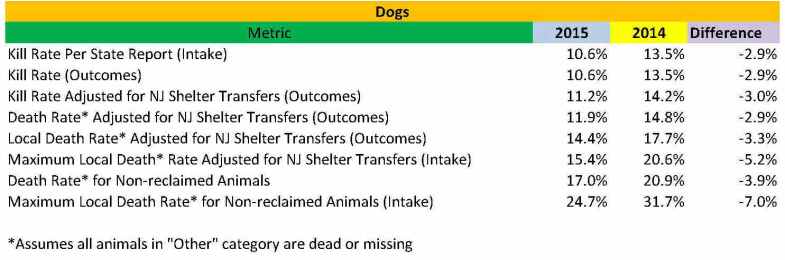
All dog statistics significantly improved in 2015 verses 2014. While an approximate 3% decrease in the dog kill and death rates may not seem huge, this is a large decrease considering the prior kill and death rates were relatively low. For example, a 2.9% decrease in the 2014 kill rate of 13.5% represents a 21% reduction. As a comparison, in 2014 the kill rate based on intake was 0.1% higher than the 2013 figure and the death rate based on outcomes was only 0.7% lower than this measure in 2013. Given saving the last 15% of animals is more difficult due to animals having more medical and behavioral problems that require treatment, this result is very good. Additionally, the larger decrease in the death rate for non-reclaimed animals indicates the kill rate decreased even more for dogs shelters actually had to find new homes for. Finally, the larger decrease in the maximum local death rate indicates shelters had less unaccounted for animals and this may indicate even fewer animals lost their lives in the state’s shelters in 2015 verses 2014.

2015 Dog vs 2014 stats

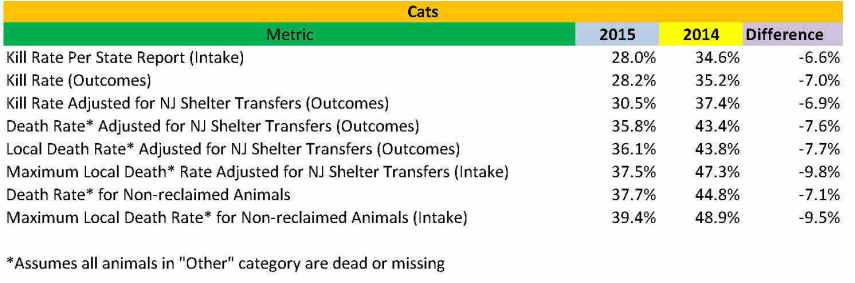
The cat statistics improved even more than the dog statistics in 2015 verses 2014. As you can see in the table below, the kill rates and death rates decreased by approximately 7% and 8% in 2015 compared to 2014. As a comparison, the cat kill rate based on intake and the cat death rate based on outcomes only decreased by 3.9% and 3.8% in 2014 verses 2013. Even more impressive, the maximum local death rate decreased by around 10% in 2015 compared to 2014. Thus, New Jersey animal shelters became much safer places for cats in 2015 than in 2014.

2015 cat vs 2014 stats

Dog Kill Rate Decreases Due to Lower Intake and Shelters Saving a Greater Percentage of Impounded Animals

The table below summarizes the changes in the dog statistics in 2015 verses 2014. Based on the changes in the metrics used moving in a similar direction, I anlyzed the kill rate based on intake below. As you can see, both dog intake and dogs killed decreased significantly while positive outcomes decreased much less. In particular, dog adoptions barely decreased despite shelters receiving 1,870 fewer dogs in 2015 compared to 2014.

Data from prior years indicates positive outcomes along with lower intake drove the improvement in the dog kill rate in 2015. While lower intake can theoretically increase live release rates due to shelters having more time and space to save animals as well as having more resources per animal, this does not always work out in the real world. For example, shelters may kill with empty cages and hoard money instead of spending it on animals. In 2014, dog intake decreased by more from the prior year (2,821 fewer dogs impounded), but the number of dogs reclaimed by owners, adopted out and sent to rescues decreased by almost as much (2,292 fewer positive dog outcomes). Therefore, the kill rate for dogs based on intake actually increased despite lower intake due to fewer positive outcomes. This indicates the decrease in the dog kill rate in 2015 was not only due to shelters taking fewer animals in, but shelters also finding more positive outcomes for the dogs coming into their facilities. In fact, this latter conclusion is consistent with my finding that New Jersey shelters have plenty of space to save their dogs and many others from elsewhere.

Dog 2015 vs 2014 reasons

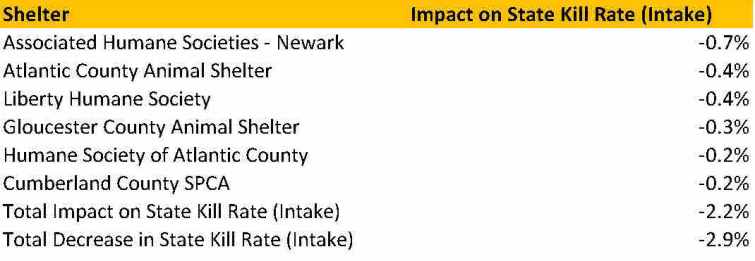
The table below details which shelters contributed most to the decrease in the dog kill rate in the state during 2015. As you can see, this list mostly represents large shelters that have high kill rates (i.e. shelters with high kill rates have more room for improvement).

Dog Shelter Kill Rate Impact

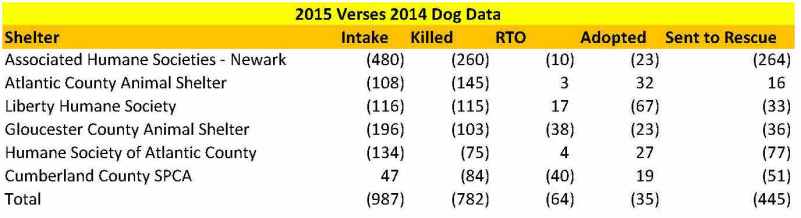
The following table showing the change in data at each shelter in 2015 verses 2014 highlights the pattern of shelters saving a greater percentage of animals they took in during 2015. As you can see, the reduction in dogs killed made up a large percentage of the drop in intake while positive outcomes decreased by much less or actually increased in some cases.

Atlantic County Animal Shelter and Liberty Humane Society deserve specific recognition for achieving greater than 90% live release rates for dogs in 2015 (i.e. often considered no kill status). The kill rate at Atlantic County Animal Shelter decreased from 19% in 2014 to 8% in 2015. Liberty Humane Society’s kill rate decreased from 21% in 2014 to 5% in 2015. These results are impressive as both shelters serve some very poor areas of the state. Atlantic County Animal Shelter’s kill rate decreased due to a combination of lower intake and adopting out more dogs and sending more dogs to rescues and other shelters. On the other hand, Liberty Humane Society’s kill rate decreased due to lower intake resulting from implementing a pet surrender prevention program and an appointment system for owner surrenders. While I’m not thrilled that the shelter has a “significant wait period” for owner surrenders, I much prefer this system over killing healthy and treatable dogs.

2015 Summary Stats (1) (7)

Cat Kill Rate Decreased Due to Shelters Increasing Positive Outcomes

The table below summarizes the changes in the cat statistics in 2015 verses 2014. In contrast to dogs, New Jersey shelters impounded more cats during 2015 as compared to 2014. However, the state’s shelters significantly increased positive outcomes.

Unfortunately, it is difficult to determine how much of the increase is due to TNR. Generally speaking, many more communities embraced TNR in 2015. However, the “Shelter/Pound Annual Report” shelters fill out does not provide TNR as an outcome. In practice, some shelters may place TNR cats in the return to owner (RTO), adopted, sent to rescues or other categories. Montclair Township Animal Shelter wrote in the number of their TNR cats in 2015 and 2014 and Edison Animal Shelter did so in 2015. I included these cats in the TNR category. Additionally, approximately 500-600 of the increase in cats returned to owners likely represents TNR based on this article and Bergen County Animal Shelter’s increase in cats returned to owners listed below.

c

The table below details which shelters contributed most to the decrease in the cat kill rate in the state during 2015.

Cats 2015 kill rate change

The following table showing the change in data at each shelter in 2015 verses 2014 documents the increase in positive live releases. All shelters except for Jersey Shore Animal Center, which stopped serving as an animal control shelter in 2015, significantly increased the number of cats adopted out and/or sent to rescue. As indicated above, approximately 500-600 more cats were neutered and released at Bergen County Animal Shelter in 2015, and were likely included in the RTO category. Therefore, the increase in the cat live release rate was largely due to shelters increasing the number of positive outcomes.

Cats shelter 2015 vs 2014

Advocacy Efforts Coincide with Increase in Lifesaving

Obviously, people working with animals, such as shelter staff, volunteers and rescuers are directly responsible for the increase in lifesaving. However, advocacy efforts can create the climate where those people are allowed to save lives in a more effective manner. For example, public pressure can force a shelter to start a kitten foster program, do off-site adoption events, and act more rescue friendly.

Statewide shelter advocacy efforts began to grow in 2015. While this blog and my related Facebook page started in early 2014, readership increased significantly in 2015. Additionally, I started analyzing and grading each of the state’s animal shelters at the end of 2014 which I think put pressure on many facilities to improve. In the past, no one really knew what went on behind closed doors. Also, a number of local advocates have told me the ideas expressed on this blog and my Facebook page inspired them to take action. Several advocates also told me that exposing poorly performing shelters they were fighting helped their cause. Thus, I do think this blog and my related Facebook page helped create a climate where local advocacy efforts could be more successful.

The Reformers-Advocates for Shelter Change in NJ group also likely positively contributed to the increase in the state live release rate in 2015. This no holds barred animal advocacy group grew out of the movement to reform the Helmetta Regional Animal Shelter and started having a significant impact in 2015. The Reformers use the Open Public Records Act (OPRA), powerful messaging and relentless public pressure to bring bad actors to justice. While this group employs much different tactics than I use and sometimes has different views on things than me, they have been wildly successful at exposing the NJ SPCA, pet stores, disreputable rescues, poorly performing animal shelters and even facilities with high live release rates. Love them or hate them, no one can deny the positive impact this group has had on New Jersey animal welfare. In fact, many regressive shelters truly fear this group and that alone may change bad behavior.

Local advocacy efforts seem to have increased in recent years. While I can’t quantify this phenomenon, I do see these campaigns increasing and getting more media exposure. Ultimately, local advocates on the ground are the key actors in forcing change.

Finally, the professional advocacy efforts by groups like People for Animals and the Animal Protection League of New Jersey have played a key role in convincing municipalities to implement TNR. These groups bring well-thought out plans that provide compelling cases, for fiscal, public health and humane reasons, to convince towns to adopt TNR.

Clearly, confrontational shelter advocacy efforts have played a positive role in New Jersey animal welfare. If shelter killing can decrease to this extent during the same time a no holds barred group like the Reformers have actively inserted themselves into the state’s shelter issues, then that pretty much proves the argument that confrontational shelter advocacy efforts work. While I favor a less in your face approach more akin to Ryan Clinton’s campaign in Austin, I do believe we must honestly call out shelters that needlessly kill and not brush that killing under the rug for the sake of collaboration. Personally, I have great respect for the work Best Friends has done to create no kill communities, and do not oppose collaboration when appropriate. In fact, I have often advocated that shelters should work together to save lives in New Jersey. However, Best Friends and Susan Houser should not make bold assertions about confrontational animal advocacy efforts without having solid data to back those claims up. As the data in this blog shows, Best Friends and Ms. Houser are dead wrong about confrontational shelter advocacy efforts, at least in New Jersey.

Speaking as someone who for years did just the things Mr. Battista is arguing for, I found his remarks perplexing. As many of us who have worked and volunteered within our broken sheltering system know, most regressive shelter leaders and animal unfriendly politicians have little interest in saving lives. At the same time, we know the public at large wants to save animals in shelters and is unaware of just how bad most of our shelters are. Naturally, making the public aware of what is really going on in shelters and calling for action puts pressure on those elected officials and shelter leaders. This pressure in turn improves the negotiating position of those animal advocates engaging elected officials and shelter directors.

In the political world, we have opinion columnists, think tanks, and special interest groups that change public opinion to make negotiations more favorable for their causes. Whether you like the National Rifle Association or not, no one can deny how effective their “moral purity” stances have been in blocking laws they oppose and passing ones they support. Thus, advocates arguing on principle help other advocates doing the negotiating for change.

Unfortunately, New Jersey animal shelters still kill too many animals and do not save nearly as many pets as they should. In future blogs, I’ll address the current state of New Jersey animal shelters. Clearly, New Jersey shelter reform advocates have much work to do, but at least for a moment, they can feel good about the recent progress made.

Associated Humane Societies-Newark Kills Friends and Families

In 2013, the NJ SPCA confiscated a loose dog named Telly around a yard that was littered with trash in Newark. The NJ SPCA sent the dog to Associated Humane Societies-Newark as the animal was apparently a stray dog. However, the NJ SPCA decided to educate and work with the property owner to improve the care of a dog named Tez the family often kept outside. Justice Rescue reported the family faced serious hardships and really needed help. The rescue cleaned up the family’s property and provided a warm dog house and much needed supplies to see if the dog could avoid going to the high kill AHS-Newark shelter. If the remediation efforts did not work, the NJ SPCA could still seize the dog and rescues were willing to take the animal.

AHS demanded the NJ SPCA and the owner surrender the dog to AHS immediately. Through a series of posts over several months, AHS whipped the animal welfare community into a frenzy. While anyone reading this blog and my Facebook page know I am highly critical of the NJ SPCA, I thought AHS was acting hypocritically. For example, AHS claimed it did not operate a high kill shelter and mostly euthanized terminally ill animals or vicious dogs:

Contrary to what has been put on the internet, we are not a high-kill shelter; we do not euthanize senior dogs for space. We have a very low euthanasia rate — much of which is senior citizens from the community who cannot afford vet fees to euthanize their own pets or extremely vicious dogs that failed evaluation and were unsafe to adopt out to families. Just log on to our home page and you will see what we do for lots of animals that come through our doors.

However, my recent analysis of AHS-Newark’s underlying intake and disposition records revealed AHS-Newark kills vast numbers of healthy and treatable animals.

To further pull at the animal welfare community’s heartstrings, AHS argued the NJ SPCA and the owner should surrender their dog to AHS due to the two separated dogs missing each other. In order to determine if these concerns were legitimate, I reviewed documents detailing how AHS cared for other bonded animals arriving at AHS-Newark from the City of Newark. Does AHS show as much compassion for these other animals who are not in the public eye?

AHS Hypocritically Kills Bonded Animals

On January 29, 2014, the Newark Police Department seized three dogs in a drug raid and sent the animals to AHS-Newark. After 14 days, AHS-Popcorn Park took one of the dogs, a highly adoptable 1 year old whippet named Summer (ID# 122684). In fact, the owner signed this desirable dog over to AHS, due to the owner lacking financial resources, on the day AHS-Popcorn Park transferred the whippet in. However, AHS-Newark kept the other dog in this household, a 5 year and 2 month old pit bull (ID# 122683) for 29 more days at AHS-Newark until AHS-Newark killed the dog for no documented reason. Similarly, AHS-Newark killed another owner’s dog seized in the raid, a 4 year and 2 month old pit bull (ID# 122686) on the same day as the other pit bull for no apparent reason. If AHS was legitimately concerned about the well being of the two bonded dogs, Tez and Telly, why would AHS separate this highly adoptable whippet from her brother and possibly another friend? Furthermore, why would AHS kill these two pit bulls who were potentially friends?

122684 pt 1

122684 pt 2

122683 pt 1

122683 pt 1 (2)


122686 pt 1

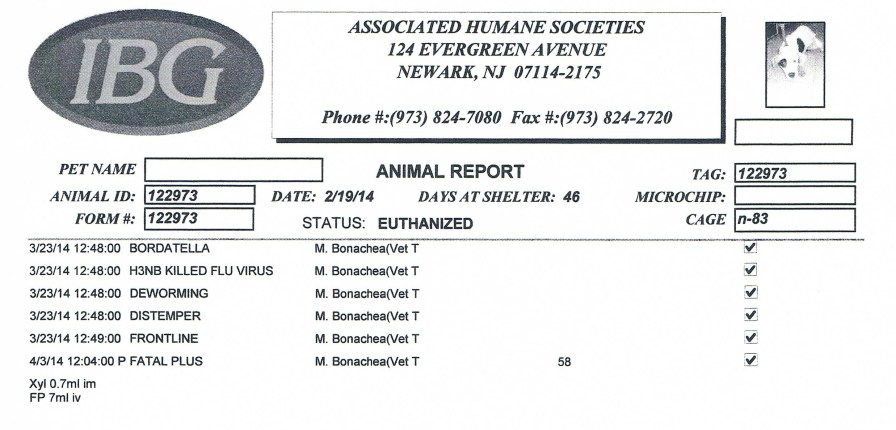
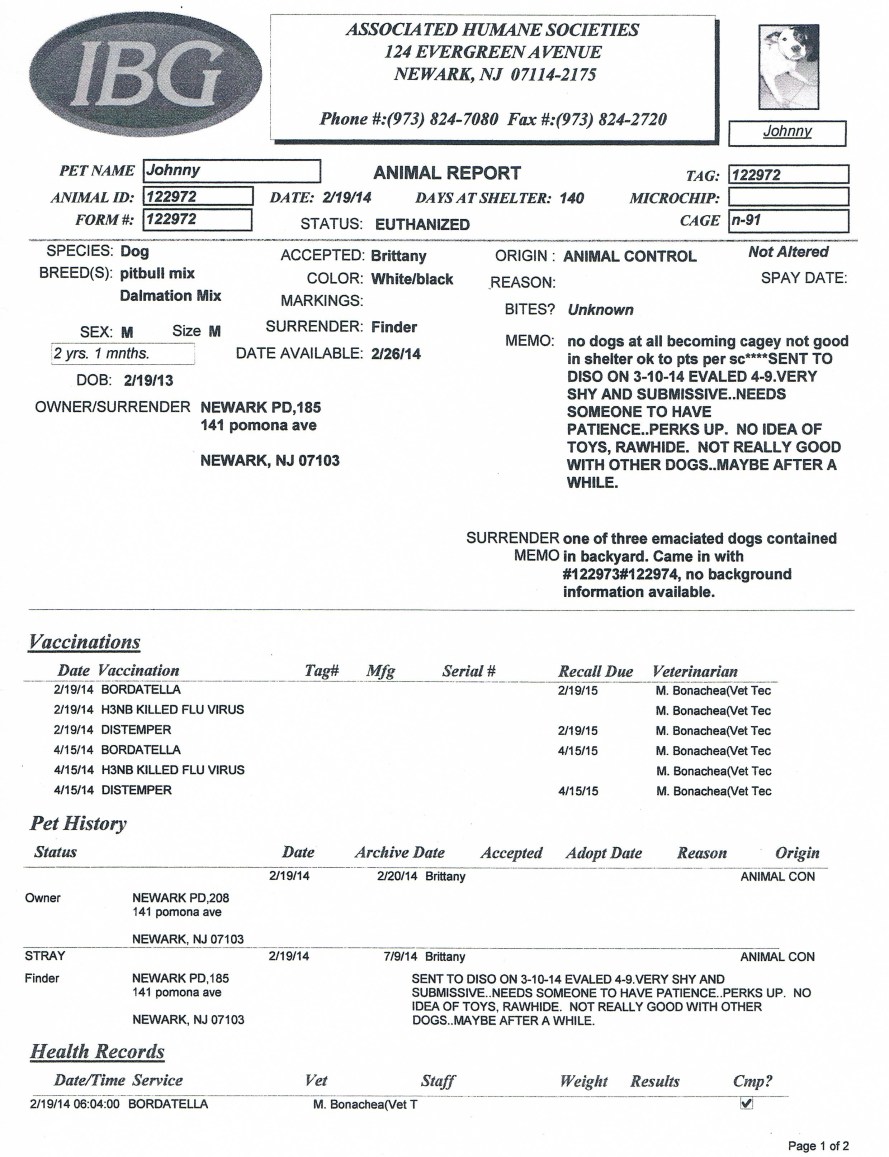
On February 19, 2014, the Newark Police Department confiscated three emaciated dogs in a backyard and brought the animals to AHS-Newark. If AHS were to ever go the extra mile to save animals, this was it. Unfortunately, AHS-Newark killed all three dogs for dubious reasons. After just 9 days, AHS-Newark killed a 3 year and 1 month old pit bull mix (ID# 122974) for no documented reason. Other than standard vaccinations, deworming and flea and tick medicine, AHS-Newark’s intake and disposition record documented no special veterinary care or treatment to heal this animal’s emotional wounds. AHS-Newark killed the second of the three emaciated dogs, a 2 year and 1 month old pit bull mix (ID# 122973), after 46 days for no documented reason. Other than various vaccinations, AHS-Newark documented no additional veterinary care or emotional support provided to this abused animal. The third dog, a 2 year and 1 month old pit bull-Dalmation mix (ID # 122972), received an evaluation stating the dog was very shy and submissive. Additionally, the evaluation said the dog needed someone with patience. Instead of rehabilitating this traumatized dog, AHS-Newark kept the dog at the very stressful and loud Newark shelter for 4 months or so and killed him for not getting along with other dogs and being “cagey.” If AHS decided to kill all three of these apparently bonded and abused dogs, how can the organization argue that the connection between Tez and Telly should not be broken?

122974 pt 1

122974 pt 2

122973 pt 1

122973 pt 2

122972 pt 1

122972 pt 2

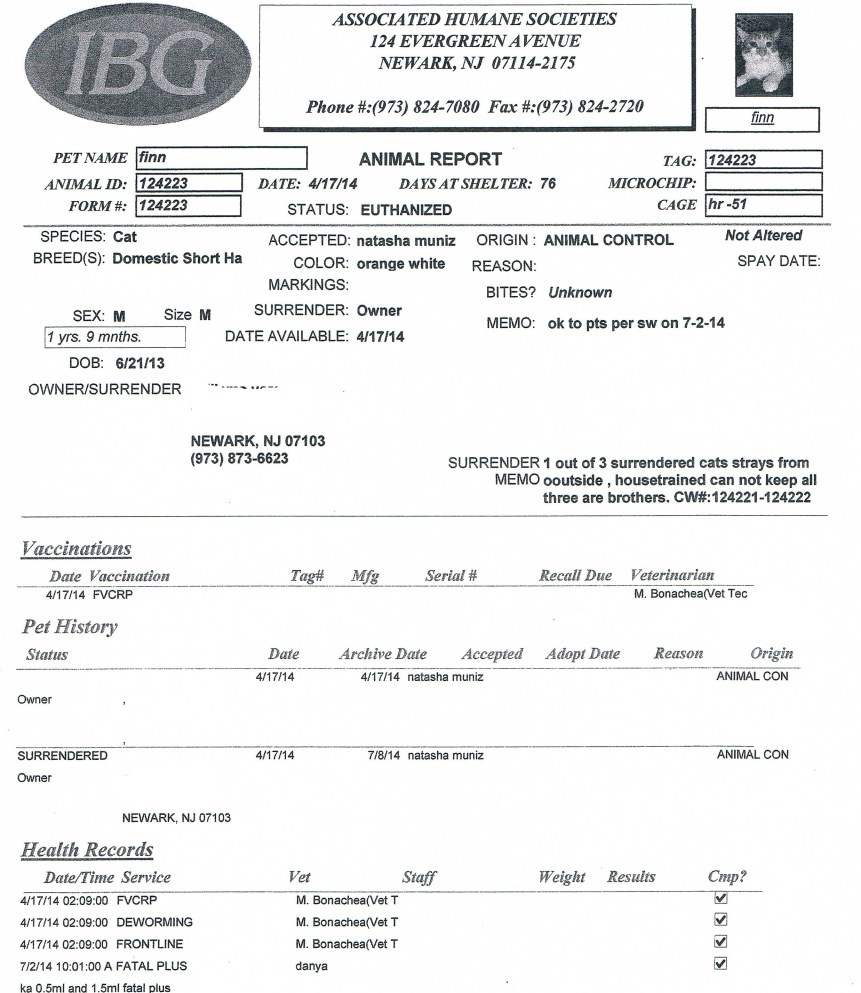
Mumu (ID# 124221), Blade (ID# 124222) and Finn (ID # 124223) were three brother cats surrendered to AHS-Newark on April 17, 2014. Despite all three cats being less than two years old and housetrained, AHS-Newark killed all three animals on the same day for no documented reason. According to AHS the connection between Tez and Telly was so powerful that the two animals could not live apart, but the bonds between these three brother cats were not strong enough to even warrant an explanation for their killing.124221

124222

124223

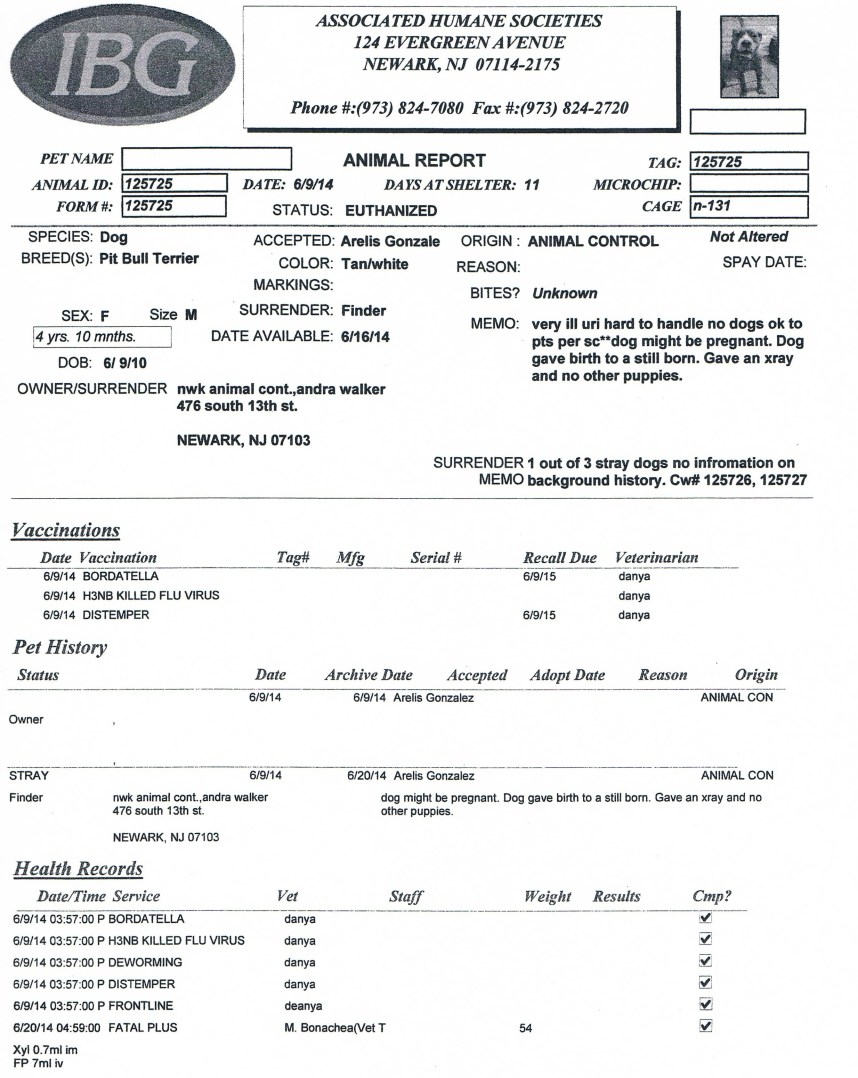
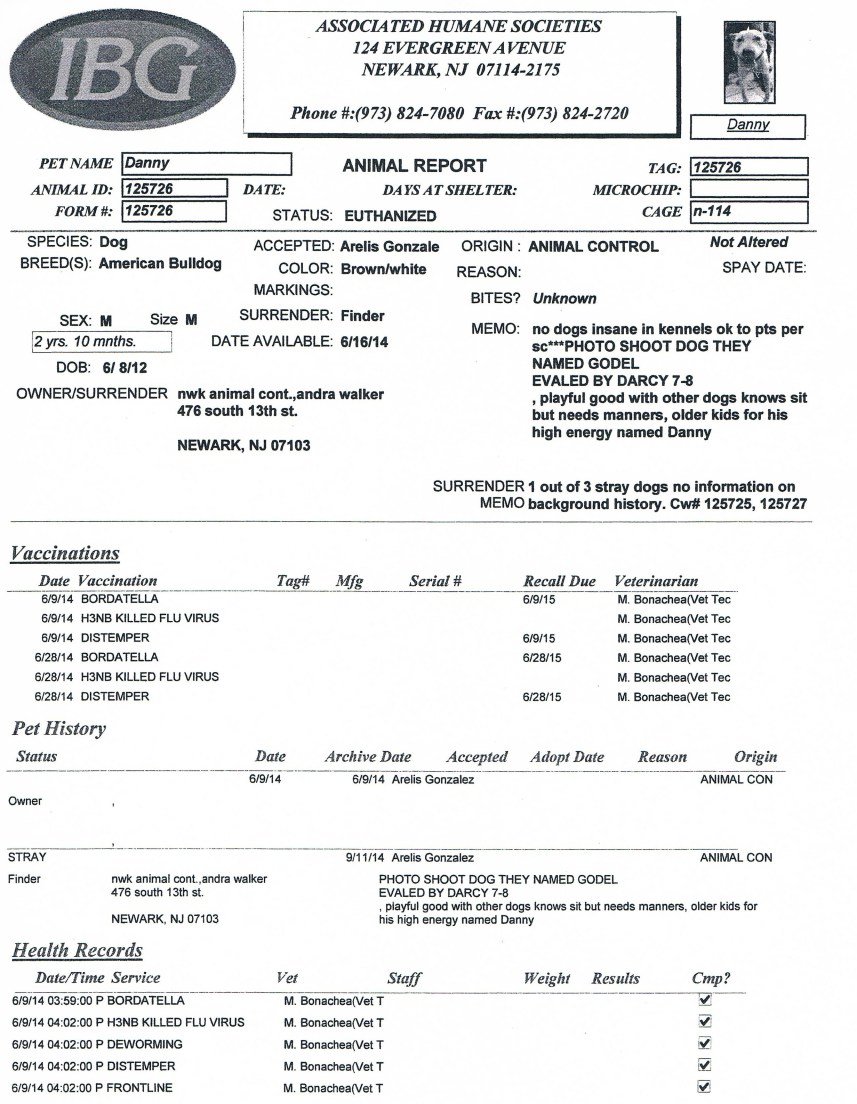
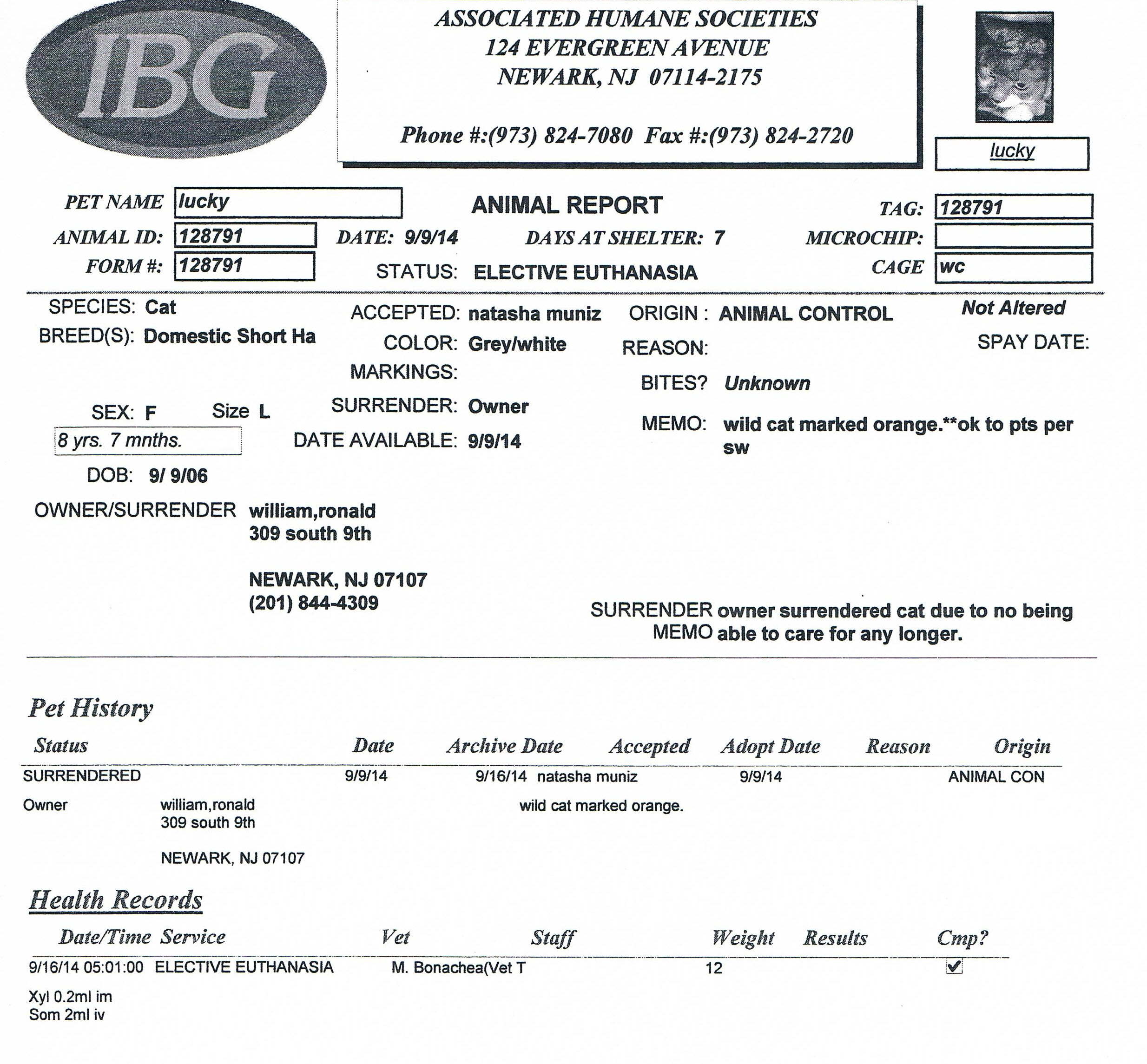
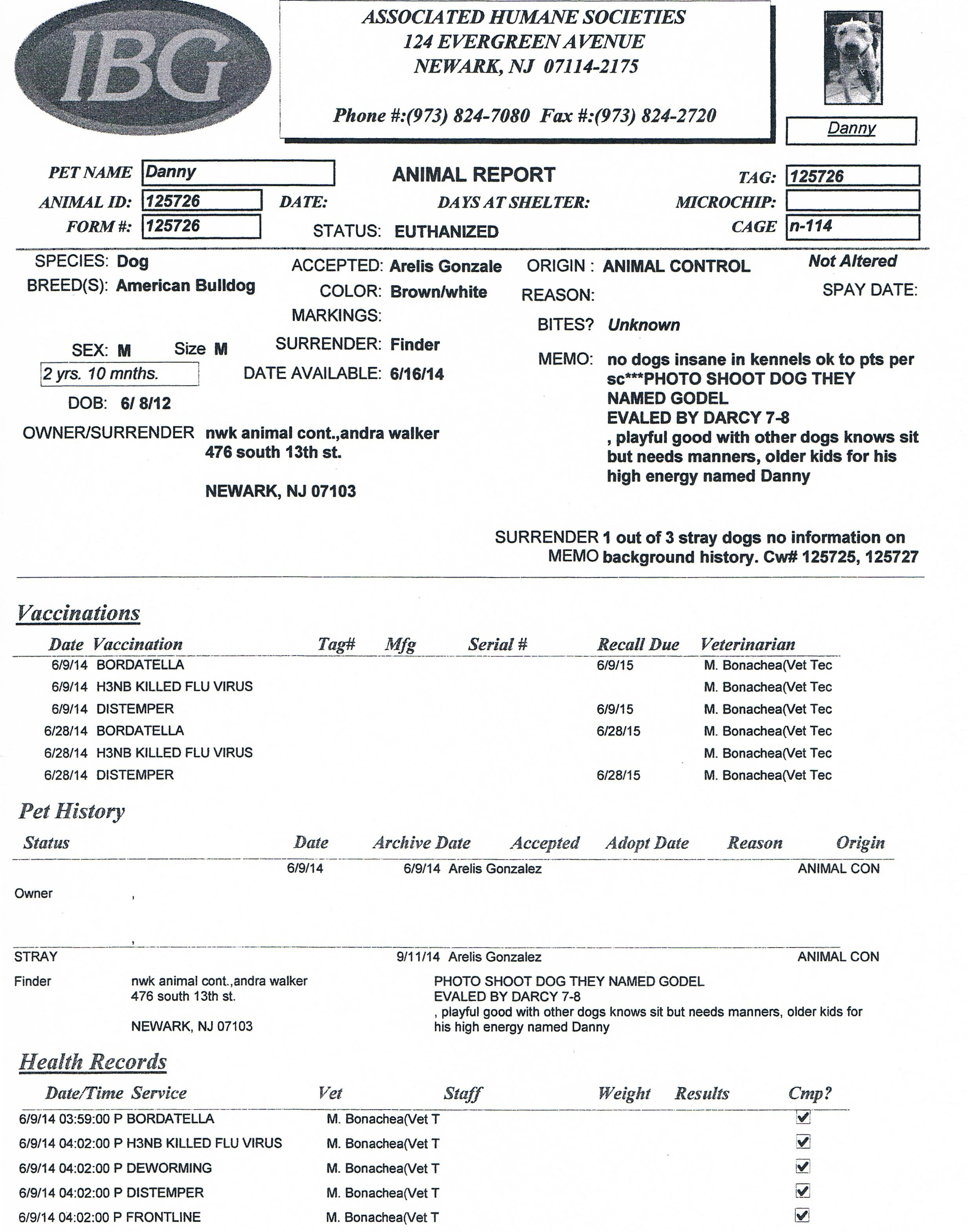
On June 9, 2014, Newark Animal Control picked up three stray dogs and sent the animals to AHS-Newark. Dog ID# 125725 was a 4 year and 10 month old pregnant pit bull like dog. The pregnant dog gave birth to one still born puppy. Despite this poor mother dog losing her puppy, AHS-Newark killed her just 11 days after her arrival for having a URI, being “hard to handle”, and not being compatible with dogs (even though she came in with two other dogs). The second of the three dogs, Dog ID# 125727 was a 1 year and 7 month old pit bull like dog. After just 12 days, and the day after AHS-Newark killed Dog ID# 125725, AHS-Newark destroyed this dog for having a URI, the isolation area being full, and not being good with other dogs (even though he came in with two other dogs). The third dog, Dog ID# 125726 was one of the rare dogs receiving a name and an evaluation. The evaluation stated this dog, named Danny, was “playful”, “good with other dogs”, and “high energy.” Furthermore, Danny was one of the select few dogs to participate in a photoshoot. Despite all this going for him, AHS-Newark killed Danny after around 3 months for not being compatible with dogs and acting “insane in kennels.” Apparently, AHS-Newark placed little value on the emotional connection between these three dogs and the mother dog’s sadness due to recently losing a puppy.

125725

125727

125726 pt 1

125726 pt 2

AHS-Newark impounded a lactating mother cat, ID #126021, and her kitten, ID# 126020, on June 19, 2014. Miraculously, AHS-Newark adopted out the kitten 8 days after her arrival at the shelter. However, the kitten’s mother remained at AHS-Newark. AHS-Newark killed the mother cat four days after the shelter adopted out her kitten. Once again AHS placed no value on the mother-kitten bond yet claimed the dogs, Tez and Telly, must be kept together at one of the organization’s shelters.

126020

126021

AHS-Newark impounded another mother cat, ID #126023, and her kitten, ID# 126022, on June 19, 2014. After just 11 days, AHS-Newark killed the mother cat for no documented reason. Five days after AHS-Newark killed the kitten’s mother, AHS-Newark killed the kitten for no apparent reason. As a result, AHS-Newark placed no value on the bond between a mother cat and her kitten and the kitten’s sadness after losing her mother.

126023


ID 126022

Donors Must Demand Far More from AHS

The examples above expose the hypocrisy of AHS. AHS emphasized the bond between animals when it came to winning a fight with the NJ SPCA and raising money, but obliterated those types of bonds when no one was looking. In fact, AHS regularly highlights alleged animal cruelty to raise money on its web site with tabloid like headlines such as “3 Abandoned Dogs Tied Outside with No Shelter”“Calista – Emaciated, Sweet 10 Month Old Pup”, “Van Gogh – Mutilated, Abandoned, Found by Good Samaritan”. While AHS may save these animals, AHS does not tell donors about the many other dogs and cats AHS-Newark kills for dubious reasons. As a result, AHS fails to disclose the complete truth about its operations to donors and the animal welfare community.

At the end of the day, donors must wake up and demand AHS change its ways. Apparently, AHS thinks it can dupe its donors into thinking most of the animals it impounds from Newark are heroically rescued and sent to loving homes. Based on the records I reviewed, this absolutely is not the case. AHS must remove its entire senior leadership team, including Roseann Trezza and Scott Crawford, and replace them with people dedicated to comprehensively implementing the no kill equation. The good people donating to AHS clearly expect the organization to save its animals. It is time donors require AHS to use their hard earned money to save animals and not kill them for convenience and cost savings

Gloucester County’s God Awful Animal Shelter

Gloucester County Animal Shelter reports some of the highest kill rates and body counts every year. In 2014, 31% of dogs and and 76% of cats were killed, died, went missing or were unaccounted for. Furthermore, 52% of dogs not reclaimed by their owners lost their lives at Gloucester County Animal Shelter in 2014. In total, 366 dogs and 2,017 cats were killed, died, went missing or were unaccounted for at Gloucester County Animal Shelter last year. To put it another way, 7 dogs and cats lose their lives at Gloucester County Animal Shelter on average each day of the year at this so-called shelter. Thus, Gloucester County Animal Shelter operates more like a death camp than an animal shelter.

Regressive kill shelter defenders often claim these facilities only kill out of necessity and provide humane and loving care to the animals. For example, PETA wrote an article on how no kill shelters are cruel and kill shelters are humane. One key excerpt was as follows:

Not all animal shelters are the same. Fortunate homeless and unwanted animals end up in the hundreds of open-admission animal shelters that are staffed by professional, caring people.

At these facilities, frightened animals are reassured, sick and injured animals receive treatment or a peaceful end to their suffering, and the animals’ living quarters are kept clean and dry. Workers at these facilities never turn away needy animals and give careful consideration to each animal’s special emotional and physical needs.

Gloucester County Animal Shelter made headlines in October after illegally killing an owned cat. On September 30, 2015, Gloucester County Animal Shelter impounded a stray cat named Moe. According to news stories, the owner’s ex-fiance’s contact information was with the microchip company and he went went to the shelter the next day. Despite this person not owning the cat, the shelter ordered him to take the cat back, surrender the animal to the facility or face neglect charges. Ultimately, he surrendered Moe to the shelter thinking it would be easier for his ex-fiance to get her cat back. After Moe’s owner found out that Moe was at the shelter later that day, she was told she had to pay $85 to adopt her own cat back. However, the owner found out that Gloucester County Animal Shelter killed Moe earlier that day for aggression. Under New Jersey law, shelters cannot kill any stray or owner surrendered animal prior to a 7 day hold period. As a result of this travesty, a Justice for Moe movement started.

At the time, a Gloucester County spokeswoman stated Moe’s death was a “sensitive subject”, but did not admit the shelter broke the law. However, this spokeswoman stated the shelter would review its procedures.

The New Jersey Department of Health (“NJ DOH”) conducted a five hour inspection three weeks after Moe arrived at Gloucester County Animal Shelter. You can read the full inspection report at this link.

Was Gloucester County Animal Shelter’s illegal killing of Moe an aberration? Is Gloucester County Animal Shelter complying with all New Jersey animal shelter laws?

Does Gloucester County Animal Shelter provide humane care to animals and a “peaceful end” to their life as PETA argues kill shelters do?

Gloucester County Animal Shelter Allows Disease to Spread Like Wildfire

The NJ DOH inspector found the shelter placed cats “one after another” inside the same enclosure without disinfecting the cage while the permanent cat housing areas were cleaned. As a result, the shelter exposed each cat to serious diseases.

1.6 (d) Repeat Deficiency- Animals shall not be placed in empty primary enclosures previously inhabited by other animals unless the enclosure has first been cleaned and disinfected.

Cats at the facility were housed in various rooms. All the cats in these rooms, other than the cats housed in the “feral” cat room, were each placed inside the same enclosure, one after the other, during the daily cleaning process. This enclosure was not cleaned and disinfected between inhabitants as required and, therefore, each cat was potentially exposed to infectious agents of every other cat housed within that room. During the cleaning process in the cat isolation room, the inspector witnessed one of the cats being removed from a holding enclosure and carried back to its primary enclosure; another cat was removed from its primary enclosure, carried over to the same holding enclosure and placed inside. When questioned, the cleaning attended confirmed that the holding enclosure is not cleaned or disinfected at any time between animals during the cleaning process.

During this cleaning process, the shelter failed to apply disinfectant solutions long enough and in the proper concentration to prevent the spread of deadly diseases, such as rabies and the canine parvovirus.

1.8 (c) Cages, floors, and hard surfaced pens or runs shall be disinfected at least once per day by washing all soiled surfaces with a detergent solution followed by a safe and effective disinfectant.

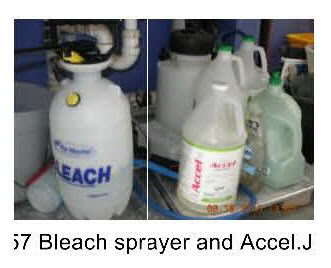
Animal enclosures were not being sufficiently disinfected at least once daily as required. The disinfectant used at the facility was not being used as instructed on the manufacture’s product label and manufacturer’s website for animal contact surfaces and the disinfecting solution was not being applied to surfaces for the required contact time. Surfaces are required to be cleaned with a detergent and rinsed to remove excess contaminants, and then the disinfectant is required to be applied to surfaces and allowed to remain wet for a 10 minute contact time. When questioned, the cleaning attendant stated that the product is not applied to surfaces for the required 10 minute contact time because they are short staffed and they do not have time to allow for the full contact time.

All animal contact surfaces are required to be mechanically scrubbed to remove greasy residue and organic matter and wiped or rinsed, taking care to avoid redepositing of soil. The product is required to be used at 4 ounces per gallon of water and applied to pre-cleaned surfaces with a 10 minute contact time on hard, nonporous surfaces to be effective against canine parvovirus and rabies virus in accordance with the manufacturer’s website. The product was being used at one ounce per gallon at the time of this inspection, which would be effective against some bacteria and viruses after a 10 minute contact time, but is not effective against canine parvovirus and rabies virus.

The inspection report also noted feeding dishpans were not correctly disinfected and air from the isolation area with sick animals potentially mixed with air in locations with healthy animals.

When animals inevitably became ill, shelter staff failed to provide treatment and isolate the sick animals from healthy ones. Apparently, a “lethargic” animal suffering with “thick purulent nasal discharge” that is “lying with its face on the bottom of the enclosure” and is “reluctant to fully open its eyes” doesn’t warrant treatment at Gloucester County Animal Shelter.

1.6 (e) Animals showing signs of contagious illness shall be removed from rooms and enclosures containing healthy animals and housed in a separate isolation room, in accordance with N.J.A.C. 8:23A-1.9 (b) through (f).

A kitten housed in the “feral” cat room and located in the same cage with another kitten, was showing signs of contagious illness, which included a thick purulent nasal discharge, lethargy, lying with its face on the bottom of the enclosure, and reluctance to fully open its eyes. This cat was not removed from its enclosure as required and housed in the isolation room at the time of this inspection.

To make matters worse, the NJ DOH inspector noted shelter staff had just cleaned this sick and suffering kitten’s enclosure and left the animal alongside a healthy kitten without contacting a veterinarian or vet tech.

1.9 (d) Repeat Deficiency- Each animal shall be observed daily by the animal caretaker in charge, or by someone under his or her direct supervision for clinical signs of communicable disease or stress. 1. Sick, diseased, injured or lame animals shall be provided with at least prompt, basic veterinary care.

The kitten described under section 1.6 was not provided with at least prompt, basic veterinary care at the time of this inspection. This kitten’s enclosure had been cleaned prior to the inspector entering this room. The person that cleaned the enclosure placed the kitten back into the same enclosure with the healthy kitten and there was no indication at the time of this inspection that the clinical signs this kitten was displaying were reported to or observed by the animal caretaker in charge, or by someone under his or her direct supervision.

The NJ DOH inspector also reported the supervising veterinarian did not establish a disease control and health care program as required by state law. In fact, the supervising veterinarian “had not visited the facility for quite some time.” Furthermore, the shelter appeared to provide prescription medicine to animals without a veterinarian observing animals and prescribing these drugs.

1.9 (a) Repeat Deficiency- Facilities shall establish and maintain a program of disease control and adequate health care (program) under the supervision and assistance of a doctor of veterinary medicine.

The facility had a VPH-20, Certification of Veterinary Supervision form posted at the facility, but there was no evidence provided at the time of this inspection that indicated that the supervising veterinarian had visited the facility and established a disease control and adequate health care program as required. The facility had a large stock of assorted medications and other pharmaceutical agents that were not licensed for over-the-counter use and that did not contain prescription labels or other written prescribed instructions established by and under the supervision of the supervising veterinarian.

The inspector was told at the time of this inspection that the veterinarian had not visited the facility for quite some time and the veterinarian had not established a written disease control and health care program. The inspector was told that animals in need of veterinary care were routinely transported to the supervising veterinarian’s office or to other veterinary establishments when the supervising veterinarian’s office was closed. The veterinarian was said to provide consultation over the phone at times, but some animals were administered prescription medications without an examination by a licensed veterinarian or a consultation and written instructions from the supervising veterinarian as required.

There were no written directives available from the supervising veterinarian including, but not limited to, proper cleaning and disinfection protocols; animal isolation procedures; procedures for the appropriate care of animals displaying signs of illness, injury, disease or stress; and protocols to prevent the transmission of disease throughout the facility, including disease transmission through fomite contamination by animal handlers and caretakers as observed at the time of this inspection. There were also no written and established feeding protocols for the animals at the facility established by the supervising veterinarian.

Gloucester County Animal Shelter Illegally Slaughters Animals Like a Serial Killer

The NJ DOH inspector confirmed that Gloucester County Animal Shelter illegally killed Moe via an intraperitoneal injection. Furthermore, the inspector found Gloucester County Animal Shelter illegally killed 384 animals prior to the 7 day hold period during the first 9 or so months of 2015. Thus, Moe’s illegal killing was not an aberration, it was normal operating procedure.

1.10 (a)1. Impounded animals must be kept alive for seven days to give opportunity for rabies disease surveillance and opportunity for owners to reclaim. (N.J.S.A. 4:19-15.16 d, e, and f.)

A stray cat that had been impounded at the facility on September 30, 2015 at 5:20 PM was euthanized the following morning on October 1, 2015 at 11:00 AM by intraperitoneal injection. Documents indicated that this cat was euthanized due to “behavioral issues.” This cat had a microchip that was registered to a previous owner, but documents show that the name and contact phone number for the current owner was provided to the facility. The current owner was not given the opportunity to reclaim the cat.

Disposition records received at the New Jersey Department of Health indicated that 312 cats and 71 dogs and one domestic rabbit were euthanized before the required seven day holding period between January 2, 2015 and October 9, 2015.

Furthermore, the inspector noted Gloucester County Animal Shelter had to keep Moe alive for at least 7 days after the shelter found out who Moe’s actual owner was on October 1.

N.J.S.A. 4:19-15.32-c. If either scan required reveals information concerning the owner of the cat or dog, the shelter or pound shall immediately seek to contact and notify the owner of the whereabouts of the cat or dog. Furthermore, if microchip identification is found, the shelter, pound shall hold the animal for at least seven days after notification to the owner.

A stray cat that was impounded at the facility on September 30, 2015 was scanned for a microchip and the person listed in the microchip database was contacted. The person listed in the database notified the facility that he was not the current owner of the cat and he was able to provide the contact information for the current owner. The cat was euthanized the following day and the current owner, whose name and phone number were written on the animal’s record, was not afforded the opportunity to reclaim her cat. The cat was not held for at least seven days after the facility was supplied with the current owner’s contact information.

The inspection report also stated Gloucester County Animal Shelter routinely broke New Jersey laws for failing to scan animals for microchips upon intake and prior to killing, adopting or transferring animals.

N.J.S.A. 4:19-15.32-a. When a cat or dog is put in the custody of and impounded with a shelter or pound, the shelter or pound shall scan the animal for microchip identification.

Records available at the time of this inspection showed that many animals were not being scanned for a microchip on intake to the facility. There were a total of 38 cats that were held in the feral cat room at the time of this inspection, but only 6 of these cats had been scanned for a microchip upon intake into the facility. There were 18 cats housed in the isolation room at the time of this inspection, but records indicated that 7 of these cats had not been scanned for a microchip upon intake to the facility. There were additional animals throughout the facility, including two dogs and a main coon type cat that had not been scanned upon intake.

N.J.S.A. 4:19-15.32-b. Prior to release of any cat or dog for adoption, transfer to another facility or foster home, or euthanasia of the cat or dog, the shelter or pound shall scan the cat or dog for microchip identification.

The inspector was told that animals were not being scanned for a microchip before being euthanized at the facility. There were no documents available at the facility that showed that animals had been scanned again prior to release, transfer, or euthanasia as required.

Gloucester County Animal Shelter Illegally and Cruelly Kills Animals

Gloucester County Animal Shelter illegally used intraperitoneal injections of Fatal Plus to kill cats. Per New Jersey law, shelters can only use intraperitoneal injections on comatose animals and neonatal kittens. Under this method, animals are injected in the abdominal cavity and can take up to 30 minutes to die. Sadly, Moe needlessly lost his life from this barbaric killing method.

1.11 (c) The acceptable methods of euthanasia include the following: 1. The primary recommended method is an intravenous injection of a barbiturate; however, an intraperitoneal or intracardiac injection may be made where intravenous injection is impractical, as in the very small animal, or in the comatose animal with depressed vascular function.

Cats and kittens were not euthanized by intravenous injection as required. Documents indicated and the inspector was told at the time of this inspection that the primary method of euthanasia for cats at the facility was an intraperitoneal injection of sodium pentobarbital. All cats and kittens were euthanized by this method, including healthy adult cats and larger kittens over 4 weeks of age rather than cats that were comatose and had depressed vascular function or very small neonate kittens where intravenous injection may be impractical. Intraperitoneal and intracardiac injections are not to be used as the primary method of euthanasia for animals at the facility and these methods of euthanasia are only acceptable with documented justification.

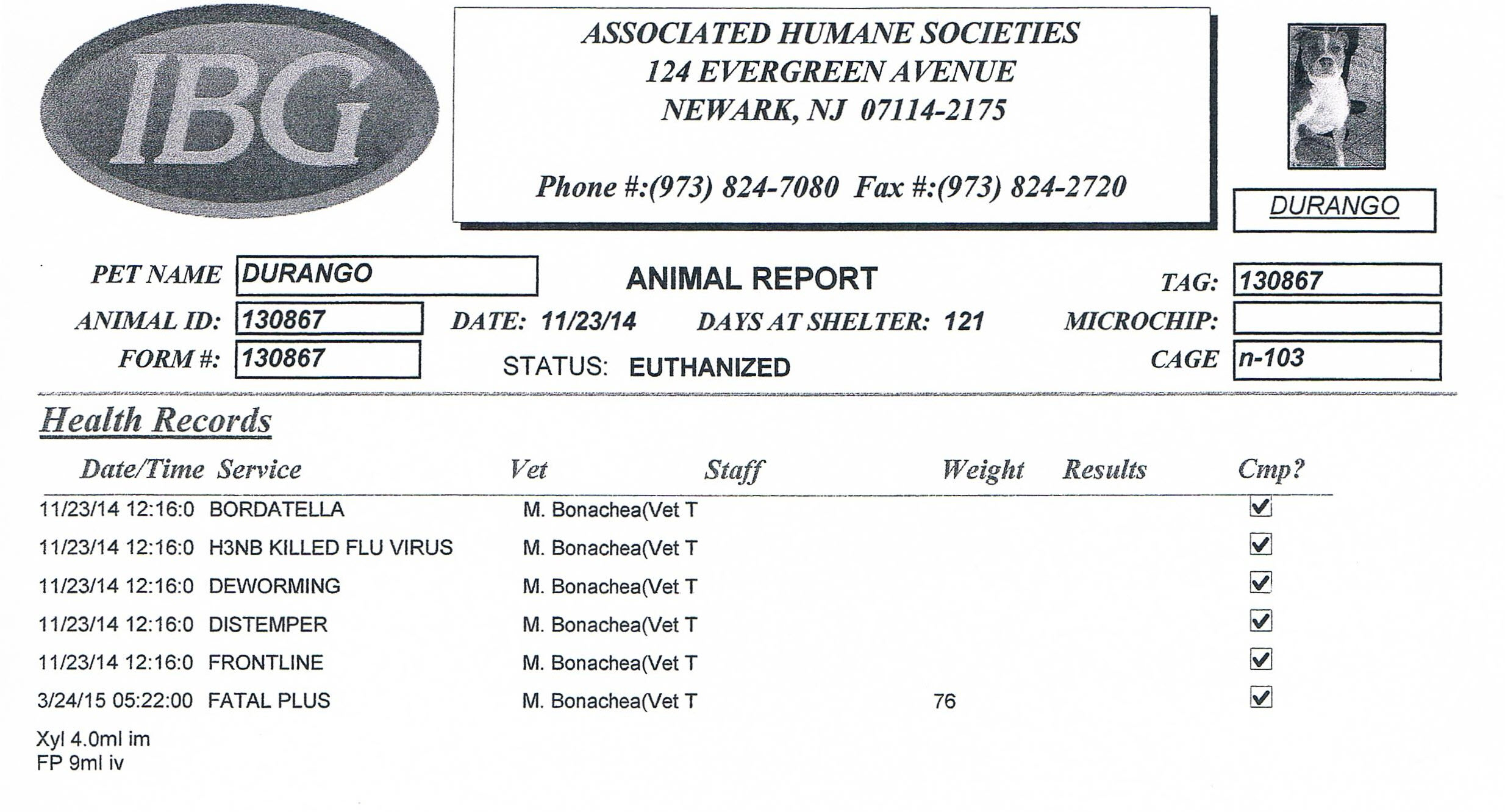
To make matters worse, Gloucester County Animal Shelter did not weigh animals prior to administering pre-killing sedatives and Fatal Plus poison. 87 cats and kittens were given low dosages of Fatal Plus and no dosage records existed for 1,204 other cats and kittens killed during the year. As a result, animals may have experienced great pain due to receiving incorrect dosages of these drugs.

1.11 (f) 3. Weigh all animals prior to administration of euthanasia, immobilizing, or tranquilizing agents.

The inspector was told that animals were not weighed prior to administration of euthanasia, immobilizing, or tranquilizing agents and that all cats received one milliliter (ml) of euthanasia solution and all kittens received .5 ml of solution. One of the euthanasia technicians stated that if a cat looks big, they would give a little more.

The label instructions on the bottle of Fatal Plus euthanasia solution stated that the required volume of solution is 1 ml per 10 lbs. of body weight and intravenous injection is preferred. The calculated dosage should be given in a single injection. Intraperitoneal or intracardiac injection may be made when intravenous injection is impractical, as in very small or comatose animals with impaired vascular functions. Since animals were not weighed before administration of euthanasia and tranquilizing agents, the dosages for these agents were not calculated as required for each individual animal.

A review of euthanasia log records received at the New Jersey Department of Health confirmed that most adult cats were given 1 ml of Fatal Plus euthanasia solution regardless of their actual weight, and kittens were given .5 ml without determining their weight before the administration of euthanasia solution. The euthanasia logs show that 1291 cats and kittens were euthanized between January 3, 2015 and October 20, 2015. Eighty of these cats were given more than 1 ml of euthanasia solution and 7 kittens were given .3 ml rather than .5 ml. There were no documents available to indicate that rabbits, ferrets, a pig, and various other domestic and wildlife species were weighed prior to the administration of euthanasia, immobilizing, or tranquilizing agents. There were no documents available to determine if the 1204 cats and kittens that were administered 1 ml or .5 ml sodium pentobarbital, as well as the additional animals that were not weighed prior to administration of euthanasia solution, were give a sufficient dosage as indicated on the product label to produce humane euthanasia as quickly and painlessly as possible in these animals.

Even more frightening, the shelter had no records indicating anyone confirmed animals were actually dead after the killing. In a worst case scenario, animals receiving dosages that were too low may have been still alive when disposed of.

Note: There were no documents available at the facility to indicate that each animal was being assessed after the administration of euthanasia agents as required to ensure that the animal was deceased prior to disposal. There were no instructions posted in the euthanasia area indicating the procedures for animal assessment after the animals were euthanized. During the inspection, there was a concern that section 1.11 (g) may not have been followed; therefore it is recommended that records be amended to include this information. The requirements for the section are as follows:

1.11 (g) After the administration of euthanasia agents to an animal, the person administering euthanasia shall assess each animal for the absence of a heartbeat by auscultation of the heart utilizing a stethoscope, establishment of the absence of a pulse and respiration, the absence of movement of the eyelid when the cornea is touched (corneal reflex) and checking for presence of maximum dilation of the pupils of the eyes. 1. The person administering euthanasia shall perform these assessments in combination at least 5 minutes apart until the person can definitively determine that the heart is no longer beating, to ensure that the animal is deceased prior to disposal.

High Kill Shelters View Animals as Trash

Animal extermination operations like Gloucester County Animal Shelter place little value on the lives of animals. After all, when you kill most of your animals, and nearly all of your cats, that seems like the logical view to take. If you are going to kill an animal in a week anyway, not treating a medical illness or taking the creature to a veterinarian doesn’t seem like a big deal. Sadly, organizations like PETA ignore countless examples of cruel operations like Gloucester County Animal Shelter and instead vilify even well-run no kill shelters. Unfortunately, PETA believes pets should not exist and their silence in these situations indicates killing pets by any means necessary is worth the cost to achieve their nefarious goal.

New Jersey Department of Health and the NJ SPCA Must Severely Punish Gloucester County Animal Shelter and Local Health Inspectors

Gloucester County Animal Shelter’s problems go far beyond minor code infractions. Frankly, the wholesale and institutionalized cruelty mandates the NJ SPCA focus on this case. Simply put, the consequences of inaction mean thousands of other animals each year will experience the same level of cruelty unless the NJ SPCA takes serious and drastic action, particularly against Shelter Director, Bill Lombardi. Sadly, the NJ SPCA’s record in pressing charges and winning cases against abusive shelters is poor.

The New Jersey Department of Health should fine Gloucester County Animal Shelter the maximum $50 fine for each infraction, including separate fines for each animal. Additionally, the New Jersey Department of Health should reinspect the shelter every month and assess new fines for each shelter law violation not corrected. Gloucester County officials must face a steep monetary penalty for allowing these blatant law-breaking activities to go on. Furthermore, the New Jersey Department of Health should recommend that the New Jersey Public Health Licensing and Examination Board revoke the local Health Officer’s license and take any other necessary disciplinary action. Simply put, the local health department allowed the shelter to operate in this illegal manner for years and needs to face serious consequences for its inaction.

Gloucester County Freeholders Must Respond to Local Shelter Reform Activists

Based on my conversation with a local activist, the shelter has ignored reformers for years. These dedicated people tried hard to work with the shelter, but were rebuffed countless times. Poor policies, such as aggressively cracking down on people practicing TNR and not adopting animals out at the shelter during weekends, leads to killing. Clearly, Gloucester County officials must fire Shelter Director, Bill Lombardi, and much of the staff and replace them with compassionate and competent people.

The shelter only takes in 13 dogs and cats per 1,000 people in Gloucester County, which is below the national average. In fact, animal control shelters take in far more animals in total and per capita and achieve no kill level live release rates. For example, the Reno, Nevada area’s open admission shelter takes in around 15,000 animals a year or around 36 dogs and cats per 1,000 people, and still saves 90% or more of these animals year after year. Clearly, we can shelter animals far better than what Gloucester County Animal Shelter is doing. People should contact Gloucester County Freeholders Robert Damminger and Daniel Christy and demand Gloucester County run a no kill shelter. It is time Gloucester County elected officials take this horrific situation and turn it into something positive.

Associated Humane Societies Kills Massive Numbers of Newark’s Homeless Animals

Associated Humane Societies often publishes emotional stories about the organization heroically rescuing animals from terrible situations in Newark. Typically, these stories are found on the AHS web site and/or their Humane News publication. These fundraising efforts are lucrative as AHS brought in an impressive $3.6 million in donations and grants for the fiscal year ended June 30, 2014. The 2003 New Jersey Commission of Investigation report on AHS stated the organization’s fundraising campaigns did not fairly represent the care typically provided to animals:

The substandard conditions and treatment of the animals, which existed on a large scale until recently, betrayed AHS’s massive fundraising campaign through the years and contradicted AHS’s persona as a “humane” organization. Bernstein capitalized on the plight of animals to garner millions of dollars in contributions, but failed to apply any portion of those millions to establish a satisfactory level of care and treatment.

Are these fundraising stories representative of the care most Newark animals receive at AHS-Newark now? Has AHS-Newark improved enough since the 2003 New Jersey Commission of Investigation report was issued?

Additional Animal Control Contracts and Summary Statistics Raise Serious Concerns

In 2014, AHS-Newark added a number of municipalities, such as South Orange and Maplewood (both towns no longer contract with AHS-Newark) and the cities and towns formerly contracting with Linden Animal Control. Despite already killing large numbers of animals, AHS-Newark decided to contract with all these additional municipalities and receive substantial fees in return. In February 2015, AHS-Newark Assistant Executive Director, Scott Crawford, stated his organization could handle the additional animals.

The shelter’s annual summary statistics showed it impounded and killed more animals in 2014 verses 2013. Animal intake increased from 5,019 dogs and cats in 2013 to 6,194 dogs and cats in 2014. AHS-Newark reported the number of dogs and cats that were killed, died or went missing increased from 1,962 in 2013 to 2,356 in 2014. As a result, AHS-Newark literally earned more revenue by impounding and killing significantly more animals in 2014 verses 2013.

Detailed Analysis Conducted 

To get a better understanding of AHS-Newark’s handling of animals, I submitted an OPRA request to the City of Newark’s Animal Control Department seeking intake and disposition records of animals the city’s Animal Control Department impounded in 2014. The City of Newark picks up animals during normal working hours and delivers most animals to the AHS-Newark shelter. At other times, AHS-Newark ACOs perform these duties. The records do not include direct owner surrenders to the shelter from Newark residents (except for a few that were included), but do include people surrendering their animals to animal control who then take the animals to AHS-Newark. After much follow-up over a period of several months, I received AHS-Newark’s underlying intake and disposition records for the animals originating from animal control in Newark.

In total, I obtained around 3,000 pages of records and it took me several months to review and summarize this information. Many of these records were for wildlife, animals leaving before animal control officers arrived, and animals that were dead by the time the animal control officer got to the location. Overall, I reviewed the intake and disposition records of 966 cats and 649 dogs that AHS-Newark impounded in 2014. These records constituted 23% of the dogs and 28% of the cats AHS-Newark reported taking in during 2014.

I reviewed each record and summarized my findings. My summary included the animal’s ID number, species, breed, origin (stray, owner surrender, confiscated by authorities), intake date, outcome date, length of stay, outcome, reasons for killing, miscellaneous information, and any comments I had. I only counted the two primary reasons for killing, but generally mentioned other reasons listed in my notes.

AHS Newark’s Underlying Records Reveal Horrors

Honestly, when I received the information I thought the City of Newark forgot to provide me the records for animals making it out of the facility alive. However, the records included some animals who were adopted out and rescued. The records I obtained listed 229 additional animals I did not receive information for. Even if all these other animals made it out of AHS-Newark alive, the dog and cat kill rate based on intake would only drop nine percentage points. My records indicated AHS-Newark impounded 5.8 dogs and cats per 1,000 residents (6.6 dogs and cats per 1,000 people if I include the 229 missing animal records) that came from animal control in Newark. As a comparison, AHS-Newark impounded 4.3 dogs and cats per 1,000 residents from animal control in Irvington per a summary spreadsheet that AHS prepared. If I assume 43% of AHS-Newark’s animals from the City of Newark came from other sources (i.e. owner surrenders, people finding animals on street, etc), which is the percentage from nearby Irvington, then AHS-Newark would take in 10.2 dogs and cats per 1,000 residents (11.6 dogs and cats per 1,000 people if I include the 229 missing animals) from all sources in Newark. This figure is around the same as, if not a bit higher than, other demographically similar cities in the area. Additionally, I submitted another OPRA request for any missing animals to the City of Newark and was told no other records existed. While I can’t say for sure if my data set contains the overwhelming number of animals AHS-Newark obtained from animal control in Newark, I think it represents a very large percentage.

The sheer number and percentage of animals losing their lives at AHS-Newark is staggering. Overall, AHS-Newark killed 79% of the cats, 63% of the dogs, and 74% of the pit bull like dogs in this data set. Furthermore, if I add animals who died at AHS-Newark and only count known outcomes, 93% of cats, 70% of dogs, and 81% of pit bull like dogs in this data set lost their lives at AHS-Newark. To put it another way, 855 out of 919 cats, 424 out of 608 dogs, and 329 out of 408 pit bull like dogs lost their lives per these records. As a result, these records indicate AHS-Newark operated more like a death camp than an animal shelter for the dogs and cats coming to the facility from animal control in the City of Newark.

2014 City of Newark Outcomes

Even if the death rate for animals from Newark Animal Control was actually lower due to the City of Newark not providing me additional records, my analysis still shows AHS-Newark killed vast numbers of healthy and treatable animals.

Results Raise Question About AHS-Newark’s Reported 2014 Statistics

These results show AHS-Newark disclosed erroneous statistics to the New Jersey Department of Health. In AHS-Newark’s 2014 Shelter/Pound Annual Report, the organization stated 12 dogs and 92 cats died or went missing. However, my data set, which only includes 23% of the dogs and 28% of the cats AHS-Newark impounded during the year, had both more dogs (13) and cats (96) dying in the shelter in 2014 than AHS-Newark reported for all of its dogs and cats. If I add the animals where a “Not Available” outcome is listed, the number of animals dying or going missing rises to 15 dogs and 101 cats. Furthermore, my data set accounted for 50% and 53% of the number of dogs and cats AHS-Newark reported to kill despite only making up 23% and 28% of the number of dogs and cats AHS-Newark reported it impounded in 2014. While AHS-Newark may kill dogs and cats from the City of Newark at a higher rate than animals coming in from other jurisdictions, I find it hard to believe the kill rate is that much higher for Newark animals, particularly cats. In addition, AHS-Newark reported it impounded the exact same number of dogs (2,794) and cats (3,400) that had outcomes for the year. Frankly, I find that pretty hard to believe given AHS-Newark stated it held over 200 dogs and 200 cats at the shelter during the beginning and end of the year. Thus, this data raises concerns that more animals are losing their lives at AHS-Newark than the shelter is reporting.

AHS-Newark Quickly Kills Animals

In February 2015, AHS-Newark Assistant Executive Director, Scott Crawford, bragged about his shelter’s capacity and the extra time the facility had to place animals compared to some other local alternatives. Based on my review of the above records, AHS killed cats and dogs arriving from Newark Animal Control in January 2014 within 30 days and 27 days on average:

AHS-NEwark Jan 2014 LOS for Newark

After AHS-Newark took over the cities and towns formerly contracting with Linden Animal Control in November 2014, AHS-Newark killed cats and dogs impounded from Newark Animal Control in this data set much more quickly. Despite Mr. Crawford’s assertion in early February 2015, AHS-Newark rapidly killed cats and dogs impounded from Newark Animal Control in this data set two months before he made this outlandish claim. Based on my review of these records, AHS-Newark killed cats and dogs impounded from Newark Animal Control in December 2014 within 13 days and 11 days on average:

AHS-NEwark Dec 2014 LOS for Newark

As a result, AHS-Newark’s assertion that it keeps many animals alive a long time is not consistent with the data I examined for dogs and cats arriving from Newark Animal Control.

Absurd Justifications for Killing

AHS-Newark used many poor excuses to kill animals. The top four reasons AHS-Newark used to kill cats were as follows:

  1. Sick
  2. Aggressive, unfriendly and feral
  3. No reason listed
  4. Ringworm

AHS-Newark’s cats were often sick due to an Upper Respiratory Infection (“URI”) or the common cold. Countless records stated AHS-Newark killed the cat due to the animal “not responding to treatment.” With so many animals getting sick and not getting better, one has to wonder what kind of disease control program AHS-Newark has?

Several examples illustrate AHS-Newark’s inability to medically treat cats with colds. Toots was surrendered to AHS-Newark due to her owner no longer being able to care for her. Despite being a young cat less than 3 years old, AHS-Newark stated they had to kill her within 10 days of arriving at the shelter. While the intake and disposition record states Toots was not responding to treatment for her URI, the veterinary log on this record only mentions the standard vaccinations, deworming and Frontline flea and tick medication received on the day she arrived at AHS-Newark. The veterinary log then mentions she was poisoned to death with Fatal Plus 10 days later. Call me crazy, but I don’t see any documentation of any additional veterinary treatment for her URI on this record.

ID 128745 Killed for URI

Brooklyn was an 11 month old cat described as “very sweet” by AHS-Newark. Yet, within 11 days of arriving at the shelter, AHS-Newark killed her due to a “very bad URI” that did not get better. However, once again the veterinary log on this record did not describe any specific treatment for her cold after her vaccinations on the day she arrived.

ID 129234 Killed for URI

Moonlight was a 15 month old stray cat and described by AHS-Newark as “very beautiful, sweet and trusting” and “wants love and attention.” Yet, AHS-Newark killed her 16 days after her arrival at the shelter due to her having a “URI” and being “weak and lethargic.” Other than two rounds of the standard shelter vaccinations and deworming, AHS-Newark once again provided no other treatment specifically for the URI per the veterinary log in this record.

ID129667 URI Cat

The records did not indicate AHS-Newark sent any of these cats to an isolation area for treatment, reached out to any rescues or tried to place the animals in foster homes to recover from their illness. Thus, AHS-Newark failed all three cats, as well as many others, who were highly adoptable.

AHS-Newark labeled many cats feral and/or unadoptable for dubious reasons. Notably, the shelter provided inadequate amounts of time to socialize fearful cats who were justifiably scared in this high kill shelter. Furthermore, I saw no efforts to socialize virtually all of these cats on their records. In fact, AHS-Newark often classified owner-surrendered cats, who presumably lived in or around homes, as feral or otherwise unsuitable for people to adopt. For example, Baby Girl was a 3 and half year old cat surrendered due to her owner moving. AHS-Newark labeled this cat a “wild” and killed her within just 8 days of arriving at the shelter. In addition, AHS-Newark did not vaccinate her upon intake and therefore increased the risk of disease among the shelter’s cat population.

ID 129063 OS Cat Killed for Feral

Me Me was surrendered by her owner due to the owner not having room for the cat. Once again AHS-Newark labeled the cat as “wild”, did not vaccinate her, and killed her within 9 days:

ID 1208046 OS Cat Killed Feral

Lucky, who was nearly 9 years old, was surrendered due to her owner not being able to care for her any longer. Despite this cat most likely having lived in or around a home for many years, AHS-Newark labeled her as “wild”, did not vaccinate her, and killed her after just 7 days.

ID 128791 Feral Cat Killed

Thus, AHS-Newark’s labeling of cats as feral, aggressive and otherwise unadoptable is highly suspect.

AHS-Newark used a “throw everything but the kitchen sink” approach to justify the mass killing of dogs. Often times the shelter listed multiple boilerplate reasons, like aggression (including “cage crazy”/”not kenneling well”), dog aggression, sick, etc. The top five reasons AHS used to kill dogs were:

  1. Aggression related issues
  2. Sick
  3. Dog aggression
  4. No reason listed
  5. Overcrowded

While certainly some dogs likely were truly aggressive, many dogs labeled as such did not seem that way. Sadie was a nearly 4 year old pit bull mix with a very good behavioral evaluation. The evaluation stated Sadie was “playful, loving and affectionate once she gets to warm up.” The evaluation also stated Sadie “allows you to handle her from head to tail without complaint” and “she is easy taking treats and likes to share her toys.” Yet, just over one month later, “SC”, who I presume is AHS Assistant Executive Director, Scott Crawford, approved her killing for “becoming temperamental.” The record provided no elaboration on what her exact problems were nor did the record document any efforts to rehabilitate her.

ID 125906 Dog Killed Aggression

Sadie2

Billy was a 2 year old Plott Hound-Boxer Mix. The dog’s evaluation stated he did not behave well inside his kennel, but “all you have to do is take him outside and he is a totally different dog.” Billy’s evaluation went on to say “he is fine with being handled all over” was “gentle with treats”, had “a great food test” and “seemed fine with the other dogs outside.” Despite this very good evaluation, AHS-Newark decided to kill him exactly 3 weeks later for being “extreme cage crazy”, “becoming hard to handle”, “doesn’t show well” and “no dogs.” AHS-Newark couldn’t even take the time to write a proper sentence to justify killing this young dog. The record provided no documentation that AHS-Newark tried to alleviate his kennel stress or perform any other efforts to rehabilitate him. Simply put, the record indicates AHS-Newark killed Billy for convenience as he didn’t “show well” and was “hard to handle.”

ID 122530 Dog Killed

Billy 2

Danny was a nearly 3 year old American Bulldog. He had a good evaluation stating he was “playful”, “good with other dogs”, “knows sit”, and “needs manners.” In other words, Danny was a big playful puppy. In addition, his record states he was a “photo shoot dog.” Just over two months after Danny’s evaluation, AHS-Newark killed Danny and justified it by stating “no dogs” and “insane in kennels.” Once again the record mentions no actions to provide any enrichment to Danny. It doesn’t take a rocket scientist to determine that a high energy dog needs stimulation and exercise. Also, the record provides no details on Danny’s alleged dog aggression which is contradicted by his behavioral evaluation. Even more disturbing, AHS-Newark killed one of the few dogs in this data set with an evaluation (less than 10% of dogs and virtually no cats had an evaluation) and included in a photo shoot. If AHS-Newark kills dogs in the spotlight, what chance do the vast majority of animals that are never seen or heard have?

ID 125726 Part 1

ID 125726 Part 2

AHS-Newark’s practice of killing massive numbers of dogs for aggression related issues clearly needs to stop. While some dogs coming into a shelter are a serious threat to people and their problems will not satisfactorily respond to rehabilitation efforts, well-run animal control shelters typically find 5% or fewer of dogs fall into this category. In this data set, AHS-Newark killed 26% of their dogs for aggression related issues plus a number of others for dog aggression. As a result, AHS-Newark is unfairly labeling dogs as aggressive.

AHS-Newark also killed dogs due to lack of space. Qunn’s intake and disposition record described him as “very excitable, but nice” and “kind of wild, but very, very friendly.” Despite this, AHS-Newark killed Quinn for not being able to place him with another dog in a kennel and him being “hyper” and “hard to handle.” The record provides no evidence that AHS gave Quinn any exercise let alone enrichment. Furthermore, AHS-Newark killed Quinn during December which is typically one of the lowest intake months for shelters. Even worse, AHS-Newark killed Quinn for lack of space less than two months before Scott Crawford bragged about his shelter’s large capacity.

ID127690 Killed Pt 1

ID127690 Killed (2)

Red was a 16 month old dog surrendered to Newark Animal Control by his owner. After just 8 days, AHS-Newark killed him for having a cold and the isolation area being full and for allegedly not being able to house him with other dogs. The intake and disposition record provides no evidence AHS-Newark gave any specific treatment for his URI other than a canine flu vaccine upon intake. AHS-Newark killed Red due to a lack of space just two and half months before Scott Crawford boasted about his shelter’s ability to house lots of animals.

ID130711

Rambo was a “friendly stray dog” who was killed due to overcrowding. AHS-Newark identified the owner and apparently talked with her. For whatever reason, the owner did not reclaim the animal. AHS-Newark killed Rambo in December, one of the lowest intake months for most shelters, due to “no dogs”, “no response” to the letter to his owner and the main kennel being full. Once again Scott Crawford decided to kill a “friendly” dog due to lack of space just two months prior to him bragging about the large amount of animals his shelter could hold.

ID129821

AHS-Newark also killed many dogs for no documented reason. Pamtera was apparently abandoned in an apartment. AHS-Newark often publicizes these types of cases in fundraising appeals. After 11 days, AHS-Newark killed Pamtera for no reason other than it being “ok to pts per kp.”

ID130032

Dog ID# 130078, like most of the animals I reviewed records for, had no name. She was a 6 year old and 5 month old small terrier mix. After just 8 days, AHS-Newark killed her once again for no reason other than being “ok to pts per kp.” Even worse, this record did not state how AHS-Newark killed Dog ID# 130078.

ID 130078

Durango’s evaluation described him as “sweet and affectionate”, “very focused and loving towards all people, but he doesn’t like other dogs”, “genuinely loved to give and get attention” and “a handsome boy with knockout gorgeous eyes.” Furthermore, his intake and disposition record states in bold and in caps “Humane News – February”, “Petfinder”, “Facebook”, “Do Not PTS.” In other words Durango was a fantastic dog and was one of the few dogs AHS-Newark intended to promote. Despite all of these great things going for him, AHS-Newark killed Durango for no reason according to this record.

ID130867

ID 130867

AHS Hands Animals Over to a Rescue Subsequently Convicted for Animal Cruelty

AHS-Newark has a difficult adoption process in my experience. Typically, AHS-Newark makes people visit the shelter multiple times to adopt an animal. Often, this process can take a number of days. As a result of these policies, animals stay too long at the facility and this increases the chance the shelter will kill animals due to lack of space.

Gabriel Ganter (formerly Gabriel Palacios) was recently convicted of animal cruelty. Ms. Ganter ran Pit Bull Kisses rescue out of Newark until she moved to Dumont. On May 13, 2015, the Bergen County SPCA raided her Dumont home and found dead dogs in garbage bags, a live dog and starved cat on chains without proper shelter (warning: the photos in this link are deeply disturbing). Furthermore, one official stated the conditions insider her house were “horrid.” Ultimately, Gabriel Ganter pleaded guilty to not providing necessary care to animals this month.

Gabriel Ganter’s Pit Bull Kisses Rescue rescued the most animals of any organization in this data set. Pit Bull Kisses rescued 16 of the 35 dogs and cats rescued in the records I reviewed. In all fairness, many people in the animal welfare community were duped by Gabriel Ganter. However, Ms. Ganter began acting erratically in the summer of 2014 and AHS-Newark should have known this. Sadly, AHS-Newark still allowed Pit Bull Kisses to rescue the following dog and cat after this point:

PBKR D1

PBKR D2

PBKR C

We can only hope this unnamed dog and cat went to other foster homes rather than Gabriel Ganter’s house of horrors.

AHS Fails Newark’s Stray Animals

The sheer amount of killing is mind boggling. Nearly 1,300 dogs and cats just from the City of Newark lost their lives after arriving at AHS-Newark in 2014. Furthermore, that number most likely would be higher if I obtained the records of the over 200 missing animals not provided to me. To put it another way, around 4 dogs and cats just from the City of Newark lose their lives at AHS-Newark on average each day of the entire year. 84% of the dogs and cats in this data set who came into AHS-Newark in 2014 and had outcomes lost their lives. For these animals, AHS-Newark is a slaughterhouse rather than a shelter.

The underlying records I examined reveal no substantial effort to end this pet extermination project. Massive numbers of animals get sick with treatable illnesses and AHS-Newark still kills them. The records I reviewed did not indicate the shelter often seeks foster homes or even places many sick animals in isolation areas. Even worse, not only do animals typically not receive behavioral rehabilitation, but AHS-Newark seems to actively classify animals as aggressive to justify killing those creatures. Worst of all, AHS-Newark placed such a low value on the lives of these animals that shelter staff couldn’t even write complete sentences or even spell correctly on many of these records. When you can’t take the time to properly document the animal’s information on its record, what hope do we have that you will invest the time and energy into saving that dog or cat? Now, perhaps these records are inaccurate, but that raises even more questions? If your records are inaccurate, why should we believe anything you claim?

Clearly, AHS-Newark should never have contracted with additional municipalities when it already killed far too many animals. Frankly, AHS-Newark should have sought ways to reduce intake rather than deliberately bring in more animals in exchange for more animal control and sheltering contract fees. While all three AHS facilities have more than enough space to save its dogs and cats, AHS fails to enthusiastically implement proven programs and policies to perform at these levels. As such, AHS-Newark should have terminated rather than have added animal control and sheltering contracts.

Donors Must Hold AHS Accountable

Donors should demand AHS-Newark comprehensively adopt the no kill equation as countless other animal control shelters successfully have. Animal control shelters in Kansas City, Missouri, Austin, Texas, and Salt Lake City, Utah achieved no kill status and even save around 90% of their pit bull like dogs. Other animal control shelters in poor urban areas, such as in Washington, DC and Baltimore, Maryland, are close to achieving no kill. All of these animal control shelters take in more animals in total and on a per capita basis than AHS-Newark. Additionally, most of these shelters receive less revenue per animal than AHS. Thus, AHS-Newark should do great things.

At the end of the day, donors must wake up and demand AHS change its ways. Apparently, AHS thinks it can dupe its donors into thinking most of the animals it impounds from Newark are heroically rescued and sent to loving homes. Based on the records I reviewed, this absolutely is not the case. AHS must remove its entire senior leadership team, including Roseann Trezza, and replace them with people dedicated to comprehensively implementing the no kill equation. The good people donating to AHS clearly expect the organization to save its animals. It is time donors require AHS to use their hard earned money to save animals and not kill them for convenience and cost savings.

North Jersey Humane Society’s Horrible Inspection Report Exposes a Fake No Kill Organization

Last year, many people applauded Bloomfield’s decision to accept Bergen County Humane Enforcement’s and Bergen Protect and Rescue’s bid to run the Bloomfield Animal Shelter. After years of problems with the Bloomfield Department of Health and Human Services’ running of the animal shelter, which included banning virtually all volunteers and prohibiting a well-known trainer from keeping a dog with very minor behavioral problems, people were understandably eager to welcome an organization stating it would run a no kill shelter. Given Vincent Ascolese’s charismatic personality and him saying all the right things during a presentation to the town, one could hardly blame people for cheering Bloomfield’s decision to hire this organization.

Personally, I was very skeptical of Bergen County Humane Enforcement and North Jersey Humane Society, which was formed to run the Bloomfield Animal Shelter. First and foremost, I knew Vincent Ascolese, who is the Director of both Bergen Protect and Rescue and North Jersey Humane Society and the Supervising Animal Control Officer, previously brought animals from Hudson County to the horrific Jersey Animal Coalition. Second, Vincent Ascolese’s shelters contract with a for profit animal control company with a checkered history in Hudson County.

I was extremely disappointed when my spouse, my young child and I visited Bergen Protect and Rescue’s Cliffside Park shelter. The facility was extremely small and cramped and two people could barely pass each other through the tiny hallway inside the facility. After being ignored for 10 minutes by the the person in charge that day, we asked if we could see the dogs. This person told us no dogs were up for adoption at the facility and we had to make an appointment to see the animals even if they had any dogs up for adoption. The staff person’s claim seemed odd as many dogs were in a small area just around the corner from us. Even worse, the very next day I saw the shelter post one of the dogs I saw outside on their Facebook page as available for adoption. In addition, the staff person told us the adoption fee for an adult pit bull was over $300. While the staff person said we could drive to an adoption event the shelter was having that day, it was impractical as we did not know the area. Thus, my personal experience with this organization was not good.

Subsequently, I read about policies not consistent with well-run no kill animal control shelters. First, I saw high adoption fees on their web site (now the shelter does not even state what the fees are) which were consistent with the over $300 adoption fee communicated to us at the Cliffside Park shelter. The shelter’s web site states it may take up to a week to adopt an animal resulting in reduced lifesaving and potential overcrowding. Additionally, the Cliffside Park shelter transports many dogs in from out of state despite having what seemed like a very undersized facility. Not surprisingly, my analyses of the Cliffside Park facility’s 2013 performance showed the shelter only adopted out 35% of the number of dogs and 33% of the number of cats the shelter should adopt out. Finally, I was concerned seeing North Jersey Humane Society adopts out at least some intact animals where the shelter refers the adopter to a low cost vet clinic participating in the state subsidized spay/neuter program (funding often runs out during the year resulting in significant delays for the discounted spay/neuter services). Typically, I only see poorly run pounds use this program rather than doing the surgeries themselves with the shelter’s veterinarian. Thus, North Jersey Humane Society’s polices were not consistent with those of well-run no kill animal control shelters.

Last week’s news about the NJ SPCA charging Vincent Ascolese with animal cruelty floored me. The NJ SPCA rightfully charged Mr. Ascolese with 14 counts of animal cruelty for killing an injured deer fawn by slashing its neck with a knife and other issues with animal care at his facility. As bad as this news sounded, it paled in comparison to what I read in the recent New Jersey Department of Health inspection report of North Jersey Humane Society’s Bloomfield shelter.

Bloomfield and North Jersey Humane Society Allow Animals to Reside in a Dump

North Jersey Humane Society’s bid to perform animal sheltering services at the Bloomfield Animal Shelter required the town to bring the facility up to the standards of N.J.A.C. 8.23A. As a result, Bloomfield had a contractual obligation to ensure the building complied with the state law’s standards. Additionally, North Jersey Humane Society had a legal and moral obligation as the shelter operator to ensure the animals were housed in a safe facility.

The inspection report stated the facility was under construction and did not have the required permits. Additionally, the Bloomfield Department of Health and Human Services did not perform the required annual inspection and therefore the shelter did not have a license to operate.

The facility was occupied while under construction without evidence of local occupancy approvals and electrical, mechanical (HVAC), and building or construction permits.

The facility was not inspected by the local health authority for the current year and was not in compliance with these rules, and therefore, was not licensed at the time of this inspection.

Despite the shelter having many unsafe areas, North Jersey Humane Society housed animals in these conditions. The shelter kept dogs in a room without a ceiling with uncovered electrical wires and various dangerous items were hanging down from above.

The ceiling of the guillotine room was removed and was completely open to the rafters in the attic space. Dogs were being housed in this room at the time of this inspection. Electrical wires and junction boxes were exposed and hanging and were not properly secured as required; insulated ventilation ducts and other items were exposed and hanging down from the rafters (Pictures 2834 through 2836).

2834 2835 2836 (14)

North Jersey Humane Society left exposed screws adjacent to dog enclosures and the shelter’s entrance putting both people and animals at risk of injury.

There were boards with long protruding screws located on the ground near the entrance gate of the facility adjacent to an outdoor animal enclosure. These screws could cause injury to both animals and people (Picture 2829).

2829 (14)

The shelter had inadequate ventilation and smelled like urine. Furthermore, insufficient lighting prevented shelter staff from properly cleaning the animal enclosures resulting in a build up of feces and urine. North Jersey Humane Society apparently placed an outdoor animal enclosure on a surface that shelter staff cannot effectively disinfect. Furthermore, the town and North Jersey Humane Society did not repaint the surfaces of the outdoor animal enclosures and the staff could therefore not properly clean these kennels.

There was a strong, stale urine odor in the first animal enclosure room located next to the main office of the facility at the time of this inspection; the ventilation was not sufficient to remove odors as required.

The lighting in the facility was not sufficient to allow the viewing of all the interior surfaces of the animal enclosures to ensure that the enclosures had been cleaned and disinfected. The enclosures in the first animal enclosure room contained small pools of urine and small fragments of feces in the corners and bottom edges that had not been removed during the cleaning process. These corners and edges were unable to be viewed clearly due to the insufficient distribution of lighting in this room.

There was a chain link enclosure placed on the pavement in the driveway in front of the facility. This asphalt pavement was not impervious to moisture and not able to be readily cleaned and disinfected. This enclosure did not have any drains to contain and properly dispose of run off as required (Picture 2831).

The surfaces of the outdoor animal enclosures attached to the side of the building and accessible to the animals in these enclosures by a guillotine door were not impervious to moisture. These surfaces were originally painted, but the paint was peeling, and the surfaces were no longer impervious to moisture (Picture 2844).

2831 (14)

2844

North Jersey Humane Society housed dogs in dangerous enclosures posing a risk of injury and possible death. The shelter left one dog in an outdoor enclosure without sufficient shade for two hours on a hot day in August and the inspector observed the dog drooling. Furthermore the dog bed in this enclosure was broken and had sharp exposed points. Another dog named Benny had a sharp metal wire that was in his cage.

The outdoor dog enclosure on the concrete slab in the driveway next to the entrance gate of the facility had a tarp type of material strapped to the top of the enclosure, but this tarp was not suitable to provide sufficient shade to avoid overheating or discomfort of the animals housed in this enclosure. ACO Stewart stated that the dog housed in this enclosure at the time of this inspection had been in the enclosure approximately two hours and the dog’s drooling was normal and not caused by overheating (Picture 2828).

A dog bed located in an outdoor enclosure near the entrance gate of the facility was broken and in need of repair. The bed contained metal triangle screw plates that had become separated from the frame. The points of the plate were exposed in an upward position and the legs of the bed were bent over (Picture 2828).

A small, thin, red coated dog named Benny was housed in an upper level enclosure in the annex room. The door of the enclosure had a wire that was bent over and protruding into the enclosure at the level of the dog that could cause injury (Picture 2856).
2828

2856

To make matters worse, the shelter housed two large Rottweilers in kennels that were approximately 30% smaller than required by N.J.A.C. 8.23A 1.6 (b):

Two large Rottweilers at the facility at the time of this inspection were each housed in primary enclosures that provided approximately 10.34 square feet of floor space when measured from the inside of the enclosure. These dogs were estimated to be approximately 39 to 42 inches long and required approximately 14 to 16 square feet of floor space.

North Jersey Humane Society Fails to Properly Clean its Shelter

North Jersey Humane Society failed to use proper procedures to clean the shelter. Specifically, the shelter did not remove cat litter, hair and other debris from an enclosure holding multiple cats. The shelter did not use EPA registered cleaning products. Even worse, the facility did not have suitable measuring devices to ensure staff applied the proper concentration of disinfectants.

Cats were being placed in a three tier cat cage during the daily cleaning process. This enclosure was being sprayed down with a spray bottle and immediately wiped out with a towel between each cat, but this cage was not being disinfected as required. There was an accumulation of cat litter, hair, and other debris trapped in the wire along the edges of the resting benches and at the bottom of this wire enclosure that had not been removed, cleaned and disinfected between each cat during the cleaning process. Toys were also being sprayed with the contents of the spray bottle and immediately wiped off, without allowing the required contact time for disinfection.

The bleach that was being used on the day of this inspection was Clorox Scented, Spashless bleach, which is not an EPA registered disinfectant. Two small bottles of Clorox regular bleach were later found in the upstairs storage area.

The disinfectants used at the facility, sodium hypochlorite (chlorine bleach) and Accel (accelerated hydrogen peroxide), were not being used at the correct dilution for disinfecting animal contact surfaces. The Accel requires a dilution ratio of 8 ounces (one cup) per gallon of water and the chlorine bleach that was found in the upstairs storage area requires 4 ounces (one half cup) per gallon of water according to the instructions on the product labels for disinfection of smooth and impervious animal contact surfaces.

There were no suitable measuring devices being used at the time of this inspection. One capful of these products (said to be approximately one ounce of concentrated solution) was being mixed into a one and a half gallon sprayer that was labeled as “Bleach” (Picture 2857). The cages were said to be sprayed down with this solution, allowed to sit for approximately 10 minutes while other cages are being sprayed down, and then the cages are rinsed with a hose and the remaining water was removed with a squeegee. The cages were not manually scrubbed clean at any time during the cleaning process.

2857

Furthermore, shelter staff stated they cleaned animal enclosures, but the inspector’s tape measure became covered with urine and feces when she was examining the cages.

The animal enclosures located in the first room of the facility near the office and main entrance to the facility were said to have been cleaned, but when a metal tape of a tape measure was placed in one of the upper cages while measuring the cage size, the length of tape became contaminated with urine and small bits of feces that remained inside of the cage after the cleaning process. The facility staff was not following proper cleaning and disinfection procedures to reduce disease hazards and odors caused by bacteria and other contaminants that remained on animal enclosure surfaces.

Finally, North Jersey Humane Society failed to use a proper cleaning solution to disinfect the animals’ food and water receptacles.

Food and water receptacles were being washed with a dishwashing liquid, rinsed and placed on a towel to dry, but they were not being disinfected daily as required. ACO Ascolese stated over the phone on the day of this inspection that the receptacles were being washed with an antibacterial type hand dishwashing liquid, but this type of dishwashing liquid was not an EPA registered disinfectant for use in animal facilities.

Cruel Treatment of Wildlife

North Jersey Humane Society treated wildlife in a way that constituted animal cruelty in my view. Two days prior to the inspection, the shelter impounded a 3 week old baby squirrel that was too young to eat, drink, urinate and defecate on its own. Instead of bottle-feeding this animal or sending the animal to a licensed wildlife rehabilitation center, the shelter tried to feed the animal with a honey seed stick. The inspector told both the ACO at the shelter and Vincent Ascolese that the shelter must transport the squirrel to a licensed wildlife rehabilitation center immediately. Furthermore, a New Jersey Division of Fish and Wildlife agent also stated the squirrel needed to go to a licensed wildlife rehabilitation center right away. Despite this emergency, Vincent Ascolese refused to do so and said he’d take the animal to the animal hospital the shelter uses.

Frankly, I am appalled that the shelter does not take injured wildlife to licensed wildlife rehabilitation centers. Even some very regressive kill shelters transport wild animals to these facilities. Furthermore, North Jersey Humane Society and Bergen Protect and Rescue could have made a simple plea on their social media pages and many people would have gladly transported the animal and offered monetary assistance.

To make matters worse, the baby squirrel and an iguana were housed in the feral cat room where the door is left open overnight. The inspection report noted some type of animal entered the room as evidenced by feces found in one of the cages. Additionally, the bars in the baby squirrel’s cage were wide enough for the animal to fall through. Given the young squirrel had not yet opened its eyes, this was a very real possibility. In fact, this did happen and the inspector actually caught the baby squirrel falling from its cage. Furthermore, the shelter staff left water in a bowl for the baby squirrel that was deep enough for the animal to drown in. As a result, the baby squirrel was housed in a room with potential predators, feral cats and wildlife that could enter the room, and left in an environment where it could drown or even fall to its death.

A baby squirrel that was impounded at the facility on 8/17/15 was crying in distress in search of its mother at the time of this inspection. This squirrel was approximately 3 weeks old and was too young to eat, drink and eliminate on its own and at this young age, may have been unable to regulate its body temperature. This squirrel was not receiving proper care and nourishment as required and was not placed in a suitable housing environment to maintain the safety and wellbeing of this animal for the two days that it was housed at the facility (Pictures 2849 and 2850).

2849

2850

A baby squirrel, approximately 3 weeks of age with its eyes not yet open, that was impounded at the facility on 8/17/15 was not being fed as required to meet the nutritional needs of this young squirrel. There was no infant replacement formula of any kind or any electrolytes or other preparation for rehydration at the facility for this squirrel at the time of this inspection.

The baby squirrel detailed in 1.7 (b) was not fed or provided with a rehydration solution during the entire inspection period. A squirrel of this age requires feeding approximately every three hours.

ACO Stewart stated that George, who was not at the facility at the time of this inspection, had been feeding the squirrel seeds and honey on a stick. Although the squirrel was too young to forage, the staff had placed the honey seed stick in the red cedar chip bedding with the assumption that the squirrel would search for its food.

The inspector, Frese, explained to ACO Stewart that this squirrel was a nursing squirrel and was too young to eat, drink, and eliminate on its own. Frese stated that this squirrel needed to be transported to a licensed wildlife rehabilitator immediately. ACO Stewart stated that the squirrel could not be transported at that time, but would be transported the next day. Frese stated that the squirrel may not live that long and then called the New Jersey Division of Fish and Wildlife and the New Jersey Society for the Prevention of Cruelty to Animals (NJSPCA) for assistance. Neither agency was available to transport the squirrel; the agent from the Division of Fish and Wildlife said the squirrel needed to be transported immediately to a licensed wildlife rehabilitator.

The Supervising ACO, Vincent Ascolese, called and spoke to Frese on the phone and explained that the squirrel was being cared for adequately with the seed stick placed in the bedding to teach the squirrel to find its food. Frese explained again that the squirrel was too young to forage and needs to be transported immediately to a rehabilitator. ACO Ascolese stated that they do not take any wildlife to a wildlife rehabilitator. He stated that he would instruct the staff to take the squirrel to Franklin Lakes Animal Hospital; that is where they take all injured and orphaned wildlife. ACO Ascolese stated that it is their policy for all injured and orphaned wildlife to be transported directly to the Franklin Lakes Animal Hospital, Wildlife Division.

There was a hole in the ceiling of the room named the “feral cat” room (Picture 2851) and the animal control officer (ACO) Nicole Stewart, confirmed that the door to this room had been left open to the outside of the building overnight. There were feces in one of the cages in this room from some type of animal that had entered the room and perched on the top of the cage (Picture 2848). An iguana and a baby squirrel were housed in this room at the time of this inspection and had been in the room while the door was open overnight. ACO Stewart stated that this room is used for the feral cats that free roam the grounds of the facility.

2851

2848

A baby squirrel was housed in an enclosure that had bars on the enclosure door that were wide enough for the squirrel to fit through. The squirrel was too young to walk normally, but was able to crawl. The squirrel crawled to the front of the enclosure and fit itself through the bars of the door. The squirrel had come halfway out of the enclosure, but was caught by the inspector, Frese, before it fell and was placed into the back into the enclosure. The squirrel was vocalizing a distress call as it crawled out of the cage (Picture 2866).
2866 (2)

The baby squirrel that was too young to eat and drink on its own was provided with a straight sided bowl filled with water in the enclosure that was deep enough that the squirrel could have become trapped and drowned in the water, due to the age and inadequate mobility of the squirrel.

The inspection report documented Vincent Ascolese killing an injured deer fawn. North Jersey Humane Society picked up a deer fawn with two broken legs in Woodland Park 12 minutes after the animal hospital the shelter uses closed (the animal hospital’s web site currently states it is open on the day of the week and time this happened). Instead of immediately taking the injured deer to another animal hospital or better yet, a licensed wildlife rehabilitation facility, as required by law, North Jersey Humane Society brought the animal back to the Bloomfield shelter. Vincent Ascolese subsequently slashed the deer’s throat in what one could consider an audition for joining the terrorist group, ISIS. Irregardless of whether the animal was hopelessly suffering, the shelter was required to send this animal for veterinary treatment. Even if euthanasia was required, slashing a deer’s throat is not humane and is illegal in New Jersey. Thus, Vincent Ascolese acted in an illegal and unethical manner and is now rightfully charged with animal cruelty.

A deer that was picked up by ACO McGowan in Woodland Park, Passaic County, on 6/29/15 was described on the “Animal Control Incident Transport Record” form as being severely injured and bleeding, with both hind legs broken and bone protruding through skin. The form stated “Well Pet Animal Hospital closed.” According to the website for this animal hospital, the normal business hours on Mondays, the day of the incident, are 9 AM to 6 PM. According to the animal control incident form, the ACO had arrived at the scene of the severely injured deer (fawn) at 6:12 PM, which was outside of this hospital’s posted hours of operation. The deer was transported to the Shelter facility at 6:47 PM. The “Animal Control Incident Transport Record” form indicated that the ACO did not immediately obtain emergency veterinary care from a licensed veterinarian as required by this regulation.

ACO Ascolese, stated during a phone call at the time of this inspection, that it is their policy for all injured and orphaned wildlife to be transported directly to the Franklin Lakes Animal Hospital, Wildlife Division. The severely injured deer that was picked up on 6/29/15 was not transported to the Franklin Lakes Animal Hospital in accordance with the policy stated by ACO Ascolese. The website for the Franklin Lakes Animal Hospital shows that the hospital’s regular operating hours are from 9 AM to 8 PM on Mondays.

A deer (fawn) that was impounded at the facility on 6/29/15 was killed by ACO Ascolese who cut the throat of the deer with a knife resulting in exsanguination (death from loss of blood). Exsanguination is an unacceptable method of euthanasia in accordance with these regulations.

Furthermore, even if throat slashing was a legal euthanasia method, Vincent Ascolese was not allowed to euthanize animals under state law at that time since he lacked the certification to do so.

Dr. Diaz confirmed that he had certified ACO Ascolese in August, 2015. On 6/29/2015, ACO Ascolese killed a deer (fawn), prior to the animal euthanasia training that had been conducted on or about 8/12/2015.

North Jersey Humane Society Fails to Provide Adequate Care to its Animals

The shelter did not provide prompt veterinary care to an injured dog. Benny had open sores on his legs and was not placing any weight on his left front leg during the inspection. Despite these issues, North Jersey Humane Society provided no veterinary care for the 3 days he was at the shelter before the inspection.

A dog named Benny was not placing any weight on his left front leg at the time of this inspection. This dog also had several ulcer type sores in various locations on all four of his legs, most of which were covered with smooth, hairless, blackened skin tissue with a raised outer edge, but some of these sores were shallow open wounds with a red and pink wound bed. This dog had not received any veterinary care since it arrived at the facility on Sunday, August 16, 2015 (Picture 2856).

2856

North Jersey Humane Society also did not provide some animals adequate amounts of water. Specifically, an iguana had no water during the 7 hour inspection and the inspector had to tell shelter staff to provide water to a thirsty Rottweiler.

An iguana located in the feral cat room had spilled its water and the water had not been replaced during the inspection.

A Rottweiler that was housed in an outdoor enclosure did not have water in his water bucket at the time of this inspection. This dog was subsequently provided with water after this was brought to the attention of ACO Stewart (Picture 2868 through 2870).

2869

2870

Shelter staff also left an iguana to sit in a wet bed during the entire 7 hour inspection.

An iguana that was impounded at the facility on 8/17/15 was housed in an enclosure with wet bedding after the water from the water bowl had been spilled in the enclosure. This wet bedding had not been changed during the entire inspection period (Picture 2867).

2867 (2)

North Jersey Humane Society did not isolate sick animals from healthy animals. The facility’s HVAC system emitted air from the isolation area, which is supposed to house sick animals, to locations holding healthy animals. In fact, the shelter used the ineffective isolation area it did have to house four healthy dogs due to overcrowding. And just how did the shelter become overcrowded? The facility transported 15 dogs, which made up 60% of the facility’s dog population at the time of the inspection, from Georgia 3 days before.

The facility did not have any isolation procedures in place and did not have a proper isolation area at the time of this inspection.

The ventilation in the dog and cat isolation rooms was not separated from the air used for the general population. The ventilation for the isolation rooms was supplied through the HVAC system for the facility and mixed with the air for the general population and did not exhaust directly to the outdoors as required.

Due to lack of space, the dog isolation room was being used to house 4 healthy dogs at the time of this inspection and the cat isolation room housed 13 cats that were not exhibiting signs of or being treated for a communicable disease. The dog isolation room did not have floor to ceiling walls and was open at the top of the walls to the holding area of the general dog population. The cat isolation room had windows that were open to the room where the general cat population was housed (Pictures 2861 and 2865).
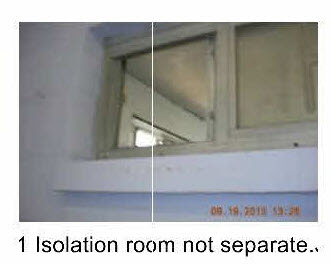
2861

2865 (2)

The 15 dogs that had been imported from Georgia and arrived at the facility on Sunday, 8/16/15, did not have completed cage cards as of the date of this inspection.

The shelter also did not answer its supervising veterinarian’s requests going back as far as five months to acquire medicines and diagnostic equipment to treat sick and/or injured animals.

A notebook was located on the premises that showed the supervising veterinarian’s findings along with the veterinarian’s signature and date of each visit. The notes in this log book indicated that the veterinarian had recommended the pharmacy stock at the facility be increased (this would require prescriptions from the supervising veterinarian with the required prescribing information) and suggested medical and diagnostic equipment be purchased for use at the facility. These notations had been recorded in the log book since March of 2015, with the last request for equipment dated 8/2/15. The facility did not have the diagnostic equipment on the premises as requested by the supervising veterinarian.

North Jersey Humane Society also had drugs without required information, such as the animal it was prescribed for, directions for use, date dispensed, and name of the facility distributing the medication. This raises serious questions as to whether the shelter illegally obtained these medicines and whether expired drugs were given to animals.

There were medications at the facility that did not contain prescription labels with the required information, including the animal’s name or identification, directions for use, the date dispensed, and the name and license number of the licensee and facility dispensing the medication. A 200 ml bottle of Toltrazuril, used for the treatment of coccidia in horses, was located on the top of a cart in the medical treatment room. The manufacturer’s label on the bottle stated to refrigerate after opening and expires one year after opening, but the bottle was not refrigerated and there was no date on the bottle indicating when the bottle had been opened. There were no records or directions from the supervising veterinarian indicating what the medication was to be used for and to which animal it had been prescribed. There was also a box of MilbeMite brand ear mite medication for cats on this cart with no prescription label, animal identification, and instructions for use (Pictures 2871 through 2873).

2871

2872

2873

North Jersey Humane Society’s Euthanasia Statistics May Not Be Accurate

North Jersey Humane Society reported it only euthanized one cat and three dogs died or went missing in its 2014 Shelter/Pound Annual Report. However, the inspection report noted 4 dead animals were in the facility’s freezer. To make matters worse, the shelter could not produce accurate and legally required intake and disposition records at the time of the inspection. Furthermore, Vincent Ascolese, who illegally killed the fawn, conveniently removed all the wildlife intake and disposition records and stored them in another county. As a result, I have no confidence in North Jersey Humane Society’s reported euthanasia and other statistics since the shelter could not produce the supporting documents.

There were also approximately four animals in the freezer that were bagged, but the bags were not labeled with a name or ID number.

Paper records were maintained on dogs and cats that were received at the facility, but the intake and disposition log which correlates when each animal arrived at the facility and the final disposition was maintained as a computer record. There was no one at the facility at the time of this inspection that had access to the computer records to ascertain when animals were received and the final dispositions. A notebook that was labeled “stray animal log” was not up to date and did not include all animals that were received at the facility. The log only listed dogs that had been impounded and the last entry was dated 7/1/15.

The “Animal Control Incident Transport Record” forms, which were the only records created for the intake and disposition of certain wildlife or other species of animals received at the facility, including the deer that was received at the facility on 6/29/15, were not kept at the premises. Kristi, the Executive Director of Shelter Services stated during a telephone conversation at the time of this inspection that all animal control records were removed from the establishment by ACO Ascolese and stored in an office located in different county.

No People Admit to Euthanizing Animals

The inspection report documented the supervising veterinarian contradicting the shelter’s statement about who performs euthanasia. Specifically, the ACO on staff during the inspection stated Dr. Nelson Diaz performs all euthanasia procedures for the shelter’s animals. However, the veterinarian stated he never euthanized any animals from the shelter despite the shelter reporting 1 euthanized cat in 2014 and four dead animals in shelter’s freezer at the time of the inspection.

Furthermore, the shelter had no required euthanasia equipment at the facility or documentation that any shelter staff were certified to euthanize animals. As a result, one has to wonder if Vincent Ascolese or some other people at the shelter illegally killed animals like Vincent Ascolese did with the deer fawn.

At the time of the inspection, no certification documents were found on the premises or made available to the inspectors to indicate which staff members were certified by a licensed veterinarian to perform humane euthanasia at the facility. ACO Stewart stated at the time of this inspection that all animal euthanasia was performed by the supervising veterinarian, Dr. Diaz. Dr. Diaz was contacted by phone and confirmed that he had not performed any animal euthanasia for this facility and he was not contacted regarding the deer (fawn) that was killed by ACO Ascolese. ACO Stewart also stated that ACO Ascolese was trained by Dr. Diaz to euthanize animals at the facility one week prior to the inspection (8/12/2015). Dr. Diaz confirmed that he had certified ACO Ascolese in August, 2015. On 6/29/2015, ACO Ascolese killed a deer (fawn), prior to the animal euthanasia training that had been conducted on or about 8/12/2015.

None of the required euthanasia equipment was on the premises at the time of this inspection; there were no posted instructions, and no euthanasia, tranquilizing or immobilizing agents on the premises. This facility was not equipped with the supplies to perform humane euthanasia on any animals at the time of this inspection and there were no records or other evidence provided at the facility during this inspection to indicate that the facility was equipped as required to perform euthanasia on 6/29/2015 when the deer (fawn) was killed by ACO Ascolese.

North Jersey Humane Society Violates Basic No Kill Principles

No kill shelters essentially need to do three broad things. First and foremost, no kill sheltering mandates not killing or allowing healthy and treatable animals to die. Second, no kill facilities must perform at a high level resulting in animals quickly leaving the shelter and going to good homes. Third, no kill sheltering requires animals be provided with an elite level of care.

North Jersey Humane Society violated all three of these principles. Vincent Ascolese never even tried to get the injured fawn to a licensed wildlife rehabilitation center. In fact, Mr. Ascolese’s organization does not use licensed wildlife rehabilitation centers for any wild animals per the inspection report. His shelter’s careless disregard for an extremely vulnerable baby squirrel also violated no kill’s unwavering standard of not killing. Whether the shelter killed the baby squirrel directly or simply allowed it to die makes no difference. The shelter must have a passion for saving animals. Clearly, Vincent Ascolese’s organization has an attitude that some animals are simply not worth saving. After all, when the Director of North Jersey Humane Society slices open the throat of a fawn, is it any wonder other staff members will not do anything to save a baby squirrel?

North Jersey Humane Society’s and Bergen Protect and Rescue’s polices resulting in prolonged lengths of stay also violate no kill principles. To make a no kill animal control shelter work, the organization must quickly place animals into good homes. With excessive adoption fees, long waiting periods to adopt animals and poor customer service, Vincent Ascolese’s shelters simply do not perform in the manner they should.

Finally, North Jersey Humane Society fails to follow basic animal sheltering practices let alone the elite level standards of a no kill facility. Housing sick animals together, leaving animals without water, not providing prompt veterinary care, keeping animals in filthy enclosures, exposing animals to dangerous kennels, and potentially providing animals with expired medicines is unacceptable for any shelter, kill or no kill. Clearly, North Jersey Humane Society failed its animals and does not deserve the no kill or even a shelter label.

Bloomfield Needs to Take Immediate Action

Bloomfield and the shelter’s other contracting municipalities should expect far better service. Assuming North Jersey Humane Society’s annual fees are the same as its $120,000 bid for animal control and $145,000 bid for sheltering services, North Jersey Humane Society receives $265,000 a year in revenue from these towns. Based on the Bloomfield Animal Shelter’s total reported intake in 2014, this works out to nearly $1,500 of revenue per animal the shelter impounds. Also, the shelter receives donations in addition to these contract fees. Surely, North Jersey Humane Society can afford to provide proper care to its animals.

Bloomfield no longer can trust Vincent Ascolese to do the right thing. First, Bloomfield must make all necessary structural improvements to the shelter to ensure the facility can comply with state law. Second, the town must form an Animal Welfare Advisory Committee, which should have qualified members dedicated to ensuring the town has an elite no kill shelter and to oversee and regulate whoever runs the Bloomfield Animal Shelter. Third, Bloomfield must enact the Companion Animal Protection Act (“CAPA”) that residents have demanded for years. Fourth, the town should pass a no kill resolution mandating at least a 95% live release rate for dogs and a 90% live release rate for cats impounded from the towns the shelter contracts with. Fifth, the town should demand North Jersey Humane Society stop transporting animals from southern states into the Bloomfield Animal Shelter. Simply put, the town can no longer take the word of a charismatic person with a dark side.

New Jersey Department of Health, the NJ SPCA and the Towns Contracting with Bergen Protect and Rescue Must Investigate That Shelter

Based on the egregious performance of North Jersey Humane Society, the New Jersey Department of Health and NJ SPCA must investigate Bergen Protect and Rescue to see if Vincent Ascolese’s other facility is also violating New Jersey shelter and animal cruelty laws. Furthermore, Cliffside Park should also do the same things as I recommend for Bloomfield to ensure the shelter is effectively supervised and regulated. Sadly, Vincent Ascolese’s organizations have lost all credibility and it is time these shelters prove to everyone they are ready to step up their game. If not, then the municipalities must move on and bring an organization in that will do the right things for the animals.
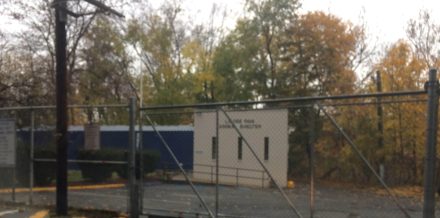
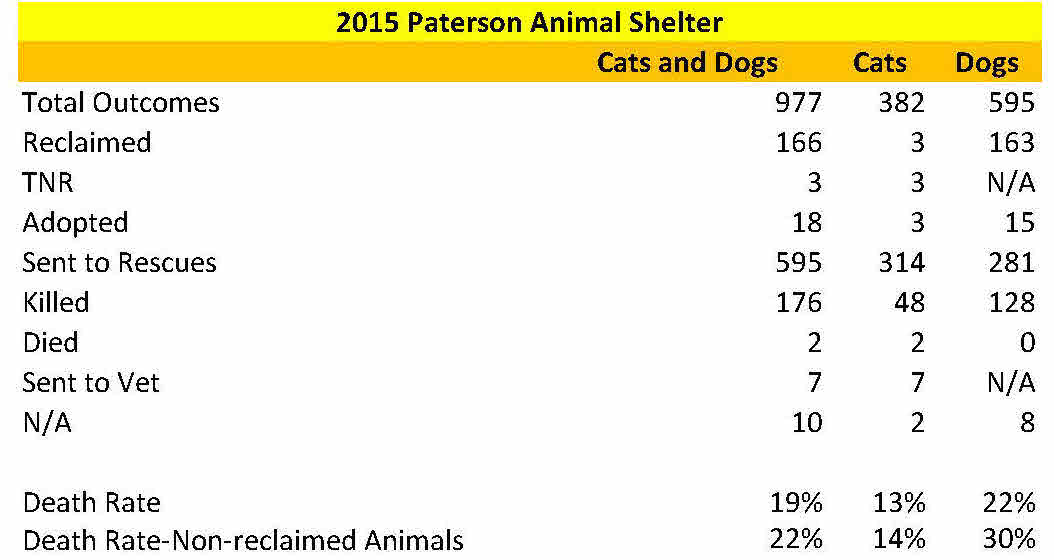
East Orange Animal Control Kills a Dog Adopted from Another Animal Shelter

One year ago, East Orange Animal Control made news for all the wrong reasons. At the time, the city’s recently hired Animal Control Officer, Amanda Ham, dramatically increased the animal shelter’s live release rate. However, East Orange Health Officer, Rochelle Evans, fired the ACO after Ms. Ham complained to the NJ SPCA about dreadful conditions the city refused to fix. Shortly after Ms. Evans fired Amanda Ham, the New Jersey Department of Health inspected the shelter and documented horrific conditions. Specifically, the New Jersey Department of Health reported animals inundated with a toxic feces and chemical filled soup, a fly infestation so severe that animals with open wounds and skin lesions were in danger of having maggots grow inside them, cats not provided with enough water and water they did have was contaminated with cat litter, and improper isolation of sick animals. Thus, East Orange Animal Control’s shelter was a complete mess last year.

East Orange Animal Control Kills a Friendly Dog Adopted from Liberty Humane Society

East Orange Animal Control killed a friendly dog recently adopted from Liberty Humane Society. Roxy was adopted from Liberty Humane Society in late April and was a sweet dog according to the shelter’s volunteers. For some reason, the adopter decided not to keep Roxy and turned her into East Orange Animal Control in late May. On Tuesday, June 2, Liberty Humane Society heard East Orange Animal Control might have Roxy and attempted to contact East Orange Animal Control, but East Orange Animal Control did not respond to Liberty Humane Society that day. On Wednesday, June 3, East Orange Animal Control killed Roxy and two other dogs while the facility had empty kennels.


Roxy Killed by East Orange 2

While some people may blame the owner for this event, this criticism is unfair. The owner did a noble thing and adopted the dog from Liberty Humane Society, a shelter with very little space, and surely saved a life. Certainly, the owner should have returned the dog to Liberty Humane Society. However, we don’t know if there were extenuating circumstances. For example, perhaps the owner could not travel to Liberty Humane Society due to lack of transportation. Alternatively, perhaps East Orange Animal Control was close to her home and she thought the shelter would do its job and get Roxy back to Liberty Humane Society. Either way, East Orange Animal Control decided to kill the dog and must shoulder 100% of the blame.

East Orange Animal Control’s actions raises serious questions. If Roxy was surrendered to East Orange Animal Control on May 28 or after, East Orange Animal Control would have violated N.J.S.A. 4:19-15.16 e. requiring shelters to offer an animal for adoption for at least 7 days before killing that animal. While East Orange Animal Control is not legally required to scan animals surrendered by their owners for a microchip, one would think a shelter would do so. If East Orange Animal Control did scan Roxy for a microchip, East Orange Animal Control would have known Roxy was recently adopted from Liberty Humane Society. If East Orange Animal Control knew Roxy was recently adopted from Liberty Humane Society, the killing of her would be even more heinous. Tragically, Liberty Humane Society had plenty of empty kennels to house Roxy after the shelter adopted out 37 animals a few days earlier during a fee-waived adoption promotion.

Liberty Humane Society Empty Kennels May 2015

East Orange Animal Control’s Questionable Veterinarian

The New Jersey State Board of Veterinary Examiners concluded Dr. Kimani Griffith was grossly negligent in the care he provided a patient’s dog. In September 2004, Dr. Griffith spayed a female dog and performed a mastectomy after noticing a lump on the dogs’s teats. After the owner’s dog experienced complications from the surgery, Dr. Griffith failed to properly diagnose the problem and delayed appropriate treatment that resulted in the dog’s death. The New Jersey State Board of Veterinary Examiners ordered Dr. Griffith to pay nearly $2,500 in fines and complete 20 hours of continuing education in the area of General Surgery.

South Orange Takes Animals to East Orange Animal Control and to Dr. Griffith

South Orange has taken at least one animal this year to East Orange’s animal shelter. After Jersey Animal Coalition left South Orange in 2014 due to conflicts related to a failed New Jersey Department of Health inspection, South Orange brought animals to the high kill Associated Humane Societies – Newark shelter. In 2015, after AHS-Newark required South Orange to also purchase animal control services, South Orange ended its relationship with AHS-Newark. Earlier this year, South Orange ACO, Melanie Troncone stated South Orange currently was taking stray animals to Puppy Love, a pet groomer in Maplewood, and South Orange Animal Hospital. Ms. Trancone stated the animals would be held for 7-10 days at these locations and then released to an unnamed rescue or a shelter. Around the same time as the ACO made this statement, she wrote the following comment on a Facebook post saying she brought a large stray dog to East Orange’s animal shelter:

South Orange Taking Dogs to East Orange

One has to question why South Orange would choose to take a lost dog to one of the state’s worst pounds? Does South Orange have a contract with East Orange Animal Control or Dr. Giffith’s Country Lakes Animal Clinic in Mine Hill? Either alternative is not good and to not notify residents is despicable while the town drags its feet on re-opening the old JAC shelter with new management.

Companion Animal Protection Act Desperately Needed

The Companion Animal Protection Act (“CAPA”) requires several things that would have prevented the tragic killing of Roxy. First, CAPA requires all, not just stray, animals be scanned for microchips and possible owners or caretakers be contacted. In the case of Roxy, a micochip scan would have identified Liberty Humane Society as the faciity she came from and East Orange Animal Control would have had to contact Liberty Humane Society. Second, under CAPA animal shelters cannot kill animals when

(1) there are empty cages, kennels, or other living environments in the shelter; and,

(2) a foster home is available; and,

(3) a rescue groups is willing to accept the animal; and,

(4) the animal can be transferred to another shelter with room to house the animal; and

(5) the director of the agency does not certify that he or she has no other alternative.

Under CAPA, East Orange Animal Control would have been prohibited from killing Roxy since the shelter had empty kennels at that time. Additionally, the shelter would have had to contact rescues, fosters and other shelters before killing Roxy which likely would have caused people to identify her earlier. Certainly, if East Orange Animal Control contacted Liberty Humane Society, which had room, Liberty Humane Society would have taken Roxy back. Thus, CAPA would likely have prevented Roxy’s killing assuming the law was properly enforced.

Mayor Lester Taylor Must Do the Right Thing for His Community and the Animals

East Orange Animal Control is currently spending much more money than other municipal shelters who save their animals. In 2013, the city spent $345 per dog and cat and likely killed most of their animals (the facility did not report outcome data). On the other hand, Perth Amboy only spent $281 per dog and cat in 2013 and saved 97% of its dogs and 93% of its cats. In 2014 East Orange budgeted $2.63 per person on its animal control and sheltering operations while Perth Amboy only spent $2.34 per person in 2014. Thus, East Orange is wasting taxpayers money and embarrassing the city in the process.

East Orange Animal Control currently bans volunteers from its shelter. Basically, the only exposure animals got until recently were pictures a couple of select people were allowed to take through the kennels. Clearly, such pictures are depressing and don’t do nearly enough to promote the adoption of these animals.
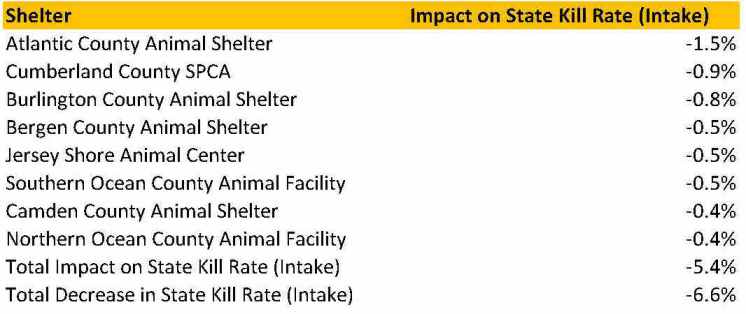
East Orange Shelter Photo 1 East Orange Shelter Photo 2 East Orange Shelter Photo 3 East Orange Shelter Photo 4

Sadly, East Orange Animal Control has now illegally banned people from even taking these photos. Furthermore, East Orange Animal Control bars the public from taking photos of the animal shelter as well.

East orange Photo ban

Nathan Winograd, who is a no kill leader and an accomplished attorney, provided the following summary of why it is illegal for animal control shelters to ban photos and videos:

Banning photography and video in public areas of the shelter limits free speech. See Animal Legal Defense Fund vs. Otter, 2014 WL 4388158*10 (D. Idaho 2014). The taking of a photograph or video is “included with the First Amendment’s guarantee of speech and press rights as a corollary of the right to disseminate the resulting recording.” ACLU vs. Alvarez, 679 F.3d 583, 597 (7th Cir. 2012). As the ACLU has correctly argued, “Videotaping and capturing images of poor shelter conditions or neglected animals are indistinguishable from ‘commenting’ or ‘speaking out’ on such conditions.” Volunteers, rescuers, and members of the public have a right to document things they believe are improper. They also can take photographs and videotape to assist in finding animals homes.

Not only is East Orange Animal Control needlessly killing animals, it now is violating our First Amendment rights of free speech and freedom of the press. As a result, East Orange Animal Control has added violating the First Amendment to the United States Constitution to its breaking of state animal shelter laws.

Volunteering at an animal shelter does as much good for the people giving their time as the animals themselves. People need to have meaning to their life. Rehabilitating an animal and being part of its metamorphosis is incredibly moving. Animals open up the most hardened hearts as evidenced by the many successful animal shelter programs at prisons. Senior citizens, young people who need direction, and families looking to spend time together can join up, save lives, and be part of something that builds up their self-esteem and their community. Thus, animal shelter volunteer programs help the people volunteering just as much as the animals those folks help.

East Orange must stop depriving its own citizens from experiencing the opportunity to volunteer and better themselves. Countless communities, such as ones with high poverty rates like Perth Amboy, have come together and made their animal shelter a source of pride. Mayor Taylor touts his community support programs yet his animal shelter refuses to let those citizens help. It is time Mayor Taylor clean house in his Animal Control department, hire caring and compassionate people, and let his community help its animals. If Perth Amboy, which has a higher poverty rate than East Orange, can do this then why can’t East Orange?
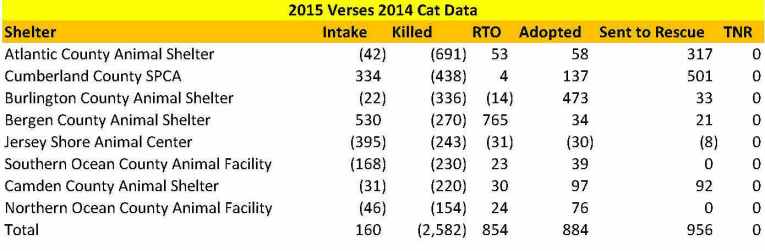
East Orange’s residents must come together and demand more from their city government. Illegal activities, unethical actions, and depriving the city’s own citizens the opportunity to better themselves have made the city’s animal shelter an urgent issue. If the elected officials refuse to fix the animal shelter, then East Orange’s citizens should make sure those officials are shown the door.

Associated Humane Societies Spends Exorbitant Amounts of Money on Lawyers

Courtesy of Barry Langdon-Lassagne

Courtesy of Barry Langdon-Lassagne

In my last blog, I detailed Associated Humane Societies’ history of conflicts. As you will see below, this combative behavior may also have severe financial consequences.

Outrageous Legal Expenditures Under Current AHS Leadership

High legal expenses are a sign of poor performance. Organizations may enter into litigation after failing to resolve conflicts amicably. Additionally, organizations may go to court if they conduct significant wrongdoings. In either case, this does not reflect well on an animal shelter. From an animal welfare organization perspective, money spent on legal fees means less resources are available to save animals and care for them.

The table below details legal expenses incurred at Associated Humane Societies (“AHS”), Monmouth County SPCA and Cumberland County SPCA over the last decade since Roseann Trezza became AHS’s Executive Director. The two SPCAs are included for comparative purposes since animal welfare organizations could theoretically incur legal costs relating to cruelty cases. AHS incurred 358 and 262 times more legal costs than Monmouth County SPCA and Cumberland County SPCA. To put it another way, AHS spent around $3.3 million more on legal fees than the two SPCAs combined over the last decade.

AHS Legal Fees (3)

While we don’t know exactly what AHS’s legal bills relate to, we do know about some of their disputes during this time period. In 2005, AHS paid $138,057 to settle alleged violations of the State’s Consumer Fraud Act and Charitable Registration and Investigation Act relating to deceptive fundraising practices. In 2003, AHS adopted out a dog who subsequently killed its owner. The dog’s previous owner paid AHS a $205 fee to keep the dog under observation for ten days, then euthanize, and cremate it. AHS subsequently fired an employee who objected to the adoption. The employee’s lawsuit against AHS went on until at least 2007. From 2011 to 2013, AHS fought to take the emaciated pit bull, Patrick, away from the veterinarians who helped save his life. Thus, AHS had plenty of disputes over the last decade.

The Patrick case was particularly appalling. Literally, AHS tried to use the court system to remove Patrick from the only loving home he ever knew since Patrick had “trademark registration number 23699” and was a “very valuable brand for commercial exploitation and fundraising.” While we don’t know how much of the nearly $1 million of legal expenses AHS incurred from 2011-2013 were due to the Patrick case, even 1 cent would be too much to pay.

AHS’s Board of Trustees is a Disgrace

That State of New Jersey Commission of Investigation (“SCI”) report on AHS railed against the organization’s Board of Trustees. The SCI report argued AHS consistently failed to fulfill its role of properly overseeing the organization:

The Board constitutes an ineffectual body that has ignored the mission of AHS to care for the animals and has allowed Bernstein free reign to operate the organization as he pleases.

This report called out AHS’s longstanding practice of putting too many employees on its Board of Trustees. Currently, the BBB Wise Giving Alliance states no more than 10% of a board should be paid staff members or indirectly compensated people. Additionally, the BBB Wise Giving Alliance states organizations should not appoint compensated persons as the chairperson or treasurer.

Despite the SCI report’s criticism, AHS still places too many employees on its board. Rosenna Trezza, AHS’s Executive Director, and John Bergmann, Popcorn Park Executive Director, both serve on the board. Furthermore, AHS’s most recent Form 990 listed Roseann Trezza as President of the Board of Trustees in violation of the BBB Wise Giving Alliance guidance. Additionally, Dr. Adriana Hordynsky also appears to work for AHS and is not listed as an independent Board of Trustees member. Assuming Dr. Hordynsky is an AHS employee, 3 of 8 or 38% of AHS’s Board of Trustees members work for the organization. Thus, AHS’s Board of Trustees still includes too many employees.

AHS’s continued practice of loading its Board of Trustees with employees creates conflicts of interest. Will paid staff members vote for things that are best for the animals, but not for themselves? For example, the Board of Trustees could vote for polices that require more of staff members to save animals. Will those Board of Trustees members vote to add work for themselves? Additionally, will Board of Trustees members who work for Roseann Trezza vote against her? Even if these staff members had employee contracts, its not too hard to imagine ways their boss could make life difficult for them. Thus, AHS’s practice of stacking its Board of Trustees with employees creates huge conflicts of interests.
AHS Board of Trustee member Barbara Lathrop has served for far too long. While AHS lists Ms. Lathrop as “Independent”, I highly doubt that is the case in the real world. Ms. Lathrop has sat on the Board of Trustees since 1976, which included 27 years during the horrific reign of Lee Bernstein. Personally, I think someone who has served on a board for nearly 40 years must be part of the organization’s status quo. Additionally, I’ve noticed Barbara Lathrop defending AHS on social media and even going as far to repeat verbatim AHS’s claim that the volunteers were to blame for AHS suspending the Tinton Falls volunteer program. In fact, in 2001 AHS’s auditors stated the organization should rotate its board members:

We believe that when the terms of certain Board members expire, the Organization should consider bringing in new Board members. This provides the Organization the opportunity to obtain the insights of new members. This would also allow the Organization to develop and further enhance their fundraising efforts and strategies by exposing the Organization to new contacts and ideas.

Two other AHS Board of Trustees members may also potentially have conflicts of interest. If Lynette Bono is the person named Lynn Bono in this article, this Board of Trustees member would be a former employee. This would be consistent with AHS’s past practices described in the SCI report. While a former employee may not have the perverse incentives of a current staff member, it is possible her perspective could be skewed towards management based on her past experience. Assuming Justin Rand is the same person as the Popcorn Park volunteer with the same name, this could also create a conflict of interest if Mr. Rand still volunteers at the shelter. For example, will a volunteer be willing to vote against the Executive Director and Board of Trustees member at an organization known for banning volunteers? Thus, as many as 6 of of AHS’s 8 Board of Trustees members may potentially have conflicts of interest.

While five of AHS’s current Board of Trustees members cannot be blamed for decisions made before their arrival over the last two years, AHS’s board has had a similar structure since 2003. For example, Roseann Trezza, John Bergmann and Barbara Lathrop all served on AHS’s Board of Trustees during the period the legal expenses in the table above were incurred. Thus, AHS’s dysfunctional board clearly allowed this wasteful spending on lawyers.

Donors and Contracting Municipalities Need to Open Their Eyes

Donors and municipalities contracting with AHS should be alarmed at these figures. AHS could have used this $3.3 million to help build a new shelter or at least significantly upgrade its existing outdated facilities in Newark and Tinton Falls. Alternatively, AHS could have spent more on rehabilitating animals both physically and mentally that were eventually killed. Instead, AHS wasted this money on lawyers.

As a donor and a taxpayer, you need to ask yourself how do you want your money spent? Should a significant portion of the money you provide an organization through philanthropic and tax dollars go to the animals or to lawyers? If an organization is so combative that it cannot settle its disputes amicably, what does that say about its compassion and empathy towards the thousands of animals that come through its doors each year? The time has come for AHS to remove and replace all of its senior management and Board of Trustees members with competent and compassionate people. If AHS chooses not to do so, donors and taxpayers should send their money to an organization that will do the right things for their animals.

Rescued Helmetta Dogs Killed

Updated on 2/25/15 for additional information

After facing much public pressure for months, the NJ SPCA raided the Helmetta Regional Animal Shelter on November 13, 2014. Around two weeks later, the NJ SPCA took over the shelter and put Niki Dawson in charge. At the time, I questioned the move due to past complaints about Ms. Dawson. On December 23, 2014, the NJ SPCA proudly announced all the animals were “safely relocated out of the shelter.” However, the NJ SPCA never provided any details on where these animals went and if they are still alive.

We now know four dogs (three of which were pit bull like dogs) were sent to a kill shelter in Pennsylvania. The Humane Society of Harrisburg Area is an animal control shelter that openly admits it has “so many pit bulls.” Furthermore, this shelter refuses to call itself “no kill” and one would expect it to kill many pit bulls. In fact, the shelter placed a 150 pit bull limit into its animal control contract with Harrisburg a few years ago. Less than a year later, the Humane Society of Harrisburg Area stopped accepting dogs from Harrisburg altogether allegedly due to a $6,300 overdue bill from the financially distressed city. As a result of this policy, police would be the judge, jury and executioner based on this excerpt from a Harrisburg police memo:

“If the animal is vicious and a danger to the public and/or officers, or if the animal is obviously sick, injured or suffering the animal may be destroyed in as safe a manner as possible. The animal will then be taken to the Agriculture Bldg. (near the loading dock area) on Cameron St. for disposal.”

Some local animal rescuers argued this policy allowed police to simply shoot certain stray dogs. Subsequently, the Humane Society of Harrisburg Area started taking dogs from the city again.

Helmetta Regional Animal Shelter activists recently uncovered deeply disturbing news about some of these dogs sent to Harrisburg. After getting the runaround from the Humane Society of Harrisburg Area for awhile, the organization admitted the following two dogs, Max and Romeo, were killed for behavioral reasons.
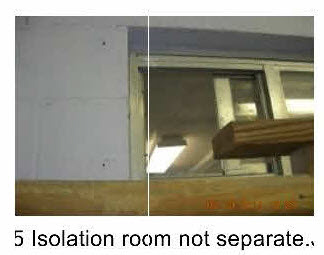
Max Helmetta Killed in Pa

Romeo Helmetta Killed in Pa

One dog was adopted. The fourth dog, Athena, is currently up for adoption with some “restrictions.” Of course, given where Athena is, she too could end up being another casualty of the decision to send these dogs to the Humane Society of Harrisburg Area.

Athena Helmetta Killed in Pa
Niki Dawson’s response to one of the animal activists was quite unsettling. Ms. Dawson said she sent the dogs to this animal control shelter due to it being a HSUS and American Humane Association (“AHA”) partner shelter. HSUS and AHA are well-known for their defense of kill shelters. While Niki Dawson also stated the Humane Society of Harrisburg Area would try and rehabilitate these dogs, one has to question this shelter’s ability to do so given its past history.

The NJ SPCA and Niki Dawson could and should have saved these dogs. Romeo’s and Max’s evaluations conducted by a Certified Dog Behavior Consultant just before leaving Helmetta Regional Animal Shelter stated both dogs showed “no aggression” outside their kennels:

Helmetta Dog Romeo Killed Evaluation

Helmetta Dog Max Killed Evaluation

While no one wants truly aggressive dogs adopted out, many rescues and limited admission shelters surely would have been better equipped than a Pennsylvania animal control shelter with “so many pit bulls” to provide any behavioral rehabilitation these dogs needed. Certainly, with the media attention Helmetta Regional Animal Shelter received, many rescues or limited admission shelters would have likely stepped up and helped. Clearly, the Humane Society of Harrisburg Area assisted in part due to the positive media attention it received. No doubt rescues or limited admission facilities would also get similar media coverage which could help with fundraising. Furthermore, even if these dogs could not be rehabilitated, the public would have easily donated the funds to send these dogs to a reputable sanctuary. Thus, the decision to send these four dogs, three of which were pit bull like dogs, to an animal control shelter with “so many pit bulls” is indefensible.

As I previously stated, the NJ SPCA and Niki Dawson need to provide a full accounting for each animal at the Helmetta Regional Animal Shelter when the NJ SPCA and Niki Dawson took over. Specifically, we need to know where each animal went, and where it is today. The longer we don’t receive this information, the less confidence the public will have in the NJ SPCA.

Significant Implications for New Jersey Shelter Reform

Both Niki Dawson and the NJ SPCA were invited to participate in State Senator Greenstein’s shelter reform roundtable. During that roundtable, Ms. Dawson argued no kill shelters were “polarizing.” Killing rescued animals and never publicly mentioning these animals were subsequently killed is “polarizing.” Frankly, this episode further reduces my confidence in these individuals to reform our shelter system. We need true reformers and not people who need reform themselves to really change New Jersey’s animal shelter system for the better.