New Jersey Animal Shelter Statistics Are Far Worse Than Previously Thought

Photo of discarded dead animals from a 2009 Office of Animal Welfare inspection report of Associated Humane Societies – Newark. The Executive Director at the time is still in charge of this shelter today.


Most New Jersey animal shelters voluntarily report detailed data to state authorities. Last August, I shared New Jersey’s animal shelters summary statistics on my Facebook page. Each year, the New Jersey Department of Health’s Office of Animal Welfare requests each licensed animal shelter in the state to submit animal shelter data for the previous year. Animal shelters voluntarily submit this data in the “Shelter/Pound Annual Report.” The Office of Animal Welfare takes these Shelter/Pound Annual Reports and compiles the number of dogs, cats and other animals impounded, redeemed, adopted and euthanized to prepare its Animal Intake and Disposition report. However, the Shelter/Pound Annual Reports include additional information on how animals were impounded (i.e. strays, owner surrenders, rescued from in-state facilities, rescued from out of state shelters, and cruelty/bite cases) and disposed of (i.e. returned to owner, adopted, sent to rescue/another shelter, and died/missing). Additionally, the Shelter/Pound Annual Reports include the number of animals in shelters at the beginning and end of the year as well as the maximum number of animals facilities can hold. Thus, the Shelter/Pound Annual Reports include very important data not found in the Office of Animal Welfare’s summary report.

I compiled the data from these reports and analyze the results in this blog. 2013 statistics for each New Jersey animal shelter are listed at this link.

Garbage Data Raises Serious Questions About New Jersey Animal Shelters’ Statistics

Several animal shelters, which reported statistics in prior years, failed to submit data in 2013. Specifically, Summit Animal Clinic in Union City, Associated Humane Societies – Tinton Falls, Mercerville Animal Hospital and Angel Pets Animal Welfare in Woodbridge disclosed this data in 2012, but did not do so in 2013. Additionally, East Orange Animal Shelter has never submitted Shelter/Pound Annual Reports to the state, but did share limited data with The Record newspaper. These shelters failure to disclose data raises serious questions. For example, are they trying to hide embarrassing statistics from the public? I’ve included these shelters’ 2012 data, and in the case of East Orange, its limited 2013 data in my analysis. Also, I performed my analysis without these shelters as well. Unless indicated below, I’ve included these shelters’ data in the analysis under the assumption the statistics would be similar if submitted to the Office of Animal Welfare in 2013.

Most New Jersey animal shelters do not properly account for their animals. Simple math dictates the number of animals at a facility at the beginning of the year, plus all animals coming in during the year, less all animals leaving for the period, should equal the number of animals a shelter has at the end of the year. Stunningly, 69 out of 100 shelters reporting these dog statistics and 71 out of 98 facilities submitting this cat data failed to get this right. This raises serious questions about the accuracy of these shelters’ reported statistics. Even worse, 54 of the 69 shelters with flawed dog statistics and 46 of the 71 facilities with incorrect cat statistics should have had more animals at the end of the year then reported. While these errors could have been due to incorrect counts of the number of animals at facilities, the more likely answer is many outcomes, such as animals killed, dying, or gone missing, were not recorded. Given 71% of the errors were due to shelters having less rather than more animals on hand at the end of the year than they should have had lends credence to the theory that errors were mostly due to shelters failing to account for various outcomes. To put it another way, 3,231 cats and dogs should have had outcomes reported and did not. Thus, there is the potential that as many as 3,231 additional dogs and cats were killed, died or went missing from New Jersey animal shelters than were reported in the last year.

Shelters may have failed to classify animals adopted out and sent to rescue properly. Both Paterson Animal Control and Elizabeth Animal Shelter reported no animals were sent to rescues and all dogs and cats leaving their facilities alive were owner reclaims or adoptions. However, rescues I know who work closely with these two facilities told me both shelters rarely adopt animals directly to the public. This makes sense as neither shelter advertized animals for adoption (i.e. no adoption web site or social medial pages) in 2013. One has to wonder how many other facilities failed to properly classify adoptions and rescues properly. This data is very important as it provides details on the burden rescues and other shelters are taking from these facilities.

We need better oversight of New Jersey animal shelters’ data reporting. Currently, these statistics are voluntarily reported and most shelters are not taking this seriously. For example, I noticed a large number of reports were submitted many months after the end of the year. This data should be easy to compile since facilities can utilize animal shelter software programs, some of which are free, to do this task. Furthermore, New Jersey animal shelter laws mandate facilities maintain much of the raw data found in the Shelter/Pound Annual Report. Unfortunately, Office of Animal Welfare inspections routinely find shelters do not properly keep records on animals. We need to make the Shelter/Pound Annual Report mandatory for animal shelters along with serious penalties for significant errors (especially if deliberate). In order for animal shelters to take data reporting seriously, we may also need to require audits of these reports. Thus, these results show we need stronger laws and the Office of Animal Welfare to play a greater role in ensuring reported animal shelter statistics are in fact accurate.

Despite the errors in these reports, the data provided still reveals important information.

More Animals Losing Their Lives in New Jersey Animal Shelters Than Previously Believed

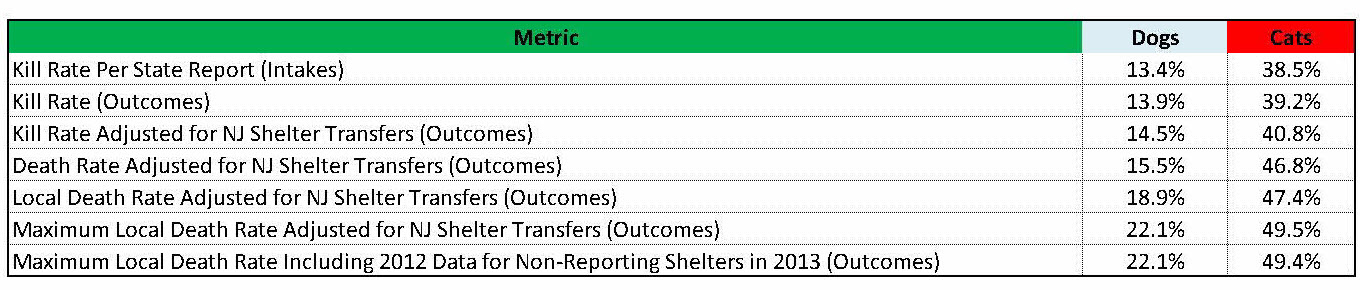
The more detailed data in the Shelter/Pound Annual Reports allows one to more critically examine the percentage of locally impounded animals dying in New Jersey’s animal shelters. The following table summarizes my analysis of the kill/death rate calculated from the Office of Animal Welfare’s summary report and the data reported in the Shelter/Pound Annual Reports.
Totals

The Animal Intake and Disposition report prepared by the Office of Animal Welfare only allows one to calculate the number of animals killed as a percentage of total animals impounded or intake. I prefer calculating the kill rate as a percentage of outcomes rather than intake as this metric directly compares positive and negative outcomes. Using intake depresses the kill rate since shelters can simply hold animals for a long time to the point of overcrowding. Calculating kill rate based on outcomes rather than intake increases the dog kill rate from 13.4% to 13.9% and the cat kill rate from 38.5% to 39.2%.

To calculate the statewide kill rate, we must also back out transfers from one New Jersey animal shelter to another state facility to avoid counting animals still in the state’s shelter system or registering two outcomes for the same animal (i.e. one New Jersey animal shelter transfers a dog or cat to another state facility who then adopts out the animal). This adjustment increases the dog kill rate from 13.9% to 14.5% and the cat kill rate from 39.2% to 40.8%.

In addition, we should increase the kill rate for animals dying or gone missing in shelters. I label this metric the death rate as these animals are likely dead or in a very bad situation. After making this adjustment, the dog death rate increases from 14.5% to 15.5% and the cat death rate rises from 40.8% to 46.8%.

Also, many shelters transport easy to adopt animals from out of state which artificially increases save rates. To properly calculate the percentage of New Jersey animals losing their lives, we need to adjust for transports. Unfortunately, shelters don’t break out their save rates by local and out of state animals. However, most likely nearly all of the out of state animals (primarily puppies and easy to adopt dogs) make it out of shelters alive. Therefore, I back out the number of out of state transports to estimate the local death rate. This adjustment increases the New Jersey dog death rate from 15.5% to 18.9% and the state cat death rate from 46.8% to 47.4%.

Also, I estimate a maximum local death rate by including the number of unaccounted for animals described in the section above. Making this adjustment increases the maximum potential New Jersey dog death rate from 18.9% to 22.1% and the maximum potential state cat death rate from 47.4% to 49.5%.

Finally, the maximum potential New Jersey cat death rate decreases slightly from 49.5% to 49.4% if I include the 2012 data from shelters who failed to report statistics in 2013 to the Office of Animal Welfare. Thus, the percentage of New Jersey animals losing their lives in our state’s animal shelters may be much higher than previously thought.

Death Rates Extremely High at a Number of New Jersey Animal Shelters

Dogs and cats are likely to lose their lives or go missing at a number of New Jersey animal shelters. Shelters with the highest death rates for dogs and cats are listed in the following tables:

NJ Shelter Rates Tables (6)

NJ Shelter Rates Tables (7)

Thus, both dogs and cats have a very good chance of leaving many New Jersey animal shelters dead rather than alive.

Many shelters fail to account for large numbers of their animals. As discussed above, a shelter’s number of animals at the end of the year should be calculated as follows:

Beginning number of animals + animals impounded – animals leaving the shelter

Unfortunately, a large number of shelters take in far more animals than they can explain where they went. Shelters having the highest numbers of unaccounted for dogs and cats are listed in the following tables:
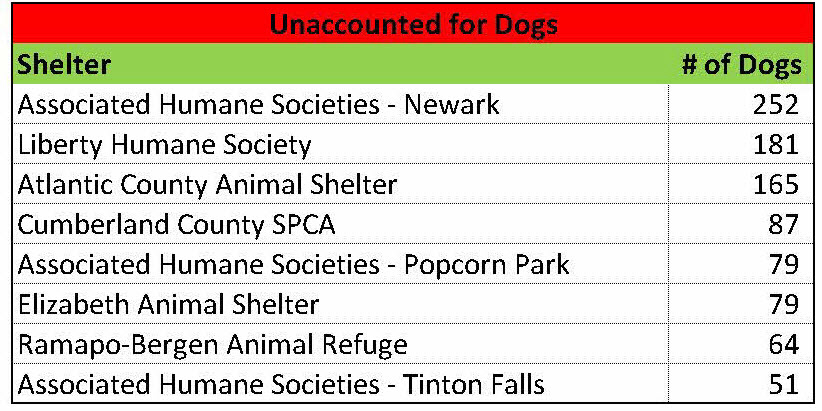
NJ Shelter Rates Tables (8)

Unacct cats

Dog and cat death rates at many shelters may be even higher if these unaccounted for animals are counted as dead or missing. If we only consider animal shelters which don’t or rarely transport, facilities with the highest dog and cat death rates considering the unaccounted for animals described above are as follows:
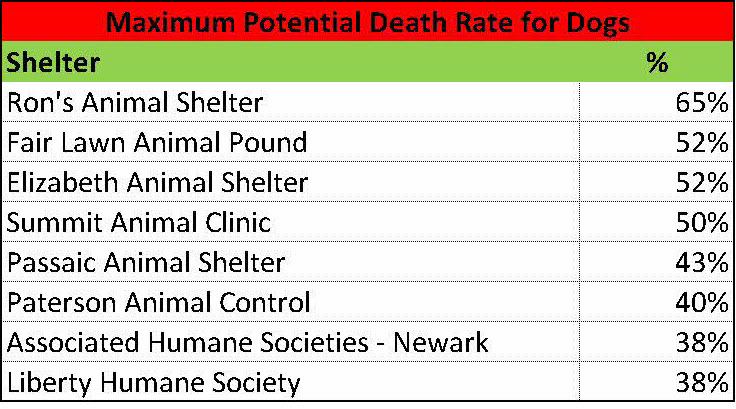
NJ Shelter Rates Tables (2)

Max pot cats po

Thus, the plight of dogs and cats may be far worse in New Jersey animal shelters when we consider the unaccounted for animals.

Shelters Turn Their Backs on New Jersey’s Animals

New Jersey animal shelters rescue far more animals from out of state than other New Jersey animal shelters. Specifically, 5,676 dogs were transferred from out of state animal shelters compared to only 1,410 dogs taken in from other New Jersey animal shelters. While perhaps some shelters, such as Animal Alliance in Lambertville, take animals from nearby New York or Pennsylvania animal control shelters, the overwhelming majority of these dogs most certainly came from down south. In fact, New Jersey animal shelters transported more dogs from out of state than dogs who were killed in, died in or went missing from New Jersey animal shelters. This number does not include additional dogs transported in from out of state by rescues operating without a physical facility. Shelters transporting the most dogs from out of state were as follows:

NJ Shelter Rates Tables (5)

New Jersey animal shelters transported 642 cats from out of state while nearly 50% of cats in the state’s animal shelters were killed, died or went missing. Animal Welfare Association (280 cats received from out of state) and Mount Pleasant Animal Shelter (211 cats received from out of state) rescued more cats from out of state facilities than New Jersey animal shelters. In the case of Mount Pleasant Animal Shelter, the organization’s Executive Director told me these cats were rescued from New York Animal Care and Control. One can only hope the out of state cats rescued by other New Jersey animal shelters came from nearby New York and Pennsylvania facilities rather than from shelters far away down south.

Return to Owner Rates Better Than Average at Most Shelters

Return to owners (“RTO”) rates are one of the positive results from this analysis. Overall, the dog and cat RTO rates of 52% and 4% are approximately twice the national average. As I noted in my blog on reuniting lost pets with owners, return to owner rates are highly correlated with socioeconomic status. Wealthier people likely have more resources/knowledge to license and microchip their dogs. Similarly, people with greater incomes are more likely to afford reclaim fees or ransom payments to animal shelters. New Jersey’s RTO rates for dogs clearly fit this pattern with shelters serving wealthy towns returning most stray dogs to owners while urban shelters are only returning about one fifth of lost dogs to owners. Clearly, we need to help people in urban areas get microchips and ID tags on their dogs. Additionally, we need to create pet help desks at shelters in these cities to help people pay the reclaim fees, which are often mandated by the cities themselves, when necessary. The statewide cat reclaim rate, like figures from across the nation, is still very low and suggests shelters need to figure out better ways to get lost cats back to their families. New Jersey should allow shelters to transfer stray cats to rescues during the mandatory 7 day hold period since few are returned to owners at shelters. This would open up space to save more cats and reduce the chance of disease (i.e. cats spending less time in shelters are not as likely to get sick).

Shelters Leave Animal Enclosures Empty While Dogs and Cats Die

New Jersey animal shelters fail to use their space to save animals. Based on the average number of animals at all of New Jersey’s animal shelters at the beginning and the end of 2013, only 61% of dog and 66% of cat capacity was used. Given December is a low intake month, I also increased these populations to an average intake month. This adjustment only raised the dog and cat capacity utilization to 62% and 87%. These estimates likely overestimate the average capacity utilized as many facilities kill animals once they reach a certain population level. Many animal shelters with low kill rates failed to rescue animals with their excess space. Additionally, other shelters used little of their available space and still killed a large percentage of their animals. Some examples after increasing the population (and therefore capacity utilization) based on the adjustment discussed above are as follows:

NJ Shelter Rates Tables (11)

NJ Shelter Rates Tables (13)

Thus, many New Jersey animal shelters are killing dogs and cats despite having ample space to house these animals.

New Jersey’s animal shelters continue to fail the state’s animals. The state’s animal control facilities only impound 8.7 animals per 1,000 New Jersey residents. As a comparison, the average community in the country impounds anywhere from 14-30 animals per 1,000 residents based on estimates from Animal People Newspaper and the Humane Society of the United States. Despite New Jersey shelters impounding a fraction of the animals other no kill communities take in on a per capita basis, the state’s animal control facilities continue to kill and allow animals to die under their care. Even worse, many of these shelters can’t even properly keep track of how many animals leave their facilities dead or alive. Our state’s animals deserve far better treatment than this. Contact your local city council members and mayor and demand better from the animal shelter serving your community. We can do this so let’s get to work!

Role Model Shelter Saves Its Pit Bulls

DSC_0109

Earlier this year, I wrote a blog on how many progressive open admission animal shelters are saving all of their pit bull type dogs. One of these progressive facilities was Colorado’s Longmont Humane Society. Longmont Humane Society’s Executive Director, Elizabeth Smokowski, was kind enough to share some data with me showing how impressive this facility is.

Longmont Humane Society places all of its savable pit bulls in a very short period of time. Based on raw data provided to me, Longmont Humane Society saved 96% of its pit bull type dogs impounded in 2014 (through November 21). Additionally, pit bulls on average only stay at the shelter for 33 days. As a comparison, Longmont Humane Society saves 98% of its non-pit bull type dogs and non-pit bull type dogs stay on average around 9.5 days at the shelter. Both pit bull type dogs and other kinds of dogs are saved at rates far exceeding the typical 90% threshold required for no kill status. Thus, Longmont Humane Society does an amazing job for all of its dogs.

Longmont Humane Society impounds far more pit bull type dogs than New Jersey animal shelters. Through November 21, Longmont Humane Society impounded around 430 pit bull type dogs this year (483 annualized). This equates to 3.59 pit bull type dogs per 1,000 people in Longmont Humane Society’s service area. As a comparison, Associated Humane Societies – Newark, which many people believe impounds extraordinary numbers of pit bulls, only takes in 2.06 pit bull type dogs per 1,000 people in its service area assuming 50% of impounded dogs are pit bull type dogs. Thus, Longmont Humane Society impounds far more pit bull type dogs than New Jersey’s urban shelters “filled with pit bulls.”

Longmont Humane Society Performance with Pit Bull Type Dogs Dispels Many Excuses Shelters Use for Killing or Refusing to Rescue Pit Bull Type Dogs

Pit bull type dogs are adopted quickly at Longmont Humane Society. Assuming a similar percentage of pit bull type dogs and all dogs are returned to owners (i.e. 35.6% of all dogs with outcomes) and those dogs are returned to owners in 5 days on average (i.e. Longmont’s hold period policy), we can estimate pit bull type dogs take 48.5 days to get adopted. However, pit bull type dogs likely take less time to get adopted than 48.5 days due to fewer pit bull type dogs probably getting returned to owners. Restrictive landlord policies often force owners to surrender their pit bull type dogs to shelters and such dogs typically aren’t returned to owners. Furthermore, breed-specific legislation in nearby communities may also result in more owners surrendering their pit bulls. With such a high save rate, many dogs likely require physical and/or behavioral rehabilitation and Longmont Humane Society still successfully adopts its pit bull type dogs out quickly. Thus, Longmont Humane Society has a high pit bull live release rate and quickly adopts out its pit bull type dogs.

Longmont Humane Society has a high pit bull live release rate and quickly adopts its dogs out despite the shelter having lots of pit bulls. Many shelters argue they have to kill or can’t rescue pit bulls due to having too many pit bulls. Longmont Humane Society’s pit bulls and other breeds short lengths of stay prove this is a meritless claim. For example, we can estimate the percentage of pit bull type dogs in Longmont Humane Society’s shelter and foster care dog population by using pit bull and non-pit bull lengths of stay and standard shelter population equations. Based on this data, 45% of Longmont Humane Society’s dog population at the shelter and in foster care should be pit bull type dogs. Furthermore, the large number of pit bulls do not negatively impact adoptions of other breeds given the non-pit bulls length of stay only averages 9.5 days. Unlike many shelters who complain about too many pit bull type dogs coming in and being forced to kill or warehouse scores of them, Longmont Humane Society rolls up its sleeves and saves these dogs.

Winning Strategies Save at Risk Dogs

Longmont Humane Society actively tries to return lost dogs to their owners. Returning lost dogs to owners is often the quickest way to get stray dogs safely out of the shelter. While Longmont Humane Society does not disclose its return to owner rate (i.e. dogs returned to owners/stay dogs taken in), it likely has a high return to owner rate given 35.6% of all dogs received (i.e. strays and owner surrenders) are returned to owners. The shelter’s web site lists lost pets both at the shelter and found by private individuals in the community. The animals can be sorted by type of animal and/or sex to allow someone to quickly find their lost family member. Additionally, people can report lost pets electronically on the shelter’s web site which can help the shelter quickly match lost dogs with their families. Thus, Longmont Humane Society takes active measures to help families find their lost pets.

Longmont Humane Society makes huge efforts at rehabilitating dogs at the shelter and in the community. Amy Sadler instituted her Playing for Life program at Longmont Humane Society several years ago. This program uses playgroups to give shelter dogs much needed exercise, which reduces stress, and increases adoptability. Furthermore, the shelter has a world class behavioral rehabilitation program helping dogs overcome treatable issues and trains other shelters in these methods. All dogs adopted from Longmont Humane Society come with lifetime behavioral support from the people running this program. Even more impressive, Longmont Humane Society provides reasonably priced classes to the public to help their dogs become model canine citizens. For example, Longmont Humane Society only charges $10 for one hour supervised playgroups designed to socialize dogs. Additionally, the shelter also offers a free new adopter workshop for Longmont Humane Society adopters (adopters from other shelters only pay $10). Thus, Longmont Humane Society makes great efforts to help dogs become emotionally healthy and build strong community support.

The shelter put into place many other innovative programs to adopt animals into loving homes. Longmont Humane Society uses foster families to help animals become more healthy, both physically and mentally, and therefore adoptable. In 2013, 656 animals or around 19% of all animals taken in spent time in foster homes. Longmont Humane Society rightly adheres to breed-neutral policies at the shelter focusing on individual behavior rather than breed labels. Also, Longmont Humane Society walks dogs outside the shelter with “Adopt Me” vests and gives interested people information about adopting. The adoption section of Longmont Humane Society’s web site is very user-friendly and allows people to quickly sort dogs who are good with other dogs or cats. Finally, the shelter has 850 active volunteers who logged over 59,000 hours helping the shelter last year. Thus, Longmont Humane Society uses a variety of innovative programs to save lives of all types of dogs.

Longmont Humane Society is a goal oriented organization. The shelter has a strategic plan for 2012-2018 listed on their website laying out measurable goals with specific deadlines. For example, Longmont Humane Society is seeking to reduce its average length of stay for dogs from 18 days to 9 days and for cats from 28 days to 14 days while maintaining no kill level save rates by 2018. Frankly, most shelters would be ecstatic with the old lengths of stay and would sit on their laurels. However, Longmont Humane Society continues to improve and has made substantial progress towards achieving its goal by reducing its average length of stay for dogs from 18 days to 14 days and for cats from 28 days to 21 days in two years. Another goal, using a mobile outreach program to help adopt animals out to underserved communities by 2018, will likely significantly reduce average length of stay for pit bull type dogs even further. Longmont Humane Society also has a goal to maintain a 95% adopter satisfaction rating on surveys and another goal to measure customer satisfaction for other programs, such as training, by 2017. Finally, the shelter lays out specific goals for attracting the best employees and financial performance. This focus on excellence allowed the shelter to turn its financial performance around while it was in danger of bankruptcy and continue improving its service to the community. Thus, Longmont Humane Society’s success with pit bull type dogs is a function of a goal oriented organization focused on continuously improving.

Longmont Humane Society proves that focusing on excellence yields impressive achievements. For far too long, most shelters have not set standards or goals and unsurprisingly fail to save their animals. Longmont Humane Society saves its pit bull type dogs and places them quickly despite taking large numbers of these dogs in and facing a severe financial crisis. Shelters need to drop the excuses for killing pit bull type dogs and do the hard work necessary to save them. Ghandi once said “The true measure of any society can be found in how it treats its most vulnerable members.” Pit bulls are the most vulnerable dogs in shelters and we should judge shelters on how they treat these animals. We know these dogs can be saved. Will those with the power to save pit bull type dogs do so or will the killing and excuses continue to win out at most shelters?

Lessons Learned from Maddie’s Free Pet Adoptions Event

On May 31 and June 1, Maddie’s Fund sponsored a free pet adoptions event in various parts of the country. Research studies show animal welfare groups can increase adoption numbers without compromising the quality of the homes by waiving fees. People can use the money instead to pay for other substantial costs, such as vet care and pet supplies. In order to save lives now and encourage animal welfare groups to offer such promotions in the future, Maddie’s Fund pays these organizations a substantial per adoption subsidy. Specifically, shelters and rescues receive $500 for healthy younger animals, $1,000 for older animals or ones with certain medical conditions, and $2,000 for older pets with certain medical issues.

Three northern and central New Jersey animal shelter organizations participated in the event. St. Huberts, Liberty Humane Society and Associated Humane Societies’ Newark and Tinton Falls shelters ran the promotion. All three organizations should be commended for participating and choosing to save lives. However, we should also look at the experience and see what areas these shelters can improve upon to save more lives in the future.

Too Many New Jersey Shelters Did Not Participate

Unfortunately, the vast majority of the state’s animal shelters failed to take advantage of this opportunity. Frankly, people who donate to these shelters should question their leadership on why they chose to not take on this opportunity to save lives and receive significant grant money from Maddie’s Fund. Whether the low participation rate was due to not knowing about the event or ideological reasons (i.e. “free adoptions are bad”), the end result is less life saving. The low participation rate shows we need to promote this event better to shelters and hold shelter leaders accountable who choose not to sign up.

Adoption Numbers Increase Significantly

The following table summarizes the participating shelters performance during the Maddie’s Fund event. In order to provide some perspective, I compared each facility’s adoption rate during the two days to these shelters’ most recently available adoption rates. Additionally, I also estimated the percentage of each shelter’s animal population adopted during the promotion by using each shelter’s adoption numbers and the most recently available shelter population numbers. The actual adoption numbers may differ if the shelters revised their totals or did not report some adoptions on their Facebook pages, but the general trend should not be different.

Maddies Results Revised

Each shelter significantly exceeded their typical adoption rate during the event. St. Huberts and Liberty Humane Society adopted out animals at over 20 times their typical two day adoption rate. The two AHS facilities, which reported far fewer adoptions, also adopted out significantly more animals than normal.

AHS-Newark’s improvement may be better than these results indicate. Based on my experience with the shelter, I suspect transfers to rescues might be included in their 2012 adoption numbers. Also, the shelter’s reported 12/31/12 shelter population number seemed extraordinarily high. The shelter reported having 300 dogs and 225 cats (maximum claimed capacity), but a July 30, 2009 Office of Animal Welfare inspection report stated the facility was at full capacity with 325 animals. If we assume half of AHS’s 2012 adoptions were really transfers to rescues and the facility only had 325 animals, AHS-Newark would have adopted out 160% more animals than normal and 4% of its shelter population.  Thus, AHS-Newark may have done a bit better than the table above suggests.

Types of Animals Impacts Adoption Numbers

St. Huberts large number of adoptions may be in part due to the types of animals it takes in. St. Huberts has largely shifted from being an animal control to a rescue shelter. Additionally, St Huberts remaining animal control contracts are in wealthier areas which tend to have easier to adopt dogs (i.e. fewer pit bulls). As a result, St. Huberts probably has more highly adoptable animals than the other three shelters.

Additionally, St. Huberts may have potentially rescued a larger than normal number of animals in preparation for the event. Shelters have a strong incentive to bring more dogs and cats in with the $500-$2,000 subsidy for adopted animals sourced from the local area.

Nonetheless, St. Huberts still did an excellent job during the event. Specifically, I noticed St Huberts adopted a good number of adult pit bull type dogs in photos posted to the St. Huberts Facebook page.

More Adoption Locations Results in More Adoptions

St. Huberts adopted out animals at numerous locations and provided more people the chance to adopt. St. Huberts adopted dogs out at its two shelters and cats were made available at the two facilities and eight off-site adoption locations. Six of the eight off-site locations were at pet stores in retail centers. These retail centers are in high traffic areas and therefore attract large numbers of potential adopters. Thus, St. Huberts made it convenient for people to go and adopt an animal.

Open Adoptions Process Verses Overzealous Screening Leads to More Adoptions

Open adoptions promote matching people with the right pet and providing excellent customer service. St. Huberts and Liberty Humane Society utilize an open adoptions process. The Humane Society of the United States, ASPCA, Petsmart Charities and of course most in the no-kill movement strongly advocate using open adoptions. Specifically, these groups note overzealous screening ends up turning people off from adopting and often doesn’t match people with the right pet or properly educate the adopter.

Open adoptions are even more important during a busy event with large numbers of people. Long and cumbersome adoption procedures can create long wait times for people to adopt which may make them leave. Additionally, shelters with a reputation for difficult adoption processes may attract fewer people to these events due to fear of a long wait time and/or an unpleasant experience. Thus, open adoption processes likely lead to more people coming to the event and more of those folks leaving with a new family member.

How AHS Can Do Better Next Time

While AHS adopted more animals than they typically do, AHS can adopt more animals at future events. Liberty Humane Society, which is an open admission shelter servicing an urban area in Hudson County, adopted out more than 3 times as many animals as both AHS shelters combined per the table above.  Liberty Humane Society’s performance relative to its typical adoption rate was over 4 times and nearly 700 times as great as AHS-Tinton Falls’ and AHS-Newark’s results. Additionally, Liberty Humane Society has far fewer financial resource than AHS. For example, Liberty Humane Society’s and AHS’s net assets per their most recently available financial statements were approximately $197 thousand and $10.7 million (including $7.8 million of cash and investments). Thus, AHS performed far worse than another nearby inner city shelter with less financial resources.

AHS can promote this event better. Liberty Humane Society’s volunteers actively promoted the event, which included plastering the local area with flyers. Strangely, the very popular Associated Humane Popcorn Park Facebook page, which has nearly 50,000 likes, did not promote the event or participate for that matter. The Associated Humane Popcorn Park Facebook page often posts stories about the Newark and Tinton Falls shelters, but did not do so this time. This critical mistake likely resulted in much less foot traffic at AHS facilities during the event. Thus, AHS should promote the event heavily in the communities it serves and on the Associated Humane Popcorn Park Facebook page in the future.

AHS’s adoption process focused on vigorous screening and paperwork may reduce the organization’s ability to process large numbers of adoptions. AHS’s web site describes a pretty long adoption process, which includes not adopting puppies or small dogs to families with children under 5 years old. Additionally, the process involves significant paperwork and “screening” which suggests a cumbersome procedure. Adoption processes such as these often makes an adopter feel disrespected and may decrease their satisfaction with the shelter and adopting in general. Cumbersome adoption processes in an event like the Maddie’s free pet adoption weekend where adoptions must occur during the two days can create a significant bottleneck. For example, people may have to wait at the shelter a long time while veterinarians are called and paperwork is reviewed. Additionally in my past experience with AHS-Newark, the shelter did not alter most dogs until an adoption was approved. People typically would bring the dogs home at a later date after the shelter spayed/neutered the animal. If people met unaltered dogs or cats at AHS during the Maddie’s free pet adoptions weekend, the animals may not have been able to get altered until after the event.  As a result of AHS’s adoption policies and procedures, the organization may not have been able to process adoptions fast enough to adopt as many animals as St. Huberts or Liberty Humane Society.

AHS should move away from its existing adoption process to a procedure focused on making excellent matches. Two great examples are the ASPCA’s Meet Your Match and the Center for Shelter Dogs Match Up II programs. Both programs offer lots of free materials online to help shelters implement these programs. KC Pet Project, which is Kansas City’s open admission shelter, provides an excellent example of how one shelter implements these types of programs. In fact, KC Pet Project has had tremendous success in similar events exemplified by its adopting 228 animals during a 3 day $25 dollar adoption promotion.

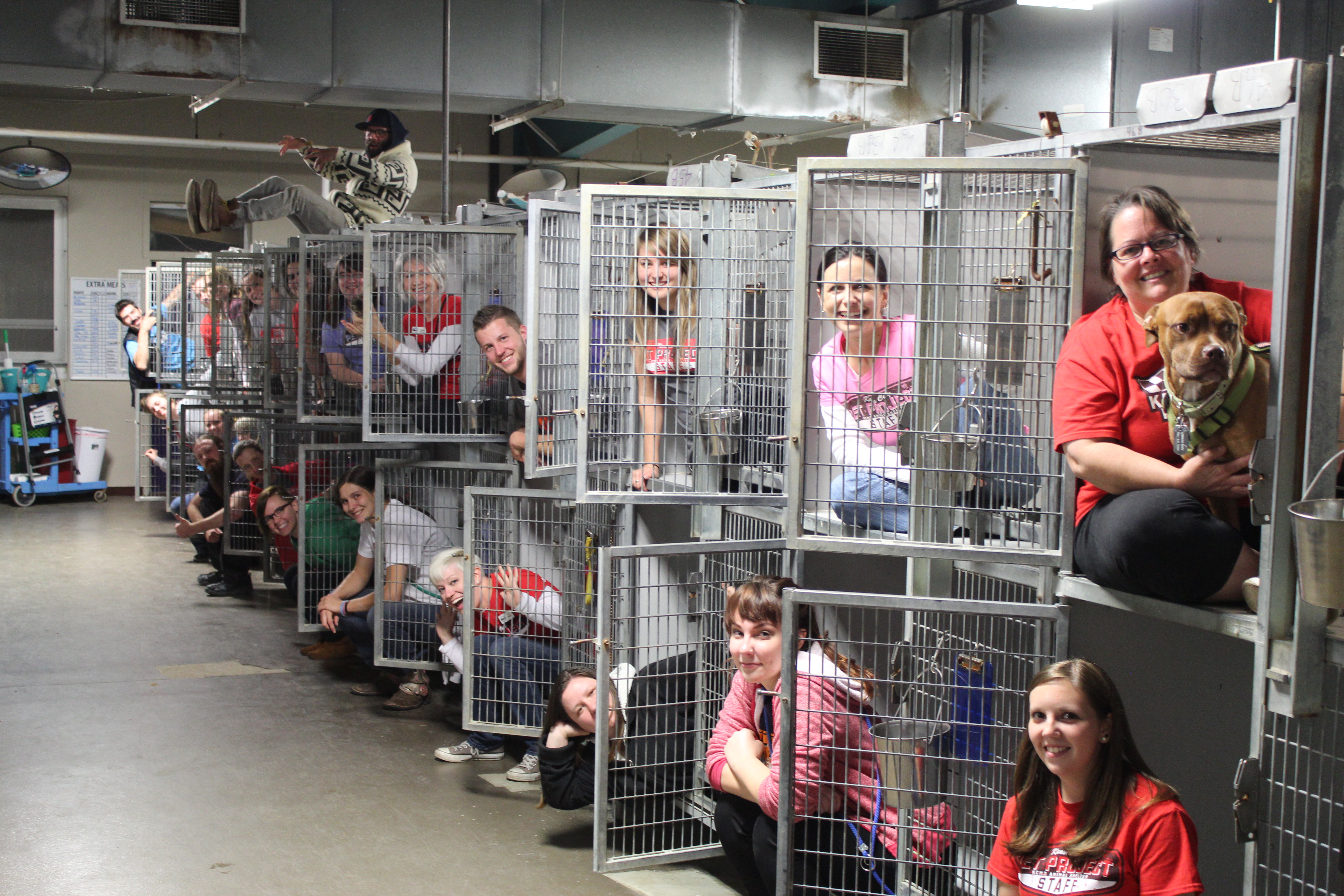
KC Pet Project Empty Kennels

Thus, AHS has lots of available information to implement a more efficient and effective adoption process.

AHS-Newark needs more volunteers to better promote its animals. Until recently, AHS-Newark had virtually no volunteer program. Currently, the shelter has a small group of hard-working volunteers doing great things. For example, the volunteers run an excellent Facebook page, do offsite meet and greet events, pack walks with a few select dogs, dog behavioral evaluations and post animals to Petfinder.  AHS-Newark needs additional volunteers or staff to post dogs onto Petfinder. As of today, AHS-Newark only had 60 dogs and cats on Petfinder which likely represents a small portion of the animals at the facility. For example, this would only be 11% of the shelter’s total population if the shelter currently has as many animals it reported having at December 31, 2012 per AHS-Newark’s 2012 Shelter/Pound Annual Report. Additional animals need to get onto Petfinder in order to properly promote all of the animals and not just a select few.

AHS-Newark needs to expand its volunteer program to make animals more adoptable and to facilitate adoptions. Currently, the shelter’s volunteer program is fairly limited. AHS-Newark should seek to emulate Nevada Humane Society whose volunteers contribute over 2,500 hours per month to the organization and conduct a variety of activities. AHS-Newark could greatly benefit by expanding its volunteer base to socialize more animals. Better socialized animals and volunteers knowing more animals well would facilitate adoptions at the Maddie’s event by properly matching families and animals. Furthermore, additional volunteers allows adopters to meet more dogs outside the kennels where the dogs show better.

While the shelter’s space is limited, the organization could find a way to create a playgroup program. Playgroups are a common theme for large shelters who save pit bull type dogs at a high rate. Specifically, these programs make the large dogs, which AHS has lots of, more adoptable and show better in kennels. During the Maddie’s free adoption weekend event, dogs regularly participating in playgroups would seem more attractive to adopters.

Finally, AHS should adopt animals out at multiple locations in future Maddie’s Fund events. Both the Tinton Falls and Newark shelters could increase cat adoptions by holding the event at multiple high traffic locations, such at various Petco, Petsmart, and Pet Valu retail stores. Additionally, AHS-Newark should adopt dogs and cats out at the Union Square adoption center location in New York City. AHS-Newark’s large amount of animals may overwhelm adopters based on recent research and some adopters may not want to visit an inner city shelter. Thus, AHS would likely increase adoptions by adopting animals out at multiple high traffic locations.

Animals Depend On Us Always Improving

Overall, all three organizations adopted more animals than normal during the Maddie’s Pet Adoption Days event. Each organization should evaluate their performance and see how they can better their performance at future events. At the end of the day, animal welfare groups should always strive to improve. Lives are at stake and the animals are counting on you doing the best you can.