Roger Haston’s Ridiculous Kill Shelter Model

Last January, I wrote about Dr. Roger Haston’s “The Future of Animal Welfare” presentation at an Animal Care Centers of NYC sponsored event. Dr. Haston, who was serving as the Chief of Analytics at PetSmart Charities at the time, was giving the same presentation at events held by shelters across the nation. While I acknowledged Roger Haston made some good points, I was deeply disturbed by his anti-pit bull and pro-killing shelter animals views. Furthermore, I addressed a number of problems with the arguments and so-called facts he presented. Subsequently, Animal Farm Foundation wrote a blog refuting many of Dr. Haston’s points and futile attempts to get Dr. Haston to address these. Additionally, Nathan Winograd dismantled Dr. Haston’s pro-killing arguments.

Shortly thereafter, Roger Haston left PetSmart Charities. Currently, Dr. Haston’s Linkedin profile states he is the President of the Institute for Animals. Unfortunately, I could not find anything about this organization. However, Dr. Haston’s Linkedin profile states the following about his position:

Strategy development, though leadership, research and leadership development services for the animal welfare industry. Focusing on the positive aspects of the relationship between people and animals.

Based on this description, it seems Dr. Haston may provide consulting services to animal shelters. Given the views Dr. Haston expressed in his “The Future of Animal Welfare” presentation, it seems kill shelters could look to him for guidance. In other words, kill shelters might look to his analyses as a way to argue against no kill.

What is the analytical basis of Dr. Haston’s anti-no kill views? Does this analysis make sense? Does this analysis match reality?

Haston’s Anti-No Kill Model

While Roger Haston did not present the model he used as the basis for his recent “The Future of Animal Welfare” events, a presentation from several years before may provide this information. In January 2015, when Dr. Haston was the Executive Director of Colorado’s Animal Assistance Foundation, he gave a presentation titled “Beyond Labels: Understanding the True Impact of Live Release Rates and Intake Policies” in a Society of Animal Welfare Administrators webinar. You can view the presentation here and the accompanying slides here.

Dr. Haston uses an interesting and robust statistical method, stochastic modeling, to conduct his analysis. Most animal sheltering data models, such as the one I created, use “deterministic modeling.” Deterministic modeling yields the same results from the inputs or variables included. On the other hand, stochastic modeling, incorporates the varied results an input or variable could have to predict the results generated from those variables. Therefore, in theory stochastic modeling is a powerful statistical tool.

While the deterministic model I use to target New Jersey animal shelter performance (amounts of animals shelters should adopt out, send to rescues and euthanize) is simpler theoretically, I reduce much of the sources of variability and therefore weaknesses of this type of model. For example, I analyze animal intake on a monthly basis, which accounts for higher intake during warmer months, and incorporate the breeds of dogs and ages of animals shelters impound and the overall adoption demand in a region. Furthermore, since I assess past performance, much of the input data I use has no variability at all. Therefore, my model performs quite well when I compare it to the actual benchmark shelters’ performance I use.

In a nutshell, Dr. Haston uses various shelter data estimates to make future projections. For example, he forecasts if a shelter will exceed capacity, what will happen when it exceeds capacity and what the facility’s future financial performance will look like.

Rigged Assumptions Lead to Anti-No Kill Results

Dr. Haston’s model would yield the same general conclusion regardless if he used stochastic or deterministic modeling. Why? He uses excessive animal intake and insufficient shelter capacity, excludes some of the quickest ways animals leave shelters and ignores how shelters would act if they exceeded capacity.

In Dr. Haston’s model, he assumes the shelter takes 3,000 dogs in during the year and the facility can hold 150 dogs at one time. Additionally, he assumes, based on an undisclosed sample of shelters, that different classes of dogs (from most to least adoptable) make up different portions of shelter intake and have varying average lengths of stay.

Using standard animal shelter capacity calculations, which assume animals come in evenly during the year, the shelter would have to on average move its dogs out of the shelter in 18.3 days or less to avoid consistently going over capacity. However, Dr. Haston’s model, which is based on each major class of dog’s average length of stay, shows these dogs would have an average length of stay of 32.0 days. Thus, a less sophisticated model would also show this shelter quickly exceeding capacity.

If there is anything to take away from this blog, this is it. Why? These key assumptions drive Dr. Haston’s subsequent conclusions that no kill animal control shelters severely restrict intake, are filled with animals few or no people want and financially implode.

Under Dr. Haston’s model, a shelter only adopts out or euthanizes an animal under the assumption all dogs are owner surrenders. Obviously, that is not realistic since stray dogs usually are a larger source of dog intake than owner surrenders. In addition, owners sometimes reclaim dogs they previously surrendered.

Typically, owners reclaim lost dogs within a few days since the animals usually have a license and/or a microchip that allows shelters to quickly identify the owner. Therefore, the model yields an excessively long average length of stay since it excludes owner reclaims.

To incorporate owner reclaims into the analysis, I used Tompkins County SPCA’s most recent statistics. Dr. Haston appeared to use Tompkin County SPCA’s adoption length of stay based off his citation of Brown, et al., 2013. While Dr. Haston did not give the full reference of this source, I believe it is this study that takes place mostly at Tompkins County SPCA from 2008-2011 which I use in my own dog analysis. Since I could only find Tompkins County SPCA’s 2018 data, I used this data to compute a revised average length of stay from Dr. Haston’s model based on an assumed 3 days and 32 days average length of stay for owner reclaims and all other outcomes and the percentage owner reclaims made up of total adoptions, total euthanasia and total owner reclaims at Tompkins County SPCA in 2018. A 3 day average length of stay falls into the middle of the range of owner reclaims’ average length of stay I computed from several New Jersey animal control shelters.

After making this adjustment, the model’s average length of stay decreased from 32.0 days to 23.1 days. As a result, the difference between the average length of stay required to avoid exceeding capacity continuously and the model’s average length of stay dropped significantly.

As you will see below, several no kill animal control shelters have dog average lengths of stay around the required average length of stay to avoid perpetual overcrowding implied in Dr. Haston’s model. First, these shelters generally do a better job adopting out dogs than the facility (primarily Tompkins County SPCA from 2008-2011) Dr. Haston used and most likely adopt out dogs quicker. Second, Dr. Haston’s model does not incorporate dogs shelters transfer to rescues. Frequently, shelters can transfer dogs quicker to rescues, especially when the facilities are rescue friendly and make an effort. For example, the Paterson Animal Shelter, which is far from a progressive shelter, transferred a large percentage of all of its dogs as well as pit bull like dogs in 2015 after just seven days on average. Similarly, 2018 Animal Care Centers of NYC data I obtained showed the organization transferred a large number of dogs to rescues in ten days on average. Additionally, my 2017 analysis of Elizabeth Animal Shelter indicated dogs adopted out and transferred to rescues, which mostly were dogs sent to rescues rather than adopted out, spent only 14 days in the shelter. Thus, Dr. Haston’s failure to use role model no kill animal control shelters and dogs sent to rescues in his model makes the model yield inaccurate or skewed results.

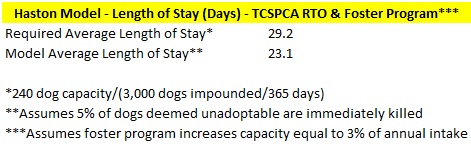
Dr. Haston’s failure to include foster homes in his model grossly understates shelter capacity. While most people appreciate the benefits foster programs can have on both the mental and physical health of animals, many don’t realize how much extra capacity these programs can add to a shelter. For example, Dr. Ellen Jefferson provided a goal in a presentation at the 2019 American Pets Alive Conference for animal control shelters to have 3% of their annual dog intake in foster homes at a given point in time. Dr. Jefferson developed this target based on certain no kill animal control shelters’ successful foster programs. Since average length of stay incorporates animals in foster homes, we can add this to the shelter’s dog holding capacity in Dr. Haston’s example. This adjustment increases the shelter’s capacity from 150 dogs to 240 dogs.

As you can see below, the shelter in Dr. Haston’s example will normally have significant excess capacity even without accounting for animals sent to rescues and no kill animal control shelters with stronger adoption programs. While the inherent volatility of dog intake at an animal control shelter, such as a large hoarding case, could temporarily cause capacity concerns, this data shows Dr. Haston’s perpetual overcrowding and related conclusions are simply incorrect.
Real World Data Contradicts Dr. Haston’s Predictions

Dr. Haston’s model predicts a 95% live release rate animal control shelter will have a ridiculously long average length of stay. While his model implies a 32 day average length of stay based on the make-up of dogs brought to the shelter, the model actually predicts an astonishing 90 day average length of stay after one year.

Why does the model predict such a longer average length of stay? Unfortunately, Dr. Haston doesn’t explain whether he is calculating average length of stay for all the animals that came into the shelter during the period or the actual population of dogs in the shelter at a point in time. Assuming Dr. Haston calculated average length of stay of all dogs taken in during the period, which is how shelters typically calculate this metric, the increase in average length of stay from 32 days to 90 days may be due to the shelter exceeding capacity and not accepting all dogs, including many easy to adopt ones. Therefore, the harder to adopt dogs, which take significantly longer to place, will make up a larger portion of the total dog intake and increase the average length of stay.

Even if shelters consistently exceed capacity, which they shouldn’t as explained above, managed admission policies could mitigate that. For example, a managed admission shelter would be more likely to immediately accept an easier to adopt small dog than a larger dog with behavioral issues if the facility was near or at capacity. Therefore, these shelters would have  a much shorter average length of stay than 90 days if these facilities exceeded capacity consistently and restricted intake.

To analyze the Dr. Haston model’s predictions, I compared his model’s key results to actual data from three no kill animal control shelters. These shelters are as follows:

  1. KC Pet Project serving Kansas City, Missouri
  2. Williamson County Animal Shelter serving most of Williamson County, Texas
  3. Lynchburg Humane Society serving Lynchburg, Virginia during the period of my analysis

Due to the lag in non-profit financial data reporting, I had to use 2017 and 2016 data for KC Pet Project and Lynchburg Humane Society, respectively. I listed the links to the data I used in this analysis at the end of this blog.

The average length of stay computed by Dr. Haston’s model vastly exceeds the three no kill animal control shelters’ average lengths of stay. Specifically, Dr. Haston’s model predicts an animal control shelter with a 95% live release rate will have an average length of stay of 90 days while KC Pet Project, Williamson County Animal Shelter and Lynchburg Humane Society had average lengths of stay of 18 days, 9 days and 19 days. In other words, Dr. Haston’s model predicted average lengths of stay five to ten times longer than these three comparable no kill animal control shelters with the same or higher live release rates. Thus, Dr. Haston’s conclusion that a 95% dog live release rate at an animal control shelter will result in the shelter holding large numbers of animals for extremely long times does not match the reality of well run no kill animal control facilities.

Successful no kill animal control shelters also have significantly lower costs than the amounts Dr. Haston’s model predicts. Dr. Haston’s model appears to only include medical and behavior costs in its “operating costs.” Unfortunately, I don’t have this subset of data for the three no kill animal control shelters. Therefore, I used each organization’s total costs, which would include other costs, such as various fixed and overhead costs, that Dr. Haston’s operating costs do not appear to include. To allocate these costs just to dogs, I used each shelter’s annual intake of dogs and cats as well as an estimate of the per animal cost based on average length of stay from the Maddie’s Fund Financial Management Tool. Even using an apparently broader measure of shelter costs, the estimated total costs per dog at KC Pet Project, Williamson County Animal Shelter and Lynchburg Humane Society were $406, $287 and $635 compared to the $750 per dog figure Dr. Haston’s model predicted.

Dr. Haston’s model also understates shelter revenue at no kill animal control shelters. Specifically, Dr. Haston only measures adoption revenue. In reality, adoption fees usually fall way short of covering animal care costs. No kill animal control shelters recoup some of these costs through funding received from the governments running or contracting with them. However, no kill organizations, especially private ones, receive significant donations since the public wants to support shelters that save lives. As you can see below, the estimated total revenue per dog (allocated the same way as total costs per dog above) was $381, $453 and $701 at KC Pet Project, Williamson County Animal Shelter and Lynchburg Humane Society compared to the $176 of adoption revenue per dog Dr. Haston’s model predicted.

The three no kill animal control shelters’ revenue and cost data disprove Dr. Haston’s implicit assertion that no kill leads to financial ruin. Dr. Haston’s model predicted a net loss of around $574 per dog. During the periods presented, both Williamson County Animal Shelter and Lynchburg Humane Society, which received only modest government funding, turned an estimated profit of $166 per dog and $66 per dog, respectively. While KC Pet Project did have an estimated loss of $25 per dog during the year presented, this was an anomaly. Since KC Pet Project was formed in 2011 and began running a no kill animal control shelter shortly thereafter, its net assets increased from $0 to $1,146,550 due to its revenues exceeding its costs over this time period. Thus, Dr. Haston’s model predicting financial ruin at no kill animal control shelters does not match the experience of these three no kill groups.

These three no kill organizations also disprove Dr. Haston’s assertion that a 95% live release rate animal control shelter turns significant numbers of dogs away. According to widely accepted estimates, the average American animal control shelter takes in 14 dogs and cats per 1,000 people. Based on the ASPCA’s estimated total animal shelter intake in the United States, which includes animal control and rescue oriented facilities, approximately half the animals are dogs and half are cats. Therefore, the average American animal control shelter takes in around 7 dogs per 1,000 people. As you can see below, KC Pet Project, Williamson County Animal Shelter and Lynchburg Humane Society took in 12 dogs per 1,000 people, 8 dogs per 1,000 people and 22 dogs per 1,000 people. In other words, these three shelters received more dogs than the average American animal control shelter. While these three no kill facilities do manage intake at times, its hard to argue they are “turning away” significant numbers of dogs and those dogs are having bad outcomes.

The three no kill animal control shelters also disprove Dr. Haston’s prediction that an animal control shelter with a 95% live release rate will do few adoptions. As you can see below, KC Pet Project, Williamson County Animal Shelter and Lynchburg Humane Society adopted out 6 dogs per 1,000 people, 5 dogs per 1,000 people and 18 dogs per 1,000 people. In other words, these three shelters adopt out around as many or significantly more dogs than the average American animal control shelter takes in let alone adopts out.

Absurd Predictions When Incorporating Rescue Oriented Shelters into the Analysis

Dr. Haston laid out one scenario where a rescue oriented shelter in the community took all dogs in when it had room and the animal control shelter had a 90% live release rate. In a second scenario, Dr. Haston assumed the animal control facility had a 95% live release rate and the rescue oriented shelter in the community did not accept the least adoptable dogs (i.e. the dogs an animal control shelter with an 85% live release rate would kill). In the real world, the rescue oriented shelter’s intake policy almost always is more similar to scenario 2 than scenario 1 since most of these organizations pick and choose which dogs they take in. While some of the qualitative results of the first scenario compared to the second scenario make sense (i.e. the animal control shelter in scenario 2 will have a longer average length of stay and higher operating costs than the animal control facility in scenario 1), the actual model’s results do not match reality.

The table below compares Dr. Haston’s animal control shelter’s predicted results under scenario 2 with successful no kill animal control shelters. All three no kill animal control shelters have selective admission rescue oriented shelters in their areas. Therefore, they are operating in a similar scenario to Dr. Haston’s model. As you can see, Dr. Haston’s model predicts an average length of stay 6-14 times longer than these shelters’ average lengths of stay. Similarly, the no kill animal control shelters pulled in 3-5 times more revenue per dog, incurred 40%-73% lower costs per dog and took in more dogs than Dr. Haston’s model shelter did. Thus, Dr. Haston’s model becomes even more absurd after he incorporates rescue oriented shelters.

So how did Dr. Haston calibrate his model to real world results? He contacted 100 no kill shelters across the country about accepting a large dog with behavioral issues and almost all of the facilities did not agree to take the dog in. Since Dr. Haston did not say which shelters these were, I assume these were selective admission shelters. Given we already know selective admission shelters cherry pick their animals, including those near the three no kill animal control shelters above, this is meaningless.

If that was not bad enough, Dr. Haston used his favorite punching bag, pit bulls, at a regressive shelter to validate his model. In a slide titled “Concentration of Difficult Animals in Open Admission Facilities”, Dr. Haston cited pit bulls making up 45% of dog intake and around 25%-30% of dogs killed at Milwaukee Area Domestic Animal Control Commission (MADACC) as evidence supporting his model’s results. First, Dr. Haston citing pit bulls as “difficult” tells you much about his attitude about these animals. While dogs having a pit bull label do stay longer at shelters, a peer-reviewed scientific study proves removing breed labels significantly reduces pit bulls lengths of stay at shelters. Second, MADACC is a regressive shelter that had 21% of their dogs lose their lives last year and 32% of dogs lose their lives in 2014 (one year after Dr. Haston’s MADACC data goes up to). For example, the Wisconsin Watchdog blog detailed the shelter needlessly killing a “pit bull mix” with a potential adopter waiting in 2014. Does anyone in their right mind think this shelter was doing all it could do five years ago? Thus, the idea that rescue oriented shelters put an unfair burden on animal control shelters and that forces them to kill is absurd.

Dystopian Conclusions

Dr. Haston makes a good point that the live release rate is a key metric, but we must also look at other data as well. I fully agree with this. For this reason, my dog report card blog each year also grades shelters on the number of local animals (which often require more effort to save) these facilities take in and adopt out. Additionally, the no kill and animal welfare movements should also create other metrics of success to ensure shelters follow all parts of the No Kill Equation. That being said, the live release rate will always be extremely important given killing animals is intolerable.

Unfortunately, Dr. Haston repeats the false notion that raising the live release rate from 85% to 95% results in longer lengths of stay, increased costs and refusing animals. While I know some shelters do severely restrict intake in order to raise their live release rates, that is not what well-run no kill animal control shelters do. As the three no kill animal control shelters’ data above showed, large no kill animal control shelters take many dogs in, save around 95% or more of these animals and do so in a financially responsible way. Can a shelter have a shorter average length of stay and lower costs if it settles for an 85% live release rate and quickly kills every challenging dog? Yes, that is likely. However, the three no kill animal control shelters’ data above prove you can still achieve a very short average length of stay and have manageable costs at a 95% or above dog live release rate. Additionally, no kill animal control shelters’ revenue surge when the public realizes these facilities are doing everything possible to save their animals. Thus, Dr. Haston’s thunderous conclusions about doom and gloom for animal control shelters achieving around 95% live release rates are wrong.

Most disturbing, Dr. Haston describes an “optimal” live release rate where killing is not only acceptable, but desirable. In essence, Dr. Haston says we should quickly kill “difficult” animals, such as pit bulls, and take in more easy to adopt dogs. In other words, shelters should operate more like pet stores instead of doing the necessary work to save “difficult” animals. While Dr. Haston doesn’t explicitly state this in his presentation, he did say “we can’t adopt our way out of” the so-called pit bull problem in a presentation he recently gave. Furthermore, Dr. Haston’s 2015 presentation stated saving more lives may mean sacrificing the individual.

Sadly, Dr. Haston’s myopic view need not be true. While shelters will adopt out more easy to adopt dogs all else being equal, all else is not equal. As the no kill movement spreads, the innovative policies will spur positive change in many organizations. As organizations improve, they will responsibly reduce dog intake, increase live outcomes and therefore rescue more at risk animals. By contrast, Dr. Haston’s narrow view only allows shelters to increase adoptions by having easy to adopt animals. That is a recipe for stagnation.

What happens when shelters run out of these easy to adopt animals in the future? Apparently, they may work with “responsible breeders.” According to a recent Animal Farm Foundation Facebook live video (starting at 11:00 minute mark), the 2019 HSUS Animal Expo conference had a session on doing just this. Specifically, shelters would have “responsible breeders” breed desirable dogs for “gold level adopters” since the shelters would be filled with those “difficult” to adopt dogs “nobody wants” like pit bulls. While I can’t say Dr. Haston supports this, it is a logical extension of his kill the “difficult” dogs and adopt out the easy dogs philosophy.

At the end of the day, Dr. Haston’s and many so-called shelter leaders’ anti-no kill views are based on a deeply flawed model. Not only do the model’s conclusions violate basic ethical values, the actual quantitative predictions fall apart when we compare them to well-run no kill animal control shelters. Clearly, no organization should consider this a prediction of what real no kill sheltering looks like. Instead, shelters should consider the model useful if they attempt to implement no kill the wrong way. If that happens, then the model could show what will happen. However, Dr. Haston does not present his model this way and declares no kill/high live release rates a disaster. Sadly, Dr. Haston’s messaging ruins what could be a very good way to illustrate the perils of not implementing no kill the right way. As a result, Dr. Haston’s model will be used by lazy shelter directors to defend the status quo and not improve.

Appendix – No Kill Animal Control Data Used in Comparison to Dr. Haston’s Model

KC Pet Project 2017 Animal Data

KC Pet Project 2016 Dog Average Length of Stay (2017 data not available, but unlikely to differ significantly)

KC Pet Project 2017 Form 990 Tax Return

Williamson County Animal Shelter 2017-2018 Animal Data, Dog Average Length of Stay and Financial Information

Lynchburg Humane Society 2016 Animal Data

Lynchburg Humane Society 2016 Dog Average Length of Stay

Lynchburg Humane Society 2016 Form 990 Tax Return

Maddie’s Fund Financial Management Tool to Estimate Cost to Care for Dogs

New York ACC and PetSmart Charities Think Killing is “The Future of Animal Welfare”

A few weeks ago, I came across an invitation from the New York ACC to attend a presentation by Dr. Roger Haston from PetSmart Charities. After seeing Dr. Haston’s impressive educational background, a PhD in Geophysics and an MBA, an apparently successful professional career, and his analytical approach, I was eager to attend. In fact, I was so interested in the topics I watched two of his presentations from elsewhere. Subsequently, I went to his speech in New York City. Based on the New York ACC hosting this event and also having Dr. Haston separately teach the organization’s staff, its safe to assume the New York ACC holds similar views to Dr. Haston.

Does Dr. Haston have the right vision for “the future of animal welfare”?

Overview of Animal Welfare History

Dr. Haston’s presentation was nearly identical to ones he’s given across the country. You can view one he recently gave here. In person, Dr. Haston was articulate and presented his material in a clear and concise manner.

First, Dr. Haston provided a short history of animal welfare in the United States. As others, such as Nathan Winograd, have stated, Henry Bergh launched the humane movement with his focus on animal cruelty in New York City in the 1800’s. Dr. Haston then talked about how poor treatment of livestock in the United Kingdom in the 1960s led to the creation of the “Five Freedoms” as a humane standard for treating these creatures.

Dr. Haston then discussed the growth of the humane movement starting around 1970. These things included the creation of high volume spay/neuter clinics, eliminating cruel euthanasia methods, increased veterinarian involvement with shelters and more adoptions. He then talked about developments in the 1990s, such as the no kill movement starting, large well funded shelters, reduced intake from high volume/low cost spay/neuter efforts and increased public interest in adopting. Finally, he talked about the Asilomar Accords, which is a method of tabulating animal shelter statistics and computing live release rates that have been criticized by many animal advocates as a way to excuse shelter killing, and the growth of rescues and transports after Hurricane Katrina in 2005.

Dr. Haston also made some other good points. He talked about the growth of transports and how the financial incentives can lead to fake rescues selling animals. Dr. Haston also talked about the failure of the animal welfare community to reach pet owners in need in poor areas. In particular, he provided a nice example of why “free” spay/neuter is often costly to people in these areas and explains why many people don’t take advantage of these services. Finally, he made a point, which I have also long made, that we need more animal welfare organizations to merge to reduce costs and improve efficiencies.

If this is all Dr. Haston discussed, I would have had a very positive review. Unfortunately, much of the rest of his presentation was repackaged excuses for shelter killing. Dr. Haston stated “conflicts and confusion” developed in the 2010s and called out no kill groups, such as Nathan Winograd’s No Kill Advocacy Center, for being divisive. Unfortunately, this set the tone for Dr. Haston’s views.

Myths of Pet Overpopulation, No Kill Shelters Severely Limiting Intake and No Kill Advocates Instigating Threats of Violence

As I’ve discussed in the past, the live release rate cannot be the only way we view shelters. Specifically, we must also ensure shelters have relatively short average lengths of stay and use large percentages of their appropriate animal enclosures to maximize life saving. In addition, we must also evaluate if and how effectively shelters implement the eleven no kill equation programs, which include humane care.

Dr. Haston provided a graph with absurd data to make the point that we shouldn’t focus on live release rates at animal control shelters. On the graph, he showed how transported dogs were generally easy to adopt. However, on the other side of the graph, Dr. Haston showed about 25% of local community intake at animal control shelters in his data set from the Pacific Northwest were “unhealthy/untreatable.” Based on the many no kill animal control shelters across the nation taking in predominantly local dogs, we know no where near 25% of dogs are hopelessly suffering or a serious threat to people without the possibility of rehabilitation. Thus, Dr. Haston seemed to just accept seemingly bad shelters words that they had all these unadoptable animals despite numerous no kill animal control shelters proving the opposite with their very high live release rates.

In another presentation he gave several years ago, Dr. Haston implied no kill leads to selective admission and shelters turning their backs on animals in need. Furthermore, Dr. Haston’s past presentation argued limited admission shelters in communities lead to the animal control shelters filling up with unadoptable animals. How do we know this is not always true? We have plenty of examples of animal control shelters achieving dog live release rates of around 95% to 99%, taking large numbers of challenging dogs and having selective admission shelters in their communities.

If that was not bad enough, Dr. Haston’s seemed to imply we should kill less adoptable dogs and transport in easier to adopt ones. He used data from an undisclosed sample of shelters, most of which I would bet are not elite no kill animal control shelters, showing intakes of certain types of dogs, such as pit bulls and Chihuahuas, exceeding their positive outcomes to insinuate we can’t save these types of dogs. In fact, he said “we can’t adopt our way out of” the so-called pit bull problem. As regular readers of this blog know, I’ve posted extensive data of high volume animal control shelters saving over 90% and up to 99% of pit bulls. You can view these blogs here, here and here. In fact when asked about saving pit bulls in shelters, Dr. Haston could only provide a nebulous and incoherent answer about solving a community problem. In other words, Dr. Haston implied until society somehow magically transforms, we would have to keep on killing pit bulls despite numerous animal control shelters proving we can save these dogs.

If that wasn’t bad enough, Dr. Haston later talked about a person who was “brutally killed by a pack of stray pit bulls.” As far as I can tell, he was simply quoting a news article that stated four pit bulls killed the victim. However, a later article stated only two of the dogs were pit bulls with the other two dogs being a boxer mix and a Queensland heeler mix. In fact, DNA tests from two forensic labs found no evidence that these dogs even killed the victim. Given many dogs are mislabeled as pit bulls, it is irresponsible for any animal welfare leader to assert “a pack of stray pit bulls” killed someone without DNA evidence supporting that claim. Even if the dogs truly were pit bulls, Dr. Haston shouldn’t be using “pit bulls” to single out these types of dogs given many breeds of dogs can and have killed people. Sadly, it seems Dr. Haston has an anti-pit bull bias.

Dr. Haston also stated shelters were underfunded and seemed to suggest we couldn’t expect great shelters without that funding. In particular, Dr. Haston had a graph showing per capita funding of shelters in various cities with New York City near the low end. In reality, the New York ACC takes very few animals in and is in fact well-funded on a per animal basis, which is the appropriate funding metric. The New York ACC received $647 per dog and cat from the City of New York based on recent data compared to Kansas City’s no kill animal control shelter receiving just $136 per dog and cat from its city contract. Even if we doubled the Kansas City shelter’s funding to account for animal control services it doesn’t currently provide, Kansas City’s no kill animal control shelter still would just receive $272 per dog and cat impounded or just 42% of the New York ACC’s government funding per dog and cat. How do these shelters succeed with such little government funding? They limit costs by moving animals quickly out to live outcomes and gain donations and volunteer support due to the public supporting their great work. Thus, Dr. Haston’s implication that we must wait until the day when money falls from trees to get shelters we deserve is patently false.

Dr. Haston also implied that the focus on live release rates and no kill led to threats against shelter personnel. In reality, no kill leaders, such as Nathan Winograd and Ryan Clinton, also tell advocates to act professionally and avoid personal attacks. To imply no kill advocates are responsible for the bad behavior of others is a cheap shot designed to discredit a movement.

Perhaps, most misleading, Dr. Haston talked about Italy’s no kill law leading to overcrowded shelters and the mafia running those facilities. While I have no idea whether the mafia runs all Italian shelters, no serious people advocate for Italy’s ban on all shelter killing. Instead, advocates argue for the Companion Animal Protection Act which requires shelters to take common sense steps to get animals out of shelters alive, responsibly reduce intake and provide elite care to animals in those facilities.

Finally, Dr. Haston points to Calgary as a solution to the “pit bull problem” and increasing public safety, but this is simply a mirage. Under the Calgary model, high dog licensing rates and severe penalties are credited with increasing live release rates (via increased numbers of dogs returned to owners) and reducing dog bites. However, as I wrote about several years ago, Calgary’s high licensing rate is due to the city’s relatively wealthy and educated population and not the so-called Calgary model. Many wealthy and educated communities also achieve high dog licensing rates and 90% plus dog live release rates.

Backwards Looking Future

Dr. Haston’s concludes his presentation by going anti-no kill. On a slide about successful messages “starting to get in our way”, Dr. Haston cites “No kill”, “Save them all” (which Best Friends has used as a call to action), “Animals should only be adopted” and “People want to kill adoptable pets” among other things. If you read between the lines, Dr. Haston seems to say “stop with no kill and saving lives” and focus on other things.

In fact, Dr. Haston states we’ve begun to reach the “limit” of lifesaving, “the anti-euthanasia movement has become unhitched from animal welfare as defined by the Five Freedoms” and “animals are starting to suffer because of it.” The Five Freedoms are as follows:

  1. Freedom from hunger or thirst
  2. Freedom from discomfort
  3. Freedom from pain, injury or disease
  4. Freedom to express normal behavior
  5. Freedom from fear and distress

Most notably, the Five Freedoms do not include to most important freedom, the freedom to live. If you don’t have the freedom to live, you can’t have any of the other freedoms since you won’t be alive to experience those freedoms.

Frankly, it is impossible for shelters to give animals the “Freedom from fear and distress” if those facilities kill animals, particularly those that routinely do so. Animals sense death and to claim a kill shelter can prevent animals from fearing the ultimate abuse, which is a very real possibility, is completely “unhinged” from reality.

Sadly, Dr. Haston is just repackaging the long disproven claim that no kill equals hoarding and poor care. Numerous no kill animal control shelters, such as Williamson County Animal Shelter in Texas, Kansas City’s KC Pet Project and Virginia’s Lynchburg Humane Society, achieve average lengths of stay for dogs of just one to three weeks. Clearly, these shelters are not warehousing animals. Will these shelters sometimes during an emergency, due to say a hoarding case, double up kennels or even place a dog in a temporary enclosure for a very short period of time? Yes. Apparently, according to people like Dr. Haston, we should just immediately kill a dog instead of doubling him or her up in a kennel or putting the animal in a temporary enclosure for a day or two. This is akin to saying we should kill children in refugee camps since they aren’t experiencing all their “Five Freedoms.” If no one in their right mind would assert that for people, why would a so called animal lover demand animals be killed when obvious lifesaving alternatives exist?

In reality, shelters fully and comprehensively implementing the No Kill Equation not only provide these freedoms, which frankly are the bare minimum, but provide elite care and the most innovative programs to keep animals happy and healthy. For example, the full version of the Companion Animal Protection Act requires shelters provide high levels of veterinary care, socialization to animals, rigorous cleaning protocols and the most humane ways of euthanizing animals. In fact, traditional shelters, the ones Dr. Haston likes to lionize, are the very organizations opposing the Companion Animal Protection Act and its high standards of humane care.

Dr Haston provides nebulous goals that mirror what poorly performing kill shelters have stated for years. Specifically, Dr. Haston says we should have the following goals:

  • Preserving and building the relationship between all pets and people
  • Eliminating, cruelty, suffering and abuse
  • Maintaining public trust and safety

The goal of “Preserving and building the relationship between all pets and people” is vague and conflicts with shelter killing. What exactly does Dr. Haston mean? How does he measure this? What are the metrics he uses to show success? In the presentation, he provided none rendering this goal meaningless. In contrast, when shelters needlessly kill healthy and treatable animals they destroy the relationship between pets and people by directly killing their pets (i.e. when shelters kill animals before an owner reclaims the pet or kill animals families had to surrender). Furthermore, kill shelters send the message to people that their pet lives do not have value. If the “professionals” kill a pet for cost or convenience, why shouldn’t a regular pet owner who is having some problem?

The goal of eliminating cruelty, suffering and abuse is laudable, but the greatest amount of companion animal cruelty, abuse and suffering occurs in regressive shelters. Virtually everyone supports ending animal cruelty. In fact, this is why I spent a large amount of time and money helping pass a new law to professionalize animal cruelty law enforcement in New Jersey. However, routine, systemic and institutional abuse occurs in many of the nation’s kill shelters. After all, if you ultimately will kill an animal, what difference does it make if the animal is in discomfort shortly before you take its life? Sadly, time and time again, we see high kill shelters abuse animals before committing the ultimate abuse, killing. Remarkably, Dr. Haston not only fails to demand shelters to stop killing, he seems to want us to increase that killing by telling us to not criticize shelters needlessly killing animals.

The “Maintaining the public trust and safety” goal is also a hidden attack on no kill. This goal, when you view it in context with the entire presentation, implies shelters must kill a good number of pets to protect the public from animals. The No Kill Movement has long supported shelters euthanizing dogs that truly are a serious threat to people with no reasonable hope of improving when reputable sanctuary options don’t exist. In fact, No Kill Learning talked about this recently. However, successful animal control shelters’ data show at most, a few percent, or as little as 0.2% at Austin Animal Center, of all dogs coming into such shelters are truly dangerous to people and can’t be fixed. In fact a University of Denver study found that severe dog bites did not increase in Austin during the time its dog live release rate skyrocketed to a very high number. Thus, the implication that proper implementation of no kill and public safety are not compatible is simply not true.

While Dr. Haston clearly is an intelligent, successful and articulate person, I think his own involvement with traditional animal welfare organizations has clouded his thinking. Dr. Haston served on the board, and ultimately was the chairman, of the Humane Society of Boulder Valley. Over the years, this organization opposed no kill just as Dr. Haston apparently does. Ultimately, he started a full time career as the Executive Director of the Animal Assistance Foundation before moving onto PetSmart Charities. The Animal Assistance Foundation muzzles organizations which use “divisive language” by making them ineligible for grants. So if an organization calls out a high kill shelter for needlessly killing animals, the Animal Assistance Foundation will apparently not give them grant money. If that wasn’t bad enough, the Animal Assistance Foundation Statement of Position on Community Responsibility provides many excuses for killing animals yet does not demand those organizations not kill animals. Thus, Dr. Haston clearly has his own biases and we should take that into consideration.

At the end of the day, Dr. Haston mars his valid points with his support for shelter killing. How can one credibly talk about preserving the bond between pets and people when this very same person condones shelter killing? How can a person talk with authenticity about ending animal cruelty when that same individual enables the ultimate abuse, which is killing? Simply put, you cannot talk coherently about helping animals if you support needlessly killing those same creatures.

Dr. Haston’s anti-no kill message is dangerous for animals due to his influence. Given he speaks around the country, has an impressive background, is articulate and represents a large animal welfare organization, many people could be swayed by his pro-killing message. Furthermore, PetSmart Charities holds the purse strings on large amounts of animal welfare grants. If PetSmart Charities incorporates Dr. Haston’s anti-no kill views into awarding grants, this could disadvantage no kill organizations and enable pro-killing groups in the future. Thus, its imperative that no kill advocates challenge Dr. Haston’s anti-no kill message.

Given the New York ACC’s continued failure to end the killing at its shelters, is it any wonder why they brought Dr. Haston in to “educate” the public and teach its own staff? Despite what the New York ACC hoped to achieve, the public will see through an impressive resume and a slick presentation to see the New York ACC for the poorly perfoming and high kill sheltering organization that it is.

Plenty of Homes Exist for Shelter Dogs and Cats in New Jersey and Cumberland County

Recently, I criticized Cumberland County SPCA’s practice of spaying obviously pregnant cats in a Facebook post. Specifically, I stated the shelter clings to the objectively false “too many animals not enough homes” narrative when it justifies spaying visibly pregnant cats. While spaying obviously pregnant cats is common in animal welfare, there are organizations heavily involved with TNR that do not do so. When a pregnant cat is spayed, the shelter kills the mother’s kittens via a forced abortion where the kittens suffocate to death or, if the kittens can breathe on their own, by taking them out of their mother and injecting them with Fatal Plus poison.

Despite my post laying out clear data on why Cumberland County SPCA does not have to kill these kittens, I received largely fact-free criticisms from several people working at Cumberland County SPCA as well as certain individuals in the rescue community. For example, people claimed pet overpopulation exists and cited shelter killing and rescues having trouble adopting out cats and kittens as support for these claims. Does Cumberland County SPCA and any New Jersey animal control shelter really need to kill these kittens?

Market Research Data Proves Shelter Killing is Unnecessary

No kill leader, Nathan Winograd, has preached that shelters do not need to kill due to “pet overpopulation” for a decade. While national groups, like HSUS and the ASPCA, opposed Mr. Winograd and the no kill movement for several years, even they agreed that more than enough homes exist for the animals coming into shelters in 2014. As you can see in this video from HSUS Expo 2014 citing data used by the Shelter Pet Project, approximately 17 million people in the country will acquire a dog or cat each year and would consider obtaining that animal from a shelter or rescue. Around 3 million of these animals are killed in shelters each year. If shelters can increase their market share by adopting out dogs and cats to 3 million of those 17 million potential homes, shelters will no longer kill healthy and treatable animals. Thus, shelters and rescues must persuade 18% of these 17 million households to choose to adopt.

The HSUS Expo 2014 also had Dr. Emily Weiss from the ASPCA and Todd Cramer from PetSmart Charities support the concept that more than enough homes exist for shelter animals. During their presentation, they touted customer friendly adoption processes (i.e. open adoptions). Furthermore, another speaker showed how many shelters and rescues would refuse to adopt to the other presenters, who are obviously good pet owners, using overly restrictive adoption polices that drive potential adopters to breeders and pet stores. Therefore, the idea that shelters do not have to kill is supported by both the leaders of the no kill movement and the traditional animal sheltering industry.

New Jersey Animal Shelters Have More Than Enough Homes for Cats

The American Pets Product Survey, which is the original source of the information above, recently issued updated data. Using this data and demographic statistics, I was able to compute reasonable estimates of just how many pets New Jersey residents acquire each year relative to the number of pets state shelters kill in a year.

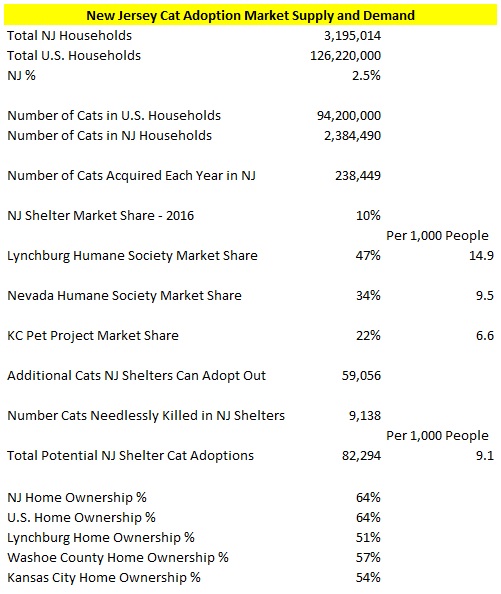
The table below summarizes the New Jersey cat adoption market. Initially, we must estimate the number of cats that live in New Jersey households. Based on the 2017-2018 American Pet Products Survey, 94,200,000 cats live in the country’s households. By taking the percentage New Jersey households are of United States’ households, we can estimate 2.5% of the 94,200,000 cats in U.S. households are in New Jersey homes. Given the home ownership rate in New Jersey and the country are identical and fewer residents in New Jersey (15%) live in homeowners associations, condos and co-ops compared to the country as a whole (21%), New Jersey residents do not face greater pet owning restrictions than the country as a whole. Therefore, using estimates in New Jersey based on national data is reasonable.

We must then compute the number of cats in New Jersey homes and how many cats New Jersey residents acquire each year. To do that, we multiply 2.5% by the 94,200,000 to estimate 2,384,490 cats live in New Jersey homes. Under the assumption cats spend 10 years in a home and people replace those cats, we can estimate New Jersey residents acquire 238,449 cats each year. While the average cat lives longer than 10 years, many people acquire adult cats and cats also become lost. Therefore, the average time a cat is in a home is likely around 10 years.

Next, we must compare New Jersey animal shelters’ share of the market to the averages of several high performing animal control shelters. Based on the data above and recent statistics from Virginia’s Lynchburg Humane Society, Nevada Humane Society’s Washoe County and Carson City facilities and Kansas City, Missouri’s KC Pet Project, these shelters have 47%, 34% and 22%, respectively, of the cat acquisition markets in their communities. All three organizations serve more challenging areas than the average New Jersey animal shelter as shown by their communities’ poverty rates (Lynchburg Humane Society: ~16%, Nevada Humane Society: 13% and KC Pet Project: 18%) exceeding New Jersey’s poverty rate (10%). Furthermore, a greater percentage of households are rented in these three areas (i.e. more pet restrictions) than New Jersey. If New Jersey’s animal shelters obtained the average of these three shelters’ cat market shares (35%), New Jersey animal shelters could adopt out 82,294 cats each year. Given New Jersey animal shelters needlessly killed 9,138 cats in 2016 (i.e. total cats needed to reduce all state animal shelters’ kill rates to 8%), New Jersey animal shelters would only need to adopt out 9,138 or 15% of the additional 59,056 cats these shelters should adopt out.

Clearly, New Jersey animal shelters can adopt out far more cats then they do.

NJ Cat Supply and Demand

Cumberland County SPCA Has More Than Enough Homes to End the Killing of Cats

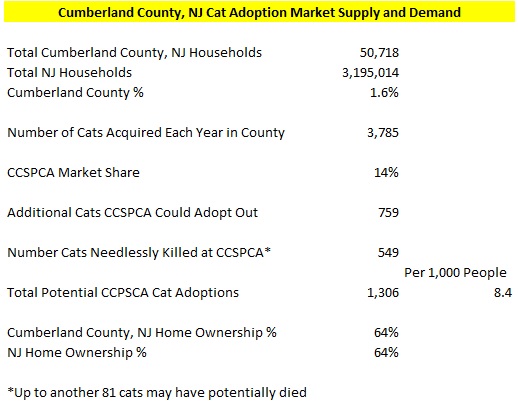
The same analysis for Cumberland County yields a similar result. As you can see below, I used Cumberland County’s number of households as a percentage of New Jersey’s households to compute the number of available homes in the county. Based on the average percentage (35%) the three benchmark animal shelters above make up of the cat adoption market, Cumberland County SPCA could adopt out 1,306 cats or nearly two and a half times more than the 547 cats the shelter adopted out in 2017. In other words, the shelter could attain a no kill level cat live release rate of 92% (i.e. a proxy for no kill status) and even rescue a little more than 100 additional cats from other facilities if it simply replicated the average cat adoption market share of these three role model shelters. While Cumberland County Animal Shelter does take in more cats than the average shelter in the state, this analysis shows more than enough homes exist for its cats.

Cumberland County, NJ Cat Market

State Has Plenty of Homes for Shelter Dogs

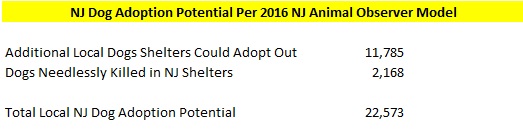
New Jersey shelters have even more homes available for their dogs than cats. Based on the average dog market share of the three benchmark shelters (23%), New Jersey animal shelters could adopt out 47,430 more dogs than they do now. Since the state’s animal shelters needlessly killed 2,168 dogs in 2016, they’d just have to reach 5% of the 47,430 additional dog adoptions to ensure every New Jersey animal shelter had at least a 95% dog live release rate. Furthermore, data from the 2017-2018 American Pets Products Survey indicates New Jersey animal shelters could adopt out 36,156 medium and large size dogs. In fact, this exceeds the 33,463 dogs the state’s shelters impounded in 2016.

NJ Dog Supply and Demand

Cumberland County SPCA Can Adopt Out Many More Dogs

Cumberland County SPCA also has many more homes available for their dogs. Based on the three role model animal shelters’ average market share of the dog acquisition market, Cumberland County SPCA could adopt out 507 more dogs than they did in 2017. Since Cumberland County SPCA needlessly killed 42 dogs (46 dogs may have lost their lives if the four dogs the shelter listed as “Other” outcomes died) in 2017, they’d just have to reach less than 10% of the 507 additional dog adoptions to ensure the shelter had at least a 95% dog live release rate. Furthermore, data from the 2017-2018 American Pets Products Survey indicates Cumberland County SPCA could adopt out 574 medium to large size dogs out a year. Thus, Cumberland County SPCA could adopt out many more dogs and stop killing healthy and treatable dogs.
Cumberland County Dog Supply and Demand

Plenty of Homes Exist in My More Conservative Analysis

Each year, I use a model I created to target the number of dogs and cats every New Jersey animal shelter should adopt out, send to rescue and rescue from other facilities. You can read more about these models for dogs here and cats here.

New Jersey animal shelters could adopt out far more dogs and cats than they unnecessarily kill according to my model. Specifically, New Jersey animal shelters could adopt out over 32,000 more cats or four times as many cats than they currently needlessly kill. Similarly, the state’s animal shelters could adopt out nearly 12,000 more local dogs (i.e. excluding transports) or five times more than they currently needlessly kill.

NJ Cat Adoption Potential - NJ Animal Observer Model

2016 NJ Shelters Dog Adoption Potential

While Cumberland County SPCA impounds more cats than most New Jersey communities, the same trend holds for this shelter. Specifically, Cumberland County SPCA could adopt out 712 more cats while it needlessly killed 549 cats (630 cats if we assume the 81 cats classified as “Other” outcomes died). Interestingly, rescues and other shelters pulled over 150 more cats than my model targets for Cumberland County SPCA. Thus, Cumberland County SPCA received more than enough rescue assistance.

CCSPCA 2017 Cat Adoption Potential - NJ Animal Observer Model

Cumberland County SPCA’s dog data is ever more favorable. Specifically, Cumberland County SPCA could adopt out 209 more dogs per my model while it needlessly killed 42 dogs (46 dogs if we assume the four dogs the shelter classified as “Other” outcomes died). Furthermore, the rescue community did more than their fair share by rescuing around 120 more dogs than I target for Cumberland County SPCA.

CCSPCA 2017 Dog Adoption Potential - NJ Animal Observer Model.jpg

Reaching Adopters Requires High Quality Customer Service

Frequently, I see regressive shelters and certain rescues complain about too many animals and not enough homes while these organizations make it difficult for people to adopt. Many shelters and rescues create an adversarial relationship with potential adopters by requiring various documents and other hurdles to “prove” their worthiness to adopt. Some examples are as follows:

  • Home checks
  • Landlord references and/or home ownership documents
  • Veterinary references
  • Personal references
  • Household pet veterinary records
  • Mandating all family members go to adopt the animal at the same time
  • Requiring existing household dogs go and visit the dog a family wants to adopt
  • Requiring fenced in yards
  • Barring families who work from adopting
  • Not allowing families with children to adopt (when the animal does not have serious behavior problems)
  • Denying adoptions when an existing pet is not spayed/neutered even when the shelter/rescue will alter the adopted pet.

While I could write paragraphs on why these policies end up killing shelter pets, the Humane Society of the United States’ Adopters Welcome guide provides excellent explanations on why these policies do not work along with supporting studies. The key points about these policies are as follows:

  1. Make potential adopters feel like criminals
  2. Cause people to provide “the right answers” and not share other information
  3. Reduce the number of good pet owners who can adopt
  4. Extend the time animals stay with shelters and rescues that ultimately lead to increased killing for space, more stress and behavioral deterioration in shelter animals and higher disease rates in shelter animals

After adopting out animals the conventional way through rescues my spouse and I fostered for, we switched to an “open” or conversational based adoptions process similar to the HSUS Adopters Welcome policies. Instead of using a check the box adoption approval process, we develop relationships with adopters. We spend a good amount of time talking with the adopter, getting to know them, and helping them determine whether the pet is a good fit. As a result of the relationships we develop, the adopters almost always become “friends” with us on Facebook and we often see the pets enjoying life in their new homes.

Why Many Shelters and Rescues Ignore Data That Saves Lives

So why do shelters ignore the clear evidence that more than enough homes exist for homeless animals, particularly in New Jersey? When shelters and their staffs kill animals, they must rationalize this fact especially if they love animals. If not enough homes exist, these individuals can then say they have no choice. This rationalization, which may have been true decades ago when shelter intake was far higher, is embedded in the culture of many shelters and even many rescuers. Thus, these people will often get angry when they learn killing shelter pets is in fact avoidable.

The reasons many rescuers also believe in pet overpopulation is more complicated. As I indicated above, some long-time rescuers may still view the world as it was decades ago when pet overpopulation really did exist. On the other hand, some rescuers may require the pet overpopulation myth to rationalize their close friendships with individuals running kill shelters. Finally, some cat rescuers, particularly those practicing TNR, may see the large numbers of community cats and be frustrated they can’t find homes for every one of them. While finding a home for every single community cat is not realistic, community cats do in fact thrive outside. Therefore, some TNR practitioners may conflate community cats with those in shelters to incorrectly conclude not enough homes exist for the much smaller number of cats in shelters.

Shelters and rescues frequently use onerous and counterproductive adoption processes due to the people they typically encounter not representing the pet owning public. Many shelters and rescues often deal with people who must surrender their animals as well those that may abuse their pets. However, this is a tiny percentage of the pet owner population. For example, New Jersey animal shelters impounded 67,594 dogs and cats in 2016 from the state while 4,655,071 dogs and cats live in New Jersey homes per the estimates above. In other words, only 1.5% of the dogs and cats in New Jersey homes entered a shelter as a stray, an owner surrender or in a cruelty seizure in 2017. However, even that estimate is too high since shelters impound many community cats with no owner. If we just look at dogs, New Jersey animal shelters only took in 1.1% of the dogs in New Jersey homes. Even this number may be too high since many dogs arriving at shelters were lost due to an accident and the owner quickly reclaimed the animal. If we exclude all reclaimed dogs from these calculations, only 0.6% of dogs in New Jersey homes would end up in a shelter. Thus, many shelters and rescues are judging potential adopters based on around 1% of New Jersey pet owners.

Many shelters and rescues may use overly strict adoption processes due to personal reasons. Unfortunately, I’ve encountered some people running shelters and rescues who believe they are morally superior to others and/or are on a power trip. While these people may claim their adoption processes are there to protect the animal, I find they enjoy having power over people who are emotionally attached to an animal they want to adopt. In extreme cases, I’ve seen overt racism involved. Finally, I’ve found some individuals running shelters and rescues to lack people skills and openly claim they hate people and love animals. While there is no crime in having that view, organizations would save more lives if they have individuals who like people interacting with adopters.

At the end of the day, the animal welfare movement must make logical decisions based on objective data rather than myth and folklore if we are to end the killing of healthy and treatable animals. The sooner we do that, the sooner will will achieve a no kill New Jersey and a no kill nation.

Austin Animal Center’s Awesome Year

Austin, Texas has become synonymous with no kill success. While Austin Animal Center exceeded the 90% live release rate many consider as being no kill in 2012, the shelter’s live release rate increased sharply in 2016. The shelter’s success in 2016 was spearheaded by Director of Animal Services, Tawny Hammond, and Deputy Chief Animal Services Officer, Kristen Auerbach, both of whom came over from Fairfax County Animal Shelter in Virginia.

Hound Manor performed a fantastic analysis of Austin Animal Center’s 2016 results. This analysis utilized various computer programming techniques to extract incredibly useful data from Austin’s open public data on its web site. While I don’t have the skills to replicate such an analysis, I was able to obtain some key data I frequently use in my New Jersey animal shelter analyses.

Tammy Hammond left Austin Animal Center in May 2017 to join Best Friends and Kristen Auerbach resigned in July 2017 to take over Pima Animal Care Center in Tuscon, Arizona. How did Austin Animal Center perform in 2017? Did the shelter continue its success without two of its key leaders?

Incredible Live Release Rates

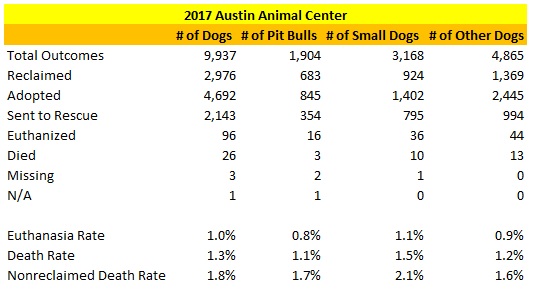
Austin Animal Center saved virtually every dog that arrived in 2017. Overall, only 1.3% of all dogs, 1.1% of pit bull like dogs, 1.5% of small dogs and 1.2% of other medium to large size dogs lost their lives or went missing at the shelter. Even if we only look at dogs who were not reclaimed by owners, only 1.8% of all dogs, 1.7% of pit bulls, 2.1% of small dogs and 1.6% of medium to large size breeds lost their lives or went missing. Thus, Austin Animal Center saved almost every dog it took in last year.

Austin Animal Center’s pit bull numbers are especially noteworthy. Despite taking in over 1,900 pit bull like dogs in 2017, Austin Animal Center saved 99% of these dogs. On a per capita basis, Austin Animal Center impounded 1.9 pit bulls per 1,000 people compared to my estimate of just 0.9 pit bulls per 1,000 people taken in by New Jersey animal shelters as a whole. In other words, Austin Animal Center saved 99% of its pit bull like dogs even though it took in twice as many of these dogs on a per capita basis as New Jersey animal shelters. Similarly, Austin Animal Center adopted out 0.8 pit bulls per 1,000 people compared to the 0.5 pit bulls per 1,000 people New Jersey animal shelters would need to adopt out to achieve a 95% dog live release rate. As a result, Austin Animal Center’s results prove New Jersey animal shelters can do a far better job with their pit bull like dogs.

Austin Animal Center 2017 Dog Statistics

Austin Animal Center also had amazing cat numbers. Overall, only 5.3% of all cats, 7.2% of adult cats, 1.9% of kittens 6 weeks to just under one year and 8.5% of kittens 6 weeks and under lost their lives at Austin Animal Center in 2017. Even if we exclude cats who were reclaimed by owners and placed through the shelter-neuter return program, only 6.4% of all cats, 11.1% of adult cats, 2.2% of kittens 6 weeks to just under 1 year and 8.6% of kittens under 6 weeks old lost their lives. Thus, Austin Animal Center saved almost all their cats of all ages.

Austin 2017 Cat Statistics

Austin Animal Center Only Euthanizes Dogs for Legitimate Reasons

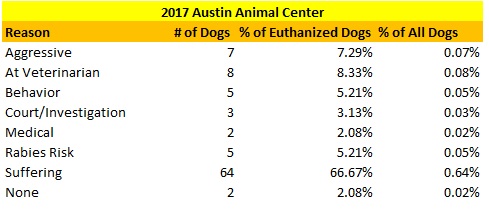
The table below lists the reasons Austin Animal Center used to euthanize dogs in 2017. As you can see, 75% of the euthanized dogs were due to severe medical reasons (i.e. suffering, at veterinarian).

Austin Animal Center limits behavioral euthanasia to truly aggressive dogs. Hound Manor’s blog on Austin Animal Center’s 2016 data found the shelter euthanized a similar percentage of dogs for behavioral reasons in the final quarter of fiscal year 2016 as the No Kill Advocacy Center targets (i.e. under 1%). As you can see below, Austin Animal Center only euthanized 0.15% of all dogs for behavioral related reasons (i.e. aggression, behavior, court/investigation). Even if we add rabies risk and none, Austin Animal Center would have only euthanized 0.22% of all dogs for behavioral reasons. Thus, Austin Animal Center limited behavioral euthanasia to truly aggressive dogs.

Austin Animal Center also reduced the number and percentage of dogs euthanized for rabies risk. As Hound Manor mentioned in its blog, few dogs killed for rabies testing end up having the disease. In fact, the New Jersey Department of Health’s guidelines state shelters should not euthanize dogs for rabies unless they have clinical signs of the disease. Austin Animal Center euthanized 5 dogs (0.05% of all dogs) in 2017 compared to the 14 dogs (0.14% of all dogs) reported by Hound Manor in fiscal year 2016.

Austin Animal Center 2017 Euthanized Dogs Reasons

The shelter also limited behavioral euthanasia for pit bull like dogs to truly aggressive animals. Austin Animal Center only euthanized 0.26% of all pit bulls for aggression and behavior. In fact, this number was nearly identical to the percentage of all dogs euthanized for behavioral related reasons. The other 0.58% of all pit bulls euthanized were suffering. When you couple this data with the results of a recent study showing severe dog bites did not increase after Austin implemented its no kill plan, it proves shelters can in fact safely adopt out large numbers of pit bull like dogs.

Austin Animal Center 2017 Pit Bulls Euthanized Reasons

Austin Animal Center’s reasons for euthanizing small dogs followed this same pattern. The shelter only euthanized one dog for aggression and other behavioral reasons (0.03% of all small dogs). This is quite close to my standard that shelters should never euthanize a small dog for aggression. Almost all the other small dogs were euthanized for severe medical issues (i.e. suffering, at veterinarian).

Austin Animal Center 2017 Small Dogs Euthanized Reasons.jpg

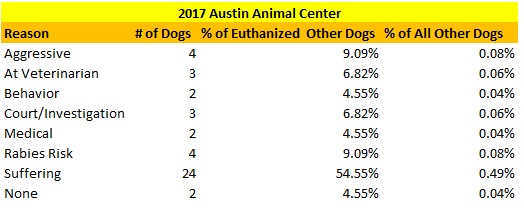
The shelter also only euthanized other medium to large size dogs for legitimate reasons. Austin Animal Center only euthanized 0.18% of other medium to large size dogs for behavioral related reasons (i.e. aggression, behavior, court/investigation). Even if we add rabies risk and none, Austin Animal Center would have only euthanized 0.30% of all dogs for behavioral reasons. Virtually all the rest of the other medium to large size dogs were euthanized for severe medical problems.

Austin Animal Center 2017 Other Dogs Euthanized Reasons
Austin Animal Center Limits Cat Euthanasia Primarily to Severe Medical Issues

The table below lists the reasons Austin Animal Center used to euthanize cats in 2017. As you can see, around 90% of the euthanized cats were due to severe medical reasons (i.e. suffering, at veterinarian). While 5% of the euthanized cats and 0.2% of all cats who had outcomes cited “medical”, its possible these were severe medical issues that warranted humane euthanasia. Similarly, Austin Animal Center’s very low numbers of cats euthanized for no documented reason or for being underage (6 cats, 2.41% of euthanized cats and 0.10% of all cats who had outcomes) may indicate clerical errors rather than the shelter killing cats for no good reason. Most impressively, Austin Animal Center did not kill a single cat for behavior or aggression.

Austin Animal Center also reduced the number and percentage of cats euthanized for rabies risk. As Hound Manor mentioned in its blog, few animals killed for rabies testing end up having the disease. Austin Animal Center euthanized 7 cats (0.11% of all cats who had outcomes) in 2017 compared to the 23 cats (0.34% of all cats who had outcomes) reported by Hound Manor in fiscal year 2016.

These statistics indicate Austin Animal Center pretty much only euthanizes hopelessly suffering cats. Given shelters should never kill cats for aggression or behavioral reasons, this is an incredible achievement since Austin Animal Center had 6,569 cats who had outcomes during the year.

Austin Animal Center 2017 Cats Euthanized Reasons

Austin Animal Center’s Partner Helps the Shelter

Austin Pets Alive has been a major reason the community achieved no kill status. Historically, this organization pulled animals directly from the kill list at Austin Animal Center. In other words, instead of cherry-picking easy to adopt animals like many rescues do, Austin Pets Alive takes on the most difficult animals. As a result of taking on these tough cases and the organization’s strong desire to make Austin no kill, Austin Pets Alive developed and implemented a host of cutting edge programs. Examples, such as dog playgroups, a Canine Good Citizen training and certification program and large scale fostering help save the lives of large dogs that are most likely to lose their lives in shelters. Other programs, such as parvo and ringworm treatment and barn cat placements save vulnerable animals. In addition, Austin Pets Alive’s owner surrender prevention program helps owners keep animals and avoid giving them to Austin Animal Center. Thus, Austin Pets Alive has historically focused on its community to help Austin Animal Center achieve no kill status.

Austin Animal Center is relying less on Austin Pets Alive than in the past. In 2012, when Austin Animal Center first exceeded a 90% live release rate, it sent 29% of its dogs and 51% of its cats to Austin Pets Alive and other shelters and rescues. Last year, it only sent 22% of its dogs and 28% of its cats to Austin Pets Alive and other organizations. As a result, Austin Pets Alive has been able to assist other Texas shelters since its local animal control shelter truly achieved no kill.

Austin Animal Center Sets a New Bar for Lifesaving

Austin Animal Center has continued to improve over the years. While Austin Animal Center benefited from having an amazing rescue oriented shelter, Austin Pets Alive, help, Austin Animal Center has really stepped up its game. You can see some of the innovative programs, such as progressive animal control, breed neutral adoption policies, a large scale foster network, innovative social media use and a huge and effective use of volunteers in this story. As a result of these efforts, Austin Animal Center has effectively limited euthanasia to hopelessly suffering animals and dogs that are truly dangerous.

While Austin Animal Center’s success is hard to match, the animal control shelter serving the area just to the north, Williamson County Animal Shelter, also is extremely successful. Despite having a significantly smaller budget per animal than Austin Animal Center (approximately 40% less after adding an estimated $200 per animal to Williamson County Animal Shelter’s budget for animal sheltering only) and receiving less rescue support for both dogs (Austin Animal Center: 22% of outcomes; Williamson County Animal Shelter: 10% of outcomes) and cats (Austin Animal Center: 28% of outcomes; Williamson County Animal Shelter: 11% of outcomes), Williamson County Animal Shelter came close to reaching Austin Animal Center’s live release rates for dogs (Austin Animal Center: 98.7%; Williamson County Animal Shelter: 98.0%) and cats (Austin Animal Center: 94.7%; Williamson County Animal Shelter: 90.2%).

Williamson County Animal Shelter also had very impressive adoption numbers. While Austin Animal Center’s per capita adoption rates of 4.6 dogs and 3.2 cats per 1,000 people are excellent, Williamson County Animal Shelter’s per capita adoption rates of 5.0 dogs and 6.7 cats per 1,000 people are even higher. Similarly, Williamson County Animal Shelter scored much better using my dog adoption model taking into account shelter capacity and owner reclaims (Austin Animal Center: 118% of target dog adoptions; Williamson County Animal Shelter: 251% of target dog adoptions). Williamson County Animal Shelter’s high score was primarily due to it quickly adopting out animals. This is reflected in the shelter’s short average length of stay figures (dogs: 8.0 days, cats: 13.4 days).

The key point is that Austin Animal Center is not unique. Since an animal shelter taking in over 7,300 dogs and cats in 2017 (i.e. higher intake than the largest New Jersey animal shelter) next door to Austin can achieve similar success, this proves Austin Animal Center was not taking homes away from animals in nearby areas. If anything, Austin Animal Center and Williamson County Animal Shelter likely spurred innovation at both facilities through raising standards and learning from each other.

New Jersey animal control shelters can achieve similar success. In 2016, Associated Humane Societies, New Jersey’s largest animal sheltering organization, took in $1,354 of revenue per dog and cat impounded. As a comparison, Austin Animal Center had a budget of $715 per dog and cat and Williamson County Animal Shelter only had a budget of $416 per dog and cat and total revenue of $493 per dog and cat after adding $200 per dog and cat for animal control services (shelter does not pick up animals). Thus, New Jersey’s largest animal welfare organization takes in far more money per dog and cat yet its Newark facility is high kill and had horrific state health department inspection reports.

Clearly, shelters like Austin Animal Center and Williamson County Animal Shelter prove most animal control shelters can achieve high live release rates and attain real no kill status (i.e. only euthanize hopelessly suffering and truly dangerous dogs). The time for excuses has stopped and its now time for action.

Associated Humane Societies-Newark’s Atrocious Inspection Report

Regular readers of this blog are familiar with Associated Humane Societies-Newark’s horrific history. In 2003, State of New Jersey Commission of Investigation (“SCI”) issued a scathing report on AHS. Specifically, the report stated AHS failed its animals on a grand scale:

The history of AHS’s shelter operation has been dominated by deplorable kennel conditions, inhumane treatment of animals by workers, mismanagement and nonexistent or inadequate medical care. The problems were neither singular nor occasional. The accounts and descriptions provided by members of the public and former and current staff members, including veterinarians, paint a bleak picture of shelter life. The reality for the animals belied AHS’s propaganda that its “sole purpose” has been “the care and welfare of animals” and that it has “a high adoption rate.”

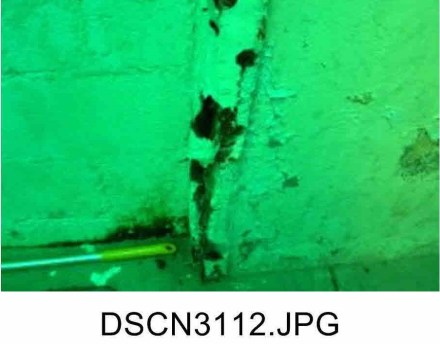
The New Jersey Department of Health found AHS-Newark violating state law left and right in 2009. This inspection revealed AHS-Newark did the following:

  1. Illegally killed animals during state’s seven day hold period
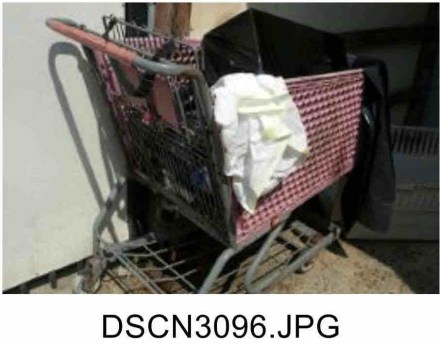
  2. Left dead rotting animals in shopping carts outside
  3. Let dogs live in filthy kennels covered in feces
  4. Failed to properly treat sick animals
  5. Did not isolate sick animals from healthy ones
  6. Failed to properly clean animal enclosures
  7. Had an inadequate disease control program
  8. Did not list weights of animals and methods used to kill animals
  9. Did not properly keep animal intake and disposition records
  10. Facility needed repairs to prevent injury to animals
  11. Allowed animal enclosures to deteriorate to the point they could not be properly cleaned

Sadly, the New Jersey Department of Health continued to find significant issues during another inspection in 2011. The inspection report noted dogs housed in kennels with a collapsed roof and workers throwing damaged roof material directly over these dogs. Additionally the report stated outdoor drains were in severe disrepair, no isolation areas for sick large dogs existed, automatic dog feeders were filthy, dogs were exposed to contaminated water and chemicals during the cleaning process, and some animals were not receiving prompt medical care.

Last year, I wrote a blog highlighting potential violations from 2014. Specifically, records I examined suggested AHS-Newark may have violated state law as follows:

  1. Illegally killing animals during state’s seven day hold period
  2. Failing to properly treat sick animals
  3. Not keeping proper animal intake and disposition records

As a result of this review and the City of Newark’s Department of Health and Community Wellness failing to conduct robust inspections, I requested the New Jersey Department of Health inspect AHS-Newark.

After animal advocates got word of a joint New Jersey Department of Health and Newark Department of Health and Community Wellness inspection (undoubtedly the New Jersey Department of Health did most, if not all, of the work) last week, AHS-Newark attempted to downplay the results. Specifically, the organization made a Facebook post that included the following language suggesting AHS-Newark just needed to refine a few processes to make sure it is “operating at the highest level”:

Associated Humane Societies (AHS) Newark branch has recently been inspected by both the NJ State Health Department and the City of Newark Health Department. We are working closely with both agencies to ensure we are operating at the highest level we can so we may provide the best service possible to both the animals and the public. We look at this as an opportunity to review and improve our processes and to retrain established and new staff.

Was AHS-Newark being fully transparent with its statement? Does AHS-Newark have massive problems? Has AHS-Newark consistently had the same issues? What kind of “service” does AHS-Newark provide to the animals and the public?

You can view the inspection report here and the related photos here. All photos posted in this blog were originally sourced from the New Jersey Department of Health’s August 22, 2017 inspection of AHS-Newark.

AHS-Newark Violates State Law on a Massive Scale

According to the inspection report, AHS-Newark did not comply with state law to such an extent that the City of Newark could not issue the facility a license.

1.2 (a) and (b) The facility is not in compliance with these rules, therefore a satisfactory certificate of inspection for the current licensing year by the local health authority cannot be issued. The facility is currently unlicensed and a license for the current year cannot be issued by the City of Newark until the facility is brought into significant compliance.

Illegal Killing During Seven Day Protection Period

AHS-Newark illegally killed both stray and owner surrendered animals during the seven day protection period. In fact, AHS-Newark illegally killed many animals according to the inspectors. Given AHS-Newark violated this law in 2009 and should have known from my blog last year that it potentially violated the law in 2014, the shelter has no excuse for these actions. To make matters worse, AHS-Newark illegally killed surrendered animals at the shelter and its clinic next door. Clearly, AHS-Newark has no respect for life since it can’t wait a mere seven days to kill animals.

1.10 (a) 1. and N.J.S.A. 4:19-15.16 Many animals were being euthanized before being held the required 7 days after intake or impoundment. Records showed that stray and surrendered animals that were received at the facility by animal control officers and other individuals were being euthanized within the mandatory 7 day holding period. Stray impounded animals are required to be held at least 7 days to provide an opportunity for owners to reclaim their lost pets. Examples of animals euthanized within the required 7 day holding period include but were not limited to the following ID numbers: 22392, 22393, 22394, 22395, 22396, 22397, 22398, 22399, 22400, 23831, 22847, 22856, 23999, 24000, 22684, 23708, 23732, 23733, 19517, 22937, 22945, 22944, and 22936.

Animals were also being accepted for elective euthanasia and were being euthanized on intake. Although the animals were being taken to the medical ward section of the facility for euthanasia to be performed, the owner of the animal was paying the euthanasia fees directly to the animal facility at the front desk. The veterinary medical ward is not a separate entity from the animal shelter and impoundment facility. In the case of an owner surrender, the facility is required to offer the animal for adoption for at least 7 days before euthanizing it, or may transfer the animal to an animal rescue organization facility or a foster home prior to offering it for adoption if such transfer is determined to be in the best interest of the animal by the shelter or pound.

Records Suggest Killing and Euthanasia May Not Be Humane

AHS-Newark violated various euthanasia provisions of state law. Specifically, AHS-Newark did not:

  1. Post proper written euthanasia/killing instructions to assist people in conducting the procedure humanely
  2. Weigh animals prior to killing/euthanasia to ensure animals received proper doses of sedatives and killing agents
  3. Specify the method of killing/euthanasia

If AHS-Newark failed to provide enough sedatives, animals could experience emotional distress. Similarly, if AHS-Newark did not provide enough Fatal Plus and verify the animals’ deaths, animals potentially could have been placed into the facility’s incinerator while still alive.

1.11 (f) Written instructions were not posted in the euthanasia area that included the dosages by weight in pounds of all euthanasia, immobilizing, and tranquilizing agents used at the facility. Animals were not being weighed prior to administration of euthanasia, immobilizing, or tranquilizing agents. The weight recorded on an animal’s record at the time of intake was being used to calculate the dosages of these substances, but the weight on intake may not be the same weight of the animal at the time it is euthanized. Euthanasia records were not maintained that contained the body weight and dosage of all euthanasia, immobilizing, and tranquilizing agents administered to each animal. Dosage and usage logs were being maintained in a euthanasia log book, but this information was not available in the records reviewed by inspectors at the time of this inspection as required. (See 1.13 for more details.)

1.13 (a) Inspectors went to the medical ward of the facility and were provided with a stack of euthanasia records for animals that had been euthanized at the facility within the past month, but these records did not include the intake information and the description of the animals as required. The inspectors were unable to correlate the intake information and record numbers of animals that were obtained at the front desk to most of these euthanasia records. The weight of the animals was not being recorded on these paper records and the method of euthanasia, such as IV, IC, or IP, was not recorded in these records. Some of the euthanasia records were also missing the amount of euthanasia and tranquilizing agents that had been administered to these animals in addition to the species and description of these animals that had been euthanized.

Dead Animals Treated Like Trash

According to the inspection report, AHS-Newark had “bags of dead animal carcasses” next to the outside portion of its dog enclosures and close to its incinerator. Clearly, these bodies were outside for a long period of time since “a swarm of flies” were around the corpses. To make matters worse, more carcasses were dumped along with actual trash in a shopping cart just like the 2009 inspection report found. What kind of terror did the live dogs in the nearby enclosures feel with this stench of death in the air?

1.3 (d) There were bags of dead animal carcasses that had attracted a swarm of flies and were placed inside the gate adjacent to the dogs housed in the outdoor enclosures. These bags were stored outside of the walk-in refrigeration unit in the fenced area where the incinerator is located. There were additional bags of carcasses and trash stored in a red shopping cart in this same area that were also covered with flies.

3094

3096

3097.jpg

AHS-Newark Allows Disease to Spread Like Wildfire

Despite AHS taking in over $9 million of revenue last year, AHS-Newark failed to have a a supervising veterinarian establish a legally required written disease control and adequate health care program. Prescribed medicines were not administered to animals or given improperly according to shelter documents.

1.9 (a) The supervising veterinarian had not established a written disease control and adequate health care program at the facility and a disease control program was not being sufficiently maintained under the supervision of the veterinarian. Medications that had been prescribed by the veterinarian were not being documented as being administered as prescribed on the prescription label. Daily medication administration logs were missing several days, indicating that the medication may not have been administered on those days; daily medication logs were not being maintained and were not available on the shelter side of the facility; a prescription label for enrofloxacin prescribed to a dog with ID number 23466, stated to administer one tablet per day, but the medical chart on the computer stated twice per day.

The inspection report noted AHS-Newark did not separate sick animals from healthy ones. Isolating sick animals with contagious diseases is the cornerstone of any disease control program. In a shelter environment, one sick animal can quickly infect dozens more.

Shockingly, AHS-Newark did not provide veterinary care to a number of sick animals. Instead, it allowed a poor “listless” dog with “thick green nasal discharge” to sit in the main kennels. The animal caretaker in charge of medical care’s response? The dog “doesn’t look sick now.” Even worse, AHS-Newark kept dogs awaiting spay/neuter surgeries with coughing dogs having various contagious diseases. Since AHS-Newark typically only spays/neuters animals after someone adopts a pet, many adopters may have received a dog who was sick.

1.9 (f) Animals with signs of a communicable disease were not separated from other healthy animals and placed in an isolation room in order to minimize dissemination of such disease. Dogs that were said to have been diagnosed with Kennel Cough Complex by the supervising veterinarian and were prescribed medications, were housed in the general population. A brindle pit mix housed in kennel number 124 in the main kennel area of the facility, appeared listless and had thick green nasal discharge (pictures 3105 and 3106). This dog was not seen by a veterinarian and was not receiving medical care and was not moved to an isolation room. When this dog was pointed out by the inspector to the animal caretaker in charge of medical care, the caretaker stated that the dog “does not look sick now.” Animals in the general medical ward room, including one of the larger dogs that was heard coughing, were prescribed treatment for various illnesses and communicable diseases, but there were also healthy animals housed in this room that were awaiting spay or neuter surgeries before being released to their adoptive families.
3105 pt 2.jpg

3106 pt 2.jpg

Even worse, AHS-Newark failed to even treat sick animals in the general population. If spreading disease to other animals was not bad enough, the inspectors specifically stated “animals exhibiting signs of stress were not provided any type of relief.”

Animals that were exhibiting signs of illness were housed with the general population and several animals that were being housed in the basement isolation room were not reported to and were not under the care of the supervising veterinarian. Animals exhibiting signs of stress were not provided with any type of relief. The disease control protocols established for the highly contagious isolation room located in the medical ward section of the facility were not being adhered to by the animal caretakers. (See 1.9 (d) through (h) for details.) There were signs on the door to two cat rooms that stated do not use until approved by Dr. Reich (the supervising veterinarian) but the manager and staff stated that they did not know why those signs were placed on the doors and why those rooms could not be used.

AHS-Newark staff allowed disease to spread from the isolation area to the rest of the facility. Animal shelter employees must wear various protective clothing and gear to avoid transmitting highly contagious diseases to healthy animals. Despite clear written instructions on the wall outside the isolation area, the AHS-Newark animal caretaker wore their gloves in the isolation area and outside of this space. In fact, this person even walked into the general medical area with these gloves exposed to highly contagious diseases. To make matters worse, the animal caretaker also took two water bowls from the isolation area to the general medical ward and the person stated they hose off litter boxes from the isolation area outside. Thus, AHS-Newark created conditions for disease to rapidly spread through and outside the facility.

1.9 (f) 1. There was a sign posted on the wall outside of the highly contagious isolation room located at the end of the hallway in the medical ward area of the facility that contained instructions and procedures to control the dissemination of disease. The sign listed two veterinarians to contact for questions, but neither of these veterinarians were listed as the supervising veterinarian for the facility. The animal caretaker that was cleaning the cages in this highly contagious isolation room was not adhering to the posted instructions. The instructions stated to wear personal protective equipment, including gowns and shoe coverings and gloves, and to remove PPE when leaving the room. The person that was cleaning this room on the day of this inspection left the room several times during the cleaning process, and was not wearing gowns or shoe coverings as instructed on the sign. This person did not remove gloves before leaving this room and walked to the restroom to fill a water bowl, touching the door handle with the used gloves on, and later walked to the general medical ward room at the other end of the hallway to use the utility sink and again to get paper for the cages in the highly contagious isolation room. When questioned, the animal caretaker stated that bowls from this highly contagious isolation room are cleaned in the utility sink located in the general medical ward room and litter boxes are taken outdoors and hosed off and cleaned outside. This practice of cleaning litter receptacles and other items outdoors, both from the isolation rooms and the general population creates the potential for disease transmission to the outside of the facility.

AHS-Newark locked up feral cats in a hidden prison. According to inspectors, the room’s glass walls were completely covered with cardboard preventing people from looking inside. Furthermore, inspectors couldn’t even see inside after removing the cardboard due to accumulated filth.

1.9 (d) Cats that were difficult to handle and classified as “feral” cats were housed in enclosures that contained glass walls that were completely covered with cardboard and newspapers. These cats could not be observed for signs of disease, illness or stress. When the inspectors pulled off a portion of the cardboard to try and view these cats, the glass beneath was too dirty to see through clearly. This enclosure door contained a padlock so the inspectors were unable to open the door to get a better view of the cats and the conditions inside this enclosure.

To make matters worse, the shelter provided no hiding boxes, soft bedding, resting benches and individual housing compartments to allow these cats to hide from other cats in order to relieve stress. Stressed cats are more likely to contract diseases. Simply put, AHS-Newark threw so-called feral cats into this room until they met their fate (presumably killing).

1.9 (d)2. The hiding boxes that had previously been used in the “feral” cat enclosures were removed due to deterioration and had not been replaced with alternate suitable hiding boxes. There were approximately 27 cats housed in one of these enclosures and these cats were not provided with soft bedding and hiding places, resting benches, or individual housing compartments to hide from other cats in the same enclosure in order to relieve stress.

AHS-Newark’s dog enclosures were kept in such disrepair that staff could not disinfect these places. Therefore, once disease spread from the isolation area or other places, the dog kennels probably became and stayed infected. If that wasn’t bad enough, AHS-Newark’s food storage area was also prone to harboring disease for the same reasons.

1.4 (f) The interior surfaces of the main dog kennel enclosures and throughout the facility were in severe disrepair. The layers of accumulated peeling paint and broken concrete in the animal enclosures and throughout the facility created crevices that were unable to be readily cleaned and disinfected. The food storage room had holes in the walls at the floor that had been filled with expanding foam. This foam was not cut back, leveled, and covered with an appropriate product to create a smooth surface before being painted which resulted in numerous nooks and crannies that could not be readily cleaned and disinfected.

3112

To make matters worse, cats in group housing resided in rooms with carpeted cat trees that contained accumulations of dried feces or vomit.

There were carpeted cat trees and sisal rope cat scratchers in the communal cat rooms that contained an accumulation of hair and dried feces or vomit. These cat trees and rope items cannot be cleaned and disinfected and need to be removed and replaced with suitable items as discussed with the manager at the time of this inspection. The window ledge in the communal cat room was in disrepair and was unable to be readily cleaned and disinfected; the caulking was in disrepair at the viewing window ledge and needed to be resealed.

AHS-Newark also may have provided contaminated food to animals. The shelter did not scrub off particles on food and water bowls. Water dispensing devices had accumulated grime. In the basement isolation area sink, AHS-Newark had a bowl of food with black mold growth. One has to wonder how long this food bowl sat there.

1.7 (e) and (h) Animal food bowls were not being scrubbed clean before being disinfected. Food and water bowls were emptied and sprayed down with a disinfectant, but were not scrubbed clean before the disinfectant was applied. There were food particles left on the inside surfaces of the food buckets after the disinfecting process and there was an accumulation of grime on the automatic waterers that the inspector was able to scrape off with her fingernail after the disinfecting process was completed. The manufacturer’s instructions for this disinfectant requires that food contact surfaces be scrubbed before disinfection and the instructions state “Then thoroughly scrub all treated surfaces with soap or detergent and rinse with potable water before reuse.” These food and water receptacles were not being scrubbed with a soap or detergent appropriate for food contact surfaces followed by a thorough rinse with potable water after this disinfectant was applied.

The utility sink located in the basement isolation room contained stainless steel bowls that had not been cleaned. There was a large serving spoon in one of these bowls that had caked on food, and the food in the bowl appeared to have signs of decomposition and black mold growth.

3149.jpg

Similarly, AHS-Newark’s food storage area was a disaster. According to the inspection report, the shelter did not regularly clean this area and it accumulated spilled food, pigeon feathers and other debris.

The food storage room was not being cleaned regularly and there was an accumulation of spilled food, trash, pigeon feathers, and debris under and between the bags and boxes of stored food. The areas between and under the roll out banks of stainless steel caging contained an accumulation of dirt, trash and debris and were not being cleaned.

3128

If all of this was not bad enough, AHS-Newark did not even clean its kennels properly. Specifically, the geniuses at AHS-Newark sprayed disinfectant in kennels before removing all the feces. Even after using a rake to remove the feces, they did not remove “a thick layer of feces that remained on these surfaces.” Thus, the shelter did not disinfect the animal enclosures.

1.8 (c) Enclosures were not being thoroughly cleaned and rinsed as required by the manufacturer’s instructions before the disinfectant was applied to non-food contact surfaces. The disinfectant was being sprayed into the kennel enclosures before the feces were removed from these enclosures. The animal caretakers were instructed to scoop the feces from the enclosures, but after they scooped with a rake, there was still a thick layer of feces that remained on these surfaces that was not scrubbed off and rinsed away before a fresh application of disinfectant was applied. The manufacturer’s instructions state “Thoroughly clean all surfaces with soap or detergent and rinse with water. Apply fresh Use Solution to floors, walls, cages and other washable hard, non-porous environmental surfaces.”

3108.jpg

AHS-Newark Leaves Animals in Inhumane Conditions

AHS-Newark left a live skunk in unspeakably cruel conditions. According to the inspection report, the shelter picked up a live skunk at 7:00 am or 7:30 am and subsequently left the animal in direct sun in a blanket covered carrier on a concrete surface with air temperatures as hot as 87 degrees. The inspector found the animal at 11:20 am. Undoubtedly, the actual temperature inside the carrier was hotter since it was on a concrete surface. To add insult to injury, AHS-Newark left the skunk next to a bag of dead animals and an incinerator. The shelter effectively left the animal to die in these hot temperatures and allowed the skunk to sense its fate with the bag of slaughtered animals and incinerator close by. The AHS manager initially told the inspector no animal was in the carrier, but when the inspector showed them the skunk, the AHS manager stated the skunk was dead. Would AHS-Newark have placed this live animal into the incinerator if the inspector was not there? Only after the inspector notified shelter personnel did AHS-Newark move the skunk to a cooler place. What medical care did AHS-Newark ultimately provide? Killing later that day.

1.5 (a) A live skunk was found inside a small animal carrier which was completely covered with a heavy, black and white heather blanket and placed in direct sunlight on a concrete surface. The outside air temperature was approximately 85 to 87 degrees Fahrenheit at the time the skunk was found by the inspector at approximately 11:20 AM. This skunk was found adjacent to a bag of dead animal carcasses in the fenced area between the outdoor animal enclosures where the incinerator is located. When questioned, the manager stated that the carrier was empty, but when the inspector lifted the blanket and saw the skunk, the manager said the skunk was dead. The inspector told the manager that the skunk was alive and needed to be moved immediately out of the direct sunlight and placed in a cool location. The manager moved the skunk over several feet out of the direct sun and shortly after, the skunk was placed in the hallway of the building and was euthanized later that day. Records indicated that this skunk was picked up at 7:00 or 7:30 AM that morning (report shows 7:00 AM over written with 7:30).

3095

3163.jpg

The shelter left a poodle in an enclosure on cardboard instead of proper bedding. As a result, the animal had urine soaked fur on its rear end and could not remain dry and clean.

1.6 (a) 4. A white poodle type dog housed in the small dog room had urine soaked fur on its rump and its legs and was unable to remain dry and clean. A large sheet of cardboard was being used as bedding in some of the small animal enclosures, which may be sufficient for cats that are provided with a separate litter receptacle, but this cardboard is not readily absorbent and liquids bead up long enough for the animals contained in these enclosures to become contaminated.

3113.jpg

AHS-Newark housed a mastiff in such a small enclosure that the animal could not turn about freely and lie in a comfortable position.

1.6 (a) 6. There was a large black mastiff type dog, ID number 23294, housed in a small enclosure, cage number 176, located against the back wall of the main basement housing area. This enclosure did not provide sufficient space for this dog to turn about freely and to lie in a comfortable normal position.

If this dog did not endure enough torture, the poor creature was left in the dark. How dark was his kennel? During the day, the inspectors could only see a reflection of the animal’s eyes and a shaded figure from outside the enclosure.

1.4 (d) There were lighting fixtures that needed repair throughout the facility, including the lighting fixture in the basement above enclosure number 176 that housed a large, black mastiff type dog. The lighting in this enclosure was insufficient and only the reflection of the eyes and a shaded figure of the dog could be seen from the front of this enclosure. (This dog can be seen in picture 3159 because of the camera flash.)

3159

Animals other than cats and dogs did not escape AHS-Newark’s neglect. According to the inspection report, the exotic animal room contained an “accumulation of rabbit feces and urine” and “most of this feces and urine had dried and adhered to these surfaces.”

The room where the exotic animals were housed contained an accumulation of rabbit feces and urine on the walls, on the electrical outlet, behind the filing cabinet and on the floors and baseboards around and under the rabbit enclosures and the filing cabinet. Most of this feces and urine had dried and adhered to these surfaces. There were white urine stains from the rabbits that had dried and set on the floor tiles surrounding these rabbit enclosures. The bars of these cages and the wheels contained an accumulation of feces and other dirt and debris and were not being cleaned and disinfected daily as required.

3167

AHS-Newark also failed to properly exercise dogs residing in small kennels as required by law. To make matters worse, AHS-Newark did not even allow dogs with a “vicious disposition” in the basement or in the small dog room to go for walks or to exercise in larger dog runs at all.

1.6 (h) Adult dogs confined in cages of less than double the minimum standard size were not being exercised in runs at least twice a day or walked on a leash for at least 20 minutes per day. Dogs housed in the basement enclosures and dogs housed in the small dog and cat room were not provided with runs to exercise and only some of these animals were being walked on a leash daily. The few dogs that were walked on a leash were said to be provided with a maximum of 5 to 10 minutes of walking time and there was not enough staff available to walk each dog for at least 20 minutes per day. Dogs with a vicious disposition that were housed in the basement or the small dog and cat room were not walked at all and did not have access to an exercise run.

AHS-Newark left several ill and injured dogs in enclosures without providing veterinary care. Two dogs appeared to have blood in their urine, one dog had diarrhea and vomited, and a third dog had an open wound on its paw. Even several dogs in the so-called basement isolation area did not receive veterinary care.

1.9 (d)1. Two dogs housed in the main dog kennel area appeared to have blood in their urine (pictures 3098 and 3099) and a shepherd type dog, ID number 23882, housed in the general housing area of the basement had diarrhea and had vomited its food. A white bully type dog had an open wound on its paw and there was no evidence that this dog was provided with medical care (picture 3157). Several animals that were housed in the basement isolation room were exhibiting signs of illness but the manager stated that these dogs had not yet been seen by a veterinarian and were not receiving medical treatment. Examples include ID numbers 23694, 23090, and 23572. Numerous animals housed in the medical ward holding room were prescribed medication, but the medical treatment logs were incomplete. Examples include, but were not limited to, ID numbers 23063, 22870, and 23378.

3098 pt 2

3099

3157

AHS-Newark’s housing facilities were deplorable. According to the inspection report, “there were holes in walls in numerous rooms large enough for rodents to traverse.” Additionally, the inspection report noted “concrete flooring and block walls were in severe disrepair throughout the entire facility, with large cracks and chunks of missing concrete.” AHS-Newark even left “a large chain-link gate balanced on top of the outdoor dog enclosures; a strip of welded wire hardware cloth with exposed sharp pointed wires” hanging over the outdoor dog enclosures with a bowl, a bottle and other debris on top of these kennels. Simply put, AHS allowed its Newark facility to fall apart despite taking in around $8 million of revenue on average each year for the last decade.

1.3 (a) The housing facilities for animals were in disrepair. There were holes in the walls in numerous rooms that were large enough for rodents to traverse. Concrete flooring and block walls were in severe disrepair throughout the entire facility, with large cracks and chunks of missing concrete. The concrete flooring was peeling off in sheets. There was a large chain-link gate balanced on top of the outdoor dog enclosures; a strip of welded wire hardware cloth with exposed sharp pointed wires was hanging over the outdoor enclosures; and a bowl, a bottle with unknown contents and other items and debris were found on top of these animal enclosures. There were screws protruding from the wall in the “feral” cat enclosure where the original hiding boxes had been removed.

3100

3102.jpg

In fact, the inspectors appeared concerned that a wall located at the door to the exterior kennels could collapse.

There was a large structural crack near the upper portion of the wall located at the door to the exterior kennels, where the concrete blocks or cinder blocks had separated and moved away from the inside wall. The attendant stated that this wall had not been evaluated by a qualified engineer and it was not determined if the wall would collapse.

The inspection report noted numerous facility problems that could injure animals. In the following example, AHS-Newark left damaged dog beds in enclosures that had exposed screws and sharp edges.

1.6 (a) 7. Many of the raised dog beds had damaged metal and plastic hardware that join the legs to the frame and support the beds. This hardware had exposed screws and sharp edges that could cause injury to the dogs. Some of these beds had damaged areas with sharp points from broken plastic legs and other chewed areas that could cause injury to the dogs.

Similarly, another dog enclosure contained a drainage pipe with no cover that could injure a dog’s legs:

1.6 (a) 2. There was a large, round, open drainage pipe in an outdoor dog enclosure that was missing a cover, which left an opening in the floor. This hole could cause leg injuries to the dogs housed in this enclosure.

The shelter’s main and outdoor dog kennels were exposed to water. HVAC vents were leaking water in the main dog kennel area. Water leaked from an air handling unit in the basement into an animal enclosure. Runoff from clogged gutters overflowed into the outside dog area. Therefore, dogs were housed in areas exposed to leaking water.

The air conditioning system was not being properly maintained or had not been properly installed to control water runoff from the various units. Water was leaking from the inside of the HVAC vents in the main dog kennel area; water was leaking from the air handling unit in the basement into an animal enclosure; and there was a heavy stream of water from an unknown source that was flowing off the roof into the gutter. The gutter was clogged with debris and this runoff was overflowing into the outside dog kennel area.

AHS-Newark’s ventilation systems had systemic problems. Despite the inspection taking place in August, AHS-Newark provided insufficient ventilation to dogs housed in the basement. Ventilation systems in other areas were filthy and/or in disrepair.

1.4 (c) The ventilation in the basement was insufficient to provide for the health and comfort of the animals housed in these rooms. The large exhaust fan in the general animal housing area of the basement was not being used at the time of this inspection, and the ventilation that was previously installed had been disconnected. The vent cover in the isolation room was cracked and contained an accumulation of dirt and debris. The ventilation covers in the general housing areas and other rooms throughout the facility also contained an accumulation of dirt and debris and needed to be cleaned. The plastic ventilation duct connected to the portable ventilation unit in the isolation room was improperly installed and was hooked to a piece of welded wire hardware cloth that was covering what appeared to be an obscured basement window opening. There was a piece of plexiglass type of plastic partially covering this window opening on the inside, in front of the hardware cloth.

The shelter’s basement, which houses dogs, had debris with “a long, roundworm like appearance” and other debris that had “the appearance of soaked rodent droppings.”

There was an accumulation of unrecognizable debris, some of which had a long, roundworm like appearance (possibly fibers of some sort), intertwined with small oblong pieces of debris that had the appearance of soaked rodent droppings. This debris had accumulated in the far corner under the utility sink located against the front wall in the basement.

If that was not bad enough, the upper storage area above the inside dogs kennels had “an excessive accumulation of rodent droppings.” Not only did AHS-Newark dogs have to live in poor conditions, but they had large amounts of rodent feces nearby.

There was an accumulation of rodent droppings in an upper storage area over the inside dog kennels and an excessive accumulation of rodent droppings in the long florescent light fixture in this same area.

Why did the shelter harbor so many rodents? The inspection report notes pet food was spilled all over the facility. Furthermore, AHS-Newark kept bags of donated food in a “haphazard” pile 3 to 4 feet high against a wall that facilitated rodent infestations.

1.3 (c) Food was spilled on top of food bags and on the floor between the wooden pallets in the food storage area located in the basement. Pieces of kibble were also found spilled in numerous locations throughout the facility, including in rooms that were not being used. Kibble was found between the fins of the baseboard radiators and under these radiators, under cages, in corners, behind storage items, inside cages that were said to have been cleaned, and there were pieces of kibble found next to rodent bait stations.

Bags of dry food that were said to have been recently donated were stored haphazardly in a pile approximately 3 to 4 feet high and touching the wall in the basement food storage room. Bags of purchased food were also stored against the wall. Food should be stored away from the wall and in a manner to facilitate cleaning in and around the bags of food, to prevent rodent harborage and infestation and to allow for sufficient ventilation to prevent moisture accumulation and molding of food.

3124.jpg

3125.jpg

Improper Intake and Disposition Records Raise Concerns of More Killing

The inspection report noted AHS-Newark failed to include the ultimate disposition of a number of animals in its records. In other words, we don’t know what happened to these creatures. If AHS-Newark failed to record what happens to all of its animals, its kill rate may be higher than it reports.

1.13 (a) Computer records were being maintained, but staff was unable to access certain disposition records, including the required euthanasia documentation, and the paper records were incomplete. Inspectors were provided with a stack of paper intake records for animals received at the facility for the past month, but these records did not include the disposition records for these animals, and the inspectors were not provided computer access to review the records for these animals. A few records were selected by inspectors and the office staff could provide the disposition information for a small number of animals, but most of this information and the details were not readily available and the euthanasia information was inaccessible to the staff at the front desk.

NJ SPCA Must File Large Numbers of Animal Cruelty Charges

AHS-Newark committed atrocities against its animals on a massive scale. Frankly, I’ve never seen any New Jersey animal shelter treat animals this badly. Given this blog reported heinous conditions at many other state shelters, this says a lot. From leaving a skunk in a covered carrier during a hot August day next to dead animals and an incinerator, to leaving ill and injured animals to suffer, to allowing highly contagious diseases to spread, to illegally killing animals during the seven day protection period, to possibly killing animals inhumanely, to having dead bodies in bags and a shopping cart for apparently long periods of time near an area housing live dogs, to leaving animals in conditions where they could injure themselves, AHS-Newark proved over and over again that it must be brought to justice.

Most troubling, the inspection report found the same problems, and even some new ones, documented in the 2003 SCI report and the horrific 2009 and 2011 New Jersey Department of Health inspection reports. Roseann Trezza was the Executive Director during the 2009 and 2011 inspections and was Assistant Executive Director when the SCI issued their report. Simply put, the NJ SPCA must throw the book at Roseann Trezza. This woman should not work with animals let alone lead the state’s largest animal sheltering organization. In the past, the NJ SPCA never went after AHS. Perhaps, this was due to former NJ SPCA Deputy Chief and Board President, Terrence Clark, also being Assistant Executive Director of AHS at the time? Whatever the reason, the NJ SPCA must act strongly if it wants to keep what little credibility it has left.

Municipalities Must Terminate Contracts with AHS

AHS-Newark contracting cities and towns can no longer fund this out of control house of horrors. While taxpayers should not support a high kill shelter, they should never pay an entity repeatedly violating state law on a massive scale. If the elected officials do not terminate their contracts with AHS-Newark, their political opponents should make this a campaign issue by running ads with the elected officials’ photos and pictures and language from this inspection report. Simply put, taxpayers should not have to tolerate spending their money on an organization treating animals like literal garbage over and over.

While some people may worry about shelter capacity issues if these municipalities leave AHS-Newark, this is not a significant problem. As I’ve documented in other blogs here and here, the state’s animal shelter system has more than enough space to absorb AHS-Newark’s animals if shelters’ use their full capacity and move animals into safe outcomes as quickly as other good animal control shelters. Specifically, all the municipalities, other than the City of Newark, are not large and do not have too many homeless animals. In the case of the City of Newark, it could request the New Jersey Department of Health to allow Newark to send its animals to several facilities in order to not overwhelm any single one.

At the same time, Newark Mayor Ras Baraka must re-start former Mayor Booker’s project to build a new no kill shelter in the city. While the City of Newark whould never have been in this position if it started building the shelter as planned in 2013, it now has all the justification it needs to take on this initiative.

Residents in the following municipalities should contact their mayors using the information below and demand they terminate their arrangements with AHS-Newark.

Belleville: (973) 450-3345
Carteret: (732) 541-3801
Clark: (732) 388-3600
Fanwood: (908)-322-8236, ext. 124; mayor@fanwoodnj.org
Hillside:(973) 926-3000
Newark: (973) 733-6400; https://www.newarknj.gov/contact-us
Irvington: (973) 399-8111
Linden: (908) 474-8493; darmstead@linden-nj.org
Fairfield: (973) 882-2700; jgasparini@fairfieldnj.org
Orange: (973) 266-4005
Plainfield: (908) 753-3000; adrian.mapp@plainfieldnj.gov
Roselle: (908) 956-5557; cdansereau@boroughofroselle.com
Rahway: 732-827-2009; mayor@cityofrahway.com
Winfield Park: (908) 925-3850

New Jersey Department of Health Must Inspect AHS-Tinton Falls and AHS-Popcorn Park

Given the massive problems at AHS-Newark, one has to also wonder how AHS-Tinton Falls and AHS-Popcorn Park operate. The New Jersey Department of Health has not inspected these other facilities in recent years. As a result, we need to know if AHS-Newark’s problems also occur at its sister shelters.

State Agencies Must Replace the Entire AHS Board and Executive Leadership

The AHS Board of Directors allowed Roseann Trezza to operate her facility without effective oversight. Roseann Trezza is the President of the Board of Directors. Furthermore, many of the AHS board members are employees/former employees or have other potential conflicts of interest that seriously question their ability to oversee this failing organization. Thus, the AHS board failed over and over to fix their organization’s catastrophic problems.

After the SCI released its 2003 report on AHS, AHS Executive Director Lee Bernstein resigned and Roseann Trezza took over. However, as we’ve seen over and over during the last 14 years, all of the awful AHS leadership needed to go.

As such, the various state agencies overseeing AHS should do everything in their power to force AHS to replace its entire leadership team and Board of Directors. Despite these massive issues, including significant structural issues potentially requiring a new facility, AHS has made statement to the press giving lame excuses and portraying that its well on its way to solving the catastrophic problems. Clearly, this organization is not serious about improving itself to any significant degree. If AHS wants to continue operating animal shelters, it must change its entire organization and not make a few minor tweaks as its recent Facebook post about the inspection implied. Creating a commission with no kill leaders and other innovative figures in the animal welfare movement can help put the right people in charge of the state’s largest animal sheltering organization. As a result, we can transform AHS-Newark from a house of horrors into a temporary home that provides love, elite care, and new lives to all healthy and treatable animals.

Passaic’s Pitiful Animal Shelter

In 2004, Passaic Animal Shelter banned its volunteer group for allegedly “violating a number of policies.” However, the volunteers, who were also known as Helping Hands Passaic, also complained about the facility’s poor conditions and unnecessary killing. Therefore, Passaic Animal Shelter, like many regressive facilities, banned the volunteers in order to protect themselves at the expense of the animals.

The New Jersey Department of Health vindicated the volunteers after it issued a scathing inspection report later that year. The inspection report’s key findings were as follows:

  1. Illegal killing of stray cats during the seven day hold period
  2. Inadequate isolation of a kitten with ringworm
  3. Several cats and dogs did not have access to water
  4. Two outdoor dog runs had metal pipes with rusty and sharp edges that could cause serious injuries
  5. Improper food storage, including cleaning solution spilled on dog food bags
  6. Improper record keeping
  7. No required inspection performed by the Passaic Health Department
  8. An animal control officer left an opossum in a vehicle for two hours in 107 degree temperatures

After the inspection, the NJ SPCA issued three summonses to shelter staff for needlessly killing the stray cats during the seven day hold period and leaving the opossum in the hot vehicle. Despite this horrific treatment of animals, one of the charged staff, Marilyn Comerford, stayed on as the Animal Control Officer for 10 more years until she retired in 2014. Even worse, the City of Passaic honored Ms. Comerford, who also was the shelter manager, “for her years of dedication and service.”

How does the Passaic Animal Shelter perform today? Is the shelter a refuge for homeless animals or a place where they go to die?

Passaic Runs a High Kill Shelter

Passaic Animal Shelter killed many dogs at its shelter in 2016.  You can view the actual records here. Overall, 22% of all dogs who were impounded in 2016 lost their lives at the Passaic Animal Shelter. If we just count the dogs not reclaimed by owners (i.e. dogs the shelter had to find new homes for), 39% of all the dogs Passaic Animal Shelter took in during 2016 were killed or died. In other words, more than one out of three dogs Passaic Animal Shelter had to find new homes for lost their lives.

Passaic Animal Shelter killed large numbers of pit bulls. Of the 86 pit bulls arriving at Passaic Animal Shelter in 2016, 33 or 39% of these animals lost their lives. If we just count pit bulls Passaic Animal Shelter had to find new homes for, 58% of these dogs lost their lives. Thus, Passaic Animal Shelter operated more like a pit bull killing factory than a shelter for pit bulls.

While Passaic Animal Shelter’s live release rate appeared good for small dogs and other non-pit bull like dogs, it still killed too many of these animals. 10% of small dogs and 13% of other non-pit bull like dogs impounded during 2016 and not reclaimed by owners lost their lives. As a comparison, the Elizabeth Animal Shelter, which is not a role model shelter, only euthanized 2% of nonreclaimed small dogs and 6% of nonreclaimed medium-large sized breeds other than pit bulls in 2016. Thus, Passaic Animal Shelter killed too many small dogs and medium to large sized non-pit bull like dogs.

Passaic Animal Shelter adopted out hardly any dogs. Of the 170 dogs arriving at Passaic Animal Shelter in 2016, the facility adopted out just 8 dogs or 5% of the dogs it took in. To put it another way, the shelter adopted out just 1 dog every 1.5 months. Frankly, a single person could foster and adopt out more dogs than the Passaic Animal Shelter did last year. Given this tiny number of dog adoptions, is it any wonder why the shelter kills so many dogs?

Passaic Animal Shelter 2016 Dog Statistics

Passaic Animal Shelter also killed large numbers of cats. You can read the actual records here. Overall, 48% of the 292 cats who were impounded during 2016 lost their lives. 45% of neonatal kittens (under 6 weeks old), 43% of older kittens (6 weeks to under 1 year) and 58% of adult cats (1 year and older) failed to leave the shelter alive. Simply put, Passaic Animal Shelter performed terribly for all types of cats.

Austin Animal Center in Texas proves Passaic Animal Shelter can save all of its healthy and treatable cats. Only 5% of all cats, 7% of cats 1 year and older, 3% of kittens aged 6 weeks to just under 1 year and 5% of kittens under 6 weeks lost their lives or went missing at Austin Animal Center in 2016. In other words, the death rate at Passaic Animal Shelter was 8 to 14 times greater for cats of various ages. Therefore, despite Passaic Animal Shelter impounding far fewer cats than Austin Animal Center in total and on a per capita basis, Passaic Animal Shelter killed a much higher percentage of these animals.

Passaic Animal Shelter also hardly adopted out any cats. Of the 292 cats entering the shelter in 2016, only 32 cats or 11% were adopted out. In fact, Passaic Animal Shelter only adopted out 1 cat every week and a half. To put it bluntly, the shelter seemed to make little to no effort to adopt out its cats.

Passaic Animal Shelter 2016 Cat Statistics

Austin Animal Center 2016 Cat Statistics

Passaic Animal Shelter’s length of stay data reveals it quickly killed dogs. On average, Passaic Animal Shelter killed all dogs after 18.9 days, pit bulls after 41.9 days, and small dogs after 10.7 days. Only one dog from other breeds was killed making its 103 day length of stay irrelevant.

To make matters worse, Passaic Animal Shelter killed dogs with empty kennels. Based on an equation for determining a shelter’s population, we can estimate the Passaic Animal Shelter’s average dog population during the year. Using the 170 annual dog intake figure and the 19.3 day average length of stay for all dogs, we can estimate Passaic Animal Shelter had on average 9 dogs in its shelter during 2016. The Passaic Department of Health’s June 7, 2016 inspection report (10 dogs at facility) and Passaic Animal Shelter’s 2016 Shelter/Pound Annual Report (7 dogs and 10 dogs at facility on 1/1/16 and 12/31/16) indicate this estimate was reasonable. 9 dogs only represents 3/4 of the shelter’s 12 dog capacity per its 2016 Shelter/Pound Annual Report. Thus, Passaic Animal Shelter killed dogs while other kennels remained empty during the year.

Passaic Animal Shelter 2016 Dogs Length of Stay

Passaic Animal Shelter quickly killed cats and took too long to safely place the other cats. On average, the shelter killed all cats after 23.3 days, neonatal kittens after 20.5 days, older kittens after 29.0 days and adult cats after just 19.5 days. With Passaic Animal Shelter killing so many cats, one would expect the facility to have an easy time adopting out the remainder who should have exhibited few behavioral or medical issues. On average, Passaic Animal Shelter adopted out all cats after 56.9 days, neonatal kittens after 71.7 days, older kittens after 40.0 days and adult cats after 71.8 days. Similarly, Passaic Animal Shelter took 43.4 days to send cats of all ages to rescues with adult cats taking nearly 2 months. As a comparison, Colorado’s Longmont Humane Society, which serves as an animal control shelter, achieved a live release rate of 91% for cats over 4 months of age as well as for kittens 4 months and under with average lengths of stay of just 23 days for the older cats and 27 days for the younger cats in 2016. In other words, cats at Passaic Animal Shelter lost their lives at 5 times the rate as Longmont Humane Society despite Longmont Humane Society impounding more cats and having a 30% lower average length of stay than Passaic Animal Shelter (24.4 days verses 34.6 days).

The shelter also killed cats when empty cages existed. Based on the same equation used for dogs above, Passaic Animal Shelter only had an average population of 28 cats in 2016 compared to a capacity of 35 cats. The Passaic Department of Health’s June 7, 2016 inspection report (25 cats at facility) and Passaic Animal Shelter’s 2016 Shelter/Pound Annual Report (13 cats and 17 cats at facility on 1/1/16 and 12/31/16) indicate this estimate was not too low. While the shelter may have been full during certain kitten season months, the shelter clearly killed cats while empty cages existed in many other parts of the year.

Passaic Animal Shelter 2016 Cats Length of Stay.jpg

Passaic Animal Shelter Fails to Provide Good Reasons for Killing

Passaic Animal Shelter killed most of its dogs for no reason. Overall, Passaic Animal Shelter listed no documented reason in the records provided to me for 69% of the dogs it killed. In other words, the shelter could not even explain why it took these animals’ lives. The shelter listed “aggressive” and “unpredictable” as reasons for 11% of the dogs it killed. Of the remaining reasons for killing dogs, Passaic Animal Shelter reported 8% were for bite cases, 6% were for serious injuries, 3% were for being nervous and 3% had an undisclosed illness.

Passaic Animal Shelter Dogs Killed Reasons

Hazel was an adult pit bull surrendered by her owner to the Passaic Animal Shelter on May 22, 2016. According to the shelter, Hazel had a “good” temperament, was not “aggressive” and had not bitten anyone. Despite this dog being clearly adoptable, Passaic Animal Shelter killed her for no documented reason 12 days later.

D69 Surrender Form

D69 Kennel Card

D69 Euthanasia Record

Kahloua was a 4 year old pit bull surrendered to the Passaic Animal Shelter by her owner on August 1, 2016. Her owner wrote a letter stating the dog was “not aggressive”, was “friendly”, was “happy”, “likes attention”, has “a good appetite” and “likes to play.” The owner also informed the shelter that Kahloua barked a little bit at people at first, but stopped once she got to know them. Despite the owner’s obvious plea to not kill her dog, Passaic Animal Shelter killed Kahloua 18 days later for no documented reason.

D112 Owner Letter to Shelter

Kaholoua.jpg

D112 Kennel Card

D112 Euthanasia Record.jpg

King was a stray adult pit bull picked up at a Burger King on December 21, 2016. Passaic Animal Shelter stated King had a “good” temperament, was not aggressive and was not involved in a bite incident. Despite King being obviously adoptable and arriving at a time of the year when few animals come into animal shelters, Passaic Animal Shelter killed King just 8 days later.

D173 pt 2

D173 Euthanasia Record

Passaic Animal Shelter Kills Cats for No Reasons and Preventable Conditions

Passaic Animal Shelter killed cats using the reasons in the table below. Overall, the shelter most commonly killed cats for no documented rationale. Additionally, the facility often killed cats for exhibiting illnesses, such as Feline Panleukopenia and upper respiratory infections, that it could significantly reduce by vaccinating cats upon intake to the facility, using volunteers to provide enrichment (improves immune response to disease), cleaning the shelter properly, and reducing the animals’ length of stay in a good way. Also, many of the cats with undisclosed illnesses likely had one of these preventable diseases. Thus, Passaic Animal Shelter killed numerous cats for no reasons and preventable causes.

Passaic Animal Shelter Cats Killed Reasons.jpg

Cat C66 was a 1 year old cat surrendered to the Passaic Animal Shelter by its owner on May 23, 2016. After just 11 days, Passaic Animal Shelter killed this cat for no documented reason.

C66 Surrender Form

C66 Euthanasia Record.jpg

Cat C188 was a 4 month old cat picked up a stray on August 25, 2016. Subsequently, the cat was surrendered to the Passaic Animal Shelter by his owner on September 6, 2016. After 21 days, Passaic Animal Shelter killed him and 3 other cats he came in with for having Feline Panleukopenia. Given the 14 day incubation period and the many other cases at Passaic Animal Shelter, it is likely Cat C188 and the other cats he came in with contracted the disease at the shelter.

C188 Intake Record

C188 Surrender Form.jpg

C188 Euthanasia Record.jpg

Frankly, the large number of Feline Panleukopenia cases at Passaic Animal Shelter are disturbing. Shelter medicine experts state shelters can greatly reduce the instances of this disease by vaccinating animals upon intake, housing cats appropriately, and cleaning effectively:

Although a scary and potentially devastating disease in a shelter, reliable vaccination on intake, effective routine cleaning with a parvocidal disinfectant, and housing that minimizes fomite transmission will greatly reduce the risk of spread. With new tools for diagnosis and risk assessment, even outbreaks can generally be managed without resorting to depopulation.

Furthermore, if Passaic Animal Shelter welcomed volunteers, it could treat cats with Feline Panleukopenia by sending these animals to specially trained fosters (technically the shelter has a foster program, but the facility does not promote fostering and few people would be willing to return fostered kittens to a high kill shelter). At these homes, the cats would receive anti-nausea drugs, antibiotics and fluid therapy in an safe environment where they would not infect other animals.

Cat C175 was a stray adult cat taken to the Passaic Animal Shelter on August 17, 2016. After 27 days, Passaic Animal Shelter killed her for being dehydrated, underweight and being icteric (i.e. having jaundice). Since this cat was at the Passaic Animal Shelter for nearly a month, she likely contracted the disease causing these symptoms at the facility.

C175 Kennel Card.jpg

C175 Euthanasia Record.jpg

Veterinarian Contracts Support Killing

Passaic Animal Shelter contracts with Rutherford Animal Hospital to provide veterinary care. On the surface, Rutherford Animal Hospital looks like an excellent choice given it is a large and modern veterinary facility. However, when one looks at the specifics in the contracts, major concerns arise.

Passaic Animal Shelter rarely vaccinates animals upon intake. While Rutherford Animal Hospital vaccinates the shelter’s animals, it visits the shelter as little as twice a week. Since Rutherford Animal Hospital, and not anyone who works at the shelter, vaccinates animals, many dogs and cats, including ones carrying highly contagious diseases, will sit in the facility spreading disease until the outside veterinarian comes to the shelter. The UC Davis Koret Shelter Medicine Program clearly explains why shelters must immediately vaccinate animals to control diseases in their facilities:

When should the vaccine be given?

Immediately upon intake, if not sooner! In almost all cases, shelter animals should be vaccinated immediately upon intake. A delay of even a day or two will significantly compromise the vaccine’s ability to provide protection. In a cost saving effort, some shelters delay vaccination until the animal is made available for adoption, or even until it is adopted. While this does provide a service to adopters, the protective effect of the vaccine within the shelter is greatly reduced or eliminated. (In some cases, the chance of the vaccine preventing disease may be 90% or better if given the day before exposure, but will drop to less than 1% if given the day after exposure.) When possible, vaccination prior to intake is ideal (e.g. for owner surrendered animals or those returning from foster care).

Therefore, Passaic Animal Shelter’s vaccination program is ineffective and this may partially explain why the facility killed so many cats for illnesses and had so many other cats die.

Passaic Animal Shelter’s contract provides details on the veterinary funding it provides. In the City of Passaic’s contract with Rutherford Animal Hospital, Passaic only pays $1,516 per month for veterinary services and $70.82 per month to test the cats it adopts out for FIV testing. Based on the details of the arrangement outlined in Rutherford Animal Hospital’s response to Passaic’s request for proposal, the city will only pay $850 per year for the FIV testing. Therefore, Passaic could pay Rutherford Animal Hospital a maximum of $19,150 per year ($20,000 total fee cap – $850 FIV fee) to provide veterinary care (excluding FIV testing and spay/neuter which adopters pay for) or $41.45 per dog and cat the shelter impounded in 2016.

The City of Passaic’s veterinary funding is inadequate. After we back out the cost of vaccines of approximately $15.53 per animal (based on $21.25 per adult dog, $27.25 per puppy, $9.25 per adult cat and $13.25 per kitten according the Maddie’s Fund’s Financial Management Tool) from the average $41.45 veterinary care fee per animal, Passaic Animal Shelter would have just $25.92 to treat each animal for all other illnesses and injuries. Clearly, that is not nearly enough to treat sick or injured animals. Given this fee also must cover the cost of killing, the city and Rutherford Animal Hospital have strong incentives to kill any animal where veterinary treatment may be costly or might not work. Thus, the contract’s financial terms encourage killing.

Passaic Animal Shelter Veterinary Care Funding.jpg

Rutherford Animal Hospital plays a major role in Passaic Animal Shelter’s high kill operation. Specifically, Rutherford Animal Hospital “makes the final determination of status of animal for adoption, fostering or euthanasia.” In other words, Rutherford Animal Hospital approves all the absurd reasons for killing animals documented in this blog. Sadly, Rutherford Animal Hospital apparently chooses to kill for financial reasons rather than treat the shelter animals like valued clients from its private practice.

Passaic Animal Shelter’s contract with Rutherford Animal Hospital seems to indirectly cap adoptions at a low number. According to the City of Passaic’s contract for spay/neuter services with Rutherford Animal Hospital, it only pays a maximum of $6,000 per year with $80, $55 and $130 fees to spay/neuter each female cat, male cat and dog of either sex. Assuming the shelter used its spay/neuter fees based on the proportions of dogs and cats it took in (i.e. 37% dogs, 63% cats) and altered equal numbers of each sex, it could only spay/neuter 17 dogs and 56 cats. Based on the shelter’s Petfinder web site indicating the adoption fees include spay/neuter and the shelter’s policy and procedure manual indicating all adopted animals must be altered, this suggests the shelter could only adopt out 17 dogs and 56 cats for the entire year. However, Passaic Animal Shelter would need to have adopted out 39 dogs and 148 cats last year to achieve 95% dog and 92% cat live release rates. Thus, Passaic Animal Shelter cannot come close to achieving no kill status based on its contract.

Passaic Animal Shelter Spay & Neuter Contractual Cap.jpg

Despite Rutherford Animal Hospital being required under its contract to maintain legally required euthanasia records, an unusually large number of dogs had weights ending in convenient numbers such as 0 or 5. Under state law, the shelter must weigh each animal prior to killing/euthanizing. If Passaic Animal Shelter only estimated weights, the shelter could have provided the wrong amount of tranquilizing and killing agents to these dogs. Thus, the shelter’s dog euthanasia records raise questions as to whether the facility actually humanely killed/euthanized dogs.

Passaic Animal Shelter Veterinary Records.jpg

Passaic Must Take a New Path

Clearly, Passaic Animal Shelter took action to protect itself at the expense of the city’s homeless animals after volunteers exposed its dirty little secrets more than a decade ago. After banning volunteers, the shelter no longer had anyone to make sure they tried to save lives. Instead, the shelter used its unilateral control to take the easy way out and kill animals needlessly. Why? The shelter’s leadership, within the facility, the Passaic Health Department, and its elected officials, simply found it easier to save a few animals and kill the rest. In fact, Passaic Animal Shelter’s “Animal Control Policy and Procedure Manual” explicitly states it will not run a no kill shelter.

Passaic Animal Shelter has more than enough resources to run a no kill facility where it only euthanizes hopelessly suffering animals. In 2016, Passaic Animal Shelter received $384 of city funding per each of the 462 dogs and cats it impounded. As a comparison, Michigan’s Chippewa County Animal Shelter only received $253 of funding per dog and cat and saved 99.5% of the 398 dogs and 99.2% the 471 cats who had outcomes in 2016. Furthermore, Chippewa County Animal Shelter impounded more animals in total (851 dogs and cats at Chippewa County Animal Shelter verses 462 dogs and cats at Passaic Animal Shelter) and on a per capita basis (22.4 dogs and cats per person at Chippewa County Animal Shelter verses 6.5 dogs and cats per resident at Passaic Animal Shelter). Unlike Passaic Animal Shelter, Chippewa County Animal Shelter welcomes volunteers and operates its facility using no kill methods. Thus, Passaic Animal Shelter has no excuse for running a high kill shelter.

Passaic residents must call newly elected Mayor Hector Lora at 973-365-5510 and make sure the mayor keeps the following promise he made:

This was about leaving a legacy for our children and (setting) an example for all.

Clearly, Passaic must set an example that taking the easy way out and killing homeless animals for convenience is unacceptable. Mayor Lora can leave a legacy for Passaic’s children by turning his shelter around and allowing his constituents and others to help him do so. Teaching children the value of life and hard work is priceless. Let’s help Mayor Lora understand this.

Elizabeth Animal Shelter Shows Improvement, But Serious Problems Remain: Part 1

Last year, I wrote a series of blogs highlighting significant problems at the Elizabeth Animal Shelter. You can read the two blogs here and here. Specifically, I discussed the following findings:

  1. Shelter had an unacceptably high kill rate
  2. Routine illegal killing of owner surrendered animals during the seven day protection period
  3. Frequent illegal transfers of stray animals to rescues during the seven day hold period
  4. Poor promotion of animals
  5. Shelter adopted out hardly any animals
  6. Shelter did not spay/neuter animals adopted out
  7. Rescues were often only the reason unclaimed animals made it out of the shelter alive
  8. No volunteers allowed at the shelter
  9. Little to no veterinary care provided
  10. Records indicated inhumane euthanasia/killing practices

In addition to my advocacy, other groups, such as the Reformers – Advocates for Animal Shelter Change in NJ, aggressively pushed for change at the Elizabeth Animal Shelter. Did Elizabeth Animal Shelter improve? Does the shelter still have serious problems?

Live Release Rate Increases Significantly

Elizabeth Animal Shelter’s statistics for all dogs and cats it impounded in 2016 are listed below. You can view the actual records here and here. Overall, 8% of dogs and 16% of cats were killed, died or had unknown outcomes. This equates to a 92% dog live release rate and an 84% cat live release rate. In fact, the shelter reached the 90% live release rate threshold for dogs, and came pretty close to it for cats, that some people consider no kill (I use a much higher standard).

2016 Elizabeth Animal Shelter Dog and Cat Statistics

Elizabeth Animal Shelter’s death rate significantly decreased in 2016 compared to 2015. Overall, the shelter’s death rates for both cats and dogs dropped by about half in 2016.

2016 Verses 2016 Elizabeth Animal Shelter Death Rate

Elizabeth Animal Shelter still killed too many pit bulls in 2016. Specifically, about 1 in 5 pit bulls and 1 out of 4 unclaimed pit bulls lost their lives. On the other hand, Elizabeth Animal Shelter achieved very high live release rates for both small dogs and all other breeds.

2016 Elizabeth Dog Breeds Statistics

Similarly, Elizabeth Animal Shelter killed too many adult cats in 2016. Overall, around 1 in 5 adult cats lost their lives. On the other hand, Elizabeth Animal Shelter reported an impressive 92% live release rate for kittens.

2016 Elizabeth Cat Age Statistics

Despite Elizabeth Animal Shelter’s death rates for adult cats and pit bulls being too high, the facility still made progress in 2016. Overall, the death rates for adult cats and pit bulls decreased by half (from 42% to 21%) and by around one quarter (from 25% to 18%).

Improved Live Release Rate Associated with End of Routine Illegal Killings

Elizabeth Animal Shelter stopped routinely killing owner surrendered animals during the seven day protection period in 2016. In 2015, Elizabeth Animal Shelter killed 124 dogs and cats during the state mandated stray hold and owner surrender protection periods (many were killed immediately). On the other hand, Elizabeth Animal Shelter only euthanized 22 dogs and cats during these periods in 2016. While I do have some questions as to whether some of these animals were in fact hopelessly suffering, which they must be for a shelter to take the animal’s life during this time, the facility did appear to relegate these to medical cases.

Overall, Elizabeth Animal Shelter killed/euthanized 15% and 4% of all the dogs and cats it impounded in 2015 and 2016 during the seven day protection period. This 11% decrease in killing over the two years accounts for nearly all of the 12% drop in the combined dog and cat live release rate from 2015 to 2016. Thus, the strong advocacy efforts to stop this illegal killing along with efforts to directly save these animals accounts for much of the improvement at the shelter.

Rescues Continue to Save the Day

Elizabeth Animal Shelter relied almost exclusively on rescues to save unclaimed animals. Based on my review of the supporting documents for approximately 40% of the dogs and cats listed as adopted or “medical release” in Elizabeth Animal Shelter’s intake and disposition records, 89% of these cats and 84% of these dogs went to rescues. This is very similar to my findings from the prior year. If I were to extrapolate this data for the entire year, I’d estimate Elizabeth Animal Shelter only adopted out 9% of the cats and 10% of the dogs they impounded. Thus, Elizabeth Animal Shelter almost entirely relied on the rescue community to save its animals.

Based on my observations, Elizabeth Animal Shelter made little effort to adopt out animals. First, the animal shelter is almost never open. The facility is only open from 4 pm to 6 pm on weekdays and from 3 pm to 4 pm on Saturdays. In other words, the shelter is essentially never open when working people can adopt (i.e. weeknights and weekends). In fact, Elizabeth Animal Shelter violates state law by not being open for at least two hours on the weekend. Second, the shelter’s adoption web site has terrible photos of dogs that look like prison mugshots. Even worse, not a single cat adoption listing is currently on the web site. Third, the shelter does not vaccinate or spay/neuter the animals it adopts out. Instead, the shelter threatens adopters from Elizabeth with fines if they do not spay/neuter the animal within 30 days. Fourth, Elizabeth continues to bar volunteers from the facility who could help market these animals. Thus, Elizabeth Animal Shelter’s poor policies continue to result in the facility adopting out few animals.

While Elizabeth Animal Shelter has very limited space, it can adopt out substantially many more animals. For example, models I developed based on the performance of good, but not the best, animal shelters suggest Elizabeth Animal Shelter could adopt out around 150 dogs and 160 cats each year. If Elizabeth Animal Shelter did this, it would likely allow the shelter to significantly reduce both the pit bull and adult cat kill rates. In reality, most high performing shelters must adopt out a substantial percentage of pit bulls and adult cats to achieve no kill level live release rates for these animals. Furthermore, if Elizabeth Animal Shelter adopted out more animals, rescues could save animals from other high kill shelters and reduce more killing in the state.

Animal Intake Decreases Significantly

Elizabeth Animal Shelter impounded far fewer dogs and and cats in 2016 as compared to 2015. You can view the actual records here and here. Specifically, the facility took in 16% fewer dogs and 32% fewer cats. However, Elizabeth Animal Shelter impounded 26% and 46% fewer owner surrendered dogs and cats in 2016 verses 2015.

Elizabeth Animal Shelter 2016 Verses 2015 Dog Intake

Elizabeth Animal Shelter 2016 Verses 2015 Cat Intake

Elizabeth Animal Shelter’s dog and cat intake decreased significantly more than both the Animal Care Centers of NYC and ACCT Philly. As you can see below, Elizabeth Animal Shelter’s dog intake decreased around 2 to 3 times more than both of the two larger urban shelters in the region. However, Elizabeth Animal Shelter’s cat intake decreased 3-11 times more than these other two shelters.

Elizabeth Animal Shelter 2016 Verses 2015 Intake Compared to Other Shelters

Elizabeth Animal Shelter’s length of stay data supports this theory. The shelter’s average length of stay for dogs and cats in 2016 were 10.7 days (7.5 days in 2015) and 8.1 days (4.1 days in 2015). As a comparison, Elizabeth Animal Shelter only had about 11-13 days and 8-17 days to get each dog and cat out of the shelter in 2015 (i.e. when the shelter took in more animals) before it ran out of space. Therefore, Elizabeth Animal Shelter appeared to take fewer animals in, particularly cats, to avoid overcrowding, at least during higher intake months.

2016 Elizabeth Animal Shelter Dog Length of Stay Data

2016 Elizabeth Animal Shelter Cat Length of Stay Data

Elizabeth Animal Shelter’s strategy of relying virtually entirely on rescues to create space is doomed to fail. While the shelter’s use of many rescues reduces the facility’s risk of any single rescue closing or not pulling animals for other reasons, large coalitions of rescues rarely are efficient at adopting out animals. Why? No single rescue faces any negative consequences if it fails to adopt out enough animals to prevent the shelter from killing. For example, if a single shelter or rescue agreed to pull all animals from Elizabeth Animal Shelter’s kill list, and Elizabeth Animal Shelter killed animals the rescue organization did not pull, the rescue organization could face criticism and lose donations. Similarly, if a single rescue saved all of the shelter’s animals it would receive praise and likely receive more financial support from the public. However, when dozens of organizations rescue animals voluntarily, no single group faces any repercussions and such groups have little to gain. Therefore, these organizations will often stick with overly restrictive adoption policies, less aggressive marketing, and overall less effective processes that result in fewer adoptions. Thus, Elizabeth Animal Shelter has limited the number of positive outcomes it can achieve and will likely have to restrict intake to avoid overcrowding and/or killing.

While I would clearly prefer Elizabeth Animal Shelter impound and safely place more animals, the facility is better off not taking in dogs and cats if it is just going to kill them. Clearly, Elizabeth Animal Shelter can do much more and take in all animals needing help, but at the end of the day, I’d rather the animals have a chance of life on the streets or with their existing owners than face a certain death at a kill shelter (especially since most of these animals are healthy cats who are far better off on the streets than in a shelter).

In Part 2 of this series of blogs, I will examine whether Elizabeth Animal Shelter still kills healthy and treatable animals. Additionally, I’ll answer the question as to whether the shelter still violates state law. You can view Part 2 here.

Bergen County Animal Shelter’s TNR Program Saves Lives, But Does Not Protect All Animals

Trap-Neuter-Return (TNR) and Return to Field programs save lives. TNR programs sterilize and return cats to a colony with a human caretaker while Return to Field initiatives also return healthy cats to where the cats were found if no caretaker exists. A recent study of an intensive Return to Field program in Florida found:

  1. Cat intake at shelter decreased by 66% over a two year period
  2. Cat intake and killing at shelter were 3.5 times and 17.5 times higher in places outside of the zip codes where the intensive Return to Field program took place
  3. Dog intake at shelter decreased by a third due to the program increasing community engagement and freeing up shelter resources to help people keep dogs they were considering surrendering to the shelter

Unsurprisingly, many animal advocates believe TNR is “the solution” to ending the killing of healthy and treatable cats in shelters.

In 2014, Kearny animal advocates successfully convinced elected officials to implement TNR. Initially, Mayor Santos opposed TNR and residents worked to change his mind. At the time, I fully supported their courageous effort and was delighted to see them succeed with help from Bergen County Animal Shelter several months later.

Kearny implemented its TNR program around the beginning of 2015 and volunteers have run it for the last two or so years. Under the program, Bergen County Animal Shelter trains caretakers who trap and feed cats and monitor the cat colonies. Bergen County Animal Shelter sterilizes the cats and those costs are included in the municipality’s animal and control sheltering contract fees. Additionally, the program requires caretakers to register colonies with the town’s TNR Committee, keep detailed records, and resolve complaints with residents.

Has Kearny’s TNR program reduced cat intake and killing at the Bergen County Animal Shelter? Did Bergen County Animal Shelter’s TNR program eliminate the killing of Kearny’s healthy and treatable cats and dogs?

Kearny TNR Program Significantly Decreases Cat Intake and Killing

Bergen County Animal Shelter impounded and killed far fewer cats from Kearny after the town enacted TNR. Prior to implementing TNR, Bergen County Animal Shelter impounded 300 stray cats from Kearny during the first 8 months of 2014. Based on Bergen County Animal Shelter’s stray cat data from all of its municipalities in 2015, I estimate the shelter impounded 425 stray cats from Kearny in 2014. Using the shelter’s 40% cat kill rate in 2014, I estimate Bergen County Animal Shelter killed 170 stray cats from Kearny in the year prior to enacting TNR. As a comparison, Bergen County Animal Shelter impounded around 150 stray cats from Kearny and killed 19 of those cats in 2016. Therefore, Bergen County Animal Shelter reduced the number of stray cats it impounded from Kearny by around 275 cats or 65% in 2016 verses 2014. Similarly, Bergen County Animal Shelter killed/euthanized around 151 or 89% fewer cats in 2016 verses 2014. Thus, the Kearny TNR program sharply reduced cat intake at the shelter and saved large numbers of the town’s cats.

Kearny volunteers and Bergen County Animal Shelter worked together to trap, neuter, vaccinate and release large numbers of cats. Specifically, volunteers trapped 205 cats in 2016 and Bergen County Animal Shelter sterilized, vaccinated and released almost all of these animals. Therefore, both TNR volunteers and Bergen County Animal Shelter actively worked together to make the TNR program succeed.

Kearny’s mayor recently wrote a letter to Lyndhurst elected officials touting the program’s success. Specifically, Mayor Santos cited fewer feral cats, reduced nuisance complains, improved public health and improved animal welfare. Kearny’s mayor sent this letter to encourage Lyndhurst lawmakers to enact a similar program in their borough.

TNR Program Fails to Save all of Kearny’s Healthy and Treatable Cats

While Bergen County Animal Shelter’s TNR program significantly reduced cat killing in Kearny, the shelter still kills too many cats from the town. 16% of cats impounded from Kearny in 2016 lost their lives at the Bergen County Animal Shelter. This death rate exceeds the general no kill benchmark of 10% and is twice as high as the 8% goal I use. If I focus just on Kearny cats Bergen County Animal Shelter has to find new homes for (i.e. excluding cats reclaimed by owners and placed into TNR colonies), the shelter killed 20% or 1 in every 5 of these animals. Thus, Bergen County Animal Shelter has not achieved no kill status for Kearny’s cats despite having a successful TNR program.

The table below summarizes the reasons Bergen County Animal Shelter used to kill and euthanize Kearny’s cats. Bergen County Animal shelter cited testing positive for FELV or FIV as a reason for taking the lives of 41% of the Kearny cats it killed. Furthermore, Bergen County Animal Shelter cited behavior/feral for killing another 27% of the cats. The shelter euthanized 18% of the cats due to injuries sustained after being hit by cars. Bergen County Animal Shelter killed/euthanized another 19% of the cats for having upper respiratory and other undefined illnesses.

2016 BCAS Kearny Cats Killed Reasons

Bergen County Animal Shelter used positive FELV and FIV snap tests as an excuse to kill cats. Based on the records I reviewed, none of these cats were hopelessly suffering. As I discussed in a prior blog, many shelters successfully adopt out both FIV and FELV positive cats. Furthermore, both Alley Cat Allies and Neighborhood Cats support neutering and releasing otherwise healthy FIV and FELV positive cats. In addition, these organizations oppose testing and killing for FIV and FELV based on the following reasons:

  1. Tests are unreliable and often positive results relate to a prior vaccination
  2. Spaying/neutering reduces risk of disease transmission
  3. Most cats are asymptomatic
  4. Tests are expensive and divert resources from lifesaving programs
  5. American Association of Feline Practitioners oppose routine killing of FIV and FELV positive cats

Furthermore, Bergen County Animal Shelter killed several cats from Kearny for “behavior” and/or being “feral” despite the shelter having a TNR program in the town.

Cat ID# 20765 was a stray cat impounded from Kearny. After just a single day, Bergen County Animal Shelter tested the cat for FELV and determined he was FELV positive. Despite no documented FELV symptoms or any other medical condition, Bergen County Animal Shelter illegally killed him on the very same day. In addition, the shelter miraculously concluded he was feral after just a single day at the shelter. As a result, Bergen County Animal Shelter violated the state’s 7 day stray hold period and needlessly killed this cat despite having a TNR program in place.

Cat ID# 22471 was a stray “feral” cat with a “possible ear tip” impounded by the Bergen County Animal Shelter. Despite Bergen County Animal Shelter having a TNR program, the shelter killed him 7 days later on the very same day he tested positive for FIV.

22471 Intake Form.jpg

22471 Intake Form 2

22471 Medical Record and Euthanasia Record

Cat ID# 21796 was a cat impounded from the “Isabelle house colony” in Kearny on June 16, 2016. After about two months, Bergen County Animal Shelter killed her for testing positive for FIV. The shelter documented no other medical issues in her records.

Tom was a 1 year old cat from Kearny and was surrendered to the shelter due to his owner moving to a place that did not allow cats. According to the owner, Tom was litter box trained, did not bite even if startled, and was an indoor cat. While Tom did not like to be held or petted, many people adopt cats with “cattitude.” Despite successfully living in a home, Bergen County Animal Shelter evaluated Tom, who was likely stressed adjusting to a shelter environment, just 4 days after arriving at the facility and deemed him aggressive. On the very same day, Bergen County Animal Shelter illegally killed Tom during the 7 day owner surrender protection period. Bergen County Animal Shelter made no effort to socialize Tom despite strong evidence showing a structured program can make many “feral” or “aggressive” cats adoptable. Even if Tom was “aggressive”, Bergen County Animal Shelter could have placed him in a colony. Instead, Bergen County Animal Shelter illegally killed this perfectly healthy cat.

Bergen County Animal Shelter could have attained a no kill level live release rate for Kearny’s cats. If the shelter saved its FIV and FELV positive cats who appeared healthy and treatable and those it deemed “aggressive”, Bergen County Animal Shelter’s death rate would decrease from 16% to 9%. Furthermore, if the shelter saved several other cats that clearly were treatable, Bergen County Animal Shelter could have reduced the Kearny cat death rate to 8% or lower. Thus, Bergen County Animal Shelter’s TNR program did not protect all of Kearny’s healthy and treatable cats.

Bergen County Animal Shelter’s Death Camp for Kearny Dogs

Bergen County Animal Shelter killed Kearny’s homeless dogs at an astronomical rate. 39% of all dogs, 79% of pit bulls and 17% of the other breeds impounded from Kearny during 2016 lost their lives. If we just count the dogs not reclaimed by owners (i.e. dogs the shelter had to find new homes for), 65% of all dogs, 92% of pit bulls and 36% of other breeds lost their lives. Simply put, Bergen County Animal Shelter was more likely to kill dogs from Kearny than find them new homes. Thus, Bergen County Animal Shelter acted more like an exterminator than an animal shelter when it came to Kearny’s homeless dogs.

2016 BCAS Kearny Dog Statistics

Bergen County killed virtually all of these Kearny dogs for so-called “behavior” reasons. The shelter cited “behavior” as the reason for killing 11 or 79% of the 14 dogs killed. Several medical reasons, some of which did not show the dog was hopelessly suffering, were used to justify killing/euthanizing the other 3 dogs.

Kearny Dogs Killed

Dog ID# 19450 was a stray dog brought to the Bergen County Animal Shelter by the Kearny Police Department. The dog’s intake record stated “Nice Dog”, “Friendly” and listed 3 heart signs indicating this was a wonderful animal.

Despite this glowing review of the dog outside of his kennel, Bergen County Animal Shelter decided to kill him 16 days later for “agitated barking” and failing to “display soft friendly behavior” in his kennel. The shelter justified this absurd decision since the dog continued his “agitated barking” after a staff person knelt down and offered a treat. Speaking as someone who dealt with the very same type of dogs at other shelters, barrier reactivity does not mean a dog is aggressive (especially one that is “Nice” and “Friendly”). In fact, the Executive Director of the open admission Humane Society of Fremont County proved even highly aggressive dogs can come around. Furthermore, the dog was sent to an isolation area and given an antibiotic three days after his evaluation suggesting he may have been sick during the evaluation (i.e. which could have caused him to “display agitated barking). Thus, Bergen County Animal Shelter needlessly killed a “nice” and “friendly” dog from Kearny.

19450 Surrender Form.jpg

19450 Surrender Form 2

19450 Evaluation.jpg

19450 Medical Treatment.jpg

19450 Killing Record.jpg

Yaya was a 9 month old dog from Kearny surrendered by her owner due to landlord issues to the Bergen County Animal Shelter. According to Yaya’s owner, Yaya lived with two adults and a child and had no behavioral issues. In fact, Yaya slept in a room next to the owner’s son.

Despite the owner’s positive experience living with Yaya in a real world setting, Bergen County Animal Shelter killed her for behavior reasons. According to Yaya’s initial evaluation on May 10, 2016, Yaya was so scared in the shelter that she “hunched up in a ball.” Furthermore, this evaluation noted Yaya was lactating and possibly being away from her puppies “may be adding to her anxiety.” The evaluation went on to recommend putting a vari kennel (i.e. a dog crate/carrier) in her enclosure to “give her a quieter place to relax.” Yaya’s second evaluation noted the “vari kennel had been removed from her kennel despite recommendations to keep in the kennel.” This second evaluation then condemned Yaya to death and justified it by stating she “growled at a female staff member”, “silently charged the gate” and “stood in front of kennel holding a hard stare.”

Bergen County Animal Shelter provided little to no help to ease Yaya’s obvious stress. First, Bergen County Animal Shelter failed to comply with their own recommendation to keep a dog crate/kennel in Yaya’s enclosure to reduce her anxiety. Furthermore, Bergen County Animal Shelter violated state law, N.J.A.C. 8.23A 1.9(d) requiring shelters provide relief to “animals displaying signs of stress.” N.J.A.C. 8.23A 1.9(d) goes on to state “environmental stress can be mediated through reducing the negative impact of excess noise, smells, visual stimuli, and perceived threats; socialization; exercise; increased privacy; and providing comfort, such as soft bedding.” Therefore, Bergen County Animal Shelter violated state law by failing to help ease the “environmental stress” Yaya endured.

Bergen County Animal Shelter’s killing dogs for kennel stress (i.e. barrier reactivity, cage aggression, etc.) is absurd. As Dogs Playing for Life states, barrier reactivity is “not an accurate indicator of a dog’s social skills.” Volunteers at most animal shelters will tell you how different dog behavior is inside a cage at a stressful shelter and outside in real world situations. In the case of Yaya, we can clearly see she was stressed out in a shelter environment, perhaps exacerbated by being separated from puppies she may have had and her human family. Furthermore, Yaya’s family indicated the dog had no issues living in their home. Instead, Bergen County Animal Shelter should have let Yaya engage in real world situations, such as through socialization outside her kennel and structured play groups as a recent scientific study recommended. Thus, Bergen County Animal Shelter’s killing of Yaya goes against smart sheltering practices and basic common sense.

Yaya Owner Surrender Questionairre 1

Yaya Owner Surrender Questionairre 2

Yaya Evaluation

Yaya Killing Record

After reviewing Bergen County Animal Shelter’s records for the Kearny dogs it took in during 2016, it was quite clear the shelter could have saved at least 95% of these dogs. Instead, Bergen County Animal Shelter took the easy way out and frequently killed Kearny dogs for convenience and cost savings.

TNR Alone Does Not Create No Kill Communities 

Bergen County Animal Shelter’s TNR program in Kearny proves organizations must implement the key No Kill Equation programs to create no kill communities. Certainly, TNR significantly decreased cat killing in Kearny, but many healthy and treatable cats and dogs from Kearny still lost their lives at the Bergen County Animal Shelter. Why? The shelter’s leader lacks a passionate commitment to lifesaving. When the shelter director looks for excuses to kill, such as a “positive” FIV or FELV test on an otherwise healthy cat or a dog stressed out in its kennel, healthy and treatable animals die no matter how good the organization’s TNR program is. Thus, Kearny or any community will never achieve no kill status until its shelter’s leaders become passionate about saving lives and enthusiastically implement the No Kill Equation.

So what should Kearny animal advocates do? First, they should thank Bergen County Animal Shelter and Kearny’s elected officials for embracing TNR. Second, they should encourage the town to consider altering the ordinance to eliminate the mandate to register colonies, as recommended by Alley Cat Allies, since this law punishes TNR practitioners who are doing lifesaving work, but are not able to comply with the ordinance’s burdensome record keeping requirements. Finally, residents should tell their elected officials to pressure Bergen County Animal Shelter to replace the facility’s incompetent shelter director and enthusiastically adopt the No Kill Equation. That is the only way we’ll make Kearny a no kill community.

Why New Jersey Residents Must Support Animal Shelter Reform Bill S3019

Over the last three years I’ve documented New Jersey animal shelters routinely violating state law, abusing animals and killing pets for ridiculous reasons. During this time, I learned our state’s animal shelter system is broken and desperately needs reform. Recently, Senator Linda Greenstein introduced a bill, S3019, to “establish additional requirements for operation and oversight of animal shelters, pounds, kennels operating as shelters or pounds, and veterinary holding facilities.” Will S3019 improve New Jersey’s animal shelter system? Will more animals make it out of our shelters alive? Will shelters treat animals more humanely?

Bill Requires Shelters to Make Efforts to Save Lives

S3019 requires shelters and municipalities to conduct “community outreach” efforts to increase adoptions. Such efforts include using web sites and social media pages to promote adoptable animals. Furthermore, shelters must notify people who surrender animals, such as a good Samaritan who finds a stray animal and brings the pet to the shelter, prior to killing the animal if the person wants the shelter to contact them. In addition, the municipality where each shelter is located must post information about adoptable animals that is easily accessible to the public.

The bill makes shelters notify rescues, other shelters and interested individuals before killing an animal. Specifically, shelters must contact these organizations in writing or through electronic communication at least two business days before killing an animal. Unfortunately, the law allows shelter directors to still kill animals rescues and other shelters are willing to take if the shelter director determines an organization is “incapable of proper care for the animal.” While shelter directors should have that power when it comes to individuals, this provision provides regressive shelters a big loophole to kill animals other reputable groups want to save. Instead, the law should allow any 501(c)(3) rescue/other animal shelter to save an animal the shelter intends to kill unless the rescuing organization has pending animal cruelty charges, animal cruelty convictions, had its 501(c)(3) status revoked or seriously violated any rescue/shelter regulation.

S3019 also requires shelter directors to attest they made efforts to save an animal before killing the creature. Shelter directors must certify the following conditions apply:

  1. Animal was offered to rescues, other shelters and interested individuals and no suitable one wanted to save the animal.
  2. No cage space, whether permanent or temporary, exists (i.e. prevents killing with empty kennels)
  3. Animal cannot be housed with another animal
  4. No suitable foster homes exist
  5. No TNR programs in the state are willing to take a cat the shelter intends to kill

The bill also requires shelters to consider, study, and if possible, implement a TNR program. In addition, S3019 requires ACOs, NJ SPCA agents and officers and other law enforcement personnel to try and bring cats with no apparent owner to a shelter with a TNR program rather than a catch and kill facility.

Finally, the bill mandates animal shelters be open at least five hours on each weekday and one weekend day and stay open until at least 7 pm on one weekday. Given many New Jersey animal shelters are hardly open to the public, particularly when people are not working, this will greatly increase owner reclaims, adoptions, and transfers to rescues.

S3019 Requires Shelters to Try and Reunite Lost Pets with Families

The bill requires shelters to do three significant things to reunite more families with their lost pets. First, shelters must maintain continuously updated lost pet lists maintained by local law enforcement or other community groups (e.g. various lost pet Facebook pages covering each part of the state) and match the shelter’s animals with these lost pet listings. Once the shelter identifies an owner, the shelter must contact the owner. Second, shelters must post photographs and descriptions of stray animals with no identified owners on the internet (or in the local municipal clerk’s office if a shelter has no web site) along with the facility’s location, hours and contact information. Third, shelters must use universal microchip scanners, which can read all microchips, to identify and contact owners of lost pets. Thus, these required actions will increase the chances owners find their lost pets.

Bill Requires Humane Care

S3019 mandates shelters provide the following to their animals:

  1. Fresh water
  2. Appropriate food
  3. Environmental enrichment, such as socialization with staff or volunteers, toys and healthy treats
  4. Exercise outside of kennels at least once a day and more if required to maintain good condition and health and support recovery from diseases and injuries
  5. Prompt cage cleaning at least twice a day to prevent disease
  6. Not expose animals to spray from hoses and toxic cleaning agents
  7. Prompt and necessary veterinary care, including antibiotics, vaccines, fluid therapy, pain management and cage rest
  8. Specialized care for vulnerable animals, such as nursing females, infant animals, sick and injured animals, scared and reactive animals, older animals, and animals requiring therapeutic exercise
  9. Isolation of sick and diseased animals away from healthy ones
  10. Age appropriate vaccines that cover specific diseases upon intake to shelter
  11. Sick or diseased and injured animals must see a licensed veterinarian immediately and licensed veterinarian must document the animals’ condition, health and any health concerns

Thus, these provisions will make shelter animals healthier and more adoptable.

S3019 Requires Humane Euthanasia Techniques

The bill requires shelters do the following among other things when euthanizing animals:

  1. Only use licensed veterinarians or veterinarian technicians who are certified by the New Jersey Department of Health in humane euthanasia
  2. Use a properly ventilated and disinfected room
  3. No animal can see other animals, whether dead or alive, when sedated and euthanized
  4. Must lower animal after he or she is given the euthanasia drug onto a flat surface where the animal can lie or be held
  5. Shelter personnel must be with animal at all times during euthanasia

Shelters must verify an animal’s death by confirming no heartbeat, no respiration, pale bluish gums and tongue and no eye response to stimuli

Furthermore, S3019 allows shelters to immediately euthanize hopelessly suffering animals when a licensed veterinarian documents this diagnosis. Specifically, the veterinarian must document “the physical condition of the animal indicates that the animal cannot continue to live without severe, unremitting pain even with prompt, necessary, and comprehensive veterinary care, or the animal has an illness that cannot be remediated with prompt, necessary, and comprehensive veterinary care and will cause the animal continuing, unremitting pain.”

Animal Shelters Must Share Animal Intake and Outcome Statistics

Currently, New Jersey Animal Shelters voluntarily submit animal intake and outcome statistics annually to the New Jersey Department of Health. These statistics detail how animals arrived at the shelter (i.e. stray, owner surrender, confiscated by authorities, etc.) and how they left the shelter (returned to owner, adopted, euthanized, rescued, etc.). In addition, shelters report the population of dogs and cats and the facility’s capacity at the beginning and end of the year as well as the municipalities the shelter provides animal control and shelter services to. Based on my review of underlying records of several New Jersey animal shelters, these summary statistics are sometimes inaccurate.

S3019 requires shelters to report most of these statistics each year to the New Jersey Department of Health. This mandate would make these reports subject to inspection and could result in more accurate statistics. In addition, the bill requires the New Jersey Department of Health to publish these statistics, in total and broken out by shelter, on its web site. Furthermore, the New Jersey Department of Health must post other information it gathers under this bill on its web site.

The bill should provide some additional data to improve transparency. Specifically, it should require the additional data shelters currently voluntarily report, such as the population of dogs and cats and the facility’s capacity at the beginning and end of the year as well as the municipalities the facility provides animal control and shelter services to. Additionally, in order to provide more transparency on how shelters handle local animals, the bill should require shelters to report the following:

  1. Number of animals broken out by species impounded from New York and Pennsylvania during the year
  2. Number of animals broken out by species impounded from other states during the year
  3. Number of New Jersey animals broken out by species euthanized during the year

S3019 also should add the required data in the Shelter Animal Count project. The Shelter Animal Count project is led by several major national animal welfare organizations, such as Maddie’s Fund, HSUS, ASPCA and Best Friends, as well as a number of other animal welfare organizations. Shelters voluntarily provide this data and the goal is to use these statistics to analyze national and regional animal sheltering trends. S3019 should add the following data reporting requirements from the Shelter Animal Count project:

  1. Break out data to show dogs and cats 5 months and younger and over 5 months of age
  2. Number of cats placed into barn cat and warehouse cats homes during the year
  3. Number of cats released through TNR programs if such cats were impounded for reasons other than TNR (i.e. strays, owner surrenders, etc.) during the year
  4. Number of animals broken out by species that died during the year
  5. Number of animals broken out by species that were lost during the year

Mandating the sharing of animal shelter statistics with the public will increase transparency and allow people to pressure animal shelters to save more lives.

New Jersey Department of Health Must Increase Oversight of Animal Shelters

Under the bill, the New Jersey Department of Health must educate shelter directors and certify these individuals are properly trained. The New Jersey Department of Health is required to use Rutgers University to provide this training. The training would cover state shelter and animal cruelty laws as well as shelter operations.

While this sounds good in practice, Senator Greenstein should amend the bill to make clear that this curriculum must emphasize life saving. If the training requires traditional animal sheltering practices, such as killing dogs and cats for silly “behavioral issues” or to reduce disease outbreaks (e.g. killing cats with ringworm), then this feature in the bill will increase rather than reduce shelter killing.

New Jersey animal shelters regularly violate state law due to the lack of regular high quality inspections. Currently, local health departments must inspect an animal shelter each year. Unfortunately, local health departments routinely perform poor quality inspections, and in some cases do not even perform the required inspections. While the New Jersey Department of Health has the right to inspect animal shelters and does an excellent job, it rarely inspects animal shelters. Over the last decade, the number of New Jersey Department of Health inspectors decreased from five to one and the state essentially stopped inspecting animal shelters. Thus, New Jersey desperately needs high quality inspections at its animal shelters.

S3019 requires at least three unannounced inspections each year. Unfortunately, the bill allows the New Jersey Department of Health to delegate these inspections to local health departments if the local health department inspectors complete a New Jersey Department of Health/Rutgers University training. While this training may educate these inspectors, local inspectors will not deal with enough shelters to gain the practical experience they need to conduct high quality inspections. Furthermore, local health departments typically either run a shelter or report to local governments that run or contract with animal shelters. In other words, these inspectors have an inherent conflict of interest that often results in poor quality inspections and shelters routinely violating state law. Thus, Senator Greenstein should amend the bill to require at least a majority, if not all three annual required inspections, be performed by the New Jersey Department of Health.

The bill also increases penalties for noncompliance with state shelter laws. Individuals and organizations that violate the law are subject to a fine of $100-$200 for the first violation, $200-$400 for the second violation, and $300-$800 for any subsequent violations. In addition, shelters having a third violation may have their license to operate suspended or revoked. Also, individuals and organizations conducting inhumane euthanasia face increased fines of $125 ($25 previously) for the first offense and $250 ($50 previously) for the second offense. Thus, shelters and employees would have a much greater incentive to comply with state law.

S3019 also provides funding mechanisms to help shelters comply with its provisions. All collected fines except those for illegal euthanasia would go towards the bill’s training programs and grants to animal control shelters for spay/neuter and other veterinary care. In addition, New Jersey taxpayers will have an option to voluntarily contribute money for these programs on their tax returns.

Animal Lovers Must Call and Write their State Senator and Assemblyman to Support S3019

While I think Senator Greenstein should make some changes to this bill, S3019 still is a game changer in its current form. Clearly, this bill will cause shelters to improve, save more lives and treat animals more humanely. In other words, animal lovers should support this bill wholeheartedly.

Unfortunately, regressive shelters will try and kill this bill behind closed doors. Based on the history of similar legislation in other states, poorly performing shelters will contact elected officials to stop this bill. Many will not do so publicly since their positions are clearly unpopular. For example, many people believe Gloucester County Animal Shelter was behind Senator Sweeney’s recent quick kill bill. Given S3019 would force shelters to do more work and no major New Jersey shelters have publicly supported this bill to the best of my knowledge, many more regressive organizations will oppose this bill.

To make matters worse, some national animal welfare organizations will also likely oppose S3019. While Alley Cat Allies urged New Jersey residents to support S3019, other powerful animal welfare organizations will not do the same. For example, HSUS fought to stop similar bills in other states. In addition, HSUS has not made any public statements on S3019 despite urging New Jersey residents to support other animal bills in the state legislature. Simply put, HSUS should step up and support this bill or at least have the courage to make its position public.

Despite these influential adversaries, we have a secret weapon. The public overwhelmingly supports this bill. For example, 7 out of 10 Americans think shelters should not kill animals and only take the lives of hopelessly suffering animals or those that are too aggressive to place. In an animal friendly state like New Jersey, more people probably oppose shelter killing. Last month, the animal loving public stood up and forced Senator Sweeney to remove language from a bill allowing shelters to kill owner surrenders during the 7 day protection period. In fact, the public outrage was so strong that the change was made just two days after I posted about that bill.

So how can you make sure S3019 becomes state law? Call and/or write your local State Senator and Assemblyman and demand they support S3019, preferably with the changes outlined in this blog. Each municipality’s State Senator and Assemblyman are listed in the link below along with additional links containing their phone numbers.

http://www.njleg.state.nj.us/districts/districtnumbers.asp

Also, you can write your local State Senator and Assemblyman using the link below:

http://www.njleg.state.nj.us/members/abcroster.asp

If there was ever a time for you to step up for the animals, this is it. Thousands of animals lives will be saved in the future if you make a quick call and/or write a short note to your elected representatives. Be on the right side of history and tell others to do the same.

What Great Animal Shelters Do After the End of the Year

Great organizations do big things and make people aware of it. In the business world, companies sell products and services customers love and advertise these facts. Businesses subsequently invest much of their profits to continuously improve these products and services. On the other hand, governments or not for profits run animals shelters and must rely on taxpayer and donor funding as well as volunteer support to help improve the way they do things.

What are some ways successful animal shelters secure the financial and volunteer support they need? How does this differ from the typical high kill shelter?

Do a Great Job

Animal shelters must save lives and inspire the public. Simply put, a shelter must lead by example to obtain public support. Organizations must enthusiastically implement most, if not all, of the no kill equation programs. You can see clear examples of organizations implementing these programs at animal control shelters in Austin, Texas, Kansas City, Missouri, and Lynchburg, Virginia. Thus, great animal shelters must perform at a high level to garner the public support they need.

Share Successes and Challenges from Prior Year

Elite animal shelters provide transparent statistics and summarize performance over the past year. Intake and disposition statistics, which provide specific details on how major types of animals came into and left the shelter, give the public a clear picture of how the organization is doing. In the business world, companies issue financial statements and supplemental disclosures to entice investors to provide funding. Similarly, detailed statistics and supporting commentary give donors and volunteers a reason to support a shelter.

In the upcoming months, many great shelters will voluntarily disclose their full 2016 intake and disposition statistics and also analyze their performance during the year. In general, you will notice several things:

  1. High and/or sharply increasing live release rates
  2. Continuous desire to improve with supporting data
  3. Inspirational tone

However, several elite shelters already provided some of this information for 2016.

Lynchburg Humane Society posted its key 2016 statistics on its Facebook page just nine days into the new year. The shelter’s post was short and contained the following key facts:

  1. Save rate increased to 96% in 2016 from 94% in 2015
  2. Shelter took in over 600 more pets than it impounded in the prior year
  3. Shelter adopted out nearly 800 more dogs in 2016
  4. Nearly 700 more kids participated in the organization’s programs in 2016
  5. Shelter saved around 600 animals from other counties and 300 more than in 2015
  6. Over 1,700 outdoor cats spayed/neutered
  7. Nearly 6,700 spay/neuter surgeries performed
  8. A link to donate to the organization

Clearly, the shelter communicates it is doing great things and improving. Simply put, the shelter inspires confidence and makes choosing to donate an easy decision.

KC Pet Project wrote an engaging summary of the organization’s 2016 performance on its web site shortly after the start of 2017. Some of the key takeaways are as follows:

  1. KC Pet Project quickly transformed a terrible shelter into the nation’s third largest no kill facility several years ago
  2. The shelter’s live release rate of 95% hit a record high in 2016
  3. The organization adopted out a record number of animals in 2016 (over 6,200 pets)
  4. The shelter impounded 4% more animals in 2016
  5. Dog length of stay decreased by 5 days to 18 days in 2016
  6. Cat length of stay decreased by 7 days to 41 days during the year
  7. Over 3,000 animals adopted out at the organization’s off-site adoption centers
  8. Thousands of pets went to foster homes during the year with over 800 of these animals directly adopted out by the fosters through the shelter’s Adoption Ambassadors program
  9. Nearly 100 feral cats adopted out as barn/warehouse cats
  10. Over 1,500 pets received extraordinary levels of care through a special program
  11. A link to donate to the organization

KC Pet Project clearly made the case it is highly successful and continuously improving. Thus, the shelter inspires animal loving people to donate and volunteer.

Austin Animal Center also shared an excellent summary of its 2016 performance on its web site in early January. The shelter’s communicated the following key messages:

  1. Shelter achieved a record high 96% live release rate (98% for dogs, 95% for cats)
  2. Shelter adopted out nearly 8,000 animals and around 500 more pets than it adopted out in the prior year
  3. Shelter returned nearly 2,800 lost animals to their families and ACOs returned an additional 700 more animals to their homes in the field (i.e. never went to the shelter)
  4. Around 800 volunteers contributed nearly 54,000 hours during the year (equivalent to 26 full time employees)
  5. 900 foster families housed 2,500 animals with fosters adopting out 2/3 of the pets themselves
  6. Fosters contributed nearly 82,000 hours in 2016 which is equivalent to 39 full time employees
  7. Shelter takes in 17,000 animal a year and typically cares for 900 animals at a time
  8. Shelter performs more than 5,000 spay/neuter surgeries a year
  9. Shelter achieved this great success despite severe weather events in the area that increased animal intake
  10. Shelter will participate in a pilot program to humanely mitigate human-wildlife conflicts
  11. Shelter started a program to help prison inmates provide care to dogs
  12. Austin Animal Center will help other shelters develop adult dog foster programs

In addition, Austin Animal Center issued detailed monthly statistical reports throughout the year. These reports provided intake and disposition statistics as well as live release rates by major animal class (i.e. neonatal puppy, neonatal kitten, puppy, kitten, adult dog and adult cat).

Austin Animal Center clearly communicates it performs excellent work, keeps improving, and looks to do even better things. In other words, Austin Animal Center’s message is inspiring and encourages people to support the shelter.

New Jersey Animal Shelters Fail to Follow Successful Formula

Hardly any New Jersey animal control shelters voluntarily disclose full statistics on their web sites and social medial pages and summarize their annual performance. In fact, I only recall a couple of shelters occasionally sharing this information. Instead, the state’s largest animal welfare organization, Associated Humane Societies, routinely posts alleged animal cruelty stories and fundraises off them while killing massive numbers of animals in its Newark shelter. As I’ve stated in a previous blog, these money-grubbing tactics make shelter pets seem like “damaged goods” to the average pet owner and reduce life saving. Additionally, these tactics shift the public’s attention from the shelter’s terrible performance to the alleged cruelty of individual people who are not representative of the public at large. Thus, most New Jersey animal shelters must start disclosing more information about themselves and stop shifting the public’s attention from their performance.

Clearly, the New Jersey animal shelter industry has an open niche for progressive organizations to sweep in and replace the many horrible organizations in the state. Now is the time for animal lovers to form a not for profit to do the great work our animals need. A few people formed KC Pet Project to take over the Kansas City animal control shelter. Within a few months, this new organization turned the facility from a high kill to a no kill shelter. If they can do it, so can you. Follow your dreams and use these successful shelters’ operating models as a guide to fix our failing shelters.