North Jersey Humane Society’s Horrible Inspection Report Exposes a Fake No Kill Organization

Last year, many people applauded Bloomfield’s decision to accept Bergen County Humane Enforcement’s and Bergen Protect and Rescue’s bid to run the Bloomfield Animal Shelter. After years of problems with the Bloomfield Department of Health and Human Services’ running of the animal shelter, which included banning virtually all volunteers and prohibiting a well-known trainer from keeping a dog with very minor behavioral problems, people were understandably eager to welcome an organization stating it would run a no kill shelter. Given Vincent Ascolese’s charismatic personality and him saying all the right things during a presentation to the town, one could hardly blame people for cheering Bloomfield’s decision to hire this organization.

Personally, I was very skeptical of Bergen County Humane Enforcement and North Jersey Humane Society, which was formed to run the Bloomfield Animal Shelter. First and foremost, I knew Vincent Ascolese, who is the Director of both Bergen Protect and Rescue and North Jersey Humane Society and the Supervising Animal Control Officer, previously brought animals from Hudson County to the horrific Jersey Animal Coalition. Second, Vincent Ascolese’s shelters contract with a for profit animal control company with a checkered history in Hudson County.

I was extremely disappointed when my spouse, my young child and I visited Bergen Protect and Rescue’s Cliffside Park shelter. The facility was extremely small and cramped and two people could barely pass each other through the tiny hallway inside the facility. After being ignored for 10 minutes by the the person in charge that day, we asked if we could see the dogs. This person told us no dogs were up for adoption at the facility and we had to make an appointment to see the animals even if they had any dogs up for adoption. The staff person’s claim seemed odd as many dogs were in a small area just around the corner from us. Even worse, the very next day I saw the shelter post one of the dogs I saw outside on their Facebook page as available for adoption. In addition, the staff person told us the adoption fee for an adult pit bull was over $300. While the staff person said we could drive to an adoption event the shelter was having that day, it was impractical as we did not know the area. Thus, my personal experience with this organization was not good.

Subsequently, I read about policies not consistent with well-run no kill animal control shelters. First, I saw high adoption fees on their web site (now the shelter does not even state what the fees are) which were consistent with the over $300 adoption fee communicated to us at the Cliffside Park shelter. The shelter’s web site states it may take up to a week to adopt an animal resulting in reduced lifesaving and potential overcrowding. Additionally, the Cliffside Park shelter transports many dogs in from out of state despite having what seemed like a very undersized facility. Not surprisingly, my analyses of the Cliffside Park facility’s 2013 performance showed the shelter only adopted out 35% of the number of dogs and 33% of the number of cats the shelter should adopt out. Finally, I was concerned seeing North Jersey Humane Society adopts out at least some intact animals where the shelter refers the adopter to a low cost vet clinic participating in the state subsidized spay/neuter program (funding often runs out during the year resulting in significant delays for the discounted spay/neuter services). Typically, I only see poorly run pounds use this program rather than doing the surgeries themselves with the shelter’s veterinarian. Thus, North Jersey Humane Society’s polices were not consistent with those of well-run no kill animal control shelters.

Last week’s news about the NJ SPCA charging Vincent Ascolese with animal cruelty floored me. The NJ SPCA rightfully charged Mr. Ascolese with 14 counts of animal cruelty for killing an injured deer fawn by slashing its neck with a knife and other issues with animal care at his facility. As bad as this news sounded, it paled in comparison to what I read in the recent New Jersey Department of Health inspection report of North Jersey Humane Society’s Bloomfield shelter.

Bloomfield and North Jersey Humane Society Allow Animals to Reside in a Dump

North Jersey Humane Society’s bid to perform animal sheltering services at the Bloomfield Animal Shelter required the town to bring the facility up to the standards of N.J.A.C. 8.23A. As a result, Bloomfield had a contractual obligation to ensure the building complied with the state law’s standards. Additionally, North Jersey Humane Society had a legal and moral obligation as the shelter operator to ensure the animals were housed in a safe facility.

The inspection report stated the facility was under construction and did not have the required permits. Additionally, the Bloomfield Department of Health and Human Services did not perform the required annual inspection and therefore the shelter did not have a license to operate.

The facility was occupied while under construction without evidence of local occupancy approvals and electrical, mechanical (HVAC), and building or construction permits.

The facility was not inspected by the local health authority for the current year and was not in compliance with these rules, and therefore, was not licensed at the time of this inspection.

Despite the shelter having many unsafe areas, North Jersey Humane Society housed animals in these conditions. The shelter kept dogs in a room without a ceiling with uncovered electrical wires and various dangerous items were hanging down from above.

The ceiling of the guillotine room was removed and was completely open to the rafters in the attic space. Dogs were being housed in this room at the time of this inspection. Electrical wires and junction boxes were exposed and hanging and were not properly secured as required; insulated ventilation ducts and other items were exposed and hanging down from the rafters (Pictures 2834 through 2836).
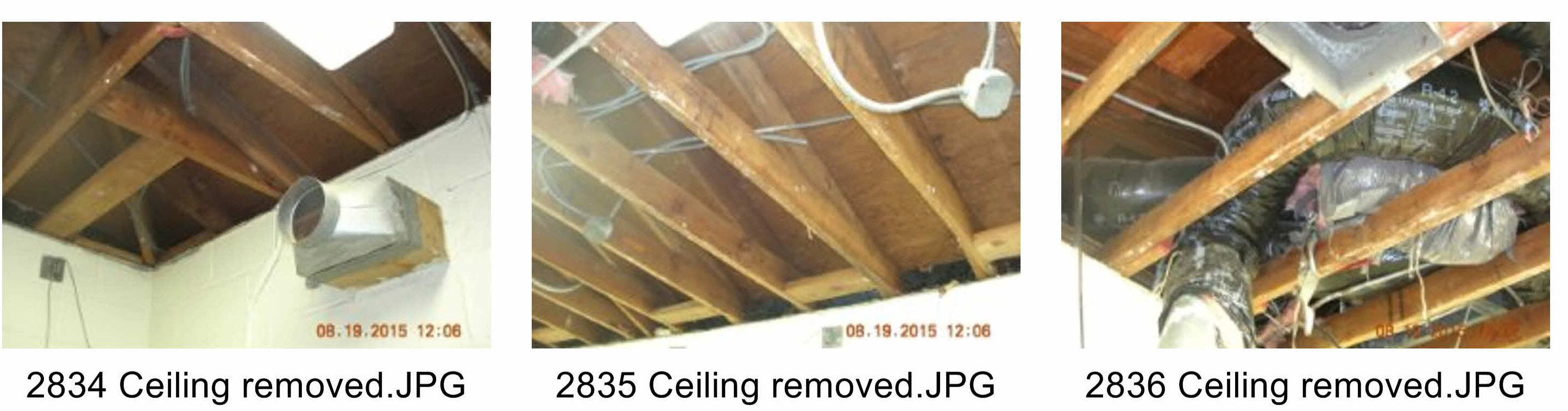
2834 2835 2836 (14)

North Jersey Humane Society left exposed screws adjacent to dog enclosures and the shelter’s entrance putting both people and animals at risk of injury.

There were boards with long protruding screws located on the ground near the entrance gate of the facility adjacent to an outdoor animal enclosure. These screws could cause injury to both animals and people (Picture 2829).

2829 (14)

The shelter had inadequate ventilation and smelled like urine. Furthermore, insufficient lighting prevented shelter staff from properly cleaning the animal enclosures resulting in a build up of feces and urine. North Jersey Humane Society apparently placed an outdoor animal enclosure on a surface that shelter staff cannot effectively disinfect. Furthermore, the town and North Jersey Humane Society did not repaint the surfaces of the outdoor animal enclosures and the staff could therefore not properly clean these kennels.

There was a strong, stale urine odor in the first animal enclosure room located next to the main office of the facility at the time of this inspection; the ventilation was not sufficient to remove odors as required.

The lighting in the facility was not sufficient to allow the viewing of all the interior surfaces of the animal enclosures to ensure that the enclosures had been cleaned and disinfected. The enclosures in the first animal enclosure room contained small pools of urine and small fragments of feces in the corners and bottom edges that had not been removed during the cleaning process. These corners and edges were unable to be viewed clearly due to the insufficient distribution of lighting in this room.

There was a chain link enclosure placed on the pavement in the driveway in front of the facility. This asphalt pavement was not impervious to moisture and not able to be readily cleaned and disinfected. This enclosure did not have any drains to contain and properly dispose of run off as required (Picture 2831).

The surfaces of the outdoor animal enclosures attached to the side of the building and accessible to the animals in these enclosures by a guillotine door were not impervious to moisture. These surfaces were originally painted, but the paint was peeling, and the surfaces were no longer impervious to moisture (Picture 2844).

2831 (14)

2844

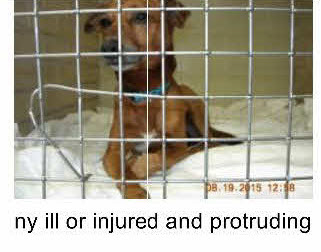
North Jersey Humane Society housed dogs in dangerous enclosures posing a risk of injury and possible death. The shelter left one dog in an outdoor enclosure without sufficient shade for two hours on a hot day in August and the inspector observed the dog drooling. Furthermore the dog bed in this enclosure was broken and had sharp exposed points. Another dog named Benny had a sharp metal wire that was in his cage.

The outdoor dog enclosure on the concrete slab in the driveway next to the entrance gate of the facility had a tarp type of material strapped to the top of the enclosure, but this tarp was not suitable to provide sufficient shade to avoid overheating or discomfort of the animals housed in this enclosure. ACO Stewart stated that the dog housed in this enclosure at the time of this inspection had been in the enclosure approximately two hours and the dog’s drooling was normal and not caused by overheating (Picture 2828).

A dog bed located in an outdoor enclosure near the entrance gate of the facility was broken and in need of repair. The bed contained metal triangle screw plates that had become separated from the frame. The points of the plate were exposed in an upward position and the legs of the bed were bent over (Picture 2828).

A small, thin, red coated dog named Benny was housed in an upper level enclosure in the annex room. The door of the enclosure had a wire that was bent over and protruding into the enclosure at the level of the dog that could cause injury (Picture 2856).
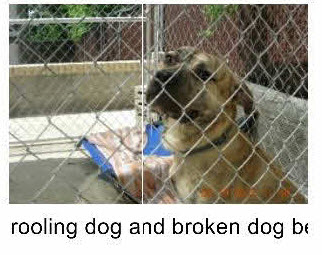
2828

2856

To make matters worse, the shelter housed two large Rottweilers in kennels that were approximately 30% smaller than required by N.J.A.C. 8.23A 1.6 (b):

Two large Rottweilers at the facility at the time of this inspection were each housed in primary enclosures that provided approximately 10.34 square feet of floor space when measured from the inside of the enclosure. These dogs were estimated to be approximately 39 to 42 inches long and required approximately 14 to 16 square feet of floor space.

North Jersey Humane Society Fails to Properly Clean its Shelter

North Jersey Humane Society failed to use proper procedures to clean the shelter. Specifically, the shelter did not remove cat litter, hair and other debris from an enclosure holding multiple cats. The shelter did not use EPA registered cleaning products. Even worse, the facility did not have suitable measuring devices to ensure staff applied the proper concentration of disinfectants.

Cats were being placed in a three tier cat cage during the daily cleaning process. This enclosure was being sprayed down with a spray bottle and immediately wiped out with a towel between each cat, but this cage was not being disinfected as required. There was an accumulation of cat litter, hair, and other debris trapped in the wire along the edges of the resting benches and at the bottom of this wire enclosure that had not been removed, cleaned and disinfected between each cat during the cleaning process. Toys were also being sprayed with the contents of the spray bottle and immediately wiped off, without allowing the required contact time for disinfection.

The bleach that was being used on the day of this inspection was Clorox Scented, Spashless bleach, which is not an EPA registered disinfectant. Two small bottles of Clorox regular bleach were later found in the upstairs storage area.

The disinfectants used at the facility, sodium hypochlorite (chlorine bleach) and Accel (accelerated hydrogen peroxide), were not being used at the correct dilution for disinfecting animal contact surfaces. The Accel requires a dilution ratio of 8 ounces (one cup) per gallon of water and the chlorine bleach that was found in the upstairs storage area requires 4 ounces (one half cup) per gallon of water according to the instructions on the product labels for disinfection of smooth and impervious animal contact surfaces.

There were no suitable measuring devices being used at the time of this inspection. One capful of these products (said to be approximately one ounce of concentrated solution) was being mixed into a one and a half gallon sprayer that was labeled as “Bleach” (Picture 2857). The cages were said to be sprayed down with this solution, allowed to sit for approximately 10 minutes while other cages are being sprayed down, and then the cages are rinsed with a hose and the remaining water was removed with a squeegee. The cages were not manually scrubbed clean at any time during the cleaning process.
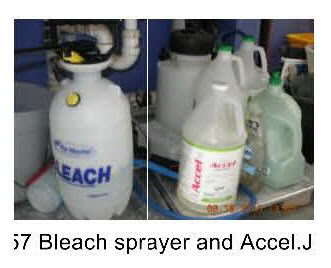
2857

Furthermore, shelter staff stated they cleaned animal enclosures, but the inspector’s tape measure became covered with urine and feces when she was examining the cages.

The animal enclosures located in the first room of the facility near the office and main entrance to the facility were said to have been cleaned, but when a metal tape of a tape measure was placed in one of the upper cages while measuring the cage size, the length of tape became contaminated with urine and small bits of feces that remained inside of the cage after the cleaning process. The facility staff was not following proper cleaning and disinfection procedures to reduce disease hazards and odors caused by bacteria and other contaminants that remained on animal enclosure surfaces.

Finally, North Jersey Humane Society failed to use a proper cleaning solution to disinfect the animals’ food and water receptacles.

Food and water receptacles were being washed with a dishwashing liquid, rinsed and placed on a towel to dry, but they were not being disinfected daily as required. ACO Ascolese stated over the phone on the day of this inspection that the receptacles were being washed with an antibacterial type hand dishwashing liquid, but this type of dishwashing liquid was not an EPA registered disinfectant for use in animal facilities.

Cruel Treatment of Wildlife

North Jersey Humane Society treated wildlife in a way that constituted animal cruelty in my view. Two days prior to the inspection, the shelter impounded a 3 week old baby squirrel that was too young to eat, drink, urinate and defecate on its own. Instead of bottle-feeding this animal or sending the animal to a licensed wildlife rehabilitation center, the shelter tried to feed the animal with a honey seed stick. The inspector told both the ACO at the shelter and Vincent Ascolese that the shelter must transport the squirrel to a licensed wildlife rehabilitation center immediately. Furthermore, a New Jersey Division of Fish and Wildlife agent also stated the squirrel needed to go to a licensed wildlife rehabilitation center right away. Despite this emergency, Vincent Ascolese refused to do so and said he’d take the animal to the animal hospital the shelter uses.

Frankly, I am appalled that the shelter does not take injured wildlife to licensed wildlife rehabilitation centers. Even some very regressive kill shelters transport wild animals to these facilities. Furthermore, North Jersey Humane Society and Bergen Protect and Rescue could have made a simple plea on their social media pages and many people would have gladly transported the animal and offered monetary assistance.

To make matters worse, the baby squirrel and an iguana were housed in the feral cat room where the door is left open overnight. The inspection report noted some type of animal entered the room as evidenced by feces found in one of the cages. Additionally, the bars in the baby squirrel’s cage were wide enough for the animal to fall through. Given the young squirrel had not yet opened its eyes, this was a very real possibility. In fact, this did happen and the inspector actually caught the baby squirrel falling from its cage. Furthermore, the shelter staff left water in a bowl for the baby squirrel that was deep enough for the animal to drown in. As a result, the baby squirrel was housed in a room with potential predators, feral cats and wildlife that could enter the room, and left in an environment where it could drown or even fall to its death.

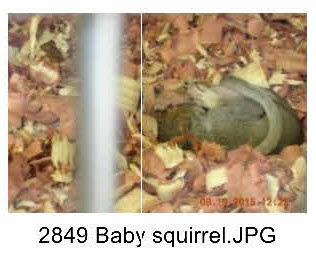
A baby squirrel that was impounded at the facility on 8/17/15 was crying in distress in search of its mother at the time of this inspection. This squirrel was approximately 3 weeks old and was too young to eat, drink and eliminate on its own and at this young age, may have been unable to regulate its body temperature. This squirrel was not receiving proper care and nourishment as required and was not placed in a suitable housing environment to maintain the safety and wellbeing of this animal for the two days that it was housed at the facility (Pictures 2849 and 2850).

2849

2850

A baby squirrel, approximately 3 weeks of age with its eyes not yet open, that was impounded at the facility on 8/17/15 was not being fed as required to meet the nutritional needs of this young squirrel. There was no infant replacement formula of any kind or any electrolytes or other preparation for rehydration at the facility for this squirrel at the time of this inspection.

The baby squirrel detailed in 1.7 (b) was not fed or provided with a rehydration solution during the entire inspection period. A squirrel of this age requires feeding approximately every three hours.

ACO Stewart stated that George, who was not at the facility at the time of this inspection, had been feeding the squirrel seeds and honey on a stick. Although the squirrel was too young to forage, the staff had placed the honey seed stick in the red cedar chip bedding with the assumption that the squirrel would search for its food.

The inspector, Frese, explained to ACO Stewart that this squirrel was a nursing squirrel and was too young to eat, drink, and eliminate on its own. Frese stated that this squirrel needed to be transported to a licensed wildlife rehabilitator immediately. ACO Stewart stated that the squirrel could not be transported at that time, but would be transported the next day. Frese stated that the squirrel may not live that long and then called the New Jersey Division of Fish and Wildlife and the New Jersey Society for the Prevention of Cruelty to Animals (NJSPCA) for assistance. Neither agency was available to transport the squirrel; the agent from the Division of Fish and Wildlife said the squirrel needed to be transported immediately to a licensed wildlife rehabilitator.

The Supervising ACO, Vincent Ascolese, called and spoke to Frese on the phone and explained that the squirrel was being cared for adequately with the seed stick placed in the bedding to teach the squirrel to find its food. Frese explained again that the squirrel was too young to forage and needs to be transported immediately to a rehabilitator. ACO Ascolese stated that they do not take any wildlife to a wildlife rehabilitator. He stated that he would instruct the staff to take the squirrel to Franklin Lakes Animal Hospital; that is where they take all injured and orphaned wildlife. ACO Ascolese stated that it is their policy for all injured and orphaned wildlife to be transported directly to the Franklin Lakes Animal Hospital, Wildlife Division.

There was a hole in the ceiling of the room named the “feral cat” room (Picture 2851) and the animal control officer (ACO) Nicole Stewart, confirmed that the door to this room had been left open to the outside of the building overnight. There were feces in one of the cages in this room from some type of animal that had entered the room and perched on the top of the cage (Picture 2848). An iguana and a baby squirrel were housed in this room at the time of this inspection and had been in the room while the door was open overnight. ACO Stewart stated that this room is used for the feral cats that free roam the grounds of the facility.

2851

2848

A baby squirrel was housed in an enclosure that had bars on the enclosure door that were wide enough for the squirrel to fit through. The squirrel was too young to walk normally, but was able to crawl. The squirrel crawled to the front of the enclosure and fit itself through the bars of the door. The squirrel had come halfway out of the enclosure, but was caught by the inspector, Frese, before it fell and was placed into the back into the enclosure. The squirrel was vocalizing a distress call as it crawled out of the cage (Picture 2866).

2866 (2)

The baby squirrel that was too young to eat and drink on its own was provided with a straight sided bowl filled with water in the enclosure that was deep enough that the squirrel could have become trapped and drowned in the water, due to the age and inadequate mobility of the squirrel.
The inspection report documented Vincent Ascolese killing an injured deer fawn. North Jersey Humane Society picked up a deer fawn with two broken legs in Woodland Park 12 minutes after the animal hospital the shelter uses closed (the animal hospital’s web site currently states it is open on the day of the week and time this happened). Instead of immediately taking the injured deer to another animal hospital or better yet, a licensed wildlife rehabilitation facility, as required by law, North Jersey Humane Society brought the animal back to the Bloomfield shelter. Vincent Ascolese subsequently slashed the deer’s throat in what one could consider an audition for joining the terrorist group, ISIS. Irregardless of whether the animal was hopelessly suffering, the shelter was required to send this animal for veterinary treatment. Even if euthanasia was required, slashing a deer’s throat is not humane and is illegal in New Jersey. Thus, Vincent Ascolese acted in an illegal and unethical manner and is now rightfully charged with animal cruelty.

A deer that was picked up by ACO McGowan in Woodland Park, Passaic County, on 6/29/15 was described on the “Animal Control Incident Transport Record” form as being severely injured and bleeding, with both hind legs broken and bone protruding through skin. The form stated “Well Pet Animal Hospital closed.” According to the website for this animal hospital, the normal business hours on Mondays, the day of the incident, are 9 AM to 6 PM. According to the animal control incident form, the ACO had arrived at the scene of the severely injured deer (fawn) at 6:12 PM, which was outside of this hospital’s posted hours of operation. The deer was transported to the Shelter facility at 6:47 PM. The “Animal Control Incident Transport Record” form indicated that the ACO did not immediately obtain emergency veterinary care from a licensed veterinarian as required by this regulation.

ACO Ascolese, stated during a phone call at the time of this inspection, that it is their policy for all injured and orphaned wildlife to be transported directly to the Franklin Lakes Animal Hospital, Wildlife Division. The severely injured deer that was picked up on 6/29/15 was not transported to the Franklin Lakes Animal Hospital in accordance with the policy stated by ACO Ascolese. The website for the Franklin Lakes Animal Hospital shows that the hospital’s regular operating hours are from 9 AM to 8 PM on Mondays.

A deer (fawn) that was impounded at the facility on 6/29/15 was killed by ACO Ascolese who cut the throat of the deer with a knife resulting in exsanguination (death from loss of blood). Exsanguination is an unacceptable method of euthanasia in accordance with these regulations.

Furthermore, even if throat slashing was a legal euthanasia method, Vincent Ascolese was not allowed to euthanize animals under state law at that time since he lacked the certification to do so.

Dr. Diaz confirmed that he had certified ACO Ascolese in August, 2015. On 6/29/2015, ACO Ascolese killed a deer (fawn), prior to the animal euthanasia training that had been conducted on or about 8/12/2015.

North Jersey Humane Society Fails to Provide Adequate Care to its Animals

The shelter did not provide prompt veterinary care to an injured dog. Benny had open sores on his legs and was not placing any weight on his left front leg during the inspection. Despite these issues, North Jersey Humane Society provided no veterinary care for the 3 days he was at the shelter before the inspection.

A dog named Benny was not placing any weight on his left front leg at the time of this inspection. This dog also had several ulcer type sores in various locations on all four of his legs, most of which were covered with smooth, hairless, blackened skin tissue with a raised outer edge, but some of these sores were shallow open wounds with a red and pink wound bed. This dog had not received any veterinary care since it arrived at the facility on Sunday, August 16, 2015 (Picture 2856).

2856

North Jersey Humane Society also did not provide some animals adequate amounts of water. Specifically, an iguana had no water during the 7 hour inspection and the inspector had to tell shelter staff to provide water to a thirsty Rottweiler.

An iguana located in the feral cat room had spilled its water and the water had not been replaced during the inspection.

A Rottweiler that was housed in an outdoor enclosure did not have water in his water bucket at the time of this inspection. This dog was subsequently provided with water after this was brought to the attention of ACO Stewart (Picture 2868 through 2870).

2869

2870

Shelter staff also left an iguana to sit in a wet bed during the entire 7 hour inspection.

An iguana that was impounded at the facility on 8/17/15 was housed in an enclosure with wet bedding after the water from the water bowl had been spilled in the enclosure. This wet bedding had not been changed during the entire inspection period (Picture 2867).
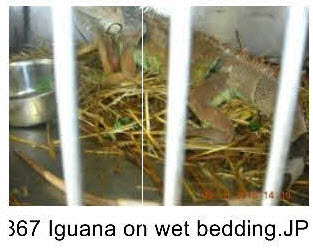
2867 (2)

North Jersey Humane Society did not isolate sick animals from healthy animals. The facility’s HVAC system emitted air from the isolation area, which is supposed to house sick animals, to locations holding healthy animals. In fact, the shelter used the ineffective isolation area it did have to house four healthy dogs due to overcrowding. And just how did the shelter become overcrowded? The facility transported 15 dogs, which made up 60% of the facility’s dog population at the time of the inspection, from Georgia 3 days before.

The facility did not have any isolation procedures in place and did not have a proper isolation area at the time of this inspection.

The ventilation in the dog and cat isolation rooms was not separated from the air used for the general population. The ventilation for the isolation rooms was supplied through the HVAC system for the facility and mixed with the air for the general population and did not exhaust directly to the outdoors as required.

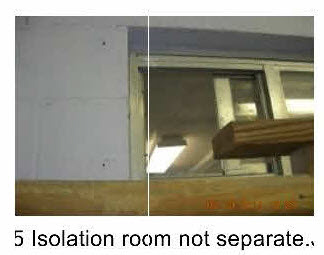
Due to lack of space, the dog isolation room was being used to house 4 healthy dogs at the time of this inspection and the cat isolation room housed 13 cats that were not exhibiting signs of or being treated for a communicable disease. The dog isolation room did not have floor to ceiling walls and was open at the top of the walls to the holding area of the general dog population. The cat isolation room had windows that were open to the room where the general cat population was housed (Pictures 2861 and 2865).

2861

2865 (2)

The 15 dogs that had been imported from Georgia and arrived at the facility on Sunday, 8/16/15, did not have completed cage cards as of the date of this inspection.

The shelter also did not answer its supervising veterinarian’s requests going back as far as five months to acquire medicines and diagnostic equipment to treat sick and/or injured animals.

A notebook was located on the premises that showed the supervising veterinarian’s findings along with the veterinarian’s signature and date of each visit. The notes in this log book indicated that the veterinarian had recommended the pharmacy stock at the facility be increased (this would require prescriptions from the supervising veterinarian with the required prescribing information) and suggested medical and diagnostic equipment be purchased for use at the facility. These notations had been recorded in the log book since March of 2015, with the last request for equipment dated 8/2/15. The facility did not have the diagnostic equipment on the premises as requested by the supervising veterinarian.

North Jersey Humane Society also had drugs without required information, such as the animal it was prescribed for, directions for use, date dispensed, and name of the facility distributing the medication. This raises serious questions as to whether the shelter illegally obtained these medicines and whether expired drugs were given to animals.

There were medications at the facility that did not contain prescription labels with the required information, including the animal’s name or identification, directions for use, the date dispensed, and the name and license number of the licensee and facility dispensing the medication. A 200 ml bottle of Toltrazuril, used for the treatment of coccidia in horses, was located on the top of a cart in the medical treatment room. The manufacturer’s label on the bottle stated to refrigerate after opening and expires one year after opening, but the bottle was not refrigerated and there was no date on the bottle indicating when the bottle had been opened. There were no records or directions from the supervising veterinarian indicating what the medication was to be used for and to which animal it had been prescribed. There was also a box of MilbeMite brand ear mite medication for cats on this cart with no prescription label, animal identification, and instructions for use (Pictures 2871 through 2873).

2871

2872

2873

North Jersey Humane Society’s Euthanasia Statistics May Not Be Accurate

North Jersey Humane Society reported it only euthanized one cat and three dogs died or went missing in its 2014 Shelter/Pound Annual Report. However, the inspection report noted 4 dead animals were in the facility’s freezer. To make matters worse, the shelter could not produce accurate and legally required intake and disposition records at the time of the inspection. Furthermore, Vincent Ascolese, who illegally killed the fawn, conveniently removed all the wildlife intake and disposition records and stored them in another county. As a result, I have no confidence in North Jersey Humane Society’s reported euthanasia and other statistics since the shelter could not produce the supporting documents.

There were also approximately four animals in the freezer that were bagged, but the bags were not labeled with a name or ID number.

Paper records were maintained on dogs and cats that were received at the facility, but the intake and disposition log which correlates when each animal arrived at the facility and the final disposition was maintained as a computer record. There was no one at the facility at the time of this inspection that had access to the computer records to ascertain when animals were received and the final dispositions. A notebook that was labeled “stray animal log” was not up to date and did not include all animals that were received at the facility. The log only listed dogs that had been impounded and the last entry was dated 7/1/15.

The “Animal Control Incident Transport Record” forms, which were the only records created for the intake and disposition of certain wildlife or other species of animals received at the facility, including the deer that was received at the facility on 6/29/15, were not kept at the premises. Kristi, the Executive Director of Shelter Services stated during a telephone conversation at the time of this inspection that all animal control records were removed from the establishment by ACO Ascolese and stored in an office located in different county.

No People Admit to Euthanizing Animals

The inspection report documented the supervising veterinarian contradicting the shelter’s statement about who performs euthanasia. Specifically, the ACO on staff during the inspection stated Dr. Nelson Diaz performs all euthanasia procedures for the shelter’s animals. However, the veterinarian stated he never euthanized any animals from the shelter despite the shelter reporting 1 euthanized cat in 2014 and four dead animals in shelter’s freezer at the time of the inspection.

Furthermore, the shelter had no required euthanasia equipment at the facility or documentation that any shelter staff were certified to euthanize animals. As a result, one has to wonder if Vincent Ascolese or some other people at the shelter illegally killed animals like Vincent Ascolese did with the deer fawn.

At the time of the inspection, no certification documents were found on the premises or made available to the inspectors to indicate which staff members were certified by a licensed veterinarian to perform humane euthanasia at the facility. ACO Stewart stated at the time of this inspection that all animal euthanasia was performed by the supervising veterinarian, Dr. Diaz. Dr. Diaz was contacted by phone and confirmed that he had not performed any animal euthanasia for this facility and he was not contacted regarding the deer (fawn) that was killed by ACO Ascolese. ACO Stewart also stated that ACO Ascolese was trained by Dr. Diaz to euthanize animals at the facility one week prior to the inspection (8/12/2015). Dr. Diaz confirmed that he had certified ACO Ascolese in August, 2015. On 6/29/2015, ACO Ascolese killed a deer (fawn), prior to the animal euthanasia training that had been conducted on or about 8/12/2015.

None of the required euthanasia equipment was on the premises at the time of this inspection; there were no posted instructions, and no euthanasia, tranquilizing or immobilizing agents on the premises. This facility was not equipped with the supplies to perform humane euthanasia on any animals at the time of this inspection and there were no records or other evidence provided at the facility during this inspection to indicate that the facility was equipped as required to perform euthanasia on 6/29/2015 when the deer (fawn) was killed by ACO Ascolese.

North Jersey Humane Society Violates Basic No Kill Principles

No kill shelters essentially need to do three broad things. First and foremost, no kill sheltering mandates not killing or allowing healthy and treatable animals to die. Second, no kill facilities must perform at a high level resulting in animals quickly leaving the shelter and going to good homes. Third, no kill sheltering requires animals be provided with an elite level of care.

North Jersey Humane Society violated all three of these principles. Vincent Ascolese never even tried to get the injured fawn to a licensed wildlife rehabilitation center. In fact, Mr. Ascolese’s organization does not use licensed wildlife rehabilitation centers for any wild animals per the inspection report. His shelter’s careless disregard for an extremely vulnerable baby squirrel also violated no kill’s unwavering standard of not killing. Whether the shelter killed the baby squirrel directly or simply allowed it to die makes no difference. The shelter must have a passion for saving animals. Clearly, Vincent Ascolese’s organization has an attitude that some animals are simply not worth saving. After all, when the Director of North Jersey Humane Society slices open the throat of a fawn, is it any wonder other staff members will not do anything to save a baby squirrel?

North Jersey Humane Society’s and Bergen Protect and Rescue’s polices resulting in prolonged lengths of stay also violate no kill principles. To make a no kill animal control shelter work, the organization must quickly place animals into good homes. With excessive adoption fees, long waiting periods to adopt animals and poor customer service, Vincent Ascolese’s shelters simply do not perform in the manner they should.

Finally, North Jersey Humane Society fails to follow basic animal sheltering practices let alone the elite level standards of a no kill facility. Housing sick animals together, leaving animals without water, not providing prompt veterinary care, keeping animals in filthy enclosures, exposing animals to dangerous kennels, and potentially providing animals with expired medicines is unacceptable for any shelter, kill or no kill. Clearly, North Jersey Humane Society failed its animals and does not deserve the no kill or even a shelter label.

Bloomfield Needs to Take Immediate Action

Bloomfield and the shelter’s other contracting municipalities should expect far better service. Assuming North Jersey Humane Society’s annual fees are the same as its $120,000 bid for animal control and $145,000 bid for sheltering services, North Jersey Humane Society receives $265,000 a year in revenue from these towns. Based on the Bloomfield Animal Shelter’s total reported intake in 2014, this works out to nearly $1,500 of revenue per animal the shelter impounds. Also, the shelter receives donations in addition to these contract fees. Surely, North Jersey Humane Society can afford to provide proper care to its animals.

Bloomfield no longer can trust Vincent Ascolese to do the right thing. First, Bloomfield must make all necessary structural improvements to the shelter to ensure the facility can comply with state law. Second, the town must form an Animal Welfare Advisory Committee, which should have qualified members dedicated to ensuring the town has an elite no kill shelter and to oversee and regulate whoever runs the Bloomfield Animal Shelter. Third, Bloomfield must enact the Companion Animal Protection Act (“CAPA”) that residents have demanded for years. Fourth, the town should pass a no kill resolution mandating at least a 95% live release rate for dogs and a 90% live release rate for cats impounded from the towns the shelter contracts with. Fifth, the town should demand North Jersey Humane Society stop transporting animals from southern states into the Bloomfield Animal Shelter. Simply put, the town can no longer take the word of a charismatic person with a dark side.

New Jersey Department of Health, the NJ SPCA and the Towns Contracting with Bergen Protect and Rescue Must Investigate That Shelter

Based on the egregious performance of North Jersey Humane Society, the New Jersey Department of Health and NJ SPCA must investigate Bergen Protect and Rescue to see if Vincent Ascolese’s other facility is also violating New Jersey shelter and animal cruelty laws. Furthermore, Cliffside Park should also do the same things as I recommend for Bloomfield to ensure the shelter is effectively supervised and regulated. Sadly, Vincent Ascolese’s organizations have lost all credibility and it is time these shelters prove to everyone they are ready to step up their game. If not, then the municipalities must move on and bring an organization in that will do the right things for the animals.


East Orange Animal Shelter’s Horrific Inspection Report Raises Serious Questions


East Orange July Photos

East Orange Animal Shelter’s ongoing problems became well-known in the last year. In 2010, the New Jersey Department of Health uncovered significant issues during an inspection. One year later, the New Jersey Department of Health found the shelter had clogged drains and allowed the facility to fall apart. Furthermore, the shelter did not clean properly and keep required records. In 2014, the New Jersey Department of Health reported animals inundated with a toxic feces and chemical filled soup due to clogged drains, a fly infestation so severe that animals with open wounds and skin lesions were in danger of having maggots grow inside them, cats not provided with enough water and water they did have was contaminated with cat litter, and improper isolation of sick animals. Last June, East Orange Animal Shelter killed a dog recently adopted from Liberty Humane Society and did not appear to make any effort to return the dog to the other shelter. Thus, East Orange has run an outlaw operation for at least half a decade.

July 2015 Inspection Details Horrible Problems

On July 16, 2015, the New Jersey Department of Health inspected the East Orange Animal Shelter and issued a failing grade to the facility. Amazingly, the shelter did not even do the most basic things correctly to the point where it seemed the city made no effort to fix its long-standing problems. Below are some of the key inspection report findings and my comments.

East Orange Animal Shelter’s basic facilities were not only disgusting, but unsafe. The shelter’s ceiling tiles were damaged by water, and most likely harboring dangerous mold, and were literally coming down, including one that was close to falling into one dog enclosure:

EO Falling Tiles

The cat room had a putrid odor and was not properly ventilated:

EO Cat Odor

The guillotine doors to the dog enclosures had cracks that accumulated contaminated materials and therefore shelter personnel could not properly clean these areas:

Dirty Guillotine Doors

The drains surrounding the outdoor dog enclosures were clogged and therefore allowed dirty and toxic liquids to build up:

Drains 1

Drains 2

Dogs had to lie on beds that were falling apart. Cats were held in stacked enclosures that were at risk of falling over.

Cages Falling Over

Kittens, which depend on nourishing food to grow, were fed unknown dry food that may or may not have been suitable for them:

EO Kitten Food

Despite running a filthy facility, shelter staff still failed to disinfect food and water bowls:

EO Food and Water Bowls

The shelter did not provide adequate amounts, and in some cases any, water to animals. The inspector had to request one of East Orange’s ACOs to fill the water bowl not once, but twice, for a mother cat who appeared dehydrated and her kittens. Even worse, the facility had plenty of water bowls and still failed to provide water to the animals as required by state law.

EO Water to Animals

The shelter cleaned cat cages with powerful chemicals while cats were inside these enclosures:

EO Cat Cleaning 1

Cat Cleaning 2

Feces were left uncleaned for so long that it dried and adhered to the floor of one dog enclosure:

Dog Feces Uncleaned

The isolation room had mold covered food and feces that had been there for two weeks:

Isolation Not Cleaned in 2 Weeks

East Orange Animal Shelter failed to adhere to its veterinarian’s disease control program:

Disease Control Program Not Followed

Most disturbingly, the shelter did not provide legally required prompt and basic veterinary care to alleviate pain and suffering. One cat (“C871”) with an injured leg did not move during the entire inspection. Another cat (“C870”) had been at the shelter for 9 days and did not eat or drink during her stay at the facility. The cat’s weight decreased 64% from 11 pounds to 4 pounds during her time at the shelter. The inspector could feel the bones of the cat and noted the cat was dehydrated and making distress calls. Yet, the inspection report stated Dr. Kimani Griffith told a shelter employee on Wednesday July 15 that he would wait 5 more days to examine the animal. Another cat died one day after arriving at the shelter and no documentation existed to show the shelter diagnosed a medical condition or provided any veterinary care.

Apparently, Dr. Kimani Griffith got wind of the New Jersey Department of Health’s arrival and came to the East Orange Animal Shelter during the 5 and half hour inspection. The NJ Department of Health inspector had to show Dr. Kimani Griffith two dogs with medical issues, one with a red irritation on his face and another who was not eating, and three cats needing veterinary attention, C871 and C870 above and a third cat. Shockingly, Dr. Kimani Griffith declined the New Jersey Department of Health inspector’s request to take the two suffering cats, C871 and C870, to his veterinary office for immediate treatment. Finally, Dr. Kimani Griffith examined the two cats at his office the next day and diagnosed C871 with a fractured leg and C870 as severely dehydrated and in chronic renal/kidney failure. Dr. Kimani Griffith put a splint on C871 and euthanized C870.

Prompt Vet Care Not Provided 1

Vet Care Not Provided 2

The shelter did not document the veterinary care it was providing to animals. Based on the lack of documentation, once must assume few animals received proper veterinary care.

Vet Care Not Provided 3

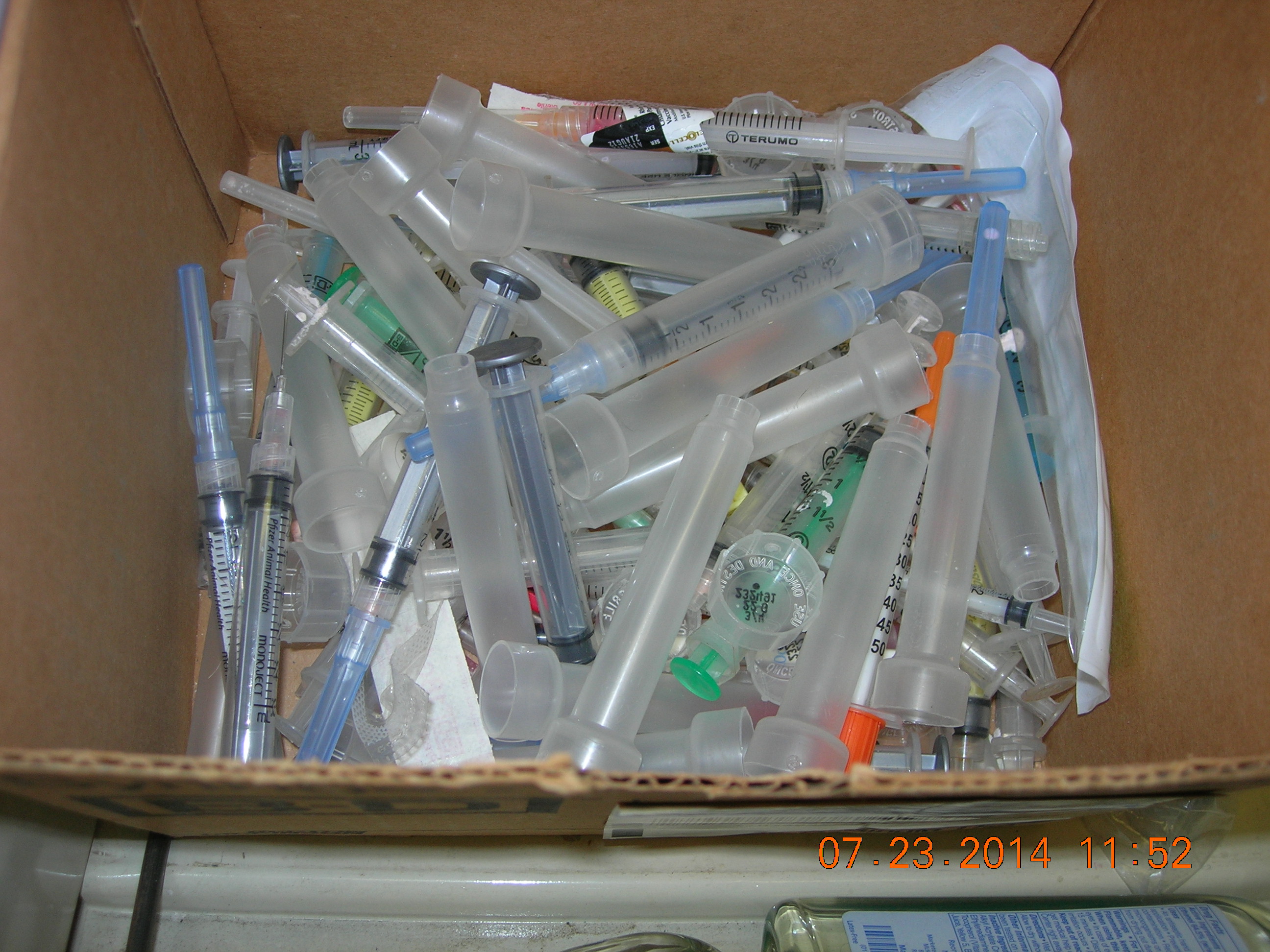
The shelter had expired drugs and even gave some to shelter animals. Additionally, needles and syringes were readily accessible as they were left in an unlocked drawer and cabinet at the shelter.

Vet Care Not Provided 4

The shelter failed to properly isolate sick animals from healthy animals. Furthermore, the ventilation system allowed air from the isolation area where sick animals are housed to mix with the general shelter area where healthy animals reside. Thus, disease could easily spread.

Isolation 1

Isolation 2

The shelter also did not document whether people surrendering several animals for euthanasia were the actual owners. In other words, someone could steal your pet and have East Orange Animal Shelter kill your dog or cat. Additionally, the shelter illegally killed a cat on the day it arrived at the shelter.

Illegally Killing

When the shelter did kill animals, it did not do so humanely. Dr. Kimani Griffith stated animals are not weighed prior to euthanasia/killing as required by N.J.A.C. 8.23A. As a result, animals may not get enough tranquilizer and euthanasia drugs causing the animals to suffer. Even more shocking, Dr. Kimani Griffith “walked” two ACOs through the euthanasia/killing process over the phone while the veterinarian was on vacation. Apparently, taking a life is no big deal and you can learn how to do so over a casual telephone call while your instructor is at the beach or somewhere else. Additionally, the shelter did not keep legally required records, such as the animal’s weight, and drug dosage used to euthanize/kill animals.

Euthanasis Violations 1

Euthanasis Violations 2

If East Orange Animal Shelter was not bad enough, the ACO vehicle used to haul animals to the facility was disgusting as well. Literally, the animals that were brought to the shelter had to lie in a filthy crate covered with blood and dirt on their way to this horrific shelter.

ACO Vehicle

The shelter also failed to maintain legally required intake and disposition records for each of the shelter’s animals:

Intake and Disposition Records

Finally, the New Jersey Department of Health answered some questions I had about the recently adopted Liberty Humane Society dog that East Orange Animal Shelter killed. While East Orange Animal Shelter did not kill the dog during the 7 day hold period, the facility did not document the dog was suffering nor did this pound document that it contacted Liberty Humane Society. Thus, East Orange Animal Shelter made no effort to save this dog.

LHS Dog

Reaction to Kane in Your Corner Investigation Raises More Questions

On Thursday, August 20, News 12’s Kane in Your Corner aired its investigation of the East Orange Animal Shelter. Amazingly, East Orange Health Officer, Rochelle Evans, who is ultimately responsible for the shelter, refused to talk with Walt Kane. However, the City’s public relations person, claimed the New Jersey Department of Health revised its report and removed most of its serious findings related to not providing prompt veterinary care. Yet, the New Jersey Department of Health subsequently responded to Walt Kane and stated they did not drop these New Jersey shelter law violations.

Walt Kane’s subsequent interview of Dr. Kimani Griffith also seemed bizarre. Dr. Kimani Griffith, who appeared quite nervous during the interview, stated East Orange’s erroneous claim that the New Jersey Department of Health removed some of the serious violations was due to a typo. On camera, Dr. Kimani Griffith said he is taking constructive criticism from the New Jersey Department of Health so “they could improve the operation.”

Yet, Dr. Kimani Griffith has been the supervising veterinarian for the East Orange Animal Shelter for all of the terrible New Jersey Department of Health inspections since 2010. Dr. Griffith receives $76,500 a year per his 2012 contract with East Orange to provide “animal care and sheltering services” to East Orange despite East Orange already having its own facility. Amazingly, Dr. Griffith’s fee represents nearly half of the shelter’s 2014 budget. Additionally, Dr. Kimani Griffith can bill the city for other services. Furthermore, Dr. Kimani Griffith also operates a shelter/rescue out of his veterinary office and apparently adopts out dogs for $300 and cats for $125. If Dr. Kimani Griffith, “rescues” animals from East Orange Animal Shelter, he could earn additional profits if he performs any vetting himself (i.e. no veterinary labor costs if he spays/neuters animal and provides vaccinations). Additionally, East Orange residents are unlikely to travel all the way to Mine Hill to adopt an animal that came from East Orange. Thus, Dr. Kimani Griffith seems to profit off East Orange’s homeless animals at the expense of East Orange’s taxpayers.

Sadly, the operation cannot just improve as Dr. Kimani Griffith suggests. East Orange must completely overhaul the shelter and remove Dr. Kimani Griffith and Rochelle Evans from having anything to do with the facility. At this point, a private no kill organization should take over as East Orange proved incapable of operating a humane shelter that saves rather than takes lives.

Walt Kane also mentioned the New Jersey State Board of Veterinary Medical Examiners is conducting an investigation. Given this board found Dr. Kimani Griffith grossly negligent in the care he provided to an animal in private practice, perhaps this is why Dr. Kimani Griffith appeared nervous and tried to convey a conciliatory tone?

South Orange Has A lot of Explaining to Do

The South Orange Health Department quarantined and effectively shut down Jersey Animal Coalition after the shelter failed a joint New Jersey Department of Health and South Orange Health Department inspection last year. Yet, the South Orange Health Department, South Orange Board of Trustees and the South Orange Board of Health allowed the Village to contract with a veterinarian who allowed a shelter he supervises to be run to the ground for at least half a decade and fail an inspection just like Jersey Animal Coalition. Additionally, the South Orange ACO brought at least one stray dog to the East Orange Animal Shelter.

The South Orange Board of Health’s hypocrisy has been exposed by these events. At a recent South Orange Board of Trustees meeting, the Board of Health railed against TNR due to alleged risks relating to diseases, such as toxoplasmosis and rabies, despite these diseases virtually never being transmitted from feral cats to humans. However, the South Orange Board of Health apparently had no problems contracting with the supervising veterinarian of a shelter that fails to segregate sick animals from healthy animals and potentially allowing zoonotic diseases to run rampant. Furthermore, the South Orange Board of Health apparently is fine with sick and injured animals not receiving medical treatment for days or even weeks. Would the physicians on the South Orange Board of Health think this is appropriate for the their human patients?

NJ SPCA Fails to Act Again

The NJ SPCA did not promptly act in a number of recent animal shelter cases. Last year, the NJ SPCA only raided the Helmetta Regional Animal Shelter after Kane in Your Corner aired its investigation. The NJ SPCA also did not take action at Linden Animal Control despite abuse that may have been even worse than Helmetta Regional Animal Shelter. In the case of Helmetta Regional Animal Shelter, charges against the shelter directors were downgraded and it appears these people will not face serious consequences for their actions.

The NJ SPCA’s performance in Essex County animal shelter abuse cases has been dismal. Despite multiple miserable inspection reports, some with horrific photos, the NJ SPCA failed to successfully take action against Associated Humane Societies – Newark in 2009 or 2011. The NJ SPCA took no successful action against Montclair Animal Shelter’s former management despite animals being forced to stay in cold conditions. Despite years of complaints about Jersey Animal Coalition, no serious action was taken against the shelter even after it failed its inspection last year. Even after being contacted about the East Orange Animal Shelter’s problems in 2014, the NJ SPCA failed to take serious action.  One has to wonder what Sergeant Al Peterson has been doing in Essex County all these years?

Clearly, the NJ SPCA could have expedited the resolution of these shelter problems if it got more effectively involved. Sadly, just like the New Jersey Commission of Investigation Report on the state’s SPCAs concluded in 2000 and the Animal Welfare Task Force Report found in 2004, the NJ SPCA and the county SPCAs inadequately protect animals and should step aside and let real professionals prosecute animal cruelty.

Special thanks to Reform the East Orange Animal Shelter for providing me with the inspection reports and photos

East Orange Animal Control Kills a Dog Adopted from Another Animal Shelter

One year ago, East Orange Animal Control made news for all the wrong reasons. At the time, the city’s recently hired Animal Control Officer, Amanda Ham, dramatically increased the animal shelter’s live release rate. However, East Orange Health Officer, Rochelle Evans, fired the ACO after Ms. Ham complained to the NJ SPCA about dreadful conditions the city refused to fix. Shortly after Ms. Evans fired Amanda Ham, the New Jersey Department of Health inspected the shelter and documented horrific conditions. Specifically, the New Jersey Department of Health reported animals inundated with a toxic feces and chemical filled soup, a fly infestation so severe that animals with open wounds and skin lesions were in danger of having maggots grow inside them, cats not provided with enough water and water they did have was contaminated with cat litter, and improper isolation of sick animals. Thus, East Orange Animal Control’s shelter was a complete mess last year.

East Orange Animal Control Kills a Friendly Dog Adopted from Liberty Humane Society

East Orange Animal Control killed a friendly dog recently adopted from Liberty Humane Society. Roxy was adopted from Liberty Humane Society in late April and was a sweet dog according to the shelter’s volunteers. For some reason, the adopter decided not to keep Roxy and turned her into East Orange Animal Control in late May. On Tuesday, June 2, Liberty Humane Society heard East Orange Animal Control might have Roxy and attempted to contact East Orange Animal Control, but East Orange Animal Control did not respond to Liberty Humane Society that day. On Wednesday, June 3, East Orange Animal Control killed Roxy and two other dogs while the facility had empty kennels.


Roxy Killed by East Orange 2

While some people may blame the owner for this event, this criticism is unfair. The owner did a noble thing and adopted the dog from Liberty Humane Society, a shelter with very little space, and surely saved a life. Certainly, the owner should have returned the dog to Liberty Humane Society. However, we don’t know if there were extenuating circumstances. For example, perhaps the owner could not travel to Liberty Humane Society due to lack of transportation. Alternatively, perhaps East Orange Animal Control was close to her home and she thought the shelter would do its job and get Roxy back to Liberty Humane Society. Either way, East Orange Animal Control decided to kill the dog and must shoulder 100% of the blame.

East Orange Animal Control’s actions raises serious questions. If Roxy was surrendered to East Orange Animal Control on May 28 or after, East Orange Animal Control would have violated N.J.S.A. 4:19-15.16 e. requiring shelters to offer an animal for adoption for at least 7 days before killing that animal. While East Orange Animal Control is not legally required to scan animals surrendered by their owners for a microchip, one would think a shelter would do so. If East Orange Animal Control did scan Roxy for a microchip, East Orange Animal Control would have known Roxy was recently adopted from Liberty Humane Society. If East Orange Animal Control knew Roxy was recently adopted from Liberty Humane Society, the killing of her would be even more heinous. Tragically, Liberty Humane Society had plenty of empty kennels to house Roxy after the shelter adopted out 37 animals a few days earlier during a fee-waived adoption promotion.

Liberty Humane Society Empty Kennels May 2015

East Orange Animal Control’s Questionable Veterinarian

The New Jersey State Board of Veterinary Examiners concluded Dr. Kimani Griffith was grossly negligent in the care he provided a patient’s dog. In September 2004, Dr. Griffith spayed a female dog and performed a mastectomy after noticing a lump on the dogs’s teats. After the owner’s dog experienced complications from the surgery, Dr. Griffith failed to properly diagnose the problem and delayed appropriate treatment that resulted in the dog’s death. The New Jersey State Board of Veterinary Examiners ordered Dr. Griffith to pay nearly $2,500 in fines and complete 20 hours of continuing education in the area of General Surgery.

South Orange Takes Animals to East Orange Animal Control and to Dr. Griffith

South Orange has taken at least one animal this year to East Orange’s animal shelter. After Jersey Animal Coalition left South Orange in 2014 due to conflicts related to a failed New Jersey Department of Health inspection, South Orange brought animals to the high kill Associated Humane Societies – Newark shelter. In 2015, after AHS-Newark required South Orange to also purchase animal control services, South Orange ended its relationship with AHS-Newark. Earlier this year, South Orange ACO, Melanie Troncone stated South Orange currently was taking stray animals to Puppy Love, a pet groomer in Maplewood, and South Orange Animal Hospital. Ms. Trancone stated the animals would be held for 7-10 days at these locations and then released to an unnamed rescue or a shelter. Around the same time as the ACO made this statement, she wrote the following comment on a Facebook post saying she brought a large stray dog to East Orange’s animal shelter:

South Orange Taking Dogs to East Orange

One has to question why South Orange would choose to take a lost dog to one of the state’s worst pounds? Does South Orange have a contract with East Orange Animal Control or Dr. Giffith’s Country Lakes Animal Clinic in Mine Hill? Either alternative is not good and to not notify residents is despicable while the town drags its feet on re-opening the old JAC shelter with new management.

Companion Animal Protection Act Desperately Needed

The Companion Animal Protection Act (“CAPA”) requires several things that would have prevented the tragic killing of Roxy. First, CAPA requires all, not just stray, animals be scanned for microchips and possible owners or caretakers be contacted. In the case of Roxy, a micochip scan would have identified Liberty Humane Society as the faciity she came from and East Orange Animal Control would have had to contact Liberty Humane Society. Second, under CAPA animal shelters cannot kill animals when

(1) there are empty cages, kennels, or other living environments in the shelter; and,

(2) a foster home is available; and,

(3) a rescue groups is willing to accept the animal; and,

(4) the animal can be transferred to another shelter with room to house the animal; and

(5) the director of the agency does not certify that he or she has no other alternative.

Under CAPA, East Orange Animal Control would have been prohibited from killing Roxy since the shelter had empty kennels at that time. Additionally, the shelter would have had to contact rescues, fosters and other shelters before killing Roxy which likely would have caused people to identify her earlier. Certainly, if East Orange Animal Control contacted Liberty Humane Society, which had room, Liberty Humane Society would have taken Roxy back. Thus, CAPA would likely have prevented Roxy’s killing assuming the law was properly enforced.

Mayor Lester Taylor Must Do the Right Thing for His Community and the Animals

East Orange Animal Control is currently spending much more money than other municipal shelters who save their animals. In 2013, the city spent $345 per dog and cat and likely killed most of their animals (the facility did not report outcome data). On the other hand, Perth Amboy only spent $281 per dog and cat in 2013 and saved 97% of its dogs and 93% of its cats. In 2014 East Orange budgeted $2.63 per person on its animal control and sheltering operations while Perth Amboy only spent $2.34 per person in 2014. Thus, East Orange is wasting taxpayers money and embarrassing the city in the process.

East Orange Animal Control currently bans volunteers from its shelter. Basically, the only exposure animals got until recently were pictures a couple of select people were allowed to take through the kennels. Clearly, such pictures are depressing and don’t do nearly enough to promote the adoption of these animals.

East Orange Shelter Photo 1 East Orange Shelter Photo 2 East Orange Shelter Photo 3 East Orange Shelter Photo 4

Sadly, East Orange Animal Control has now illegally banned people from even taking these photos. Furthermore, East Orange Animal Control bars the public from taking photos of the animal shelter as well.

East orange Photo ban

Nathan Winograd, who is a no kill leader and an accomplished attorney, provided the following summary of why it is illegal for animal control shelters to ban photos and videos:

Banning photography and video in public areas of the shelter limits free speech. See Animal Legal Defense Fund vs. Otter, 2014 WL 4388158*10 (D. Idaho 2014). The taking of a photograph or video is “included with the First Amendment’s guarantee of speech and press rights as a corollary of the right to disseminate the resulting recording.” ACLU vs. Alvarez, 679 F.3d 583, 597 (7th Cir. 2012). As the ACLU has correctly argued, “Videotaping and capturing images of poor shelter conditions or neglected animals are indistinguishable from ‘commenting’ or ‘speaking out’ on such conditions.” Volunteers, rescuers, and members of the public have a right to document things they believe are improper. They also can take photographs and videotape to assist in finding animals homes.

Not only is East Orange Animal Control needlessly killing animals, it now is violating our First Amendment rights of free speech and freedom of the press. As a result, East Orange Animal Control has added violating the First Amendment to the United States Constitution to its breaking of state animal shelter laws.

Volunteering at an animal shelter does as much good for the people giving their time as the animals themselves. People need to have meaning to their life. Rehabilitating an animal and being part of its metamorphosis is incredibly moving. Animals open up the most hardened hearts as evidenced by the many successful animal shelter programs at prisons. Senior citizens, young people who need direction, and families looking to spend time together can join up, save lives, and be part of something that builds up their self-esteem and their community. Thus, animal shelter volunteer programs help the people volunteering just as much as the animals those folks help.

East Orange must stop depriving its own citizens from experiencing the opportunity to volunteer and better themselves. Countless communities, such as ones with high poverty rates like Perth Amboy, have come together and made their animal shelter a source of pride. Mayor Taylor touts his community support programs yet his animal shelter refuses to let those citizens help. It is time Mayor Taylor clean house in his Animal Control department, hire caring and compassionate people, and let his community help its animals. If Perth Amboy, which has a higher poverty rate than East Orange, can do this then why can’t East Orange?

East Orange’s residents must come together and demand more from their city government. Illegal activities, unethical actions, and depriving the city’s own citizens the opportunity to better themselves have made the city’s animal shelter an urgent issue. If the elected officials refuse to fix the animal shelter, then East Orange’s citizens should make sure those officials are shown the door.

Associated Humane Societies’ History of Conflicts

Recently, Associated Humane Societies made headlines after it banned volunteers from its Tinton Falls shelter. On Saturday, April 11 I saw a number of social media posts about AHS banning all of its volunteers. On the next day, which ironically fell on the eve of National Volunteer Appreciation Week, the Associated Humane Popcorn Park Facebook page announced AHS suspended the Tinton Falls programs due to alleged misdeeds by the Tinton Falls volunteers. The banned volunteers responded and disputed the shelter’s allegations. While I am not close enough to the situation to comment on the validity of both sides claims, I think looking at AHS’s history of disputes is quite revealing.

Corrupt Start to the Modern AHS Era

Lee Bernstein, who served as AHS’s Executive Director from 1969 to 2003, used highly unethical tactics to raise money for AHS and himself. Bernstein, who was a Newark City Councilman and AHS Board of Trustees member, voted to significantly increase the animal control contract fee Newark paid to AHS in 1968. After this fact became known, Mr. Bernstein faced a recall election to remove him from the Newark City Council. On the day before another Newark City Council resolution in 1969 to increase the fees paid to AHS again, Bernstein told the AHS Board that the new Newark contract was contingent on AHS hiring him as Executive Director for 5 years and paying him a specific salary if Bernstein lost his recall election. Newark residents subsequently booted the corrupt Bernstein from office in the recall election and Bernstein became AHS’s Executive Director.

The City of Newark later won a lawsuit against AHS to render the contract null and void. The judge’s ruling included the following statement:

In the light of the foregoing, the Court is satisfied that the contract of March 25, 1969 had its genesis in a corrupt understanding by which Lee Bernstein would receive employment and be supplied with a regular source of income, in the event that his political tenure (and income) were terminated by the recall election of June 1969. A corrupt understanding that undoubtedly was conceived in the mind of Mr. Bernstein, but to which the other members of the Board of Trustees of the defendant Humane Societies, nevertheless, gave their prior approval and assent.

Ultimately, Lee Bernstein was sentenced to jail for four months relating to this matter. Thus, AHS’s modern history had a corrupt beginning.

Horrific Treatment of Animals During Lee Bernstein Era

In 2003, the State of New Jersey Commission of Investigation (“SCI”) issued a scathing report on AHS. Some of the report’s key findings were as follows:

  • AHS raised massive amounts of money and failed to use enough of it to properly care for its animals
  • Shelters were mismanaged and ruled by then Executive Director, Lee Bernstein, with an iron fist
  • Ineffective oversight by AHS’s Board of Trustees

The SCI report summarized the history under Lee Bernstein as follows:

The history of AHS’s shelter operation has been dominated by deplorable kennel conditions, inhumane treatment of animals by workers, mismanagement and nonexistent or inadequate medical care. The problems were neither singular nor occasional.The accounts and descriptions provided by members of the public and former and current staff members, including veterinarians, paint a bleak picture of shelter life. The reality for the animals belied AHS’s propaganda that its “sole purpose” has been “the care and welfare of animals” and that it has “a high adoption rate.”

One example of Lee Bernstein’s cruelty was when he ordered a veterinarian to use only one needle per animal. Apparently, Bernstein thought the 5 cents savings per animal was more important than the pain an animal endured from being stabbed multiple times with a dull needle:

Bernstein reacted by issuing a memorandum to the veterinarian that “effective immediately, use only ONE needle per animal. . . .

In a responding memorandum, the veterinarian countered that the needles “are not especially high quality to begin with, become much more dull [with one or two passages through a vial’s rubber stopper] and, therefore, more painful to the animal upon injection.” She asserted, “According to you, the cost is $0.03-$0.04 per animal for an additional needle (plus probably at most $0.01 for medical waste disposal) – a bargain for an organization concerned about animal welfare.” She noted that “some shelter personnel are not especially adept at administering injections and a dull needle make[s] the job harder on everyone” and cited a recent complaint by a woman “who was appalled by her cat being stabbed four times before the vaccine was successfully administered at the shelter.” During this timeframe, AHS realized profits in excess of $1 million and had cash and investment balances valued at more than $8 million.

The SCI report stated Bernstein was a firm believer of survival of the fittest when it came to spending money on veterinary care:

His philosophy was that the strong ones would survive and the others would not. Assistant Director Terry Clark also expressed disapproval of her treating shelter animals. In an apparent attempt to dissuade her, Clark stated in one conversation that Bernstein’s remedy would be to euthanize any shelter animals that he finds in the clinic.

While some may say this report is old news, AHS’s current Executive Director, Roseann Trezza, worked at AHS and served on the AHS Board of Trustees for three decades prior to the release of the SCI report. In fact, she was the Assistant Executive Director when the report was released. Popcorn Park Director, John Bergmann, also worked at AHS and was a Board of Trustees member during some of the time period covered by this report. Similarly, AHS Board of Trustees member and Treasurer, Barbara Lathrop, also had been with AHS for 27 years prior to the release of the SCI report. Thus, many people in AHS’s current leadership worked at AHS for many years during the horrible Lee Bernstein era.

Additionally, the SCI report alleged Roseann Trezza helped Bernstein implement his don’t treat the shelter animals plan:

In addition, Dr. Binkowski’s practice of returning animals under treatment to the shelter with instructions to the worker to administer certain medications was thwarted when Trezza issued a memorandum, dated March 9, 1994, to the front office and kennel staff that she was assigning one individual in the front office to “be responsible for dispensing the medication [and that n]o medications are to be held or given out by the kennel staff.” According to Dr. Binkowski, this rule effectively deprived many, if not most of the animals of their medications because the front office employee had numerous other responsibilities and administering to the shelter animals was not her primary assignment.

Finally, Roseann Trezza showed her true colors when AHS published a glowing memorial article on Lee Bernstein in a 2008 issue of the Humane News. Remarkably, AHS made no mention of Lee Bernstein’s egregious acts towards the shelter animals detailed in the SCI report.

Two years after the SCI report was published, AHS paid $138,057 to settle alleged violations of the State’s Consumer Fraud Act and Charitable Registration and Investigation Act. Unfortunately, the settlement agreement only mandated a two year monitoring program to ensure AHS’s compliance.

History of Conflicts with Shelter Veterinarians in SCI Report

The SCI report detailed recurring conflicts between AHS and its veterinarians over the care provided to animals at the organization’s Newark, Tinton Falls and Popcorn Park shelters. The striking thing about these conflicts was the consistency in the accounts from various veterinarians. The following statements by one AHS-Newark veterinarian summarized the theme of all these accounts well:

After you received my letter of resignation, you asked me what it would take to get me to sign a contract. One of the main reasons I am resigning is because insufficient resources are allocated for basic needs – housing, food, and medical well-being of the shelter animals and the operation of the Medical Department. As a result, it is my professional judgment that minimal standards of care are not being met and that delivery of medical care to animals is sorely lacking to the point that animals are suffering. Indeed, I am becoming increasingly alarmed at the level of care provided by AHS which I think is often below the minimal standard of humane care provided by state anti-cruelty laws. Also, I am concerned that AHS is acting negligently toward animal owners and the public that it is supposed to serve. I should state that I have many examples in addition to ones described below which I will discuss with you or any interested party.

Frankly, any animal welfare organization that repeatedly fights with its own veterinarians to provide less care to its animals should get out of the animal sheltering business.

AHS also responded in a defiant tone to the SCI report. The organization did state it would try to improve, accepted Lee Bernstein’s resignation and appointed Roseann Trezza as the new Executive Director. However, AHS also wrote the report was “replete with outdated information, pervasive exaggeration, factual embellishments, and intellectually impossible conclusions.” Thus, I did not leave with a warm fuzzy feeling that AHS was going to become a hunky dory organization.

AHS Throws a Concerned Employee Under the Bus

AHS fired an employee shortly after he raised concerns about a dog that eventually killed an adopter according to court documents. The employee expressed reservations about AHS’s and Roseann Trezza’s decision to adopt out a dog with a serious bite history. The dog’s previous owner paid AHS a $205 fee to keep the dog under observation for ten days, then euthanize, and cremate it. The dog killed the adopter nine days after the adoption in an attack that was eerily similar to the one on the previous owner. After hearing this news, the employee told other workers that he knew this would happen. Two weeks later AHS fired the employee under Roseann Trezza’s orders per the court documents.

AHS allowed another employee to continue working at the organization after he was charged with altering records related to the case. Several months after the dog killed the adopter, Burlington County authorities brought charges against AHS-Newark’s shelter manager at the time, Denton Infield, for allegedly deleting portions of the dog’s records indicating prior vicious behavior. Despite this act, AHS not only continued to employ Mr. Infield for years after this incident, but allowed him to represent the shelter in a number of media interviews.

While I don’t think AHS thought this dog could have killed this woman, the organization’s treatment of the two employees speaks volumes about AHS. The employee who correctly pointed out the issue was fired while the staff member who was charged with tampering with evidence stayed on in a prominent role with AHS. Evidently, loyalty is more important than doing the right thing at AHS.

AHS Fights Against Proposed Improvements from the Animal Welfare Task Force

After the SCI report on AHS and an earlier one on the the state’s SPCAs, Governor McGreevey formed the Animal Welfare Task Force to improve animal welfare in New Jersey. The Animal Welfare Task Force Report made the following recommendations:

  • Update animal cruelty laws
  • Replace the NJ SPCA with specially trained police officers to enforce animal cruelty laws
  • Use low cost financing to build more animal shelters
  • Implement progressive animal shelter policies
  • Make TNR legal and encourage its practice
  • Increase quality and quantity of animal shelter inspections
  • Improve training and oversight of animal control officers

While anyone seriously concerned about animals would enthusiastically support this report, Roseann Trezza came out strongly against a preliminary version. Specifically, Roseann Trezza seemed to parrot PETA, which kills almost all of its shelter animals, with this frightening quote:

“What they want is obviously unrealistic,” said Roseann Trezza, executive director of the Associated Humane Societies, the largest private animal shelter operation in the state with three shelters and a zoo. “In a perfect world, we wouldn’t have to euthanize any animal. But in reality, people do not want to adopt many animals we find and the job of animal protectors is not to merely prolong life, but to relieve suffering,” said Trezza.

To make matters worse, Roseann Trezza appeared to fight against the recommendation to make TNR legal and the preferred practice for dealing with feral cats:

Trezza recited a litany of New Jersey cases––familiar to ANIMAL PEOPLE––involving cat colony caretakers who worked without backups, then died, fell ill, or moved, leaving unfed cats behind.

While I don’t know if AHS opposed TNR for financial or philosophical reasons, the end result was the Animal Welfare Task Force recommendation for TNR never was adopted statewide.

AHS Fights With New Jersey Department of Health Inspectors

New Jersey Department of Health inspectors found horrific problems at AHS in 2009. While I could write an entire series of blogs on these inspection reports, the photos below summarize the conditions very well:

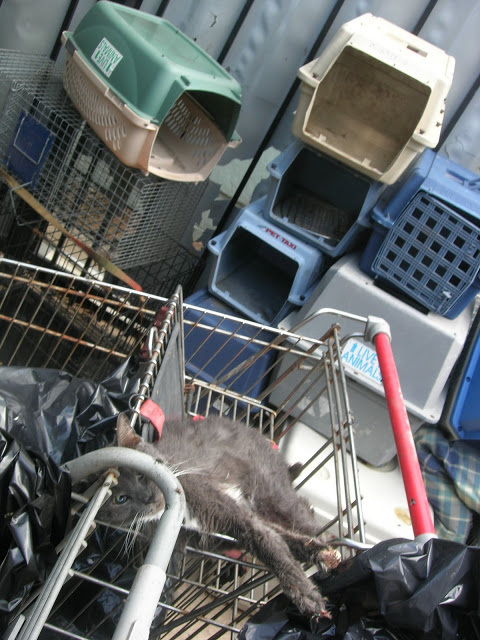
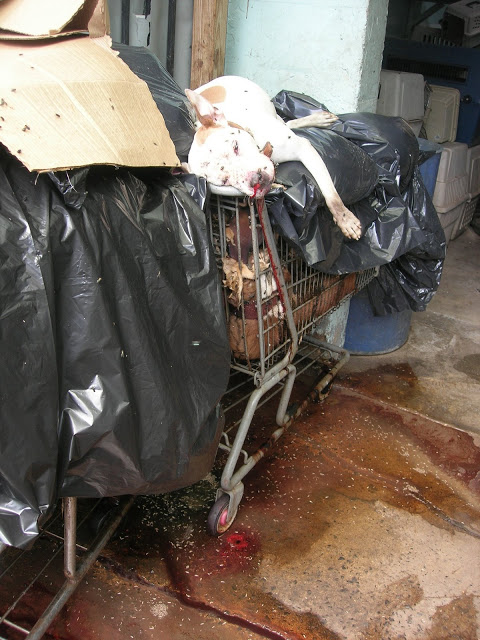
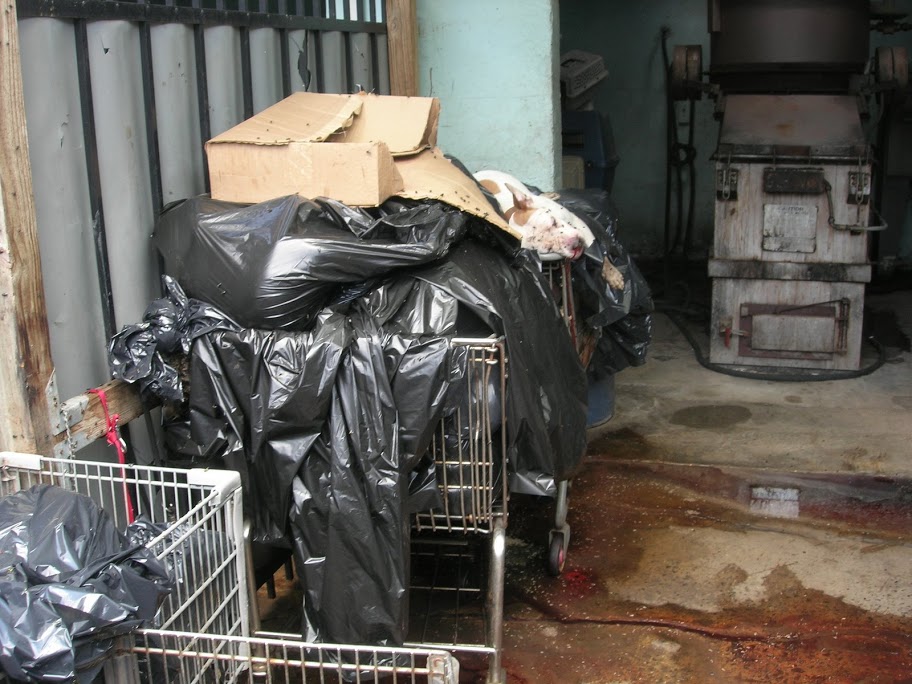
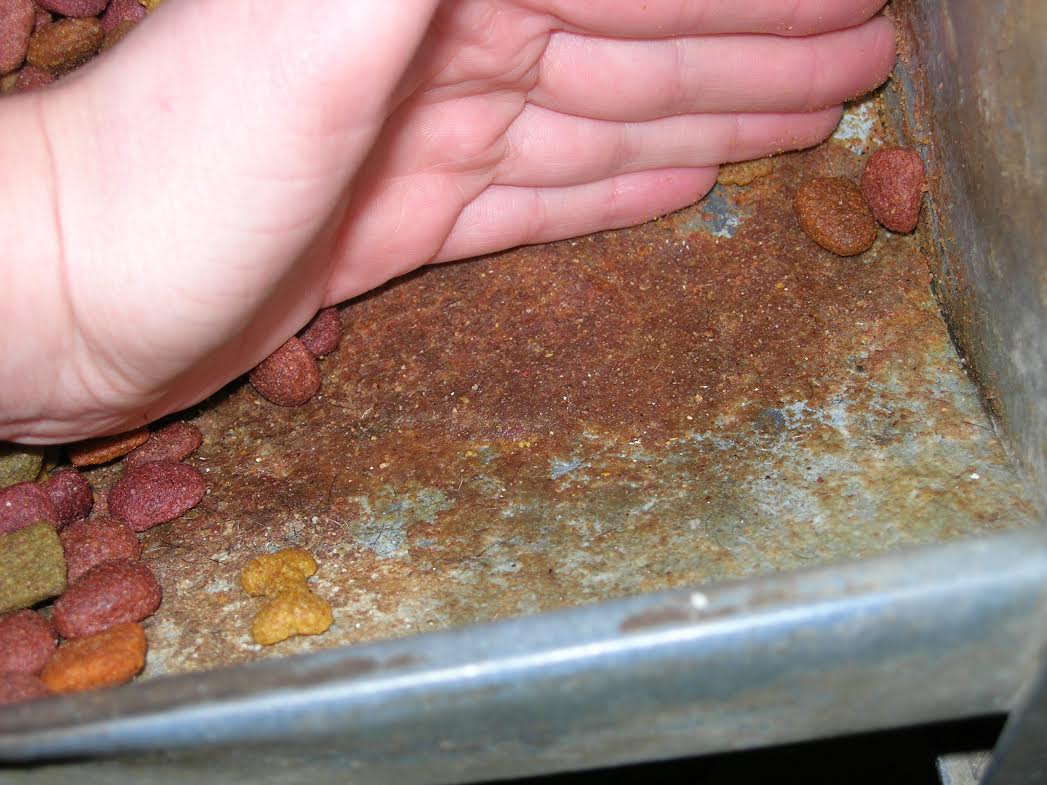
6 Puppy with wounded ears 13 Dogs in feces 14 Dog covered in feces 15 Dogs in dirty kennel 21 Dead animals in shopping cart 24 Closeup of Mange Dog 40 Dead Cat That Was Found in Colony Room 43 Dead Dogs in Shopping Carts. Blood. Maggots 44 Severe Fly And Maggot Infestation

AHS complained the inspectors were just too hard on them. In an interview with NBC New York, Denton Infield, who was charged with tampering with evidence in the dog killing an adopter case six years earlier, basically said dogs are going to poop at night and you can’t prevent them from wallowing in it. Mr. Infield went on to say poor AHS contracts with dozens of municipalities and might close due to potential fines. Ironically, New Jersey animal shelter regulations only allow fines of up to $50 per offense. During that year AHS had a $1.5 million profit and over $10 million in net assets. Clearly, Mr. Infield and AHS were full of it.

Sadly, the New Jersey Department of Health continued to find significant issues during another inspection in 2011. The inspection report noted dogs housed in kennels with a collapsed roof and workers throwing damaged roof material directly over these dogs. Additionally the report stated outdoor drains were in severe disrepair, no isolation areas for sick large dogs existed, automatic dog feeders were filthy, dogs were exposed to contaminated water and chemicals during the cleaning process, and some animals were not receiving prompt medical care.

The following photos were taken during the 2011 inspection:

AHS 2011 Insepction Sick Rottie AHS 2011 Inspection Cakes on Food 2 AHS 2011 Inspection Dog Near Feces in Drain AHS 2011 Inspection Dog Under Roof Construction AHS 2011 Inspection Smeared Feces

Outrageous Fight with Veterinarians and Animal Welfare Activists for Patrick

In 2011, AHS helped rescue an incredibly emaciated pit bull named Patrick. The dog was found in a garbage chute by workers in an apartment building and was rushed to AHS. To AHS’s credit, the shelter’s veterinarian stabilized Patrick and then sent him to a New Jersey veterinary hospital for intensive treatment. After bonding with Patrick, the veterinarians that ran the animal hospital wanted to adopt Patrick.

Instead of celebrating the fact that the severely abused dog finally had a loving home, AHS filed a lawsuit to take Patrick back. The lawsuit stated Patrick was “trademark registration number 23699” and was a “very valuable brand for commercial exploitation and fundraising.” Unsurprisingly, the animal welfare community was outraged by this action. Luckily, AHS ultimately lost the case after a judge awarded custody to the veterinarians who cared for Patrick.

Vicious Fights with Cory Booker

AHS fought with Cory Booker during the Senator’s tenure as Newark’s mayor. In 2011, the former Mayor announced his intention to build a new no kill shelter in Newark. Instead of rejoicing that AHS may have to kill fewer animals with another shelter in the city, AHS trotted out Denton Infield and spewed out all sorts of nonsense about no kill shelters. This nonsense seemed eerily similar to what PETA, which kills almost all of the shelter animals it takes in, says about no kill shelters. Ironically, AHS stated that Cory Booker should give the money he raised to AHS. Newark’s Deputy Mayor at the time, Adam Zipkin, rightfully called AHS on this BS, and cited no kill animal control shelters in Reno, Nevada, Tompkins County, New York, Charlottesville, Virginia, Marquette, Michigan, Berkeley, California, and Austin, Texas to prove Newark can be a no kill community.

AHS again fought with Cory Booker in 2013. This time AHS sent out Scott Crawford who complained former Mayor Booker was “belittling us and causing us problems.” After all, how dare the Mayor question the record of the high kill shelter with such a sordid history in his own city? Deputy Mayor Zipkin stated the city intended to build a new no kill shelter “due to our extreme dissatisfaction with the level of care at the existing AHS facility – and because far too many of the animals are unnecessarily killed there each year by AHS.” Thus, AHS could not get along with the popular mayor of the city where the organization’s largest shelter is.

Repeated Fights with Volunteers

AHS-Tinton Falls banned its volunteers in 1998 after the volunteers complained about poor shelter conditions. When complaints to AHS and the New Jersey Department of Health resulted in no meaningful actions, one volunteer reached out to her Assemblywoman on the matter. Subsequently, the NJ SPCA was contacted and around a week or so later AHS ended its volunteer program at the shelter for “insurance reasons.” At the time, Lee Bernstein said the volunteers complained about shelter conditions because they were just bitter about being banned. The volunteers were ultimately proven right after the SCI report came out citing the deplorable conditions at AHS’s shelters.

AHS-Newark’s relationship with volunteers running two separate “Friends” pages ended in recent years. In 2013, AHS banned the volunteers running the “Friends of Newark NJ Animal Shelter” Facebook page which currently has over 6,700 fans. At the time, the page primarily focused on saving the shelter’s dogs. In 2012, the last full year this page supported the shelter, AHS-Newark reported 15% of its dogs were killed, died, went missing or were unaccounted for. In 2013, after these volunteers were banned, 38% of AHS-Newark’s dogs were killed, died, went missing or were unaccounted for. Subsequent to the banning of these volunteers, another volunteer formed a Facebook page called the “Friends of Associated Humane Society – Newark.” However, the volunteer parted ways with AHS on less than friendly terms in 2014. Thus, AHS has a history of fighting with and banning the very volunteers giving their all to help the organization’s animals.

History Repeats Itself

To be fair, AHS has improved since the Lee Bernstein era. The SCI report did detail Roseann Trezza fighting with Lee Bernstein at times. For example, Roseann Trezza advocated for sending more animals to rescues.

However, AHS has a very long way to go. The organization’s kill rate is still way too high based on recent data. Furthermore, the three AHS shelters only adopted out 14-39 percent and 6-44 percent of cats and dogs that AHS should adopt out based on my recent analyses of the organization’s performance.

At the end of the day, I firmly believe the banned volunteers side of the story verses AHS’s version. This organization’s history of conflict and highly questionable activities is consistent with them banning volunteers for nefarious reasons. George Santayana stated:

“Those who fail to learn from history are doomed to repeat it”

Unfortunately with AHS’s history, fighting with volunteers and other animal advocates is par for the course. Until AHS’s senior leadership is replaced with competent and compassionate people, AHS’s history of not doing right by the animals will continue.

Shelter Reform Roundtable Set Up to Fail

North_Fremantle_Railway_Bridge_collapse,_1926

As a response to the Helmetta Regional Animal Shelter debacle, State Senator Linda Greenstein took up the issue of shelter reform. State Senator Greenstein’s district contains several municipalities which contracted with Helmetta Regional Animal Shelter. Ms. Greenstein found out firsthand what the true nature of many New Jersey’s shelters are like when she was denied access to the facility.

State Senator Greenstein convened a roundtable recently on reforming New Jersey’s animal shelter system. Understandably, Ms. Greenstein attempted to bring together a variety of people who could provide valuable input into the eventual drafting of shelter reform legislation. Unfortunately, many of these individuals represent obstacles to meaningful shelter reform legislation.

Humane Society of the United States and Animal Welfare Federation of New Jersey Dominate Roundtable

Despite its name, the Humane Society of the United States (“HSUS”) has been one of the biggest opponents to real shelter reform in the nation. In the 1990’s, HSUS told shelters to kill rather than send animals to rescues due to moving the animals being potentially “stressful.” In 2003, HSUS argued a shelter should not give a euthanasia list to a rescue group dedicated to saving animals from a local kill shelter. HSUS advised the shelter not to work with this rescue group arguing the rescue group was holding the shelter “hostage.” Ironically, regressive shelters often hold animals hostage in exchange for rescues not speaking the truth about these organizations. In 1998, HSUS opposed Hayden’s Act in California which prevented shelters from killing animals that rescues were willing to save. Luckily, California enacted this legislation which resulted in rescues saving large numbers of animals. During the 1990s, feral cat activists in North Carolina requested HSUS help them persuade their local shelter to allow TNR in their area. Not only did HSUS refuse to help the TNR advocates, HSUS wrote a letter to the local prosecutor stating feral cat colony caretakers should be charged with abandonment. Around 2007, HSUS raised funds from the public to “care for the dogs” seized during the Michael Vick dog fighting case, but did not care for the dogs and actually lobbied authorities to kill these dogs. Last year, HSUS stopped a Minnesota bill which would prevent shelters from killing animals rescues were willing to take, ban the gas chamber and heart sticking, and killing owner surrenders immediately. Thus, HSUS has long opposed progressive shelter reform efforts.

HSUS actions are consistent with an industry lobbying group focused on protecting the organizations it represents and not the animals. Most industries have a lobbying group to advocate for its companies’ interests. For example, the American Bankers Association works to undermine financial regulations. The American Petroleum Institute spends large sums of money to open up lands to exploit natural resources at the cost of the the environment. The Grocery Manufacturers Association, which is the major lobbyist for the food industry, has fought to kill legislation requiring food companies to label products with genetically modified (“GMO”) ingredients. Similarly, HSUS tries to block efforts designed to make shelters do more work and face more scrutiny. Thus, HSUS is nothing more than an industry lobbyist group with a kind name when it comes to shelter reform legislation.

The Animal Welfare Federation of New Jersey (“AWFNJ”) also has a poor track record. This group’s mission statement includes “uniting all New Jersey animal protection organizations”, but makes no mention of reducing the death toll at New Jersey animal shelters. Based on the most recently reported data to the Office of Animal Welfare, 27,936 dogs and cats were killed, died or went missing at New Jersey Animal shelters in a single year. This number rises to 30,048 if dogs and cats shelters failed to account for are included in the totals. Despite the severe problems at numerous New Jersey shelters in the last year, the AWFNJ was shockingly silent. In fact, the AWFNJ’s web site currently lists the former manager of one of these problem shelters as a member of its Board of Directors. The Montclair Township Animal Welfare Advisory Committee, whose Vice Chair is a local respected veterinarian, long advocated the Shelter Manager, Melissa Neiss, be replaced due to the shelter’s alleged neglect of its animals. Why should we trust an organization which allows this sort of person to serve on their Board of Directors? Even worse, the AWFNJ wrote a letter to Governor Christie in 2011 opposing new legislation preventing shelters from killing owner surrenders during a 7 day hold period. Luckily, the 7 day hold period for owner surrendered animals became law and killing owner surrendered animals within minutes of arriving at shelters is now illegal. Thus, the AWFNJ has done little to nothing to stop recent shelter abuses and tried to block essential shelter reform.

HSUS and AWFNJ have too much influence over the shelter reform roundtable. New Jersey State Director of HSUS and AWFNJ board member, Kathleen Schatzmann, serves on the roundtable. Niki Dawson, who worked at HSUS in 2012, and recently served as AWFNJ President is also a member of the roundtable. Similarly, St. Huberts Executive Director, Heather Cammissa, held several positions at HSUS, including Kathleen Schatzmann’s current job, and and is on the Advisory Board of AWFNJ. Additionally, the current AWFNJ President and Director of Animal Alliance, Anne Trinkle, also serves on the shelter reform roundtable. Thus, the shelter establishment industry has too much of a voice in actually reforming and regulating New Jersey’s animal shelters.

Helmetta Regional Animal Shelter’s Failed Regulator Serves on Shelter Reform Roundtable

The Director of Middlesex County Department of Health, Lester Jones, is also a roundtable member. Mr. Jones’ agency allowed the Helmetta Regional Animal Shelter to go on its merry way for years despite large numbers of complaints and poor inspection reports. Even worse, Lester Jones actually defended the shelter last August saying the problems were no big deal and again in September. Additionally, the Middlesex County Department of Health opposes TNR and Helmetta Regional Animal Shelter fulfilled Lester’s department’s wish with the facility’s catch and kill policy for feral cats. While Lester Jones did make some meaningful suggestions at the roundtable, the past history of his organization is worrisome.

Shelter Establishment Shows its True Colors at Shelter Reform Roundtable

State Senator Greenstein made some key points about New Jersey’s shelters. Specifically, State Senator Greenstein said existing shelter law and its enforcement allows many shelters to do bad things. Ms. Greenstein cited Helmetta as an example of a shelter which took too many animals in to properly care for them.

State Senator Greenstein correctly pointed out the distinction between kill and no kill shelters as follows:

“My take on this whole thing standing back on it and looking at it is that it comes down to these competing philosophies,” she said. “There’s the old-fashion philosophy which we call a kill shelter. I realize that you are pretty much taking the animals in like you would any other trash and you have to keep them for a week then you probably much expect to get rid of them and that leads to the idea of that it’s ok for them to get sick and it’s ok for the conditions not to be too clean and the state standards don’t require too much.”

She said then there the whole new philosophy that you shelters that are doing a good job are into this “no kill philosophy.”

“Try to get them adopted and do whatever you can to keep them healthy,” she said.

Despite this correct and common sense summary of the situation, the shelter industry hacks jumped in and said don’t use the words “kill” and “no kill” as it apparently hurts the feelings of people killing their animals:

New Jersey State Director of the Humane Society of the United States Kathleen Schatzmann warned that the term “no kill shelter” could be “very polarizing to certain groups.” “If perhaps we cannot use that terminology I think all of the good groups have the same end goal in mind to lessen the euthanasia rates and have as much adoption and volunteer participation as possible,” said Ms. Schatzmann.

No kill is mainstream now as major national groups, such as Maddies Fund and Best Friends use the term. In fact, Best Friends argues we should start being honest and drop the word “euthanasia” altogether and use “kill” when shelters take the lives of healthy and treatable animals. Both these groups directly are working on making large communities no kill while HSUS contributes hardly any of its funds to saving companion animals. Additionally, the more we avoid being honest about what is at stake (i.e. whether we kill animals or not), the less likely we will take action to stop it. Thus, HSUS employee and AWFNJ board member, Kathleen Schatzmann, once again shows these groups are more focused on protecting the shelter industry than the animals who are being slaughtered by the people running these so called shelters.

Former HSUS employee and ex-AWNJ President, Niki Dawson, showed where her allegiances lie with this doozy of a remark:

Helmetta Regional Animal Shelter Interim Director Niki Dawson agreed that the phrase should be “avoided.” “It is polarizing for those animal facilities that are doing the best that they can but may not have the resources to have an on-site behavioral trainer to work with some of the more difficult dogs,” said Ms. Dawson.

So shelters are killing animals because they can’t afford a behaviorist? This is a joke as shelters across the nation with few financial resources manage to save their dogs. Perth Amboy Animal Shelter, which serves a community with a higher poverty rate than Jersey City, saved 97% of its dogs in 2013 and only euthanized 5 dogs in 2014. Additionally, Perth Amboy Animal Shelter only spent $281 per cat and dog in 2013. As a comparison, East Orange Animal Shelter, which had horrific problems last year, spent $345 per dog and cat in 2013. Associated Humane Societies, which has its largest kill shelter in Newark, took in revenue of around $1,000 per dog and cat based on its most recently reported data. Similarly, Old Bridge Animal Shelter, which serves a middle class area, saved 99% of its dogs despite only having a budget of $152 per dog and cat in 2013. If Perth Amboy Animal Shelter and Old Bridge Animal Shelter can achieve this success with their meager funding, then other shelters can do so as well.

Shelters do not require an on-site behavioral trainer to save their dogs. Approximately 80-90% of dogs coming into shelters do not have severe behavior issues. Therefore, shelters can achieve no kill or come close to doing so without needing serious behavior rehabilitation. Shelters can hire a trainer on a part time basis or even get a trainer to volunteer their services to help the few dogs with serious behavior issues. Finally, shelters can run large scale dog play groups, such as Amy Sadler’s Playing for Life program, which significantly reduces behavior problems in shelter dogs. Most importantly, these types of playgroups do not require a trainer or behaviorist.

Niki Dawson’s comments are very disappointing, but not surprising. While I held out hope Ms. Dawson changed her ways, her past experience working at HSUS and at high kill shelters likely still impacts her mindset. While serving as Executive Director at Camden County Animal Shelter, the dog kill rate increased from approximately 20% in 2007 and 19% in 2008, the two years before Ms. Dawson’s tenure as Executive Director began near the end of 2008, to 28% in her last calender year at the shelter in 2010. In 2013, Camden County Animal Shelter’s kill rate was back down to 19%. In 2010 while Niki Dawson was assisting Liberty Humane Society, many people in the community criticized her shelter for killing dogs. In a roughly one month span, Liberty Humane Society killed 25 dogs along with 47 cats and some people questioned how the shelter used temperament testing to make life and death decisions for dogs. No kill leader, Nathan Winograd, told Ms. Dawson she was not doing enough positive outreach and she had alternatives to killing dogs. Thus, Ms. Dawson’s defense of high kill shelters is not surprising based on her fairly recent experience running these types of facilities.

St. Huberts Executive Director, Heather Cammisa, who used to work at HSUS and is on the AWFNJ Advisory Board, said New Jersey’s animal shelters are just dandy:

Executive Director of St. Hubert’s Heather Cammisa said that they have made tremendous progress in New Jersey in not euthanizing animals.”We’ve come a really far way so now that we can share how we got there with our states they look up to us as a leader,” said Ms. Cammisa. She attributes it to responsive, effective animal control in every municipality, low-cost spay and neutering accessibility and the law in 1983.

Call me crazy, but I don’t consider the loss of as many as 30,000 or more dog and cat lives in New Jersey shelters during 2013 a success. Furthermore, would you consider Ron’s Animal Shelter an example of “tremendous progress?” Ron’s Animal Shelter killed 65% and 86% of its dogs and cats in 2013 and reported virtually identical kill rates in 2006. Any state that allows a shelter to keep on operating a slaughterhouse like that is no “leader.” Additionally, New Jersey animal shelters had a combined dog and cat kill rate of 28% in 2013 while only 11% of dogs and cats were euthanized in Colorado’s animal shelters during that same year. New Jersey’s kill rate was nearly 3 times higher than Colorado’s euthanasia rate despite Colorado shelters taking in nearly 3.5 times as many dogs and cats per capita. Thus, New Jersey animal shelters are not “leaders”, they are an embarrassment.

Like Niki Dawson, Heather Cammissa’s past history working for a kill shelter likely influences her views. Ms. Cammissa served as Executive Director of the Jersey Shore Animal Center for 5 years. During her last year as Executive Director in 2006, the shelter killed 45% of its cats. Furthermore, she worked for HSUS during a tumultuous time when HSUS vehemently opposed the no kill movement. Not surprisingly, her current shelter refuses to use the term “no kill” and says its “divisive among animal welfare professionals.”

That being said, Ms. Cammissa did say New Jersey shelters need to “clean up” their data reporting. Unfortunately, many more things need fixing as well.

Animal Alliance Director and AWFNJ President Anne Trinkle claimed our laws are fine and we just need better enforcement:

“The law, as it is written, is pretty comprehensive it is just a matter of enforcement,” said Annie Trinkle, director of Animal Alliance and Welfare Federation of New Jersey.

I do agree that New Jersey animal shelter laws are reasonably good relating to humane care. Certainly, effective enforcement would help. However, the penalties for noncompliance are too weak and municipalities hold too much power when things go wrong. Additionally, more specificity on how humane care is provided, such as requiring animal enclosures be cleaned twice a day, is needed. As a result, a horrific shelter like Helmetta can continue on its merry way for far too long.

Enforcing shelter laws mandating humane care may lead to increased killing if lifesaving requirements are not put into law. Simply put, shelters can comply with existing laws cheaply and easily by killing animals right after their 7 day hold period. That is why I recommend that New Jersey enact the Companion Animal Protection Act.

Shelter Reform Roundtable Members from Outside the Animal Shelter Lobby Must Stand Up and Fight for What is Right

The shelters invited to the roundtable are not role model shelters in my opinion. While these shelters do have relatively low euthanasia rates and I’m sure provide humane care, these organizations’ contribution to making New Jersey a no kill state falls far below their potential. Specifically, these shelters are blessed with excess space relative to the number of local animals they need to adopt out and some serve very affluent areas. Unfortunately, based on my recent analysis of these shelters’ performance on dogs and an upcoming one on cats, these organizations do not save nearly as many animals from New Jersey as they should. Thus, these groups are not rock star shelters and their low euthanasia rates are due more to favorable circumstances than highly successful operations.

State Senator Greenstein said certain members of the roundtable were not interested in fundamental change. Unfortunately, this is not surprising given the number of the establishment shelter industry insiders on the roundtable.

As I’ve previously stated, our state’s shelter system needs monumental changes if we are going to become a no kill state. Specifically, we need to do the following things to end the killing of healthy and treatable animals in New Jersey:

  1. Require the Office of Animal Welfare to do quarterly inspections for every shelter in the state
  2. Institute the Companion Animal Protection Act (“CAPA”)
  3. Enact a no kill resolution instructing all shelters to develop a plan to reach at least a 90% save rate as the Austin, Texas City Council did
  4. Mandatory data reporting in the Companion Animal Protection Act should require an audit or at least a thorough independent review for accuracy

CAPA and a no kill resolution are essential as regressive shelters will simply kill more animals after the 7 day hold period if we raise humane care standards. Furthermore, too many shelters, such as Helmetta Regional Animal Shelter, will bully volunteers and rescues from speaking up about poor treatment of animals without explicit laws making this illegal. CAPA requires shelters to follow many parts of the no kill equation, which is a series of programs proven to reduce or actually end the killing of savable animals. Specifically, CAPA requires animal shelters/municipalities do the following common sense things:

  1. Implement TNR and prohibit anti-feral cat policies
  2. Develop detailed animal care protocols for all animals, which includes nursing mothers, unweaned kittens and puppies, and animals which are old, sick, injured or needing therapeutic exercise
  3. Clean animal enclosures at least two times per day to maintain proper hygiene and be welcoming to prospective adopters
  4. Not kill any animal a rescue is willing to take
  5. Prohibit banning of rescues unless the rescue is currently charged with or convicted of animal cruelty/neglect
  6. Contact all rescues at least two business days before an animal is killed
  7. Match lost pet reports with animals in shelter and post stray animals on the internet immediately to help find lost pets owners
  8. Promote animals for adoption using local media and the internet
  9. Adopt animals out seven days a week for at least six hours each day, which includes evenings and weekends when potential adopters are likely to visit
  10. Not have discriminatory adoption policies based on breed/age/species/appearance (i.e. can’t prohibit pit bull, elderly pet, etc. adoptions)
  11. Offer low cost spay/neuter services, substantive volunteer opportunities to the public, and pet owner surrender prevention services
  12. Not kill any animals when empty cages exist, enclosures can be shared with other animals, or foster homes are available
  13. Shelter Executive Director must certify they have no other alternative when killing/euthanizing an animal
  14. Publicly display animal shelter intake and disposition statistics (i.e. numbers of animals taken in, adopted, returned to owner, killed, etc) for the prior year
  15. Provide the local government and the public access to the intake and disposition statistics each month
  16. Pet licensing revenues must be used to fund low cost spay/neuter and medical care for shelter animals rather than go to other government uses

My advice to the other roundtable members, such as the two former Helmetta Regional Animal Shelter volunteers and State Senator Greenstein, is to stand up for what is right. Do not let people with imposing sounding job titles intimidate you. The public is behind you and wants you to enact the above things. As in Austin, Texas, activists fought the Austin Animal Services shelter director and the ASPCA and made their city the largest no kill community in the country. Like the HSUS and former HSUS members on the roundtable, the ASPCA told activists not to criticize the high kill city shelter. After 1 year of implementing the ASPCA plan, killing actually increased by 11%. No kill activists subsequently convinced the City Council to implement the no kill resolution despite the ASPCA’s opposition and Austin has been a no kill city for the last four years.

To those not on the shelter reform roundtable, please contact State Senator Greenstein at this link and tell her you want fundamental change like the recommendations above.

Our shelter system is in crisis and we need to call out the defenders and enablers of the status quo. If we truly want to save our state’s homeless animals, we need to say enough is enough. Only then will we put the policies into place to make New Jersey the no kill state it should be.

New Jersey Animal Shelter Statistics Are Far Worse Than Previously Thought

Photo of discarded dead animals from a 2009 Office of Animal Welfare inspection report of Associated Humane Societies – Newark. The Executive Director at the time is still in charge of this shelter today.


Most New Jersey animal shelters voluntarily report detailed data to state authorities. Last August, I shared New Jersey’s animal shelters summary statistics on my Facebook page. Each year, the New Jersey Department of Health’s Office of Animal Welfare requests each licensed animal shelter in the state to submit animal shelter data for the previous year. Animal shelters voluntarily submit this data in the “Shelter/Pound Annual Report.” The Office of Animal Welfare takes these Shelter/Pound Annual Reports and compiles the number of dogs, cats and other animals impounded, redeemed, adopted and euthanized to prepare its Animal Intake and Disposition report. However, the Shelter/Pound Annual Reports include additional information on how animals were impounded (i.e. strays, owner surrenders, rescued from in-state facilities, rescued from out of state shelters, and cruelty/bite cases) and disposed of (i.e. returned to owner, adopted, sent to rescue/another shelter, and died/missing). Additionally, the Shelter/Pound Annual Reports include the number of animals in shelters at the beginning and end of the year as well as the maximum number of animals facilities can hold. Thus, the Shelter/Pound Annual Reports include very important data not found in the Office of Animal Welfare’s summary report.

I compiled the data from these reports and analyze the results in this blog. 2013 statistics for each New Jersey animal shelter are listed at this link.

Garbage Data Raises Serious Questions About New Jersey Animal Shelters’ Statistics

Several animal shelters, which reported statistics in prior years, failed to submit data in 2013. Specifically, Summit Animal Clinic in Union City, Associated Humane Societies – Tinton Falls, Mercerville Animal Hospital and Angel Pets Animal Welfare in Woodbridge disclosed this data in 2012, but did not do so in 2013. Additionally, East Orange Animal Shelter has never submitted Shelter/Pound Annual Reports to the state, but did share limited data with The Record newspaper. These shelters failure to disclose data raises serious questions. For example, are they trying to hide embarrassing statistics from the public? I’ve included these shelters’ 2012 data, and in the case of East Orange, its limited 2013 data in my analysis. Also, I performed my analysis without these shelters as well. Unless indicated below, I’ve included these shelters’ data in the analysis under the assumption the statistics would be similar if submitted to the Office of Animal Welfare in 2013.

Most New Jersey animal shelters do not properly account for their animals. Simple math dictates the number of animals at a facility at the beginning of the year, plus all animals coming in during the year, less all animals leaving for the period, should equal the number of animals a shelter has at the end of the year. Stunningly, 69 out of 100 shelters reporting these dog statistics and 71 out of 98 facilities submitting this cat data failed to get this right. This raises serious questions about the accuracy of these shelters’ reported statistics. Even worse, 54 of the 69 shelters with flawed dog statistics and 46 of the 71 facilities with incorrect cat statistics should have had more animals at the end of the year then reported. While these errors could have been due to incorrect counts of the number of animals at facilities, the more likely answer is many outcomes, such as animals killed, dying, or gone missing, were not recorded. Given 71% of the errors were due to shelters having less rather than more animals on hand at the end of the year than they should have had lends credence to the theory that errors were mostly due to shelters failing to account for various outcomes. To put it another way, 3,231 cats and dogs should have had outcomes reported and did not. Thus, there is the potential that as many as 3,231 additional dogs and cats were killed, died or went missing from New Jersey animal shelters than were reported in the last year.

Shelters may have failed to classify animals adopted out and sent to rescue properly. Both Paterson Animal Control and Elizabeth Animal Shelter reported no animals were sent to rescues and all dogs and cats leaving their facilities alive were owner reclaims or adoptions. However, rescues I know who work closely with these two facilities told me both shelters rarely adopt animals directly to the public. This makes sense as neither shelter advertized animals for adoption (i.e. no adoption web site or social medial pages) in 2013. One has to wonder how many other facilities failed to properly classify adoptions and rescues properly. This data is very important as it provides details on the burden rescues and other shelters are taking from these facilities.

We need better oversight of New Jersey animal shelters’ data reporting. Currently, these statistics are voluntarily reported and most shelters are not taking this seriously. For example, I noticed a large number of reports were submitted many months after the end of the year. This data should be easy to compile since facilities can utilize animal shelter software programs, some of which are free, to do this task. Furthermore, New Jersey animal shelter laws mandate facilities maintain much of the raw data found in the Shelter/Pound Annual Report. Unfortunately, Office of Animal Welfare inspections routinely find shelters do not properly keep records on animals. We need to make the Shelter/Pound Annual Report mandatory for animal shelters along with serious penalties for significant errors (especially if deliberate). In order for animal shelters to take data reporting seriously, we may also need to require audits of these reports. Thus, these results show we need stronger laws and the Office of Animal Welfare to play a greater role in ensuring reported animal shelter statistics are in fact accurate.

Despite the errors in these reports, the data provided still reveals important information.

More Animals Losing Their Lives in New Jersey Animal Shelters Than Previously Believed

The more detailed data in the Shelter/Pound Annual Reports allows one to more critically examine the percentage of locally impounded animals dying in New Jersey’s animal shelters. The following table summarizes my analysis of the kill/death rate calculated from the Office of Animal Welfare’s summary report and the data reported in the Shelter/Pound Annual Reports.

Totals

The Animal Intake and Disposition report prepared by the Office of Animal Welfare only allows one to calculate the number of animals killed as a percentage of total animals impounded or intake. I prefer calculating the kill rate as a percentage of outcomes rather than intake as this metric directly compares positive and negative outcomes. Using intake depresses the kill rate since shelters can simply hold animals for a long time to the point of overcrowding. Calculating kill rate based on outcomes rather than intake increases the dog kill rate from 13.4% to 13.9% and the cat kill rate from 38.5% to 39.2%.

To calculate the statewide kill rate, we must also back out transfers from one New Jersey animal shelter to another state facility to avoid counting animals still in the state’s shelter system or registering two outcomes for the same animal (i.e. one New Jersey animal shelter transfers a dog or cat to another state facility who then adopts out the animal). This adjustment increases the dog kill rate from 13.9% to 14.5% and the cat kill rate from 39.2% to 40.8%.

In addition, we should increase the kill rate for animals dying or gone missing in shelters. I label this metric the death rate as these animals are likely dead or in a very bad situation. After making this adjustment, the dog death rate increases from 14.5% to 15.5% and the cat death rate rises from 40.8% to 46.8%.

Also, many shelters transport easy to adopt animals from out of state which artificially increases save rates. To properly calculate the percentage of New Jersey animals losing their lives, we need to adjust for transports. Unfortunately, shelters don’t break out their save rates by local and out of state animals. However, most likely nearly all of the out of state animals (primarily puppies and easy to adopt dogs) make it out of shelters alive. Therefore, I back out the number of out of state transports to estimate the local death rate. This adjustment increases the New Jersey dog death rate from 15.5% to 18.9% and the state cat death rate from 46.8% to 47.4%.

Also, I estimate a maximum local death rate by including the number of unaccounted for animals described in the section above. Making this adjustment increases the maximum potential New Jersey dog death rate from 18.9% to 22.1% and the maximum potential state cat death rate from 47.4% to 49.5%.

Finally, the maximum potential New Jersey cat death rate decreases slightly from 49.5% to 49.4% if I include the 2012 data from shelters who failed to report statistics in 2013 to the Office of Animal Welfare. Thus, the percentage of New Jersey animals losing their lives in our state’s animal shelters may be much higher than previously thought.

Death Rates Extremely High at a Number of New Jersey Animal Shelters

Dogs and cats are likely to lose their lives or go missing at a number of New Jersey animal shelters. Shelters with the highest death rates for dogs and cats are listed in the following tables:

NJ Shelter Rates Tables (6)

NJ Shelter Rates Tables (7)

Thus, both dogs and cats have a very good chance of leaving many New Jersey animal shelters dead rather than alive.

Many shelters fail to account for large numbers of their animals. As discussed above, a shelter’s number of animals at the end of the year should be calculated as follows:

Beginning number of animals + animals impounded – animals leaving the shelter

Unfortunately, a large number of shelters take in far more animals than they can explain where they went. Shelters having the highest numbers of unaccounted for dogs and cats are listed in the following tables:

NJ Shelter Rates Tables (8)

Unacct cats

Dog and cat death rates at many shelters may be even higher if these unaccounted for animals are counted as dead or missing. If we only consider animal shelters which don’t or rarely transport, facilities with the highest dog and cat death rates considering the unaccounted for animals described above are as follows:

NJ Shelter Rates Tables (2)

Max pot cats po

Thus, the plight of dogs and cats may be far worse in New Jersey animal shelters when we consider the unaccounted for animals.

Shelters Turn Their Backs on New Jersey’s Animals

New Jersey animal shelters rescue far more animals from out of state than other New Jersey animal shelters. Specifically, 5,676 dogs were transferred from out of state animal shelters compared to only 1,410 dogs taken in from other New Jersey animal shelters. While perhaps some shelters, such as Animal Alliance in Lambertville, take animals from nearby New York or Pennsylvania animal control shelters, the overwhelming majority of these dogs most certainly came from down south. In fact, New Jersey animal shelters transported more dogs from out of state than dogs who were killed in, died in or went missing from New Jersey animal shelters. This number does not include additional dogs transported in from out of state by rescues operating without a physical facility. Shelters transporting the most dogs from out of state were as follows:

NJ Shelter Rates Tables (5)

New Jersey animal shelters transported 642 cats from out of state while nearly 50% of cats in the state’s animal shelters were killed, died or went missing. Animal Welfare Association (280 cats received from out of state) and Mount Pleasant Animal Shelter (211 cats received from out of state) rescued more cats from out of state facilities than New Jersey animal shelters. In the case of Mount Pleasant Animal Shelter, the organization’s Executive Director told me these cats were rescued from New York Animal Care and Control. One can only hope the out of state cats rescued by other New Jersey animal shelters came from nearby New York and Pennsylvania facilities rather than from shelters far away down south.

Return to Owner Rates Better Than Average at Most Shelters

Return to owners (“RTO”) rates are one of the positive results from this analysis. Overall, the dog and cat RTO rates of 52% and 4% are approximately twice the national average. As I noted in my blog on reuniting lost pets with owners, return to owner rates are highly correlated with socioeconomic status. Wealthier people likely have more resources/knowledge to license and microchip their dogs. Similarly, people with greater incomes are more likely to afford reclaim fees or ransom payments to animal shelters. New Jersey’s RTO rates for dogs clearly fit this pattern with shelters serving wealthy towns returning most stray dogs to owners while urban shelters are only returning about one fifth of lost dogs to owners. Clearly, we need to help people in urban areas get microchips and ID tags on their dogs. Additionally, we need to create pet help desks at shelters in these cities to help people pay the reclaim fees, which are often mandated by the cities themselves, when necessary. The statewide cat reclaim rate, like figures from across the nation, is still very low and suggests shelters need to figure out better ways to get lost cats back to their families. New Jersey should allow shelters to transfer stray cats to rescues during the mandatory 7 day hold period since few are returned to owners at shelters. This would open up space to save more cats and reduce the chance of disease (i.e. cats spending less time in shelters are not as likely to get sick).

Shelters Leave Animal Enclosures Empty While Dogs and Cats Die

New Jersey animal shelters fail to use their space to save animals. Based on the average number of animals at all of New Jersey’s animal shelters at the beginning and the end of 2013, only 61% of dog and 66% of cat capacity was used. Given December is a low intake month, I also increased these populations to an average intake month. This adjustment only raised the dog and cat capacity utilization to 62% and 87%. These estimates likely overestimate the average capacity utilized as many facilities kill animals once they reach a certain population level. Many animal shelters with low kill rates failed to rescue animals with their excess space. Additionally, other shelters used little of their available space and still killed a large percentage of their animals. Some examples after increasing the population (and therefore capacity utilization) based on the adjustment discussed above are as follows:

NJ Shelter Rates Tables (11)

NJ Shelter Rates Tables (13)

Thus, many New Jersey animal shelters are killing dogs and cats despite having ample space to house these animals.

New Jersey’s animal shelters continue to fail the state’s animals. The state’s animal control facilities only impound 8.7 animals per 1,000 New Jersey residents. As a comparison, the average community in the country impounds anywhere from 14-30 animals per 1,000 residents based on estimates from Animal People Newspaper and the Humane Society of the United States. Despite New Jersey shelters impounding a fraction of the animals other no kill communities take in on a per capita basis, the state’s animal control facilities continue to kill and allow animals to die under their care. Even worse, many of these shelters can’t even properly keep track of how many animals leave their facilities dead or alive. Our state’s animals deserve far better treatment than this. Contact your local city council members and mayor and demand better from the animal shelter serving your community. We can do this so let’s get to work!

New Jersey’s Lawless Animal Shelters Need Policing

Recently, terrible conditions at New Jersey animal shelters became well-publicized. The NJ SPCA took over Hunterdon Humane Animal Shelter in January after Hunterdon Humane Animal Shelter’s Board President was charged with animal cruelty for failing to provide proper care to a number of cats at the facility. In March, Jersey Animal Coalition failed a joint state Office of Animal Welfare and South Orange inspection resulting in the shelter’s planned closing in November. The Office of Animal Welfare inspected the East Orange Animal Shelter in June and found horrific problems. During June, Elizabeth Animal Shelter illegally killed an owner’s two dogs before the 7 day state mandated hold period elapsed. In July and August, the Office of Animal Welfare inspected Linden Animal Control and requested Linden’s Health Officer shut the facility down. The Office of Animal Welfare also documented significant problems at Helmetta Regional Animal Shelter in July and the problems continue to exist today. Local animal activists in Montclair documented Montclair Township Animal Shelter violating New Jersey animals shelter laws, such as failing to maintain adequate temperatures in the facility, using toxic solutions of chemicals causing burns and possibly lung injuries to shelter animals, and failing to provide prompt veterinary care. As a a result of these events, animal activists in New Jersey are becoming aware of the crisis in our state’s animal shelters.

New Jersey Animal Shelter Laws Are Pretty Good

New Jersey’s animal shelter laws are pretty good relative to other states. Our stray/hold period of seven days is longer than most states. New Jersey also prevents its shelters from killing owner surrendered pets immediately by requiring these animals be held 7 days or sent to rescue. Furthermore, state animal shelter laws require facilities to have a supervising veterinarian who approves a disease control program that addresses “both the animals’ physical and psychological well-being.” N.J.A.C. 8.23A-1.9 also mandates “animals displaying signs of stress shall be provided with relief pursuant to the disease control and health care program.” New Jersey shelters must also keep their facilities clean and use solutions and products that will not harm the animals. Finally, specific rules exist to help ensure euthanasia is done as humanely as possible.

Local Boards of Health Fail Miserably at Enforcing New Jersey Animal Shelter Laws

New Jersey animal shelter laws are largely enforced by local boards of health rather than the New Jersey Department of Health’s Office of Animal Welfare. Under N.J.A.C. 8.23A-1.2 (b), animal shelters must pass an annual inspection by the local health authority. The New Jersey Department of Health’s Office of Animal Welfare, which is tasked with ensuring sanitary and humane conditions exist at New Jersey’s animal shelters, also has the right under state law to inspect these facilities. In practice, the Office of Animal Welfare rarely inspects animal shelters. Ultimately, local municipalities through a recommendation by the local health authority or the state Office of Animal Welfare can revoke an animal shelter’s license.

The shocking conditions exposed this year at northern New Jersey animal shelters prove local health authorities cannot adequately enforce the state’s animal shelter laws. Prior to the NJ SPCA arresting Hunterdon Humane Animal Shelter’s Board President in January 2014, the Office of Animal Welfare issued a scathing inspection report on October 23, 2013. The inspection report noted Hunterdon Humane Animal Shelter housed sick and healthy cats together, kept cats with feces all over their feet and legs, failed to provide sick kittens covered in feces prompt vet care, allowed cats and kittens to have eye discharge so severe they couldn’t open their eyes, illegally killed animals before the 7 day hold period elapsed, and routinely used heart sticking to kill animals. Jersey Animal Coalition, which performed poorly in state Office of Animal Welfare inspections from 2005 – 2007, passed subsequent South Orange inspections and then miserably failed an Office of Animal Welfare inspection in March 2014. The inspection report noted sick/injured animals and animals under severe psychological stress were not treated, massive amounts of feces within and outside the facility, sick and healthy animals were housed together, no disease control program approved by a veterinarian, and animals not provided adequate amounts of water. The Office of Animal Welfare inspected East Orange Animal Shelter in June and reported animals inundated with a toxic feces and chemical filled soup, a fly infestation so severe that animals with open wounds and skin lesions were in danger of having maggots grow inside them, cats not provided with enough water and water they did have was contaminated with cat litter, and improper isolation of sick animals. Montclair’s Board of Health was “unable to locate” legally required inspections from 2010 and 2012, and took a grand total of an hour and 45 minutes and 60 minutes to conduct inspections in 2011 and 2013, respectively. Montclair’s Animal Welfare Advisory Committee documented numerous problems going on for years, such as dogs exposed to the elements, animals left isolated for extended times, and water not being properly supplied to dogs and cats. In October, Clifton Animal Control allegedly forced an owner to surrender their dog and then illegally killed the family pet before the required 7 day hold period elapsed. Thus, we clearly see local boards of health cannot properly ensure New Jersey’s animal shelters are kept sanitary and run in a humane manner.

Reports of serious violations of state animal shelter laws at various central central New Jersey facilities show the problem exists throughout the state. Elizabeth Animal Shelter, which presumably passed the Elizabeth Board of Health’s annual inspections, apparently routinely illegally killed owner surrendered animals. Based on reports at the time, the Elizabeth Animal Shelter told a person surrendering two dogs, which he did not own, to bring the dogs in on their weekly kill day and the shelter executed the animals that very same day. Linden’s Board of Health failed to even perform legally required annual inspections of Linden Animal Control from 2007-2012. When the state Office of Animal Welfare inspected the facility on two occasions, the Office of Animal Welfare requested Linden close the facility immediately due to the horrific conditions. Helmetta Regional Animal Shelter inspections conducted by the Middlesex County Board of Health and Office of Animal Welfare turned up serious problems for years, but the very same local regulator continues to say everything is good. At the same time, activists documented terrible conditions and blatant violations of New Jersey animal shelter and federal controlled substance laws. As a result, local boards of health fail to do the necessary job of ensuring animal shelter laws are properly enforced.

The failure of local boards of health to properly enforce animal shelter laws is not surprising. In reality these entities are ill-equipped to inspect animal shelters. Local boards of health are used to inspecting places, such as restaurants, which are far different than animal shelters. In reality, animal shelters are more akin to hospitals than restaurants and other businesses local boards of health usually inspect. The New Jersey Department of of Health and several other public and private entities inspect health care facilities for compliance with state and federal laws at least annually. As a result, the New Jersey Department of Health’s Office of Animal Welfare should regulate the state’s animal shelters in a similar manner as the New Jersey Department of Health regulates hospitals and other health care facilities.

Local health departments are not independent from many of the shelters these agencies regulate. While local Health Officers must be licensed by the New Jersey Department of Health, these Health Officers and their personnel are employees of local governments. As such, these local health departments will typically not want to rock the boat. After all, would you want to tell the elected official, who is your boss, that his or her animal shelter failed to comply with New Jersey laws? Clearly, the costs to fix, which would either increase property taxes or reduce spending on other popular programs, and negative press hurt the reelection prospects of these local politicians. When you consider the state Office of Animal Welfare rarely performs independent inspections, local Health Officers have a strong incentive to not enforce New Jersey’s animal shelter laws. Thus, the system to regulate New Jersey’s animal shelters is set up to fail.

NJ SPCA Cannot Effectively Regulate Animal Shelters

The NJ SPCA, which are New Jersey’s animal police, has limited authority and will to clean up the state’s animal shelters. This private group, which holds police powers relating to animal cruelty law enforcement, typically handles animal shelters with kid gloves. For example, several people told me the NJ SPCA was notified of Jersey Animal Coalition’s problems years ago, but never acted until after the state Office of Animal Welfare and South Orange Board of Health asked the NJ SPCA to investigate Jersey Animal Coalition for animal neglect/cruelty last March. After seven months, the NJ SPCA has yet to conclude its investigation, but stated last May they would first work with the shelter to clean up its issues before bringing animal cruelty charges. Apparently, this cleanup never happened since Jersey Animal Coalition is closing and the NJ SPCA does not look like it will charge anyone. Similarly, the NJ SPCA’s Monmouth County guy, Buddy Amato, gave Helmetta Regional Animal shelter a glowing report in August despite numerous inspections, photos, and complaints proving otherwise. Subsequently, the NJ SPCA came to the shelter again and found major issues, but gave management 30-60 days to fix their problems. In 2012, Buddy Amato defended several Monmouth County towns who illegally killed feral cats before the state mandated 7 day hold period elapsed. Even when the NJ SPCA did take action against Hunterdon Humane Animal Shelter, the courts put the former Board President charged with animal cruelty back in charge. As a result, the NJ SPCA’s and the courts coddling of cruel animal shelter directors encourages all animals shelter directors to act in their own, rather than the animals, interest.

New Jersey Department of Health’s Office of Animal Welfare Needs to Directly Enforce State Animal Shelter Laws

The Office of Animal Welfare needs to dramatically increase the number of its animal shelter inspections. From January 1, 2013 through August 6, 2014, the Office of Animal Welfare only inspected six different animal shelters out of one hundred plus facilities in the state housing dogs or cats. The Office of Animal Welfare only has one inspector, Linda Frese, to police over one hundred animal shelters plus countless pet shops statewide. Luckily, Linda Frese performs thorough inspections and does terrific work. However, Ms. Frese needs lots of help to ensure all shelters are inspected properly. Given the crisis at our state’s animal shelters, the Office of Animal Welfare needs to hire enough inspectors to ensure every animal shelter in the state is inspected on a quarterly basis. Additionally, the Office of Animal Welfare should conduct these inspections without notifying local health departments to ensure these are truly surprise inspections.

New Jersey must pass new legislation providing the Office of Animal Welfare full power to close down terrible animal shelters. Under current law, the Office of Animal Welfare can only recommend that a municipality revoke an animal shelter’s license. As a result, local politicians currently can allow terrible animals shelters to continue neglecting their animals. Thus, the independent state Office of Animal Welfare must hold this authority to ensure New Jersey animal shelters are run properly.

Companion Animal Protection Act Needs to Become State Law

New Jersey shelter laws and the Office of Animal Welfare encourage shelter killing. Animal shelters in the Garden State may kill animals for any reason after seven days. For far too many shelters it is simply easier and cheaper to kill animals after one week. After all, if you have fewer animals in your facility you don’t have to clean, feed, and provide veterinary care to those animals. In fact, the Office of Animal Welfare actually encourages shelters to kill and advises municipalities to contract with kill rather than no kill shelters. As a result, New Jersey must pass legislation to force shelters to stop killing and start saving their animals.

The Companion Animal Protection Act (“CAPA”) needs to become law to ensure shelters save rather than take lives. CAPA requires shelters to follow many parts of the no kill equation, which is a series of programs proven to reduce or actually end the killing of savable animals. Specifically, CAPA requires animal shelters/municipalities do the following:

  1. Implement TNR and prohibit anti-feral cat policies
  2. Develop detailed animal care protocols for all animals, which includes nursing mothers, unweaned kittens and puppies, and animals which are old, sick, injured or needing therapeutic exercise
  3. Clean animal enclosures at least two times per day to maintain proper hygiene and be welcoming to prospective adopters
  4. Not kill any animal a rescue is willing to take
  5. Prohibit banning of rescues unless the rescue is currently charged with or convicted of animal cruelty/neglect
  6. Contact all rescues at least two business days before an animal is killed
  7. Match lost pet reports with animals in shelter and post stray animals on the internet immediately to help find lost pets owners
  8. Promote animals for adoption using local media and the internet
  9. Adopt animals out seven days a week for at least six hours each day, which includes evenings and weekends when potential adopters are likely to visit
  10. Not have discriminatory adoption policies based on breed/age/species/appearance (i.e. can’t prohibit pit bull, elderly pet, etc. adoptions)
  11. Offer low cost spay/neuter services, substantive volunteer opportunities to the public, and pet owner surrender prevention services
  12. Not kill any animals when empty cages exist, enclosures can be shared with other animals, or foster homes are available
  13. Shelter Executive Director must certify they have no other alternative when killing/euthanizing an animal
  14. Publicly display animal shelter intake and disposition statistics (i.e. numbers of animals taken in, adopted, returned to owner, killed, etc) for the prior year
  15. Provide the local government and the public access to the intake and disposition statistics each month
  16. Pet licensing revenues must be used to fund low cost spay/neuter and medical care for shelter animals rather than go to other government uses

Passing CAPA will require a huge fight as many New Jersey’s animal shelters along with the Humane Society of the United States (“HSUS”) and ASPCA will lobby against these common sense reforms. HSUS and the ASPCA fought similar reform efforts in many other states, such as New York, Minnesota, and California. However, this is a fight we must take on. CAPA, quarterly shelter inspections by the Office of Animal Welfare, and giving the Office of Animal Welfare the power to shut shelters down will spur massive improvements in the state’s animal shelters. Non-compliant municipalities and private animal shelters will face stiff penalties and therefore will dramatically change their ways.

As the past year showed us, we no longer can wait for municipalities and animals shelters to police themselves. Now is the time for a new sheriff to ride into town to bring law and order to our animal shelters. We can make this happen by demanding our state senators and local assemblymen/assemblywomen pass these laws to improve our shelter system. State Senator, Linda Greenstein, seems quite amenable to reforming our state’s shelter system and is someone we should work with.  Animal lovers are a huge voting block and New Jersey politicians better take us seriously. Enough is enough and if the politicians won’t help, we will show them the door. We can do this so let’s get to work!

Helmetta’s Hellhole of a Shelter

Recently, Helmetta Regional Animal shelter has come under fire. A newly created Facebook page, Reform the Helmetta Regional Animal Shelter, and web page details very concerning issues on a daily basis. The documentation includes terrible inspection reports, shocking photos, and detailed accounts from adopters, volunteers and former employees. Most impressively, the Facebook and web pages clearly articulate these points and come across as highly credible.

Helmetta’s Questionable Shelter Project

The shelter opened up in 2011 with a lot of publicity. Helmetta issued $1.9 million in bonds to fund the construction. Mayor Nancy Martin at the time stated “The borough took an area which was in need of redevelopment and built a beautiful state of the art facility that serves 21 Middlesex and Monmouth County municipalities.” Helmetta uses the facility to shelter its homeless animals and numerous other municipalities in exchange for animal control contract fees.

Mayor Nancy Martin hired friends and family to run the shelter. Nancy Martin, who also serves as tax collector of Perth Amboy, hired Perth Amboy Animal Shelter’s former shelter’s managers, Michal Cielesz, and her husband, Richard Ceilesz, to run the new shelter. The couple killed 37% of Perth Amboy Animal Shelter’s dogs and cats per the shelter’s report to New Jersey’s Office of Animal Welfare during their last year in 2010 compared to the new management’s 4% euthanasia rate in 2013. However, Perth Amboy’s police department records show the Cielesz’s killed 43% of the dogs and cats impounded in 2010. Additionally, the Perth Amboy police department reported only 12 dogs and cats were adopted out of 507 dogs and cats impounded during the Cielesz’s last year running the Perth Amboy Animal Shelter. Mayor Nancy Martin also landed her son, Brandon Metz, the head Animal Control Officer job at the shelter and even got the town to approve her son receiving $50 per animal control call “after normal business hours (which may be as early as 3 pm on weekdays and weekends based on some animal control contracts). According to a 2011 town newsletter, the Mayor’s son also receives $1,000 per animal control contract. To further support her son, Mayor Martin even got the town’s taxpayers to pay her son additional hourly wages to clean kennels. Mayor Martin’s son also serves as Borough Laborer, Water Meter Reader, and Certified Recycling Coordinator. As a result, Mayor Martin appears to use a significant amount of the shelter’s funding to pay her friends and family.

The shelter brings in a significant amount of money to Helmetta. In 2013, the shelter earned $415,959 in revenue from its animal control contracts and shelter operations and only incurred $280,125 in related expenses. As a result, Helmetta earned a $135,834 profit from running its shelter. However, the shelter also has debt service costs to cover from Helmetta’s $1.9 billion bond issuance to build the shelter. Per borough officials, Helmetta pays $80,000 – $90,000 of debt service costs each year resulting in the shelter’s net positive cash flow of only around $45,834 – $55,834. The shelter would have negative cash flow of approximately $63,000 – $73,000 without other fees primarily from dogs transported for adoption from out of state shelters. As a result, Nancy Martin’s shelter project has a very thin margin of error to financially succeed.

Helmetta’s Flawed Financial Model Requires Running a Regressive Shelter

Helmetta’s shelter was designed as a profit making enterprise. In a 2011 newsletter to Helmetta residents, Mayor Nancy Martin argued Helmetta was building the shelter to provide a “source of revenue to keep the tax base stable” after the town’s previously hyped real estate redevelopment project on the property fell apart. Mayor Martin also stated each additional animal control contract brought “additional revenue” and was “pure profit.” Thus, the town and the Mayor’s son were to profit from homeless animals in Middlesex and Monmouth Counties.

Helmetta entered into animal control contracts with too many municipalities. To a certain extent, entering into multiple contracts makes financial sense as the revenues earned from such contracts more adequately cover fixed overhead costs, such as the Executive Director’s salary and utilities. However, Helmetta took this to an extreme and impounds too many animals for the space it has. For example, in 2012 Helmetta impounded 483 local dogs. Based on the shelter’s assumed capacity of 33 dogs, these dogs would only have 25 days before no space was left for these animals. To make matters worse, the shelter’s animal control contracts pay Helmetta on a per animal basis and encourage impounding more animals. Furthermore, Mayor Martin’s son, Brandon Metz, opposes TNR in most places and conveniently allows him to bring in more of his $50 per hour “after normal business hours” fees. As a result, Helmetta and the Mayor’s son literally profit off taking in too many animals and killing them.

Helmetta’s original shelter projections grossly underestimated the cost to properly care for animals. In the 2011 newsletter, Helmetta only forecasted total shelter costs, which includes expenses unrelated to animal care, would equal $57 per animal. Even the most efficient and effective shelters, such as KC Pet Project and Nevada Humane Society, incur much higher costs. For example, if Helmetta spent the $218-$395 per animal as these shelters pay, Helmetta’s originally projected $58,000 profit from running the shelter would turn into a $204,000 – $602,000 loss. These private shelters make up for their funding deficiency through fundraising, but Helmetta cannot receive these kind of monetary donations as a government run shelter. As a result of this gross underestimation of sheltering costs, the shelter needed to find other ways to make money to support the Mayor’s grand plan.

Helmetta’s Money Making Rescue Operation

Helmetta’s shelter transports massive numbers of easy to adopt dogs and puppies each year from southern states to the detriment of local dogs. Per the facility’s 2012 Shelter/Pound Annual Report, Helmetta transported 400 dogs in from other communities, 382 of which came from out of state. These additional animals reduce the time dogs have to stay in the shelter before space runs out from 25 to 14 days based on the assumptions above. Furthermore, the shelter impounded many more dogs in 2013 presumably due to increased transports. Based on the 1,296 dogs impounded in 2013 and the assumed capacity of 33 dogs, dogs would only have 9 days before space ran out at the shelter. Thus, Helmetta Regional Animal Shelter significantly reduces the chances of the contracting towns dogs from finding loving homes by transporting massive numbers of out of state dogs.

Transporting animals increases risk of disease at the destination shelter. Transported dogs often bring new and virulent diseases to shelters. The shelters exporting the dogs usually lack proper disease prevention/containment procedures. For example, the source shelter’s need to transport (i.e. overcrowding, lack of resources) often leads to animals being more likely to come down with serious diseases. Additionally, the trip to the new shelter can cause the animals to get sick due to overcrowding in vehicles and stress. Making matters worse, young puppies, whose mothers might not be vaccinated, transported on such trips do not have fully developed immune systems may be even more susceptible to getting sick. Dr. Kate Hurley, Director of the University of California Davis Shelter Medicine Program, who is one of the nation’s leading shelter medicine experts, argues shelters, such as Helmetta, must “have adequate veterinary resources and isolation rooms to
quarantine the animals.” Thus, Helmetta Regional Animal Shelter must have a top notch facility and procedures to transport hundreds of out of state animals each year.

Helmetta should incur significant costs for transporting and caring for these dogs brought to New Jersey. The town’s accounting records show Helmetta pays $400 to transport 10-13 dogs and puppies or approximately $35 per dog/puppy. Maddie’s Fund shelter financial management template estimates dogs staying at the shelter 21 days on average should cost $245 ($16 to feed, $50 to spay/neuter, $53 to vaccinate/de-worm, $66 to hold in facility, $10 for dog supplies and $50 to treat medical problems) to properly care for assuming all animals require medical treatment. Similarly, puppies staying at the shelter for only 14 days should cost $187 ($5 to feed, $50 to spay/neuter, $54 to vaccinate/de-worm, $18 to hold in facility, $10 for dog supplies and $50 to treat medical problems). The town’s adoption fees of $200 per puppy, $150 per vaccinated dog and $100 per unvaccinated dog would result in the following losses per animal:

1) Puppy – $22 loss
2) Dog ($150 fee) – $130 loss
3) Dog ($100 fee) – $180 loss

Helmetta’s shelter must cut corners to make a profit off the transported dogs and puppies. The shelter does not vaccinate animals upon intake or spay/neuter dogs and cats it adopts out. Additionally, Helmetta does not have enough staff to care for its animals. The National Animal Control kennel staffing guidelines argue Helmetta should have 15 kennel staff caring for the 182 animals it had at the shelter on July 16, 2014. However, the Middlesex County Department of Health found only 4 employees cleaned the facility in the morning and either the shelter director or another employee, such as an animal control officer, cared for animals after 12 noon when the shelter had a similar number of animals.  Skimping on cleaning staff leads to the following heartbreaking images at Helmetta Regional Animal Shelter:

Helmetta Filth 3

Helmetta Filth 2

Helmetta Filth 1

Furthermore, Helmetta provides little to no medical care for its animals. For example, the shelter’s veterinarian, Dr. Ehab Ibraheim, only visits the shelter monthly for a paid inspection. While Helmetta’s contracts allow the shelter to bill the municipalities for veterinary costs, the shelter does not profit from providing care and the extra fees could encourage these municipalities to not renew their contracts. The billings from several large contracting municipalities show Helmetta rarely provides veterinary care. Additionally, numerous adopters have come forward complaining of gravely sick animals to the point the borough council had to vote to refund the adoption fees. Countless images show the ramifications of not providing proper veterinary care for the shelter’s animals:

Helmetta sick animals 2

Helmetta sick animals

Helmetta sick animals 3

Helmetta’s cutting corners turns its shelter’s financial performance around. The $22 loss per transported puppy transforms into $142 profit per puppy when you don’t employ enough kennel staff and withhold vaccinations, veterinary care, and dog supplies. Similarly, the $130 loss per transported dog with a $150 adoption fee turns into a $33 profit per dog when proper care is not provided. Thus, Helmetta literally makes money off animals suffering.

State and Local Inspections Consistently Reveal Significant Problems

Helmetta’s shelter performed poorly in two New Jersey Office of Animal Welfare inspections. In October 2011, the inspector found the new facility’s kennel flooring was not impervious to moisture and therefore a disease vector. Furthermore, the inspection report noted kennels were not physically cleaned due to lacking enough staff. Additionally, Helmetta did not use the proper cleaning solution when they did happen to attempt to disinfect animal enclosures. The inspection report also noted the shelter’s “Veterinarian of Record” did not approve the shelter’s disease control program and the facility lacked a dedicated isolation area to prevent the spread of disease. The inspection report also noted improper euthanasia documentation and record keeping. In a follow-up inspection a month later, these same problems persisted.

Middlesex County Health Department inspections in October 2012 and July 2014 also documented widespread violations of New Jersey shelter laws. Both inspections revealed the “Veterinarian of Record” did not design, review or approve the facility’s disease control program or individual animal treatment protocols. The inspection reports also revealed kennel flooring continued to allow moisture to build up creating a ripe environment for disease to spread. Additionally, shelter management failed to isolate sick animals and keep proper records. The July 2014 report also noted management failed to properly clean the facility and even used food cans as water bowls. If lack of veterinary care at Helmetta wasn’t bad enough, the shelter transported dogs from out of state without legally required health certificates from a veterinarian. Thus, Helmetta continued to allow serious problems to persist for nearly three years at their “state-of the art facility.”

The repeated violations of New Jersey shelter law are consistent with Helmetta’s profit off the back of animals financial model. Hiring more people to clean, having a veterinarian approving a disease control program and providing proper care to animals, building a proper isolation area all cost money. Additionally, inaccurate record keeping could allow the shelter to kill animals before the 7 day required hold period, over-bill municipalities and even allow employees to sell pets themselves. As a result of Helmetta’s stated goal of profiting from the shelter are consistent with these recurring violations.

NJ SPCA Has No Credibility on the Helmetta Shelter Issue

Monmouth County SPCA’s Chief Humane Law Enforcement Officer’s recent email to Mayor Martin destroyed the NJ SPCA’s credibility on this issue. In the letter, Buddy Amato praised Helmetta Regional Animal Shelter’s cleanliness, staff, and shelter operations contradicting numerous inspection reports and countless other accounts. Helmetta subsequently posted the letter on their web site to discredit activists trying to reform this disgraceful “shelter.” Apparently, Buddy Amato did not expect his letter to cause him “embarrassment” and told Mayor Martin to remove the letter from Helmetta’s web site. Apart from the numerous grammatical errors in Buddy Amato’s emails, the “inspection” itself lacked detail and hardly represents anything close to a thorough inspection. As a result, no one should take this report seriously.

Unfortunately, Buddy Amato, despite working for the no kill Monmouth County SPCA, has a history of defending heinous actions by animal control officers. In 2012, Buddy Amato defended 3 Monmouth County towns who routinely killed stray cats before the legal 7 day stray hold period ended. According to Buddy Amato, there was “no cruelty” and towns just had “administrative issues” and “no one should lose their job.” In what world, is illegally killing a healthy cat not cruelty? If you or I trapped a stray cat and injected it with poison, Buddy Amato certainly would prosecute us and rightly so. Apparently Buddy Amato and the Monmouth County SPCA believe illegally killing animals is fine as long as its done by their friends in the business. Thus, Buddy Amato’s glowing report on Helmetta’s shelter lacks any credibility given it comes from the “no one should lose their job” for illegally killing healthy cats guy.

The NJ SPCA conducted an official investigation subsequent to the Buddy Amato debacle, but it raised more questions than provided answers. Specifically, the NJ SPCA prepared a report and issued 6 warnings, but will not release it to the public. Instead, the state’s animal police gave Helmetta 30-60 days to correct their problems. Helmetta has known about the significant issues at their shelter for 3 years from various local and state inspections. Frankly, the NJ SPCA’s coddling of shelters is disgraceful and enough is enough. Given the NJ SPCA’s own guy in Monmouth County went to bat for the shelter recently, how confident should we be that the NJ SPCA will really make sure the shelter gets cleaned up?

Middlesex County Board of Health Cannot Be Trusted to Do the Right Thing

The Middlesex County Board of Health has a history of being anti-animal. Despite all major animal welfare organizations, such as HSUS, ASPCA, Best Friends and no kill advocates, supporting TNR, Middlesex County Board of Health opposes TNR. Even worse, the Middlesex County Board of Health parrots false claims by cat hating groups, such as the American Bird Conservancy Association and PETA, who actively advocate rounding up and killing cats. To further destroy their credibility, the Middlesex Board of Health claims they advocate trapping and adopting out feral cats (impossible if cat is truly feral). Additionally, the Middlesex County Board of Health openly opposed the construction of a Middlesex County animal shelter in a letter to Mayor Martin. Interestingly, three years later Helmetta opened up its own for profit county animals shelter which fulfilled Middlesex County Board of Health’s catch and kill wish for feral cats.

Helmetta traps

As a result, we must view the Middlesex County Board of Health’s regulatory actions in light of these conflicts of interest.

The Middlesex County Board of Health’s response to Helmetta Regional Animal Shelter’s problems are distressing. Despite Helmetta violating New Jersey animal shelter laws for nearly three years, the Middlesex County Board of Health Director, Lester Jones, said do not worry about it after the issues became widely publicized in August. In fact, Lester Jones performed another inspection about a week later without the Office of Animal Welfare and miraculously reported improvements. After the NJ SPCA got involved one month later, Lester Jones performed another inspection and suddenly the same problems from before recurred, such as failing to isolate sick animals, out of state dogs without proper records, filthy conditions, and improper animal and medical record keeping. Remarkably, four days later Lester and Company inspected the shelter again and said things were greatly improving. Sorry Lester, I and many others are very worried about the conditions at this shelter. Given Middlesex County Board of Health’s failure to take effective action for three years and the conflicts of interest above, we cannot take this agency seriously. Time after time, local health departments fail to inspect shelters properly and ensure problems get fixed. Frankly, the Middlesex County Board of Health needs to request the state Office of Animal Welfare inspect the facility and then get completely out of the way. The Middlesex County Board of Health must have no involvement in the inspection and subsequent corrective actions for this intervention to have any credibility.

Helmetta Attempts to Cover Up its Disgraceful Shelter and Government

Helmetta’s Mayor and Borough Council are trying to hide the shelter’s and local government’s embarrassing facts from the public. During the summer, a former adopter, who adopted a gravely ill puppy from the shelter, took a video of an OPRA request he served at the borough’s municipal building. A part time police officer, who is also collecting a public pension, angrily told the man to stop taking the video and the officer said he did not need to follow the US Constitution. After the video went viral and Helmetta faced wide criticism, the officer resigned. As a response, Helmetta drafted an ordinance to ban all videos and pictures in public buildings, which would include the animal shelter, without a permit approved by the borough. The ACLU of New Jersey stated the proposed ordinance is illegal and would be subject to a legal challenge. In addition to making the borough’s taxpayers pay unnecessary legal expenses, Helmetta is clearly trying to operate under a veil of secrecy. Most disturbingly, Helmetta’s proposed ordinance is a blatant attempt to prevent the public from seeing the consequences of the borough’s for profit shelter.

Helmetta and Other Contracted Municipalities Residents Must Take Action

Residents in towns contracting for animal control and sheltering with Helmetta must demand their governments terminate these contracts. Clearly, Helmetta has no intention of running an animal shelter for the right reasons. The shelter’s stated goal, which is to run a for profit shelter, conflicts with the shelter’s duty to properly care for the animals. Repeated New Jersey shelter law violations over the course of three years prove the town’s elected officials and shelter management do not intend to improve the situation. Additionally, the lack of proper record keeping calls into question the validity of the amounts, which are largely based off these records, these municipalities taxpayers are paying Helmetta. Sayreville, the largest municipality contracting with Helmetta, seriously is considering terminating their arrangement with the shelter. Residents of these municipalities need to openly campaign to remove these politicians if these disgraceful arrangements continue.

Helmetta never needed to build an animal shelter. Based on New Jersey communities with similar demographics, the borough Helmetta should only need to impound around 15 animals a year from its borders. Assuming an average length of stay in the shelter of 30 days, the borough would typically only need to house 1 animal at a time. Literally, someone could foster the borough’s stray animals in their house. Helmetta residents need to question why the town incurred $1.9 million of debt to build a county animal shelter and allowed atrocities to occur at this facility when Helmetta itself barely had to house any animals.

The Mayor previously brought shame on the town by requiring police officers to aggressively write speeding tickets for nonresidents. Now, three officers in a police force of around six are suing Helmetta about this issue. Even worse, one of the lawsuits alleges discrimination based on one officer’s sexual orientation to force him to quit. Like the animal shelter, Mayor Martin tried to use the police department as a revenue source to reduce the need to raise property taxes. As with the animal shelter, the Mayor’s plan appears illegal and highly unethical and has brought negative publicity and embarrassment to this once quiet town.

Helmetta residents must recall Mayor Nancy Martin and all her allies on the Borough Council. At a certain point, Helmetta residents have to say enough is enough. Residents can no longer tolerate elected officials who run the town to the ground and then try to pass laws to hide these facts. Unfortunately, corruption and cruelty to animals go hand and hand in Helmetta. To end the cruelty at the animal shelter, residents must remove the corrupt politicians who caused it.

Linden Animal Control Fails Office of Animal Welfare Inspection

Linden Animal Control, which has had a terrible reputation for years, recently came under fire. At an April 15 City Council meeting, Robert Scutro and several other people passionately argued the shelter needed drastic changes (see 2 hour and 21 minute mark of the video). During the meeting, City Health Officer, Nancy Koblis, and City Council Member, Michele Yamakaitis, largely dismissed the concerns. Yamakaitis heads the Animal Control Committee which was formed to investigate and rectify Linden Animal Control’s issues. Elizabeth’s Health Department, at the request of Yamakaitis’s committee, found serious problems during a May 8 inspection. On July 23, New Jersey Department of Health’s Office of Animal Welfare, which typically conducts much more thorough inspections, visited the facility and failed Linden Animal Control. The city plans to shut the shelter down at the end of 2014, contract with another facility in 2015, and open a new shelter in 2016.

Linden issued a stunning press release after the Office of Animal Welfare inspection report. The city clearly attempted to downplay the shelter’s problems and make it seem as if they were on top of the issue. Basically, Yamakaitis stated the facility is run down, but animals aren’t being neglected. Mayor Richard Gerbounka blamed the issues on Union County not building a facility, but said all was good:

“Our facility certainly wasn’t the best in the area, but we attempted to maintain it with reasonable standards while Union County was proposing a county-wide facility. Many of these issues came with age, which would require larger scale remodeling with a large cost associated, and this remodeling would have been moot if Union County built a facility that would have not only been more modern, but larger.”

Yamakaitis made several general short-term recommendations, but all the recommendations are dependent on “materials, financing, and ability becoming available.” As a result, the recommendations are meaningless because they are not mandatory. Its like a 500 pound man saying “I’ll lose weight if somehow I end up eating healthier and exercising.” In other words, the recommendations are pointless.

Linden’s Animal Control Committee plans on building the new shelter with private funding. As you will see below, Linden Animal Control’s problems were primarily the result of the individuals in charge and we should not donate one cent to these same people.

Office of Animal Welfare Inspection Report Shows Problems Due to People Running the Shelter

The Office of Animal Welfare inspection report revealed little to no effort was made to clean the shelter. Despite only housing 7 dogs from animal control and a handful of cats, shelter staff did not pick up feces. Instead, they sprayed feces with a hose without removing dogs from adjacent kennels, resulting in chunks of feces and chemicals hitting animals. Even worse, spraying rather than scooping feces caused a toxic urine, feces, and chemical filled soup to pass by each animal. Given the trenches were not maintained, this feces, urine, and chemical brew just sat in front of all the animals to breathe in. As a result, Linden Animal Control’s staff allowed the animals to literally live in crap.

Linden Animal Control’s cleaning protocol used frighteningly toxic chemicals. In the report, one animal control officer admitted to using bleach at a concentration 32 times higher than required for safely cleaning with animals present in nearby kennels. In fact, the bleach concentration used with animals in the facility was 10 times higher than the level used to disinfect a facility with no animals present. Additionally, the inspector noted the high concentration of bleach was so corrosive it could have led to the deterioration of the building’s structure. Thus, Linden Animal Control exposed animals to hazardous levels of chemicals and may have contributed to the dangerous conditions of the building itself.

Linden Animal Control did little to contain or treat diseases at the shelter. The facility had no legally required isolation area for sick animals. Additionally no legally required disease control program was put in place by the alleged supervising veterinarian, Dr. Shukla of Rahway Animal Hospital. Also, nothing was being done to alleviate stress or provide for the psychological well-being of animals. In fact, Linden Animal Control had no records or documentation showing many animals received any medical treatment to “alleviate pain and suffering” as required by law. One dog who was lucky enough to see the veterinarian apparently did not receive its required medicine for various worms and Giardia as significant amounts of the medicine were missing during the inspection. The inspector also noted “this dog was not provided with any means of stress relief, such as separation or barriers to prevent the direct view of other dogs, soft bedding, and a clean, dry environment, free from the strong odor of urine and the scent of other bodily secretions that had permeated the porous concrete in the dog enclosures.” As a result, Linden Animal Control’s management did little to help the animals under its care.

2533 Exterior dog enclosures need repair; dog transferred to AHS

Linden Animal Control also failed to perform legally required procedures to reunite lost pets with their families. Records indicated animals were not properly scanned for microchips. Additionally, records proved numerous animals were not held the legally required 7 days. Holes in the ceiling allowed 10 cats to escape over 16 weeks from the Linden prison, which prevented their owners from finding the cats at the shelter. Also, the shelter was left open during the day when the ACOs were out allowing anyone to take any animal they wish.

Linden Animal Control failed to document it humanely killed its animals. The shelter has no euthanasia room so animals can see, smell, and hear other animals being killed. No legally required euthanasia instructions, weighing animals for proper drug dosage, or method of killing were documented. Additionally, no one kept records of how these drugs were used as required by law. While City Council member Yamakaitis claimed animals are now being killed at Rahway Animal Hospital, the inspection showed Ketamine, which is widely abused drug, was dispensed and numerous used syringes were found.

2502 Ketamine

2504 Used Syringes in Drawer

Of course Yamakaitis also said “extremely injured or sick animals” are still killed at Linden Animal Control. I guess Linden has lots of “extremely injured or sick animals.” Good thing those pesky animals are suffering so much as Yamaitikis’s dream team can give them the wonderful gift of a cruel death in front of all their cell mates.

Linden Animal Control devoted a significant portion of the shelter’s space for their own and their friend’s dogs. The shelter, which took in 226 dogs in 2012, only has 11 kennels. On average, Linden Animal Control would only have 18 days before it ran out of kennel space. Despite this shortage of space, employees used one kennel to house their personal dog and another enclosure to hold a Linden Department of Transportation employee’s dog. Making matters worse, Linden Animal Control only impounds strays (i.e. does not accept owner surrenders) and is licensed as a pound and not a boarding facility. The staff also used another kennel to hold a scale for euthanasia which they are supposedly not doing. As a result, the shelter lost nearly 30% of its already small amount of kennel space due to employees selfish decisions.

Linden failed to perform even basic maintenance at its shelter. Crumbling cinder blocks, rusted steel posts, dirty food bowls lying around, accumulations of fur and dirt under cat cages, improperly working air conditioning, an oil furnace without its front panel, and overgrowing vegetation engulfing the facility all indicate neglect of the shelter. Similarly, allowing a drainage system to fall into disrepair, which contributed to a feces, urine and chemical soup surrounding the animals like a toxic moat, also indicates the management couldn’t care less about the facility or its animals. In fact, the shelter had holes in the cat room so large that rodents and small mammals could “freely walk in.” To make the shelter more inviting for wild animals, the shelter left open bags of cat food adjacent to these openings. Additionally, if rodents and small mammals were not enough to welcome in, shelter staff allowed a mop to lie in dirty water for god knows how long allowing mosquitoes and other insects to breed at will.

2519 Cat enclosures rusted, stick inside cage

2496 Floor in front of furnace

2498 Mop bucket, dirty water stored outside, rusted mop head

Linden Should Get Out of the Animal Control and Sheltering Business

Mayor Gerbunka’s claim the condition of the shelter was due to Union County failing to build an animal shelter is ridiculous. Employees negligence or downright sadism caused most of these problems. Furthermore, the Union County shelter was not under construction and the idea that it was coming anytime soon is a joke. Additionally, Linden failed to maintain the basic fixtures at the shelter, such as fencing, enclosures, and even doors to the facility. The fact Linden plans to close the shelter at the end of the year and build a new facility clearly shows it failed to do the right thing for many years.

Linden residents must hold Mayor Gerbunka accountable this November. Mayor Gerbunka, in addition to presiding over this disgraceful shelter, has consistently denied the allegations and defended those directly responsible for the situation. Animal advocates need to send a strong message that this behavior has consequences.

Linden, Roselle, Fanwood, Clark, and Winfield residents need to demand a real no kill shelter. All these municipalities will contract with a new facility in 2015. The people running any new shelter must truly care for the animals. Clearly, Mayor Gerbunka Council Member Yamakaitis, Linden Health Officer, Nancy Koblis, and Linden Animal Control staff must have no role in animal control or the operation and oversight of a new shelter. At this time in history, animal control shelters are saving well over 95% of their animals and providing high quality care. We know how to do it and just have to demand it. After all the animals have gone through at Linden Animal Control for decades, the least we can do in those creatures memories is to provide state of the art care for homeless animals in the future.

Additional Information – Key Extracts From Office of Animal Welfare Inspection Report

“The concrete trenches inside the interior and exterior dog enclosures had settled and were in disrepair. Contaminated and stagnant water and excrement collected in these trenches and did not progress to the drain. These trenches and drains were not covered and the dogs housed in these enclosures were not protected from contamination, injury, and disease transmission from the animal waste and chemicals in this water.”

“Feces was not scooped and removed from animal enclosures, but was forced into the drainage trenches with a hose. This action not only increases the risk of contamination of adjacent animal enclosures and animals due to the particles of feces that become air borne when sprayed with a high pressure hose, but large chunks of fecal matter then has to be forced down the trenches toward the drain with the hose. These drainage trenches were not covered inside these animal enclosures and this fecal matter and other waste material had to pass along each animal enclosure, exposing each of these animals in adjacent enclosures to this waste material.”

“Animals in adjacent enclosures were not being protected from water and other waste material when the feces were being sprayed into the drainage trenches. The animal enclosures did not have a barrier between each enclosure to prevent the flow of water and waste materials from contaminating animals and adjacent enclosures. Each time a hose is used in animal enclosures, the animal in that enclosure as well as animals in adjacent enclosures will need to be removed from the enclosures to prevent contamination.”

“The dog enclosures were not sloped appropriately in some areas to allow liquids to run toward the drain. Urine from some of the dog enclosures had streamed into the main walkway at the time of this inspection.”

“There were no grates or other type of coverings over the drainage trenches inside each of the indoor and outdoor dog enclosures. Dogs were not protected from contamination and disease transmission from the animal waste that collected in these trenches.”

“The facility was not being cleaned and disinfected properly. The enclosures were not being cleaned with a detergent followed by a safe and effective disinfectant and feces were not being scooped and removed from enclosures before the enclosures were hosed down. When asked how the facility was cleaned and disinfected on a daily basis, the Animal Control Officer stated that he mixes a half-gallon (8 cups) of bleach into a half-gallon of water and this mixture is poured onto the walls and floors of the animal enclosures. Some of the bottles of bleach found in the facility at the time of this inspection contained a concentration of more than 8% sodium hypochlorite. Bleach to water at a ratio of 1:1 is highly corrosive and could cause eroding of the cinder blocks and other building materials and could also cause skin burns and inhalation injuries to people and animals. The highest concentration of bleach that would be used as a disinfectant for resistant fungal spores in an animal facility is a ratio of 1:10 (1 ½ cups to 1 gallon water) with a product containing 6% sodium hypochlorite. The animals would need to be removed from rooms where this high concentration of bleach is used. The ratio for standard disinfection of animal facilities on a daily basis would be 1:32 (1/2 cup bleach per gallon of water.)”

“The facility did not have a separate isolation room available on the premises to house animals that display signs of communicable disease from healthy animals.”

“Premises were not clean and in good repair to protect animals from injury and disease and to facilitate the prescribed husbandry practices and prevent nuisances. Animal enclosures were in severe disrepair and were unable to be properly disinfected due to the large cracks and chunks of missing concrete in the flooring, around expansion joints, in the walls of the dog enclosures, and in the areas around the guillotine doors. The surfaces of these enclosures were not impervious to moisture and there was a strong odor of urine and animal waste that had permeated these concrete and cinder block surfaces and the odor was unable to be abated, even though the surfaces had been doused with a 1:1 ratio of bleach to water. There was an accumulation of algae or other growth on the mortar joints and the cinder blocks in the outdoor animal enclosures.”

“All areas throughout the facility were not being cleaned on a daily basis. The building was in severe disrepair and the floors, walls, ceilings, exterior doors and other surfaces were not being maintained in good repair.”

“The supervising veterinarian for the facility was said to be Dr. Shukla of the Rahway Animal Hospital, but there was no documentation available at the facility to indicate that a disease control and health care program had been established and was being maintained under the direction of a supervising veterinarian at the facility. There was no evidence that a program to address the psychological well-being of animals, including stress induced behaviors, was in effect at the facility.”

“There were no medical records, no veterinary signatures, and no treatment logs to document that any medical treatments were being or had been administered at the facility and there was no documentation to indicate that a veterinarian had visited the facility and was in charge of a disease control and health care program.”

“Records that were available in the office of the Linden Health Department showed that some animals were described as displaying signs of illness and some of these animals had died at the facility. There were no medical records available to indicate that these animals were provided with at least prompt basic veterinary care to relieve pain and suffering.”

“An emaciated female dog, ticket number 1054, was picked up on 7/22/14 according to the information on the ticket, and was taken to an animal hospital for emergency veterinary care before being transported to the impoundment facility. This dog was said to have been prescribed Panacur (prescription brand of Fenbendazole) by a local veterinarian for the treatment of roundworms and Giardia. This medication is required to be given three days in a row to be effective against certain species of roundworm, hookworm, whipworm and tapeworm and up to five days in a row for Giardia, but only one packet was found in the pouch on the gate of her enclosure on the date of this inspection. There were no records documenting that this medication had been administered, when it may have been administered, and by whom it may have been administered. This dog was also prescribed a feeding regimen by the veterinarian. Instructions indicated that this dog was to be fed small amounts of canned food every four hours; but there were no treatment records available on the premises to document that this dog had been fed as instructed.
This dog also had enlarged and distended teats and may have recently nursed puppies before being impounded. This dog was displaying signs of stress at the time of this inspection; she was pacing from side to side and was snapping at the dogs housed on either side of her enclosure. This dog was not provided with any means of stress relief, such as separation or barriers to prevent the direct view of other dogs, soft bedding, and a clean, dry environment, free from the strong odor of urine and the scent of other bodily secretions that had permeated the porous concrete in the dog enclosures.”

“The facility did not have an isolation room to separate animals with signs of a communicable disease and there were no procedures in place at the time of this inspection to control the dissemination of disease as recommended by the supervising veterinarian.”

“Records indicated that numerous animals that were impounded by Linden Animal Control Officers were not being held for the required seven day holding period before being euthanized, transferred or adopted. Records also indicated that numerous cats had escaped soon after being transported to the facility.”

“No records were available at the facility to indicate that a written description of lost animals and proof of ownership, such as a license for or picture of the animal, was being obtained from persons searching for lost pets. There were no procedures and security measures established at the facility for the viewing of confined animals to prevent the spread of disease.”

“Since the date of this inspection, the NJDOH has received documentation indicating that at least two impounded dogs had been transferred out of the facility before being held the required seven days. One dog, number 1054 described previously, had been transferred to another non-contracting animal facility due to the inability of the Linden Animal Shelter staff to

“The certifications signed by various veterinarians for the three persons administering animal euthanasia at the facility did not state the technique or techniques for which the individuals were certified.”

“It was not determined at the time of this inspection where the euthanasia procedures were carried out. Written instructions for euthanasia is required to be posted in the euthanasia area. This area should not be in the direct view of or within close proximity of other animals housed at the facility to prevent undue stress that may be caused to animals housed in the vicinity.”

“Records were not maintained on the premises that contained the body weight and dosages of the immobilizing and tranquilizing agents administered to each animal being euthanized. There were no records created or maintained that indicated the route of injection of each substance administered to animals as required. There was a bottle of Ketamine on the premises that had been used, as evidenced by the needle punctures and a crystalized residue on the rubber stopper of the bottle. There were no logs and disposition records on the premises documenting the appropriate use of this drug.”

“Some records did not contain complete information as required for animals that had been impounded or otherwise taken into the facility and the final disposition was not being recorded
or was incomplete on most of the documents for impounded animals. There were no medical records available for animals that may have received veterinary medical treatment; and the method of euthanasia, including the dosages by weight and the route of injection, was not being recorded in the animal’s final disposition record for the animals that had been euthanized.”

“When the owner’s identification or other form of identification that could be traced back to the owner was found on an animal picked up by Linden Animal Control Officers, no records were available to indicate that notification was being served by the Animal Control Officers to the owners or persons charged with the care of the animal that the animal had been seized and would be liable to be offered for adoption or euthanized if not claimed within seven days after service of the notice.”

“The facility did not have a certificate of inspection issued by the local health authority showing compliance with these rules. There was no documentation at the facility indicating that the facility was licensed to operate as required under N.J.S.A. 4:19-15.8. The application for licensure shall be accompanied by the written approval of the local municipal and health authorities showing compliance with the local and State rules and regulations governing the location of and sanitation at such establishment. This facility was not in compliance with State rules and regulations at the time of this inspection, which is a prerequisite for licensing.”

“There were two dogs at the facility that were not impounded animals, but were said to be owned by municipal or other employees. One dog was being housed at the facility for long term boarding, but there were no records or other identifying information for the dog or the employee. Another dog was said to be surrendered by its owner and the owner was a Department of Transportation employee. There was no owner information for this dog on the animal’s ticket and there were no other records available for this dog. This facility was not licensed as a boarding kennel at the time of this inspection. The facility has eleven dog enclosures available to house impounded animals for five municipalities, including Linden. One of these enclosures was being used to store the scale for animal euthanasia, and two other’s housed employee’s dogs, and one enclosure housed a dog being held under a court order, leaving seven available enclosures to house impounded animals.”

“The housing facilities for animals were not maintained in good repair, to protect the animals from injury, to contain the animals, and to restrict the entrance of other animals. The soffit panels over the exterior dog enclosures had fallen down and the attic roof space was exposed. This space was large enough to allow wildlife and other animals to enter the building.”

“There were holes in the ceiling of the cat room; one appeared to be for a pipe which had been removed and one was a framed access opening with no panel with which to cover it. This access opening in the ceiling of the cat room was large enough to allow easy escape into the attic space and out of the building through the fallen soffit panels over the exterior dog enclosures. A portion of records that were reviewed documented that ten cats had escaped from the facility within a 16 week period.”

“There was a hole in the wall in the cat room with a white PVC pipe in it that led directly to the outside of the facility and was large enough for rats and other small animals to enter and exit freely. There was a hole in the floor in the cat room which could have originally been some type of drain, but its function was unable to be determined. This hole was not covered and contained an accumulation of cat litter, food, and other waste material.”

“The exterior concrete slab under and surrounding the steel posts which were supporting the roof of the facility was crumbling and the steel posts were severely rusted and deteriorated. The cinder blocks of the lower section of the interior and exterior wall of the building which were surrounding the guillotine doors inside the dog enclosures were separating and the blocks were showing signs of deterioration. The cinder blocks at the end of the wall of the building in the exterior dog enclosures were separating outward from the top of the wall, creating a diminishing gap from top to bottom along the blocks in a step pattern. The steel access door to the underground concrete utility or valve box where the pipe clean outs were located was severely rusted and the hinges were rusted into a position that prevented the lid from closing completely.”

“There was a mop bucket and string mop attached to a severely rusted mop handle that was sitting outside in front of this green metal structure. This bucket was filled with dirty water and appeared to have not been used for some time and was creating a harborage for mosquitos and other water breeding insects.”

“Although the main entrance gate was locked on the morning of this inspection, the exterior door to the main indoor housing area of the facility was ajar and the facility was left unlocked when the animal control officer left the facility. There were no other employees or volunteers at the facility at that time.”

“Inside the building there was an accumulation of food, fur, dirt, and other materials under cat cages, between the filing cabinet and refrigerator, around and behind the utility sink, around and behind the furnace and the base of the wall, and there was a buildup of dirt on the floors in front of the furnace and other areas throughout the facility. There were cobwebs and debris around the wiring that passed through the walls below the ceiling and there were cobwebs and debris around the open bags of food and other items stored in the cat room.”

“The oil furnace had a large rusted area above the oil burner assembly. The facility had working air conditioning at the time of this inspection, but the Health Officer said the unit has to be watched because it was not working properly; it freezes up and the unit shuts down. The unit needs to defrost before it can be started up again. The front panel for the oil furnace that was said to be missing was found during the inspection, but the screws to attach it to the front of the furnace were missing.”

“The concrete flooring in the cat room was in disrepair and was not smooth in many areas and was not easily cleaned and disinfected. The interior and exterior surfaces, including the doors of the cat enclosures were rusted and peeling and unable to be properly cleaned and disinfected.”

“Surfaces of the indoor and outdoor dog enclosures were severely deteriorating, had cracks and chunks of broken concrete in some areas, and the multiple layers of paint on these surfaces had peeled off and the surfaces were not impervious to moisture and able to be readily cleaned and disinfected. There were numerous areas of unsealed concrete that was not impervious to moisture and was unable to be disinfected. The plastic dog beds used inside the enclosures were scratched and chewed in some areas and had crevices that were unable to be properly cleaned and disinfected.”

East Orange Animal Shelter’s Dismal Office of Animal Welfare Inspection Report

East Orange Animal Shelter was largely unknown until very recently. Prior to Amanda Ham’s hiring as an East Orange Animal Control Officer in 2013, few people knew a shelter existed in East Orange. In fact, East Orange Animal Shelter did not even report its animal intake and disposition statistics to the New Jersey Department of Health. The animal shelter had no web site, adoption site (i.e. Petfinder, Adopt a Pet, etc.) or Facebook page. Additionally, East Orange Animal Shelter prohibits people from volunteering. As a result, the homeless animals entering this shelter probably had a poor chance of making it out alive.

Amanda Ham started turning things around at the shelter, but the city’s Health Officer abruptly ended the progress. In order to serve East Orange, Amanda moved to the city to ensure she could be close to the shelter. Amanda started a Facebook page and aggressively reached out to adopters and rescues. In addition, Amanda started a foster program and single-handedly ran off site adoption events. As a result of the animal control officer’s efforts, adoptions and rescues from the shelter reached levels never seen before. People started visiting the East Orange Shelter and the city had a potential success story in the making. However, Amanda Ham’s complaints about inhumane conditions at the shelter fell on deaf ears among the city’s shelter management. After Amanda Ham filed a complaint with the NJ SPCA, East Orange’s Health Officer fired Amanda for no official reason last month. As a result, East Orange’s heartwarming story came to a tragic end.

On June 17, New Jersey Department of Health’s Office of Animal Welfare inspected East Orange Animal Shelter and found serious violations of New Jersey shelter laws. Some of the report’s key findings along with my commentary are as follows:

  • The shelter was not licensed to operate a New Jersey animal shelter due to its shelter license expiring on February 1, 2013.
  • Dog food spilled over in a storage area had mold growth.
  • All areas of the facility needed cleaning and disenfecting.
  • Uncleaned feces and standing water led to a fly and mosquito infestation. The fly infestation was so severe that animals were at risk of having maggots grow in wounds or skin lesions.
  • Feces were not picked up and led to a strong odor in the shelter. The feces build up clogged the drainage system and caused large amounts of contaminated liquids to be present.
  • Some dog enclosures fencing were being held up with dog leashes.
  • Certain cat cages were in disrepair and could easy be tipped over.
  • Some cat enclosures were barely half the required size.
  • 4-5 week old kitten fed adult cat food instead of kitten milk formula.
  • Cats provided water contaminated with cat food and litter.
  • Cats provided water in extremely small bowls posing risk of dehydration.
  • Shelter lacked enough products to properly clean facility. Additionally, the facility lacked measuring utensils to use appropriate amount of cleaning solution to disenfect shelter.
  • Cat cages were not properly cleaned leading to a build up of fur, litter and food.
  • No medical records on animals were kept at the facility by the supervising veterinarian.
  • No cat isolation area in shelter which is needed to prevent the spread of disease.
  • Dog isolation area allowed contaminated air to vent into areas housing other animals.
  • No documentation that euthanasia was properly done under New Jersey shelter laws. Specifically, the scale did not properly work nor were the agents used to kill/euthanize animals documented. As a result, animals may have been inhumanely euthanized (i.e. not enough tranquilizing/euthanasia drugs provided due to animal not being accurately weighed; illegal means of euthanasia/killing).
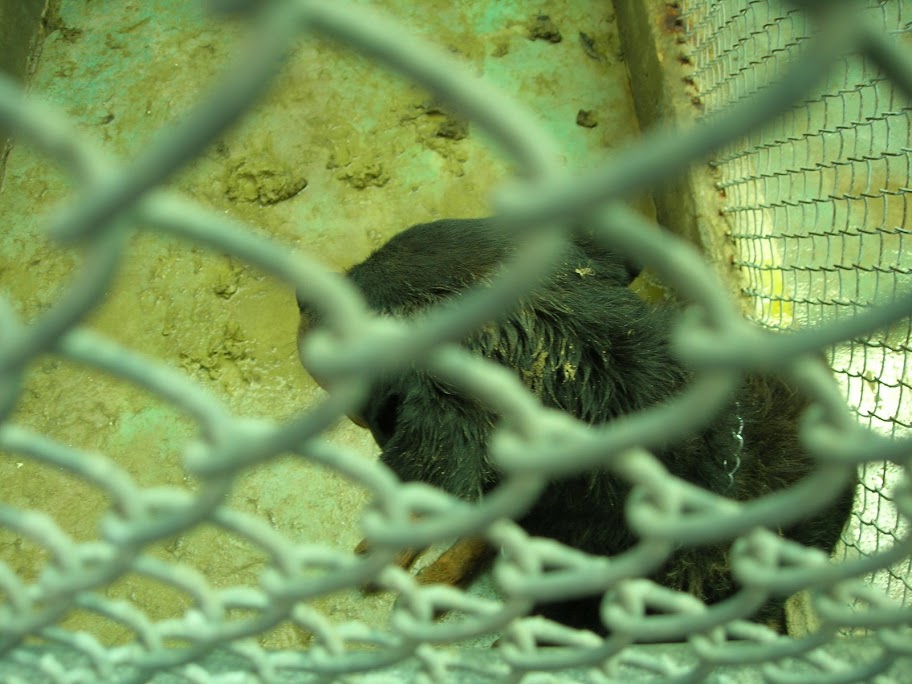
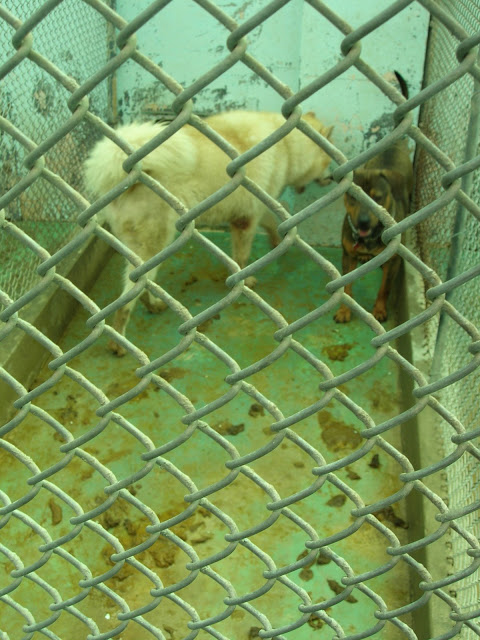
  • Required record keeping not done. Specifically, each animal’s ultimate outcome (reclaimed by owner, adoption, rescue, euthanasia, etc) was not documented. Additionally, the animals at the facility lacked information to properly identify them. The shelter also lacked any records of animals coming in from January 16 to April 28 of this year.
  • No records existed to show shelter scanned animals for microchips as required by New Jersey shelter law.

The poor inspection report shows East Orange Animal Shelter’s disregard for the animals under its care. Cleaning up feces, eliminating fly and mosquito infestations, fixing broken animal enclosures, providing adequate water to animals, having enough cleaning supplies, scanning animals for microchips and keeping basic records is not rocket science. Even worse, the shelter had these conditions despite only having 9 dogs (4 of which left during the inspection) and 13 cats. Frankly, one has to wonder what kind of people come to work each day, see these horrific things, and then do nothing? Also, without adequate record keeping we have no comfort that employees are not selling animals on the side and pocketing the money like a worker did at the Hudson County SPCA. Additionally, the city’s 2013 animal control budget suggests funding is not the issue. Specifically, the $151,268 budget is approximately $2.35 per resident and equates to $294 per animal assuming the city impounds animals at a rate similar to other northern New Jersey urban animal shelters (8 dogs and cats per 1000 people). As a comparison, KC Project, which is Kansas City, Missouri’s animal control shelter, had total revenue per animal of $225 in 2012 and saved 90% of its animals in the second half of the year. Clearly, East Orange’s Health Department, which oversees the shelter, is not serving the city’s residents or homeless animals appropriately. As a result, this suggests East Orange’s Health Officer’s motives for firing Amanda Ham were to protect the city’s Health and Animal Control departments rather than to properly run the city’s animal shelter.

The Office of Animal Welfare inspection also reveals local health departments inability to regulate municipal shelters. Typically, municipal animal shelters are run by local health departments. Those same local health departments also are responsible for inspecting the facilities for compliance with New Jersey shelter regulations. Self-policing never works and the idea we should trust local health departments to inspect themselves is preposterous. Additionally, local health departments commonly lack the skills to perform adequate inspections, particularly regarding animal welfare. As a result, the Office of Animal Welfare needs to conduct frequent inspections of municipal shelters due to local health departments’ incompetence and conflicts of interest.

The Office of Animal Welfare inspection report vindicates Amanda Ham and demands East Orange immediately reinstate her. Clearly, Amanda Ham went above and beyond her normal duties as an animal control officer to get the shelter into compliance with public health and animal welfare laws. Additionally, she made herculean efforts to get animals adopted and rescued. Frankly, Amanda Ham should not only be rehired, but promoted to run the animal shelter.

East Orange has a simple choice here. It can continue to waste its citizens hard earned tax money on a catch and kill pound failing to comply with New Jersey shelter laws. Alternatively, the shelter can become a model facility that its residents can be proud of. Imagine a shelter scanning animals for microchips, checking license databases, and knocking on doors in the field, to return lost pets to worried owners at their front door? Imagine a shelter offering distraught pet owners solutions to pet problems which keeps their families together? Imagine a shelter where young people needing some direction, senior citizens looking to do some good, and parents and children searching for ways to spend time together, can unite and help people and animals? Imagine a shelter where local residents can come and bring a new healthy family member home and have a resource whenever they need help? East Orange can achieve this as it has its potential leader willing and able to get the job done. Will East Orange’s Mayor Lester E. Taylor, who touts his community service accomplishments, stand up for his constituents and the city’s homeless animals or the incompetent shelter management responsible for this embarrassing inspection report? We eagerly await Mayor Taylor’s decision.