What Great Animal Shelters Do After the End of the Year

Great organizations do big things and make people aware of it. In the business world, companies sell products and services customers love and advertise these facts. Businesses subsequently invest much of their profits to continuously improve these products and services. On the other hand, governments or not for profits run animals shelters and must rely on taxpayer and donor funding as well as volunteer support to help improve the way they do things.

What are some ways successful animal shelters secure the financial and volunteer support they need? How does this differ from the typical high kill shelter?

Do a Great Job

Animal shelters must save lives and inspire the public. Simply put, a shelter must lead by example to obtain public support. Organizations must enthusiastically implement most, if not all, of the no kill equation programs. You can see clear examples of organizations implementing these programs at animal control shelters in Austin, Texas, Kansas City, Missouri, and Lynchburg, Virginia. Thus, great animal shelters must perform at a high level to garner the public support they need.

Share Successes and Challenges from Prior Year

Elite animal shelters provide transparent statistics and summarize performance over the past year. Intake and disposition statistics, which provide specific details on how major types of animals came into and left the shelter, give the public a clear picture of how the organization is doing. In the business world, companies issue financial statements and supplemental disclosures to entice investors to provide funding. Similarly, detailed statistics and supporting commentary give donors and volunteers a reason to support a shelter.

In the upcoming months, many great shelters will voluntarily disclose their full 2016 intake and disposition statistics and also analyze their performance during the year. In general, you will notice several things:

  1. High and/or sharply increasing live release rates
  2. Continuous desire to improve with supporting data
  3. Inspirational tone

However, several elite shelters already provided some of this information for 2016.

Lynchburg Humane Society posted its key 2016 statistics on its Facebook page just nine days into the new year. The shelter’s post was short and contained the following key facts:

  1. Save rate increased to 96% in 2016 from 94% in 2015
  2. Shelter took in over 600 more pets than it impounded in the prior year
  3. Shelter adopted out nearly 800 more dogs in 2016
  4. Nearly 700 more kids participated in the organization’s programs in 2016
  5. Shelter saved around 600 animals from other counties and 300 more than in 2015
  6. Over 1,700 outdoor cats spayed/neutered
  7. Nearly 6,700 spay/neuter surgeries performed
  8. A link to donate to the organization

Clearly, the shelter communicates it is doing great things and improving. Simply put, the shelter inspires confidence and makes choosing to donate an easy decision.

KC Pet Project wrote an engaging summary of the organization’s 2016 performance on its web site shortly after the start of 2017. Some of the key takeaways are as follows:

  1. KC Pet Project quickly transformed a terrible shelter into the nation’s third largest no kill facility several years ago
  2. The shelter’s live release rate of 95% hit a record high in 2016
  3. The organization adopted out a record number of animals in 2016 (over 6,200 pets)
  4. The shelter impounded 4% more animals in 2016
  5. Dog length of stay decreased by 5 days to 18 days in 2016
  6. Cat length of stay decreased by 7 days to 41 days during the year
  7. Over 3,000 animals adopted out at the organization’s off-site adoption centers
  8. Thousands of pets went to foster homes during the year with over 800 of these animals directly adopted out by the fosters through the shelter’s Adoption Ambassadors program
  9. Nearly 100 feral cats adopted out as barn/warehouse cats
  10. Over 1,500 pets received extraordinary levels of care through a special program
  11. A link to donate to the organization

KC Pet Project clearly made the case it is highly successful and continuously improving. Thus, the shelter inspires animal loving people to donate and volunteer.

Austin Animal Center also shared an excellent summary of its 2016 performance on its web site in early January. The shelter’s communicated the following key messages:

  1. Shelter achieved a record high 96% live release rate (98% for dogs, 95% for cats)
  2. Shelter adopted out nearly 8,000 animals and around 500 more pets than it adopted out in the prior year
  3. Shelter returned nearly 2,800 lost animals to their families and ACOs returned an additional 700 more animals to their homes in the field (i.e. never went to the shelter)
  4. Around 800 volunteers contributed nearly 54,000 hours during the year (equivalent to 26 full time employees)
  5. 900 foster families housed 2,500 animals with fosters adopting out 2/3 of the pets themselves
  6. Fosters contributed nearly 82,000 hours in 2016 which is equivalent to 39 full time employees
  7. Shelter takes in 17,000 animal a year and typically cares for 900 animals at a time
  8. Shelter performs more than 5,000 spay/neuter surgeries a year
  9. Shelter achieved this great success despite severe weather events in the area that increased animal intake
  10. Shelter will participate in a pilot program to humanely mitigate human-wildlife conflicts
  11. Shelter started a program to help prison inmates provide care to dogs
  12. Austin Animal Center will help other shelters develop adult dog foster programs

In addition, Austin Animal Center issued detailed monthly statistical reports throughout the year. These reports provided intake and disposition statistics as well as live release rates by major animal class (i.e. neonatal puppy, neonatal kitten, puppy, kitten, adult dog and adult cat).

Austin Animal Center clearly communicates it performs excellent work, keeps improving, and looks to do even better things. In other words, Austin Animal Center’s message is inspiring and encourages people to support the shelter.

New Jersey Animal Shelters Fail to Follow Successful Formula

Hardly any New Jersey animal control shelters voluntarily disclose full statistics on their web sites and social medial pages and summarize their annual performance. In fact, I only recall a couple of shelters occasionally sharing this information. Instead, the state’s largest animal welfare organization, Associated Humane Societies, routinely posts alleged animal cruelty stories and fundraises off them while killing massive numbers of animals in its Newark shelter. As I’ve stated in a previous blog, these money-grubbing tactics make shelter pets seem like “damaged goods” to the average pet owner and reduce life saving. Additionally, these tactics shift the public’s attention from the shelter’s terrible performance to the alleged cruelty of individual people who are not representative of the public at large. Thus, most New Jersey animal shelters must start disclosing more information about themselves and stop shifting the public’s attention from their performance.

Clearly, the New Jersey animal shelter industry has an open niche for progressive organizations to sweep in and replace the many horrible organizations in the state. Now is the time for animal lovers to form a not for profit to do the great work our animals need. A few people formed KC Pet Project to take over the Kansas City animal control shelter. Within a few months, this new organization turned the facility from a high kill to a no kill shelter. If they can do it, so can you. Follow your dreams and use these successful shelters’ operating models as a guide to fix our failing shelters.

Paterson’s Pathetic Pound – Part 2: Illegal Activities

In Part 1, I reported details on Paterson Animal Shelter’s high kill rate. In this blog, I will examine whether the shelter complies with state shelter laws. In addition, I will discuss ways the shelter can turn things around.

Illegal Killing During Seven Day Protection Period

Under state law, shelters cannot kill either owner surrendered or stray animals until seven days pass. The purpose of this law is to provide owners a chance to reclaim their lost pets and prevent shelters from immediately killing animals. In practice, the New Jersey Department of Health allows shelters to euthanize animals during this seven day period if facilities meet both of the following conditions:

  1. If a veterinarian deems euthanasia necessary for humane reasons to prevent excessive suffering when illness and injury is severe and the prognosis for recovery is extremely poor
  2. Only a licensed veterinarian should perform euthanasia in the above situation and they must clearly document the rationale in the animal’s medical record

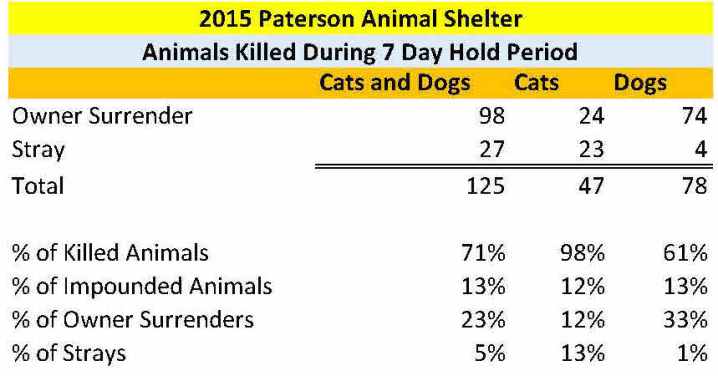
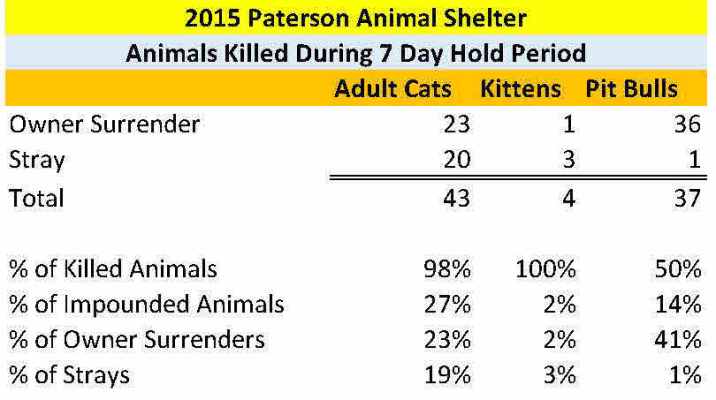
Paterson Animal Shelter illegally killed animals during the seven day protection period on a massive scale. In 2015, the shelter killed 125 cats and dogs, 47 cats and 78 dogs during this seven day protection period. Remarkably, Paterson Animal Shelter killed 71% of the cats and dogs, 98% of the cats and 61% of the dogs it killed in 2015 during this seven day period. Even worse, Paterson Animal Shelter killed 96 out of the 125 (77%) cats and dogs, 41 out of the 47 (87%) cats and 55 out of the 78 dogs (71%) it killed during the seven day protection period on the very first day. Thus, Paterson Animal Shelter killed large numbers of animals during the seven day protection period and on the very day many of these animals entered the shelter.

Paterson Animal Shelter killed large percentages of owner surrendered animals during the seven day protection period. Specifically, Paterson Animal Shelter killed 23% of owner surrendered cats and dogs, 12% of owner surrendered cats and 33% of owner surrendered dogs during the seven day protection period.

paterson-animal-shelter-2015-intake-and-disposition-records-final-17

paterson-animal-shelter-2015-intake-and-disposition-records-final-19

Paterson Animal Shelter had none of the legally required documentation that would allow it to euthanize these animals during the seven day protection period. While the shelter wrote things like “sick”, “grave condition”, and “tumor” in the records of some of these animals, the shelter provided no veterinary records documenting these animals were truly hopelessly suffering and that the veterinarian euthanized the animal as required by state law. In a small number of cases, the shelter mentioned some of the animals were taken to its outside veterinarian and euthanized, but this is not sufficient to comply with state law. Therefore, the shelter violated state shelter law even if some of these animals were hopelessly suffering.

The shelter killed many animals during the seven day protection period for convenience. In fact, Paterson Animal Shelter killed 27 of the 78 dogs (35%) during the seven day protection period for behavioral reasons. The shelter also killed 7 of the 47 cats (15%) for behavioral reasons that clearly indicated the animals were not hopelessly suffering.

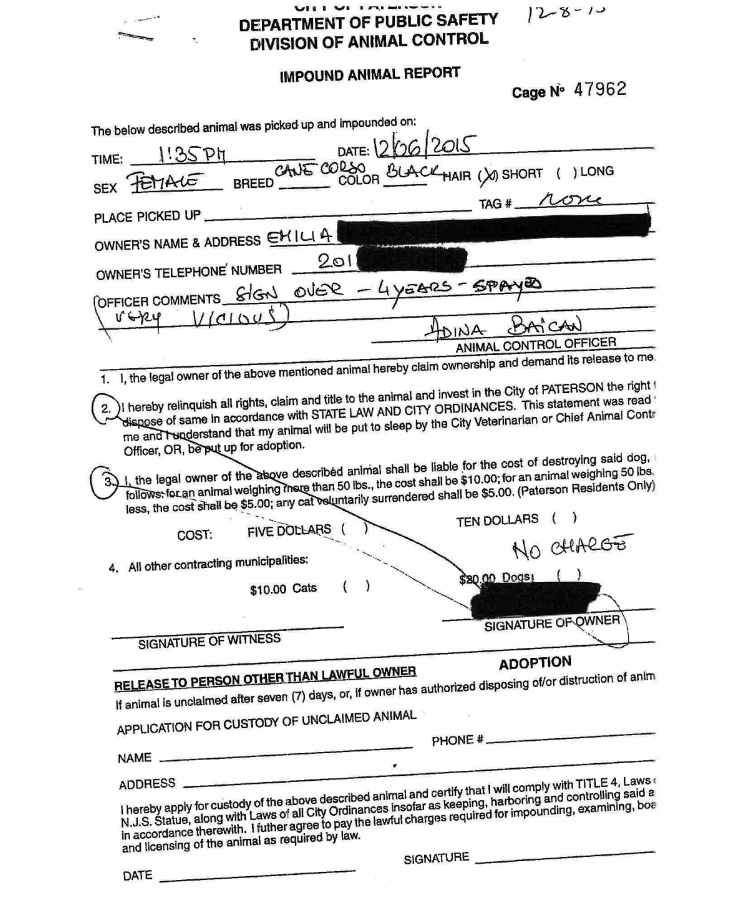
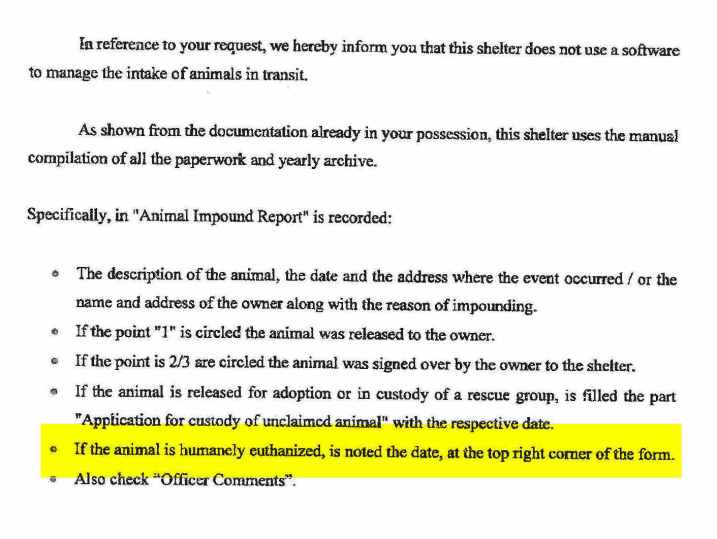
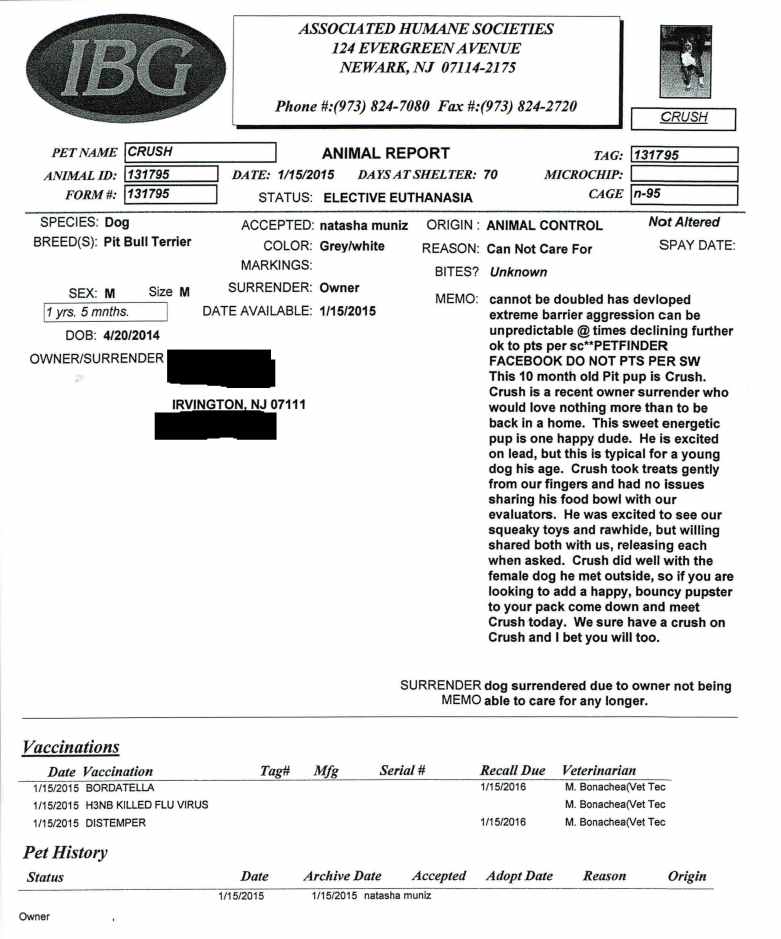
Dog ID# 47962 was a 4 year old female Cane Corso surrendered by her owner to the Paterson Animal Shelter on December 6, 2015. Based on the shelter’s record keeping methodology described in the second image below, the date in the upper right corner indicates when the dog was killed. Paterson Animal Shelter killed this Cane Corso in the prime of her life after just 2 days and stated she was “very vicious” as the reason. Even if this dog was truly dangerous to people and would not respond to behavioral rehabilitation efforts (impossible to determine after just 2 days), a shelter can never kill a dog for behavioral reasons until seven days go by. Even worse, Paterson Animal Shelter illegally killed this dog after the New Jersey Department of Health sent out a directive on October 20, 2015 clarifying state law requiring shelters to not kill owner surrendered and stray animals during the seven day protection period. Thus, Paterson Animal Shelter illegally killed this dog.

47962

paterson-animal-impound-reports-instructions

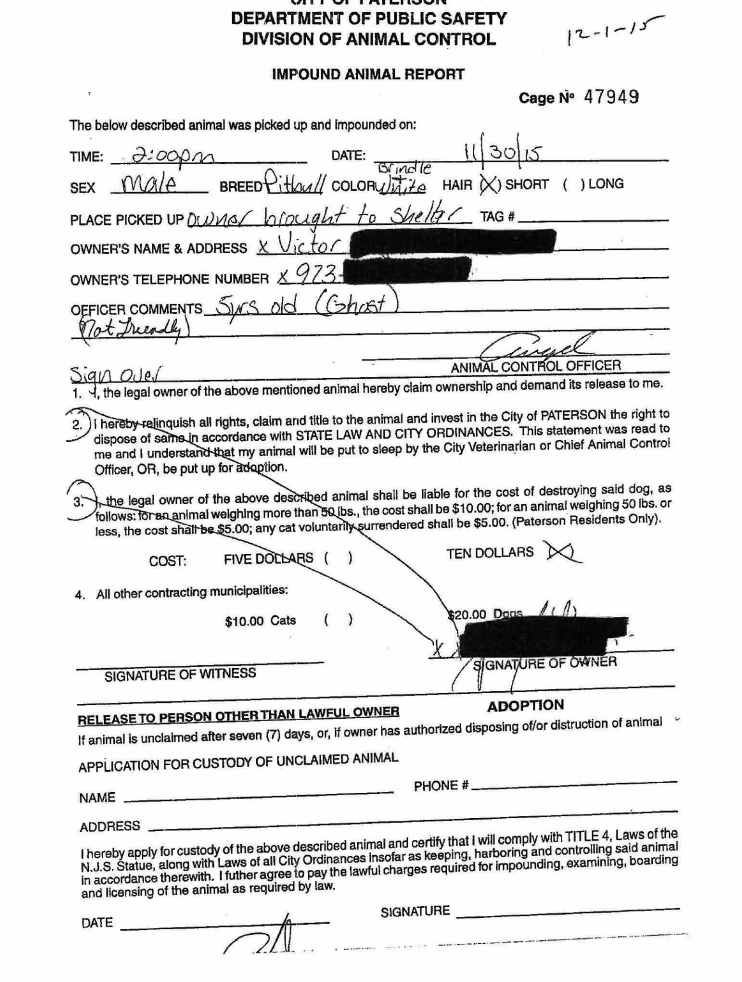
Ghost was a 5 year old pit bull surrendered by his owner to the Paterson Animal Shelter on November 30, 2015. After just one day, Paterson Animal Shelter illegally killed Ghost for being “not friendly.”

Dog ID 47949.jpg

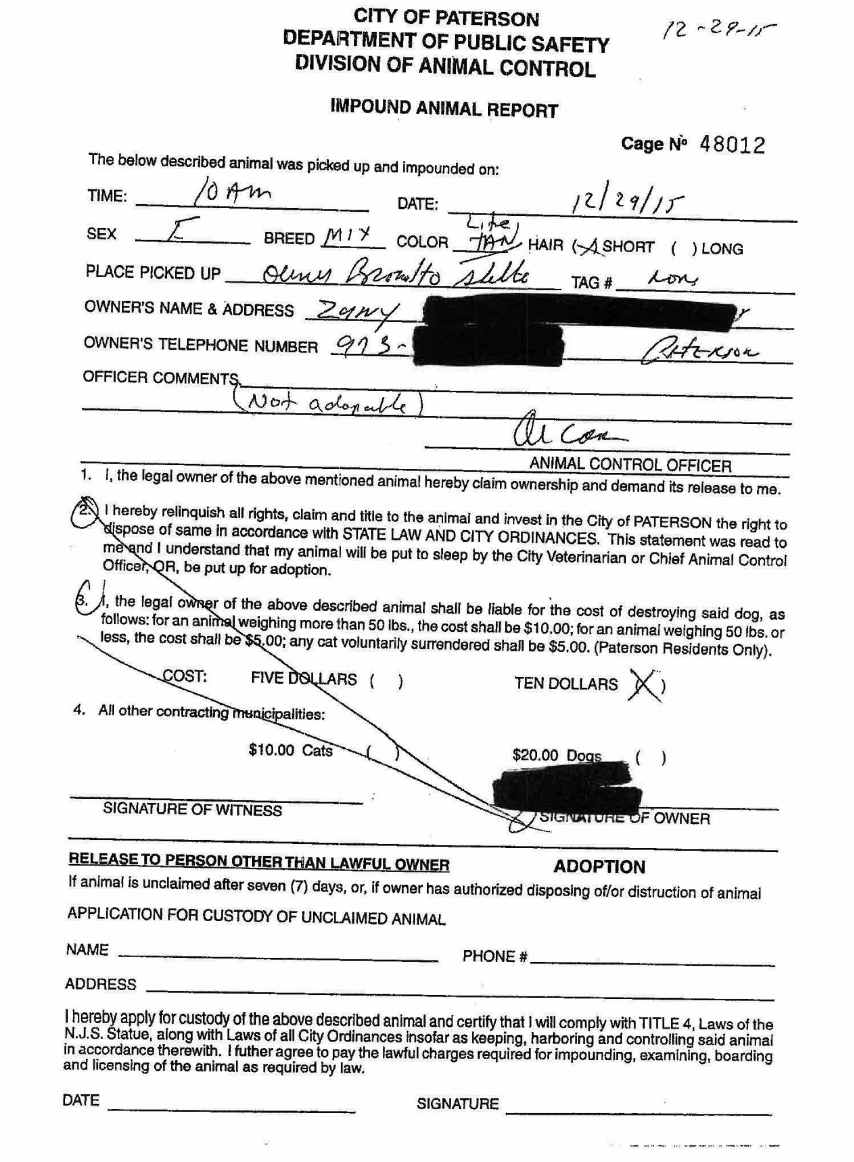
Dog ID# 48012 was a female mixed breed dog surrendered by her owner to the Paterson Animal Shelter on December 29, 2015. Despite state law prohibiting the killing of owner surrendered animals for seven days, Paterson Animal Shelter killed this dog on the day she arrived at the facility for being “not adoptable.”

Dog ID 48012.jpg

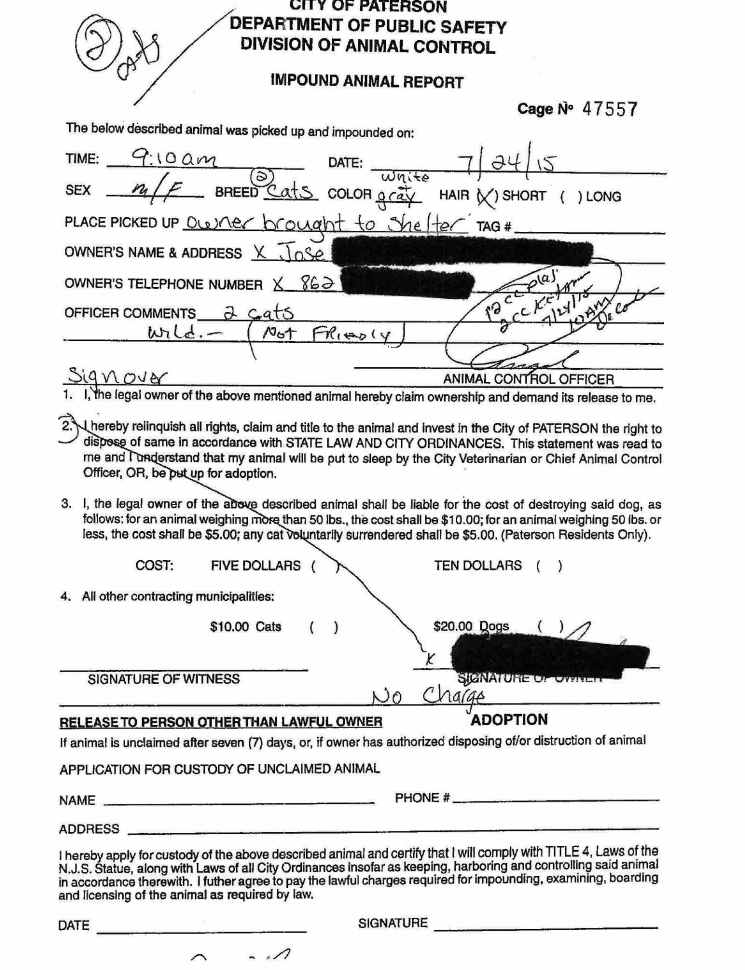
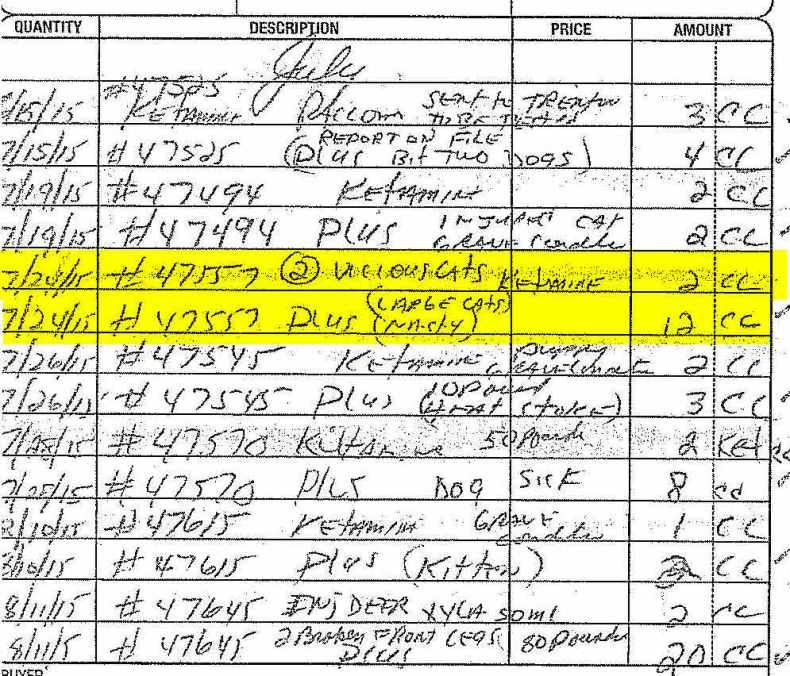
Cat ID# 47557 contained 2 white and gray cats that were surrendered by their owner to the Paterson Animal Shelter on July 24, 2015. Despite having an owner, Paterson Animal Shelter deemed both cats “wild” and “not friendly” and killed the two animals on the day they arrived at the facility per the euthanasia log below. Clearly, no one can determine if cats are feral, particularly ones that had an owner, as soon as they arrive at a shelter. However, even if these cats were truly feral, Paterson Animal Shelter cannot kill them until seven days pass. Thus, Paterson Animal Shelter illegally killed these two cats.

cat-id-47557

47557-euth-records

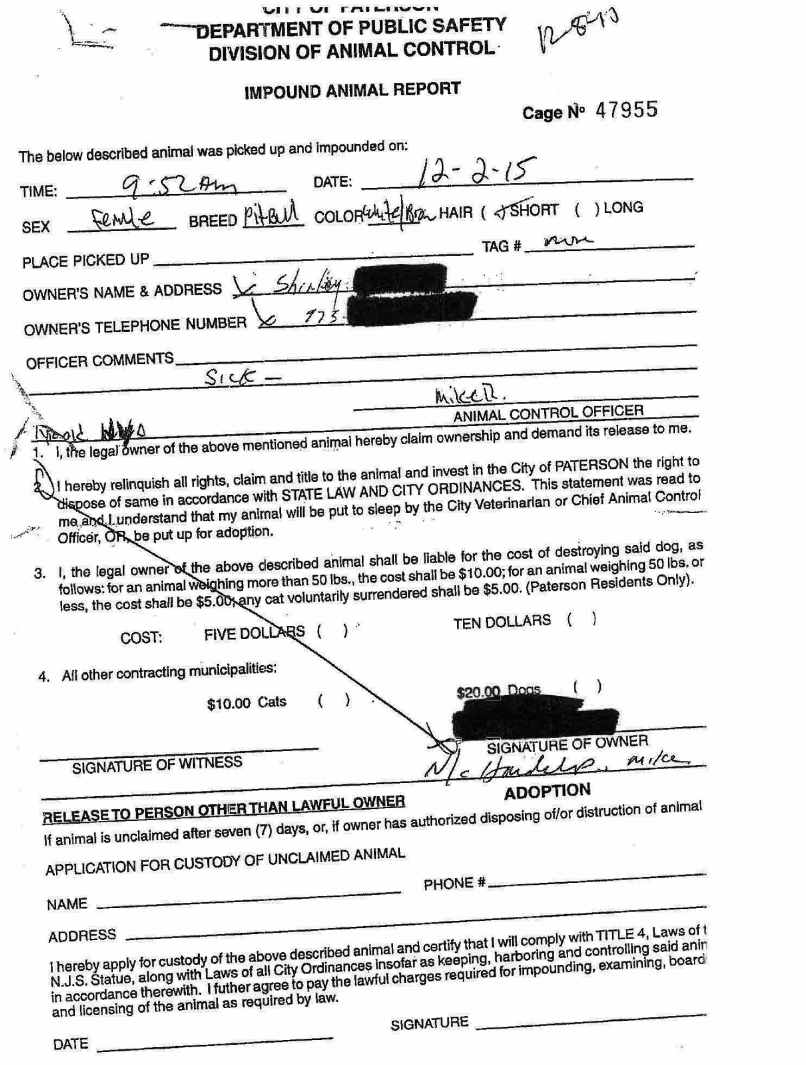
Dog ID# 47955 was a 1 year old pit bull surrendered to the Paterson Animal Shelter on December 2, 2015. Paterson Animal Shelter killed this young dog six days later for being “sick”, but did not provide any additional details. The shelter provided no veterinary records to prove this animal was hopelessly suffering for this or any other animal despite my OPRA requests for such information. Thus, Paterson Animal Shelter appeared to illegally kill this young dog during the seven day protection period.

Dog ID 47955.jpg

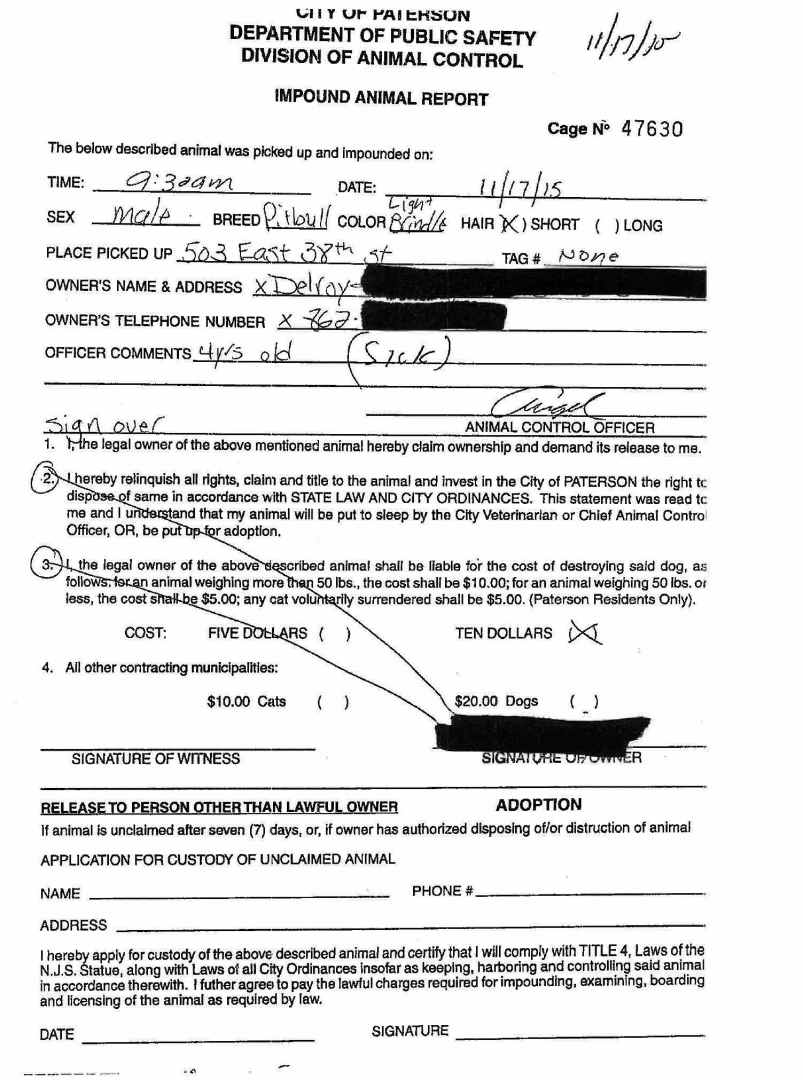
Dog ID # 47630 was a 4 year old pit bull surrendered to the Paterson Animal Shelter on November 17, 2015. On that same day, Paterson Animal Shelter killed this dog for being “sick”, but provided no documentation that the dog was hopelessly suffering. Thus, Paterson Animal Shelter appeared to illegally kill this dog during the seven day protection period.

47630.jpg

Cat ID # 48010 contained 5 cats that were surrendered by their owner to the Paterson Animal Shelter on December 29, 2015. The record also stated it had 6 cats, but I assume that was a mistake. The shelter’s euthanasia log shows the shelter killed all 5 cats on the day the animals arrived at the facility. Paterson Animal Shelter simply wrote “old” and “sick”, but provided no veterinary documents to prove the animals were hopelessly suffering and euthanized by a veterinarian. Most importantly, it is next to impossible that all 5 cats were hopelessly suffering. Thus, Paterson Animal Shelter clearly violated the seven day protection period.

cat-id-48010

48010-euth-log

Records Raise Serious Questions as to Whether Paterson Animal Shelter Humanely Euthanizes Animals 

Paterson Animal Shelter’s euthanasia records do not specify how the shelter killed or euthanized animals. Specifically, the records do not state whether the shelter euthanized/killed each animal by an intravenous (preferred method), intraperitoneal or intracardiac (i.e. heart sticking) injection. Per New Jersey law, shelters can only use intraperitoneal injections on comatose animals and neonatal kittens. Under this method, animals are injected in the abdominal cavity and can take up to 30 minutes to die. Heart sticking, as the name implies, involves stabbing an animal in the heart with Fatal Plus poison and New Jersey shelters can only use this method on heavily sedated, anesthetized or comatose animals. Thus, Paterson Animal Shelter’s euthanasia records do not indicate whether animals are in fact humanely euthanized in accordance with state law.

Paterson Animal Shelter chooses to sedate rather than comfort animals prior to euthanasia. Specifically, the shelter injected ketamine or xylazine into nearly every animal to restrain them prior to administering a poison to kill the animals. The Humane Society of the United States Euthanasia Reference Manual states shelters should avoid using a preeuthanasia anesthetic and hold and comfort animals when appropriate:

When appropriate, it is often best practice to hold and comfort an animal for direct IV or IP injection of sodium pentobarbital rather than injecting a preeuthanasia anesthetic, but neglecting or refusing to use pre-euthanasia drugs when direct injection would cause the animal undue stress is equally ill-advised.

Paterson Animal Shelter’s decision to sedate virtually every animal instead of comforting these creatures speaks volumes about how the shelter feels about animals. While some animals are aggressive and require sedatives, surely a good number of these animals were not vicious or incapable of being comforted.

To make matters worse, Paterson Animal Shelter’s use of pure ketamine as a pre-euthanasia drug is cruel. The Humane Society of United State Euthanasia Reference Manual states shelters should not use ketamine alone to sedate an animal for killing as it makes the animal’s muscles rigid and the injection stings so much that the animal reacts very negatively to it. If that was not bad enough, large doses can cause convulsions and seizures.

Ketamine (available commercially as Ketaset, Ketaject, and others) is an anesthetic agent that renders an animal completely immobile. However, when used alone it can cause the muscles to become rigid, causing the body to  stiffen. It also stings so much upon injection that it creates a fairly pronounced reaction in most animals. Moreover, in large doses it can produce convulsions and seizures. For these reasons, ketamine is recommended for use only when combined with another drug (like xylazine to create PreMix, above), that tempers these negative effects

Paterson Animal Shelter’s use of another pre-euthanasia sedative, pure xylazine, is not humane and also puts shelter staff at risk. The Humane Society of the United States Euthanasia Reference Manual recommends shelters not use xylazine alone as it may cause vomiting, the animal to act violently to sudden noises and movements, the animal to bite, and makes it more difficult to inject the euthanasia drug.

Despite these advantages, xylazine is not recommended for use as a pre-euthanasia drug by itself because: a) it commonly causes vomiting, particularly in cats and in any animal that has recently eaten; b) though sedated, the animal remains conscious, and may react violently to sudden noises and movements; c) it may dangerously reduce the animal’s natural bite inhibition, making it potentially even more dangerous to handle; and d) it lowers the animal’s blood pressure to the point that it can be difficult to inject the sodium pentobarbital for euthanasia. For these reasons, xylazine is recommended for use only when combined with another drug (like ketamine to create PreMix, above), that tempers these negative effects.

Euthanasia and Intake and Disposition Records Do Not Comply With State Law

Under N.J.A.C. 8:23A-1.11(f) 3 and 4, shelters must weigh each animal and keep a log of those body weights as well as the drugs used to immobilize and euthanize the animals.

Establish and maintain, in accordance with N.J.A.C. 8:23A-1.13, euthanasia records that contain the body weight and dosage of all euthanasia, immobilizing, and tranquilizing agents administered to each animal.

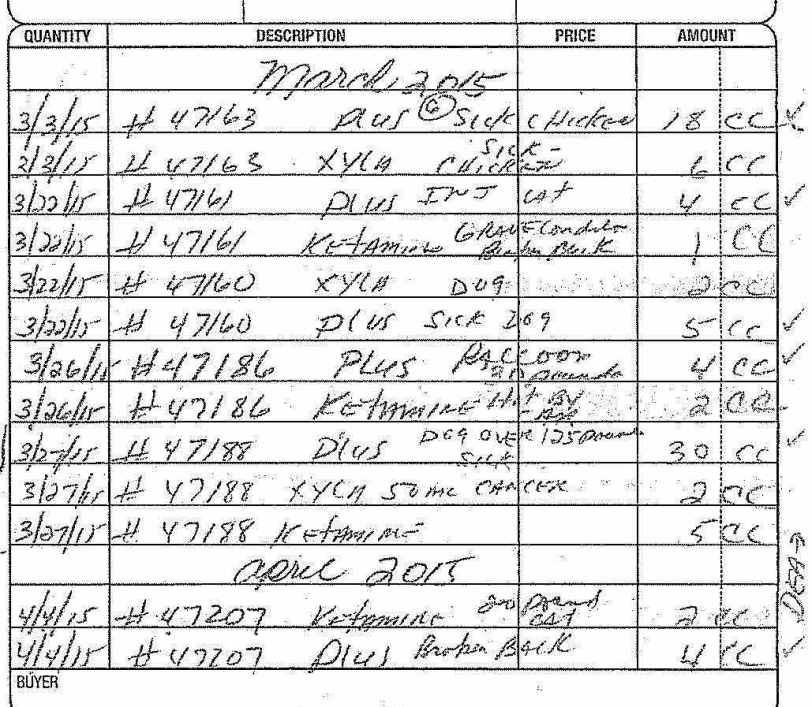
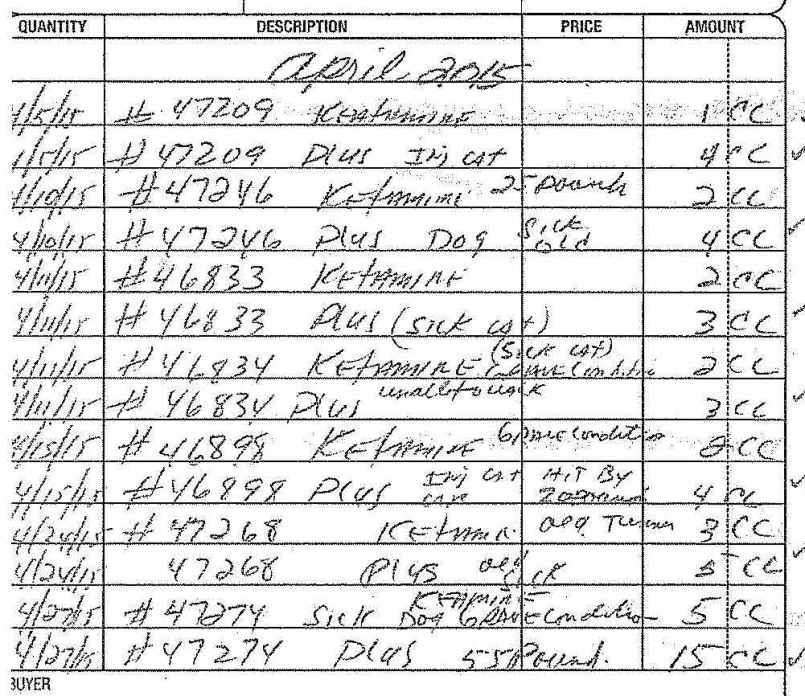
Many of Paterson Animal Shelter’s euthanasia logs failed to document the weight of the animals killed/euthanized. Additionally, many of the weights listed had suspiciously round numbers like 20 pounds, 25 pounds, 70 pounds, etc. that possibly point to shelter staff estimating weights. If animals received too small of a dose of euthanasia drugs due to not being weighed, it is possible some animals were dumped or put into an incinerator still alive.

paterson-animal-shelter-march-2015-euthanasia-log

paterson-animal-shelter-april-2015-euthanasia-log

N.J.A.C. 8.23A-1.13(a) requires shelters keep intake and disposition records containing the following information for each animal the facility impounds:

There shall be kept at each kennel, pet shop, shelter or pound a record of all animals received and/or disposed of. Such record shall state the date each animal was received, description of animal, license number, breed, age and sex; name and address of person from whom acquired; date euthanized and method, or name and address of person to whom sold or otherwise transferred.

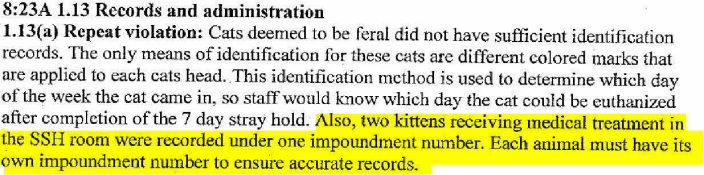
Most of Paterson Animal Shelter’s intake and disposition records did not include the animal’s age. Additionally, most of the shelter’s cat intake and disposition records also did not list the animal’s breed. Finally, many of the shelter’s records contained multiple animals on the same record under the same ID number. Therefore, Paterson Animal Shelter did not retain all the required information for each impounded animal as the New Jersey Department of Health explained in its August 26, 2009 inspection report on Associated Humane Societies-Newark.

multiple-animals-on-same-id.jpg

Shelter Lacks Any Records Proving it Provides Veterinary Care and Has a Disease Control Program

Under N.J.A.C. 8.23A 1.9(d), animal shelters must provide “at least prompt basic veterinary care” to “sick, diseased, injured or lame animals.” In practice, New Jersey Department of Health inspectors require shelters to retain veterinary records to prove the shelter complies with this law.

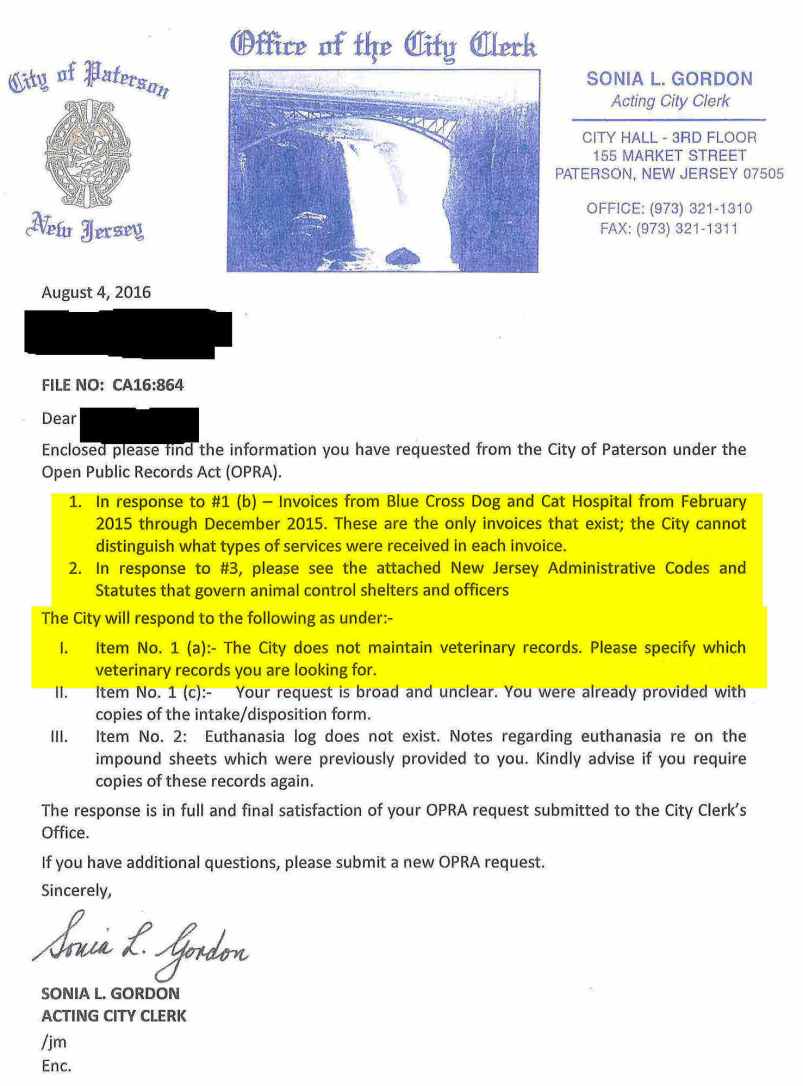
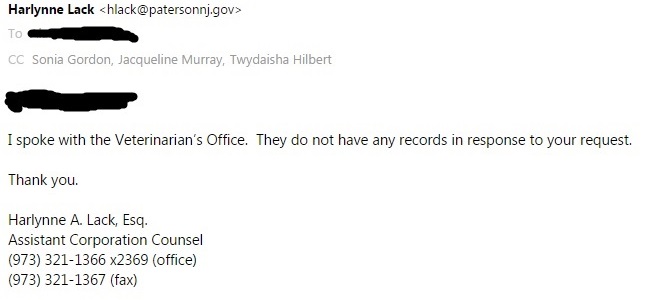
Paterson Animal Shelter did not maintain veterinary records during 2015. Despite my repeated OPRA requests, the shelter stated it had no veterinary records at the shelter or with its outside veterinarian.

Furthermore, Paterson Animal Shelter’s veterinarian invoices listed no explanation for the services performed. Specifically, Blue Cross Dog and Cat Hospital charged the City of Paterson $2,000 a month for unknown services. Based on both the shelter and veterinarian providing me no medical records, I have to assume the City of Paterson pays this veterinarian to act as the supervising veterinarian, to kill animals, and do little else.

As a result of Paterson Animal Shelter’s lack of any veterinary records, the shelter appears to provide little to no veterinary care to its animals other than killing.

Under N.J.A.C. 8.23A 1.9(a), shelters “shall establish and maintain a program of disease control and adequate health care (program) under the supervision and assistance of a doctor of veterinary medicine.” Furthermore, “the program shall address the physical and psychological well-being of animals at the facility, including stress-induced behaviors, such as repetitious behavior or vocalizations, from auditory, visual, and olfactory stimuli.” Finally, the supervising veterinarian must sign a form certifying such a program is in place. Thus, animal shelters must develop a program to address physical and mental disease at their facilities.

Paterson Animal Shelter has no written policies and procedures. Specifically, the City of Paterson’s response to my request for such policies and procedures stated the shelter follows the state’s shelter laws. In other words, the shelter has no written disease control program let alone other policies, such as intake, adoption, and rescue. Frankly, it is stunning that the animal shelter in the state’s third largest city has no documented policies.

Paterson Animal Shelter OPRA Request for Veterinary Records and Policies.jpg

Paterson Budget, Outside Veterinarian Invoice and Policies Full Response (3).jpg

paterson-veterinary-records

Shelter May Violate Operating Hours Law

Under N.J.A.C. 8.23A 1.10(b), an animal control shelter must have public access hours to allow people to reclaim their lost pets. The law states “the hours for public access shall be at least two hours each business day Monday through through Friday and two hours Saturday or Sunday, excluding legal holidays.”

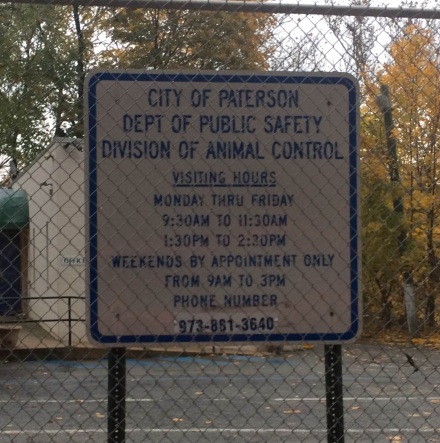
Paterson Animal Shelter’s compliance with the law is questionable. On weekends, the shelter is only open by appointment only from 9 am to 3 pm. Based on my interpretation of the law, being open by appointment only on weekends does not meet the public access requirement. Regardless, any shelter requiring people make an appointment to visit the facility on weekends is not serious about saving lives. Similarly, the shelter’s very limited weekday hours, which are limited to two hours in the morning and one hour in the afternoon, make it extremely difficult for working people to reclaim, rescue or adopt an animal.

Paterson Animal Shelter Hours.jpg

Paterson Division of Health Fails to Perform Proper Annual Shelter Inspections

Under N.J.A.C. 8.23A 1.2(b), the local health authority must inspect an animal shelter each year and issue a certificate indicating the shelter complies with state shelter laws. After requesting the Paterson Division of Health’s 2014, 2015 and 2016 Paterson Animal Shelter inspection reports, the City of Paterson could only provide a June 15, 2015 inspection report. Subsequent to my request, the Paterson Division of Health conducted its 2016 inspection on November 29, but this inspection occurred five and half months after the required deadline for the annual inspection (i.e. 2016 inspection occurred seventeen and half months after the 2015 inspection). Presumably, the Paterson Division of Health did not inspect the Paterson Animal Shelter in 2014 and the shelter therefore should not have had a license to operate during 2014 and for five and half months in both 2015 and 2016.

The Paterson Division of Health’s 2015 and 2016 inspection reports provide no confidence that the shelter complies with state shelter laws. The 2015 inspection, which took just an hour and half, missed all the shelter’s illegal killing of animals during the seven day protection period, the lack of a documented disease control program and veterinary records, missing required information in the intake and disposition and euthanasia records, and possible violations of the public operating hours requirement on weekends. In fact, the inspection report’s only comment stated “No Chapter 23A violations observed at the time of this inspection.” Similarly, the 2016 inspection report also only wrote essentially the same comment. Thus, the Paterson Division of Health failed to do even the most basic inspection.

Local health departments typically fail to properly inspect animal shelters. Under New Jersey animal shelter law, local health departments must inspect animal shelters each year. In reality these entities are ill-equipped to inspect animal shelters. Local health departments are used to inspecting places, such as restaurants, which are far different than animal shelters. Furthermore, the same health department that inspects Paterson Animal Shelter is under the same municipal government as the animal shelter. Clearly, this is a conflict of interest and recent experience in the state shows it plays out in poor quality inspections.

Passaic County SPCA Fails to Crack Down on Illegal Killing

The Passaic County SPCA has jurisdiction over the shelter and can enforce animal cruelty laws. For example, the Passaic County SPCA could potentially file animal cruelty charges related to the shelter illegally killing certain animals during the seven day protection period. Stuart Goldman, who is the former President and Chief Humane Law Enforcement Officer for the Monmouth County SPCA, recently brought such a case alleging this against the Gloucester County Animal Shelter.

The Passaic County SPCA has an inherent conflict of interest in enforcing animal cruelty laws against the Paterson Animal Shelter. The Paterson Animal Shelter Chief Animal Control Officer, John Decando, also is a law enforcement officer with the Passaic County SPCA. Thus, the Passaic County SPCA’s lack of action is not surprising.

Shelter Budget Reflects Misguided Priorities

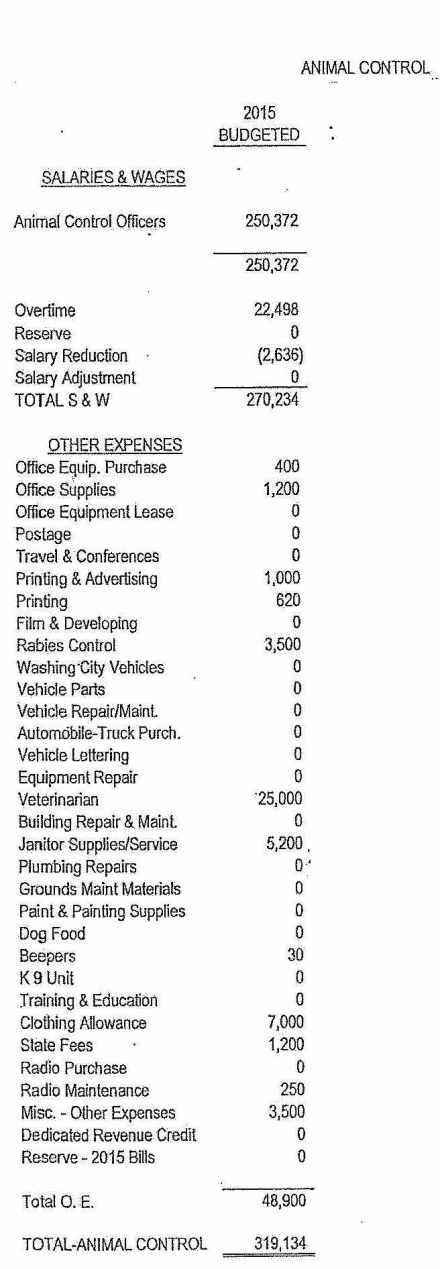
Paterson spends almost its entire shelter budget on employee salaries. The shelter’s 2015 budget reveals the Paterson Animal Shelter allocated $270,234 for its ACO salaries and $25,000 for a part-time veterinarian. Shockingly, 93% of the shelter’s budget went to pay the shelter’s ACOs and its shelter veterinarian (who provided no details on the services he performed in 2015). Even worse, virtually none of the remaining $23,900 in the shelter’s budget seems to go to saving lives. For example, $5,200 goes to janitor services and another $7,000 is allocated to a “clothing allowance.” One has to wonder why ACOs need $7,000 to buy clothes? Thus, the Paterson Animal Shelter appears to allocate virtually no money to saving the animals the public expects it to save.

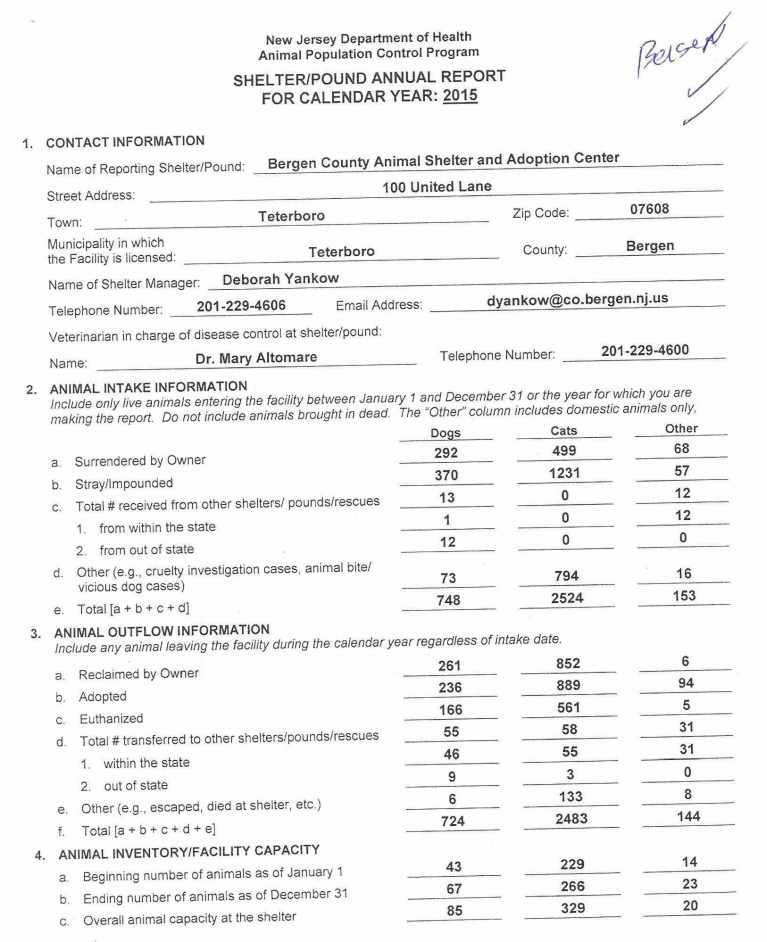
Paterson Animal Shelter has enough funds to save lives. While the Paterson Animal Shelter’s budget is not huge, it still received $327 per dog and cat impounded during 2015 ($252 per dog and cat using the facility’s 2015 Shelter/Pound Annual Report animal intake figures). As a comparison, Michigan’s Chippewa County Animal Shelter, which also serves an impoverished area, received $242 per dog and cat and saved 98% of the 402 dogs and 488 cats it took in during 2015. In contrast to Paterson Animal Shelter, Chippewa County Animal Shelter relies heavily on volunteer and foster programs to save lives.

2015-paterson-animal-shelter-budget

Shelter Must Comply with State Law

The Paterson Animal Shelter has some positive things going for it. Many times the shelter waived fees for people surrendering as well as reclaiming animals due to hardships. Additionally, the shelter has low owner reclaims fees that help increase the chance animals are returned to owners. Finally, the shelter worked very closely with Second Chance Pet Adoption League and Start II rescue to save many animals.

That being said, Paterson Animal Shelter has significant problems that it must immediately address to comply with state law. Paterson Animal Shelter must cease killing animals, whether stray or owner surrenders, during the seven day protection period unless a veterinarian documents why the animals are hopelessly suffering and that veterinarian euthanizes the animal. The shelter and its veterinarian must create a written disease control program addressing both the physical and mental needs of its animals. Furthermore, the shelter must provide veterinary care to animals at the shelter and retain all records to document it is doing so. Also, the shelter must develop specific euthanasia protocols, which must include weighing animals and using recommended euthanasia procedures in the Humane Society of United State Euthanasia Reference Manual. Finally, Paterson Animal Shelter must include all required animal information, such as age and breed, in its intake and disposition records and remain open for at least two hours on weekends. Thus, Paterson Animal Shelter must do many things to comply with the bare minimum standards in state shelter laws.

Chief Animal Control Officer Must Turn Shelter Around or Resign

Chief ACO, John DeCando, has been the face of the Paterson Animal Shelter for more than four decades. Mr. DeCando has led the animal shelter since 1975 and often is covered in the media. Unfortunately, Mr. DeCando only appears to contact the media to bring the spotlight on himself. For example, he frequently gives interviews about animal cruelty cases portraying himself as a hero, but to my knowledge never uses the media to save animals at his shelter.

John DeCando came under fire in recent years for collecting huge sums of money. From 2006 to 2010, Mr. DeCando claimed he was on call after hours and entitled to double time pay totaling $144,000 despite not doing any actual work approximately 80% of the time. Even worse, John DeCando’s own union president stated Mr. DeCando was not entitled to this pay. In fact, John DeCando’s subordinates only logged less than a month of this overtime during this five year period suggesting Mr. DeCando kept this sweet money for almost nothing deal entirely for himself. One has to wonder how many dogs, cats and wild animals could have received veterinary care with John DeCando’s $144,000 windfall?

While John DeCando’s failures at the Paterson Animal Shelter are serious, I do think Paterson should give him the opportunity to turn the shelter around. Mr. DeCando is charismatic and has the ability to run the shelter at a high level if he chooses to do so. He also has done some good things, such as waiving fees in hardship cases. Also, city officials do not seem to help him much with the shelter. As such, Paterson’s elected officials should give John DeCando a reasonable period of time to bring the shelter into compliance with state law and enact progressive lifesaving policies to increase the shelter’s dog live release rate to at least 95% and its cat live release rate to 92% or higher.

Paterson Animal Shelter Must Implement Lifesaving Policies

Paterson Animal Shelter should create a pet surrender prevention program to reduce intake at this space constrained facility. Nearly 40% of the dogs and more than 50% of the cats arriving at Paterson Animal Shelter were surrendered by their owners. If the shelter is coercing owners, who love their animals, to surrender their pets, then the shelter needs to cease doing so. Ideally, Paterson Animal Shelter would reach out to a group like Downtown Dog Rescue, which runs a highly successful pet surrender prevention program on behalf of the South Los Angeles City Shelter and three other municipal shelters, to learn how it can recruit a private organization to volunteer at the Paterson Animal Shelter to help families keep their pets. In 2015, Downtown Dog Rescue kept 1,172 pets, including 1,063 dogs and 108 cats, out of the South Los Angeles Shelter at an average cost per animal ranging from $50 to $150. Downtown Dog Rescue helps struggling pet owners pay fees, fines, and pet care costs and fix broken fences and dog houses. Paterson Animal Shelter can also reach out to national organizations, such as the ASPCA, Best Friends and HSUS, to seek guidance on recruiting such an organization as well as obtaining any additional funding that may entice a private group to run a shelter intervention program.

Paterson Animal Shelter can also move towards managed intake for owner surrenders. Under a managed intake program, a shelter uses various techniques to slow down and reduce intake. For example, a shelter will typically require owners to wait for a short period of time, such as a week, or make an appointment to surrender an animal. At the same time, the shelter will offer advice and provide materials to solve various pet problems. Often times, pet owners reevaluate their decision and keep the animal during the short wait period. However, the shelter must always immediately take in an animal the pet owner refuses to keep during this short period or if the pet is in a dangerous situation. As a result of this program, Lynchburg Humane Society found 60% of people wanting to surrender their pets ended up keeping their animal or rehomed the animal themselves with no increase in pet abandonment. Similarly, Liberty Humane Society in Jersey City achieved a live release rate of around 90% after instituting an appointment program.

The City of Paterson must ensure all animals are vaccinated upon arriving at the shelter to reduce the risk of disease. In the case of owner surrenders, the shelter should vaccinate the animals prior to the waiting period discussed above to ensure the animal has time to build immunity. In the end, this small investment will save the shelter money, particularly since it will need to hold animals longer to comply with state law.

The City of Paterson must shift money from animal control to lifesaving and heavily rely on volunteers. Given virtually all of the shelter’s budget is paid to ACOs, the shelter should reallocate a substantial portion of these funds to actually care for animals. Additionally, the shelter should recruit a “Friends” group to help raise funds for the shelter. To assist the effort, the City of Paterson should create a clear plan to reach a 90% plus live release rate and attain no kill status. Furthermore, the shelter should actively recruit volunteers to help in all aspects of caring for animals and getting those pets quickly into good homes. Simply having a single rescue make pleas to pull dogs from an unnamed shelter is not enough.

The shelter must stay open for many more hours to allow people to save animals. Specifically, the shelter must stay open seven days a week for at least six hours each day and include weekday evening hours. Simply put, people cannot reclaim, rescue or adopt dogs and cats if the shelter is often closed.

Paterson Animal Shelter must create a high volume adoption program. Currently, people can adopt unaltered and unvaccinated animals for $28, but the shelter makes no effort to market animals. Unsurprisingly, Paterson Animal Shelter only adopted out 3 cats and 15 dogs in 2015. Obviously, the shelter must vaccinate and alter all animals it adopts out. Furthermore, it should do so immediately for owner surrenders and right after the hold period for strays. The shelter can use volunteers to take attractive photos and videos, write engaging profiles, and market the animals on social media and adoption web sites. Additionally, John DeCando, who is very savvy with the media, should use his connections to frequently promote adoption, particularly when the facility is at near capacity.

Paterson Animal Shelter and nearby facilities should create a coalition to rescue dogs and cats. Based on my recent analyses on New Jersey animal shelter performance for dogs and cats, Paterson Animal Shelter would still need to send a substantial number of animals to rescues or other shelters even if it adopts out animals at a good rate. Specifically, Paterson Animal Shelter should have sent 232 dogs and 156 cats to rescues and/or other facilities in 2015. While Paterson Animal Shelter exceeded those goals, placing so many animals with rescues puts an unfair burden on these cash-strapped groups and also prevents rescues from saving animals from other shelters. As a result, other nearby shelters should step up and take animals from Paterson Animal Shelter after the facility runs out of space.

Paterson Animal Shelter can team up with a number of nearby shelters to save all of the facility’s healthy and treatable animals. If other nearby shelters perform as they should and quickly move animals out of their facilities, they can easily save Paterson Animal Shelter’s animals. For example, the nearby Wayne Animal Shelter, Ramapo-Bergen Animal Refuge and Pequannock Animal Shelter could save all healthy and treatable dogs that the Paterson Animal Shelter lacks the space to adopt out. Similarly, both Ramapo-Bergen Animal Refuge or Wayne Animal Shelter could single-handedly rescue all of the cats that Paterson Animal Shelter lacks the space to adopt out. Furthermore, many other nearby shelters could also help as well. Thus, Paterson Animal Shelter and nearby animal shelters can easily end the killing in the area.

Recently, Paterson Mayor, Joey Torres, expressed interest in moving the shelter to a more accessible location, expanding it, and adopting out animals. While I have doubts as to whether Paterson has the funding to build a proper animal shelter, these remarks do indicate the city’s elected officials could be receptive to turning this shelter around.

The City of Paterson must change course at its shelter. In an impoverished city with widespread corruption at the highest levels of government, Paterson desperately needs something to inspire residents. Turning around the Paterson Animal Shelter with local residents playing a key role fits the bill. Allowing youth, working families and senior citizens the opportunity to build something wonderful helps people as much as the animals they are caring for. If Paterson’s elected officials do turn this shelter around, they will not only help their animals and voters, but also their own political careers. Will they do the right thing?

2015 Cat Report Cards for New Jersey Animal Shelters

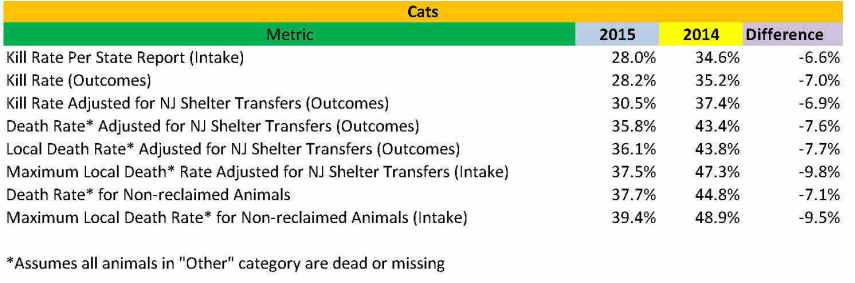
Cats are losing their lives at an alarming rate in New Jersey animal shelters. Nearly 16,000 cats or 36% of the cats coming into New Jersey animal shelters in 2015 were killed, died or went missing. This blog explores the reasons why this tragedy is occurring and whether we can end the massacre. Additionally, I’ll try and answer the question whether shelters need to resort to neutering and releasing healthy friendly cats or not impounding these cats at all to avoid killing cats in shelters.

Model Assesses New Jersey Animal Shelters’ Life Saving Performance

In order to assess how good of a job New Jersey animal shelters are doing, I’ve developed an analysis I call the “Life Saving Model.” While shelter performance is dependent on many variables, such as finances, facility design, local laws, etc., the most critical factor impacting potential life saving is physical space. As a result, my analysis focuses on making the best use of space to save the maximum number of New Jersey cats.

The Life Saving Model measures the number of local animals a shelter should adopt out, rescue from other facilities, send to rescues or other shelters and euthanize to achieve no kill level live release rates. The targeted outcomes take into account each facility’s physical capacity and the number of cats the organization receives from its community (i.e. strays, owner surrenders, cruelty cases). I assume a target euthanasia rate, take the number of cats actually returned to owners and then estimate how many community cats a shelter should adopt out. To the extent space runs out, I then calculate how many cats must be sent to rescue. If the shelter has excess space after properly serving its local community, the facility uses that room to rescue and adopt out cats from nearby areas. The targeted results calculated from this model are compared to the actual results from each shelter below.

The Life Saving Model requires a more complex analysis for cats than dogs in New Jersey. Generally speaking, New Jersey animal shelters receive few litters of young puppies who are vulnerable to disease. On the other hand, local shelters receive lots of young kittens, particularly during the April to October kitten season. These young kittens are highly vulnerable to disease and those without mothers require bottle feeding every 1-2 hours. Therefore, animal welfare organizations should not hold these kittens in a traditional shelter setting and instead should send these animals to foster homes or a kitten nursery at or outside of the facility. During the months outside of kitten season (i.e. November-March), my model assumes shelters with enough physical space will be able to place young kittens into their volunteers’ foster homes and/or in a kitten nursery run by the animal shelter. In kitten season with many young animals coming in, I assume a certain percentage of the cat intake will need to go to rescues or other shelters. For shelters who rescue cats, I assume a small percentage of the cats are young kittens who are hopelessly suffering and will require humane euthanasia. Thus, my Life Saving Model is a bit more complicated than the analysis I did for dogs.

To read specific details and assumptions used in the model, please see the Appendix at the end of this blog.

My analysis puts a cap on the targeted numbers of cats rescued from other shelters and adoptions. While my unmodified targeted numbers of rescued and adopted animals are quite achievable, I wanted to provide very conservative goals for New Jersey animal shelters. For example, the unmodified model resulted in a statewide per capita cat adoption rate less than half the level found at some of the best animal control shelters.

My modified analysis capped cat adoptions at 8 cats per 1,000 people within each New Jersey county. In other words, the targeted numbers of cats rescued from other shelters and adopted below are the lesser of

  1. Number predicted by model
  2. Number determined by capping adoptions at 8 cats per 1,000 people in the county

In simple terms, a shelter is expected to achieve this per capita adoption rate unless the facility lacks enough space. If a shelter does not have sufficient room, it won’t have the time to reach all the potential adopters and requires assistance from rescues and/or other facilities.

Another complexity in this analysis are feral cats. In an ideal world, shelters would practice trap-neuter-return (TNR) or shelter-neuter-return (SNR) for feral cats only. In TNR, the public or a third party typically does the work and the shelter doesn’t take in feral cats. In the variant of SNR I support, the shelter would take in feral cats, neuter them and release them back to where they were found. Unfortunately, many municipalities prohibit these programs and shelters in these places generally catch and kill feral cats.

Ideally, I would perform two analyses as follows:

  1. Modeling a large scale and targeted TNR program by reducing cat intake at shelters needing to implement TNR or improve their existing TNR programs
  2. Estimating the number of truly feral cats taken in and counting these cats as killed

The first analysis assumes TNR could be implemented and would result in fewer New Jersey cats for shelters to place. In a blog I wrote last year, I estimated the impact of a high volume targeted spay/neuter program. Generally speaking, this analysis required many animal control shelters to adopt out more cats, send fewer cats to rescue, and rescue more cats from other shelters due to the extra shelter space resulting from lower local cat intake. In other words, this analysis would require shelters to achieve higher performance targets.

The second analysis assumes local laws cannot be changed and shelters are stuck receiving unadoptable feral cats. Unfortunately, I do not have the data to calculate the percentage of truly feral cats received at each New Jersey animal shelter. Based on an analysis of Michigan animal shelter data, Nathan Winograd estimated at least 6% of cat intake at Michigan animal shelters are truly feral cats. Similarly, Wisconsin’s Clark County Humane Society 2014 cat statistics show feral cats who were trapped, vaccinated and returned to the community made up 7% of cat outcomes. Based on these numbers and the success of barn cat programs in Pflugerville, Texas and the Maryville, Tennessee area, barn cat programs should be able to save most feral cats in similar communities. On the other hand, California’s Orange County Animal Care reported approximately 24% of the cats it took in during 2012, which was before it practiced TNR, were feral and euthanized. However, I suspect at least some of these cats were fearful rather than truly feral and could have been socialized and eventually adopted out. In fact, a recent study documented 18% of impounded cats were feral/aggressive, but all these cats became safe enough to adopt out after people gently touched the cats and spoke to them softly for 6 days. Thus, the number of truly feral cats may be much lower than the amount of cats most shelters label as aggressive.

My model assumes shelters are doing the proper thing and practicing TNR and placing the reasonable number of feral cats received as barn cats. Obviously, many shelters do take in a good number of feral cats due to poor laws or misguided policies. As a result, the number of New Jersey cats killed may be higher than my model predicts for some shelters. However, my model’s results using total cat intake rather than assuming a larger percentage of feral cats will not be too much different for the targeted adoption and euthanasia rate metrics as explained in my blog from two years ago. The following analysis assumes shelters receive a reasonable number of truly feral cats. As a result, shelters can adopt out these cats through a barn cat program. While I realize some shelters do receive greater numbers of truly feral cats, the purpose of this analysis is to examine whether New Jersey animal shelters can handle the number of cats received.

New Jersey Animal Shelters Contain Enough Space to Save Most of New Jersey’s Healthy and Treatable Cats and Many More from Other States

New Jersey’s animal shelter system has enough space to save most of the state’s healthy and treatable cats. The table below details the targeted numbers of cat outcomes the New Jersey animal shelter system should achieve. Out of the 44,418 New Jersey cats coming into the state’s animal shelters in 2015, 30,099 and 8,582 cats should have been adopted out and sent to other shelters/rescues by the facilities originally taking the cats in. However, other New Jersey animal shelters had enough capacity to rescue 26,383 cats or more than three times the number of cats needing rescue from space constrained facilities. Unfortunately, some of the cats needing rescue, such as very young kittens, should not go to a shelter and still must go to either kitten nurseries or foster homes. That being said, many adult cats are in fact killed in New Jersey animal shelters and many facilities with excess space could save these cats.

New Jersey animal shelters have enough excess space to save many cats from out of state as well. Specifically, New Jersey animal shelters had enough physical capacity to rescue and adopt out at least 17,801 cats from out of state shelters or New Jersey’s streets after achieving a greater than 90% live release rate for cats coming into the state’s animal shelters. In reality, the New Jersey shelter system could rescue more than 17,801 cats from out of state shelters or from New Jersey’s streets given the 17,801 figure assumes all cats needing rescue from space constrained New Jersey shelters are sent to other New Jersey shelters as opposed to rescue groups. As explained above, some of the cats needing rescue from New Jersey shelters with a shortage of space are young kittens which should not go to most animal shelters. To put this number into perspective, New Jersey animal shelters contain enough space to make both New York City and Philadelphia no kill cities for cats and increase those cities’ cat live release rates to 92% as follows (per 2015 data):

  • New York City – 2,267 additional cats need saving
  • Philadelphia – 2,786 additional cats need saving

Certainly, some New Jersey animal shelters do pull some cats from New York City and Philadelphia animal control shelters. Even if I assumed all of the out of state cats rescued by New Jersey animal shelters came from New York City and Philadelphia, that number is only 6% of the number that New Jersey shelters could rescue from New York City and Philadelphia animal control shelters. While some of these cats from New York City and Philadelphia animal control shelters are young kittens which should not go to a normal animal shelter, many other cats could go to New Jersey animal shelters and be adopted out. As a result, the additional number of cats New Jersey animal shelters could save from New York City and Philadelphia is not much lower than the figures above. Thus, New Jersey animal shelters could make New Jersey a no kill state for cats and help other states reach that goal as well.

These adoption goals are quite achievable when comparing the performance of well-run animal control shelters across the country. New Jersey animal shelters would only need to adopt out 6.3 cats per 1,000 people in the state (4.4 cats per 1,000 people if no cats were rescued from out of state and all cats sent to rescue were rescued by other New Jersey animal shelters and adopted out). As a comparison, recent per capita cat adoption numbers from several high performing no kill open admission shelters are as follows:

  • Lynchburg Humane Society (Lynchburg, Virginia) – 17.2 cats per 1,000 people
  • Tompkins County SPCA (Ithaca, New York area) – 14.8 cats per 1,000 people
  • Charlottesville-Albemarle SPCA (Charlottesville, Virginia area) – 11.9 cats per 1,000 people
  • Nevada Humane Society (Reno, Nevada and Carson City, Nevada areas) – 9.7 cats per 1,000 people

Thus, many communities are already adopting out significantly more cats than the number I target for New Jersey animal shelters.

Additionally, the adoption target, 6.3 cats per 1,000 people, I set for New Jersey animal shelters is lower than the state of Colorado’s per capita cat adoption rate of 7.7 cats per 1,000 people. Given Colorado still has some regressive animal shelters and only an 84% live release rate for cats, Colorado’s per capita cat adoption rate can increase. Thus, the cat adoption targets I laid out for New Jersey animal shelters are quite achievable.

2015-cat-model-summary

Cat Deaths Vary Widely at New Jersey Animal Shelters

The goal of any properly managed animal shelter is to save all of its healthy and treatable animals. In some cases, such as selective admission rescue oriented shelters, it is pretty easy to not kill animals. In addition, other animal shelters with easy to service animal control contracts (i.e. few animals impounded) can avoid unnecessary killing due to having lots of extra space. As a result, some shelters may have an easier time than others in preventing killing at their shelters.

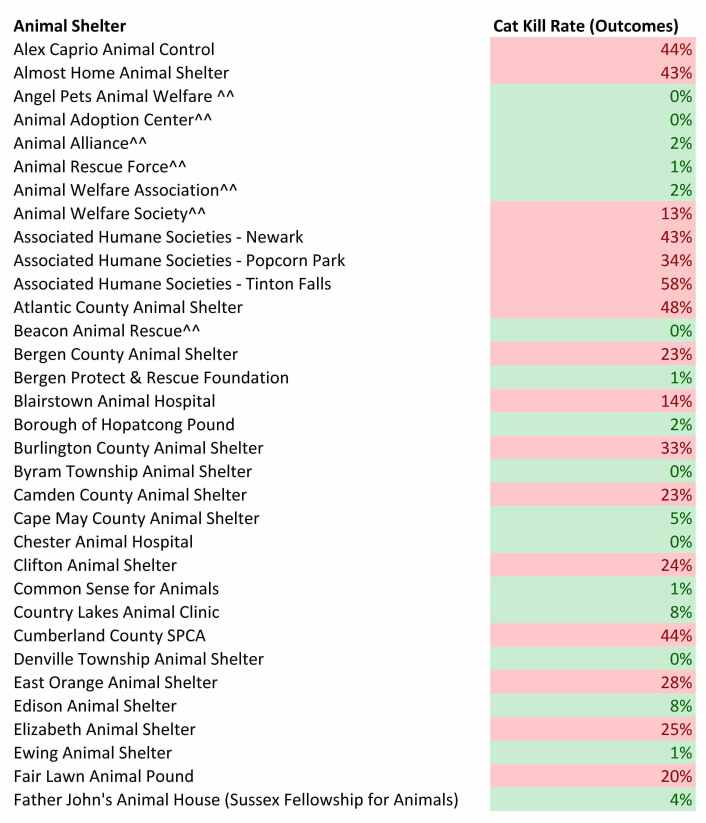
The tables below detail the cat kill rates at each New Jersey animal shelter. These figures do not include cats who died or went missing. Shelters having cat kill rates equal to or less than 8% and greater than 8% are highlighted in green and red in the tables below.

The overall results show too many cats are unnecessarily losing their lives at New Jersey animal shelters. 12,370 savable cats lost their lives or went missing at New Jersey animal shelters in 2015 under the assumption cats classified as “Other” in each shelter’s statistics died or went missing. While some of the cats in the “Other” Category may have went through TNR programs, it has been my experience based on reviews of underlying records from several local shelters that most of the cats in the “Other” category died or went missing. Obviously, some of the cats shelters killed were truly feral and required TNR or placement as barn/warehouse cats, but surely many others could have been adopted out. Thus, New Jersey’s shelter system is failing its cats.

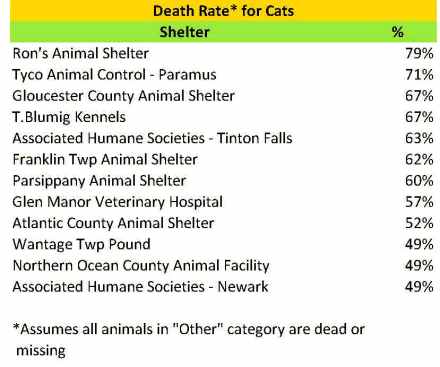
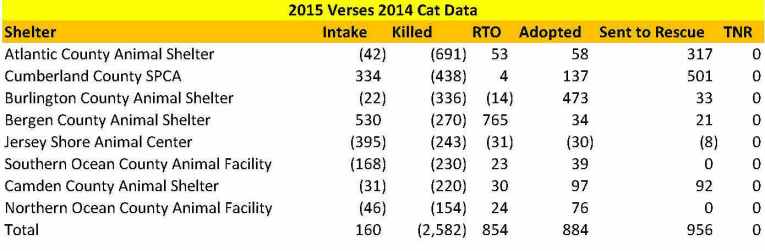
Several animal shelters in South Jersey and elsewhere account for a large percentage of the savable cats unnecessarily losing their lives. Specifically, Gloucester County Animal Shelter, Cumberland County SPCA, Burlington County Animal Shelter, Atlantic County Animal Shelter and Camden County Animal Shelter account for 5,695 or 46% of the 12,370 cats needlessly losing their lives. Associated Humane Societies three shelters had 2,285 cats unnecessarily lose their lives in 2015. Northern Ocean County Animal Facility and Southern Ocean County Animal Facility had 978 cats lose their lives needlessly in 2015. Bergen County Animal Shelter, which happens to serve many towns in one of the country’s wealthiest counties, had 495 cats unnecessarily lose their lives in 2015. Collectively, these 11 shelters are 11% of the state’s shelters and account for 9,453 or 76% of the cats needlessly losing their lives.

Rescue oriented shelters generally had fewer cats lose their lives than targeted. While saving large numbers of cats is what we all want, some of these shelters may have achieved this result by taking in easier cats. Austin Pets Alive, which is a rescue oriented shelter in Texas, has developed some of the most innovative cat programs and only had a cat live release rate of 94% in 2015. This was due to Austin Pets Alive taking in many cats requiring significant treatment, such as neonatal kittens, from the city animal control shelter. As a result, some of the rescue oriented shelters with significantly fewer cats euthanized than targeted may have avoided taking in many of the more difficult cases.

Several animal control shelters euthanized the targeted number of cats or fewer. Borough of Hopatcong Pound, Byram Township Animal Shelter, Cape May County Animal Shelter, Denville Animal Shelter, Edison Animal Shelter, Ewing Animal Shelter, Father John’s Animal House, Humane Society of Ocean County, Liberty Humane Society, Monmouth SPCA, Montclair Animal Shelter, Montgomery Township Animal Shelter, Pequannock Township Animal Shelter, Perth Amboy Animal Shelter, Randolph Township Pound, Rockaway Animal Hospital LLC, Secaucus Animal Shelter, Somerset Regional Animal Shelter, St. Hubert’s-Madison, Trenton Animal Shelter, Wayne Animal Shelter and West Milford Animal Shelter prove animal control shelters can avoid killing healthy and treatable cats.
2015 Cat Kill Rate.jpg

2015 Cat Kill Rate (2).jpg

2015 Cat Kill Rate (3).jpg

Space Constrained Facilities Not Receiving Enough Support from Rescues and Other Animal Shelters

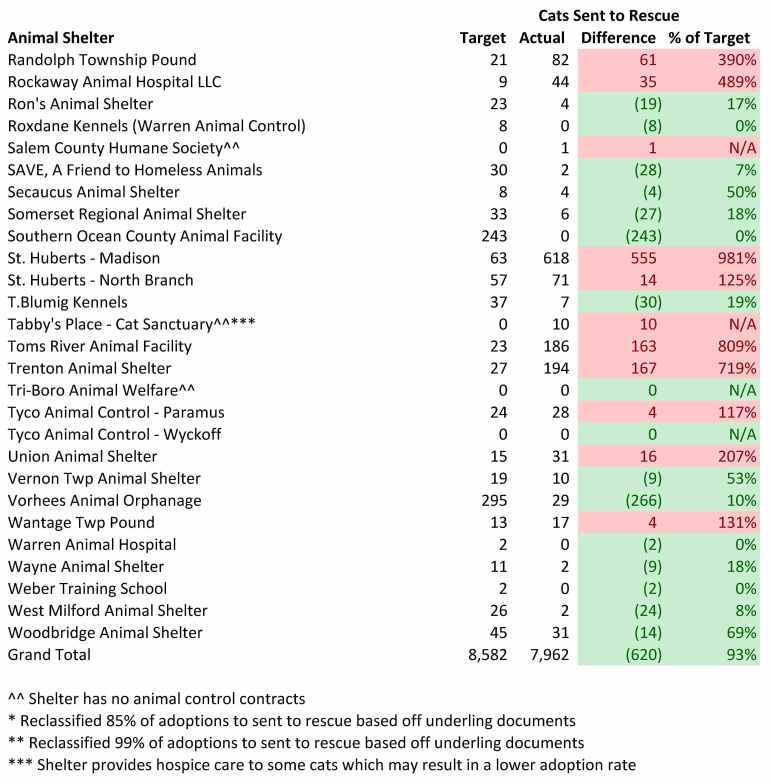
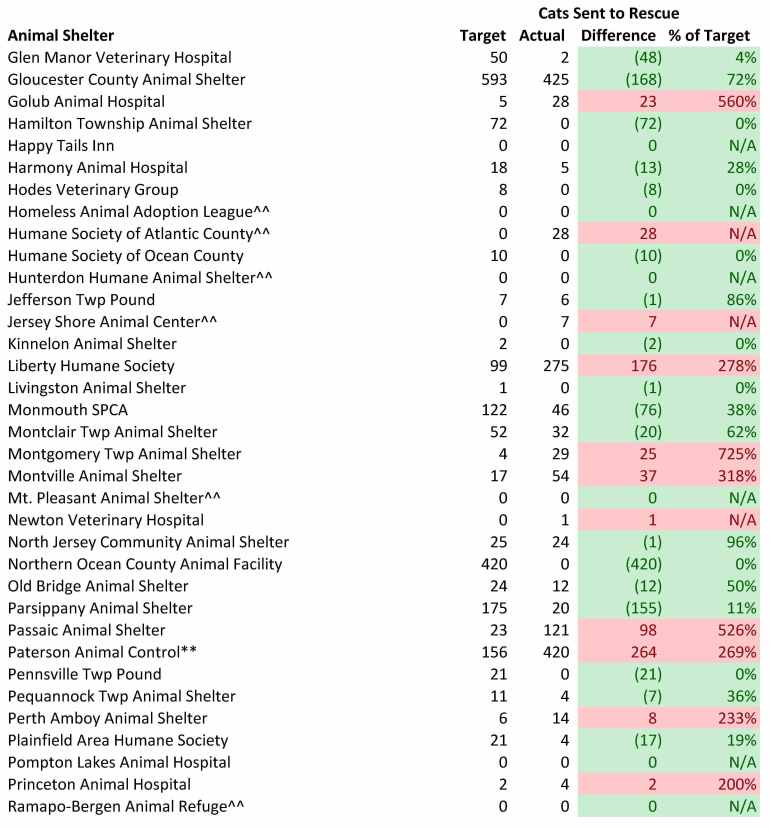
Some animal shelters will require more support from rescues and animal shelters with excess space than others. If a shelter has relatively high intake and very limited space, it will need more help than other shelters. While sending animals to rescues is a good thing, we do want shelters most needing rescue support to receive that help given rescues have limited resources. The tables below compare the number of cats a shelter should transfer to other organizations per the model and the number of cats actually sent to other animal welfare groups. Shelters marked in green are receiving less than the expected rescue support while facilities marked in red are receiving too much rescue help.

Overall, New Jersey shelters are not receiving enough help from other animal welfare organizations. While the overall number of cats rescued was 93% of the amount needed for the state as a whole, the actual number was 48% since many cats were rescued from facilities which did not require so much rescue assistance. Only 25 out of the 74 facilities needing rescue assistance received the required support. In other words, only 34% of the animal shelters needing rescue help received the amount these facilities require.

We truly need to understand the reasons for this rescue shortfall. While poor data collection (i.e. shelters classifying rescues as adoptions) may explain part of this rescue deficit, the large size of this number points to other causes as well. For example, New Jersey shelters significantly exceeded their dog rescue needs, but just 34% of shelters needing cat rescue assistance received the needed support. Certainly, some of these cats are feral and not candidates for most rescues. However, many other cats surely are home-able. Many high kill facilities may not reach out to rescues for cats, such as during kitten season, as much as they do for dogs. This data supports the need for the Companion Animal Protection Act (“CAPA”), which requires shelters to contact rescues and other facilities at least two business days before killing animals. On the other hand, shelters with excess capacity may not be doing their part to save cats from space constrained facilities.

Several shelters received too much rescue help. Rescues may want to help these organizations due to rescue friendly policies. Alternatively, these shelters may be relying too heavily on rescues to save their animals. Shelters (excluding St. Hubert’s which transfers cats as part of national rescue campaigns) receiving the most extra rescue support were as follows:

  • Associated Humane Societies-Newark – 648 more cats transferred than necessary
  • Paterson Animal Control – 264 more cats transferred than necessary (estimated due to the shelter’s incorrect reporting of rescues as adoptions)
  • Liberty Humane Society – 176 more cats transferred than necessary
  • Trenton Animal Shelter – 167 more cats transferred than necessary
  • Atlantic County Animal Shelter – 165 more cats transferred than necessary
  • Toms River Animal Facility – 163 more cats transferred than necessary

While Liberty Humane Society is known as a progressive shelter, most of the other facilities are not good in my opinion. Local activists have campaigned to remove Toms River Animal Facility’s Shelter Director, Jim Bowen. Associated Humane Societies-Newark has a history of problems and kills animals for ridiculous reasons. Paterson Animal Control has no volunteer program, no social media page or even a website with animals for adoption. Thus, many shelters receiving greater than expected rescue support seem to do little more than allow rescues to save the day.

On the other hand, many space constrained shelters received far less rescue help than needed. Facilities receiving the lowest amount of rescue support in relation to their needs were as follows:

  • Cumberland County SPCA – 668 fewer cats transferred than necessary
  • Northern Ocean County Animal Facility – 420 fewer cats transferred than necessary
  • Vorhees Animal Orphanage – 266 fewer cats transferred than necessary
  • Southern Ocean County Animal Facility – 243 fewer cats transferred than necessary
  • Bergen County Animal Shelter – 194 fewer cats transferred than necessary
  • Gloucester County Animal Shelter – 168 fewer cats transferred than necessary
  • Parsippany Animal Shelter – 155 fewer cats transferred than necessary
  • Camden County Animal Shelter – 104 fewer cats transferred than necessary

The million dollar question is why do these shelters receive very little rescue help? Some, such as Northern Ocean County Animal Facility and Southern Ocean County Animal Facility, reported no cats sent to rescues and may incorrectly count these animals as adopted. As you will see below, Vorhees Animal Orphanage adopts out many cats and is doing a good job. On the other hand, Gloucester County Animal Shelter routinely illegally killed animals during the 7 day hold period, allowed disease to spread like wildfire and does not adopt out animals at the shelter on weekends. Similarly, Bergen County Animal Shelter is a high kill facility and refuses to even give information to rescues over the phone. Parsippany Animal Shelter has long had a tumultuous relationship with the animal welfare community. As a result, shelters receiving too little rescue help may or may not be doing their part to get that assistance.

Rescue groups and shelters with extra space should pull cats from kill shelters with the highest rescue “target” numbers and deficits in the tables below. If shelters not needing rescue support get that extra help, these shelters will not take the steps necessary to properly run their facilities. As a result of enabling poorly performing shelters and not pulling cats from truly space constrained facilities, rescuing cats from shelters with enough space leads to less lifesaving.

Shelters receiving less than needed rescue support should also examine their own policies and performance. Are the shelter’s operating processes allowing too many animals to get sick and therefore discouraging organizations to rescue their animals due to subsequent medical costs? Does the shelter actively reach out to rescues/other shelters and treat them with respect? Does the shelter make it convenient for other organizations to pull their animals?

Given killing animals for space is intolerable, the space-constrained shelters need to expand their effective cat capacity. These facilities could use extra space in their buildings to house cats on a short-term basis. These shelters can enter into arrangements with local veterinarians and local pet stores to house and adopt out some cats. Furthermore, shelters can create or expand foster programs to increase the number of cats cared for. Additionally, creating a pet owner surrender prevention program and an appointment system for owners willing to delay surrendering their cats could free up space in these shelters. Finally, space-constrained shelters with multiple animal control contracts should terminate some of these arrangements to bring their capacity for care in line with the number of cats they take in. As a result, space constrained shelters still need to take active steps to reduce killing rather than simply solely relying on rescue support.

2015-cat-re

2015-cat-re-2

2015 cat re (3).jpg

Most New Jersey Animal Shelters Fail to Come Close to Reaching Their Cat Adoption Potential

We can assess each shelter’s contribution to making New Jersey and nearby areas no kill. While a shelter may be able to avoid killing healthy and treatable animals, it still may not live up to its potential for adopting out cats. On the other hand, a space constrained shelter may kill healthy and treatable cats, but still do a good job adopting animals out.

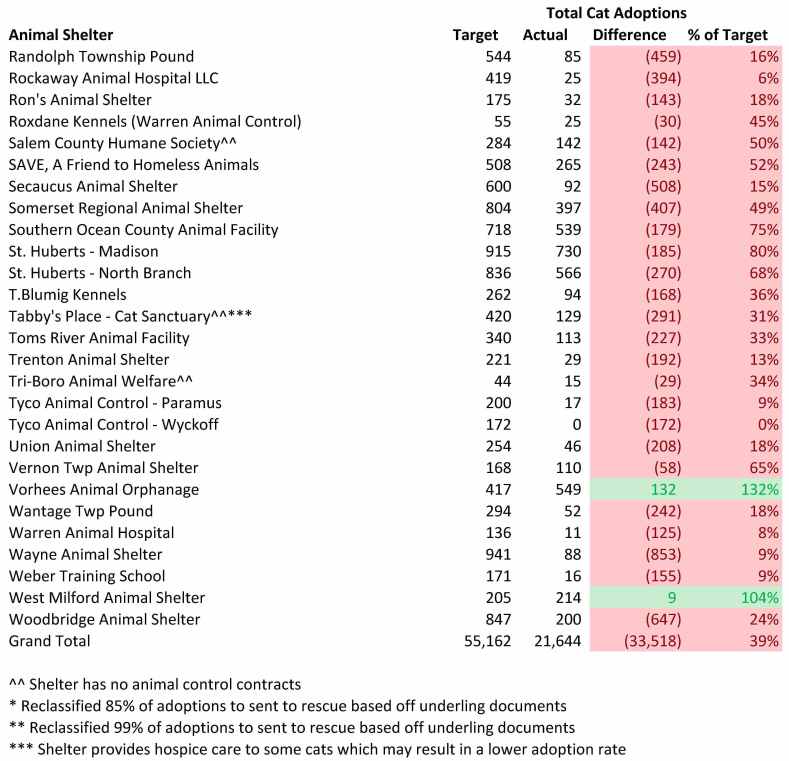
The tables below compare the number of cats from New Jersey and nearby states each animal shelter should adopt out with the estimated number of cats actually adopted out.

Rescue oriented organizations may look better than they actually are. Many rescue oriented shelters likely pull much easier to adopt cats than the bulk of cats needing to get rescued from local facilities.

Few organizations reached or exceeded their adoption targets. Specifically, only 7 out of 97 shelters met the cat adoption goals computed by the Life Saving Model. Thus, the overwhelming number of New Jersey animal shelters need to step up their adoption efforts.

Several rescue oriented shelters exceeded their adoption targets. Animal Welfare Association exceeded its cat adoption target by the most of any shelter in terms of total adoptions. Animal Welfare Association has reasonable normal adoption fees of $95 for kittens and $65 for adult cats, but runs reduced and no adoption fee promotions as well. Animal Welfare Association also waives fees for certain cats who may take longer to adopt out, such as cats who are older or have behavioral or health issues. Furthermore, the shelter’s “Best Friends” program allows people who adopt a cat to pay just $25 for a second cat who is 1 year or older. Animal Welfare Association also waives cat adoption fees for active military personnel and veterans in its Pets for Vets program. The shelter also waives adoption fees for senior citizens adopting certain senior pets. Additionally, Animal Welfare Association uses an open adoption process focused on properly matching animals and people rather than an overly judgmental procedure based on black and white rules. To aid its open adoptions process, Animal Welfare Association uses the ASPCA’s Feline-ality program. Animal Welfare Association’s adoption rate increased by 20% and its cat length of stay decreased by 23 days after the shelter implemented the Feline-ality program. Finally, Animal Welfare Association installed perches in their cat enclosures to provide cats more vertical space which keeps the cats happier and more adoptable. Beacon Animal Rescue also exceeded its adoption target and charges a reasonable $75 fee for all cats. Other rescue oriented shelters exceeding their adoption targets were Mt. Pleasant Animal Shelter and Ramapo-Bergen Animal Refuge. Thus, several rescue oriented shelters exceeded their cat adoption targets and Animal Welfare Association used a variety of innovative strategies to adopt out many cats.

Several animal control shelters also exceeded their adoption targets. Despite not being open many hours, West Milford Animal Shelter exceeded its adoption goal. This shelter charges a very reasonable $35 fee for all cats and runs a creative Facebook page called “The Real Cats at West Milford Animal Shelter.” Byram Township Animal Shelter also exceeded its adoption goal. While the shelter has very limited adoption hours, the shelter’s volunteer organization partner also holds frequent adoption days at high traffic retail stores. The shelter’s volunteer organization charges reasonable adoption fees of $65 and $85 for cats and kittens, but also sometimes offers discounts when two or more cats are adopted together. Also, adoption fees for senior and special needs cats are only $35. Vorhees Animal Orphanage also exceeded its adoption goal. This shelter’s normal adoption fees are quite reasonable. For example, senior cats and special needs cats are $25 and adult cats are $75. The shelter also is open 7 days a week, including weekday evenings and weekends (except one Wednesday a month and certain holidays), which makes it convenient for working people to adopt animals. Additionally, Vorhees Animal Orphanage adopts cats out at one PetSmart store and three PetValu locations. Thus, several animal control shelters exceeded or came close to achieving their cat adoption goals and therefore prove these adoption targets are achievable.

Rescues should focus on pulling animals from Vorhees Animal Orphanage. This shelter’s cat kill rate is too high and its need for rescues greatly exceeds the amount of animals actually pulled from this organization. While some of these cats may be feral and therefore not adoptable, many other cats surely could be rescued from this shelter. Given this shelter is adopting cats out at a good rate, rescues and other other shelters should help this facility out by pulling more cats from Vorhees Animal Orphanage.

Some municipal animal control shelters may be doing a better job with cats than the numbers below indicate. In some cases, municipalities may frown on government run shelters using taxpayer funds to rescue cats from elsewhere. My suggestion to these shelters is to find ways to use more of your facility’s capacity to expand your lifesaving work to other areas. For example, these shelters should consider taking in animals from other shelters for a fee or even contracting with other municipalities.

Associated Humane Societies performance is particularly disappointing. Specifically, Associated Humane Societies has the physical capacity to significantly reduce the killing of healthy and treatable cats. Associated Humane Societies adoption shortfall of 6,971 cats is 56% of the 12,370 cats unnecessarily losing their lives in New Jersey animal shelters. Associated Humane Societies has the funding to reach these adoption targets as the organization took in nearly $9 million of revenue last year. This works out to $462 of revenue per dog and cat I project the shelter should take in per my Life Saving Model. As a comparison, KC Pet Project, which is a no kill open admission shelter in Kansas City, Missouri, took in only $318 of revenue per dog and cat. Activists wanting to increase life saving in New Jersey should focus on changing Associated Humane Societies’ policies given the lifesaving potential of this organization.

Bergen County Animal Shelter’s adoption shortfall of 1,768 cats is quite disappointing. Bergen County is among the top 1% of the nation’s wealthiest counties and the shelter received $470 of funding per dog and cat I project the shelter should take in based on direct support from Bergen County and the revenue from the local charity that helps support the shelter.

2015-cat-ado

2015-cat-ado-2

2015-cat-ado-3

Shelters Fail to Use Excess Space to Save Cats

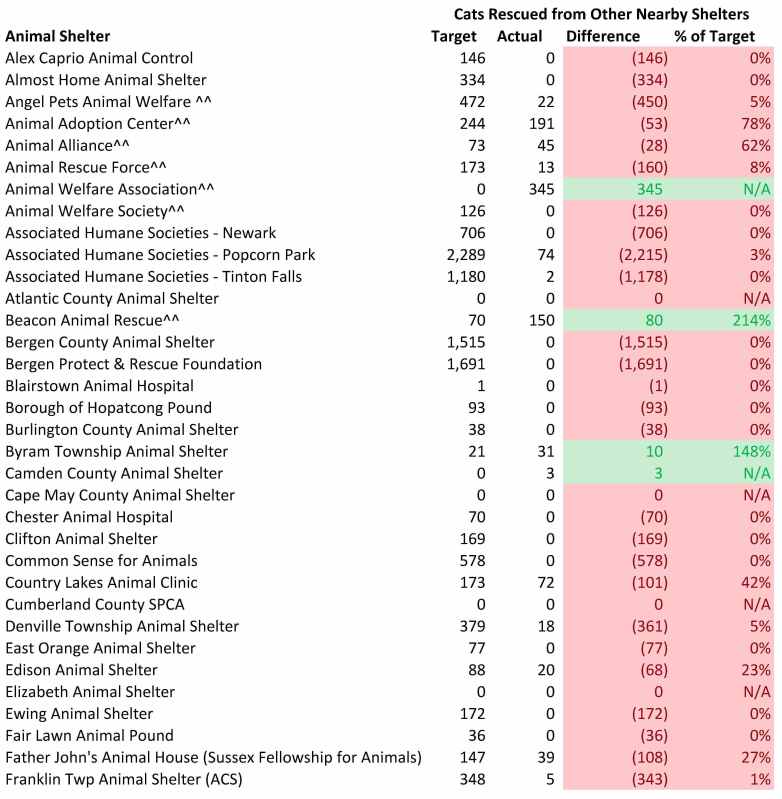
To further examine New Jersey animal shelters’ performance in saving homeless cats, I compared the targeted number of cats each shelter should pull from nearby shelters to the number actually rescued from local facilities. I assume all cats rescued from out of state came from nearby areas, such as Philadelphia and New York City. While some of the out of state rescued cats may have comes from far away areas, I believe this is a small number and does not significantly impact the results.

Virtually all New Jersey animal shelters are failing to rescue the number of cats they should. 82 of the 97 shelters should rescue some cats from other local shelters. In fact, 48 of the 82 shelters with targeted excess capacity failed to rescue even a single cat from other animal shelters. Only 5 shelters with significant amounts of space to rescue cats from nearby shelters met or exceeded their cat rescue target. Thus, nearly all New Jersey animal shelters with targeted excess capacity are failing to do their share in ending the killing of healthy and treatable cats.2015-rr
2015 rr (2).jpg

2015 rr (3).jpg

TNR Is Essential, But Should Not Be An Excuse to Do Nothing

TNR must be instituted to end the killing of healthy and treatable cats. While many shelters may potentially come close to or reach a 90% live release rate, feral cats may still be killed. Simply put, New Jersey cannot become a no kill state without TNR becoming the law of the land. The Companion Animal Protection Act (“CAPA”) prevents shelters and municipalities from taking actions to hinder TNR, such as banning feral cat colony caretakers from feeding cats and lending traps out to the public for catching and killing feral cats. Even without an explicit law allowing TNR, the New Jersey Department of Health should encourage municipalities to implement TNR by changing its neutral stance on TNR to an endorsement of the practice. Furthermore, shelters, especially private facilities with animal control contracts, should refuse to take feral cats from places where TNR is prohibited and the shelter cannot place these feral cats as barn cats or send these animals to reputable sanctuaries per recommendations of many national animal welfare groups.

Shelters should not use anti-feral cat laws as an excuse for failing to institute innovative programs. Too many times shelters blame anti-feral cat ordinances for their outrageously high cat kill rates. However, my analysis proves cats are not dying in New Jersey’s shelter system due to too many cats coming into the state’s shelter system. While TNR certainly would reduce cat intake and make saving lives easier, our state’s shelter system has more than enough space to handle the number of cats that come in. Shelters need to implement key programs, such as foster care, high volume adoptions, and vaccination upon intake. Additionally, shelters need to stay open weeknights and weekends when working people can adopt. Similarly, shelters should use innovative marketing, customer friendly open adoption processes, multiple off-site adoption locations, and frequent discounted adoption promotions to quickly move cats into good homes. Furthermore, implementing a program where fearful and aggressive cats are touched gently and spoken to softly likely will significantly reduce the number of cats labeled as “feral” and increase adoptions. Thus, anti-TNR ordinances do not prevent shelters from implementing other life saving policies.

Shelters Do Not Need to Leave Friendly Cats on the Street

Shelters do not need to neuter and release friendly cats or refuse to take these cats in given enough capacity exists within the New Jersey shelter system. In 2013, a group of animal welfare leaders, which included the Humane Society of the United States (“HSUS”) and the ASPCA, prepared a white paper stating a shelter should not impound cats if those cats or other cats in the shelter would subsequently be killed. The evidence supporting this policy, such as cats being more likely to find homes on the street than in traditional shelters, is quite strong. However, my analysis shows the entire New Jersey shelter system does have enough space to handle friendly cats. While certain shelters are space constrained and could benefit from refusing to admit healthy and friendly cats, other shelters in the state have more than enough capacity to step in and find these cats homes. Thus, New Jersey shelters do not need to resort to refusing to take in friendly cats or neutering and releasing friendly cats to avoid killing cats provided these shelters work together and follow best practices.

Kitten Nurseries and Ringworm Wards Key to Saving Vulnerable Cats

Orphaned kittens are typically automatically killed in traditional animal shelters due to the time commitment required to care for these animals. Unweaned kittens require bottle feeding as frequently as every 1-2 hours. As a result, kittens not placed into foster care are typically killed in most animal shelters.

Kitten nurseries or bottle baby wards radically increase the save rate for orphaned kittens still requiring milk. While foster care and rescue programs can save unweaned kittens, kitten nurseries are more efficient and make the job easier. Austin Animal Services, which is the animal control shelter in Austin, Texas, killed 1,200 plus kittens a year before Austin Pets Alive created a bottle baby program. Volunteers work in two hour shifts to feed and care for the kittens. Additionally, nursing mothers are pulled from the city shelter and used to help nurse highly vulnerable young kittens who are orphaned. Kittens are put on antibiotics and treated for fleas and worms immediately to help prevent complications from transitioning from breast milk to formula. Austin Pets Alive has pulled as many as 1,600 kittens a year from the city shelter and saved nearly 90% of these kittens in recent years through this bottle baby program. Best Friends created a kitten nursery in South Salt Lake City, Utah and saved 1,400 kittens from Salt Lake City area shelters. Thus, kitten nursery programs can save young and vulnerable kittens.

Ringworm ward programs easily save cats with this skin fungus. In traditional animal shelters, cats with ringworm are killed due to the risk that other animals and humans will catch this skin fungus. Austin Pets Alive created a specific “Ringworm Ward” program to treat and adopt out these cats. These cats are treated both topically and orally in an isolated area. After the cats are no longer contagious, the cats are sent to foster homes to complete their treatment and regrow their hair. Austin Pets Alive uses steeply discounted adoption fees of only $15 along with catchy slogans like “Adopt a Fun Guy (Fungi)”, “Lord of the Ringworm”, and “Hairy(less) Potter” to quickly place these cats and open up space for additional cats with ringworm. 100% of cats entering this program are saved. Thus, shelters can save cats with ringworm.

Regional kitten nurseries and ringworm wards are the practical solution to saving these vulnerable cats. Given the New Jersey shelter system has significant excess capacity to care for cats, certain shelters should convert some of that excess space for use as kitten nurseries and ringworm wards. Creating regional centers to care for unweaned kittens and cats with ringworm would allow the programs to run at a large enough scale to work efficiently. Shelters, such as Associated Humane Societies-Popcorn Park, Monmouth SPCA, and St. Hubert’s-Madison appear to have the space and financial resources to implement these programs. Furthermore, the Animal Welfare Federation of New Jersey (“AWFNJ”) should take the steps needed to create kitten nurseries and ringworm wards in regional centers throughout the state. Surely, the AWFNJ has the connections to convince key decision makers to implement these programs and obtain any necessary funding. Thus, New Jersey shelter leaders must immediately take the steps needed to save the large numbers of treatable kittens and cats with ringworm in our state’s shelters.

Results Require New Jersey Animal Shelters to Take Action

The findings from this analysis mandate New Jersey animal shelters change their ways. While TNR remains a significant issue, most shelters are clearly not taking steps to save large numbers of healthy and treatable cats. Many shelters are not vaccinating upon intake, charging excessive adoption fees, making it too difficult to adopt, not being open when working people can go to shelters, leaving cat enclosures empty, not trying to rehabilitate fearful and aggressive cats and not using barn cat, foster care, kitten nursery and ringworm ward programs. Simply put, too many shelters are not doing what it takes to save lives. With more than one in three cats entering New Jersey’s shelters dying, going missing or being unaccounted for, our state’s shelters are failing their cats.

New Jersey shelters have a cat crisis and it is time for the killing to stop. We have the information and even the blueprints from numerous communities which stopped killing and started saving their cats. It is time the excuses end and action begins. The public is fed up with the killing and demands shelters save their animals. Our state’s animal welfare organizations need to get on board the lifesaving wagon or risk getting run over by it. Which will they choose?

Appendix Life Saving Model Assumptions

The Life Saving Model utilizes the following basic animal shelter population equations to calculate the targeted cat outcomes for each facility:

Daily capacity or population = Daily animal intake x average length of stay

Average length of stay = Daily capacity or population/daily intake

Each shelter’s community cat intake (i.e. owner surrenders, strays, cruelty cases), number of cats returned to owners, and maximum cat capacity were taken from its 2015 “Shelter/Pound Annual Report” submitted to the New Jersey Department of Health. You can see the full data set I compiled from these reports here.

  • Community cat intake and cats returned to owners were initially estimated for each month by dividing the annual figures by 12. In order to take into account the extra space in low intake months and reduced space in high intake months, we multiply that number by each month’s percentage of the average month. For example, assume 240 cats were taken in during the year and the average month equals 20 cats (240/12). In July, the cat intake is 120% higher than the average month and we therefore multiply 20 cats by 1.2 to equal 24 cats. If 120 cats were returned to owners during the year, the estimated number of cats returned to owners in July would equal 12 cats (120/12 = 10; 10*1.2). The monthly intake percentages were based off the average of the 2015 cat intake data on New York Animal Care & Control’s and ACCT Philly’s web sites.
  • The estimated number of community cats returned to owners each month are then assumed to stay 5 days on average at shelters based on data from other shelters across the country.
  • The number of community cats euthanized (including animals who died or are missing) is set to equal 8% of intake. 8% is a reasonable standard euthanasia rate to use given other open admission animal shelters, such as Austin Animal Services, equal or exceed this target and New Jersey’s much lower per capita cat intake makes it easier to save lives. The average length of stay for euthanized cats is assumed to equal 8 days. I assume these cats have severe and untreatable health issues and are euthanized immediately after their required 7 day hold period.
  • The average length of stay used for adopted community cats was 42 days. This estimate was roughly halfway between the average cat length of stay figures for a number of no kill animal control shelters. For example, the average length of stay for cats in recent years was 14.2 days at Texas’s Williamson County Animal Shelter, less than 18 days at Nevada Humane Society, 19 days (25 days for cats and 8 days for kittens) at Colorado’s Longmont Humane Society, 33 days (32 days for cats and 34 days for kittens) at New Hampshire SPCA, 35 days at Montana’s Flathead County Animal Shelter, 40 days at Lynchburg Humane Society, and 61 days for adopted cats only at New York’s Tompkins County SPCA. While the average length of stay of adopted cats at these shelters other than Tompkins County SPCA may have been slightly higher since this data is for all cats and not just those adopted, the difference is not likely significant given adoptions represent most of the outcomes at these shelters. Unfortunately, I was not able to break down the adoption length of stay figures by age or breed for New Jersey’s shelters like I did in my analysis on dogs due to a lack of detailed cat intake data at New Jersey animal shelters. Upon reviewing cats up for adoption at several New Jersey animal control shelters and a few of the high performing facilities above, I did not see any significant differences in types of cats taken in. In the future, I hope to refine this analysis further.
  • The average length of stay used for community cats adopted out from rescue oriented shelters was 30 days. Rescue oriented animal shelters typically carefully select animals taken into their shelters. Based on the San Francisco’s SPCA’s 21 day and Tony La Russa’s Animal Rescue Foundation’s 23 day average length of stay figures reported a number of years ago, I used a shorter length of stay for community cats adopted from New Jersey animal shelters without animal control contracts. I chose 30 days as a conservative estimate.
  • Cats transferred to rescue or other facilities are assumed to stay at shelters 8 days on average based on the assumption strays can’t be released until the 7 day hold period elapses.
  • Community cats not returned to owners or euthanized are initially assumed as adopted for each month outside of kitten season (i.e. November-March). However, if the calculated length of stay exceeds the shelter’s required length of stay, cats are moved from adoption (i.e. with a longer length of stay) to rescue (i.e. shorter length of stay) until the calculated length of stay each month approximately equals the required length of stay.
  • During kitten season (April-October), animal control shelters are assumed to send a certain percentage of cats to rescues even if they have excess space. Due to the large numbers of kittens coming into shelters during these months, I assume shelters will not be able to place all of them into foster homes or a kitten nursery at this time. As a result, I assume animal control shelters will send 10% of their annual community cat intake to rescues based on the shelters’ estimated relative cat intake each month. For example, if a shelter took 100 cats in during the year and August made up 50% of the total cat intake from April to November, 5 cats would go to rescue in August (i.e. 100*10% = 10 cats; 10*50% = 5 cats). I used 10% based off the rescue percentage of cat intake in 2014 at Kansas City’s KC Pet Project. KC Pet Project is a no kill open admission shelter with an inadequate facility and is a good comparison for some of our state’s run down shelters. Shelters requiring rescue support due to space constraints are assumed to send these additional cats to rescues during kitten season.
  • Shelters are not expected to use the excess space created by fosters taking kittens to rescue and adopt out additional cats. This is based on the assumption that the kittens will return to shelters once old enough to safely stay at the facilities.
  • Required length of stay = Shelter’s reported capacity/adjusted daily intake for the month. Adjusted daily intake for month = Adjusted monthly intake per first bullet above/the number of days in the month.
  • Shelters with excess capacity are assumed to use the extra space to rescue and adopt out cats from other New Jersey animal shelters. Given some of these cats will be young and highly vulnerable kittens, I assume 5% of these rescues will be euthanized for humane reasons. I used 5% based off Austin Pets Alive’s and Austin Humane Society’s weighted average cat euthanasia rate in 2014. These two shelters pull many cats from Austin Animal Services, which is the city’s animal control shelter, and their cat euthanasia rate is a reasonable proxy for the percentage of hopelessly suffering cats rescued from animal control shelters. To the extent all healthy and treatable New Jersey animal shelter cats are saved, I assume additional cats are pulled from nearby states. The average length of stay for rescued and adopted cats is the same as the cats taken in by animal control shelters (i.e. 42 days). Similarly, I used 8 days as the average length of stay for rescued and euthanized cats from other shelters.
  • Each month’s targeted outcomes are added to determine how many cats New Jersey animal shelters should adopt out, send to rescue and rescue from other nearby animal shelters.
  • Space constrained shelters were assumed to adopt out their easiest to adopt animals first until they run out of space. To estimate the average adoption length of stay, I used cat adoption length of stay data from Perth Amboy Animal Shelter from 2014 and the first half of 2015. I broke the adoption length of stay data into 5 groups that each made up 20% of the data. The average adoption length of stay for each of these 5 groups was calculated. The average adoption length of stay of each group was divided by the average length of stay for all of the adopted cats in the Perth Amboy Animal Shelter data set. Those percentages were then multiplied by the average cat adoption length of stay determined in the model above and used to determine the adoption lengths of stay used for space-constrained shelters.
  • The targeted number of cats adopted were capped at 8 cats per 1,000 people in each county. If the model yielded a higher result than this cap, the targeted numbers of cats adopted were equal to this cap. For shelters in these counties (except Passaic County), I calculated the cap at the county level and then reduced the number of cats adopted for the county to equal the cap. I excluded West Milford from Passaic County due the town’s large distance from the population centers in the rest of the county. Each shelter’s percentage of total targeted adoptions in the county from the unmodified model were applied to the the total reduction in the number of cats adopted in the county to yield the targeted numbers of cats adopted in the modified model. Rescued and euthanized cats for these shelters were reduced based on the modified model’s assumption that shelters adopted out and euthanized 95% and 5% of rescued cats.
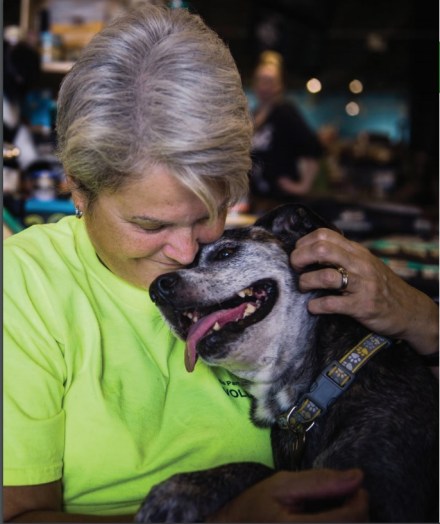
Bergen County Animal Shelter’s No Kill Con Job (Part 1 of 3)

In 2015, Bergen County Executive, James Tedesco, and the Bergen County Board of Chosen Freeholders announced the approval of a resolution recognizing Bergen County Animal Shelter as a “no kill shelter by adopting the Asilomar Accords.” Mr. Tedesco went on to state the following:

As an animal lover, I believe formalizing this designation gives the residents of our county a better understanding of the shelter’s mission and helps us highlight what a great organization this is. Bergen County’s Animal Shelter is not only one of the best public animal shelters in the state, but arguably one of the best in the Northeast.

Furthermore, Bergen County Freeholder, Dr. Joan Voss, gave Bergen County Animal Shelter Director, Deborah Yankow, a “Women of Distinction” award in 2016 for Ms. Yankow’s achievements in “The field of Animal Compassion.”

Is Bergen County Animal Shelter a no kill shelter? Is Bergen County Animal Shelter one of the best public animal shelters in New Jersey and arguably in the Northeast? Should Bergen County Animal Shelter’s Director receive an award for animal compassion?

Asilomar Accords Do Not Equal a No Kill Shelter

The Asilomar Accords were a deeply flawed agreement. In 2004, the regressive shelter establishment, Maddie’s Fund and certain limited admission shelters created the Asilomar Accords to allegedly save more animals in shelters. In general, the Asilomar Accords did not require shelters to adopt any lifesaving programs. However, the Asilomar Accords required members to not criticize each other, even if such criticism was warranted. Additionally, the Asilomar Accords encouraged members to not use terms such as “no kill’ as it was “divisive.”

The Asilomar Accords require members to compile specific animal shelter statistics and report this data to the public each year. Animal shelters must report the numbers of impounded animals each year and the specific outcomes in an “Animal Statistics Table.” Euthanized animals are broken down into “healthy”, “treatable” and “unhealthy-untreatable” categories. Animals are considered “treatable” if a “reasonable and caring pet owner/guardian in the community would provide the treatment necessary to make the animal healthy” or “maintain a satisfactory quality of life.” However, animals that “pose a significant risk to human health or safety or to the health or safety of other animals” are not “treatable” per the Asilomar Accords. Shelters calculate an Asilomar Accords Live Release Rate excluding animals euthanized by request of their owners and classified as “untreatable” and dogs and cats who died or went missing. Shelters must share these statistics with the public by posting on their web site, in newsletters, etc.

The Asilomar Accords statistics often have been exploited by regressive shelters. For example, many poorly run facilities classify large numbers of animals as “untreatable” and then claim they are no kill (i.e. “we don’t euthanize healthy and treatable animals”).

Bergen County Animal Shelter fails to comply with the Asilomar Accords despite the county’s elected leaders claims. Bergen County Animal Shelter does not publicly share its “Animal Statistics Table” on its web site as required by the Asilomar Accords. In addition, Bergen County Animal Shelter is not listed as a participating organization on the Shelter Animals Count web site (current version of the Asilomar Accords data reporting standards). Even worse, Bergen County Animal Shelter fails to explain in its Standard Operating Procedures manual how its definition of “unadoptable” (i.e.”unhealthy-untreatable” per the Asilomar Accords) is consistent with Asilomar Accords requirement that the shelter provide care that a “reasonable and caring pet owner/guardian in the community” would give to the animal. The shelter simply uses a general definition of “unadoptable” for “animals with serious unmanageable health problems, or an aggressive bite history toward humans or other animals, or who exhibit unmanageable antisocial behavioral characteristics.” To fully comply with the Asilomar Accords, Bergen County Animal Shelter needs to state what specific health problems are “unmanageable” and why “a reasonable and caring pet owner/guardian” in Bergen County would not provide that care. Given Bergen County is in the top 1% of the wealthiest counties in the country, most residents would provide lots of care to their pets before deciding to euthanize a beloved family member. Thus, Bergen County Animal Shelter fails to comply with the weak and traditional shelter friendly Asilomar Accords.

Statistics Reveal Bergen County Animal Shelter is a High Kill Shelter

Bergen County Animal Shelter’s 2015 “Shelter Pound Annual Report” proves the shelter is far from a “no kill” facility. In 2015, 24% of dogs and 28% of cats were killed, died or went missing. Specifically, Bergen County Animal Shelter reported killing 166 dogs and 561 cats. On average, Bergen County Animal Shelter kills 2 dogs and cats each day of the year. The animal welfare community generally requires a shelter to achieve a 90% or greater live release rate to call itself no kill. However, no kill leader, Nathan Winograd, who created the 90% test, recently raised the standard to achieve higher live release rates. Clearly, Bergen County Animal Shelter’s 2015 reported statistics prove Bergen County Animal Shelter is a high kill shelter and not a no kill facility.

Bergen County Animal Shelter 2016 Shelter Pound Annual Report

Bergen County Animal Shelter’s 2015 statistics in its Asolomar Accords format were different from its 2015 Shelter/Pound Annual Report. While Bergen County Animal Shelter does not publicly report its Asilomar Accords Animal Statistics Table, I obtained each month’s table from 2015 under the New Jersey Open Public Records Act (“OPRA”) and tabulated the totals below. Bergen County Animal Shelter reported taking in significantly fewer cats in the Asiolmar Accords format. Similarly, Bergen County Animal Shelter reported fewer cats reclaimed by owners and more cats adopted, killed and died in the Asilomar Accords Animal Statistics Table. The shelter also reported taking in significantly more dogs in the Asilomar Accords Statistics Table. Furthermore, Bergen County Animal Shelter disclosed significantly more dogs who were killed in the Asilomar Accords Statistics Table. Additionally, a number of various other outcomes were different. Thus, Bergen County Animal Shelter reported different statistics in the two reporting formats indicating the numbers in one of the reports were incorrect.

2015 Bergen Asilomar Stats.jpg

Bergen County Animal Shelter’s Underlying Records Reveal Much Higher Kill Rates

In order to better understand the Bergen County Animal Shelter’s performance, I obtained the facility’s 2015 intake and disposition records under OPRA. Bergen County Animal Shelter sent me shelter software reports listing each dog and cat the shelter impounded in 2015, its outcome and its intake and outcome dates.

I tabulated all of this data and recalculated Bergen County Animal Shelter’s statistics. While the intake numbers are calculated the same way as the Shelter/Pound Annual Report above (i.e. all animals impounded in 2015), the outcome numbers are calculated slightly differently. In the Shelter/Pound Annual Report, only 2015 outcomes are counted. This could include animals impounded in 2014 who were subsequently adopted or killed in 2015. On the other hand, my data counts the animals who were impounded in 2015 and had outcomes in 2015 and 2016. However, the outcomes should be close as both methods calculate outcomes over a 12 month period and the overwhelming number of ultimate outcomes occur in the year the animals were impounded in.

The table below summarizes Bergen County Animal Shelter’s 2015 statistics using the shelter’s underlying records. The total number of impounded cats is significantly different than the “Shelter/Pound Annual Report.” The “Shelter/Pound Annual Report” had 578 more cats than the underlying records. Apparently, much of the difference is due to Bergen County Animal Shelter reporting more cats that the shelter neutered and released in its “Shelter/Pound Annual Report.” In a recent article, Bergen County Animal Shelter Director, Deborah Yankow, stated the shelter neutered and released 788 cats in 2015, which accounts for much of the difference between the 852 cats reclaimed per the Shelter/Pound Annual Report and the 71 cats reclaimed per the underlying records. However, the underlying records have a “Release” outcome as well and the shelter only recorded only 122 cats in this category. It is unclear to me whether that represents cats who were trapped, neutered and released or cats released to their owners. Thus, it seems Bergen County Animal Shelter overstated the number of cats that were trapped, neutered and released in its 2015 Shelter/Pound Annual Report or failed to record hundreds of these cats in its records as required by N.J.A.C. 8.23A-1.13.

The total numbers of impounded dogs and dogs killed are significantly different than the corresponding figures in the Shelter/Pound Annual Report. Specifically, the “Shelter Pound Annual Report” reported 104 fewer impounded dogs during 2015. Apparently, this is primarily due to Bergen County Animal Shelter excluding 103 dogs classified as owner-requested euthanasia from the Shelter Pound Annual Report’s total dogs taken in and killed figures. Thus, Bergen County Animal Shelter’s Shelter Pound/Annual Report clearly is incorrect.

Bergen County Animal Shelter’s intake and disposition records revealed it killed many more cats and dogs than it reported in its 2015 Shelter/Pound Annual Report. Specifically, Bergen County Animal Shelter reported killing 58 more cats and 97 more dogs in its underlying records than its Shelter/Pound Annual Report.

Additionally, Bergen County Animal Shelter reported sending 52 fewer cats and 54 fewer dogs to rescues in its intake and disposition records compared to its Shelter/Pound Annual Report. Most of the other outcome categories in the underlying records and the Shelter/Pound Annual Report were reasonably close.

Overall, Bergen County Animal Shelter’s intake and disposition records revealed a far higher death rate than that reported in its 2015 Shelter/Pound Annual Report. 42% of cats were killed, died or went missing per the facility’s underlying records compared to just 28% of cats per data from Bergen County Animal Shelter’s Shelter/Pound Annual Report. Similarly, 33% of dogs were killed, died or went missing per the facility’s underlying records compared to just 24% of dogs per data from Bergen County Animal Shelter’s Shelter/Pound Annual Report. Thus, Bergen County Animal Shelter’s underlying records reveal far more animals are losing their lives at this self-described “no kill shelter.”

Bergen County Animal Shelter’s death rate for animals actually requiring sheltering is even higher. Since Bergen County Animal Shelter serves a very wealthy county, most stray dogs have licenses and/or microchips allowing the shelter to quickly return these dogs to their owners. While the cat owner reclaim rate is low, it is still significantly higher than the nationwide cat owner reclaim rate. If we calculate the death rate based off animals not reclaimed by owners, which are the ones the shelter has to work to save, 44% of cats and 49% of dogs lost their lives. Thus, nearly half of all dogs and cats requiring any amount of real work lose their lives at this so-called “no kill shelter.”

Bergen County Animal Shelter also reported large owner-requested euthanasia figures. Specifically, the shelter’s records indicated owner-requested euthanasia represented 3% and 12% of all impounded cats and dogs. If we just count animals surrendered by their owners, Bergen County Animal Shelter classified 15% of cat and 32% of dog owner surrenders as owner requested euthanasia. While the cat numbers seem a bit high, the dog numbers are off the charts. The shelter asserts that nearly 40% of the dogs killed and around 1 of 3 dogs surrendered by their owners are owner requested euthanasia. Given Bergen County Animal Shelter largely serves a wealthy area, I find the number of dogs requested by their owners to be euthanized suspicious. I’m also concerned since some shelters coerce people to sign owner-requested euthanasia forms. Thus, Bergen County Animal Shelter’s large owner-requested euthanasia figures raise major red flags.

Even if we exclude owner-requested euthanasia, 40% and 23% of all cats and dogs lost their lives at Bergen County Animal Shelter in 2015. If we exclude owner-requested euthanasia from the non-reclaimed animal death rate, 41% and 37% of all non-reclaimed cats and dogs lost their lives at Bergen County Animal Shelter in 2015. Thus, Bergen County Animal Shelter is still a high kill shelter even if we exclude owner-requested euthanasia.

Bergen 2015 Intake and Disposition Records Summary (3)

Bergen County Animal Shelter’s length of stay data reveals much about the shelter’s operation. On average, the shelter kills cats and dogs after 20 days and 16 days. However, these figures, particularly for dogs, are heavily influenced by the large number of owner surrendered animals that the shelter kills immediately. As expected, owner reclaimed animals go home quickly (10 days for cats and 3 days for dogs). On the other hand, the shelter takes way too long to adopt out cats (66 days) and dogs (47 days) particularly given the types of animals it adopts out (i.e. few challenging animals make it to the adoption floor due to the high kill rate).Bergen County Animal Shelter LOS All Dogs and Cats

Bergen County Animal Shelter’s length of stay data indicates the shelter kills with empty kennels. Based on standard animal shelter population equations, we can estimate the average number of animals at the shelter during the year as follows:

Daily capacity or population = Daily animal intake x average length of stay

Therefore, based on the shelter’s reported animal intake and average length of stay, we can estimate the facility housed 219 cats and 56 dogs on average during 2015. Based on these estimates and the shelter’s capacity disclosed in its 2015 Shelter/Pound Annual Report, Bergen County Animal Shelter only used roughly 2/3 of its available animal holding space on average during 2015. Thus, Bergen County Animal Shelter clearly kills dogs and cats when the shelter has room to house those animals.

Bergen County Animal Shelter 2015 Capacity Used

Adult Dogs and Cats Killed at an Alarming Rate

Bergen County Animal Shelter’s statistics are far worse when we focus on animals the shelter labels as “adult.” Generally speaking, the shelter classified cats and dogs over 1 year old as “adult”, but there were a few classification errors (i.e. older dogs classified as “adult”). However, the number of these animals were not large enough to significantly impact the outcomes below. 54% of adult cats and 36% of adult dogs were killed or died. Similarly, 59% of non-reclaimed adult cats and 54% of non-reclaimed adult dogs were killed or died per the facility’s underlying records. In other words, more than half of adult cats and dogs requiring actual sheltering lost their lives at this so-called “no kill shelter.”

Even if we exclude owner-requested euthanasia, 51% and 25% of all adult cats and dogs lost their lives at Bergen County Animal Shelter in 2015. If we exclude owner-requested euthanasia from the non-reclaimed animal death rate, 55% and 41% of all non-reclaimed adult cats and adult dogs lost their lives at Bergen County Animal Shelter in 2015. Thus, Bergen County Animal Shelter’s underlying records reveal this self-proclaimed “no kill shelter” kills tremendous numbers of adult cats and dogs.

Bergen Adult Animals 2015

Bergen County Animal Shelter’s adult animal length of stay data revealed the shelter killed adult dogs and cats quickly and took too long to adopt out these animals. Specifically, Bergen County Animal Shelter killed adult cats and dogs after just 18 days and 15 days, respectively. In other words, the shelter generally seemed to make little effort to rehabilitate animals. Furthermore, the shelter took 74 days and 50 days on average to adopt out each adult cat and dog. These figures are even worse considering these are likely very adoptable animals since the shelter kills virtually all animals with any significant issues.

Bergen Adult Animals LOS

Pit Bulls Killed in Droves

Bergen County Animal Shelter kills pit bull like dogs at an astounding rate. 50% of all pit bull like dogs lost their lives at Bergen County Animal Shelter in 2015. Even worse, 67% of non-reclaimed pit bull like dogs were killed or died at Bergen County Animal Shelter in 2015. If we exclude owner-requested euthanasia, Bergen County Animal Shelter still killed 47% of its pit bulls and 64% of its pit bulls not reclaimed by owners. Thus, Bergen County Animal Shelter kills around half of all its pit bull like dogs and around two thirds of those pit bull like dogs requiring actual sheltering.

Bergen County Animal Shelter kills most of its adult pit bull like dogs. 61% of adult pit bull like dogs lost their lives at Bergen County Animal Shelter in 2015. In fact, 83% of non-reclaimed adult pit bull like dogs were killed or died at Bergen County Animal Shelter in 2015. Even if we exclude owner-requested euthanasia, the shelter killed 58% of its adult pit bulls and 81% of its adult pit bulls not reclaimed by owners. As a result, adult pit bull like dogs virtually have no chance of making it out alive of the so-called “no kill” Bergen County Animal Shelter.

Bergen Pit Bull Data

Bergen County Animal Shelter’s poor performance is exemplified by its pit bull length of stay data. While Bergen County Animal Shelter’s average length of stay of 36 days for all pit bulls is reasonable, the actual details uncover the true story. The shelter’s average length of stay is relatively low due to owners reclaiming and Bergen County Animal Shelter killing many pit bulls. Of course, we want owners to reclaim their lost pets. However, Bergen County Animal Shelter’s respectable number of reclaimed pit bulls is due mostly to the relatively wealthy people in its service area obtaining licenses and microchips (i.e. making it easy for the shelter to find the owner). On the other hand, Bergen County Animal Shelter kills its pit bulls relatively quickly (26 days on average). These two factors mask the horrendously long time it takes to adopt out pit bulls (73 days for all pit bulls, 115 days for adult pit bulls). As a comparison, data from recent years showed no kill animal control shelters adopting out pit bull like dogs within around 20-40 days. Given the pit bulls Bergen County Animal Shelter adopts out are likely easier to place (i.e. Bergen County Animal Shelter quickly kills many of the types of pit bulls these other shelters spend time to rehabilitate), this performance is even more disappointing. Thus, Bergen County Animal Shelter quickly kills its pit bulls and takes way too long to adopt out the few pit bulls it allows to live.

Bergen Pit Bulls LOS

Small Dogs Are Not Safe at Bergen County Animal Shelter

At most New Jersey animal shelters, small dogs fly out the door to rescues and adopters. For example, Perth Amboy Animal Shelter, which has little space and serves a poor area, saved 97% of 116 small dogs it took in during 2014 and the first half of 2015 per records I reviewed last year. Even the regressive Elizabeth Animal Shelter saved 95% of the 144 small dogs it impounded in 2015. Thus, “no kill” shelters should save 95% or more of the small dogs they take in.

Bergen County Animal Shelter’s killing even extends to large numbers of small dogs. 26% of all small dogs lost their lives at Bergen County Animal Shelter in 2015. Even worse, 39% of non-reclaimed small dogs were killed or died at Bergen County Animal Shelter in 2015. Additionally, the shelter labeled an extraordinary large number of these dogs as “owner-requested euthanasia”, which raises questions about whether these animals were truly hopelessly suffering. If we exclude owner-requested euthanasia, Bergen County Animal Shelter still killed 14% of its small dogs and 24% of its small dogs not reclaimed by owners. Thus, Bergen County Animal Shelter fails to achieve “no kill” status even for small dogs.

Bergen Small Dog Data.jpg

Bergen County Animal Shelter’s length of stay data shows how poorly the facility handles small dogs. Overall, Bergen County Animal Shelter killed small dogs after just 10 days on average. On the other hand, Bergen County Animal Shelter took an astonishingly long 42 days on average to adopt out its small dogs. As a comparison, Perth Amboy Animal Shelter took 14 days on average to adopt out its small dogs based on data from 2014 and the first half of 2015. Similarly, Elizabeth Animal Shelter took 5 days on average to safely get non-reclaimed small dogs out of the shelter in 2015. Thus, Bergen County Animal Shelter quickly killed small dogs and took way too long to adopt out these highly desirable animals.

Bergen Small Dogs LOS

Wildlife Slaughtered

Bergen County Animal Shelter killed wildlife at an alarming rate. Based on over 450 records of wild animals I reviewed, 46% of all wild animals impounded during 2015 lost their lives. In fact, this figure would be even higher if I counted the many animals who died on their way to Bergen County Animal Shelter after being picked up by the shelter’s animal control officers.

Bergen County Animal Shelter’s wildlife kill rate was much higher for some species. Specifically, Bergen County Animal Shelter killed 65%, 62% and 69% of all the opossums, raccoons and skunks it impounded during 2015. While raccoons and skunks are considered “rabies vector species”, it is virtually impossible that most of these animals were exhibiting signs of the disease or bit someone. Furthermore, the shelter killed a similar percentage of opossums, which are not rabies vector species. Thus, Bergen County Animal Shelter appeared quite content to kill common wildlife species without even sending the animals to a wildlife rehabilitation facility.

Bergen Wildlife 2015

Clearly, Bergen County Animal Shelter is a high kill shelter rather than a “no kill” facility. Despite Bergen County’s highest elected officials boasting, the shelter kills large numbers of all types of animals and the Director does not deserve any award for “animal compassion.”

In Part 2 of this series of blogs, I will examine the reasons why Bergen County Animal Shelter kills large numbers of animals.

Associated Humane Societies-Newark’s Horrible Handling of Irvington’s Homeless Animals

Last year, I analyzed a large number of records for animals coming into Associated Humane Societies-Newark during 2014. These records, which primarily consisted of animals coming in from animal control in Newark, revealed massive killing and incompetence at this so-called “shelter.” Overall, 93% of cats, 70% of dogs, and 81% of pit bull like dogs with known outcomes in this data set lost their lives at AHS-Newark.

Did AHS-Newark change for the better in 2015? Does AHS-Newark save a lot more animals coming in from other municipalities? Do animals coming in from animal control fare worse than dogs and cats arriving at the shelter from other sources?

Detailed Analysis Conducted 

To get a better understanding of AHS-Newark’s handling of animals, I submitted an OPRA request to the City of Irvington’s Health Department seeking intake and disposition records of all Irvington animals, such as strays and owner surrenders, AHS-Newark impounded during the first 9 or so months in 2015. After much follow-up over a period of several months, I received AHS-Newark’s underlying intake and disposition records for these animals. Unfortunately, AHS-Newark refused to honor subsequent OPRA requests for records of animals coming in during the last three or so months of 2015.

In total, I obtained around 300 animal records and it took me several weeks to review and summarize this information. Many of these records were for wildlife, animals leaving before animal control officers arrived, and animals that were dead by the time the animal control officer got to the location. Overall, I reviewed the intake and disposition records of 89 cats and 93 dogs that AHS-Newark impounded from Irvington in 2015.

I reviewed each record and summarized my findings. My summary included the animal’s ID number, species, breed, origin (stray, owner surrender, confiscated by authorities), intake date, outcome date, length of stay, outcome, reasons for killing, miscellaneous information, and any comments I had.

Underlying Records Reveal Mass Killing

The sheer number and percentage of Irvington animals losing their lives at AHS-Newark is staggering. Overall, AHS-Newark killed 75% of the cats, 60% of the dogs and 74% of the pit bull like dogs that had outcomes in this data set. These kill rates were only slightly lower than the kill rates from my 2014 data set for Newark animals where AHS-Newark killed 83% of cats, 67% of dogs and 79% of pit bull like dogs. Furthermore, if I add Irvington animals who died at AHS-Newark, 83% of cats, 60% of dogs and 74% of pit bull like dogs lost their lives in this data set at AHS-Newark. As a comparison, 93% of cats, 70% of dogs and 81% of pit bull like dogs lost their lives in the 2014 data set for Newark animals. To put it another way, 62 out of 75 cats, 46 out of 77 dogs, and 32 out of 43 pit bull like dogs who had outcomes lost their lives per these Irvington records. As a result, these records indicate AHS-Newark operated more like a death camp than an animal shelter for the dogs and cats coming to the facility from Irvington during the first 9 months of 2015.

The percentage of dogs and cats losing their lives increases if we only consider the animals AHS-Newark had to shelter for more than a short period of time. Typically, shelters quickly return dogs and cats to their owners since such animals usually are licensed and/or have microchips. Therefore, shelters have to do little work to return these animals to their families. If I calculate the death rate excluding owner-reclaims, 83% of cats, 68% of dogs and 82% of pit bull like dogs lost their lives in this data set. In other words more than 2 out of 3 dogs and 4 out 5 pit bull like dogs and cats not reclaimed by owners lost their lives in this data set. Thus, AHS-Newark operated more like a pet killing factory than an animal shelter for Irvington’s homeless dogs and cats during the first 9 months of 2015.

AHS-Newark’s kill and death rates for dogs may actually be higher. Of the 22 unclaimed dogs safely making it out of AHS-Newark, 16 of these animals were transferred to AHS-Tinton Falls and AHS-Popcorn Park. Similarly, 6 of the 7 unclaimed pit bull like dogs leaving AHS-Newark alive went to AHS-Tinton Falls and AHS-Popcorn Park. AHS-Tinton Falls and AHS-Popcorn Park do not operate their shelters under a no kill philosophy and it is possible some of these dogs lost their lives at these other AHS facilities. Thus, AHS-Newark’s statistics may even be worse than the charts below indicate.

AHS-Newark’s adoption statistics in this data set were abysmal. Specifically, AHS-Newark only adopted out 8% of its cats, 4% of its dogs, and 0% of its pit bull like dogs in this data set. In fact, AHS-Newark only adopted out 9% of its small dogs in this data set. AHS-Newark poor adoption policies, which include normal dog adoption fees of $200 or more, requiring notarized letters from landlords when leases are silent about pets, and requiring existing dogs meet dogs at the facility, hamper the shelter’s ability to adopt out animals. In addition, the large number of animals receiving inadequate physical and behavioral care and the overall poor customer service at the shelter also hurt adoption efforts. Thus, AHS-Newark needs to overhaul their policies to increase adoptions.

Irvington’s overall 2015 statistics and the animal control only data were nearly identical. This suggests the horrific Newark statistics, which were primarily animals coming in from animal control, I reviewed last year may be similar to the overall Newark statistics.

AHS Irvington 2015 Dog and Cat StatsAHS Irvington 2015 Pit Bulls and Small Dogs Stats

AHS-Newark’s length of stay data reveals the shelter’s poor performance. First and foremost, AHS-Newark killed cats in this data set after just 12 days on average. Overall, AHS-Newark’s dog length of stay figures indicated animals resided way too long at the shelter. For example, despite the shelter only adopting out 4 out of 93 dogs, AHS-Newark still took nearly 7 weeks on average to adopt those few animals out. Additionally, AHS-Newark’s dog average length of stay figure may actually be higher since the shelter had significant numbers of animals that were in the ending population and transferred to other AHS shelters. Therefore, these animals likely spent additional time in an AHS shelter. Finally, even this data set’s small dogs, which typically fly out of shelters, spent 49 days on average at AHS-Newark. The 49 day average length of stay figure understates the time spent at AHS shelters since more than half of these dogs went to another AHS shelter after leaving the Newark facility or were in the ending population at AHS-Newark. Thus, AHS-Newark quickly killed cats and took way too long to safely place dogs in this data set.

AHS Irvington 2015 LOS Data

AHS Irvington 2015 LOS Data Pits and Small Dogs

Poor Reasons for Killing

AHS-Newark killed many healthy and treatable animals. AHS-Newark’s top three reasons for killing cats were as follows:

  1. Feral/Aggressive
  2. Sick
  3. Ringworm

On March 8, 2015 an Irvington resident surrendered two cats named Benny and Jet to AHS-Newark due to the person being unable to care for the animals. Despite the cats having a previous home, AHS-Newark labeled the cats as “feral” and killed the two animals 9 days later.

cat ID 132712Cat ID 132713

On May 4, 2015 Cat ID# 134247 arrived at AHS-Newark “covered in motor oil and gasoline.” Despite this cat’s obvious trauma, AHS-Newark stated this cat “WILL BITE” and killed her 17 days after coming into the shelter. The shelter did note it was able to give the cat a bath. No rehabilitation efforts were documented on the record below. A recent study found gradual touching and petting and talking in a soft voice is highly effective at socializing so-called aggressive cats. Thus, AHS-Newark appeared to do little to save this traumatized cat.

Cat id 134247.jpg

On May 8, 2015, AHS-Newark impounded a female cat and two kittens from an address in Irvington. The 7 year and 5 month old black cat (Cat ID# 134396), which may have been the mother of the two 7 month old black kittens, was killed by AHS-Newark 11 days later. AHS-Newark killed the female kitten, Cat ID# 134395, two minutes later. Three minutes after AHS-Newark killed the female kitten, the shelter killed the male kitten (Cat ID# 134394). Frankly, I wonder how close these kittens were to each other and the mother prior to their killing given the short time between killing each animal. If the animals were in fact near each other and were a family, I can only imagine the horror these kittens were in prior to AHS-Newark poisoning them to death.

Cat ID134396

Cat ID 134394.jpg

134495

AHS-Newark took in Cat ID# 131808 from an Irvington resident who found her on January 16, 2015. After just 8 days, AHS-Newark killed the cat for having an upper respiratory infection that was “not improving.” Nothing in the “Health Records” on the document below indicate any specific treatment for the URI beyond the vaccinations on the day this 12 month old cat arrived at AHS-Newark. Furthermore, the record provides no documentation that AHS-Newark tried to place this cat in a foster home or with a rescue prior to killing her.

Cat ID 131808.jpg

Kathleen was surrendered to AHS-Newark on March 26, 2015 due to her owner moving out of state. According to the record below, Kathleen’s owner stated the 9 year and 7 month old cat never went outside. While its unclear from the record where Kathleen caught a URI, I would think an indoor cat would not have had the virus prior to arriving at the shelter. While at AHS-Newark, Kathleen’s URI did not respond to treatment and the cat developed pneumonia. According to the “Health Records” on the document below, AHS-Newark provided no other treatment beyond normal veterinary care on the day this cat arrived at the shelter. Amazingly, Kathleen developed pneumonia during the cat’s less than two week stay at AHS-Newark. After just 12 days, AHS-Newark killed Kathleen.

Cat ID 133217.jpg

AHS-Newark used a “throw everything but the kitchen sink” approach to justify the mass killing of dogs. Often times the shelter listed multiple boilerplate reasons, like aggression (including “cage crazy”/”not kenneling well”), dog aggression, sick, etc. The top three reasons AHS used to kill dogs were:

  1. Aggression related issues
  2. Dog aggression
  3. Overcrowded

AHS-Newark labeled many dogs as aggressive that did not seem that way. On August 3, 2015, AHS-Newark received Emmet back from an adopter. The adopter returned this 1 year and 8 month old Labrador mix due to Emmet having a sore and being too active. While Emmet was at the shelter previously, he received an excellent evaluation. Besides being “full of puppy energy” and dog selective, he “had a great food test” and was “gentle taking treats” and “friendly with people.” Furthermore, Emmet was one of the select few dogs chosen for a photoshoot and the shelter wrote “DO NOT PTS” (i.e. do not put to sleep) prior to his adoption. Despite this great evaluation and favorable treatment at the shelter, “sc”, who I presume is former AHS Assistant Executive Director, Scott Crawford, decided to kill him for being “Cagey” (i.e. cage aggression), “very dog aggressive” and for the crime of being returned by an adopter. As the Dogs Playing for Life program has found, cage or barrier aggression often does not mean a dog is aggressive in normal conditions outside of an unnatural kennel environment. Thus, it seems AHS-Newark simply looked for a reason to kill this young Labrador mix after he was returned by his adopter.

Dog ID 137543 pt 1.jpg

Dog ID 137543 pt 2

Zoey was a 3 year and 6 month old stray dog taken to AHS-Newark on May 15, 2015. On August 18, 2015 the shelter wrote “DO NOT PTS-PHOTOSHOOT/FACEBOOK” on Zoey’s record below. Additionally, the photo on Zoey’s record below showed a person sitting with her. Despite AHS-Newark’s clear instructions not to kill Zoey, Scott Crawford decided to kill her two weeks later for being “cage craze”, “been developing barrier issues”, and acting “aggressive during length of stay.” Nothing in the record below indicated AHS provided any kind of behavioral treatment to Zoey.

Dog ID 134633 pt 1.jpg

Dog ID 134633 pt 2.jpg

Spike was a 4 year and 4 month old stray dog taken to AHS-Newark on June 3, 2015. AHS-Newark killed Spike 20 days later for having dog aggression, “developing barrier issues” and lack of space. Nothing on the record indicated AHS-Newark tried to socialize Spike with other dogs to help treat his alleged dog aggression.

Dog ID 135253.jpg

Star was a 3 year and 5 month old stray dog taken to AHS-Newark on June 3, 2015. On July 21, 2015, AHS-Newark wrote “DO NOT PTS PER SW PHOTOSHOOT FACEBOOK.” Around a month later on August 22, 2015, AHS-Newark again wrote “DO NOT PTS” after Star apparently was evaluated. Star’s evaluation was spectacular. Specifically, the evaluation stated “She radiates joy with her disposition” and she was “a Kennel staff favorite with her wonderful loving disposition”, “warm and affectionate”, “very friendly”, and a “GREAT DOG.” With an evaluation like this and instructions to not kill her written on two separate occasions, one would think Star was safe. Sadly, AHS-Newark killed Star just 18 days later for being dog aggressive, “no interest for adoption” and lack of space. If a dog like Star can’t make it out of AHS-Newark alive, what chance do the many dogs outside the public spotlight have?

Dog ID 135258 Pt 1.jpg

Dog ID 135258 Pt 2.jpg

Crush, who was a 1 year and 5 month old dog, was surrendered by his owner to AHS-Newark on January 15, 2015. Apparently, AHS-Newark posted Crush on Petfinder and Facebook as the shelter wrote “PETFINDER FACEBOOK DO NOT PTS PER SW.” Crush had an excellent evaluation that described him as “one happy dude” and went on to say “had no issues sharing his food bowl”, he shared his toys with people, and “did well with the female dog he met outside.” Despite his stellar evaluation, AHS-Newark killed Crush 70 days after he arrived at the shelter. AHS-Newark justified killing Crush for not being able to be share a kennel with another dog, “extreme barrier aggression”, being “unpredictable at times” and “declining further.” No where on the record does AHS-Newark mention any efforts to preserve Crush’s psychological well-being. Under N.J.A.C. 8.23A-1:9, shelters must have a disease control program that addresses the psychological well-being of their animals. Thus, it seems AHS-Newark did nothing to prevent Crush from deteriorating at the stressful AHS-Newark shelter or simply mislabeled him as having various forms of aggression.

Dog ID 131795

Dog ID 131795 (2)

Questionable Statistics

The data I reviewed suggests AHS-Newark may also kill large numbers of animals from other communities the shelter contracts with. AHS-Newark’s death rate for the Irvington animals in this blog was nearly as high as the 2014 Newark animal data set I reviewed in a prior blog. While Newark and Irvington may be more difficult communities to serve (i.e. higher intake, fewer reclaimed animals, more pit bull like dogs, etc.), I find it hard to imagine the death rates, particularly for unclaimed animals, are that much lower in other contracting municipalities.

The statistics in this blog and my prior blog on Newark animals arriving at AHS-Newark make me question AHS-Newark’s 2015 reported statistics. AHS-Newark killed 43% of cats and 25% of dogs based on its 2015 summary statistics. However, AHS-Newark killed 75% of cats and 60% of dogs in the 2015 Irvington data set I reviewed. If I exclude unclaimed animals, AHS-Newark killed 44% of unclaimed cats and 31% of unclaimed dogs based on its 2015 summary statistics. In the data set above, AHS-Newark killed 75% of unclaimed cats and 68% of unclaimed dogs. Thus, I question whether AHS-Newark’s reported summary statistics are in fact accurate.

AHS-Newark Requires New Leadership

AHS shocked the animal welfare community this summer when it hired Niki Dawson to replace Scott Crawford as its Assistant Executive Director. While I certainly had serious issues with Niki Dawson’s views and past performance, I stated she could make some improvements. However, I expressed skepticism that Ms. Dawson would have the authority to make those changes with Roseann Trezza being in charge. Around a month or so after joining AHS, AHS and Niki Dawson apparently parted ways as AHS posted Niki Dawson’s position on a job listing web site in late August. Furthermore, around the same time several people independently told me Niki Dawson no longer was working at AHS.

Niki Dawson’s quick departure from AHS is deeply disturbing. While Ms. Dawson has had a history of working at shelters for very short periods of time, her time at AHS is one of the shortest tenures that I know of. Even more unsettling is the fact that Niki Dawson has long held traditional sheltering and anti-no kill views. In fact, Ms. Dawson faced significant criticism from animal advocates over the years for killing animals at various shelters. Frankly, if a prominent traditional shelter and anti-no kill leader only lasts a month or so at AHS, that should raise major red flags to the New Jersey Department of Health, the NJ SPCA and the AHS Board of Directors. The longer these authorities fail to act the more their personal and professional reputations will deteriorate.

Clearly, AHS has failed its animals as well as the people in the communities it serves. From possible violations of state shelter laws to killing massive numbers of animals to killing dog and cats who are friends and families to wasting obscene amounts of money on lawyers to banning volunteers and fighting with many others in the animal welfare community, Roseann Trezza and AHS continue to do wrong by their animals and the public at large.

AHS needs a new Executive Director who will make the massive changes in culture, staffing, and programs needed to make the Newark facility an excellent shelter. Nothing will change at AHS as long as Roseann Trezza calls the shots. Given the scale of the killing at AHS, animal welfare advocates should make replacing Roseann Trezza with a compassionate and competent leader their primary goal. If animal advocates succeed, thousands of animals and hundreds of thousands of people will benefit. Personally, I can’t think of any anything better for New Jersey’s pets and animal loving people.

2015 New Jersey Animal Shelter Statistics Reveal Big Problems Still Exist

Earlier this month, I wrote a blog detailing decreased killing at New Jersey animal shelters in 2015. This blog will explore the 2015 statistics in more detail and assess the current status of the state’s animal shelters.

Most New Jersey animal shelters voluntarily report detailed data to state authorities. Last month, I shared the 2015 summary statistics for New Jersey animal shelters on my Facebook page. Each year, the New Jersey Department of Health requests each licensed animal shelter in the state to submit animal shelter data for the previous year. Animal shelters voluntarily submit this data in the “Shelter/Pound Annual Report.” The New Jersey Department of Health takes these Shelter/Pound Annual Reports and compiles the number of dogs, cats and other animals impounded, redeemed, adopted and euthanized to prepare its Animal Intake and Disposition report. However, the Shelter/Pound Annual Reports include additional information on how animals were impounded (i.e. strays, owner surrenders, rescued from in-state facilities, rescued from out of state shelters, and cruelty/bite cases) and disposed of (i.e. returned to owner, adopted, sent to rescue/another shelter, and died/missing/other outcome). Additionally, the Shelter/Pound Annual Reports include the number of animals in shelters at the beginning and end of the year as well as the maximum number of animals facilities can hold. Thus, the Shelter/Pound Annual Reports include very important data not found in the New Jersey Department of Health’s summary report.

I compiled the data from these reports and analyze the results in this blog. 2015 statistics for each New Jersey animal shelter are listed at this link.

Garbage Data Raises Serious Questions About New Jersey Animal Shelters’ Statistics

Most New Jersey animal shelters do not properly account for their animals. Simple math dictates the number of animals at a facility at the beginning of the year, plus all animals coming in during the year, less all animals leaving for the period, should equal the number of animals a shelter has at the end of the year. Stunningly, 54 out of 91 shelters reporting these dog statistics and 55 out of 92 facilities submitting this cat data failed to get this right. While this is actually a significant improvement over the results in 2014, this raises serious questions about the accuracy of these shelters’ reported statistics. 25 of the 54 shelters with flawed dog statistics and 29 of the 55 facilities with incorrect cat statistics should have had more animals at the end of the year then reported. While these errors could have been due to incorrect counts of the number of animals at facilities, these shelters may have not recorded outcomes, such as animals who were killed, died, or went missing. To put it another way, 1,193 cats and dogs should have had outcomes reported and did not. Thus, there is the potential that as many as 1,193 additional dogs and cats were killed, died or went missing from New Jersey animal shelters than were reported in 2015.

Even worse, a number of animal shelters reported having a different number of animals at the end of 2014 and at the beginning of 2015. Obviously, shelters should report the same number of animals at the end of the prior year and the start of the current year. However, 40 of 90 shelters reported different numbers of dogs at the end of 2014 and the beginning of 2015. Similarly, 38 of 91 shelters reported different numbers of cats at the end of 2014 and the beginning of 2015. The worst offenders were Burlington County Animal Shelter (39 missing dogs and 98 missing cats at the beginning 2015), Monmouth SPCA (43 missing dogs and 56 missing cats at the beginning 2015) and Bergen Protect and Rescue Foundation (22 extra dogs and 76 missing cats at the beginning of 2015).

Shelters may have failed to classify animals adopted out and sent to rescue properly. Both Paterson Animal Control and Elizabeth Animal Shelter reported no animals were sent to rescues and all dogs and cats leaving their facilities alive were owner reclaims or adoptions. However, intake and disposition records I reviewed at both of these shelters in 2015 revealed virtually all “adopted” animals are actually rescued. This makes sense as neither shelter advertises animals for adoption on a web site like Petfinder. One has to wonder how many other facilities failed to properly classify adoptions and rescues properly. This data is very important as it provides details on the burden rescues and other shelters are taking on from these facilities.

We need better oversight of New Jersey animal shelters’ data reporting. Currently, these statistics are voluntarily reported and most shelters are not taking this seriously. For example, I noticed a large number of reports were submitted many months after the end of the year. This data should be easy to compile since facilities can utilize animal shelter software programs, some of which are free, to do this task. Furthermore, New Jersey animal shelter laws mandate facilities maintain much of the raw data found in the Shelter/Pound Annual Report. Unfortunately, New Jersey Department of Health inspections routinely find shelters do not properly keep records on animals. We need to make the Shelter/Pound Annual Report mandatory for animal shelters along with serious penalties for significant errors (especially if deliberate). In order for animal shelters to take data reporting seriously, we may also need to require audits of these reports. Thus, these results show we need stronger laws and the New Jersey Department of Health to play a greater role in ensuring reported animal shelter statistics are in fact accurate.

Despite the errors in these reports, the data provided still reveals important information.

More Animals Losing Their Lives in New Jersey Animal Shelters Than Disclosed in Summary Report

The more detailed data in the Shelter/Pound Annual Reports allows one to more critically examine the percentage of locally impounded animals dying in New Jersey’s animal shelters. The following table summarizes my analysis of the kill/death rate calculated from the New Jersey Department of Health’s summary report and the data reported in the Shelter/Pound Annual Reports.

2015 NJ Summary Totals2.jpgThe Animal Intake and Disposition report prepared by the New Jersey Department of Health only allows one to calculate the number of animals killed as a percentage of total animals impounded or intake. I prefer calculating the kill rate as a percentage of outcomes rather than intake as this metric directly compares positive and negative outcomes. Using intake may depress the kill rate since shelters can simply hold animals for a long time to the point of overcrowding. Calculating kill rate based on outcomes rather than intake increases the cat kill rate from 28.0% to 28.2% and the dog kill rate remains the same.

To calculate the statewide kill rate, we must also back out transfers from one New Jersey animal shelter to another state facility to avoid counting animals still in the state’s shelter system or registering two outcomes for the same animal (i.e. one New Jersey animal shelter transfers a dog or cat to another state facility who then adopts out the animal). This adjustment increases the dog kill rate from 10.6% to 11.2% and the cat kill rate from 28.2% to 30.5%.

In addition, we should increase the kill rate for animals who died or went missing in shelters. I label this metric the death rate as these animals are likely dead or in a very bad situation. Unfortunately, the Shelter/Pound Annual Report includes animals who died or went missing in the “Other” outcome category. While it is possible this “Other” category contains positive live releases, such as TNR for cats, I suspect the “Other” category consists almost entirely of animals who died or went missing for most shelters. Therefore, I classify animals in the “Other” category as dead or missing unless the shelter specifies the number of animals included in this category that left the shelter alive. For example, I do not count cats as dead/missing when shelters, such as Montclair Township Animal Shelter and Edison Animal Shelter, write a note on the form listing out the number of TNR cats placed in the “Other” outcome category. After making this adjustment, the dog death rate increases from 11.2% to 11.9% and the cat death rate rises from 30.5% to 35.8%.

Also, many shelters transport easy to adopt animals from out of state which artificially increases live release rates. To properly calculate the percentage of New Jersey animals losing their lives, we need to adjust for transports. Unfortunately, shelters don’t break out their save rates by local and out of state animals. However, most likely nearly all of the out of state animals (primarily puppies and easy to adopt dogs) make it out of shelters alive. Therefore, I back out the number of out of state transports to estimate the local death rate except for St. Hubert’s. Since St. Hubert’s subsequently transfers many of these animals to other shelters, I only subtract out the number of dogs St. Hubert’s rescues from out of state less the number of dogs it transfers to other shelters. This adjustment increases the New Jersey dog death rate from 11.9% to 14.4% and the state cat death rate from 35.8% to 36.1%.

Also, I estimate a maximum local death rate by including the number of unaccounted for animals described in the section above. Making this adjustment increases the maximum potential New Jersey dog death rate from 14.4% to 15.4% and the maximum potential state cat death rate from 36.1% to 37.5%.

Some animal shelters quickly return large percentages of their animals to owners. At these shelters, the populations served are typically well-off and animals are licensed and have microchips. To account for the animals facilities actually have to shelter, I calculated a death rate for non-reclaimed animals and a maximum potential death rate for non-reclaimed local animals. The non-reclaimed death rate and maximum potential death rate for dogs is 17.0% and 24.7%. Non-reclaimed cats had a 37.7% death rate and a 39.4% maximum potential death rate. Thus, the percentage of New Jersey animals losing their lives in our state’s animal shelters may be much higher than the state summary report suggests.

Death Rates Extremely High at a Number of New Jersey Animal Shelters

Dogs and cats are likely to lose their lives or go missing at a number of New Jersey animal shelters. Shelters with the highest death rates for dogs and cats (excluding very low intake facilities) are listed in the following tables:

2015 dog death rate

2015 cat death rate
Thus, both dogs and cats have a very good chance of leaving many New Jersey animal shelters dead rather than alive.

In terms of raw numbers, the following shelters had the most animals lose their lives or go missing:

2015 Dogs Killed died

2015 cats killed died

Many shelters fail to account for large numbers of their animals. As discussed above, a shelter’s number of animals at the end of the year should be calculated as follows:

Beginning number of animals + animals impounded – animals leaving the shelter

Unfortunately, a large number of shelters take in far more animals than they can explain where they went. Shelters having the highest numbers of unaccounted for dogs and cats are listed in the following tables:

2015 unaccounted for dogs

2015 unaccounted for cats

Dog and cat death rates at many shelters may be even higher if these unaccounted for animals are counted as dead or missing. If we only consider animal shelters which reported transporting few or no animals in 2015, facilities with the highest dog and cat death rates considering the unaccounted for animals described above are as follows:

2015 max pot dogs

2015 max pot cats.jpg

Thus, the plight of dogs and cats may be far worse in New Jersey animal shelters when we consider the unaccounted for animals.

Shelters Turn Their Backs on New Jersey’s Animals

New Jersey animal shelters rescue far more dogs from out of state than from other New Jersey animal shelters. Specifically, New Jersey animal shelters transferred in 5,350 dogs from out of state animal shelters and only rescued 1,631 dogs from other New Jersey animal shelters. In fact, transports of out of state dogs increased by 260 dogs while rescues of dogs from other New Jersey animal shelters decreased by 61 dogs in 2015 compared to 2014. While the state’s local death rate decreased in 2015, it is likely the local death rate would have decreased by more if not for the massive number of out of state transports.

While perhaps some shelters, such as Animal Alliance in Lambertville, take animals from nearby New York or Pennsylvania animal control shelters, the overwhelming majority of these dogs most certainly came from down south. In fact, New Jersey animal shelters transported more dogs from out of state than dogs who were killed in, died in and went missing from New Jersey animal shelters. This number does not include additional out of state dogs transported into New Jersey by rescues operating without a physical facility. Shelters transporting the most dogs from out of state were as follows:

2015 Dogs transported

Return to Owner Rates Better Than Average at Most Shelters

Return to owners (“RTO”) rates are one of the positive results from this analysis. Overall, the dog and cat RTO rates of 57% and 7% are approximately 2-3 times the national average. As I noted in my blog on reuniting lost pets with owners, return to owner rates are highly correlated with socioeconomic status. Wealthier people likely have more resources/knowledge to license and microchip their dogs. Similarly, people with greater incomes are more likely to afford reclaim fees or ransom payments to animal shelters. New Jersey’s RTO rates for dogs clearly fit this pattern with shelters serving wealthy towns returning most stray dogs to owners while certain urban shelters are returning a much lower percentage of lost dogs to owners. Clearly, we need to help people in urban areas get microchips and ID tags on their dogs. Additionally, we need to create pet help desks at shelters in these cities to help people pay the reclaim fees, which are often mandated by the cities themselves, when necessary. The statewide cat reclaim rate, like figures from across the nation, is still very low and suggests shelters need to figure out better ways to get lost cats back to their families. New Jersey should allow shelters to transfer stray cats to rescues during the mandatory 7 day hold period since few are returned to owners at shelters. This would open up space to save more cats and reduce the chance of disease (i.e. cats spending less time in shelters are not as likely to get sick).

To get a better idea of how organizations are doing with animals they actually have to shelter, I also examined what percentage of non-reclaimed dogs lose their lives at each facility. Shelters with the highest non-reclaimed dogs death rates are as follows:

2015 nonreclaimed dog death rate

Shelters with the highest maximum non-reclaimed dogs death rates are as follows (excluding facilities that reported transporting many dogs and taking very few animals in):

2015 max pot non rec death rate

Shelters Leave Animal Enclosures Empty While Dogs and Cats Die

New Jersey animal shelters fail to use their space to save animals. Based on the average number of animals at all of New Jersey’s animal shelters at the beginning and the end of 2015, only 49% of dog and 63% of cat capacity was used. Given December is a low intake month, I also increased these populations to an average intake month. This adjustment only raised the dog and cat capacity utilization to 51% and 95%. These estimates likely overestimate the average capacity utilized as many facilities kill animals once they reach a certain population level. Many animal shelters with low kill rates failed to rescue animals with their excess space. Additionally, other shelters used little of their available space and still killed a large percentage of their animals. Some examples after increasing the population (and therefore capacity utilization) based on the adjustment discussed above are as follows:

2015 space usage dogs.jpg

2015 space cusage cats.jpg

Thus, many New Jersey animal shelters are killing dogs and cats despite having ample space to house these animals.

New Jersey’s animal shelters continue to fail the state’s animals. The state’s animal shelters only impound 8.2 dogs and cats per 1,000 New Jersey residents. If we just count animals originating from New Jersey, the state’s animal shelters only impound 7.6 dogs and cats per 1,000 people. As a comparison, the average community in the country impounds anywhere from 14-30 animals per 1,000 residents based on estimates from Animal People Newspaper and the Humane Society of the United States. Despite New Jersey shelters impounding a fraction of the animals other no kill communities take in on a per capita basis, the state’s animal control facilities continue to kill and allow animals to die under their care. Even worse, many of these shelters can’t even properly keep track of how many animals leave their facilities dead or alive. Our state’s animals deserve far better treatment than this. Contact your local city council members and mayor and demand better from the animal shelter serving your community. We can do so much better and it is time our shelters operate this way.

2015 New Jersey Animal Shelter Statistics Show Significant Improvement and Prove Advocacy Works

Recently, a number of people and organizations in the no kill movement slammed animal advocates for demanding shelters save more animals. Susan Houser, who is the author of the Out the Front Door blog and Facebook page, repeatedly denounced animal advocates for criticizing regressive high kill shelters that allegedly were improving. Ms. Houser has also claimed strong advocacy was driving good leaders out of the shelter industry resulting in potentially less lifesaving. Best Friends Co-Founder, Francis Battista, wrote an article comparing President Obama’s recent statement on getting things done in a democracy to no kill movement tactics. While the article denounced people who say nasty things about high kill shelters, it also criticized people who act with “moral purity” and call out those regressive facilities. In a nutshell, Mr. Battista stated people should shut up and not try to win over hearts and minds with principled stands and instead try to work with bad actors.

Does strong advocacy that is highly critical of shelters reduce or increase lifesaving?

Data Reviewed

Each year, licensed animal shelters in the state submit animal shelter data to the New Jersey Department of Health for the previous year. For the last several years, I’ve tabulated this data and calculated various metrics. You can view the 2015 data at this link. After compiling the 2015 data, I compared the results to the 2014 statistics I tabulated last year.

2015 Statistics Show Significant Increase in Lifesaving

The table below summarizes the dog statistics in 2015 and 2014. To see how I calculate the various metrics, please review the footnotes in this link and my blog analyzing the 2014 statistics.

All dog statistics significantly improved in 2015 verses 2014. While an approximate 3% decrease in the dog kill and death rates may not seem huge, this is a large decrease considering the prior kill and death rates were relatively low. For example, a 2.9% decrease in the 2014 kill rate of 13.5% represents a 21% reduction. As a comparison, in 2014 the kill rate based on intake was 0.1% higher than the 2013 figure and the death rate based on outcomes was only 0.7% lower than this measure in 2013. Given saving the last 15% of animals is more difficult due to animals having more medical and behavioral problems that require treatment, this result is very good. Additionally, the larger decrease in the death rate for non-reclaimed animals indicates the kill rate decreased even more for dogs shelters actually had to find new homes for. Finally, the larger decrease in the maximum local death rate indicates shelters had less unaccounted for animals and this may indicate even fewer animals lost their lives in the state’s shelters in 2015 verses 2014.

2015 Dog vs 2014 stats

The cat statistics improved even more than the dog statistics in 2015 verses 2014. As you can see in the table below, the kill rates and death rates decreased by approximately 7% and 8% in 2015 compared to 2014. As a comparison, the cat kill rate based on intake and the cat death rate based on outcomes only decreased by 3.9% and 3.8% in 2014 verses 2013. Even more impressive, the maximum local death rate decreased by around 10% in 2015 compared to 2014. Thus, New Jersey animal shelters became much safer places for cats in 2015 than in 2014.

2015 cat vs 2014 stats

Dog Kill Rate Decreases Due to Lower Intake and Shelters Saving a Greater Percentage of Impounded Animals

The table below summarizes the changes in the dog statistics in 2015 verses 2014. Based on the changes in the metrics used moving in a similar direction, I anlyzed the kill rate based on intake below. As you can see, both dog intake and dogs killed decreased significantly while positive outcomes decreased much less. In particular, dog adoptions barely decreased despite shelters receiving 1,870 fewer dogs in 2015 compared to 2014.

Data from prior years indicates positive outcomes along with lower intake drove the improvement in the dog kill rate in 2015. While lower intake can theoretically increase live release rates due to shelters having more time and space to save animals as well as having more resources per animal, this does not always work out in the real world. For example, shelters may kill with empty cages and hoard money instead of spending it on animals. In 2014, dog intake decreased by more from the prior year (2,821 fewer dogs impounded), but the number of dogs reclaimed by owners, adopted out and sent to rescues decreased by almost as much (2,292 fewer positive dog outcomes). Therefore, the kill rate for dogs based on intake actually increased despite lower intake due to fewer positive outcomes. This indicates the decrease in the dog kill rate in 2015 was not only due to shelters taking fewer animals in, but shelters also finding more positive outcomes for the dogs coming into their facilities. In fact, this latter conclusion is consistent with my finding that New Jersey shelters have plenty of space to save their dogs and many others from elsewhere.

Dog 2015 vs 2014 reasons

The table below details which shelters contributed most to the decrease in the dog kill rate in the state during 2015. As you can see, this list mostly represents large shelters that have high kill rates (i.e. shelters with high kill rates have more room for improvement).

Dog Shelter Kill Rate Impact

The following table showing the change in data at each shelter in 2015 verses 2014 highlights the pattern of shelters saving a greater percentage of animals they took in during 2015. As you can see, the reduction in dogs killed made up a large percentage of the drop in intake while positive outcomes decreased by much less or actually increased in some cases.

Atlantic County Animal Shelter and Liberty Humane Society deserve specific recognition for achieving greater than 90% live release rates for dogs in 2015 (i.e. often considered no kill status). The kill rate at Atlantic County Animal Shelter decreased from 19% in 2014 to 8% in 2015. Liberty Humane Society’s kill rate decreased from 21% in 2014 to 5% in 2015. These results are impressive as both shelters serve some very poor areas of the state. Atlantic County Animal Shelter’s kill rate decreased due to a combination of lower intake and adopting out more dogs and sending more dogs to rescues and other shelters. On the other hand, Liberty Humane Society’s kill rate decreased due to lower intake resulting from implementing a pet surrender prevention program and an appointment system for owner surrenders. While I’m not thrilled that the shelter has a “significant wait period” for owner surrenders, I much prefer this system over killing healthy and treatable dogs.

2015 Summary Stats (1) (7)

Cat Kill Rate Decreased Due to Shelters Increasing Positive Outcomes

The table below summarizes the changes in the cat statistics in 2015 verses 2014. In contrast to dogs, New Jersey shelters impounded more cats during 2015 as compared to 2014. However, the state’s shelters significantly increased positive outcomes.

Unfortunately, it is difficult to determine how much of the increase is due to TNR. Generally speaking, many more communities embraced TNR in 2015. However, the “Shelter/Pound Annual Report” shelters fill out does not provide TNR as an outcome. In practice, some shelters may place TNR cats in the return to owner (RTO), adopted, sent to rescues or other categories. Montclair Township Animal Shelter wrote in the number of their TNR cats in 2015 and 2014 and Edison Animal Shelter did so in 2015. I included these cats in the TNR category. Additionally, approximately 500-600 of the increase in cats returned to owners likely represents TNR based on this article and Bergen County Animal Shelter’s increase in cats returned to owners listed below.

c

The table below details which shelters contributed most to the decrease in the cat kill rate in the state during 2015.

Cats 2015 kill rate change

The following table showing the change in data at each shelter in 2015 verses 2014 documents the increase in positive live releases. All shelters except for Jersey Shore Animal Center, which stopped serving as an animal control shelter in 2015, significantly increased the number of cats adopted out and/or sent to rescue. As indicated above, approximately 500-600 more cats were neutered and released at Bergen County Animal Shelter in 2015, and were likely included in the RTO category. Therefore, the increase in the cat live release rate was largely due to shelters increasing the number of positive outcomes.

Cats shelter 2015 vs 2014

Advocacy Efforts Coincide with Increase in Lifesaving

Obviously, people working with animals, such as shelter staff, volunteers and rescuers are directly responsible for the increase in lifesaving. However, advocacy efforts can create the climate where those people are allowed to save lives in a more effective manner. For example, public pressure can force a shelter to start a kitten foster program, do off-site adoption events, and act more rescue friendly.

Statewide shelter advocacy efforts began to grow in 2015. While this blog and my related Facebook page started in early 2014, readership increased significantly in 2015. Additionally, I started analyzing and grading each of the state’s animal shelters at the end of 2014 which I think put pressure on many facilities to improve. In the past, no one really knew what went on behind closed doors. Also, a number of local advocates have told me the ideas expressed on this blog and my Facebook page inspired them to take action. Several advocates also told me that exposing poorly performing shelters they were fighting helped their cause. Thus, I do think this blog and my related Facebook page helped create a climate where local advocacy efforts could be more successful.

The Reformers-Advocates for Shelter Change in NJ group also likely positively contributed to the increase in the state live release rate in 2015. This no holds barred animal advocacy group grew out of the movement to reform the Helmetta Regional Animal Shelter and started having a significant impact in 2015. The Reformers use the Open Public Records Act (OPRA), powerful messaging and relentless public pressure to bring bad actors to justice. While this group employs much different tactics than I use and sometimes has different views on things than me, they have been wildly successful at exposing the NJ SPCA, pet stores, disreputable rescues, poorly performing animal shelters and even facilities with high live release rates. Love them or hate them, no one can deny the positive impact this group has had on New Jersey animal welfare. In fact, many regressive shelters truly fear this group and that alone may change bad behavior.

Local advocacy efforts seem to have increased in recent years. While I can’t quantify this phenomenon, I do see these campaigns increasing and getting more media exposure. Ultimately, local advocates on the ground are the key actors in forcing change.

Finally, the professional advocacy efforts by groups like People for Animals and the Animal Protection League of New Jersey have played a key role in convincing municipalities to implement TNR. These groups bring well-thought out plans that provide compelling cases, for fiscal, public health and humane reasons, to convince towns to adopt TNR.

Clearly, confrontational shelter advocacy efforts have played a positive role in New Jersey animal welfare. If shelter killing can decrease to this extent during the same time a no holds barred group like the Reformers have actively inserted themselves into the state’s shelter issues, then that pretty much proves the argument that confrontational shelter advocacy efforts work. While I favor a less in your face approach more akin to Ryan Clinton’s campaign in Austin, I do believe we must honestly call out shelters that needlessly kill and not brush that killing under the rug for the sake of collaboration. Personally, I have great respect for the work Best Friends has done to create no kill communities, and do not oppose collaboration when appropriate. In fact, I have often advocated that shelters should work together to save lives in New Jersey. However, Best Friends and Susan Houser should not make bold assertions about confrontational animal advocacy efforts without having solid data to back those claims up. As the data in this blog shows, Best Friends and Ms. Houser are dead wrong about confrontational shelter advocacy efforts, at least in New Jersey.

Speaking as someone who for years did just the things Mr. Battista is arguing for, I found his remarks perplexing. As many of us who have worked and volunteered within our broken sheltering system know, most regressive shelter leaders and animal unfriendly politicians have little interest in saving lives. At the same time, we know the public at large wants to save animals in shelters and is unaware of just how bad most of our shelters are. Naturally, making the public aware of what is really going on in shelters and calling for action puts pressure on those elected officials and shelter leaders. This pressure in turn improves the negotiating position of those animal advocates engaging elected officials and shelter directors.

In the political world, we have opinion columnists, think tanks, and special interest groups that change public opinion to make negotiations more favorable for their causes. Whether you like the National Rifle Association or not, no one can deny how effective their “moral purity” stances have been in blocking laws they oppose and passing ones they support. Thus, advocates arguing on principle help other advocates doing the negotiating for change.

Unfortunately, New Jersey animal shelters still kill too many animals and do not save nearly as many pets as they should. In future blogs, I’ll address the current state of New Jersey animal shelters. Clearly, New Jersey shelter reform advocates have much work to do, but at least for a moment, they can feel good about the recent progress made.

Elizabeth’s Breed Specific Legislation and Other Anti-Animal Laws

Update 5/13/16: On May 11, the Elizabeth City Council passed a repeal of the BSL ordinance and it will take effect 20 days later. I want to commend the City Council and the Health Officer for taking this action.

Update: 4/22/16: Elizabeth’s Health Officer states the city does not enforce Elizabeth’s Breed Specific Legislation due to state law overriding the municipal code. However, I believe Elizabeth must revoke the law due to citizens reading the law and believing that it applies in Elizabeth. Additionally, we have no guarantees the city will not enforce the law in the future. Furthermore, the law sends the wrong message about pit bulls to the public.

In my last blog, I criticized Elizabeth’s elected officials for running a regressive pound. However, the city’s laws also affect animals and their owners. Do these laws help the animal shelter save lives or make shelter killing more likely? Does the city’s animal statutes protect or break the human-animal bond in the city?

Breed Specific Legislation is Ineffective

Breed Specific Legislation (“BSL”) is designed to regulate pit bull like dogs and certain other breeds in order to protect the public from these animals. All the major national animal welfare groups except for PETA oppose BSL. The following groups publicly came out against BSL:

  1. American Bar Association
  2. American Kennel Club (“AKC”)
  3. ASPCA
  4. American Veterinary Medical Association
  5. American Veterinary Society of Animal Behavior
  6. Animal Farm Foundation
  7. Association of Pet Dog Trainers
  8. Best Friends Animal Society
  9. British Veterinary Association
  10. Centers for Disease Control & Prevention (“CDC”)
  11. Humane Society of the United States (“HSUS”)
  12. National Animal Care and Control Association
  13. National Canine Research Council
  14. Royal Society for the Prevention of Cruelty to Animals – Australia
  15. Royal Society for the Prevention of Cruelty to Animals – United Kingdom
  16. United Kennel Club (“UKC”)
  17. United States Department of Justice
  18. President Obama’s Administation

BSL is ineffective and costly. Multiple case studies show serious dog bites do not decrease after BSL is enacted. Furthermore, funds used to enforce BSL are diverted from saving shelter animals and other productive uses. Additionally, cities could face significant litigation costs when enforcing these laws against owners of restricted breeds. Also, people may not license their dogs due to the fear of being targeted by authorities. Lower dog licensing rates lead to fewer owners reclaiming their animals from shelters and increased shelter killing as well as operating costs. Finally, these laws tarnish the reputation of communities that enact BSL.

Elizabeth’s BSL Makes Pit Bulls and Their Owners Seem Like Criminals

Elizabeth requires owners of pit bulls to obtain a special pit bull license in addition to a regular dog license. While this may not seem like a big deal, the law sends the message that pit bulls are different and more dangerous than other dogs. Requiring owners to obtain a special pit bull license stigmatizes owners and their dogs. After all, if the city believes pit bulls are dangerous, why shouldn’t landlords fear these animals? This government sponsored discrimination encourages rental polices preventing tenants from owning pit bull like dogs. Fewer housing options in turn results in more people surrendering their pit bulls to the shelter and increased killing. Given that around 1 of 3 unclaimed pit bulls lost their lives at the Elizabeth Animal Shelter in 2015, this is a very serious problem. Thus, the special license makes owners and their dogs feel like criminals and feeds the cycle of discrimination against people and their pit bull like dogs.

Elizabeth’s restrictions on walking pit bull like dogs are disgraceful. Elizabeth’s city code states “No person under the age of eighteen (18) years may own, control, attempt to control or walk a pit bull.” In other words, a family’s teenage son or daughter cannot walk their own pit bull like dog legally in the city. If a parent’s teenage son or daughter does walk the family’s pit bull, the parent or other adult owner of the dog could face a sentence of of up to 6 months in jail and a maximum $1,000 fine (applies to any violation of the city’s anti-pit bull law). To make matters worse, the city requires owners to muzzle their pit bulls, use a steel leash and collar, and carry a device that can pry open the dog’s jaws when walking their pit bull. Honestly, Elizabeth’s laws make it nearly impossible for any pit bull owner to legally walk their dog. Additionally, people can’t walk more than one pit bull at a time even if such dogs are fully under the person’s control. Furthermore, Elizabeth requires pit bull owners to put up visible signs at their homes “advising of the presence of a pit bull and its potential viciousness.” Finally, the city confiscates the owner’s pit bull (i.e. takes to the city’s kill shelter) if the owner violates the law on two occasions. Thus, Elizabeth’s laws treat all pit bulls and their owners as convicted criminals.

Dog Licensing and Animal Shelter Fees Go to Elizabeth and Not the Animal Shelter

Elizabeth requires all dog license and animal shelter fees paid by the public go to general government purposes rather than to the animal shelter. Assuming Elizabeth’s residents own a similar number of dogs as people in the United States as a whole and each resident paid $10 on average for their dog license (the fees are $12 and $8 for intact and altered dogs) and 25% of those dog owners licensed their animals, the city could have provided over $76,000 to its animal shelter. As a comparison, the Elizabeth Health Department’s 2015 budget only showed $167,722 specifically allocated to animal control and sheltering. If Elizabeth simply earmarked these estimated dog licensing fees to its shelter, the city would have $106 more to spend on each unclaimed dog and cat arriving at the shelter. The city could use these licensing fees to pay for spay/neuter and vaccinations for all animals the shelter adopts out and sends to rescues. Thus, Elizabeth should change its laws to ensure dog licensing fees go to funding the animal shelter and not the general operations of the city government.

Adopters Threatened with Massive Fines

Elizabeth’s city code threatens adopters with significant fines if the adopter does not spay/neuter and vaccinate their animals within 30 days. As I mentioned in my previous blog, the city has chutzpah to require adopters to spay/neuter their animals when the shelter itself refuses to do so. Upon reviewing the Elizabeth’s statutes, I found it is even worse. Specifically, adopters must alter their animal as well as get a rabies vaccine within 30 days or face a $250 fine for each offense (i.e. $500 if neither is done within 30 days). If the person commits the offense a second time, say they adopt two animals at different times, the fines double and could total up to $1,000. In a city like Elizabeth, where many residents face serious economic challenges, 30 days may not be enough time to find a vet to provide low-cost spay/neuter services and a city or privately run low-cost or free rabies clinic. Thus, a person seeking to do right by animals and adopt could face severe financial penalties for failing to do the very things the city of Elizabeth refused to do.

Pet Limit Law Leads to Increased Shelter Killing

Elizabeth’s pet limit law results in increased shelter intake and fewer available homes for animals at the shelter. The city restricts households from owning more than any combination of five dogs and cats (households owning more than 5 licensed animals before this ordinance was enacted are exempted). While the city allows people to petition the Director of the Health and Human Services to house more than five animals, I highly doubt many people would try. First and foremost, if the city denies the pet owner’s petition, the person will have to get rid of a family member. Most people would simply take their chances with the authorities not finding out. Second, the Director of Health and Human Services can deny the petition if he or she views the animals as a “nuisance”, which has nothing to do with animal welfare. The ASPCA, HSUS, Best Friends and the No Kill Advocacy Center all oppose these laws as these statutes waste scarce resources that cities can use to save animals and lead to increased shelter killing. Cities should pursue policies that keep animals with their loving families and increase the number of good homes for animals in shelters. Thus, Elizabeth’s pet limit law hurts Elizabeth’s dogs and cats and pet owning residents.

Secretive Dog Control Committee Not Conducive to Running a Successful Shelter

The city’s animal laws delegate the design of Elizabeth Animal Shelter’s policies to three council members serving on the Dog Control Committee. First and foremost, politicians should not design detailed animal shelter policies. Certainly, the Dog Control Committee can set overall goals and the general types of programs the shelter should have, but it should not dictate how the shelter is run on a day to day basis unless the shelter’s leader is incompetent. In that type of environment, you will have great difficult attracting and retaining a dynamic and compassionate leader to to run the shelter. Second, the city must disclose the members of the Dog Control Committee and the shelter’s policies to provide transparency as to what exactly happens at this facility as the ASPCA recommends.

Elizabeth’s Police Department and Animal Control Department Can Kill Animals for Dubious Reasons

Elizabeth’s city code allows police officers and ACOs to “kill any dangerous animals of any kind when it is necessary for the protection of any person or property.” While killing an animal that poses a serious danger to a person may be a necessary evil that occurs rarely, killing any animal “for the protection of property” is unacceptable. Under that standard, the city’s police or animal control personnel can kill a scared, abused dog abandoned in an apartment that was biting the door to get out.

Elizabeth  Must Change its Animal Laws to Become a Humane Community

Elizabeth’s elected officials clearly need to overhaul their animal laws. The city treats pit bull owners like common criminals and perpetuates discrimination against these people and their dogs. Elizabeth must change laws leading to increased killing at its shelter. Furthermore, the city must remove the curtain hiding the secretive Dog Control Committee and its policies. While the city’s animal control employees may not enthusiastically enforce these laws, Elizabeth residents are always at risk of that changing. In addition, the presence of these laws sends the wrong message and communicates either the city cares little about animals and/or is not serious about enforcing its own laws. Most Elizabeth residents would be appalled if they knew these laws existed in their city. The time has come for Elizabeth’s elected officials to act. The sooner these laws become past history the better.

Elizabeth’s Enigma of an Animal Shelter (Part 1 of 2)

Several years ago I visited the Elizabeth Animal Shelter. Upon arriving at the facility, which was open for a mere hour that day, I waited for 45 minutes for an animal control officer to show up and allow me in the building. Instead of keeping the shelter open for extra time, the ACO only gave me a few minutes to look at the animals before closing the shelter. The facility only housed a few animals despite serving the fourth largest city in New Jersey. When I inquired about a friendly pit bull like dog, the ACO said he didn’t like that dog and the animal must have something wrong with his head. When I offered to take photos of dogs to help increase adoptions, the ACO told me Elizabeth will not allow me to do so. As a result, I did not have a good experience with the Elizabeth Animal Shelter.

On June 5, 2014 the Elizabeth Animal Shelter illegally killed two young adult dogs on the day the animals arrived at the facility. At the time, the owner, Jennifer Arteta, left her two dogs, Daphne and Rocko, with her father while she visited her sick grandfather in another country. For whatever reason, the owner’s father brought the dogs to the Elizabeth Animal Shelter. Within 30 minutes of the two dogs arrival at the facility, the Elizabeth Animal Shelter killed the two dogs for being “sick and unadoptable”, but never provided any specifics on how they came to that conclusion. Even worse, shelter personnel denied ever seeing the two dogs when Ms. Arteta went to the facility two days later. Apparently, the shelter placed more value on the the leashes and collars of the two dogs since Ms. Arteta spotted them in the building. Only at that point did the shelter admit to killing the two dogs. By law, the shelter could not kill Daphne and Rocko for 7 days. Thus, the Elizabeth Animal Shelter illegally killed two dogs and tried to hide that fact.

Daphne’s and Rocko’s owner and other animal activists subsequently tried to reform the Elizabeth Animal Shelter. Ms. Arteta created a Facebook page called “Justice for Daphne and Rocko” and along with other animal activists demanded reform at several City Council meetings in June and July of 2014. At those meetings, you clearly could see most of the City Council members feeling public pressure to act.

Elizabeth and the shelter reform activists appeared to cut a deal. From what I could tell, the shelter reform activists ended their campaign in exchange for the shelter giving them unflattering photos of animals coming into the shelter. To facilitate this apparent agreement, the shelter brought in Darcy Del Castillo, who previously volunteered at Associated Humane Societies-Newark, on a part-time basis. Based on my understanding, Ms. Del Castillo works/volunteers on Thursdays, which is the day Elizabeth Animal Shelter accepts owner surrenders. While Ms. Del Castillo certainly did help animals as a volunteer at AHS-Newark, I found her often defending shelters, even bad ones, as shown by the following statement on her “Shelter Helpers” Facebook page:

“No one is to use this page to bash or harass a shelter
it is here for the animals only”

Furthermore, Associated Humane Societies Executive Director, Roseann Trezza, wrote a glowing recommendation for Ms. Del Castillo and even pointed out how well Darcy got along with upper management and didn’t intrude into the shelter’s operations. Roseann Trezza has run Associated Humane Societies since 2003 and held high level positions for several prior decades during the awful Lee Bernstein era. Additionally, Roseann Trezza’s shelter had numerous poor inspection reports in 2009 and 2011 and her shelter kills massive numbers of animals. Frankly, getting a letter of recommendation from someone like Roseann Trezza for an animal sheltering position is a huge red flag. Apparently, Elizabeth felt comfortable bringing in someone who would not rock the boat.

Trezza Darcy letterAround a year after the illegal killing of Daphne and Rocko and the related uproar, the Elizabeth Law Department put out a statement saying people, including city residents, could not volunteer at the animal shelter.

So the question is did Elizabeth Animal Shelter change for the better? How does it compare to other shelters?

Data Reviewed

Several months ago I obtained Elizabeth Animal Shelter’s intake and disposition records for each animal coming into the Elizabeth Animal Shelter in 2014 and through October 2015. Subsequently, I requested the rest of Elizabeth Animal Shelter’s 2015 intake and disposition records. Additionally, I requested all other supporting documents, such as owner surrender forms, adoption and rescue paperwork, veterinary records, veterinary invoices, euthanasia records, and any other documents pertaining to each animal for a few months of the year. My objective was to obtain a complete understanding of the job Elizabeth Animal Shelter is doing.

Statistics Show Mixed Results

The Elizabeth Animal Shelter’s 2015 statistics are summarized below. As you can see, the shelter has a moderately high death rate. Specifically, the overall death rate (animals killed plus dogs and cats that escaped plus animals that died at the shelter/known outcomes) was 22% for dogs and cats combined, 28% for cats and 16% for dogs. If we only consider animals requiring new homes (i.e. excluding animals returned to their owners), the overall death rate was 25% for dogs and cats combined, 29% for cats and 20% for dogs. Based on my review of a sample of underlying records, animals labeled as “Medical Release” left the shelter alive. Clearly, the Elizabeth Animal Shelter performs far better than the nearby Associated Humane Societies-Newark does for dogs and cats coming in primarily from animal control in the city of Newark. However, the shelter’s statistics reveal that Elizabeth is far from a no kill community.

Elizabeth Animal Shelter 2015 Statistics (29)

Elizabeth Animal Shelter’s statistics for dogs are less impressive upon examining the data more closely. Specifically, 40% of the dogs coming into the shelter in 2015 were small dogs. Given small dogs are quite easy to place, the large number of these dogs inflates the dog live release rate. While pit bull like dogs make up a significant portion of the shelter’s dog intake, the actual percentage (38%) was lower than I expected for an urban shelter. Elizabeth Animal Shelter’s death rate for pit bull like dogs with known outcomes was 25% in 2015. As a comparison, the nearby Perth Amboy Animal Shelter reported 14% and 0% death rates for pit bull like dogs in 2014 and 2015. Similarly, large animal shelters, such as KC Pet Project, Salt Lake Animal Services, Austin Animal Center and Longmont Humane Society, have pit bull like dog live release rates of around 90% or higher. If we only consider pit bull like dogs Elizabeth Animal Shelter had to place (i.e. excluding animals returned to owners), Elizabeth Animal Shelter’s overall pit bull death rate was 30%. As a result, Elizabeth Animal Shelter still needs to significantly improve its performance with pit bull like dogs.

Elizabeth Animal Shelter 2015 Statistics (27)

The Elizabeth Animal Shelter has had mixed results since the turmoil in 2014. In 2013, the shelter’s kill rates were 12% for cats and 39% for dogs. While the dog kill rate decreased 24 percentage points over the last two years, the cat kill rate increased 14 percentage points over this time. As a result, the Elizabeth Animal Shelter has made some progress with dogs, but went in the wrong direction with cats.

The Elizabeth Animal Shelter shelter has a very short average length of stay (“LOS”) for animals having positive outcomes. Reducing length of stay in a good way is critical for shelters, particularly space constrained facilities like Elizabeth, to save lives. Additionally, shelters with short lengths of stay have lower disease rates and fewer animals developing behavioral problems. Typically, returning lost pets to owners is the fastest way an animal safely leaves a shelter. Overall, the Elizabeth Animal Shelter’s owner reclaim rate (number of stray animals returned to owners/number stray animals impounded) for dogs was 36%. While that number isn’t very high, owner reclaim rates generally are lower in poor areas. As a comparison, Elizabeth Animal Shelter’s owner reclaim rate for dogs was higher than AHS-Newark’s reclaim rate for dogs primarily coming from animal control in Newark (10% in 2014) and about the same as Perth Amboy Animal Shelter’s rate for 2014 and the first half of 2015 (37%). Additionally, Elizabeth Animal Shelter’s average length of stay for animals rescued/adopted was 4.8 days for cats, 9.3 days for dogs, 12.3 days for pit bull like dogs and 5.3 days for small dogs. Thus, Elizabeth Animal Shelter quickly sent out the animals it got out of the shelter safely.

Rescues Save the Day

Virtually all non-reclaimed animals leaving Elizabeth Animal Shelter alive are saved by rescues. The Elizabeth Animal Shelter erroneously reports all of these animals as “adopted” in its “Shelter/Pound Annual Report” submitted to the New Jersey Department of Health and the supporting intake and disposition records. Based on my review of the underlying paperwork for 35% of these “adoptions”, rescues “adopted” at least 85% of these animals. In reality, I believe rescues make up a higher percentage of these “adoptions” since the shelter did not always list the rescue on the adoption forms. Thus, rescues are saving virtually all animals not reclaimed by owners who leave the Elizabeth Animal Shelter alive.

While many rescues saved animals from Elizabeth Animal Shelter, the following groups pulled the most dogs and cats per the paperwork I reviewed:

Elizabeth Dog Rescues 2015

Elizabeth Animal Shelter Cat Rescues 2015

Elizabeth Animal Shelter has the ability to adopt out far more animals. Certainly, Elizabeth Animal Shelter’s small facility makes it difficult for the shelter to have enough time to adopt out large numbers of animals. For example, Elizabeth Animal Shelter only has around 9-13 days and 10-16 days to get each dog and cat out of the shelter on average before the facility runs out of room during most months. However, Elizabeth Animal Shelter could have adopted out 140 dogs (39% of dog intake) and would only have needed to send 120 dogs (33% of dog intake) to rescues using the model from my recent blog for dogs and the 2015 dog intake and disposition records. Similarly, Elizabeth Animal Shelter could have adopted out 206 cats (47% of cat intake) and only would have needed to send 188 cats to rescues (43% of cat intake) using the model from my recent blog for cats and the 2015 cat intake and disposition records. Furthermore, Elizabeth Animal Shelter could have rescued and adopted out an additional 21 cats during the lower intake months resulting in potentially 229 cat adoptions in 2015. As a comparison, Elizabeth Animal Shelter should have adopted out 369 dogs and cats, but only adopted out at most 75 dogs and cats or just 20% of the number they should have. Additionally, Elizabeth Animal Shelter could adopt out even more animals if it expanded capacity by creating a foster program as well as building additional animal enclosures on the vacant land around the shelter. Thus, Elizabeth Animal Shelter could adopt out far more animals than it does.

Elizabeth Animal Shelter’s almost exclusive reliance on rescues is not impressive. As I wrote in a previous blog, sending animals to rescues generally leads to no net increase in lifesaving in New Jersey. Specifically, rescues that pull from Elizabeth Animal Shelter cannot take animals from other shelters as foster homes are typically in short supply. While Elizabeth Animal Shelter certainly needs rescue assistance, the facility is requiring rescues to do all the hard work in finding good homes. Additionally, Elizabeth Animal Shelter does not spay/neuter its animals or provide vaccinations. Furthermore, the records I reviewed indicated Elizabeth Animal Shelter provides virtually no veterinary care whatsoever to animals other than a handful needing emergency medical care. As a result, Elizabeth Animal Shelter requires rescues to save its animals and bear almost all the financial costs.

Poor Policies Lead to Low Adoption Rates

Elizabeth Animal Shelter’s policies explain the facility’s low adoption rate. First and foremost, the shelter only adopts out animals for 2 hours a day on weekdays and for just a single hour on Saturdays. In fact, the shelter’s weekend hours violate state shelter law requiring the facility be open for two hours on the weekend for people to reclaim their lost pets. Second, the shelter currently has no animals listed on its adoption web site, Adopt a Pet. Third, the city allows no volunteers to help. Fourth, the shelter does not alter or vaccinate any animals prior to adoption. Even worse, the Elizabeth Animal Shelter threatens adopters that they must alter their pet within 30 days or face fines on the descriptions of the dogs they post on Facebook:

“AS PER CITY ORDINANCE ANY ANIMAL ADOPTED MUST BE ALTERED WITHIN 30 DAYS OR FACE FINES”

While New Jersey’s low cost spay/neuter program allows people to alter pets adopted from shelters for $20, many prospective adopters don’t know about this program and wouldn’t be willing to risk breaking the law. Furthermore, people often have to wait long periods of time to alter their pets through the program due to delays in funding. Frankly, Elizabeth’s refusing to take responsibility for the animals it adopts out while demanding adopters do the right thing is a clear example of chutzpah and hypocrisy.

Elizabeth Animal Shelter’s posting of depressing photos discourages adoptions. As Best Friends’ adoption guidance states, good photos are critical in getting animals adopted. Specifically, Best Friends recommends shelters take clear photos of happy animals where the pets are relaxed and not scared or anxious. As you can see in the following photos from the Elizabeth Animal Shelter, the pictures are of poor quality and the animals look stressed and unhappy. In fact, the photos look more like prison mugshots than something that would appeal to adopters.

Elizabeth Animal Shelter Photo 2

Elizabeth Animal Shelter Photo 1

Elizabeth Animal Shelter Photo 3Elizabeth Animal Shelter Photo 4Elizabeth Animal Shelter Photo 6Elizabeth Animal Shelter Photo 5Elizabeth Animal Shelter Photo 7

Elizabeth Animal Shelter’s adoption profiles posted on Facebook also turn off adopters. Specifically, Elizabeth Animal Shelter usually fails to write appealing bios and often the profiles turn off adopters. Kristen Aurbach, the Deputy Chief of the no kill Austin Animal Services municipal shelter, recently wrote an excellent blog on the Animal Farm Foundation website explaining why shelters should use adoption bios to exclusively market animals and save all their perceived flaws for adoption counseling sessions. The profile serves to get someone in the door and build an emotional connection with the animal. Once that happens, the shelter discloses the full details of the animal during an adoption counseling session. An adoption profile is like a resume and no job seeker would ever expect to land an interview let alone a job if the person listed all their flaws on the resume. As you can see in the bio below, Elizabeth Animal Shelter is mixing marketing with adoption counseling and discouraging many potential adopters.

Elizabeth Animal Shelter Adoption Profile

Thus, Elizabeth Animal Shelter poor adoption policies result in few adoptions.

Part 2 of this blog analyzes Elizabeth Animal Shelter’s compliance with New Jersey shelter laws, the shelter’s recent actions, and provides an answer to the question as to whether Elizabeth Animal Shelter still needs reform. You can read Part 2 at this link.

Big or Small Animal Shelters: Which are Better?

One key issue in animal welfare is whether animal shelters should serve small or large numbers of people and animals? Unfortunately, I’ve never seen much discussion about this topic. This blog attempts to answer this question and provide practical solutions.

Live Release Rates Are Lower at Large No Kill Animal Control Shelters

Smaller no kill animal control shelters tend to have higher live release rates than similar facilities taking in more animals. While some small to medium sized no kill animal control shelters achieve live release rates in the 97%-99% range, most large no kill animal control shelters are in the 90%-95% range. As a result, smaller facilities tend to have the potential to achieve higher live release rates.

Smaller shelters may take advantage of their limited service areas. Shelters taking in animals from a very limited area can adopt out many animals to people outside the communities they take animals from. From my review of shelters, the only facilities achieving per capita adoption rates exceeding around 23 dogs and cats per 1,000 people were small-medium sized shelters. Of course, if every facility was tiny smaller shelters as a whole would not sustain such sky high per capita adoption rates.

On the other hand, per capita animal intake rates are lower at larger shelters. Smaller shelters may have higher per capita intake rates due to animals coming in from outside their limited service areas. If a shelter serves a relatively small area, stray animals from other communities may come in more often. Also, larger communities may have fewer animal control officers relative to their populations and therefore impound fewer dogs and cats. Thus, larger shelters may have lower per capita adoption rates at least in part due to the facilities impounding fewer animals relative to the human population in the area.
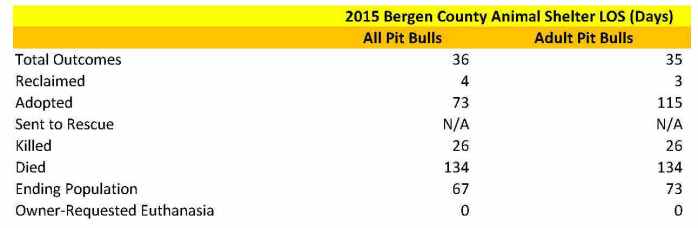
Smaller Shelters Are More Conducive to Getting Animals Adopted

Animal shelter environments are unnatural for dogs and cats. Despite cats being able to live in colonies and with people, these animals are still solitary by nature. In a typical animal shelter, cats must share living quarters with large numbers of other cats as well as potential predators (i.e. dogs). Therefore, animal shelters are usually highly stressful environments for most cats. While dogs are social animals, they evolved to be social with their family or pack (an extended family generally). In fact the dog’s ancestor, the wolf, is fiercely territorial to the point where being killed by other wolves in turf wars is the number one cause of natural mortality. As a result, putting large numbers of strange animals in one building is highly stressful to most dogs and cats.
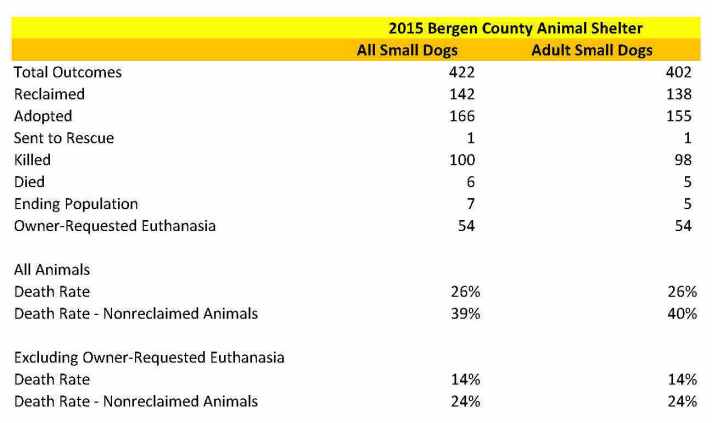
Larger shelters increase the risk of sickness and behavioral deterioration. Simply put, more animals means more dogs and cats can potentially transmit contagious diseases to each other. Similarly, all else being equal, more animals equals more noise, sights, and scents that can stress animals out. Shelters with a greater percentage of animals becoming sick and developing behavioral problems will have prolonged lengths of stay, increased costs and decreased lifesaving. Thus, shelters that can prevent physical and mental illness in the first place have greater lifesaving potential.

Animal shelters housing more animals tend to have longer lengths of stay all else being equal. If two shelters adopt out the same number of animals and one of the facilities has twice as many animals, each animal will stay twice as long at that shelter. Longer lengths of stay tend to radically increase the chance of cats catching upper respiratory infections in shelters. For example, a recent study found that 40% and 60% of highly socialized cats and other cats at a medium sized animal control shelter developed upper respiratory infections after just 30 days. Similarly, disease rates for dogs are likely higher as well during longer lengths of stay. Additionally, animals are more likely to develop behavioral issues the longer they reside at shelters making adopting those pets out harder. Thus, larger shelters tend to have longer lengths of stay and animals face greater challenges staying happy and healthy in such places.

Smaller shelters with fewer animals up for adoption make it easier for people to select a pet. While extremely small shelters may not have enough animals for people to choose from, most facilities seem to have enough animals for people to find a suitable pet (excluding people looking for animals rarely coming into shelters). Virtually all people prefer to have a reasonable number of potential animals to choose from. Unfortunately, adopters often become overwhelmed when they must select among vast numbers of animals. Often dubbed “The Paradox of Choice”, people tend to buy less of things when presented too many options. In an animal shelter environment, which tends to involve far more emotion than buying typical consumer goods, this effect is likely amplified. In fact, the ASPCA found one shelter increased adoptions and doubled the rate of people who left with a pet after limiting the number of animals on the adoption floor. While a larger shelter can of course reduce the number of animals up for adoption, most do not and consumers have a more reasonable number of animals to choose from in smaller shelters.

Financial Issues Place Greater Challenges on Smaller Shelters

Shelters and any other enterprise have both fixed and variable costs. Variable costs vary with the level of operations. In other words, if an animal shelter takes in more animals, it incurs more costs to care for the animals (i.e. additional kennel staff to care for animals, veterinary expenses, etc.). Fixed costs do not vary with the level of operations in the short-term. Examples include rent, administrative salaries, such as those of an Executive Director, and insurance. If a shelter has a high amount of fixed expenses, it basically starts in a hole and needs significant revenue, such as taxpayer funding, donations and adoption fees to cover these costs.
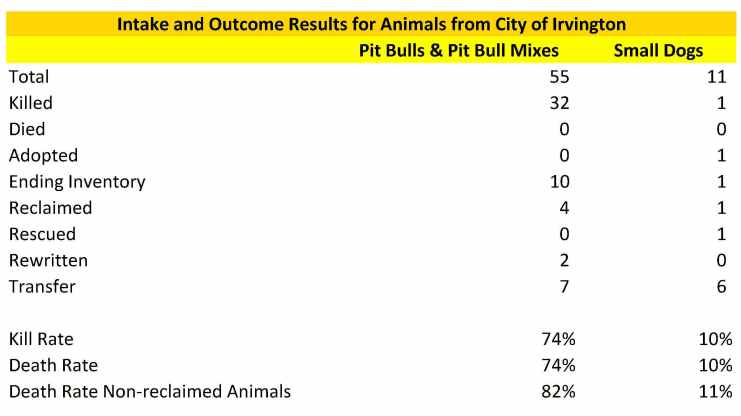
Fixed costs are more significant at smaller shelters. Typically animal control shelters are funded indirectly based on the number of animals they take in. In other words, shelters expecting to take in more animals receive more money from the contracting municipality than if those shelters anticipated impounding fewer animals. At a smaller shelter taking in fewer animals, that means less revenue comes in. On the other hand, that shelter will typically incur many of the same fixed costs as a larger shelter. As a result, smaller shelters have high costs, but lack the revenue to cover those expenses.

The following example illustrates the financial challenges smaller shelters face. Let’s assume a municipality has 20,000 people. Based on the average New Jersey community taking in around 8 dogs and cats per 1,000 people, the shelter would impound 160 dogs and cats each year. In order to ensure a prompt response to animals in distress at any time of day, the municipality would require at least two ACOs. Additionally, the shelter would require a director to manage the facility. Assuming a $50,000 salary for each ACO and an $80,000 salary for the shelter director, the municipality would spend $180,000 on these employee salaries alone. This works out to a cost of $9 per resident for animal control and sheltering just considering these fixed costs. However, most New Jersey communities only pay around $2 or less per resident for animal control and sheltering. Furthermore, the municipality would spend $1,125 per animal and that would exclude any direct animal care costs and other fixed and variable costs. As a comparison, some no kill animal control shelters spend less than $300 per animal counting all costs. Thus, operating a small animal control shelter is very expensive.

Municipalities often operate under a pound model to compensate for these unfavorable economics. Under a pound model, the shelter has no director and ACOs work in the shelter when not on animal control calls. Unfortunately, most ACOs are not qualified to perform all the specialized tasks at an animal shelter, such as providing veterinary care, customer service, marketing, fundraising, community relations, etc. Often these facilities operate for very limited hours and many times are not open during those times when an ACO is out on a call. Also, many times these pounds only hold animals for a short period of time and then either kill the dogs and cats or send the pets to rescues. Furthermore, many of these pounds often rely on various fines and fees to raise money that result in the facility impounding more animals, more animals staying longer at the shelter and more killing. Examples include aggressive enforcement of animal control laws and high owner reclaim fees. Thus, many of the compensating measures to reduce operating costs of small animal control shelters do not benefit the animals.

Preferred Animal Shelter Operating Models

Municipalities can use shared service arrangements for animal control services while operating a local shelter. While towns operating their animal control operation undoubtedly improve response times, such functions are expensive. Recently, Fair Lawn sought proposals to outsource its animal control operation, but maintain its municipal shelter. Fair Lawn budgeted $141,000 for animal control officers salaries in 2014 when the municipality performed animal control and ran the shelter . In 2015, the Bergen County Animal Shelter put out a bid for just $42,000 to provide animal control services and operate the town’s local animal shelter (Fair Lawn ultimately selected Tyco Animal Control). As a result, a municipality can save significant amounts of money by outsourcing animal control, but keeping the local animal shelter.

Multiple small municipal shelters can collaborate and share expenses. In a small animal shelter, an Executive Director, behaviorist, marketing manager, ACO and a veterinarian would not have enough work to keep busy. However, several small municipal shelters can collectively hire these specialized people to provide such services. For example, the veterinarian can spend a couple of days a week at one shelter, a day or two at other facilities, and go to individual shelters additional times when needed (i.e. an emergency). Typically, many small and medium sized shelters contract with a private veterinarian who prioritizes his or her individual clients over shelter animals. Thus, smaller shelters can work together to obtain the benefits of operating both a small and large shelter while keeping costs down to a manageable level.

Several small shelters can also collaborate to operate adoption centers at pet stores. Typically, a small shelter could not provide enough animals and staff and volunteers to operate a dog and cat adoption center in a Petco or PetSmart. However, several small shelters would have enough animals to place in these venues. Additionally, these shelters collectively could hire the staff and/or recruit the volunteers needed to run the operation. In exchange, the shelters could enter into an arrangement with each other to split the costs and revenues from operating the adoption center in an equitable manner. Thus, small shelters can work together to conduct activities only bigger shelters do.

Small municipal animal shelters can use volunteers to significantly reduce costs. Volunteers provide free labor to perform basic tasks like cleaning the shelter and administrative work. Additionally, volunteers conduct activities requiring highly specialized skills, such as behavioral rehabilitation, marketing and fundraising. For example, Michigan’s Chippewa County Animal Shelter saved 98% of its dogs and cats in 2014 despite receiving only $182 of government funding per dog and cat. As a comparison, Associated Humane Societies takes in around $900 of total revenue in per dog and cat. Chippewa County Animal Shelter, which takes in nearly 1,000 dogs and cats in a year and serves a human population of around 39,000 people, only has a shelter manager and three kennel attendants. In fact, the Chippewa County Animal Shelter credits its volunteer and foster programs for saving lives.  Thus, small shelters relying heavily on volunteers can run efficient and effective operations.

Private volunteer organizations dedicated to helping shelters can improve the efficiency and effectiveness of small shelters. Often these organizations have more time to dedicate to developing and enhancing volunteer programs. For example, an ACO at a small shelter may not have the time or the skills to recruit volunteers as well as a separate volunteer group dedicated to that effort. An example in New Jersey is EASEL and the Ewing Township Animal Shelter. Prior to EASEL taking over the Ewing Animal Shelter several months ago, EASEL helped the shelter attain no kill status through its coordinated volunteer efforts. Thus, independent volunteer organizations can make shelter programs more effective.

Privatizing small municipal shelters can significantly improve efficiency. Municipal shelters of any size face more bureaucratic challenges. For example, the municipal council may have to approve any policy changes, such as lowering adoption fees for a promotion, making it difficult to save lives. Additionally, municipal shelter employees typically are in a union and the union can make it next to impossible to terminate poorly performing staff. In perhaps the most egregious case of unions interfering in shelter operations, the Teamsters Local 210 President defended the Helmetta Regional Animal Shelter Director and Assistant Director, who were subsequently charged with animal cruelty, despite ample evidence showing these people committed unspeakable atrocities. Even after the local prosecutor charged the former Helmetta Regional Animal Shelter Director and Assistant Director with animal cruelty, the union continued to fight against Helmetta’s firing of these two people. Thus, private organizations can operate more efficiently than municipal shelters.

Large organizations also can obtain some of the benefits of smaller shelters. Big shelters should operate adoption centers at Petco and PetSmart stores to reduce the number of animals at their main shelters and to increase adoptions. KC Pet Project, which operates Kansas City’s no kill animal control shelter, runs two permanent off-site adoption locations and adopts out 35% of its animals at these locations. Additionally, large shelters can operate smaller facilities and use its leadership to oversee those operations in a manner similar to the collaboration model I describe for smaller shelters above. Thus, large shelters can also obtain some of the benefits smaller shelters enjoy.

At the end of the day, just about any shelter, large or small, can succeed if it enthusiastically implements highly effective programs, such as those making up the no kill equation, to reduce intake and quickly send animals to good homes. However, shelters can operate even more effectively if they utilize some of the business models discussed in this blog. Clearly, homeless animals should expect organizations to operate at the highest possible level given these creatures lives are literally on the line. Thus, municipalities and shelters should act to make their operations more efficient and effective at saving lives.