Animal Control Shelter Adopts Out Every Single One of Its Pit Bulls

Majority Project

Recently, I heard the claim pit bulls are dying in New Jersey animal shelters due to “overpopulation” and the “average family” not wanting them. These reactions followed my previous blog setting adoption and euthanasia goals for New Jersey animal shelters. While I personally like some of the people making these assertions and agree with them on other issues, I believe this is a dangerous myth that has deadly consequences for pit bulls everywhere. Many shelters have already achieved no kill for their pit bulls despite taking in large numbers of these dogs. In this blog, I’ll explore the notion that the average family (presumably white and middle class) doesn’t want pit bulls so we shouldn’t even bother trying to save them.

Colorado Animal Control Shelter Proactively Works to Save Its Pit Bull Type Dogs

Ark Valley Humane Society serves Chaffee County, Colorado. Chaffee County’s population is 91% white and its poverty rate is below the national average.  Families make up a similar percentage of households as your typical New Jersey suburb. Thus, Chaffee County, Colorado is similar to many New Jersey communities.

Ark Valley Humane Society radically increased its pit bull live release rate in one year. In 2012, 40% of the shelter’s pit bulls were killed. Instead of complaining about “pit bull overpopulation” and “the average family not wanting pit bulls”, Ark Valley Humane Society set a strategic goal to turn their pit bull performance around. The shelter’s strategy focused on a longer term objective of reducing pit bull intake via offering free spay/neuter for pit bulls and a shorter term goal to quickly adopt out pit bulls into loving homes. Ark Valley Humane Society engaged the public, instituted multi-dog playgroups, and trained pit bulls to obey basic commands and become good canine citizens. As a result of these efforts, Ark Valley Humane Society adopted out all 27 pit bulls they took in during 2013.

Ark Valley Humane Society’s description of their efforts is as follows:

We are especially proud of our 2013 Pit-Bull Initiative. Pit-bulls and bully breeds have suffered a negative public perception. Faced with increasing numbers of pit-bulls, AVHS decided to take action to improve this breed’s ability to find forever homes. AVHS began offering free spay/neuter for owned pit-bulls and the pit-bull mixes living in Chaffee County. We have increased emphasis on public education, instituted multi-dog play groups for behavior modification, and formed shelter dog training classes for basic commands and good citizenship. Our efforts have resulted in the adoption of all 27 pit-bull intakes for 2013. No pit-bulls were lost due to ill health or unmanageable aggression issues.

While 27 pit bulls does not sound like a lot of dogs, this is large number for this community. Chaffee County is a sparsely populated area and only has 17,809 residents. The surrounding counties also have a low population density making it unlikely many people from elsewhere would visit this shelter to adopt dogs. This equates to a pit bull intake and adoption rate of 1.52 pit bulls per 1,000 people. As a comparison, I estimate New Jersey animal shelters collectively only take in approximately 1.15 pit bulls per 1,000 people and would only need to adopt out 0.70 pit bulls per 1,000 people to achieve no kill for our state’s pit bulls. Additionally, Ark Valley Humane Society took in 35% more pit bulls during the year they saved all of these dogs compared to the prior year when the shelter killed 40% of its pit bulls. Thus, Ark Valley Humane Society adopted out all if its pit bulls despite taking in significantly more pit bulls per capita than New Jersey animal shelters do as a whole.

Ark Valley Humane Society likely quickly adopted out its pit bulls. While the shelter did not disclose the time it took pit bulls to get adopted, we can come up with a reasonable estimate. Pit bulls made up 6% of all dogs taken in and the shelter’s average length of stay for dogs was 11.8 days. Typically, pit bulls stay 2-4 times longer than other dogs at high performing no kill animal control shelters. Using these numbers and some simple algebra, we can estimate pit bulls took 22.3 days, 31.6 days, and 40 days to get adopted assuming the pit bull average length of stay was 2 times, 3 times, and 4 times longer than other dogs. Even if pit bulls stayed at the shelter 5 times longer than other breeds, pit bulls would only take 47.6 days to get adopted. Furthermore, the fact that all pit bulls impounded in 2013 were adopted out during the year also supports the notion pit bulls left the shelter quickly. As a result, claims that pit bulls take “forever’ to get adopted are simply untrue.

Local Shelters Need to Stop Making Excuses and Work on Saving Our State’s Pit Bulls

Many other shelters are saving their pit bulls. For example, Longmont Humane Society, which serves a similar demographic in a more suburban area of Colorado, saves 96% of its pit bulls and takes in roughly 3 times as many pit bulls per capita than the average New Jersey animal shelter. Kansas City, Missouri’s animal control shelter, KC Pet Project, takes in nearly 3 times as many pit bulls per capita than the typical New Jersey animal shelter and has a pit bull save rate close to 90%. Thus, many shelters across the nation are saving their pit bulls.

Several New Jersey shelters are doing a good job adopting out their pit bulls. Perth Amboy Animal Shelter, which serves an area with a high poverty rate, is likely saving over 90% of their pit bulls based on their overall dog live release rate of 97% and pit bulls probably comprising a substantial percentage of the dogs taken in. For example, if this shelter saved 99% of non-pit bulls, pit bulls would only need to make up 22% or more of the dog intake for the pit bull live release rate to equal or exceed 90%. Not surprisingly, I estimate Perth Amboy Animal Shelter adopted out roughly 40% more pit bulls per capita in 2013 based on the assumptions from my prior blog than the average New Jersey animal shelter needs to do to achieve no kill for pit bulls. Similarly, I estimate Trenton Animal Shelter is adopting approximately 30% more pit bulls per capita than the average New Jersey animal shelter should despite severe space constraints (i.e. which limits adoption potential). Thus, there is no reason other New Jersey animal shelters cannot adopt out more pit bulls.

People truly want pit bull type dogs. Based on recent data, pit bulls are among the three most popular breeds in New Jersey. Given people keep obtaining these dogs, which is often not from shelters, demand clearly exists for pit bulls. Additionally, all sorts of families and people adopt pit bull type dogs. Furthermore, even if the myth that suburban families won’t adopt pit bull type dogs were true, shelters can still adopt out these dogs off-site in nearby urban areas. Thus, New Jersey residents want pit bull like dogs and local shelters need to meet that demand.

Adopting out many sterilized pit bulls to the public will decrease pit bull breeding. Many pit bulls are surrendered to shelters due to owners lacking resources to fix solvable problems. If we can help these people, fewer pit bulls will come into shelters, and people will be more likely to get sterilized pit bulls from shelters in the future. Significantly increasing the number of sterilized pit bulls in the state will decrease the number of pit bulls coming into shelters. Thus, we can save the pit bulls currently in shelters and reduce the number of pit bulls arriving at shelters in the future.

Local animal shelters need to abandon the excuses and help save our pit bulls. Animal Farm Foundation has tons of resources for shelters to use and offers internships to shelter personnel to improve their pit bull adoption rates. Shelters can also contact Executive Directors from successful shelters and seek their advice. Additionally, shelters can bring in Amy Sadler to properly implement multi-dog playgroups. Similarly, organizations can engage no kill consultants, such as Humane Network and No Kill Learning, to provide detailed advice as well. Thus, shelters need to take proactive steps to improve their pit bull adoption rates.

It is time we stopped making excuses and do what is possible. Like Ark Valley Humane Society showed, where these is a will there is way. It is time all shelters do the same.

New Jersey Animal Shelter Statistics Are Far Worse Than Previously Thought

Photo of discarded dead animals from a 2009 Office of Animal Welfare inspection report of Associated Humane Societies – Newark. The Executive Director at the time is still in charge of this shelter today.


Most New Jersey animal shelters voluntarily report detailed data to state authorities. Last August, I shared New Jersey’s animal shelters summary statistics on my Facebook page. Each year, the New Jersey Department of Health’s Office of Animal Welfare requests each licensed animal shelter in the state to submit animal shelter data for the previous year. Animal shelters voluntarily submit this data in the “Shelter/Pound Annual Report.” The Office of Animal Welfare takes these Shelter/Pound Annual Reports and compiles the number of dogs, cats and other animals impounded, redeemed, adopted and euthanized to prepare its Animal Intake and Disposition report. However, the Shelter/Pound Annual Reports include additional information on how animals were impounded (i.e. strays, owner surrenders, rescued from in-state facilities, rescued from out of state shelters, and cruelty/bite cases) and disposed of (i.e. returned to owner, adopted, sent to rescue/another shelter, and died/missing). Additionally, the Shelter/Pound Annual Reports include the number of animals in shelters at the beginning and end of the year as well as the maximum number of animals facilities can hold. Thus, the Shelter/Pound Annual Reports include very important data not found in the Office of Animal Welfare’s summary report.

I compiled the data from these reports and analyze the results in this blog. 2013 statistics for each New Jersey animal shelter are listed at this link.

Garbage Data Raises Serious Questions About New Jersey Animal Shelters’ Statistics

Several animal shelters, which reported statistics in prior years, failed to submit data in 2013. Specifically, Summit Animal Clinic in Union City, Associated Humane Societies – Tinton Falls, Mercerville Animal Hospital and Angel Pets Animal Welfare in Woodbridge disclosed this data in 2012, but did not do so in 2013. Additionally, East Orange Animal Shelter has never submitted Shelter/Pound Annual Reports to the state, but did share limited data with The Record newspaper. These shelters failure to disclose data raises serious questions. For example, are they trying to hide embarrassing statistics from the public? I’ve included these shelters’ 2012 data, and in the case of East Orange, its limited 2013 data in my analysis. Also, I performed my analysis without these shelters as well. Unless indicated below, I’ve included these shelters’ data in the analysis under the assumption the statistics would be similar if submitted to the Office of Animal Welfare in 2013.

Most New Jersey animal shelters do not properly account for their animals. Simple math dictates the number of animals at a facility at the beginning of the year, plus all animals coming in during the year, less all animals leaving for the period, should equal the number of animals a shelter has at the end of the year. Stunningly, 69 out of 100 shelters reporting these dog statistics and 71 out of 98 facilities submitting this cat data failed to get this right. This raises serious questions about the accuracy of these shelters’ reported statistics. Even worse, 54 of the 69 shelters with flawed dog statistics and 46 of the 71 facilities with incorrect cat statistics should have had more animals at the end of the year then reported. While these errors could have been due to incorrect counts of the number of animals at facilities, the more likely answer is many outcomes, such as animals killed, dying, or gone missing, were not recorded. Given 71% of the errors were due to shelters having less rather than more animals on hand at the end of the year than they should have had lends credence to the theory that errors were mostly due to shelters failing to account for various outcomes. To put it another way, 3,231 cats and dogs should have had outcomes reported and did not. Thus, there is the potential that as many as 3,231 additional dogs and cats were killed, died or went missing from New Jersey animal shelters than were reported in the last year.

Shelters may have failed to classify animals adopted out and sent to rescue properly. Both Paterson Animal Control and Elizabeth Animal Shelter reported no animals were sent to rescues and all dogs and cats leaving their facilities alive were owner reclaims or adoptions. However, rescues I know who work closely with these two facilities told me both shelters rarely adopt animals directly to the public. This makes sense as neither shelter advertized animals for adoption (i.e. no adoption web site or social medial pages) in 2013. One has to wonder how many other facilities failed to properly classify adoptions and rescues properly. This data is very important as it provides details on the burden rescues and other shelters are taking from these facilities.

We need better oversight of New Jersey animal shelters’ data reporting. Currently, these statistics are voluntarily reported and most shelters are not taking this seriously. For example, I noticed a large number of reports were submitted many months after the end of the year. This data should be easy to compile since facilities can utilize animal shelter software programs, some of which are free, to do this task. Furthermore, New Jersey animal shelter laws mandate facilities maintain much of the raw data found in the Shelter/Pound Annual Report. Unfortunately, Office of Animal Welfare inspections routinely find shelters do not properly keep records on animals. We need to make the Shelter/Pound Annual Report mandatory for animal shelters along with serious penalties for significant errors (especially if deliberate). In order for animal shelters to take data reporting seriously, we may also need to require audits of these reports. Thus, these results show we need stronger laws and the Office of Animal Welfare to play a greater role in ensuring reported animal shelter statistics are in fact accurate.

Despite the errors in these reports, the data provided still reveals important information.

More Animals Losing Their Lives in New Jersey Animal Shelters Than Previously Believed

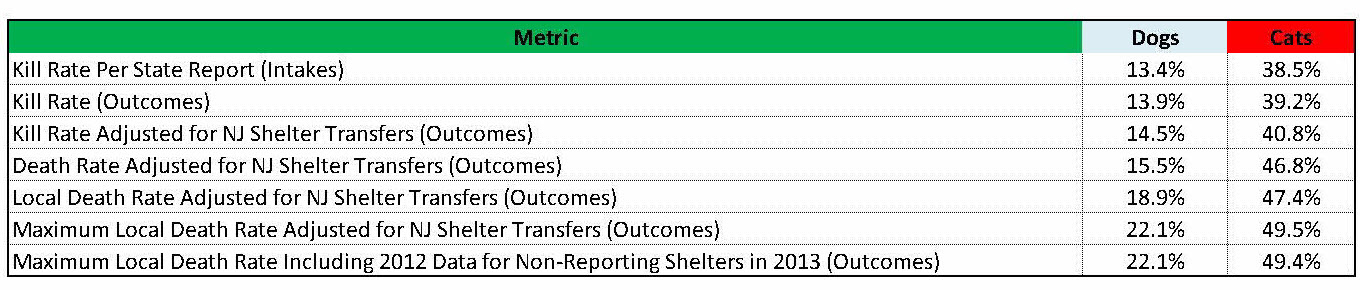
The more detailed data in the Shelter/Pound Annual Reports allows one to more critically examine the percentage of locally impounded animals dying in New Jersey’s animal shelters. The following table summarizes my analysis of the kill/death rate calculated from the Office of Animal Welfare’s summary report and the data reported in the Shelter/Pound Annual Reports.

Totals

The Animal Intake and Disposition report prepared by the Office of Animal Welfare only allows one to calculate the number of animals killed as a percentage of total animals impounded or intake. I prefer calculating the kill rate as a percentage of outcomes rather than intake as this metric directly compares positive and negative outcomes. Using intake depresses the kill rate since shelters can simply hold animals for a long time to the point of overcrowding. Calculating kill rate based on outcomes rather than intake increases the dog kill rate from 13.4% to 13.9% and the cat kill rate from 38.5% to 39.2%.

To calculate the statewide kill rate, we must also back out transfers from one New Jersey animal shelter to another state facility to avoid counting animals still in the state’s shelter system or registering two outcomes for the same animal (i.e. one New Jersey animal shelter transfers a dog or cat to another state facility who then adopts out the animal). This adjustment increases the dog kill rate from 13.9% to 14.5% and the cat kill rate from 39.2% to 40.8%.

In addition, we should increase the kill rate for animals dying or gone missing in shelters. I label this metric the death rate as these animals are likely dead or in a very bad situation. After making this adjustment, the dog death rate increases from 14.5% to 15.5% and the cat death rate rises from 40.8% to 46.8%.

Also, many shelters transport easy to adopt animals from out of state which artificially increases save rates. To properly calculate the percentage of New Jersey animals losing their lives, we need to adjust for transports. Unfortunately, shelters don’t break out their save rates by local and out of state animals. However, most likely nearly all of the out of state animals (primarily puppies and easy to adopt dogs) make it out of shelters alive. Therefore, I back out the number of out of state transports to estimate the local death rate. This adjustment increases the New Jersey dog death rate from 15.5% to 18.9% and the state cat death rate from 46.8% to 47.4%.

Also, I estimate a maximum local death rate by including the number of unaccounted for animals described in the section above. Making this adjustment increases the maximum potential New Jersey dog death rate from 18.9% to 22.1% and the maximum potential state cat death rate from 47.4% to 49.5%.

Finally, the maximum potential New Jersey cat death rate decreases slightly from 49.5% to 49.4% if I include the 2012 data from shelters who failed to report statistics in 2013 to the Office of Animal Welfare. Thus, the percentage of New Jersey animals losing their lives in our state’s animal shelters may be much higher than previously thought.

Death Rates Extremely High at a Number of New Jersey Animal Shelters

Dogs and cats are likely to lose their lives or go missing at a number of New Jersey animal shelters. Shelters with the highest death rates for dogs and cats are listed in the following tables:

NJ Shelter Rates Tables (6)

NJ Shelter Rates Tables (7)

Thus, both dogs and cats have a very good chance of leaving many New Jersey animal shelters dead rather than alive.

Many shelters fail to account for large numbers of their animals. As discussed above, a shelter’s number of animals at the end of the year should be calculated as follows:

Beginning number of animals + animals impounded – animals leaving the shelter

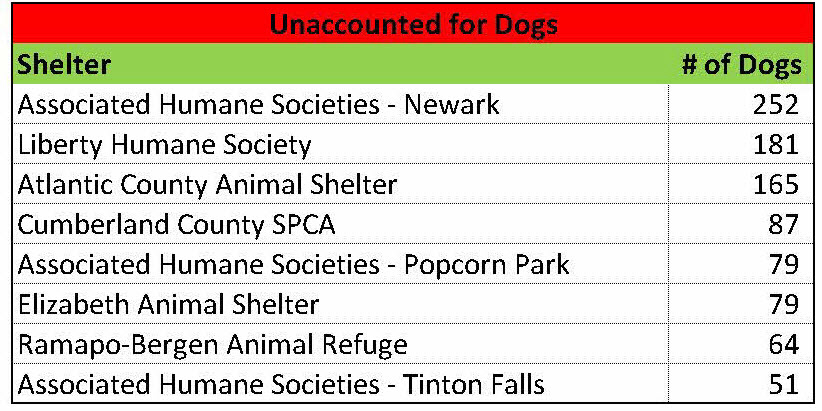
Unfortunately, a large number of shelters take in far more animals than they can explain where they went. Shelters having the highest numbers of unaccounted for dogs and cats are listed in the following tables:

NJ Shelter Rates Tables (8)

Unacct cats

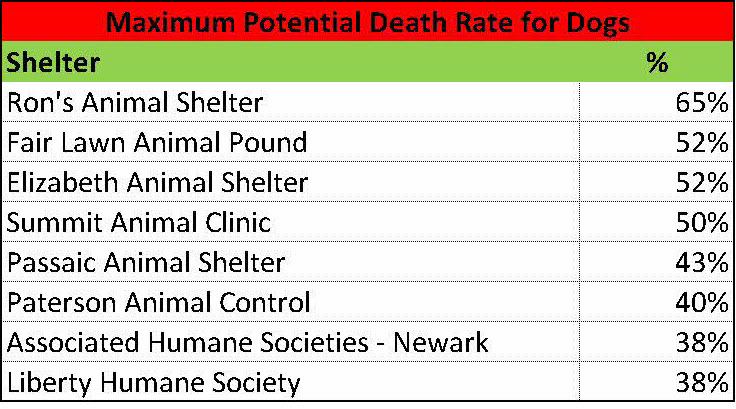
Dog and cat death rates at many shelters may be even higher if these unaccounted for animals are counted as dead or missing. If we only consider animal shelters which don’t or rarely transport, facilities with the highest dog and cat death rates considering the unaccounted for animals described above are as follows:

NJ Shelter Rates Tables (2)

Max pot cats po

Thus, the plight of dogs and cats may be far worse in New Jersey animal shelters when we consider the unaccounted for animals.

Shelters Turn Their Backs on New Jersey’s Animals

New Jersey animal shelters rescue far more animals from out of state than other New Jersey animal shelters. Specifically, 5,676 dogs were transferred from out of state animal shelters compared to only 1,410 dogs taken in from other New Jersey animal shelters. While perhaps some shelters, such as Animal Alliance in Lambertville, take animals from nearby New York or Pennsylvania animal control shelters, the overwhelming majority of these dogs most certainly came from down south. In fact, New Jersey animal shelters transported more dogs from out of state than dogs who were killed in, died in or went missing from New Jersey animal shelters. This number does not include additional dogs transported in from out of state by rescues operating without a physical facility. Shelters transporting the most dogs from out of state were as follows:

NJ Shelter Rates Tables (5)

New Jersey animal shelters transported 642 cats from out of state while nearly 50% of cats in the state’s animal shelters were killed, died or went missing. Animal Welfare Association (280 cats received from out of state) and Mount Pleasant Animal Shelter (211 cats received from out of state) rescued more cats from out of state facilities than New Jersey animal shelters. In the case of Mount Pleasant Animal Shelter, the organization’s Executive Director told me these cats were rescued from New York Animal Care and Control. One can only hope the out of state cats rescued by other New Jersey animal shelters came from nearby New York and Pennsylvania facilities rather than from shelters far away down south.

Return to Owner Rates Better Than Average at Most Shelters

Return to owners (“RTO”) rates are one of the positive results from this analysis. Overall, the dog and cat RTO rates of 52% and 4% are approximately twice the national average. As I noted in my blog on reuniting lost pets with owners, return to owner rates are highly correlated with socioeconomic status. Wealthier people likely have more resources/knowledge to license and microchip their dogs. Similarly, people with greater incomes are more likely to afford reclaim fees or ransom payments to animal shelters. New Jersey’s RTO rates for dogs clearly fit this pattern with shelters serving wealthy towns returning most stray dogs to owners while urban shelters are only returning about one fifth of lost dogs to owners. Clearly, we need to help people in urban areas get microchips and ID tags on their dogs. Additionally, we need to create pet help desks at shelters in these cities to help people pay the reclaim fees, which are often mandated by the cities themselves, when necessary. The statewide cat reclaim rate, like figures from across the nation, is still very low and suggests shelters need to figure out better ways to get lost cats back to their families. New Jersey should allow shelters to transfer stray cats to rescues during the mandatory 7 day hold period since few are returned to owners at shelters. This would open up space to save more cats and reduce the chance of disease (i.e. cats spending less time in shelters are not as likely to get sick).

Shelters Leave Animal Enclosures Empty While Dogs and Cats Die

New Jersey animal shelters fail to use their space to save animals. Based on the average number of animals at all of New Jersey’s animal shelters at the beginning and the end of 2013, only 61% of dog and 66% of cat capacity was used. Given December is a low intake month, I also increased these populations to an average intake month. This adjustment only raised the dog and cat capacity utilization to 62% and 87%. These estimates likely overestimate the average capacity utilized as many facilities kill animals once they reach a certain population level. Many animal shelters with low kill rates failed to rescue animals with their excess space. Additionally, other shelters used little of their available space and still killed a large percentage of their animals. Some examples after increasing the population (and therefore capacity utilization) based on the adjustment discussed above are as follows:

NJ Shelter Rates Tables (11)

NJ Shelter Rates Tables (13)

Thus, many New Jersey animal shelters are killing dogs and cats despite having ample space to house these animals.

New Jersey’s animal shelters continue to fail the state’s animals. The state’s animal control facilities only impound 8.7 animals per 1,000 New Jersey residents. As a comparison, the average community in the country impounds anywhere from 14-30 animals per 1,000 residents based on estimates from Animal People Newspaper and the Humane Society of the United States. Despite New Jersey shelters impounding a fraction of the animals other no kill communities take in on a per capita basis, the state’s animal control facilities continue to kill and allow animals to die under their care. Even worse, many of these shelters can’t even properly keep track of how many animals leave their facilities dead or alive. Our state’s animals deserve far better treatment than this. Contact your local city council members and mayor and demand better from the animal shelter serving your community. We can do this so let’s get to work!

Role Model Shelter Saves Its Pit Bulls

DSC_0109

Earlier this year, I wrote a blog on how many progressive open admission animal shelters are saving all of their pit bull type dogs. One of these progressive facilities was Colorado’s Longmont Humane Society. Longmont Humane Society’s Executive Director, Elizabeth Smokowski, was kind enough to share some data with me showing how impressive this facility is.

Longmont Humane Society places all of its savable pit bulls in a very short period of time. Based on raw data provided to me, Longmont Humane Society saved 96% of its pit bull type dogs impounded in 2014 (through November 21). Additionally, pit bulls on average only stay at the shelter for 33 days. As a comparison, Longmont Humane Society saves 98% of its non-pit bull type dogs and non-pit bull type dogs stay on average around 9.5 days at the shelter. Both pit bull type dogs and other kinds of dogs are saved at rates far exceeding the typical 90% threshold required for no kill status. Thus, Longmont Humane Society does an amazing job for all of its dogs.

Longmont Humane Society impounds far more pit bull type dogs than New Jersey animal shelters. Through November 21, Longmont Humane Society impounded around 430 pit bull type dogs this year (483 annualized). This equates to 3.59 pit bull type dogs per 1,000 people in Longmont Humane Society’s service area. As a comparison, Associated Humane Societies – Newark, which many people believe impounds extraordinary numbers of pit bulls, only takes in 2.06 pit bull type dogs per 1,000 people in its service area assuming 50% of impounded dogs are pit bull type dogs. Thus, Longmont Humane Society impounds far more pit bull type dogs than New Jersey’s urban shelters “filled with pit bulls.”

Longmont Humane Society Performance with Pit Bull Type Dogs Dispels Many Excuses Shelters Use for Killing or Refusing to Rescue Pit Bull Type Dogs

Pit bull type dogs are adopted quickly at Longmont Humane Society. Assuming a similar percentage of pit bull type dogs and all dogs are returned to owners (i.e. 35.6% of all dogs with outcomes) and those dogs are returned to owners in 5 days on average (i.e. Longmont’s hold period policy), we can estimate pit bull type dogs take 48.5 days to get adopted. However, pit bull type dogs likely take less time to get adopted than 48.5 days due to fewer pit bull type dogs probably getting returned to owners. Restrictive landlord policies often force owners to surrender their pit bull type dogs to shelters and such dogs typically aren’t returned to owners. Furthermore, breed-specific legislation in nearby communities may also result in more owners surrendering their pit bulls. With such a high save rate, many dogs likely require physical and/or behavioral rehabilitation and Longmont Humane Society still successfully adopts its pit bull type dogs out quickly. Thus, Longmont Humane Society has a high pit bull live release rate and quickly adopts out its pit bull type dogs.

Longmont Humane Society has a high pit bull live release rate and quickly adopts its dogs out despite the shelter having lots of pit bulls. Many shelters argue they have to kill or can’t rescue pit bulls due to having too many pit bulls. Longmont Humane Society’s pit bulls and other breeds short lengths of stay prove this is a meritless claim. For example, we can estimate the percentage of pit bull type dogs in Longmont Humane Society’s shelter and foster care dog population by using pit bull and non-pit bull lengths of stay and standard shelter population equations. Based on this data, 45% of Longmont Humane Society’s dog population at the shelter and in foster care should be pit bull type dogs. Furthermore, the large number of pit bulls do not negatively impact adoptions of other breeds given the non-pit bulls length of stay only averages 9.5 days. Unlike many shelters who complain about too many pit bull type dogs coming in and being forced to kill or warehouse scores of them, Longmont Humane Society rolls up its sleeves and saves these dogs.

Winning Strategies Save at Risk Dogs

Longmont Humane Society actively tries to return lost dogs to their owners. Returning lost dogs to owners is often the quickest way to get stray dogs safely out of the shelter. While Longmont Humane Society does not disclose its return to owner rate (i.e. dogs returned to owners/stay dogs taken in), it likely has a high return to owner rate given 35.6% of all dogs received (i.e. strays and owner surrenders) are returned to owners. The shelter’s web site lists lost pets both at the shelter and found by private individuals in the community. The animals can be sorted by type of animal and/or sex to allow someone to quickly find their lost family member. Additionally, people can report lost pets electronically on the shelter’s web site which can help the shelter quickly match lost dogs with their families. Thus, Longmont Humane Society takes active measures to help families find their lost pets.

Longmont Humane Society makes huge efforts at rehabilitating dogs at the shelter and in the community. Amy Sadler instituted her Playing for Life program at Longmont Humane Society several years ago. This program uses playgroups to give shelter dogs much needed exercise, which reduces stress, and increases adoptability. Furthermore, the shelter has a world class behavioral rehabilitation program helping dogs overcome treatable issues and trains other shelters in these methods. All dogs adopted from Longmont Humane Society come with lifetime behavioral support from the people running this program. Even more impressive, Longmont Humane Society provides reasonably priced classes to the public to help their dogs become model canine citizens. For example, Longmont Humane Society only charges $10 for one hour supervised playgroups designed to socialize dogs. Additionally, the shelter also offers a free new adopter workshop for Longmont Humane Society adopters (adopters from other shelters only pay $10). Thus, Longmont Humane Society makes great efforts to help dogs become emotionally healthy and build strong community support.

The shelter put into place many other innovative programs to adopt animals into loving homes. Longmont Humane Society uses foster families to help animals become more healthy, both physically and mentally, and therefore adoptable. In 2013, 656 animals or around 19% of all animals taken in spent time in foster homes. Longmont Humane Society rightly adheres to breed-neutral policies at the shelter focusing on individual behavior rather than breed labels. Also, Longmont Humane Society walks dogs outside the shelter with “Adopt Me” vests and gives interested people information about adopting. The adoption section of Longmont Humane Society’s web site is very user-friendly and allows people to quickly sort dogs who are good with other dogs or cats. Finally, the shelter has 850 active volunteers who logged over 59,000 hours helping the shelter last year. Thus, Longmont Humane Society uses a variety of innovative programs to save lives of all types of dogs.

Longmont Humane Society is a goal oriented organization. The shelter has a strategic plan for 2012-2018 listed on their website laying out measurable goals with specific deadlines. For example, Longmont Humane Society is seeking to reduce its average length of stay for dogs from 18 days to 9 days and for cats from 28 days to 14 days while maintaining no kill level save rates by 2018. Frankly, most shelters would be ecstatic with the old lengths of stay and would sit on their laurels. However, Longmont Humane Society continues to improve and has made substantial progress towards achieving its goal by reducing its average length of stay for dogs from 18 days to 14 days and for cats from 28 days to 21 days in two years. Another goal, using a mobile outreach program to help adopt animals out to underserved communities by 2018, will likely significantly reduce average length of stay for pit bull type dogs even further. Longmont Humane Society also has a goal to maintain a 95% adopter satisfaction rating on surveys and another goal to measure customer satisfaction for other programs, such as training, by 2017. Finally, the shelter lays out specific goals for attracting the best employees and financial performance. This focus on excellence allowed the shelter to turn its financial performance around while it was in danger of bankruptcy and continue improving its service to the community. Thus, Longmont Humane Society’s success with pit bull type dogs is a function of a goal oriented organization focused on continuously improving.

Longmont Humane Society proves that focusing on excellence yields impressive achievements. For far too long, most shelters have not set standards or goals and unsurprisingly fail to save their animals. Longmont Humane Society saves its pit bull type dogs and places them quickly despite taking large numbers of these dogs in and facing a severe financial crisis. Shelters need to drop the excuses for killing pit bull type dogs and do the hard work necessary to save them. Ghandi once said “The true measure of any society can be found in how it treats its most vulnerable members.” Pit bulls are the most vulnerable dogs in shelters and we should judge shelters on how they treat these animals. We know these dogs can be saved. Will those with the power to save pit bull type dogs do so or will the killing and excuses continue to win out at most shelters?

Bear Hunt Supporters Exploit a Tragedy to Push for More Killing

Last September, a black bear killed a young man named Darsh Patel in West Milford’s Apshawa Preserve. This incident, which occurred a few miles from where I live in a park I enjoy hiking in, really hit home for me. My deepest condolences go out to the victim’s family and friends.

Bear hunt supporters immediately pointed to the incident as a reason to kill more bears. Predictably, anti-animal Star Ledger opinion writer, Paul Mulshine, who recently defended Hunterdon Humane Animal Shelter’s President charged with animal cruelty, demanded that New Jersey expand its bear hunt. Even worse, the Star Ledger Editorial Board agreed with Mulshine and supports reducing restrictions on the bear hunt based on supposed public safety reasons. Sadly, the West Milford Town Council voted by a 4-2 margin to ask the New Jersey Division of Fish and Wildlife to expand the bear hunt for public safety reasons. Are black bears a serious danger to humans? Does bear hunting increase public safety? Do non-lethal solutions provide a better alternative to increase public safety?

Fatal Bear Attacks Are Exceedingly Rare

Black bears rarely kill people especially in places like New Jersey. From 1900 to 2009, 63 people in North America were killed by black bears in 59 attacks. However, nearly 80% of these incidents took place in remote areas of Alaska and Canada, which are vastly different environments than New Jersey (i.e. bears infrequently encounter people and may be more likely to perceive humans as prey). Only 3 of these fatal attacks occurred in the eastern United States and none took place in New Jersey. While 63 fatalities initially sounds like a large number, it is quite small when you consider approximately 950,000 black bears and over 350 million people live in North America. According to black bear biologist Lynn Rogers, only one in a million black bears would try and kill someone. Assuming New Jersey has 2,800 bears based on recent population estimates and the average black bear lives 15 years, a black bear would kill a person in New Jersey once every 5,357 years. As a comparison, groups advocating hunting admit that around 100 people each year are killed in hunting accidents in the United States. Typically, black bears, which are much more timid than brown bears in western North America, flee or simply ignore people. Thus, the risk of a black bear killing a person in New Jersey is extremely low.

Tragic Bear Incident in West Milford Was Avoidable

Reports from witnesses detail the chain of events leading to the death of Darsh Patel. The black bear initially encountered and stalked, but did not attack, a male and female hiker. The two hikers warned five young men, which included the bear attack victim, not to proceed on the trail due to an aggressive bear. Instead of taking the advice, the five young men approached the bear and took photos with their cell phones from approximately 30 yards away. The bear subsequently slowly followed the young men and the group fled in separate directions. The victim lost his shoe, appeared exhausted and the bear was five feet from Mr. Patel when witnesses last saw him.

Human error caused this bear to transform from an aggressive to a deadly bear. Speaking as someone who has hiked in Apshawa Preserve, the park typically has plenty of hikers. This bear must have encountered many people before, such as the man and woman just prior to the deadly incident, and never initiated such an attack. Additionally, Dr. Steven Herrero’s research on fatal black bear attacks showed 91% of such incidents occurred when people hiked in groups of only 1-2 members. As such, the group of five young men, which should have been an unlikely target, clearly acted in a manner that provoked an attack. For example, approaching a black bear they knew was acting aggressively put themselves in danger. Also, the act of running from the bear likely triggered its prey drive much like a dog. In fact, the New Jersey Division of Fish and Wildlife specifically warns not to take these two actions (i.e. approaching and running away from a bear). Finally, Mr. Patel’s loss of his shoe and exhaustion likely made him appear highly vulnerable to the bear. As a result, the group’s actions likely turned a potentially dangerous bear into a deadly bear.

Venturing into wild places means one has to assume risk. Police and emergency medical services personnel have a difficult time reaching someone in these locations. Ironically, just two days after the West Milford bear attack, a woman fell off a cliff and suffered serious injuries while hiking in nearby Sparkill, New York. In a one month span, two people died from falls off the same Catskills hiking trail in Hunter, New York. Yet, none of these hiking fatalities received anywhere near the press coverage as the “bear kills man” story.

That being said, we need to take every dangerous and potentially dangerous incident seriously. While only one in a million bears would ever attack someone in this manner, a bear presenting a serious safety risk to people should be placed in a sanctuary or humanely killed if such sanctuary is not available.

New Jersey should revise its law limiting pepper spray to “one pocket-sized device” and build more signs on how to act around bears at trail heads. Bear spray, which is essentially a large canister of pepper spray, is highly effective and even more so than a gun. While I think bear spray is not needed for black bears in New Jersey, it may provide people the peace of mind they need. Additionally, building more signs at trailheads about how to act around a bear may have prevented the behavior that led to the fatal West Milford attack.

Public safety concerns surrounding black bears should focus on more common rather than fluke events. Frankly, fatal black bear attacks are too rare to drive black bear management decisions. However, other incidents, such as bears breaking into homes, occur more frequently and black bear management policies should focus on reducing these conflicts.

New Jersey Division of Fish and Wildlife Cannot Be Trusted to Implement Proper Bear Management Policies

The New Jersey Division of Fish and Wildlife supports hunters and not the general public’s interests. Like most state fish and wildlife agencies, the New Jersey Division of Fish and Wildlife is mostly supported by hunting tag fees. While such fees could go to general government uses, these fees are instead specifically used to support wildlife management programs. Even worse than the financial incentive for the New Jersey Division of Fish and Wildlife to act in hunters interests, is the actual composition of the Fish and Game Council governing the agency. Specifically, the Fish and Game Council through an archaic 1945 law must have the following members:

1) 3 farmers recommended to the Governor for appointment by the agriculture convention

2) 6 “sportsmen”(i.e. hunters and fishers) recommended to the Governor for appointment by the New Jersey State Federation of Sportsmen’s Clubs

3) 2 commercial fisherman

One look at the Fish and Game’s composition shows 100% of its members come from group’s exploiting animals. Notably absent are any members focused on maintaining healthy ecosystems or animal welfare. In fact, the New Jersey State Federation of Sportsmen’s clubs, which appoints a majority of the Fish and Game Council, specifically states they support sport hunting and trapping. Even worse, New Jersey hunters only comprise approximately 1% of the state’s population, but hunters represent as many as 55% of the Fish and Game Council members. Thus, the Fish and Game Council is not an unbiased body making wildlife management decisions.

Highly Questionable Claims of Bear Hunt Increasing Public Safety

The New Jersey Division of Fish and Wildlife has long argued bear hunting was needed for public safety reasons. In 1997, the New Jersey Division of Fish and Wildlife called for a hunting season to “control” black bear numbers for “public safety” purposes despite New Jersey having less than 20% of the number of bears we have today. Even worse, the agency wanted to reduce the number of bears to around 300 in the entire state or around 10% of the number of bears we currently have. This policy would effectively eliminate the black bear’s critical ecological functions, which includes preying on overly abundant deer, and wildlife watchers, which far outnumber hunters, ability to view these magnificent creatures. Thus, the New Jersey Division of Fish and Wildlife has long proposed draconian bear management policies.

The New Jersey Division of Fish and Wildlife’s data supporting bear public safety concerns has significant flaws. NJ Advance Media, which provides analyses to the Star Ledger, used the agency’s data to argue the bear hunt is working despite reported serious bear complaints increasing the last two years when bear numbers decreased due to hunting.

The New Jersey Division of Fish and Wildlife places bear complaints into the following groups:

1) Category 1: Bears posing a serious threat to people or property. Bears are killed as soon as possible.

2) Category 2: Nuisance bears which are not a threat to public safety or property. Use aversive conditioning methods, such as rubber bullets, to encourage bears to leave area.

3) Category 3: Bears exhibiting normal behaviors and not causing a nuisance or a threat to public safety. Generally provide advice to residents, but no action taken against bears.

Category 1 bear complaints are the only serious incidents potentially affecting public safety. However, most Category 1 complaints, which are used by the agency to argue for bear hunts, do not in fact represent public safety concerns. Specifically, agricultural damage claims exceeding $500 (i.e. bears eating crops, livestock kills, etc.), which farmers can take actions to stop, result in bears being classified as Category 1 and sentenced to death. For example, only 33 or 31% of Category 1 incidents in 2013 actually related to public safety. Similarly, only 52 or 31% of incidents from through October 20, 2014 actually posed a risk to human safety. Thus, the New Jersey Division of Fish and Wildlife inflates the “public safety” Category 1 incidents and uses those incidents to kill bears posing no risk to people.

The methods the New Jersey Division of Fish and Wildlife uses to compile bear incidents are also flawed. Specifically, bear experts from the Fourth International Human-Bear Conflicts Workshop agreed using phone calls to measure bear incidents, which the New Jersey Division of Fish and Wildlife does, is a terrible choice. For example, one reason New Jersey bear complaints may have increased over the last decade is due to greater use of cell phones rather than a real increase in bear incidents. Also, surges in public reporting of bear complaints may be due to more awareness of the issue rather than an increase in actual incidents. State wildlife agencies may in fact drum up fear and cause increased reporting of conflicts. Additionally, Dr. Edward A. Tavss, a Chemistry professor from Rutgers University, analyzed the the New Jersey Division of Fish and Wildlife’s surge in incidents from 1999-2009 and found serious complaints actually decreased when data collection methods were standardized. Specifically, the agency used additional data sources, which included counting the same incidents twice, to collect data during the years bear complaints surged. Even worse, the New Jersey Division of Fish and Wildlife added a data collection source in 2003 which increased reported complaints and led to a bear hunt. As a result, the New Jersey Division of Fish and Wildlife’s data lacks credibility.

The New Jersey Division of Fish and Wildlife and NJ Advance Media’s claims that the bear hunt increased public safety are inconsistent with a number of studies. Pennsylvania, which has 18,000 black bears and 116,000 bear hunters, found bear hunts killing as much as 50% of the bear population did not reduce serious bear incidents and if anything may have increased conflicts. Similarly, Wisconsin also reported increased killing of bears during hunts had either no effect on or actually increased the number of serious bear incidents. Back in 2005, Dr. Edward Tavss reviewed a number of studies from different states, such as Virginia, New York, Minnesota and Ontario, Canada, and found bear hunting either increased or had no impact on the number of bear complaints. Most interestingly, Dr. Tavss noted Northeastern Pennsylvania, which is next door to and connected to New Jersey’s core bear population, reported more bear complaints despite more bears killed during hunts. Thus, the notion New Jersey’s bear hunt somehow has a completely different result is highly unlikely in my humble opinion.

The bear hunt may not increase public safety for a number of reasons. Logically, on the surface one would think fewer bears results in less human-bear interactions and lower numbers of complaints. Mark Ternent of the Pennsylvania Game Commission “found nuisance bears got killed equally as often as non-conflict bears” despite measures taken to encourage hunting near residential areas. Killing a resident bear who is not causing conflict opens up the territory for another bear who may cause problems. Additionally, hunting predators creates social chaos and typically results in younger populations. Like teenage humans, such bears are more likely to get into trouble. For example, an adolescent bear, who normally may not survive due to dominant bears occupying territories, may choose to raid garbage cans or invade homes due to the bear lacking skills to forage naturally. Thus, hunting bears may in fact increase rather than reduce conflicts with people.

Black bear hunting does not make bears fear people. The Star Ledger Editorial Board argued the bear hunt is necessary to make bears fear people. However, Dr. Stephen Stringham, who studied both brown and black bears in Alaska, Montana, California, New York and Vermont, refutes that point of view. Specifically, Dr. Stringham states bears shot by hunters usually die and therefore can’t learn to fear people. Furthermore, bears learn fear more from being stalked, which can be done by non-hunters, such as photographers. The New Jersey hunt will induce even less fear due to hunters being allowed to shoot bears eating bait, such as jelly doughnuts. Most bears shot will be killed and will require little to no stalking. Furthermore, the West Milford fatal bear attack occurred after several hunting seasons. While the attack occurred in a very small area where hunting is prohibited, the male black bear who killed Darsh Patel certainly would have had a home range encompassing adjacent areas where bear hunting is allowed. As a result, the bear hunt will not make bears fear people to any significant degree and increase public safety.

Black bear hunting reduces public safety by increasing the risk people are accidentally shot. Public safety is quite an ironic argument bear hunt supporters use. Each year around 100 people are killed by hunters in the United States while only 63 people were killed by black bears in both the United States and Canada over a 110 year period. During hunting season in New Jersey, hikers flock to the few protected areas where hunting is prohibited or significantly limited. These very same areas, such a Pyramid Mountain Natural Historic Area, have large bear populations. If hikers were more concerned with black bears than hunters, the hikers would go to the areas filled with hunters. People rightly are more concerned with the much higher risk of being shot by a hunter. Thus, the bear hunt likely reduces public safety by increasing the risk people are accidentally shot by hunters.

Effective Garbage Control is the Only the Solution to Human-Bear Conflicts

Scientific studies consistently show effective garbage control is key to reducing black bear conflicts with people. Dr. Edward A. Tavss conducted a review, which was mostly based off peer-reviewed scientific studies, in 2005 showing effective garbage control policies significantly reduced bear conflicts with humans. Specifically, garbage control decreased conflicts in Yellowstone National Park, Yosemite National Park, Great Smoky National Park, Juneau, Alaska, Elliot Lake, Ontario, Nevada’s Lake Tahoe Basin and New Jersey from 1999-2005 when non-lethal efforts were focused on. Also, additional communities implemented these programs since then. Logically, this makes sense as easily accessible garbage provides bears, which require large amounts of food to survive winter hibernation, far more calories with much less effort than naturally foraging. The garbage therefore encourages bears to leave the woods and hang out in developed areas. Unfortunately, bears, like many food-habituated animals, may lose their fear of people and become a risk to public safety. Additionally, the extra calories bears obtain from unsecured garbage allow sows to have larger litters and greater numbers of those cubs to survive. As a result, unsecured garbage in bear country increases the number of bears and encourages bears to hang out in developed areas.

New Jersey does not effectively prevent bears from accessing garbage and other human sources of food. While New Jersey has a law that prohibits intentional feeding of bears, the law is not enforced. Many times I’ve driven through neighborhoods bordering protected areas with dense bear populations and seen flimsy garbage containers or loose bags of trash. Similarly, Susan Russell of the League of Humane Voters of New Jersey shared photos of readily accessible garbage in West Milford’s bear country. Despite the New Jersey Department of Environmental Protection’s nonsensical claim that there is 99% compliance with New Jersey’s guidelines for restaurants to secure garbage, News 4 New York found dozens of unsecured garbage containers in Allamuchy, Liberty and Independence townships on the first day of the 2010 bear hunt. Furthermore, New Jersey deer hunters leave over 1 million pounds of food as bait for deer each year in the state’s forests. Additional amounts are also left by bear hunters as well. Thus, New Jersey has much to do to reduce the availability of human foods to bears.

Preventing bears from accessing garbage also makes efforts to keep bears away from humans easier. Aversive conditioning, which consists of such things as shooting bears with rubber bullets, using specially trained dogs to harass bears, and loud noises, attempts to encourage nuisance bears to leave residential areas. Research indicates aversive conditioning efforts are far more effective if bears are not food conditioned. As a result, preventing bears access to food helps efforts to encourage bears to leave residential areas.

Effective Garbage Control is Cheap

A recent peer reviewed study showed bear proof garbage cans significantly reduced black bear conflicts with people. The study, which was published in the Southeastern Naturalist, took place in Florida and compared bear incidents and interactions in two areas before and after bear proof garbage containers were provided to residents. Researchers gave residents a common bear proof garbage container, which costs about $150 more than a regular trash can, in one area and provided a regular garbage can with a $20 bear proof modification to people in another location. The study’s key findings on the more expensive bear proof garbage container were as follows:

1) The percentage of respondents reporting bears in their garbage decreased from around 75% before bear proof garbage cans were used to around 10% a year after bear proof garbage cans were used

2) The percentage of respondents reporting a bear in their yard decreased from 85% before bear proof garbage cans were used to 32% a year after bear proof garbage cans were used

3) The percentage of respondents reporting seeing a bear at least every few days decreased from 28% before bear proof garbage cans were used to 3% a year after bear proof garbage cans were used

4) The percentage of respondents reporting not seeing a bear increased from 5% before bear proof garbage cans were used to 39% a year after bear proof garbage cans were used

5) 90% of respondents felt the bear proof cans were effective and 97% would recommend them to someone else

The study also found the $20 modified bear proof garbage containers also reduced bear conflicts as follows:

1)  The percentage of respondents reporting bears in their garbage decreased from around 60% before the bear proof garbage cans were used to less than 5% a year after bear proof garbage cans were used

2) The percentage of respondents reporting a bear in their yard decreased from 41% before bear proof garbage cans were used to 16% a year after bear proof garbage cans were used

3) The percentage of respondents reporting seeing a bear at least every few days decreased from 47% before bear proof garbage cans were used to zero a year after bear proof garbage cans were used

4) The percentage of respondents reporting not seeing a bear increased from 38% before bear proof garbage cans were used to 68% a year after bear proof garbage cans were used

5) 72% of respondents felt the bear proof cans were effective and 91% would recommend them to someone else

Furthermore, the Florida Fish and Wildlife Conservation Commission reported a 69% decrease in bear incidents reported in the two areas after the bear proof garbage cans were used. Additionally, other sources of human food provided to bears, such as pet food and bird/wildlife feeding, were not eliminated and doing so could have further decreased the number of bear-human interactions. As a result, bear proof garbage containers as cheap as $20 can significantly reduce bear conflicts to manageable levels.

Black Bear Hunting Makes So Sense from Ecological or Animal Welfare Perspectives

Hunting predators makes no ecological sense. In the natural world, adult large carnivores, such as black bears are not preyed on by other animals except for fluke incidents. However, most states, such as New Jersey, institute hunting seasons on these animals resulting in unnaturally low carnivore numbers. Biologist, hunter and former hunting guide, George Wuerthener, persuasively argues that state wildlife agencies, such as the New Jersey Division of Fish and Wildlife, consistently ignore the ecological role predators play and the social composition of carnivores. Black bears are key seed dispersers. For example, bears consume berries and spread the seeds elsewhere when they defecate. Additionally, bears break up logs while searching for insects and help the process of decay. Also, black bears may help limit overly abundant whitetail deer populations through their predation on fawns. Furthermore, hunting tends to skew the population to less experienced animals, who may have less foraging knowledge, and therefore may less effectively fulfill their ecological role as mature animals. Thus, the bear hunt artificially depresses the bear population and results in less healthy forests.

The bear hunt also makes no sense from a moral point of view. While an argument could be made human hunters make up for extinct native carnivores which preyed on New Jersey whitetail deer, such as red wolves and cougars, the same argument cannot be made for New Jersey black bears who have no natural predators. Recent research on populations of heavily hunted gray wolves, who also have no natural predators, show these wolves have elevated levels of stress hormones that potentially have significant negative evolutionary and human conflict effects. Furthermore, black bear hunting at current levels likely will result in few black bears living anywhere close to their natural lifespan without hunting. Additionally, New Jersey’s black bear hunt under the guise of “population control” allows slob hunting practices, which violate ethical hunting concepts such as fair chase. For example, bears can be shot over bait, such as jelly doughnuts, and the New Jersey Division of Wildlife actually encourages hunters to shoot mothers with cubs and cubs as well. This line of thinking is supported by a recent study by two biology professors, including the world famous Isle Royale Wolf Project researcher John Vucetich, who persuasively argue that predator hunting is not justified from a biological, moral or ethical point of view. Thus, the New Jersey bear hunt should not take place based on a moral argument as well.

The tragic incident in West Milford should not be the basis to implement a terrible bear policy with even worse consequences. We should not respond in anger with a pitchfork mentality that will reduce rather than increase public safety. Instead, we should use the increased attention to get serious on reducing conflicts we have control over. At the very least, the New Jersey Division of Fish and Wildlife can start providing people in high density bear areas the $20 modification to make garbage cans bear proof. In the end, we have to act rational and not in a knee jerk manner. New Jersey residents by and large are compassionate and smart. Let’s act in a way that fits with who we are as a people. I’m confident if we do that we will implement the proper bear policy.
Helmetta’s Hellhole of a Shelter

Recently, Helmetta Regional Animal shelter has come under fire. A newly created Facebook page, Reform the Helmetta Regional Animal Shelter, and web page details very concerning issues on a daily basis. The documentation includes terrible inspection reports, shocking photos, and detailed accounts from adopters, volunteers and former employees. Most impressively, the Facebook and web pages clearly articulate these points and come across as highly credible.

Helmetta’s Questionable Shelter Project

The shelter opened up in 2011 with a lot of publicity. Helmetta issued $1.9 million in bonds to fund the construction. Mayor Nancy Martin at the time stated “The borough took an area which was in need of redevelopment and built a beautiful state of the art facility that serves 21 Middlesex and Monmouth County municipalities.” Helmetta uses the facility to shelter its homeless animals and numerous other municipalities in exchange for animal control contract fees.

Mayor Nancy Martin hired friends and family to run the shelter. Nancy Martin, who also serves as tax collector of Perth Amboy, hired Perth Amboy Animal Shelter’s former shelter’s managers, Michal Cielesz, and her husband, Richard Ceilesz, to run the new shelter. The couple killed 37% of Perth Amboy Animal Shelter’s dogs and cats per the shelter’s report to New Jersey’s Office of Animal Welfare during their last year in 2010 compared to the new management’s 4% euthanasia rate in 2013. However, Perth Amboy’s police department records show the Cielesz’s killed 43% of the dogs and cats impounded in 2010. Additionally, the Perth Amboy police department reported only 12 dogs and cats were adopted out of 507 dogs and cats impounded during the Cielesz’s last year running the Perth Amboy Animal Shelter. Mayor Nancy Martin also landed her son, Brandon Metz, the head Animal Control Officer job at the shelter and even got the town to approve her son receiving $50 per animal control call “after normal business hours (which may be as early as 3 pm on weekdays and weekends based on some animal control contracts). According to a 2011 town newsletter, the Mayor’s son also receives $1,000 per animal control contract. To further support her son, Mayor Martin even got the town’s taxpayers to pay her son additional hourly wages to clean kennels. Mayor Martin’s son also serves as Borough Laborer, Water Meter Reader, and Certified Recycling Coordinator. As a result, Mayor Martin appears to use a significant amount of the shelter’s funding to pay her friends and family.

The shelter brings in a significant amount of money to Helmetta. In 2013, the shelter earned $415,959 in revenue from its animal control contracts and shelter operations and only incurred $280,125 in related expenses. As a result, Helmetta earned a $135,834 profit from running its shelter. However, the shelter also has debt service costs to cover from Helmetta’s $1.9 billion bond issuance to build the shelter. Per borough officials, Helmetta pays $80,000 – $90,000 of debt service costs each year resulting in the shelter’s net positive cash flow of only around $45,834 – $55,834. The shelter would have negative cash flow of approximately $63,000 – $73,000 without other fees primarily from dogs transported for adoption from out of state shelters. As a result, Nancy Martin’s shelter project has a very thin margin of error to financially succeed.

Helmetta’s Flawed Financial Model Requires Running a Regressive Shelter

Helmetta’s shelter was designed as a profit making enterprise. In a 2011 newsletter to Helmetta residents, Mayor Nancy Martin argued Helmetta was building the shelter to provide a “source of revenue to keep the tax base stable” after the town’s previously hyped real estate redevelopment project on the property fell apart. Mayor Martin also stated each additional animal control contract brought “additional revenue” and was “pure profit.” Thus, the town and the Mayor’s son were to profit from homeless animals in Middlesex and Monmouth Counties.

Helmetta entered into animal control contracts with too many municipalities. To a certain extent, entering into multiple contracts makes financial sense as the revenues earned from such contracts more adequately cover fixed overhead costs, such as the Executive Director’s salary and utilities. However, Helmetta took this to an extreme and impounds too many animals for the space it has. For example, in 2012 Helmetta impounded 483 local dogs. Based on the shelter’s assumed capacity of 33 dogs, these dogs would only have 25 days before no space was left for these animals. To make matters worse, the shelter’s animal control contracts pay Helmetta on a per animal basis and encourage impounding more animals. Furthermore, Mayor Martin’s son, Brandon Metz, opposes TNR in most places and conveniently allows him to bring in more of his $50 per hour “after normal business hours” fees. As a result, Helmetta and the Mayor’s son literally profit off taking in too many animals and killing them.

Helmetta’s original shelter projections grossly underestimated the cost to properly care for animals. In the 2011 newsletter, Helmetta only forecasted total shelter costs, which includes expenses unrelated to animal care, would equal $57 per animal. Even the most efficient and effective shelters, such as KC Pet Project and Nevada Humane Society, incur much higher costs. For example, if Helmetta spent the $218-$395 per animal as these shelters pay, Helmetta’s originally projected $58,000 profit from running the shelter would turn into a $204,000 – $602,000 loss. These private shelters make up for their funding deficiency through fundraising, but Helmetta cannot receive these kind of monetary donations as a government run shelter. As a result of this gross underestimation of sheltering costs, the shelter needed to find other ways to make money to support the Mayor’s grand plan.

Helmetta’s Money Making Rescue Operation

Helmetta’s shelter transports massive numbers of easy to adopt dogs and puppies each year from southern states to the detriment of local dogs. Per the facility’s 2012 Shelter/Pound Annual Report, Helmetta transported 400 dogs in from other communities, 382 of which came from out of state. These additional animals reduce the time dogs have to stay in the shelter before space runs out from 25 to 14 days based on the assumptions above. Furthermore, the shelter impounded many more dogs in 2013 presumably due to increased transports. Based on the 1,296 dogs impounded in 2013 and the assumed capacity of 33 dogs, dogs would only have 9 days before space ran out at the shelter. Thus, Helmetta Regional Animal Shelter significantly reduces the chances of the contracting towns dogs from finding loving homes by transporting massive numbers of out of state dogs.

Transporting animals increases risk of disease at the destination shelter. Transported dogs often bring new and virulent diseases to shelters. The shelters exporting the dogs usually lack proper disease prevention/containment procedures. For example, the source shelter’s need to transport (i.e. overcrowding, lack of resources) often leads to animals being more likely to come down with serious diseases. Additionally, the trip to the new shelter can cause the animals to get sick due to overcrowding in vehicles and stress. Making matters worse, young puppies, whose mothers might not be vaccinated, transported on such trips do not have fully developed immune systems may be even more susceptible to getting sick. Dr. Kate Hurley, Director of the University of California Davis Shelter Medicine Program, who is one of the nation’s leading shelter medicine experts, argues shelters, such as Helmetta, must “have adequate veterinary resources and isolation rooms to
quarantine the animals.” Thus, Helmetta Regional Animal Shelter must have a top notch facility and procedures to transport hundreds of out of state animals each year.

Helmetta should incur significant costs for transporting and caring for these dogs brought to New Jersey. The town’s accounting records show Helmetta pays $400 to transport 10-13 dogs and puppies or approximately $35 per dog/puppy. Maddie’s Fund shelter financial management template estimates dogs staying at the shelter 21 days on average should cost $245 ($16 to feed, $50 to spay/neuter, $53 to vaccinate/de-worm, $66 to hold in facility, $10 for dog supplies and $50 to treat medical problems) to properly care for assuming all animals require medical treatment. Similarly, puppies staying at the shelter for only 14 days should cost $187 ($5 to feed, $50 to spay/neuter, $54 to vaccinate/de-worm, $18 to hold in facility, $10 for dog supplies and $50 to treat medical problems). The town’s adoption fees of $200 per puppy, $150 per vaccinated dog and $100 per unvaccinated dog would result in the following losses per animal:

1) Puppy – $22 loss
2) Dog ($150 fee) – $130 loss
3) Dog ($100 fee) – $180 loss

Helmetta’s shelter must cut corners to make a profit off the transported dogs and puppies. The shelter does not vaccinate animals upon intake or spay/neuter dogs and cats it adopts out. Additionally, Helmetta does not have enough staff to care for its animals. The National Animal Control kennel staffing guidelines argue Helmetta should have 15 kennel staff caring for the 182 animals it had at the shelter on July 16, 2014. However, the Middlesex County Department of Health found only 4 employees cleaned the facility in the morning and either the shelter director or another employee, such as an animal control officer, cared for animals after 12 noon when the shelter had a similar number of animals.  Skimping on cleaning staff leads to the following heartbreaking images at Helmetta Regional Animal Shelter:

Helmetta Filth 3

Helmetta Filth 2

Helmetta Filth 1

Furthermore, Helmetta provides little to no medical care for its animals. For example, the shelter’s veterinarian, Dr. Ehab Ibraheim, only visits the shelter monthly for a paid inspection. While Helmetta’s contracts allow the shelter to bill the municipalities for veterinary costs, the shelter does not profit from providing care and the extra fees could encourage these municipalities to not renew their contracts. The billings from several large contracting municipalities show Helmetta rarely provides veterinary care. Additionally, numerous adopters have come forward complaining of gravely sick animals to the point the borough council had to vote to refund the adoption fees. Countless images show the ramifications of not providing proper veterinary care for the shelter’s animals:

Helmetta sick animals 2

Helmetta sick animals

Helmetta sick animals 3

Helmetta’s cutting corners turns its shelter’s financial performance around. The $22 loss per transported puppy transforms into $142 profit per puppy when you don’t employ enough kennel staff and withhold vaccinations, veterinary care, and dog supplies. Similarly, the $130 loss per transported dog with a $150 adoption fee turns into a $33 profit per dog when proper care is not provided. Thus, Helmetta literally makes money off animals suffering.

State and Local Inspections Consistently Reveal Significant Problems

Helmetta’s shelter performed poorly in two New Jersey Office of Animal Welfare inspections. In October 2011, the inspector found the new facility’s kennel flooring was not impervious to moisture and therefore a disease vector. Furthermore, the inspection report noted kennels were not physically cleaned due to lacking enough staff. Additionally, Helmetta did not use the proper cleaning solution when they did happen to attempt to disinfect animal enclosures. The inspection report also noted the shelter’s “Veterinarian of Record” did not approve the shelter’s disease control program and the facility lacked a dedicated isolation area to prevent the spread of disease. The inspection report also noted improper euthanasia documentation and record keeping. In a follow-up inspection a month later, these same problems persisted.

Middlesex County Health Department inspections in October 2012 and July 2014 also documented widespread violations of New Jersey shelter laws. Both inspections revealed the “Veterinarian of Record” did not design, review or approve the facility’s disease control program or individual animal treatment protocols. The inspection reports also revealed kennel flooring continued to allow moisture to build up creating a ripe environment for disease to spread. Additionally, shelter management failed to isolate sick animals and keep proper records. The July 2014 report also noted management failed to properly clean the facility and even used food cans as water bowls. If lack of veterinary care at Helmetta wasn’t bad enough, the shelter transported dogs from out of state without legally required health certificates from a veterinarian. Thus, Helmetta continued to allow serious problems to persist for nearly three years at their “state-of the art facility.”

The repeated violations of New Jersey shelter law are consistent with Helmetta’s profit off the back of animals financial model. Hiring more people to clean, having a veterinarian approving a disease control program and providing proper care to animals, building a proper isolation area all cost money. Additionally, inaccurate record keeping could allow the shelter to kill animals before the 7 day required hold period, over-bill municipalities and even allow employees to sell pets themselves. As a result of Helmetta’s stated goal of profiting from the shelter are consistent with these recurring violations.

NJ SPCA Has No Credibility on the Helmetta Shelter Issue

Monmouth County SPCA’s Chief Humane Law Enforcement Officer’s recent email to Mayor Martin destroyed the NJ SPCA’s credibility on this issue. In the letter, Buddy Amato praised Helmetta Regional Animal Shelter’s cleanliness, staff, and shelter operations contradicting numerous inspection reports and countless other accounts. Helmetta subsequently posted the letter on their web site to discredit activists trying to reform this disgraceful “shelter.” Apparently, Buddy Amato did not expect his letter to cause him “embarrassment” and told Mayor Martin to remove the letter from Helmetta’s web site. Apart from the numerous grammatical errors in Buddy Amato’s emails, the “inspection” itself lacked detail and hardly represents anything close to a thorough inspection. As a result, no one should take this report seriously.

Unfortunately, Buddy Amato, despite working for the no kill Monmouth County SPCA, has a history of defending heinous actions by animal control officers. In 2012, Buddy Amato defended 3 Monmouth County towns who routinely killed stray cats before the legal 7 day stray hold period ended. According to Buddy Amato, there was “no cruelty” and towns just had “administrative issues” and “no one should lose their job.” In what world, is illegally killing a healthy cat not cruelty? If you or I trapped a stray cat and injected it with poison, Buddy Amato certainly would prosecute us and rightly so. Apparently Buddy Amato and the Monmouth County SPCA believe illegally killing animals is fine as long as its done by their friends in the business. Thus, Buddy Amato’s glowing report on Helmetta’s shelter lacks any credibility given it comes from the “no one should lose their job” for illegally killing healthy cats guy.

The NJ SPCA conducted an official investigation subsequent to the Buddy Amato debacle, but it raised more questions than provided answers. Specifically, the NJ SPCA prepared a report and issued 6 warnings, but will not release it to the public. Instead, the state’s animal police gave Helmetta 30-60 days to correct their problems. Helmetta has known about the significant issues at their shelter for 3 years from various local and state inspections. Frankly, the NJ SPCA’s coddling of shelters is disgraceful and enough is enough. Given the NJ SPCA’s own guy in Monmouth County went to bat for the shelter recently, how confident should we be that the NJ SPCA will really make sure the shelter gets cleaned up?

Middlesex County Board of Health Cannot Be Trusted to Do the Right Thing

The Middlesex County Board of Health has a history of being anti-animal. Despite all major animal welfare organizations, such as HSUS, ASPCA, Best Friends and no kill advocates, supporting TNR, Middlesex County Board of Health opposes TNR. Even worse, the Middlesex County Board of Health parrots false claims by cat hating groups, such as the American Bird Conservancy Association and PETA, who actively advocate rounding up and killing cats. To further destroy their credibility, the Middlesex Board of Health claims they advocate trapping and adopting out feral cats (impossible if cat is truly feral). Additionally, the Middlesex County Board of Health openly opposed the construction of a Middlesex County animal shelter in a letter to Mayor Martin. Interestingly, three years later Helmetta opened up its own for profit county animals shelter which fulfilled Middlesex County Board of Health’s catch and kill wish for feral cats.

Helmetta traps

As a result, we must view the Middlesex County Board of Health’s regulatory actions in light of these conflicts of interest.

The Middlesex County Board of Health’s response to Helmetta Regional Animal Shelter’s problems are distressing. Despite Helmetta violating New Jersey animal shelter laws for nearly three years, the Middlesex County Board of Health Director, Lester Jones, said do not worry about it after the issues became widely publicized in August. In fact, Lester Jones performed another inspection about a week later without the Office of Animal Welfare and miraculously reported improvements. After the NJ SPCA got involved one month later, Lester Jones performed another inspection and suddenly the same problems from before recurred, such as failing to isolate sick animals, out of state dogs without proper records, filthy conditions, and improper animal and medical record keeping. Remarkably, four days later Lester and Company inspected the shelter again and said things were greatly improving. Sorry Lester, I and many others are very worried about the conditions at this shelter. Given Middlesex County Board of Health’s failure to take effective action for three years and the conflicts of interest above, we cannot take this agency seriously. Time after time, local health departments fail to inspect shelters properly and ensure problems get fixed. Frankly, the Middlesex County Board of Health needs to request the state Office of Animal Welfare inspect the facility and then get completely out of the way. The Middlesex County Board of Health must have no involvement in the inspection and subsequent corrective actions for this intervention to have any credibility.

Helmetta Attempts to Cover Up its Disgraceful Shelter and Government

Helmetta’s Mayor and Borough Council are trying to hide the shelter’s and local government’s embarrassing facts from the public. During the summer, a former adopter, who adopted a gravely ill puppy from the shelter, took a video of an OPRA request he served at the borough’s municipal building. A part time police officer, who is also collecting a public pension, angrily told the man to stop taking the video and the officer said he did not need to follow the US Constitution. After the video went viral and Helmetta faced wide criticism, the officer resigned. As a response, Helmetta drafted an ordinance to ban all videos and pictures in public buildings, which would include the animal shelter, without a permit approved by the borough. The ACLU of New Jersey stated the proposed ordinance is illegal and would be subject to a legal challenge. In addition to making the borough’s taxpayers pay unnecessary legal expenses, Helmetta is clearly trying to operate under a veil of secrecy. Most disturbingly, Helmetta’s proposed ordinance is a blatant attempt to prevent the public from seeing the consequences of the borough’s for profit shelter.

Helmetta and Other Contracted Municipalities Residents Must Take Action

Residents in towns contracting for animal control and sheltering with Helmetta must demand their governments terminate these contracts. Clearly, Helmetta has no intention of running an animal shelter for the right reasons. The shelter’s stated goal, which is to run a for profit shelter, conflicts with the shelter’s duty to properly care for the animals. Repeated New Jersey shelter law violations over the course of three years prove the town’s elected officials and shelter management do not intend to improve the situation. Additionally, the lack of proper record keeping calls into question the validity of the amounts, which are largely based off these records, these municipalities taxpayers are paying Helmetta. Sayreville, the largest municipality contracting with Helmetta, seriously is considering terminating their arrangement with the shelter. Residents of these municipalities need to openly campaign to remove these politicians if these disgraceful arrangements continue.

Helmetta never needed to build an animal shelter. Based on New Jersey communities with similar demographics, the borough Helmetta should only need to impound around 15 animals a year from its borders. Assuming an average length of stay in the shelter of 30 days, the borough would typically only need to house 1 animal at a time. Literally, someone could foster the borough’s stray animals in their house. Helmetta residents need to question why the town incurred $1.9 million of debt to build a county animal shelter and allowed atrocities to occur at this facility when Helmetta itself barely had to house any animals.

The Mayor previously brought shame on the town by requiring police officers to aggressively write speeding tickets for nonresidents. Now, three officers in a police force of around six are suing Helmetta about this issue. Even worse, one of the lawsuits alleges discrimination based on one officer’s sexual orientation to force him to quit. Like the animal shelter, Mayor Martin tried to use the police department as a revenue source to reduce the need to raise property taxes. As with the animal shelter, the Mayor’s plan appears illegal and highly unethical and has brought negative publicity and embarrassment to this once quiet town.

Helmetta residents must recall Mayor Nancy Martin and all her allies on the Borough Council. At a certain point, Helmetta residents have to say enough is enough. Residents can no longer tolerate elected officials who run the town to the ground and then try to pass laws to hide these facts. Unfortunately, corruption and cruelty to animals go hand and hand in Helmetta. To end the cruelty at the animal shelter, residents must remove the corrupt politicians who caused it.

Merritt Clifton Uses Manipulative Math to Try and Discredit Nathan Winograd and No Kill

Renowned no kill and pit bull hater, Merritt Clifton, recently wrote an article downplaying Nathan Winograd’s no kill success. Clifton uses manipulative math and logic to argue Nathan Winograd’s no kill equation leads to less lifesaving than spay and pray and other archaic shelter policies.

Analysis Focuses on Shelter Animal Deaths Per 1,000 People Rather than Save Rates

Clifton bases his entire argument on shelter animal deaths per 1,000 people rather than shelter save rates. Per capita shelter kill rates certainly are an important statistic as they provide a perspective to the amount of killing in a community. However, per capita rates of shelter killing tell us nothing about how shelters are doing. Per capita shelter killing may decrease due to spay/neuter rates in the community at large, which may be due to socioeconomic status of the population or access to affordable spay/neuter resources outside of the shelter, or other external forces having nothing to do with shelter performance. Additionally, per capita kill rates tell us nothing about an animal’s prospects once it lands in a shelter. In other words, a shelter can kill a large percentage of the animals coming though its doors, but still have a low per capita kill rate. People want their shelters to save most of the animals coming into their facility. Animals having little chance of making it out alive of shelters rightfully disturbs many people. Thus, any comparative analysis of shelter performance must include save rates.

Clifton’s Own Preferred Metrics Show Nathan Winograd’s and No Kill’s Superior Performance

Clifton’s entire argument using total change in per capita kill rates ignores basic logic of any intelligent analysis. In a stunning example of lazy or deliberately deceptive logic, Clifton takes gross changes in per capita kill rates to assert Nathan Winograd wasn’t very successful. Unfortunately, the per capita kill rates were much different in these analyses and they require percentage change analysis. Specifically, per capita kill rates were so much higher in Clifton’s counterexamples to Nathan Winograd’s work at the San Francisco SPCA and Tompkins County SPCA that these kill rates had far more room to decline. However, we clearly can see Nathan Winograd outperformed Clifton’s counterexamples on an apples and apples comparison using percentages.

Clifton’s first misleading example compares Nathan Winograd’s performance at the San Fransisco SPCA with shelters nationally during the same period. As you can see, shelters nationally were killing far more animals than San Fransisco and therefore could decrease shelter killing in total more. However, we see on a percentage basis Nathan Winograd outperformed these shelters by nearly a 3-1 margin.

Merritt Clifton Nathan Winograd Analysis SF SPCA V1

Clifton’s second example is even more misleading. In this example, Clifton compares Nathan Winograd’s improvement in total per capita kill rate in San Fransisco with the period after he left. Clifton not only fails to use percentages, but uses a longer period to show Nathan Winograd’s results were not impressive. Once again, we clearly see the flaw in Clifton’s analysis when we compare the results on a percentage improvement per year basis. Specifically, Nathan Winograd’s save rate was 33% better per year. Additionally, Clifton fails to mention the per capita kill rate decrease at San Fransisco SPCA after Nathan Winograd left largely reflected lower intake, which has been a nationwide trend, and the save rate (percentage of animals impounded leaving alive) has not improved since Nathan Winograd left nearly a decade and a half ago. Clifton also failed to point out San Francisco’s save rate stagnated despite save rates nationwide dropping significantly during that same period.

Merritt Clifton Nathan Winograd Analysis SF SPCA V2

Clifton uses a similar misleading example comparing Nathan Winograd’s performance at Tompkins County SPCA with the period before he arrived. Once again, Clifton uses total rather than percentage improvement in per capita shelter killing rates and periods of differing length. After we adjust for these analytical errors, we see Nathan Winograd reduced per capita shelter killing at a rate over 6 times greater per year:

Merritt Clifton Nathan Winograd Analysis Tompkins

Finally, Clifton posts the most egregious of all comparisons. He compares the era of regressive kill shelter legend, Phillis Wright, with the era of Nathan Winograd’s No Kill Advocacy Center. In addition to the analytical errors above, Clifton also mistakenly assumes all shelters today are following the no kill equation. Even with this assumption stacked against no kill, the per capita kill rate decreased twice as much per year since the No Kill Advocacy Center’s arrival:

Merritt Clifton Nathan Winograd Analysis PW

Nathan Winograd and No Kill Had More Challenging Obstacles to Overcome

Nathan Winograd had to use new techniques to decrease shelter killing. In the previous periods, such as during Phyllis Wright’s era, spay/neuter rates were quite low. All shelters needed to do was point people where to get spay/neuter done and that alone would significantly decrease kill rates. For example, spay/neuter rates were quite low in the early 1970s, but currently dog and cat spay/neuter rates are up to 83% and 91% per nationally per the ASPCA. Additionally, shelters in Phyllis Wright’s era could easily adopt more animals out as massive numbers of highly adoptable animals were killed then. As a result, Nathan Winograd needed to enact innovative programs to further decrease killing. These policies required far more work, and hence met more resistance, from regressive and lazy shelter directors. Thus, Nathan Winograd decreased the rate of killing in a much more challenging environment.

Clifton makes another egregious error by claiming Tompkins County SPCA was doing great before Nathan Winograd arrived and achieving no kill was basically a piece of cake. Specifically, Clifton states the shelter had a below average per capita kill rate during that time. Based on Clifton’s per capita kill rate of 1.8 and Nathan Winograd’s 93% save rate at Tompkins County SPCA, that equates to an intake of 25.7 dogs and cats per 1,000 people. Tompkins County SPCA’s per capita intake during Nathan Winograd’s time was nearly twice the national per capita intake rate of 14 dogs and cats per 1000 people today per Clifton’s former newspaper. Assuming the per capita intake rate was the same during the year before Nathan Winograd arrived at Tompkins County SPCA, the Tompkins County kill rate would have been approximately 30%. Based on Austin Pets Alive’s data, most of the improvement from reducing the kill rate from 30% to 7% would have been due to saving more challenging animals, such as underage puppies and kittens, critically ill or injured animals and animals with behavioral problems. Thus, Nathan Winograd faced a far more difficult challenge if Tompkins County SPCA was doing as great as Clifton claims.

Finally, Clifton fails to mention the animals amazingly short average length of stay at Tompkins County SPCA under Nathan Winograd’s leadership. Nathan Winograd’s animals stayed on average 8 days at Tompkins County SPCA despite the facility being old and rundown when Nathan Winograd arrived. Clearly, getting nearly all of the animals safely out of your facility in 8 days on average would yield no kill results at almost any shelter.

Clifton Makes a 180 Degree Turn on Nathan Winograd

Merritt Clifton praised Nathan Winograd quite a bit not too long ago. In 2008, Clifton concluded his review of Nathan Winograd’s book, “Redemption, The Myth of Pet Overpopulation and the No Kill Revolution in America” by saying:

The loose ends barely matter. Winograd’s arguments would be only strengthened by using better data–and as it stands,  Redemption is probably the most provocative and best-informed overview of animal sheltering ever written.

Similarly, Clifton stated the following when Nathan Winograd ran Tompkins County SPCA:

Animal People, an independent publication, rated the Tompkins County Society for the Prevention of Cruelty to Animals as having the lowest number of animals euthanized per capita in the nation for the past two years. While the national average is 15 animals killed per 1,000 people, Ithaca had 1.9 in 2002 and 1.8 in 2003, said Merritt Clifton, editor of Animal People.

“It’s impressive to see an agency performing 10 times better than the national average,” Clifton said. “Knowing that the local SPCA is doing all it can to save the lives of the dogs or cats raises the level of the community’s satisfaction in the care for its animals.”

Clifton’s about face is quite telling. While we don’t know what is inside Mr. Clifton’s head, clearly Clifton has become anti-no kill. Most likely no kill is at odds with Mr. Clifton’s goal of eradicating pit bull type dogs. After all, numerous open admission shelters achieved no kill for pit bull type dogs alone. At the same time, Clifton has long been an animal welfare “journalist” and supporting outright killing of all pit bulls conflicts with that aspect of his career. Clifton’s play then would be the backdoor eradication through his vocal calls for pit bull sterilization using the bogus claims its for the protection of pit bulls. Thus, advocating only for spay and pray policies is how Clifton can reconcile his pit bull eradication position and his reputation as an animal welfare “journalist.”

Merritt Clifton’s donors for his new web site fit nicely into this ideology. Not surprisingly, Colleen Lynn, who runs the anti-pit bull dogbites.org website, donated to Clifton’s endeavor. The most telling donor is Ruth Steinberger, who advocates spay/neuter as the primary solution to shelter killing. However, Steinberger also believes shelters should NOT adopt out pit bulls using PETA like logic that all of them will be adopted by dog fighters:

“There is no other breed where people go to the shelter to victimize the animal,” said Steinberger.

As such, you just need to follow the money to see where Clifton’s positions come from. Luckily, Clifton no longer is the primary animal shelter commentator in the digital age. Additionally, Clifton’s sloppy and misleading analyses have further brought him to irrelevance. Thankfully, people finally see Clifton for what he truly is.

East Orange Animal Shelter’s Dismal Office of Animal Welfare Inspection Report

East Orange Animal Shelter was largely unknown until very recently. Prior to Amanda Ham’s hiring as an East Orange Animal Control Officer in 2013, few people knew a shelter existed in East Orange. In fact, East Orange Animal Shelter did not even report its animal intake and disposition statistics to the New Jersey Department of Health. The animal shelter had no web site, adoption site (i.e. Petfinder, Adopt a Pet, etc.) or Facebook page. Additionally, East Orange Animal Shelter prohibits people from volunteering. As a result, the homeless animals entering this shelter probably had a poor chance of making it out alive.

Amanda Ham started turning things around at the shelter, but the city’s Health Officer abruptly ended the progress. In order to serve East Orange, Amanda moved to the city to ensure she could be close to the shelter. Amanda started a Facebook page and aggressively reached out to adopters and rescues. In addition, Amanda started a foster program and single-handedly ran off site adoption events. As a result of the animal control officer’s efforts, adoptions and rescues from the shelter reached levels never seen before. People started visiting the East Orange Shelter and the city had a potential success story in the making. However, Amanda Ham’s complaints about inhumane conditions at the shelter fell on deaf ears among the city’s shelter management. After Amanda Ham filed a complaint with the NJ SPCA, East Orange’s Health Officer fired Amanda for no official reason last month. As a result, East Orange’s heartwarming story came to a tragic end.

On June 17, New Jersey Department of Health’s Office of Animal Welfare inspected East Orange Animal Shelter and found serious violations of New Jersey shelter laws. Some of the report’s key findings along with my commentary are as follows:

  • The shelter was not licensed to operate a New Jersey animal shelter due to its shelter license expiring on February 1, 2013.
  • Dog food spilled over in a storage area had mold growth.
  • All areas of the facility needed cleaning and disenfecting.
  • Uncleaned feces and standing water led to a fly and mosquito infestation. The fly infestation was so severe that animals were at risk of having maggots grow in wounds or skin lesions.
  • Feces were not picked up and led to a strong odor in the shelter. The feces build up clogged the drainage system and caused large amounts of contaminated liquids to be present.
  • Some dog enclosures fencing were being held up with dog leashes.
  • Certain cat cages were in disrepair and could easy be tipped over.
  • Some cat enclosures were barely half the required size.
  • 4-5 week old kitten fed adult cat food instead of kitten milk formula.
  • Cats provided water contaminated with cat food and litter.
  • Cats provided water in extremely small bowls posing risk of dehydration.
  • Shelter lacked enough products to properly clean facility. Additionally, the facility lacked measuring utensils to use appropriate amount of cleaning solution to disenfect shelter.
  • Cat cages were not properly cleaned leading to a build up of fur, litter and food.
  • No medical records on animals were kept at the facility by the supervising veterinarian.
  • No cat isolation area in shelter which is needed to prevent the spread of disease.
  • Dog isolation area allowed contaminated air to vent into areas housing other animals.
  • No documentation that euthanasia was properly done under New Jersey shelter laws. Specifically, the scale did not properly work nor were the agents used to kill/euthanize animals documented. As a result, animals may have been inhumanely euthanized (i.e. not enough tranquilizing/euthanasia drugs provided due to animal not being accurately weighed; illegal means of euthanasia/killing).
  • Required record keeping not done. Specifically, each animal’s ultimate outcome (reclaimed by owner, adoption, rescue, euthanasia, etc) was not documented. Additionally, the animals at the facility lacked information to properly identify them. The shelter also lacked any records of animals coming in from January 16 to April 28 of this year.
  • No records existed to show shelter scanned animals for microchips as required by New Jersey shelter law.

The poor inspection report shows East Orange Animal Shelter’s disregard for the animals under its care. Cleaning up feces, eliminating fly and mosquito infestations, fixing broken animal enclosures, providing adequate water to animals, having enough cleaning supplies, scanning animals for microchips and keeping basic records is not rocket science. Even worse, the shelter had these conditions despite only having 9 dogs (4 of which left during the inspection) and 13 cats. Frankly, one has to wonder what kind of people come to work each day, see these horrific things, and then do nothing? Also, without adequate record keeping we have no comfort that employees are not selling animals on the side and pocketing the money like a worker did at the Hudson County SPCA. Additionally, the city’s 2013 animal control budget suggests funding is not the issue. Specifically, the $151,268 budget is approximately $2.35 per resident and equates to $294 per animal assuming the city impounds animals at a rate similar to other northern New Jersey urban animal shelters (8 dogs and cats per 1000 people). As a comparison, KC Project, which is Kansas City, Missouri’s animal control shelter, had total revenue per animal of $225 in 2012 and saved 90% of its animals in the second half of the year. Clearly, East Orange’s Health Department, which oversees the shelter, is not serving the city’s residents or homeless animals appropriately. As a result, this suggests East Orange’s Health Officer’s motives for firing Amanda Ham were to protect the city’s Health and Animal Control departments rather than to properly run the city’s animal shelter.

The Office of Animal Welfare inspection also reveals local health departments inability to regulate municipal shelters. Typically, municipal animal shelters are run by local health departments. Those same local health departments also are responsible for inspecting the facilities for compliance with New Jersey shelter regulations. Self-policing never works and the idea we should trust local health departments to inspect themselves is preposterous. Additionally, local health departments commonly lack the skills to perform adequate inspections, particularly regarding animal welfare. As a result, the Office of Animal Welfare needs to conduct frequent inspections of municipal shelters due to local health departments’ incompetence and conflicts of interest.

The Office of Animal Welfare inspection report vindicates Amanda Ham and demands East Orange immediately reinstate her. Clearly, Amanda Ham went above and beyond her normal duties as an animal control officer to get the shelter into compliance with public health and animal welfare laws. Additionally, she made herculean efforts to get animals adopted and rescued. Frankly, Amanda Ham should not only be rehired, but promoted to run the animal shelter.

East Orange has a simple choice here. It can continue to waste its citizens hard earned tax money on a catch and kill pound failing to comply with New Jersey shelter laws. Alternatively, the shelter can become a model facility that its residents can be proud of. Imagine a shelter scanning animals for microchips, checking license databases, and knocking on doors in the field, to return lost pets to worried owners at their front door? Imagine a shelter offering distraught pet owners solutions to pet problems which keeps their families together? Imagine a shelter where young people needing some direction, senior citizens looking to do some good, and parents and children searching for ways to spend time together, can unite and help people and animals? Imagine a shelter where local residents can come and bring a new healthy family member home and have a resource whenever they need help? East Orange can achieve this as it has its potential leader willing and able to get the job done. Will East Orange’s Mayor Lester E. Taylor, who touts his community service accomplishments, stand up for his constituents and the city’s homeless animals or the incompetent shelter management responsible for this embarrassing inspection report? We eagerly await Mayor Taylor’s decision.

CNN Takes An Inside Job To Defend High Kill Shelters

CNN’s “Insight Man” featuring Morgan Spurlock, who is best know for his “Super Size Me” documentary, aired a show this week about the Animal Rescue League of Berks County, Pennsylvania (“Berks ARL”). The program had Mr. Spurlock volunteer at this shelter and showed various aspects of its operations. Berks ARL and Mr. Spurlock should be commended for bringing the shelter killing issue to a large audience. Unfortunately, this documentary perpetuated the myth that open admission shelters have no choice in killing and the killing is the irresponsible public’s fault. No kill shelters were falsely labeled as only being no kill by significantly limited admissions.
 
Berks ARL serves Berks County, Pennsylvania which has a population of around 413,000 people. The shelter claims to kill more than half the animals it takes in. Based on the shelter’s claimed intake of around 9,000 – 10,000 dogs and cats, this equates to a per capita intake rate of 22-24 dogs and cats per 1000 people. This per capita intake rate is significantly lower than many no kill open admission shelters, such as Washoe County Animal Services – Nevada Humane Society (36 dogs and cats per 1000 people) and Williamson County Regional Animal Shelter in Texas (38 dogs and cats per 1000 people), which save 90% plus of their impounded animals. Both shelters boast extremely short length of stays despite these 90% plus save rates. For example, Williamson County Regional Animal Shelter’s dogs and cats stay on average 11 and 15 days at the shelter.
 
Shelter Policy on Impounds and Adoption Show Misguided Priorities
 
Berks ARL makes surrendering animals easy, but adoption difficult. During the episode, Berks ARL revealed the shelter has an after hours “drop-off” area. Apparently, Berks ARL views pets value so low that the animals should be discarded like a piece of trash in the middle of the night. Similarly, their animal control officers are available 24 hours a day, 365 days a year, to pick up animals. On the other hand, the shelter is closed for adoptions on Wednesdays and Sundays and is only open from 11-3 on Saturdays. As a result, the shelter is only open for four hours on weekends, which is the busiest adoption time, but allows people to surrender pets anytime. Additionally, the adoption process involves all sorts background checks, such as veterinarian calls, verifying homeowner and landlord information in databases, as well as having all children and other household dogs present. Also, don’t think about adopting an animal if its 15 minutes before closing time either. Additionally, a dog adopted during the show was not altered which forced the adopter to come back a second time to pick the animal up after surgery. While the shelter does bring dogs to occasional events for “meet and greets”, offsite adoptions are apparently not generally done. As a result, people who do not want to visit an animal shelter because it is sad or otherwise unpleasant can’t usually adopt from Berks ARL. The adoption procedures contrast sharply with KC Pet Project, which made Kansas City’s outdated open admission shelter no kill in a year and a half.  Thus, Berks ARL makes surrendering an animal easy and adopting one a pain.
 
Berks ARL should manage intake if it cannot adopt out the animals received fast enough. Mainstream animal welfare groups, such as Humane Society of the United States and the ASPCA, advocate managed intake for shelters who would be forced to kill animals to make room for others. Managed intake serves many useful purposes for shelters. For example, pet owners who must make an appointment or wait a week may reconsider their decision. Additionally, that time could be used to implement solutions provided by the shelter through a pet owners surrender prevention program. Also, these programs ensure animals are vaccinated before intake, which reduces disease at the shelter, and manages the flow of animals to reduce costs and increase save rates.
 
Berks ARL also impounds cats at will and killed 4 out of 5 of them during the 2010 kitten season. As the mainstream animal welfare groups proposed, shelters should not impound stray healthy cats unless TNR is done. Apparently, Berks ARL’s former Board President did not hear of this strategy in 2010 as he provided no other viable solution at the time. Now, perhaps the shelter’s viewpoint has more recently changed, but I doubt cat save rates are very high now (I cannot find the shelter’s recent cat statistics anywhere). During the show, one of the shelter’s staff had a very lackadaisical attitude about Morgan Spurlock taking a newborn kitten home to foster. Unlike many shelters which have robust kitten foster programs or nursery wards which save 90% of neonatal kittens, the Berks ARL staff member nonchalantly stated its “50-50” he survives the night and gave the highly vulnerable kitten to Mr. Spurlock who never fostered a kitten before. Not surprisingly this kitten eventually died, but this was after Mr. Spurlock got the kitten through that first vulnerable night. Additionally, the shelter apparently only refers people to other organizations for trap, neuter, release and such programs are apparently done on a small scale. Thus, Berks ARL is not doing the right thing with feral cats or their kittens.
 
Frightening Evaluation Used to Kill a Dog
 
The shelter’s behavioral evaluations were done under unnatural conditions. During the show, the canine evaluator took a grey pit bull from his cage into a room literally a few feet away. Speaking as someone who has done many behavioral evaluations, I would never evaluate a dog without taking them for at least a 5 minute walk. Behavioral evaluations in stressful shelter environments often provide incorrect results. Taking a dog straight from the cage and into an adjacent room is not an accurate way to gauge an animal’s behavior in more normal circumstances. Another pit bull was taken straight out for a face to face meeting with an “aggressive” dog. While this pit bull passed the dog to dog evaluation, that is no way to introduce dogs, particularly ones stressed out in a shelter environment.
 
Berks ARL’s canine evaluator displayed a warped mindset on adoptability. Most interestingly, the canine evaluator never did a formal evaluation. She just observed some body language and felt the dog was neglected and labeled him unadoptable. The dog was killed during the documentary, but the killing was not shown. In a blog post by the shelter, they claimed they did their duty by holding the dog the legally mandated 48 hour hold period and the dog “displayed aggression.” The type of aggression, and the possible reasons (such as temporary stress, health condition, specific trigger) were not mentioned. While this dog may have been unadoptable, the time devoted to and efforts at rehabilitation were virtually nonexistent. Even the ASPCA states their SAFER test, which Berks ARL says is part of their behavioral testing protocol, should be used to develop a plan for rehabilitation and not a thumbs up and down life or death test. Given shelters taking in stray dogs under animal control contracts/adoption guarantee agreements, such as Animal Ark in Hastings, Minnesota, and UPAWS in Marquette, Michigan save 98%-99% of animals, behavioral euthanasia should be quite rare. Similarly, Austin Animal Services, which has a lower overall save rate, only reports around 4% of adult dogs euthanized for behavioral reasons.
 
Berks ARL used other questionable adoptability criteria. Dog park safety is apparently one of their criteria for “adoptability” per their blog post which likely relegates a large segment of the nation’s dog population to death if they end up at Berks ARL. Additionally, the dog evaluator stated on the show that resource guarding and animal aggression may also lead to killing. Given that research finds 50% of resource guarders in shelters don’t display such behavior in a home environment and most owners don’t care about it, using food aggression as a make or break adoption criteria is highly questionable. Additionally, a very large percentage of dogs display some animal aggression, whether it is towards other dogs, cats, rabbits, etc. Simply using that as an excuse for killing is unacceptable. Clearly, Berks ARL are using temperament tests as a reason to kill.
 
“Overwhelming” Number of Animals Due to Berks ARL and Not the “Irresponsible Public”
 
Berks ARL must take responsibility for the “overwhelming” number of animals entering their shelter. Based on the documentary, Berks ARL typically houses 170 dogs and cats (presumably its capacity) and takes in 9,000 -10,000 dogs and cats which equates to animals needing to get in and out of the shelter within 6-7 days. However, Berks ARL’s per capita intake of around 22-24 dogs and cats per 1000 people is far less than many open admission shelters who achieved no kill status. This tells me the shelter over contracted for its capacity and that is the shelter’s and not the public’s fault. No one forced Berks ARL to contract with nearly every municipality in Berks County. If the number of animals coming in under those contracts is too much, they should do some or all of the following:
 
1) Enter into less contracts so they can service their contracts properly (i.e. save lives and not take them)
2) Build enough kennels and cages to house animals long enough to get them adopted (the shelter has 10 acres of property)
3) Get rid of overnight drop off area which encourages pet abandonment
4) Stop impounding stray cats unless they do TNR and/or implement a robust barn cat program
5) Build a large foster program to expand effective shelter capacity
6) Do offsite adoptions in multiple high traffic locations each day
7) Start large scale dog playgroups where nearly every dog participates to enrich dogs lives and increase adoptability
8) Animal control officers should search lost pet reports, ask people in area about impounded pets, post fliers and scan microchips in the field to increase owner redemptions
9) Develop appointment system and pet surrender prevention programs to manage intake and help owners solve fixable problems
10) Work with local and national animal welfare groups to get volunteers to effectively target high impound areas with free spay/neuter, identity tags, microchips and pet owner retention efforts (Beyond Breed, Downtown Dog Rescue, and Spay/Neuter Kansas City are great examples)
11) Conduct behavioral evaluations properly to solve issues instead of looking for reasons to kill
12) Fully implement all other parts of the no kill equation to reduce length of stay
 
If Berks ARL wants to stop the killing, it will need to enact these changes instead of complaining about “pet overpopulation” and “not enough homes.” The data shows enough homes exist and other large open admission shelters ended the killing with much greater challenges. The question is does Berks ARL have what it takes to end the killing or will they use CNN’s Inside Man to rationalize the killing?

Losing Prejudices Reunites Families

Reuniting Lost Pets With Their Families Represents a Huge Opportunity to Save Lives and Reduce Costs

Owners reclaiming their pets saves lives. Pets returned to owners do not get killed at shelters. Additionally, returning dogs to their owners boosts save rates since dogs who might fail shelter behavioral tests could safely live with the family these dogs already trust. Similarly, cats who might be killed for being incorrectly classified as feral could leave the shelter alive with their family. Thus, returning stray pets to their owners increases life saving.

Owners reclaiming their pets, particularly dogs, saves shelters significant costs. 80% of reclaimed stray dogs at Kansas City’s open admission no kill shelter occur within 5 days of arriving at the shelter. Similarly, 80% of lost dogs in California shelters reunite with their families within 4 days of entering the shelter. While animals getting adopted/transferred to rescue or killed may impact these quick turnaround times (i.e. the dog or cat may not get reclaimed by owner after a long time since they are out of the shelter), most shelters cannot hold animals for extended periods of time. As a result, shelters can most quickly get stray animals, which must be held 7 days in New Jersey for owner reclaim, out of shelters alive by finding the pets owners. Finding stray pets owners therefore saves significant costs associated with housing, adopting, or killing dogs or cats.

Many shelters return few lost pets to their owners. Currently, many of New Jersey’s large urban shelters only return approximately 20%-30% of stray dogs and around 2% of stray cats to owners. Nationally, owner reclaim rates are also similar. While some cats may be feral and have no owner, the percentage of stray owned cats returned to owners likely is still very low. Given about 2/3 and 80% of our dogs and cats are strays, respectively, at some of New Jersey’s large urban shelters, boosting owner reclaim rates will significantly increase life saving and reduce shelter costs.

Licensing is a Seductive Mirage

Licensing is often seen as the go to solution for owners to find their lost pets. Certainly, animal shelters will return licensed dogs wearing their tags to their owners. In fact, shelters have to do little work when a dog is licensed. Not surprisingly, shelters have strongly advocated pet licensing for a long time.

While I’m not aware of precise dog licensing rates for New Jersey municipalities, logic suggests dog licensing and microchipping rates should be higher in wealthier areas. For example, St. Huberts – Madison served the well to do towns of Bernardsville, Chatham Boro, and East Hanover in 2012 and returned virtually all stray dogs and nearly 80% of stray cats to their owners (all three towns require cat licenses). Similarly, Tyco Animal Control, which serves 22 wealthy North Jersey towns returned 88% of all stray dogs (Tyco Animal Control typically does not accept regular owner surrenders) to their owners in 2012. Despite killing more dogs than they adopted out, Tyco Animal Control still saved 96% of its impounded dogs in 2012 by virtue of its high return to owner rate. Thus, licensing and microchipping are wildly successful in saving lives and reducing shelter costs in wealthy areas.

Calgary’s successful licensing model has long been advocated to increase return to owner and live release rates. Licensing is a key component of Calgary’s “Responsible Pet Ownership” initiative which challenges the community to license their pets, spay/neuter, and be good pet owners in general. Calgary’s licensing program uses various incentives, such as discounts at retail stores, and no fee promotions for first time pet licenses. Calgary also imposes a steep $250 fine on owners of unlicensed pets. Like the wealthy communities in North Jersey above, Calgary has high licensing compliance rates and returned 84% and 47% of stray dogs and cats to their owners in 2012. As a result of these high reclaim rates, Calgary saved 95% and 80% of stray dogs and cats during this period. Unfortunately, we do not know Calgary’s total save rate since owner surrenders go to Calgary Humane Society, which kills for space, and does not report its live release rate. Additionally, licensing revenues fully fund animal control and sheltering for Calgary’s stray pets. As a result of Calgary Animal Services’ success, other cities are looking to emulate the Calgary model.

Calgary significant differs socioeconomically from poor areas of the United States with high kill rates. Calgary has had the highest per capita income of major Canadian cities going back to at least 1980. Additionally, the economy grew and diversified significantly since the 1980s. Calgary’s population also is among the most educated of all Canadian cities and over 2/3 of people over 25 have attended college. Additionally, 73% of Calgary household owned homes compared to only 23 percent in Newark, New Jersey. Calgary had a very high dog reclaim rate of around 45% in 1985 before the city aggressively pursued dog licensing efforts. In fact, the pace of dog reclaim rate increases was virtually indistinguishable from the mid-late 1980s (before aggressive dog licensing efforts began) to periods after. Also, dog reclaim rates just about reached today’s levels by the mid 1990s. The city’s cat reclaim rates remained flat from before cat licensing began in 2006 until now. Ironically, Bill Bruce, the man largely credited with the success of Calgary, joined the Calgary’s Animal Services in 2000 after the high dog and cat reclaim rates were achieved. Thus, high licensing rates in Calgary like the wealthy communities served by St. Huberts and Tyco Animal Control are more reflective of socioeconomic status than policy choices.

The Calgary licensing model should not be followed by large United States cities with high poverty rates. Poor people have an extremely difficult time caring for their pets and insisting they pay licensing fees will not help them nor will they likely comply. Simply put, asking poor pet owners in low income cities to solely fund animal control and sheltering is unfair and not likely to succeed. If poor pet owners must solely fund animal control and sheltering, governments should use a pet food/supplies tax to allow these pet owners to pay in small bits throughout the year instead of all in one shot. Also, some minority groups poor experiences with animal control in the past may lead to low licensing compliance rates as well. Additionally, like most animal control mandates strict enforcement of licensing may lead to more impounds and shelter killing. Finally, large resources devoted to an unlikely to succeed licensing endeavor may divert resources from other life saving initiatives.

Providing Outreach and Support in Poor Communities Will Increase Reclaim Rates

Communities can achieve the benefits of licensing by conducting strong outreach efforts. Licensing’s two primary benefits, other than raising funds, are identifying lost dogs and ensuring pets are vaccinated for rabies. Recently, geographic information systems have been used to target areas generating large numbers of shelter impounds. Additionally, groups such as Beyond Breed in Brooklyn, Spay/Neuter Kansas City, and Downtown Dog Rescue in Los Angeles go into these underserved communities and provide much needed support. If we were to step up such efforts and offer free microchips, identity tags, and rabies vaccines, we would achieve what licensing efforts seek. Literally, driving around these communities in a service van and going door to door could go a long way to getting identification on the community’s animals and increasing rabies vaccination rates. I’d suggest even offering free goodies, such as ice cream, to draw people in to start important conversations. Animal welfare groups could engage Petco Foundation and Petsmart Charities and request identity tags since their retail stores offer these tags at relatively affordable prices. Given people in these underserved communities rarely shop at Petco and Petsmart, the stores would not lose any significant revenues from such an endeavor. Thus, building a relationship within the community can start getting lost pets home.

Local governments and animal shelters must break down barriers to reuniting owners and lost pets. Unfortunately, many shelters presume stray animals are mostly “dumped on the streets” by their owners and do not make any real effort to get these animals home. However, Kathy Pobloski, Director of Lost Dogs Wisconsin and writer of Wisconsin Watchdog blog, provides the following reasons why owners fail to reclaim lost pets:

  1. The owner didn’t know the animal was at the shelter
  2. The owner can’t afford to reclaim the pet
  3. The owner has no transportation
  4. The owner has outstanding warrants or is illegal so doesn’t want to go to a government agency
  5. The owner has a language barrier
  6. The owner does not have internet access or the ability to effectively search for their dog

Most of these barriers can be torn down with effective outreach. For example, the same community programs used to tag and microchip dogs can also educate pet owners to immediately go to the local shelter.  Similarly, community outreach can inform pet owners that they can reclaim their pets and not be reported for potentially being an illegal or undocumented resident. Also, shelters can have volunteers distribute fliers widely in areas with high numbers of strays to inform people their lost pets may be at the shelter. Additionally, shelters should have people who speak foreign languages, allow volunteers to transport lost pets back to their owners, and be flexible on redemption fees if the owner cannot afford them. In fact, redemption fees can total hundreds and even thousands of dollars in some cases. Over the long term, shelters as well as animal advocates should lobby local governments to drop redemption fees altogether. Shelters are funded by taxes and people should not pay a ransom fee to return a family member. When a child is lost, we don’t make the parents pay a redemption fee. We shouldn’t do so either with people’s furry kids either. Finally, shelters can make pleas for animal advocates to form lost pet search groups, such as Lost Dogs Wisconsin and Lost Dogs Illinois, which have remarkable track records in reuniting pets to their families.

Animal control officers should make every effort to redeem pets they find in the field. Nevada Humane Society, which has a return to owner rate of nearly 60%, has its animal control officers check for tags and microchips in the field, examines lost pet reports, and asks people in the area if they know the stray animal’s owner.  By finding the owner in the field, the animal never even goes to the shelter reducing sheltering costs and stress to the animal.

The Wisconsin Watchdog blog posted a “how to” guide for shelters to increase their return to owner rates. Tips include immediately posting stray dog photos to shelter web sites and Facebook pages (Lost and Found Pets New Jersey is another great place for shelters in this state). Additionally, Wisconsin Watchdog recommends having specific volunteers check lost pet reports and help owners coming to shelters to find their lost pets. Also, they recommend giving guidance to owners on how to find their lost pet who is not at the shelter. Shelters should read and implement all the recommendations.

Nationally, animal welfare groups should use a single web site for posting and searching for stray pets coming into their facilities. These groups should heavily promote this web site so the general public posts their animals there to facilitate owners finding their lost dogs at shelters. In fact, one such web site already exists. Thus, national animal welfare groups and local shelters should strongly advocate the use of a specific web site by the public and shelters.

Strategically, these specific actions by shelters will boost reclaim rates in the short term. Over the long-term, greater numbers of pets with identity tags and microchips through community outreach efforts should increase reclaim rates to the very high levels seen in wealthy places. At the end of the day you have to work for positive changes and this means engaging and supporting your community. Unfortunately, their are no free lunches unless your shelter serves a wealthy community.

Jersey Animal Coalition Debacle Reveals Deep Rifts With The Community

The Office of Animal Welfare’s and South Orange Board of Health’s Jersey Animal Coaltion inspection report and related NJ SPCA investigation into possible animal cruelty unleashed a tremendous reaction from the local community. Maplewood Online has a message board which discusses local news and events. While the posters are anonymous and content cannot be verified, the sheer volume and passion of responses is quite telling in my opinion.  The negative reactions are also consistent with Jersey Animal Coalition’s Google Reviews. Clearly, many people had some very poor experiences with the shelter’s management.

Jersey Animal Coalition’s relationship with the town of Maplewood also has been rocky. Under Jersey Animal Coalition’s lease with South Orange, Jersey Animal Coalition only pays $1 to rent the facility in exchange for taking in all stray “house pets” brought in by South Orange’s and Maplewood’s animal control officers. “House pets” are defined as “cats, dogs and similar domesticated animals normally kept in the home.” Jersey Animal Coalition contends feral cats are not their obligation while Maplewood believes Jersey Animal Coalition must take in feral cats. Maplewood compromised and agreed to not bring in feral cats which couldn’t be safely handled. Under the arrangement, Jersey Animal Coalition agreed to take feral kittens since such kittens could be socialized and eventually adopted. However, in August, 2012, Jersey Animal Coalition changed course and refused to take these kittens in. In that same month, Maplewood instituted a stray cat feeding ban and a very regressive feral cat policy.

Jersey Animal Coalition’s feral cat policy is inconsistent with the no kill equation. Community involvement and trap, neuter release are two key no kill equation programs. While not accepting feral cats is preferable to impounding and killing them, the shelter should passionately fight to implement trap, neuter release (“TNR”) programs. Personally, I am concerned about the fate of feral cats under Jersey Animal Coalition’s policy. For example, do the towns animal control officers take feral cats who are injured, sick or subject to residents complaints to get killed elsewhere?  If TNR programs are illegal, the shelter should use barn cat programs to send feral cats to live outdoors as a substitute to trap, neuter, release. Based on Jersey Animal’s Coalition’s service area’s approximate population of 40,000 people and nearby Montclair and Union animal shelter’s per capita cat intake rates, I estimate Jersey Animal Coalition should take in approximately 140 cats per year. However, Jersey Animal Coalition’s 2012 “Shelter/Pound Annual Report” submitted to the New Jersey Department of Health only reported 40 cats impounded (given the shelter’s lack of impound records I’m not sure how they even came up with this number). If we assume the 100 cat difference between expected and actual impounds are feral cats, then Jersey Animal Coalition should be able to place this small number through a barn cat program. In reality, the number of feral cats needing placement would be smaller since some of those 100 cats would be kittens who could be socialized and adopted. Thus, Jersey Animal Coalition could have solved the feral cat problem if it simply implemented a barn cat program like other successful no kill communities.

Luckily, Maplewood may have had a change of heart. In February, 2014 Maplewood’s Township Committee voted unanimously for its Health Officer to work with a TNR group to develop a course of action. Unfortunately, Jersey Animal Coalition’s management does not appear to have a significant role in this effort. Additionally, South Orange apparently still has a regressive feral cat policy.

Jersey Animal Coalition’s handling of the feral cat issue also demonstrates poor management of the relationship with the municipalities. If Jersey Animal Coalition did not want to impound feral cats, then the organization should have clearly spelled that out in the lease. The towns health departments have a keen interest in managing feral cats. For example, the towns deal with residents complaining about large colonies of intact animals. Jersey Animal Coalition basically said “you are on your own” after signing the lease and accepting approximately $285,000 of funding to help build the shelter along with paying virtually no rent for a 5,400 square foot facility on a sizable property. To add further insult to injury, the shelter transported hundreds of dogs, most of which were out of state puppies, each year into the shelter per their “Shelter/Pound Annual Reports” while refusing to accept many of their own community’s cats.  As a result, the two towns would have every right to hold some ill will towards shelter management.

Most disturbingly Jersey Animal Coalition’s poor performance apparently decreased the community’s and the Maplewood Health Department’s support for no kill shelters. On Maplewood Online, several people pointed to Jersey Animal Coalition’s inspection report as proof no kill open admission shelters do not work.  Similarly,  Maplewood’s Health Department blamed Jersey Animal Coalition’s no kill policy for overcrowding at the shelter. Unfortunately, Jersey Animal Coalition caused confusion on what no kill is by asserting it is a “100% no kill shelter.” No kill simply means no killing and returns euthanasia to its true definition. No kill shelters do euthanize about 1%-10% of impounded animals for severe medical or behavioral reasons.  Apparently, Jersey Animal Coalition is confusing no euthanasia with no killing and a no kill shelter with a sanctuary. Proper sanctuaries provide refuge for unadoptable animals and offer large outdoor areas for the animals to enjoy. On the other hand, Jersey Animal Coalition’s long term residents spend years living in inadequate sized kennels with no documentation showing legally mandated exercise is provided. Thus, the community has every right to think no kill shelters are a bad thing if Jersey Animal Coalition is the only no kill shelter they know.

Jersey Animal Coalition’s debacle provides an important lesson to no kill advocates. We no longer can stand by quietly when shelters describing themselves as no kill fail to deliver. In my opinion, Jersey Animal Coalition did not properly implement all 11 no kill equation programs. No kill advocates need to develop some sort of certification program, such as peer review in the accounting and legal professions. Currently, the Out the Front Door Blog is the closest thing we have to this. Luckily, Jersey Animal Coalition never made it to the listing of no kill communities. Also, no kill advocates must push for frequent high quality inspections, such as those done by New Jersey’s Office of Animal Welfare. Unfortunately, shelters need more regulation and even self-described no kill shelters cannot always be trusted to do the right thing.