2014 New Jersey Animal Shelter Statistics Show Little Improvement

East Orange Animal Shelter Dog

Most New Jersey animal shelters voluntarily report detailed data to state authorities. Last September, I shared the 2014 summary statistics for New Jersey animal shelters on my Facebook page. Each year, the New Jersey Department of Health requests each licensed animal shelter in the state to submit animal shelter data for the previous year. Animal shelters voluntarily submit this data in the “Shelter/Pound Annual Report.” The New Jersey Department of Health takes these Shelter/Pound Annual Reports and compiles the number of dogs, cats and other animals impounded, redeemed, adopted and euthanized to prepare its Animal Intake and Disposition report. However, the Shelter/Pound Annual Reports include additional information on how animals were impounded (i.e. strays, owner surrenders, rescued from in-state facilities, rescued from out of state shelters, and cruelty/bite cases) and disposed of (i.e. returned to owner, adopted, sent to rescue/another shelter, and died/missing). Additionally, the Shelter/Pound Annual Reports include the number of animals in shelters at the beginning and end of the year as well as the maximum number of animals facilities can hold. Thus, the Shelter/Pound Annual Reports include very important data not found in the New Jersey Department of Health’s summary report.

I compiled the data from these reports and analyze the results in this blog. 2014 statistics for each New Jersey animal shelter are listed at this link.

Garbage Data Raises Serious Questions About New Jersey Animal Shelters’ Statistics

Several animal shelters, which reported statistics in prior years, failed to submit data in 2014. Specifically, Livingston Animal Shelter, Hunterdon Hills Animal Hospital, All Pets Veterinary Hospital and Warren Animal Hospital disclosed this data in 2013, but did not do so in 2014. These shelters failure to disclose data raises serious questions. For example, are they trying to hide embarrassing statistics from the public?

Most New Jersey animal shelters do not properly account for their animals. Simple math dictates the number of animals at a facility at the beginning of the year, plus all animals coming in during the year, less all animals leaving for the period, should equal the number of animals a shelter has at the end of the year. Stunningly, 67 out of 96 shelters reporting these dog statistics and 68 out of 95 facilities submitting this cat data failed to get this right. This raises serious questions about the accuracy of these shelters’ reported statistics. Even worse, 42 of the 67 shelters with flawed dog statistics and 43 of the 68 facilities with incorrect cat statistics should have had more animals at the end of the year then reported. While these errors could have been due to incorrect counts of the number of animals at facilities, the more likely answer is many outcomes, such as animals killed, dying, or gone missing, were not recorded. Given 63% of the errors were due to shelters having less rather than more animals on hand at the end of the year than they should have had lends credence to the theory that errors were mostly due to shelters failing to account for various outcomes. To put it another way, 2,699 cats and dogs should have had outcomes reported and did not. Thus, there is the potential that as many as 2,699 additional dogs and cats were killed, died or went missing from New Jersey animal shelters than were reported in the last year.

Shelters may have failed to classify animals adopted out and sent to rescue properly. Both Paterson Animal Control and Elizabeth Animal Shelter reported no animals were sent to rescues and all dogs and cats leaving their facilities alive were owner reclaims or adoptions. However, rescues I know who work closely with these two facilities told me both shelters rarely adopt animals directly to the public. This makes sense as neither shelter advertized animals for adoption (i.e. no adoption web site or social medial pages run by the two shelters) in 2014. One has to wonder how many other facilities failed to properly classify adoptions and rescues properly. This data is very important as it provides details on the burden rescues and other shelters are taking from these facilities.

We need better oversight of New Jersey animal shelters’ data reporting. Currently, these statistics are voluntarily reported and most shelters are not taking this seriously. For example, I noticed a large number of reports were submitted many months after the end of the year. This data should be easy to compile since facilities can utilize animal shelter software programs, some of which are free, to do this task. Furthermore, New Jersey animal shelter laws mandate facilities maintain much of the raw data found in the Shelter/Pound Annual Report. Unfortunately, New Jersey Department of Health inspections routinely find shelters do not properly keep records on animals. We need to make the Shelter/Pound Annual Report mandatory for animal shelters along with serious penalties for significant errors (especially if deliberate). In order for animal shelters to take data reporting seriously, we may also need to require audits of these reports. Thus, these results show we need stronger laws and the New Jersey Department of Health to play a greater role in ensuring reported animal shelter statistics are in fact accurate.

Despite the errors in these reports, the data provided still reveals important information.

More Animals Losing Their Lives in New Jersey Animal Shelters Than Disclosed in Summary Report

The more detailed data in the Shelter/Pound Annual Reports allows one to more critically examine the percentage of locally impounded animals dying in New Jersey’s animal shelters. The following table summarizes my analysis of the kill/death rate calculated from the New Jersey Department of Health’s summary report and the data reported in the Shelter/Pound Annual Reports.

2014 Summary Stats (1) (1) (2)The Animal Intake and Disposition report prepared by the New Jersey Department of Health only allows one to calculate the number of animals killed as a percentage of total animals impounded or intake. I prefer calculating the kill rate as a percentage of outcomes rather than intake as this metric directly compares positive and negative outcomes. Using intake depresses the kill rate since shelters can simply hold animals for a long time to the point of overcrowding. Calculating kill rate based on outcomes rather than intake increases the cat kill rate from 34.6% to 35.2% and the dog kill rate remains the same.

To calculate the statewide kill rate, we must also back out transfers from one New Jersey animal shelter to another state facility to avoid counting animals still in the state’s shelter system or registering two outcomes for the same animal (i.e. one New Jersey animal shelter transfers a dog or cat to another state facility who then adopts out the animal). This adjustment increases the dog kill rate from 13.5% to 14.2% and the cat kill rate from 35.2% to 37.4%.

In addition, we should increase the kill rate for animals who died or went missing in shelters. I label this metric the death rate as these animals are likely dead or in a very bad situation. After making this adjustment, the dog death rate increases from 14.2% to 14.8% and the cat death rate rises from 37.4% to 43.4%.

Also, many shelters transport easy to adopt animals from out of state which artificially increases live release rates. To properly calculate the percentage of New Jersey animals losing their lives, we need to adjust for transports. Unfortunately, shelters don’t break out their save rates by local and out of state animals. However, most likely nearly all of the out of state animals (primarily puppies and easy to adopt dogs) make it out of shelters alive. Therefore, I back out the number of out of state transports to estimate the local death rate except for St. Hubert’s. Since St. Hubert’s subsequently transfers many of these animals to other shelters, I only subtract out the number of dogs St. Hubert’s rescues from out of state less the dogs it transfers to other shelters. This adjustment increases the New Jersey dog death rate from 14.8% to 17.7% and the state cat death rate from 43.4% to 43.8%.

Also, I estimate a maximum local death rate by including the number of unaccounted for animals described in the section above. Making this adjustment increases the maximum potential New Jersey dog death rate from 17.7% to 20.6% and the maximum potential state cat death rate from 43.8% to 47.3%.

Some animal shelters quickly return large percentages of their animals to owners. At these shelters, the populations served are typically well-off and animals are licensed and have microchips. To account for the animals facilities actually have to shelter, I calculated a death rate for non-reclaimed animals and a maximum potential death rate for non-reclaimed local animals. The non-reclaimed death rate and maximum potential death rate for dogs is 20.9% and 31.7%. Non-reclaimed cats had a 44.8% death rate and a 48.9% maximum potential death rate. Thus, the percentage of New Jersey animals losing their lives in our state’s animal shelters may be much higher than previously thought.

Overall, the statewide statistics showed little improvement from 2013. The dog death rate in 2014 only was three tenths of one percent lower than 2013. While the maximum potential dog death rate was 3.4 percentage points lower in 2014, we don’t know whether that is due to better record keeping or actually improved life saving. The cat death rate and maximum potential death rate decreased by 3.4% and 4.2%. The growing acceptance of TNR likely slightly decreased the percentage of cats losing their lives in New Jersey animal shelters this year. That being said, the improvements were very small and the percentage of dogs and cats losing their lives in the state’s animal shelters is still way too high.

Death Rates Extremely High at a Number of New Jersey Animal Shelters

Dogs and cats are likely to lose their lives or go missing at a number of New Jersey animal shelters. Shelters with the highest death rates for dogs and cats (excluding very low intake facilities) are listed in the following tables:
Dog Death rate 2014

Cat Death Rate 2014

Thus, both dogs and cats have a very good chance of leaving many New Jersey animal shelters dead rather than alive.

In terms of raw numbers, the following shelters had the most animals lose their lives or go missing:

Total Killed Died 2014 Dogs

Total Killed Died 2014 Cats

Many shelters fail to account for large numbers of their animals. As discussed above, a shelter’s number of animals at the end of the year should be calculated as follows:

Beginning number of animals + animals impounded – animals leaving the shelter

Unfortunately, a large number of shelters take in far more animals than they can explain where they went. Shelters having the highest numbers of unaccounted for dogs and cats are listed in the following tables:

Unacct dogs

Unacct cats 2014

Dog and cat death rates at many shelters may be even higher if these unaccounted for animals are counted as dead or missing. If we only consider animal shelters which reported transporting few or no animals in 2014, facilities with the highest dog and cat death rates considering the unaccounted for animals described above are as follows:

Max Pot Dr 2014 Dogs

Max Pot cats 2014

Thus, the plight of dogs and cats may be far worse in New Jersey animal shelters when we consider the unaccounted for animals.

Shelters Turn Their Backs on New Jersey’s Animals

New Jersey animal shelters rescue far more animals from out of state than other New Jersey animal shelters. Specifically, 5,090 dogs were transferred from out of state animal shelters compared to only 1,692 dogs taken in from other New Jersey animal shelters. The number of out of state dogs transported into New Jersey decreased in 2014, but that is due to problems at Jersey Animal Coalition and Helmetta Regional Animal Shelter during the year. These problems likely resulted in fewer transported dogs. However, Jersey Animal Coalition, which is now closed, did not report any statistics for 2014. Furthermore, Helmetta Regional Animal Shelter erroneously reported it transported no dogs during 2014 as the facility imported many dogs from the south before the shelter’s problems received media attention in the summer of 2014. Thus, the decrease in transports is likely due to a combination of  incorrect reporting and increased regulatory pressure on these two shelters that transported many dogs into New Jersey.

While perhaps some shelters, such as Animal Alliance in Lambertville, take animals from nearby New York or Pennsylvania animal control shelters, the overwhelming majority of these dogs most certainly came from down south. In fact, New Jersey animal shelters transported more dogs from out of state than dogs who were killed in, died in and went missing from New Jersey animal shelters. This number does not include additional dogs transported in from out of state by rescues operating without a physical facility. Shelters transporting the most dogs from out of state were as follows:

Dogs Transported 2014

Return to Owner Rates Better Than Average at Most Shelters

Return to owners (“RTO”) rates are one of the positive results from this analysis. Overall, the dog and cat RTO rates of 55% and 5% are approximately twice the national average. As I noted in my blog on reuniting lost pets with owners, return to owner rates are highly correlated with socioeconomic status. Wealthier people likely have more resources/knowledge to license and microchip their dogs. Similarly, people with greater incomes are more likely to afford reclaim fees or ransom payments to animal shelters. New Jersey’s RTO rates for dogs clearly fit this pattern with shelters serving wealthy towns returning most stray dogs to owners while many urban shelters are only returning about around a quarter of lost dogs to owners. Clearly, we need to help people in urban areas get microchips and ID tags on their dogs. Additionally, we need to create pet help desks at shelters in these cities to help people pay the reclaim fees, which are often mandated by the cities themselves, when necessary. The statewide cat reclaim rate, like figures from across the nation, is still very low and suggests shelters need to figure out better ways to get lost cats back to their families. New Jersey should allow shelters to transfer stray cats to rescues during the mandatory 7 day hold period since few are returned to owners at shelters. This would open up space to save more cats and reduce the chance of disease (i.e. cats spending less time in shelters are not as likely to get sick).

To get a better idea how organizations are doing with animals they actually have to shelter, I also examined what percentage of non-reclaimed dogs lose their lives at each facility. Shelters with the highest non-reclaimed dogs death rates are as follows:

non-reclaimed dog death rate

Shelters with the highest maximum non-reclaimed local dogs death rates are as follows (excluding facilities that reported transporting many dogs and taking very few animals in):

Max non-reclaimed dog death rate

Shelters Leave Animal Enclosures Empty While Dogs and Cats Die

New Jersey animal shelters fail to use their space to save animals. Based on the average number of animals at all of New Jersey’s animal shelters at the beginning and the end of 2014, only 53% of dog and 65% of cat capacity was used. Given December is a low intake month, I also increased these populations to an average intake month. This adjustment only raised the dog and cat capacity utilization to 62% and 85%. These estimates likely overestimate the average capacity utilized as many facilities kill animals once they reach a certain population level. Many animal shelters with low kill rates failed to rescue animals with their excess space. Additionally, other shelters used little of their available space and still killed a large percentage of their animals. Some examples after increasing the population (and therefore capacity utilization) based on the adjustment discussed above are as follows:

Space usage dogs 2014

Space usage Cats 2014

Thus, many New Jersey animal shelters are killing dogs and cats despite having ample space to house these animals.

New Jersey’s animal shelters continue to fail the state’s animals. The state’s animal shelters only impound 9.0 dogs and cats per 1,000 New Jersey residents. If we just count animals originating from New Jersey, the state’s animal shelters only impound 7.9 dogs and cats per 1,000 people. As a comparison, the average community in the country impounds anywhere from 14-30 animals per 1,000 residents based on estimates from Animal People Newspaper and the Humane Society of the United States. Despite New Jersey shelters impounding a fraction of the animals other no kill communities take in on a per capita basis, the state’s animal control facilities continue to kill and allow animals to die under their care. Even worse, many of these shelters can’t even properly keep track of how many animals leave their facilities dead or alive. Our state’s animals deserve far better treatment than this. Contact your local city council members and mayor and demand better from the animal shelter serving your community. We can do so much better and it is time our shelters operate this way.
Animal Control Shelter Adopts Out Every Single One of Its Pit Bulls

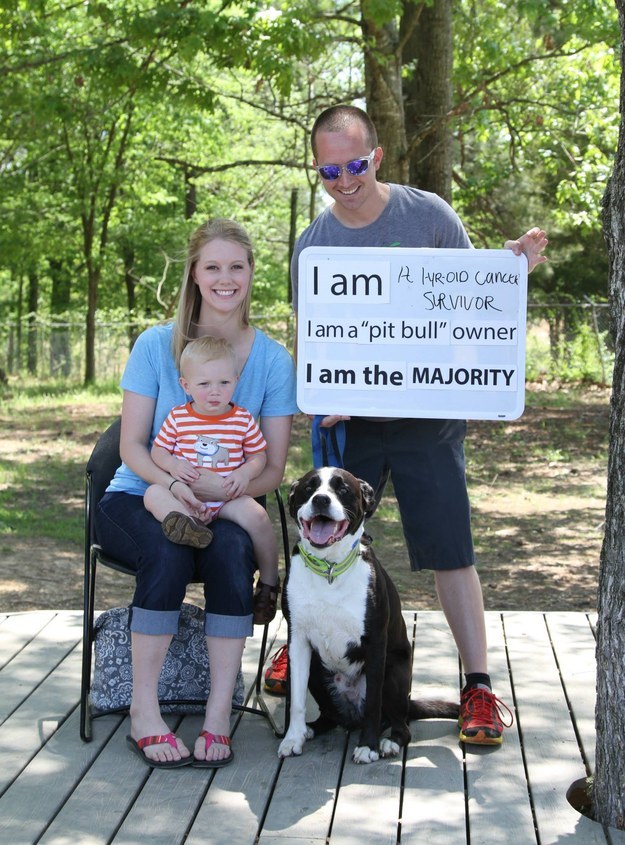
Majority Project

Recently, I heard the claim pit bulls are dying in New Jersey animal shelters due to “overpopulation” and the “average family” not wanting them. These reactions followed my previous blog setting adoption and euthanasia goals for New Jersey animal shelters. While I personally like some of the people making these assertions and agree with them on other issues, I believe this is a dangerous myth that has deadly consequences for pit bulls everywhere. Many shelters have already achieved no kill for their pit bulls despite taking in large numbers of these dogs. In this blog, I’ll explore the notion that the average family (presumably white and middle class) doesn’t want pit bulls so we shouldn’t even bother trying to save them.

Colorado Animal Control Shelter Proactively Works to Save Its Pit Bull Type Dogs

Ark Valley Humane Society serves Chaffee County, Colorado. Chaffee County’s population is 91% white and its poverty rate is below the national average.  Families make up a similar percentage of households as your typical New Jersey suburb. Thus, Chaffee County, Colorado is similar to many New Jersey communities.

Ark Valley Humane Society radically increased its pit bull live release rate in one year. In 2012, 40% of the shelter’s pit bulls were killed. Instead of complaining about “pit bull overpopulation” and “the average family not wanting pit bulls”, Ark Valley Humane Society set a strategic goal to turn their pit bull performance around. The shelter’s strategy focused on a longer term objective of reducing pit bull intake via offering free spay/neuter for pit bulls and a shorter term goal to quickly adopt out pit bulls into loving homes. Ark Valley Humane Society engaged the public, instituted multi-dog playgroups, and trained pit bulls to obey basic commands and become good canine citizens. As a result of these efforts, Ark Valley Humane Society adopted out all 27 pit bulls they took in during 2013.

Ark Valley Humane Society’s description of their efforts is as follows:

We are especially proud of our 2013 Pit-Bull Initiative. Pit-bulls and bully breeds have suffered a negative public perception. Faced with increasing numbers of pit-bulls, AVHS decided to take action to improve this breed’s ability to find forever homes. AVHS began offering free spay/neuter for owned pit-bulls and the pit-bull mixes living in Chaffee County. We have increased emphasis on public education, instituted multi-dog play groups for behavior modification, and formed shelter dog training classes for basic commands and good citizenship. Our efforts have resulted in the adoption of all 27 pit-bull intakes for 2013. No pit-bulls were lost due to ill health or unmanageable aggression issues.

While 27 pit bulls does not sound like a lot of dogs, this is large number for this community. Chaffee County is a sparsely populated area and only has 17,809 residents. The surrounding counties also have a low population density making it unlikely many people from elsewhere would visit this shelter to adopt dogs. This equates to a pit bull intake and adoption rate of 1.52 pit bulls per 1,000 people. As a comparison, I estimate New Jersey animal shelters collectively only take in approximately 1.15 pit bulls per 1,000 people and would only need to adopt out 0.70 pit bulls per 1,000 people to achieve no kill for our state’s pit bulls. Additionally, Ark Valley Humane Society took in 35% more pit bulls during the year they saved all of these dogs compared to the prior year when the shelter killed 40% of its pit bulls. Thus, Ark Valley Humane Society adopted out all if its pit bulls despite taking in significantly more pit bulls per capita than New Jersey animal shelters do as a whole.

Ark Valley Humane Society likely quickly adopted out its pit bulls. While the shelter did not disclose the time it took pit bulls to get adopted, we can come up with a reasonable estimate. Pit bulls made up 6% of all dogs taken in and the shelter’s average length of stay for dogs was 11.8 days. Typically, pit bulls stay 2-4 times longer than other dogs at high performing no kill animal control shelters. Using these numbers and some simple algebra, we can estimate pit bulls took 22.3 days, 31.6 days, and 40 days to get adopted assuming the pit bull average length of stay was 2 times, 3 times, and 4 times longer than other dogs. Even if pit bulls stayed at the shelter 5 times longer than other breeds, pit bulls would only take 47.6 days to get adopted. Furthermore, the fact that all pit bulls impounded in 2013 were adopted out during the year also supports the notion pit bulls left the shelter quickly. As a result, claims that pit bulls take “forever’ to get adopted are simply untrue.

Local Shelters Need to Stop Making Excuses and Work on Saving Our State’s Pit Bulls

Many other shelters are saving their pit bulls. For example, Longmont Humane Society, which serves a similar demographic in a more suburban area of Colorado, saves 96% of its pit bulls and takes in roughly 3 times as many pit bulls per capita than the average New Jersey animal shelter. Kansas City, Missouri’s animal control shelter, KC Pet Project, takes in nearly 3 times as many pit bulls per capita than the typical New Jersey animal shelter and has a pit bull save rate close to 90%. Thus, many shelters across the nation are saving their pit bulls.

Several New Jersey shelters are doing a good job adopting out their pit bulls. Perth Amboy Animal Shelter, which serves an area with a high poverty rate, is likely saving over 90% of their pit bulls based on their overall dog live release rate of 97% and pit bulls probably comprising a substantial percentage of the dogs taken in. For example, if this shelter saved 99% of non-pit bulls, pit bulls would only need to make up 22% or more of the dog intake for the pit bull live release rate to equal or exceed 90%. Not surprisingly, I estimate Perth Amboy Animal Shelter adopted out roughly 40% more pit bulls per capita in 2013 based on the assumptions from my prior blog than the average New Jersey animal shelter needs to do to achieve no kill for pit bulls. Similarly, I estimate Trenton Animal Shelter is adopting approximately 30% more pit bulls per capita than the average New Jersey animal shelter should despite severe space constraints (i.e. which limits adoption potential). Thus, there is no reason other New Jersey animal shelters cannot adopt out more pit bulls.

People truly want pit bull type dogs. Based on recent data, pit bulls are among the three most popular breeds in New Jersey. Given people keep obtaining these dogs, which is often not from shelters, demand clearly exists for pit bulls. Additionally, all sorts of families and people adopt pit bull type dogs. Furthermore, even if the myth that suburban families won’t adopt pit bull type dogs were true, shelters can still adopt out these dogs off-site in nearby urban areas. Thus, New Jersey residents want pit bull like dogs and local shelters need to meet that demand.

Adopting out many sterilized pit bulls to the public will decrease pit bull breeding. Many pit bulls are surrendered to shelters due to owners lacking resources to fix solvable problems. If we can help these people, fewer pit bulls will come into shelters, and people will be more likely to get sterilized pit bulls from shelters in the future. Significantly increasing the number of sterilized pit bulls in the state will decrease the number of pit bulls coming into shelters. Thus, we can save the pit bulls currently in shelters and reduce the number of pit bulls arriving at shelters in the future.

Local animal shelters need to abandon the excuses and help save our pit bulls. Animal Farm Foundation has tons of resources for shelters to use and offers internships to shelter personnel to improve their pit bull adoption rates. Shelters can also contact Executive Directors from successful shelters and seek their advice. Additionally, shelters can bring in Amy Sadler to properly implement multi-dog playgroups. Similarly, organizations can engage no kill consultants, such as Humane Network and No Kill Learning, to provide detailed advice as well. Thus, shelters need to take proactive steps to improve their pit bull adoption rates.

It is time we stopped making excuses and do what is possible. Like Ark Valley Humane Society showed, where these is a will there is way. It is time all shelters do the same.

New Jersey Animal Shelter Statistics Are Far Worse Than Previously Thought

Photo of discarded dead animals from a 2009 Office of Animal Welfare inspection report of Associated Humane Societies – Newark. The Executive Director at the time is still in charge of this shelter today.


Most New Jersey animal shelters voluntarily report detailed data to state authorities. Last August, I shared New Jersey’s animal shelters summary statistics on my Facebook page. Each year, the New Jersey Department of Health’s Office of Animal Welfare requests each licensed animal shelter in the state to submit animal shelter data for the previous year. Animal shelters voluntarily submit this data in the “Shelter/Pound Annual Report.” The Office of Animal Welfare takes these Shelter/Pound Annual Reports and compiles the number of dogs, cats and other animals impounded, redeemed, adopted and euthanized to prepare its Animal Intake and Disposition report. However, the Shelter/Pound Annual Reports include additional information on how animals were impounded (i.e. strays, owner surrenders, rescued from in-state facilities, rescued from out of state shelters, and cruelty/bite cases) and disposed of (i.e. returned to owner, adopted, sent to rescue/another shelter, and died/missing). Additionally, the Shelter/Pound Annual Reports include the number of animals in shelters at the beginning and end of the year as well as the maximum number of animals facilities can hold. Thus, the Shelter/Pound Annual Reports include very important data not found in the Office of Animal Welfare’s summary report.

I compiled the data from these reports and analyze the results in this blog. 2013 statistics for each New Jersey animal shelter are listed at this link.

Garbage Data Raises Serious Questions About New Jersey Animal Shelters’ Statistics

Several animal shelters, which reported statistics in prior years, failed to submit data in 2013. Specifically, Summit Animal Clinic in Union City, Associated Humane Societies – Tinton Falls, Mercerville Animal Hospital and Angel Pets Animal Welfare in Woodbridge disclosed this data in 2012, but did not do so in 2013. Additionally, East Orange Animal Shelter has never submitted Shelter/Pound Annual Reports to the state, but did share limited data with The Record newspaper. These shelters failure to disclose data raises serious questions. For example, are they trying to hide embarrassing statistics from the public? I’ve included these shelters’ 2012 data, and in the case of East Orange, its limited 2013 data in my analysis. Also, I performed my analysis without these shelters as well. Unless indicated below, I’ve included these shelters’ data in the analysis under the assumption the statistics would be similar if submitted to the Office of Animal Welfare in 2013.

Most New Jersey animal shelters do not properly account for their animals. Simple math dictates the number of animals at a facility at the beginning of the year, plus all animals coming in during the year, less all animals leaving for the period, should equal the number of animals a shelter has at the end of the year. Stunningly, 69 out of 100 shelters reporting these dog statistics and 71 out of 98 facilities submitting this cat data failed to get this right. This raises serious questions about the accuracy of these shelters’ reported statistics. Even worse, 54 of the 69 shelters with flawed dog statistics and 46 of the 71 facilities with incorrect cat statistics should have had more animals at the end of the year then reported. While these errors could have been due to incorrect counts of the number of animals at facilities, the more likely answer is many outcomes, such as animals killed, dying, or gone missing, were not recorded. Given 71% of the errors were due to shelters having less rather than more animals on hand at the end of the year than they should have had lends credence to the theory that errors were mostly due to shelters failing to account for various outcomes. To put it another way, 3,231 cats and dogs should have had outcomes reported and did not. Thus, there is the potential that as many as 3,231 additional dogs and cats were killed, died or went missing from New Jersey animal shelters than were reported in the last year.

Shelters may have failed to classify animals adopted out and sent to rescue properly. Both Paterson Animal Control and Elizabeth Animal Shelter reported no animals were sent to rescues and all dogs and cats leaving their facilities alive were owner reclaims or adoptions. However, rescues I know who work closely with these two facilities told me both shelters rarely adopt animals directly to the public. This makes sense as neither shelter advertized animals for adoption (i.e. no adoption web site or social medial pages) in 2013. One has to wonder how many other facilities failed to properly classify adoptions and rescues properly. This data is very important as it provides details on the burden rescues and other shelters are taking from these facilities.

We need better oversight of New Jersey animal shelters’ data reporting. Currently, these statistics are voluntarily reported and most shelters are not taking this seriously. For example, I noticed a large number of reports were submitted many months after the end of the year. This data should be easy to compile since facilities can utilize animal shelter software programs, some of which are free, to do this task. Furthermore, New Jersey animal shelter laws mandate facilities maintain much of the raw data found in the Shelter/Pound Annual Report. Unfortunately, Office of Animal Welfare inspections routinely find shelters do not properly keep records on animals. We need to make the Shelter/Pound Annual Report mandatory for animal shelters along with serious penalties for significant errors (especially if deliberate). In order for animal shelters to take data reporting seriously, we may also need to require audits of these reports. Thus, these results show we need stronger laws and the Office of Animal Welfare to play a greater role in ensuring reported animal shelter statistics are in fact accurate.

Despite the errors in these reports, the data provided still reveals important information.

More Animals Losing Their Lives in New Jersey Animal Shelters Than Previously Believed

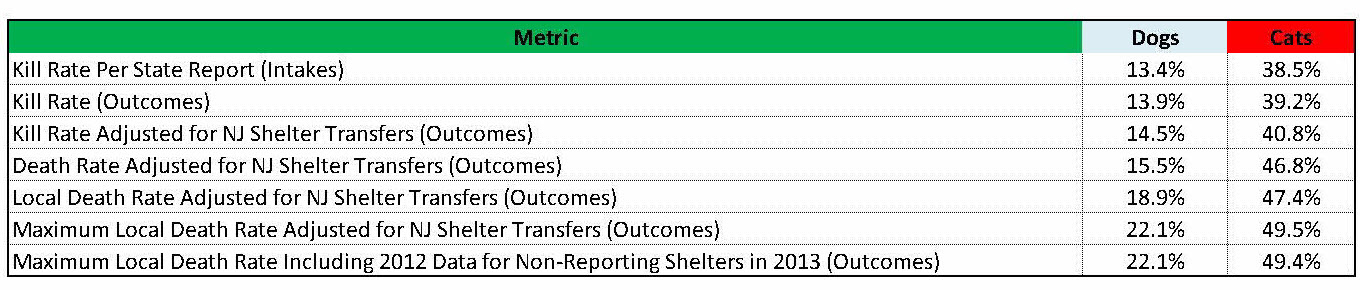
The more detailed data in the Shelter/Pound Annual Reports allows one to more critically examine the percentage of locally impounded animals dying in New Jersey’s animal shelters. The following table summarizes my analysis of the kill/death rate calculated from the Office of Animal Welfare’s summary report and the data reported in the Shelter/Pound Annual Reports.

Totals

The Animal Intake and Disposition report prepared by the Office of Animal Welfare only allows one to calculate the number of animals killed as a percentage of total animals impounded or intake. I prefer calculating the kill rate as a percentage of outcomes rather than intake as this metric directly compares positive and negative outcomes. Using intake depresses the kill rate since shelters can simply hold animals for a long time to the point of overcrowding. Calculating kill rate based on outcomes rather than intake increases the dog kill rate from 13.4% to 13.9% and the cat kill rate from 38.5% to 39.2%.

To calculate the statewide kill rate, we must also back out transfers from one New Jersey animal shelter to another state facility to avoid counting animals still in the state’s shelter system or registering two outcomes for the same animal (i.e. one New Jersey animal shelter transfers a dog or cat to another state facility who then adopts out the animal). This adjustment increases the dog kill rate from 13.9% to 14.5% and the cat kill rate from 39.2% to 40.8%.

In addition, we should increase the kill rate for animals dying or gone missing in shelters. I label this metric the death rate as these animals are likely dead or in a very bad situation. After making this adjustment, the dog death rate increases from 14.5% to 15.5% and the cat death rate rises from 40.8% to 46.8%.

Also, many shelters transport easy to adopt animals from out of state which artificially increases save rates. To properly calculate the percentage of New Jersey animals losing their lives, we need to adjust for transports. Unfortunately, shelters don’t break out their save rates by local and out of state animals. However, most likely nearly all of the out of state animals (primarily puppies and easy to adopt dogs) make it out of shelters alive. Therefore, I back out the number of out of state transports to estimate the local death rate. This adjustment increases the New Jersey dog death rate from 15.5% to 18.9% and the state cat death rate from 46.8% to 47.4%.

Also, I estimate a maximum local death rate by including the number of unaccounted for animals described in the section above. Making this adjustment increases the maximum potential New Jersey dog death rate from 18.9% to 22.1% and the maximum potential state cat death rate from 47.4% to 49.5%.

Finally, the maximum potential New Jersey cat death rate decreases slightly from 49.5% to 49.4% if I include the 2012 data from shelters who failed to report statistics in 2013 to the Office of Animal Welfare. Thus, the percentage of New Jersey animals losing their lives in our state’s animal shelters may be much higher than previously thought.

Death Rates Extremely High at a Number of New Jersey Animal Shelters

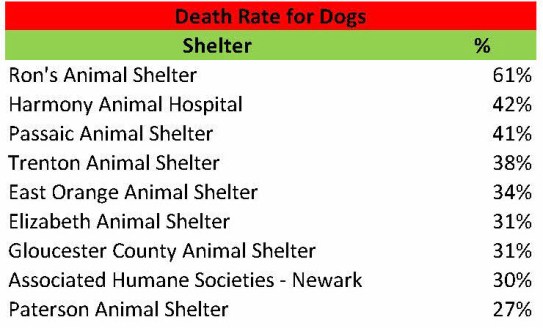
Dogs and cats are likely to lose their lives or go missing at a number of New Jersey animal shelters. Shelters with the highest death rates for dogs and cats are listed in the following tables:

NJ Shelter Rates Tables (6)

NJ Shelter Rates Tables (7)

Thus, both dogs and cats have a very good chance of leaving many New Jersey animal shelters dead rather than alive.

Many shelters fail to account for large numbers of their animals. As discussed above, a shelter’s number of animals at the end of the year should be calculated as follows:

Beginning number of animals + animals impounded – animals leaving the shelter

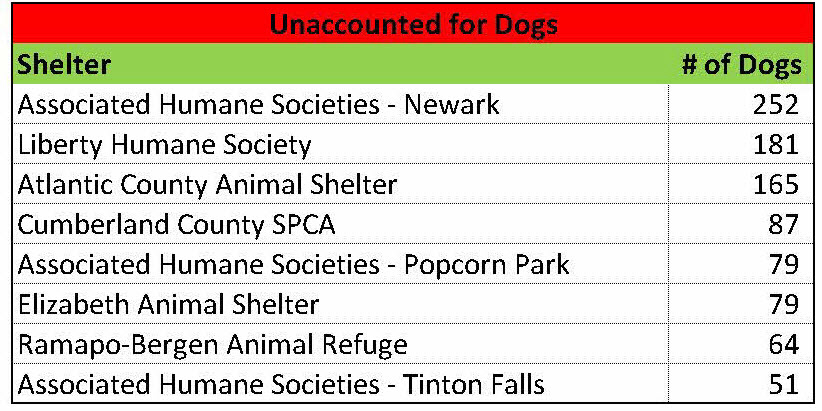
Unfortunately, a large number of shelters take in far more animals than they can explain where they went. Shelters having the highest numbers of unaccounted for dogs and cats are listed in the following tables:

NJ Shelter Rates Tables (8)

Unacct cats

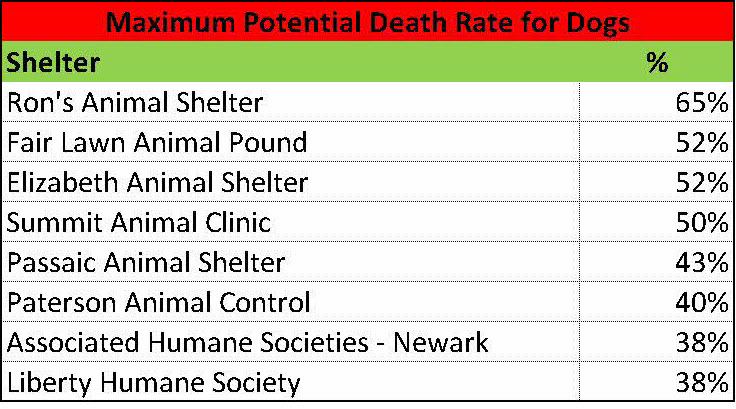
Dog and cat death rates at many shelters may be even higher if these unaccounted for animals are counted as dead or missing. If we only consider animal shelters which don’t or rarely transport, facilities with the highest dog and cat death rates considering the unaccounted for animals described above are as follows:

NJ Shelter Rates Tables (2)

Max pot cats po

Thus, the plight of dogs and cats may be far worse in New Jersey animal shelters when we consider the unaccounted for animals.

Shelters Turn Their Backs on New Jersey’s Animals

New Jersey animal shelters rescue far more animals from out of state than other New Jersey animal shelters. Specifically, 5,676 dogs were transferred from out of state animal shelters compared to only 1,410 dogs taken in from other New Jersey animal shelters. While perhaps some shelters, such as Animal Alliance in Lambertville, take animals from nearby New York or Pennsylvania animal control shelters, the overwhelming majority of these dogs most certainly came from down south. In fact, New Jersey animal shelters transported more dogs from out of state than dogs who were killed in, died in or went missing from New Jersey animal shelters. This number does not include additional dogs transported in from out of state by rescues operating without a physical facility. Shelters transporting the most dogs from out of state were as follows:

NJ Shelter Rates Tables (5)

New Jersey animal shelters transported 642 cats from out of state while nearly 50% of cats in the state’s animal shelters were killed, died or went missing. Animal Welfare Association (280 cats received from out of state) and Mount Pleasant Animal Shelter (211 cats received from out of state) rescued more cats from out of state facilities than New Jersey animal shelters. In the case of Mount Pleasant Animal Shelter, the organization’s Executive Director told me these cats were rescued from New York Animal Care and Control. One can only hope the out of state cats rescued by other New Jersey animal shelters came from nearby New York and Pennsylvania facilities rather than from shelters far away down south.

Return to Owner Rates Better Than Average at Most Shelters

Return to owners (“RTO”) rates are one of the positive results from this analysis. Overall, the dog and cat RTO rates of 52% and 4% are approximately twice the national average. As I noted in my blog on reuniting lost pets with owners, return to owner rates are highly correlated with socioeconomic status. Wealthier people likely have more resources/knowledge to license and microchip their dogs. Similarly, people with greater incomes are more likely to afford reclaim fees or ransom payments to animal shelters. New Jersey’s RTO rates for dogs clearly fit this pattern with shelters serving wealthy towns returning most stray dogs to owners while urban shelters are only returning about one fifth of lost dogs to owners. Clearly, we need to help people in urban areas get microchips and ID tags on their dogs. Additionally, we need to create pet help desks at shelters in these cities to help people pay the reclaim fees, which are often mandated by the cities themselves, when necessary. The statewide cat reclaim rate, like figures from across the nation, is still very low and suggests shelters need to figure out better ways to get lost cats back to their families. New Jersey should allow shelters to transfer stray cats to rescues during the mandatory 7 day hold period since few are returned to owners at shelters. This would open up space to save more cats and reduce the chance of disease (i.e. cats spending less time in shelters are not as likely to get sick).

Shelters Leave Animal Enclosures Empty While Dogs and Cats Die

New Jersey animal shelters fail to use their space to save animals. Based on the average number of animals at all of New Jersey’s animal shelters at the beginning and the end of 2013, only 61% of dog and 66% of cat capacity was used. Given December is a low intake month, I also increased these populations to an average intake month. This adjustment only raised the dog and cat capacity utilization to 62% and 87%. These estimates likely overestimate the average capacity utilized as many facilities kill animals once they reach a certain population level. Many animal shelters with low kill rates failed to rescue animals with their excess space. Additionally, other shelters used little of their available space and still killed a large percentage of their animals. Some examples after increasing the population (and therefore capacity utilization) based on the adjustment discussed above are as follows:

NJ Shelter Rates Tables (11)

NJ Shelter Rates Tables (13)

Thus, many New Jersey animal shelters are killing dogs and cats despite having ample space to house these animals.

New Jersey’s animal shelters continue to fail the state’s animals. The state’s animal control facilities only impound 8.7 animals per 1,000 New Jersey residents. As a comparison, the average community in the country impounds anywhere from 14-30 animals per 1,000 residents based on estimates from Animal People Newspaper and the Humane Society of the United States. Despite New Jersey shelters impounding a fraction of the animals other no kill communities take in on a per capita basis, the state’s animal control facilities continue to kill and allow animals to die under their care. Even worse, many of these shelters can’t even properly keep track of how many animals leave their facilities dead or alive. Our state’s animals deserve far better treatment than this. Contact your local city council members and mayor and demand better from the animal shelter serving your community. We can do this so let’s get to work!