2014 New Jersey Animal Shelter Statistics Show Little Improvement

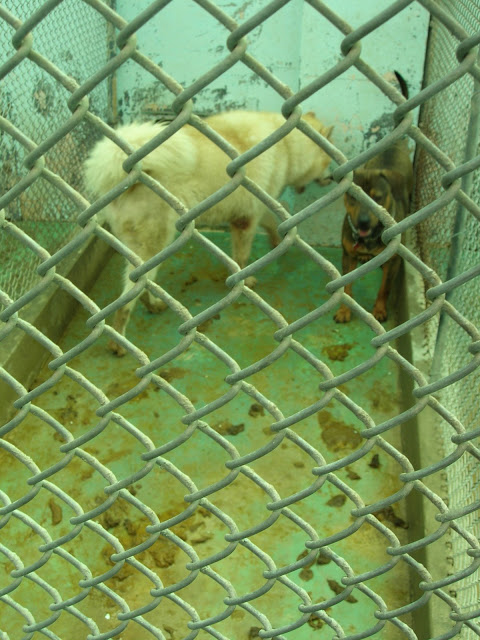
East Orange Animal Shelter Dog

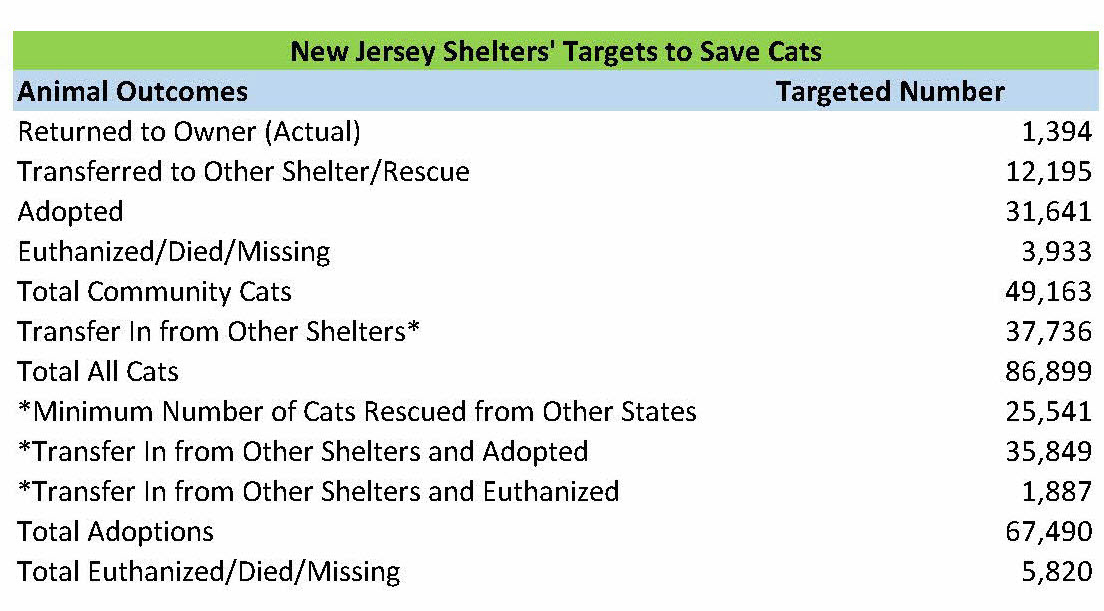
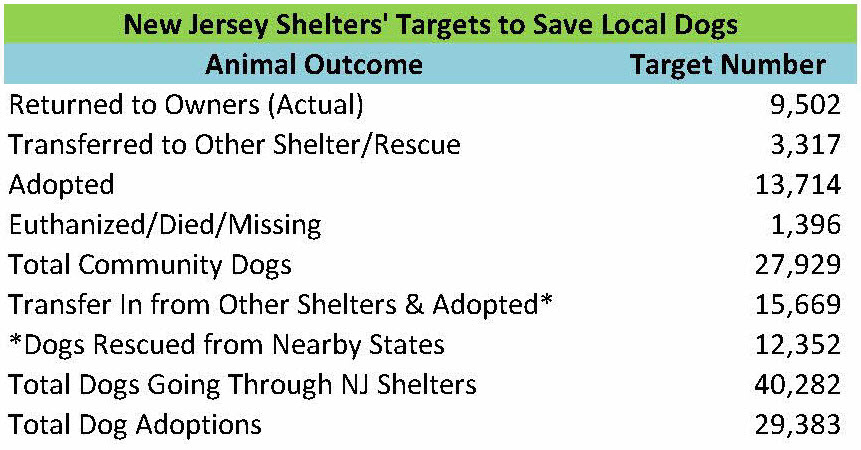
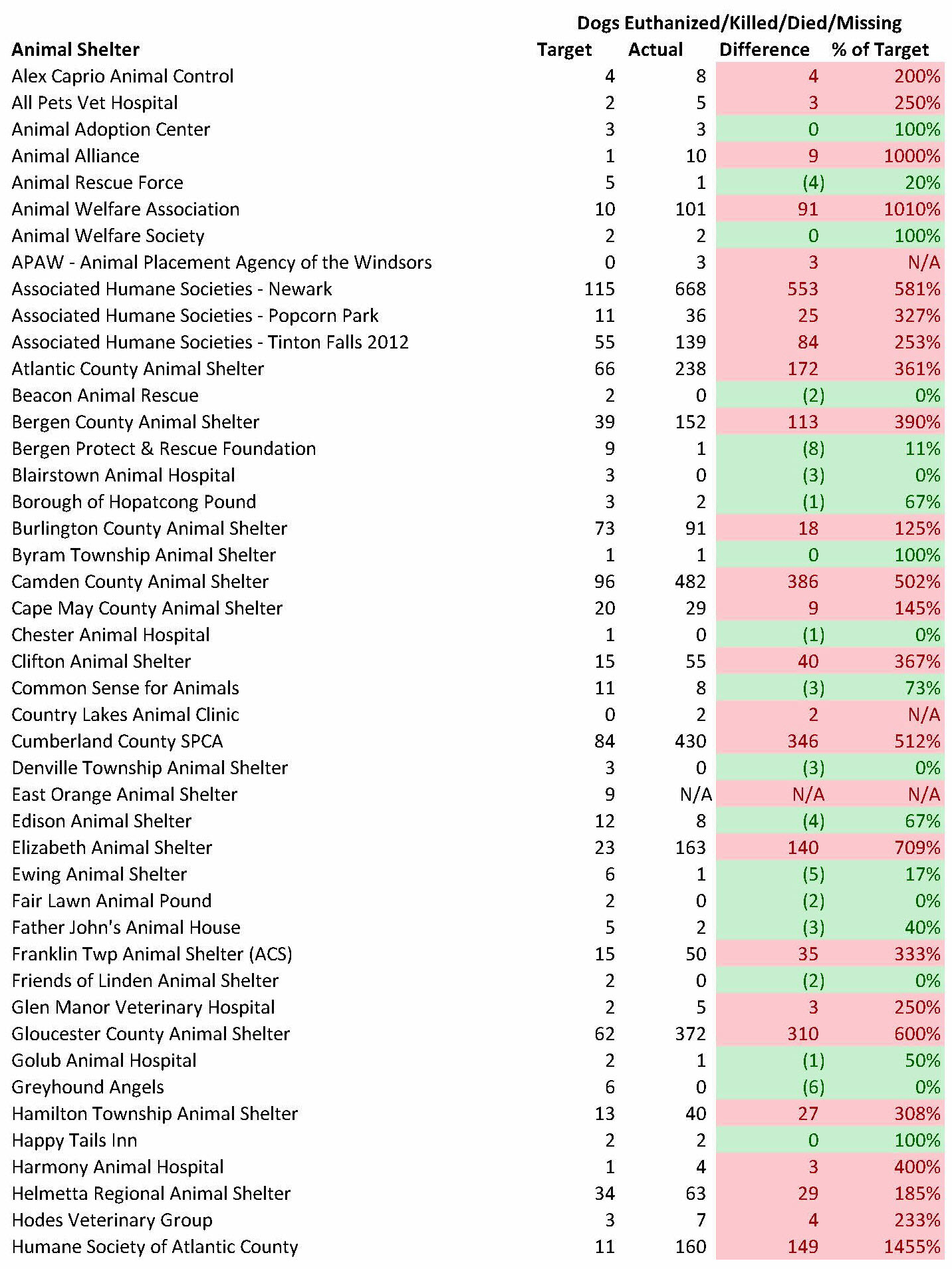
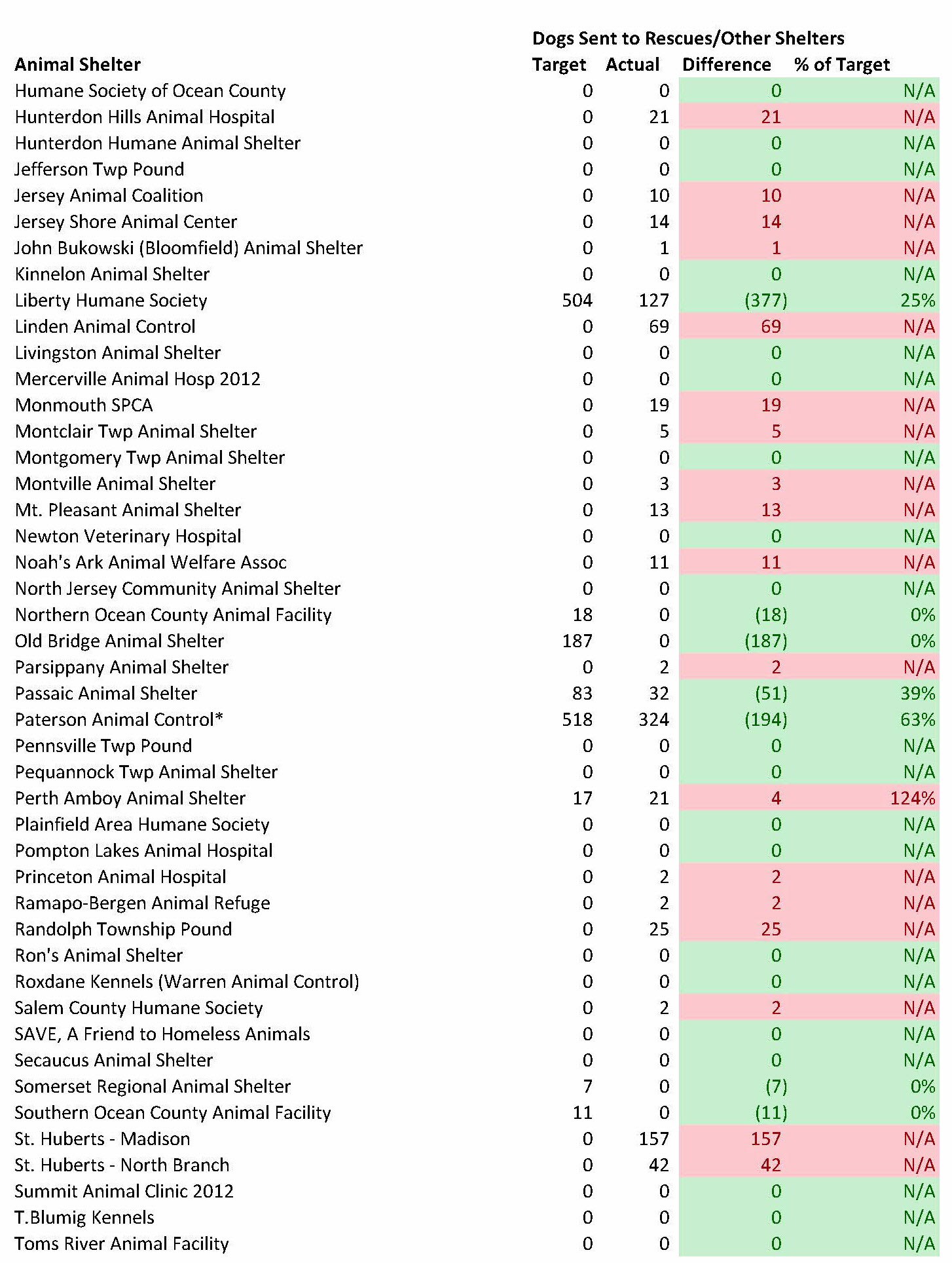
Most New Jersey animal shelters voluntarily report detailed data to state authorities. Last September, I shared the 2014 summary statistics for New Jersey animal shelters on my Facebook page. Each year, the New Jersey Department of Health requests each licensed animal shelter in the state to submit animal shelter data for the previous year. Animal shelters voluntarily submit this data in the “Shelter/Pound Annual Report.” The New Jersey Department of Health takes these Shelter/Pound Annual Reports and compiles the number of dogs, cats and other animals impounded, redeemed, adopted and euthanized to prepare its Animal Intake and Disposition report. However, the Shelter/Pound Annual Reports include additional information on how animals were impounded (i.e. strays, owner surrenders, rescued from in-state facilities, rescued from out of state shelters, and cruelty/bite cases) and disposed of (i.e. returned to owner, adopted, sent to rescue/another shelter, and died/missing). Additionally, the Shelter/Pound Annual Reports include the number of animals in shelters at the beginning and end of the year as well as the maximum number of animals facilities can hold. Thus, the Shelter/Pound Annual Reports include very important data not found in the New Jersey Department of Health’s summary report.

I compiled the data from these reports and analyze the results in this blog. 2014 statistics for each New Jersey animal shelter are listed at this link.

Garbage Data Raises Serious Questions About New Jersey Animal Shelters’ Statistics

Several animal shelters, which reported statistics in prior years, failed to submit data in 2014. Specifically, Livingston Animal Shelter, Hunterdon Hills Animal Hospital, All Pets Veterinary Hospital and Warren Animal Hospital disclosed this data in 2013, but did not do so in 2014. These shelters failure to disclose data raises serious questions. For example, are they trying to hide embarrassing statistics from the public?

Most New Jersey animal shelters do not properly account for their animals. Simple math dictates the number of animals at a facility at the beginning of the year, plus all animals coming in during the year, less all animals leaving for the period, should equal the number of animals a shelter has at the end of the year. Stunningly, 67 out of 96 shelters reporting these dog statistics and 68 out of 95 facilities submitting this cat data failed to get this right. This raises serious questions about the accuracy of these shelters’ reported statistics. Even worse, 42 of the 67 shelters with flawed dog statistics and 43 of the 68 facilities with incorrect cat statistics should have had more animals at the end of the year then reported. While these errors could have been due to incorrect counts of the number of animals at facilities, the more likely answer is many outcomes, such as animals killed, dying, or gone missing, were not recorded. Given 63% of the errors were due to shelters having less rather than more animals on hand at the end of the year than they should have had lends credence to the theory that errors were mostly due to shelters failing to account for various outcomes. To put it another way, 2,699 cats and dogs should have had outcomes reported and did not. Thus, there is the potential that as many as 2,699 additional dogs and cats were killed, died or went missing from New Jersey animal shelters than were reported in the last year.

Shelters may have failed to classify animals adopted out and sent to rescue properly. Both Paterson Animal Control and Elizabeth Animal Shelter reported no animals were sent to rescues and all dogs and cats leaving their facilities alive were owner reclaims or adoptions. However, rescues I know who work closely with these two facilities told me both shelters rarely adopt animals directly to the public. This makes sense as neither shelter advertized animals for adoption (i.e. no adoption web site or social medial pages run by the two shelters) in 2014. One has to wonder how many other facilities failed to properly classify adoptions and rescues properly. This data is very important as it provides details on the burden rescues and other shelters are taking from these facilities.

We need better oversight of New Jersey animal shelters’ data reporting. Currently, these statistics are voluntarily reported and most shelters are not taking this seriously. For example, I noticed a large number of reports were submitted many months after the end of the year. This data should be easy to compile since facilities can utilize animal shelter software programs, some of which are free, to do this task. Furthermore, New Jersey animal shelter laws mandate facilities maintain much of the raw data found in the Shelter/Pound Annual Report. Unfortunately, New Jersey Department of Health inspections routinely find shelters do not properly keep records on animals. We need to make the Shelter/Pound Annual Report mandatory for animal shelters along with serious penalties for significant errors (especially if deliberate). In order for animal shelters to take data reporting seriously, we may also need to require audits of these reports. Thus, these results show we need stronger laws and the New Jersey Department of Health to play a greater role in ensuring reported animal shelter statistics are in fact accurate.

Despite the errors in these reports, the data provided still reveals important information.

More Animals Losing Their Lives in New Jersey Animal Shelters Than Disclosed in Summary Report

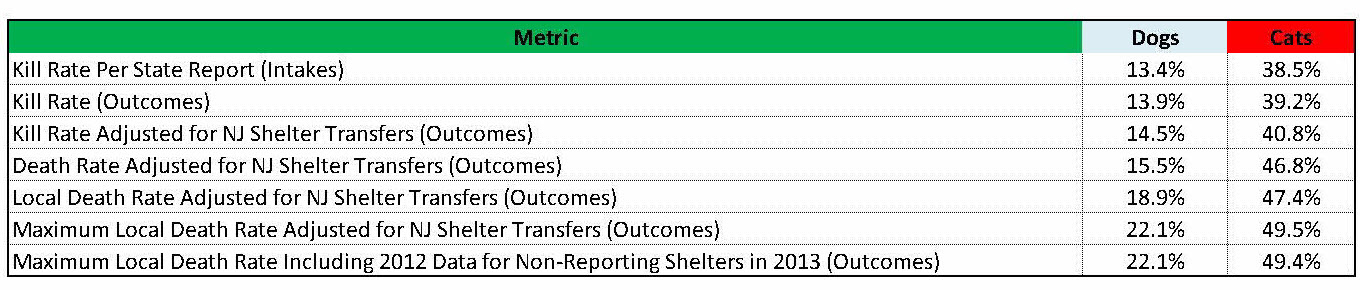
The more detailed data in the Shelter/Pound Annual Reports allows one to more critically examine the percentage of locally impounded animals dying in New Jersey’s animal shelters. The following table summarizes my analysis of the kill/death rate calculated from the New Jersey Department of Health’s summary report and the data reported in the Shelter/Pound Annual Reports.

2014 Summary Stats (1) (1) (2)The Animal Intake and Disposition report prepared by the New Jersey Department of Health only allows one to calculate the number of animals killed as a percentage of total animals impounded or intake. I prefer calculating the kill rate as a percentage of outcomes rather than intake as this metric directly compares positive and negative outcomes. Using intake depresses the kill rate since shelters can simply hold animals for a long time to the point of overcrowding. Calculating kill rate based on outcomes rather than intake increases the cat kill rate from 34.6% to 35.2% and the dog kill rate remains the same.

To calculate the statewide kill rate, we must also back out transfers from one New Jersey animal shelter to another state facility to avoid counting animals still in the state’s shelter system or registering two outcomes for the same animal (i.e. one New Jersey animal shelter transfers a dog or cat to another state facility who then adopts out the animal). This adjustment increases the dog kill rate from 13.5% to 14.2% and the cat kill rate from 35.2% to 37.4%.

In addition, we should increase the kill rate for animals who died or went missing in shelters. I label this metric the death rate as these animals are likely dead or in a very bad situation. After making this adjustment, the dog death rate increases from 14.2% to 14.8% and the cat death rate rises from 37.4% to 43.4%.

Also, many shelters transport easy to adopt animals from out of state which artificially increases live release rates. To properly calculate the percentage of New Jersey animals losing their lives, we need to adjust for transports. Unfortunately, shelters don’t break out their save rates by local and out of state animals. However, most likely nearly all of the out of state animals (primarily puppies and easy to adopt dogs) make it out of shelters alive. Therefore, I back out the number of out of state transports to estimate the local death rate except for St. Hubert’s. Since St. Hubert’s subsequently transfers many of these animals to other shelters, I only subtract out the number of dogs St. Hubert’s rescues from out of state less the dogs it transfers to other shelters. This adjustment increases the New Jersey dog death rate from 14.8% to 17.7% and the state cat death rate from 43.4% to 43.8%.

Also, I estimate a maximum local death rate by including the number of unaccounted for animals described in the section above. Making this adjustment increases the maximum potential New Jersey dog death rate from 17.7% to 20.6% and the maximum potential state cat death rate from 43.8% to 47.3%.

Some animal shelters quickly return large percentages of their animals to owners. At these shelters, the populations served are typically well-off and animals are licensed and have microchips. To account for the animals facilities actually have to shelter, I calculated a death rate for non-reclaimed animals and a maximum potential death rate for non-reclaimed local animals. The non-reclaimed death rate and maximum potential death rate for dogs is 20.9% and 31.7%. Non-reclaimed cats had a 44.8% death rate and a 48.9% maximum potential death rate. Thus, the percentage of New Jersey animals losing their lives in our state’s animal shelters may be much higher than previously thought.

Overall, the statewide statistics showed little improvement from 2013. The dog death rate in 2014 only was three tenths of one percent lower than 2013. While the maximum potential dog death rate was 3.4 percentage points lower in 2014, we don’t know whether that is due to better record keeping or actually improved life saving. The cat death rate and maximum potential death rate decreased by 3.4% and 4.2%. The growing acceptance of TNR likely slightly decreased the percentage of cats losing their lives in New Jersey animal shelters this year. That being said, the improvements were very small and the percentage of dogs and cats losing their lives in the state’s animal shelters is still way too high.

Death Rates Extremely High at a Number of New Jersey Animal Shelters

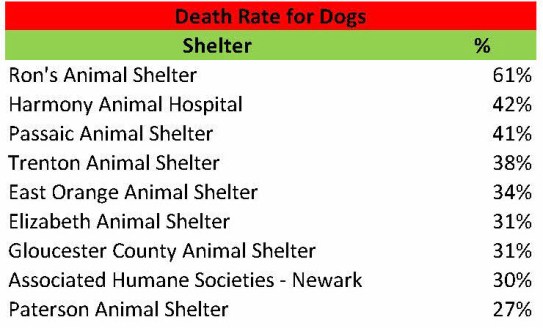
Dogs and cats are likely to lose their lives or go missing at a number of New Jersey animal shelters. Shelters with the highest death rates for dogs and cats (excluding very low intake facilities) are listed in the following tables:

Dog Death rate 2014

Cat Death Rate 2014

Thus, both dogs and cats have a very good chance of leaving many New Jersey animal shelters dead rather than alive.

In terms of raw numbers, the following shelters had the most animals lose their lives or go missing:

Total Killed Died 2014 Dogs

Total Killed Died 2014 Cats

Many shelters fail to account for large numbers of their animals. As discussed above, a shelter’s number of animals at the end of the year should be calculated as follows:

Beginning number of animals + animals impounded – animals leaving the shelter

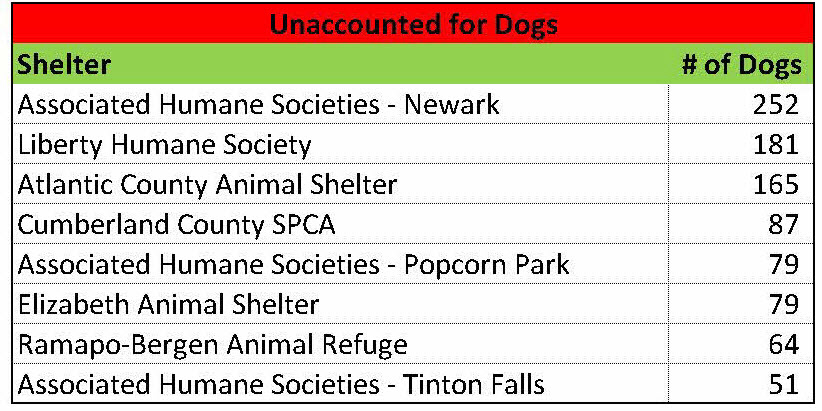
Unfortunately, a large number of shelters take in far more animals than they can explain where they went. Shelters having the highest numbers of unaccounted for dogs and cats are listed in the following tables:

Unacct dogs

Unacct cats 2014

Dog and cat death rates at many shelters may be even higher if these unaccounted for animals are counted as dead or missing. If we only consider animal shelters which reported transporting few or no animals in 2014, facilities with the highest dog and cat death rates considering the unaccounted for animals described above are as follows:

Max Pot Dr 2014 Dogs

Max Pot cats 2014

Thus, the plight of dogs and cats may be far worse in New Jersey animal shelters when we consider the unaccounted for animals.

Shelters Turn Their Backs on New Jersey’s Animals

New Jersey animal shelters rescue far more animals from out of state than other New Jersey animal shelters. Specifically, 5,090 dogs were transferred from out of state animal shelters compared to only 1,692 dogs taken in from other New Jersey animal shelters. The number of out of state dogs transported into New Jersey decreased in 2014, but that is due to problems at Jersey Animal Coalition and Helmetta Regional Animal Shelter during the year. These problems likely resulted in fewer transported dogs. However, Jersey Animal Coalition, which is now closed, did not report any statistics for 2014. Furthermore, Helmetta Regional Animal Shelter erroneously reported it transported no dogs during 2014 as the facility imported many dogs from the south before the shelter’s problems received media attention in the summer of 2014. Thus, the decrease in transports is likely due to a combination of  incorrect reporting and increased regulatory pressure on these two shelters that transported many dogs into New Jersey.

While perhaps some shelters, such as Animal Alliance in Lambertville, take animals from nearby New York or Pennsylvania animal control shelters, the overwhelming majority of these dogs most certainly came from down south. In fact, New Jersey animal shelters transported more dogs from out of state than dogs who were killed in, died in and went missing from New Jersey animal shelters. This number does not include additional dogs transported in from out of state by rescues operating without a physical facility. Shelters transporting the most dogs from out of state were as follows:

Dogs Transported 2014

Return to Owner Rates Better Than Average at Most Shelters

Return to owners (“RTO”) rates are one of the positive results from this analysis. Overall, the dog and cat RTO rates of 55% and 5% are approximately twice the national average. As I noted in my blog on reuniting lost pets with owners, return to owner rates are highly correlated with socioeconomic status. Wealthier people likely have more resources/knowledge to license and microchip their dogs. Similarly, people with greater incomes are more likely to afford reclaim fees or ransom payments to animal shelters. New Jersey’s RTO rates for dogs clearly fit this pattern with shelters serving wealthy towns returning most stray dogs to owners while many urban shelters are only returning about around a quarter of lost dogs to owners. Clearly, we need to help people in urban areas get microchips and ID tags on their dogs. Additionally, we need to create pet help desks at shelters in these cities to help people pay the reclaim fees, which are often mandated by the cities themselves, when necessary. The statewide cat reclaim rate, like figures from across the nation, is still very low and suggests shelters need to figure out better ways to get lost cats back to their families. New Jersey should allow shelters to transfer stray cats to rescues during the mandatory 7 day hold period since few are returned to owners at shelters. This would open up space to save more cats and reduce the chance of disease (i.e. cats spending less time in shelters are not as likely to get sick).

To get a better idea how organizations are doing with animals they actually have to shelter, I also examined what percentage of non-reclaimed dogs lose their lives at each facility. Shelters with the highest non-reclaimed dogs death rates are as follows:

non-reclaimed dog death rate

Shelters with the highest maximum non-reclaimed local dogs death rates are as follows (excluding facilities that reported transporting many dogs and taking very few animals in):

Max non-reclaimed dog death rate

Shelters Leave Animal Enclosures Empty While Dogs and Cats Die

New Jersey animal shelters fail to use their space to save animals. Based on the average number of animals at all of New Jersey’s animal shelters at the beginning and the end of 2014, only 53% of dog and 65% of cat capacity was used. Given December is a low intake month, I also increased these populations to an average intake month. This adjustment only raised the dog and cat capacity utilization to 62% and 85%. These estimates likely overestimate the average capacity utilized as many facilities kill animals once they reach a certain population level. Many animal shelters with low kill rates failed to rescue animals with their excess space. Additionally, other shelters used little of their available space and still killed a large percentage of their animals. Some examples after increasing the population (and therefore capacity utilization) based on the adjustment discussed above are as follows:

Space usage dogs 2014

Space usage Cats 2014

Thus, many New Jersey animal shelters are killing dogs and cats despite having ample space to house these animals.

New Jersey’s animal shelters continue to fail the state’s animals. The state’s animal shelters only impound 9.0 dogs and cats per 1,000 New Jersey residents. If we just count animals originating from New Jersey, the state’s animal shelters only impound 7.9 dogs and cats per 1,000 people. As a comparison, the average community in the country impounds anywhere from 14-30 animals per 1,000 residents based on estimates from Animal People Newspaper and the Humane Society of the United States. Despite New Jersey shelters impounding a fraction of the animals other no kill communities take in on a per capita basis, the state’s animal control facilities continue to kill and allow animals to die under their care. Even worse, many of these shelters can’t even properly keep track of how many animals leave their facilities dead or alive. Our state’s animals deserve far better treatment than this. Contact your local city council members and mayor and demand better from the animal shelter serving your community. We can do so much better and it is time our shelters operate this way.

Associated Humane Societies Kills Massive Numbers of Newark’s Homeless Animals

Associated Humane Societies often publishes emotional stories about the organization heroically rescuing animals from terrible situations in Newark. Typically, these stories are found on the AHS web site and/or their Humane News publication. These fundraising efforts are lucrative as AHS brought in an impressive $3.6 million in donations and grants for the fiscal year ended June 30, 2014. The 2003 New Jersey Commission of Investigation report on AHS stated the organization’s fundraising campaigns did not fairly represent the care typically provided to animals:

The substandard conditions and treatment of the animals, which existed on a large scale until recently, betrayed AHS’s massive fundraising campaign through the years and contradicted AHS’s persona as a “humane” organization. Bernstein capitalized on the plight of animals to garner millions of dollars in contributions, but failed to apply any portion of those millions to establish a satisfactory level of care and treatment.

Are these fundraising stories representative of the care most Newark animals receive at AHS-Newark now? Has AHS-Newark improved enough since the 2003 New Jersey Commission of Investigation report was issued?

Additional Animal Control Contracts and Summary Statistics Raise Serious Concerns

In 2014, AHS-Newark added a number of municipalities, such as South Orange and Maplewood (both towns no longer contract with AHS-Newark) and the cities and towns formerly contracting with Linden Animal Control. Despite already killing large numbers of animals, AHS-Newark decided to contract with all these additional municipalities and receive substantial fees in return. In February 2015, AHS-Newark Assistant Executive Director, Scott Crawford, stated his organization could handle the additional animals.

The shelter’s annual summary statistics showed it impounded and killed more animals in 2014 verses 2013. Animal intake increased from 5,019 dogs and cats in 2013 to 6,194 dogs and cats in 2014. AHS-Newark reported the number of dogs and cats that were killed, died or went missing increased from 1,962 in 2013 to 2,356 in 2014. As a result, AHS-Newark literally earned more revenue by impounding and killing significantly more animals in 2014 verses 2013.

Detailed Analysis Conducted 

To get a better understanding of AHS-Newark’s handling of animals, I submitted an OPRA request to the City of Newark’s Animal Control Department seeking intake and disposition records of animals the city’s Animal Control Department impounded in 2014. The City of Newark picks up animals during normal working hours and delivers most animals to the AHS-Newark shelter. At other times, AHS-Newark ACOs perform these duties. The records do not include direct owner surrenders to the shelter from Newark residents (except for a few that were included), but do include people surrendering their animals to animal control who then take the animals to AHS-Newark. After much follow-up over a period of several months, I received AHS-Newark’s underlying intake and disposition records for the animals originating from animal control in Newark.

In total, I obtained around 3,000 pages of records and it took me several months to review and summarize this information. Many of these records were for wildlife, animals leaving before animal control officers arrived, and animals that were dead by the time the animal control officer got to the location. Overall, I reviewed the intake and disposition records of 966 cats and 649 dogs that AHS-Newark impounded in 2014. These records constituted 23% of the dogs and 28% of the cats AHS-Newark reported taking in during 2014.

I reviewed each record and summarized my findings. My summary included the animal’s ID number, species, breed, origin (stray, owner surrender, confiscated by authorities), intake date, outcome date, length of stay, outcome, reasons for killing, miscellaneous information, and any comments I had. I only counted the two primary reasons for killing, but generally mentioned other reasons listed in my notes.

AHS Newark’s Underlying Records Reveal Horrors

Honestly, when I received the information I thought the City of Newark forgot to provide me the records for animals making it out of the facility alive. However, the records included some animals who were adopted out and rescued. The records I obtained listed 229 additional animals I did not receive information for. Even if all these other animals made it out of AHS-Newark alive, the dog and cat kill rate based on intake would only drop nine percentage points. My records indicated AHS-Newark impounded 5.8 dogs and cats per 1,000 residents (6.6 dogs and cats per 1,000 people if I include the 229 missing animal records) that came from animal control in Newark. As a comparison, AHS-Newark impounded 4.3 dogs and cats per 1,000 residents from animal control in Irvington per a summary spreadsheet that AHS prepared. If I assume 43% of AHS-Newark’s animals from the City of Newark came from other sources (i.e. owner surrenders, people finding animals on street, etc), which is the percentage from nearby Irvington, then AHS-Newark would take in 10.2 dogs and cats per 1,000 residents (11.6 dogs and cats per 1,000 people if I include the 229 missing animals) from all sources in Newark. This figure is around the same as, if not a bit higher than, other demographically similar cities in the area. Additionally, I submitted another OPRA request for any missing animals to the City of Newark and was told no other records existed. While I can’t say for sure if my data set contains the overwhelming number of animals AHS-Newark obtained from animal control in Newark, I think it represents a very large percentage.

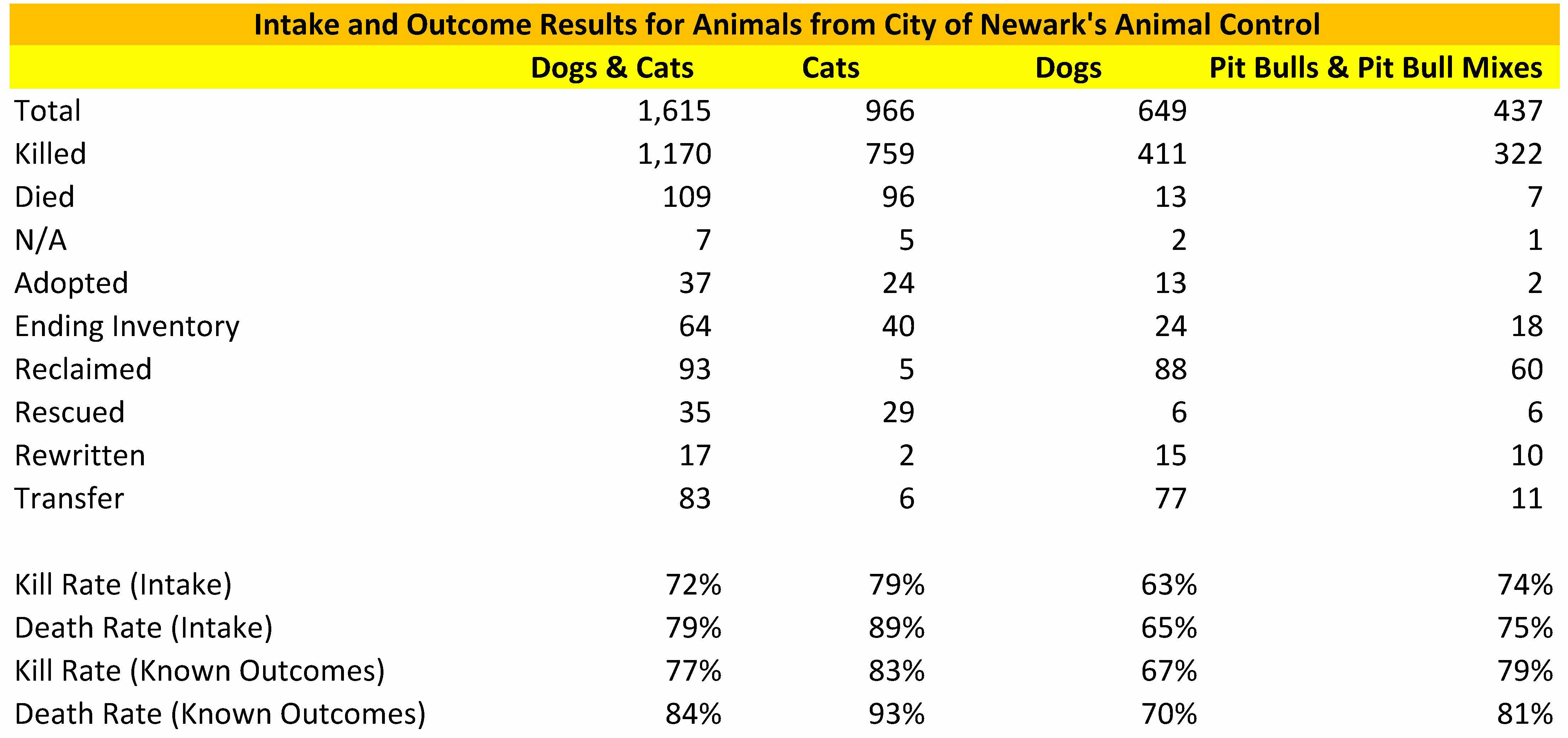
The sheer number and percentage of animals losing their lives at AHS-Newark is staggering. Overall, AHS-Newark killed 79% of the cats, 63% of the dogs, and 74% of the pit bull like dogs in this data set. Furthermore, if I add animals who died at AHS-Newark and only count known outcomes, 93% of cats, 70% of dogs, and 81% of pit bull like dogs in this data set lost their lives at AHS-Newark. To put it another way, 855 out of 919 cats, 424 out of 608 dogs, and 329 out of 408 pit bull like dogs lost their lives per these records. As a result, these records indicate AHS-Newark operated more like a death camp than an animal shelter for the dogs and cats coming to the facility from animal control in the City of Newark.

2014 City of Newark Outcomes

Even if the death rate for animals from Newark Animal Control was actually lower due to the City of Newark not providing me additional records, my analysis still shows AHS-Newark killed vast numbers of healthy and treatable animals.

Results Raise Question About AHS-Newark’s Reported 2014 Statistics

These results show AHS-Newark disclosed erroneous statistics to the New Jersey Department of Health. In AHS-Newark’s 2014 Shelter/Pound Annual Report, the organization stated 12 dogs and 92 cats died or went missing. However, my data set, which only includes 23% of the dogs and 28% of the cats AHS-Newark impounded during the year, had both more dogs (13) and cats (96) dying in the shelter in 2014 than AHS-Newark reported for all of its dogs and cats. If I add the animals where a “Not Available” outcome is listed, the number of animals dying or going missing rises to 15 dogs and 101 cats. Furthermore, my data set accounted for 50% and 53% of the number of dogs and cats AHS-Newark reported to kill despite only making up 23% and 28% of the number of dogs and cats AHS-Newark reported it impounded in 2014. While AHS-Newark may kill dogs and cats from the City of Newark at a higher rate than animals coming in from other jurisdictions, I find it hard to believe the kill rate is that much higher for Newark animals, particularly cats. In addition, AHS-Newark reported it impounded the exact same number of dogs (2,794) and cats (3,400) that had outcomes for the year. Frankly, I find that pretty hard to believe given AHS-Newark stated it held over 200 dogs and 200 cats at the shelter during the beginning and end of the year. Thus, this data raises concerns that more animals are losing their lives at AHS-Newark than the shelter is reporting.

AHS-Newark Quickly Kills Animals

In February 2015, AHS-Newark Assistant Executive Director, Scott Crawford, bragged about his shelter’s capacity and the extra time the facility had to place animals compared to some other local alternatives. Based on my review of the above records, AHS killed cats and dogs arriving from Newark Animal Control in January 2014 within 30 days and 27 days on average:

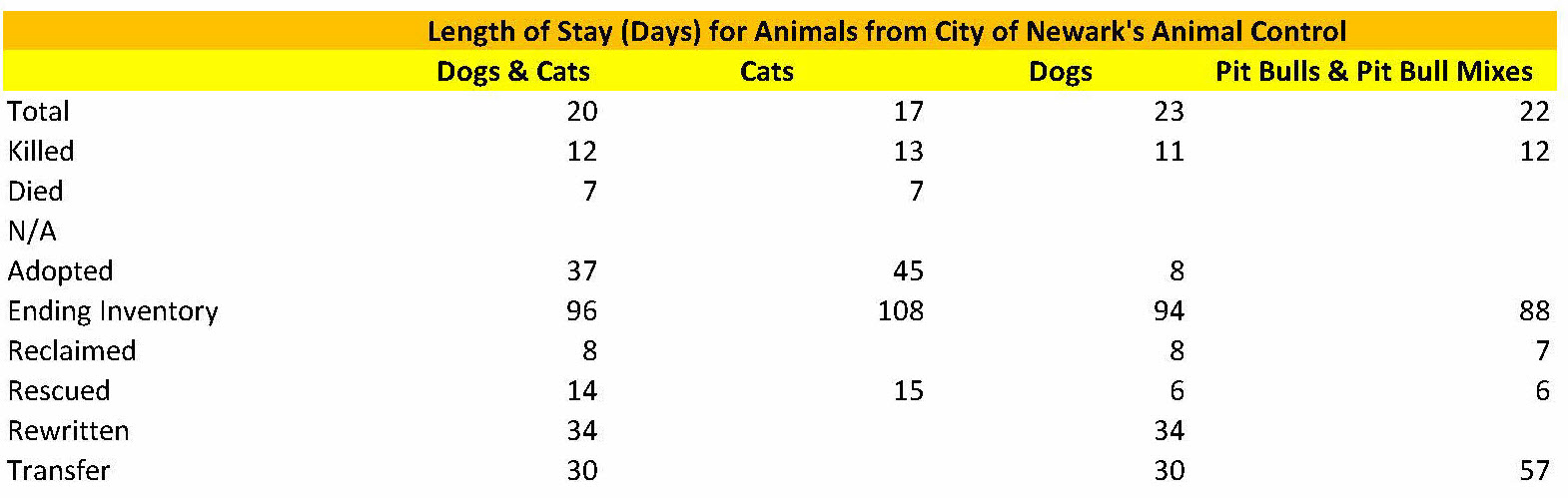
AHS-NEwark Jan 2014 LOS for Newark

After AHS-Newark took over the cities and towns formerly contracting with Linden Animal Control in November 2014, AHS-Newark killed cats and dogs impounded from Newark Animal Control in this data set much more quickly. Despite Mr. Crawford’s assertion in early February 2015, AHS-Newark rapidly killed cats and dogs impounded from Newark Animal Control in this data set two months before he made this outlandish claim. Based on my review of these records, AHS-Newark killed cats and dogs impounded from Newark Animal Control in December 2014 within 13 days and 11 days on average:

AHS-NEwark Dec 2014 LOS for Newark

As a result, AHS-Newark’s assertion that it keeps many animals alive a long time is not consistent with the data I examined for dogs and cats arriving from Newark Animal Control.

Absurd Justifications for Killing

AHS-Newark used many poor excuses to kill animals. The top four reasons AHS-Newark used to kill cats were as follows:

  1. Sick
  2. Aggressive, unfriendly and feral
  3. No reason listed
  4. Ringworm

AHS-Newark’s cats were often sick due to an Upper Respiratory Infection (“URI”) or the common cold. Countless records stated AHS-Newark killed the cat due to the animal “not responding to treatment.” With so many animals getting sick and not getting better, one has to wonder what kind of disease control program AHS-Newark has?

Several examples illustrate AHS-Newark’s inability to medically treat cats with colds. Toots was surrendered to AHS-Newark due to her owner no longer being able to care for her. Despite being a young cat less than 3 years old, AHS-Newark stated they had to kill her within 10 days of arriving at the shelter. While the intake and disposition record states Toots was not responding to treatment for her URI, the veterinary log on this record only mentions the standard vaccinations, deworming and Frontline flea and tick medication received on the day she arrived at AHS-Newark. The veterinary log then mentions she was poisoned to death with Fatal Plus 10 days later. Call me crazy, but I don’t see any documentation of any additional veterinary treatment for her URI on this record.

ID 128745 Killed for URI

Brooklyn was an 11 month old cat described as “very sweet” by AHS-Newark. Yet, within 11 days of arriving at the shelter, AHS-Newark killed her due to a “very bad URI” that did not get better. However, once again the veterinary log on this record did not describe any specific treatment for her cold after her vaccinations on the day she arrived.

ID 129234 Killed for URI

Moonlight was a 15 month old stray cat and described by AHS-Newark as “very beautiful, sweet and trusting” and “wants love and attention.” Yet, AHS-Newark killed her 16 days after her arrival at the shelter due to her having a “URI” and being “weak and lethargic.” Other than two rounds of the standard shelter vaccinations and deworming, AHS-Newark once again provided no other treatment specifically for the URI per the veterinary log in this record.

ID129667 URI Cat

The records did not indicate AHS-Newark sent any of these cats to an isolation area for treatment, reached out to any rescues or tried to place the animals in foster homes to recover from their illness. Thus, AHS-Newark failed all three cats, as well as many others, who were highly adoptable.

AHS-Newark labeled many cats feral and/or unadoptable for dubious reasons. Notably, the shelter provided inadequate amounts of time to socialize fearful cats who were justifiably scared in this high kill shelter. Furthermore, I saw no efforts to socialize virtually all of these cats on their records. In fact, AHS-Newark often classified owner-surrendered cats, who presumably lived in or around homes, as feral or otherwise unsuitable for people to adopt. For example, Baby Girl was a 3 and half year old cat surrendered due to her owner moving. AHS-Newark labeled this cat a “wild” and killed her within just 8 days of arriving at the shelter. In addition, AHS-Newark did not vaccinate her upon intake and therefore increased the risk of disease among the shelter’s cat population.

ID 129063 OS Cat Killed for Feral

Me Me was surrendered by her owner due to the owner not having room for the cat. Once again AHS-Newark labeled the cat as “wild”, did not vaccinate her, and killed her within 9 days:

ID 1208046 OS Cat Killed Feral

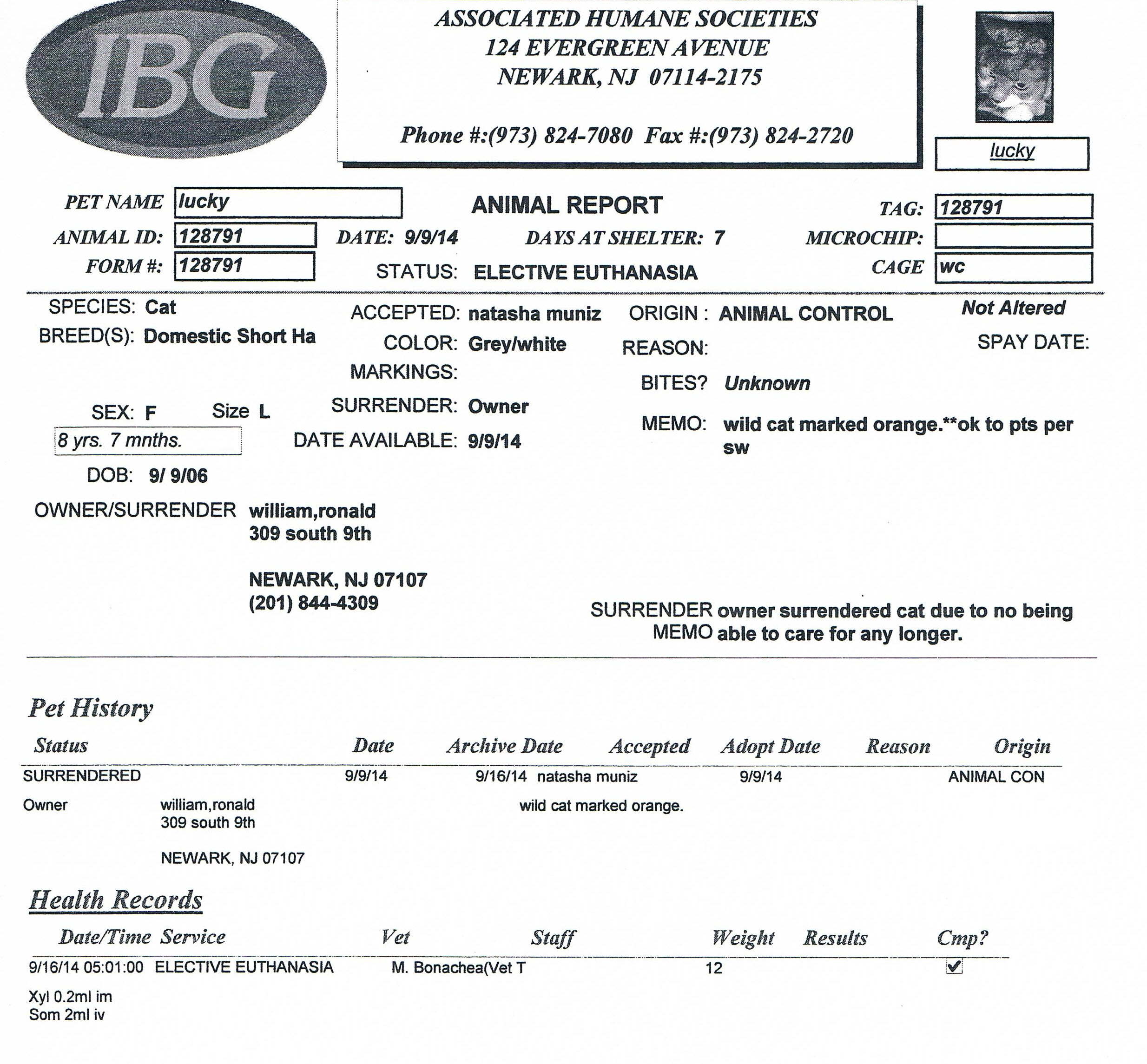
Lucky, who was nearly 9 years old, was surrendered due to her owner not being able to care for her any longer. Despite this cat most likely having lived in or around a home for many years, AHS-Newark labeled her as “wild”, did not vaccinate her, and killed her after just 7 days.

ID 128791 Feral Cat Killed

Thus, AHS-Newark’s labeling of cats as feral, aggressive and otherwise unadoptable is highly suspect.

AHS-Newark used a “throw everything but the kitchen sink” approach to justify the mass killing of dogs. Often times the shelter listed multiple boilerplate reasons, like aggression (including “cage crazy”/”not kenneling well”), dog aggression, sick, etc. The top five reasons AHS used to kill dogs were:

  1. Aggression related issues
  2. Sick
  3. Dog aggression
  4. No reason listed
  5. Overcrowded

While certainly some dogs likely were truly aggressive, many dogs labeled as such did not seem that way. Sadie was a nearly 4 year old pit bull mix with a very good behavioral evaluation. The evaluation stated Sadie was “playful, loving and affectionate once she gets to warm up.” The evaluation also stated Sadie “allows you to handle her from head to tail without complaint” and “she is easy taking treats and likes to share her toys.” Yet, just over one month later, “SC”, who I presume is AHS Assistant Executive Director, Scott Crawford, approved her killing for “becoming temperamental.” The record provided no elaboration on what her exact problems were nor did the record document any efforts to rehabilitate her.

ID 125906 Dog Killed Aggression

Sadie2

Billy was a 2 year old Plott Hound-Boxer Mix. The dog’s evaluation stated he did not behave well inside his kennel, but “all you have to do is take him outside and he is a totally different dog.” Billy’s evaluation went on to say “he is fine with being handled all over” was “gentle with treats”, had “a great food test” and “seemed fine with the other dogs outside.” Despite this very good evaluation, AHS-Newark decided to kill him exactly 3 weeks later for being “extreme cage crazy”, “becoming hard to handle”, “doesn’t show well” and “no dogs.” AHS-Newark couldn’t even take the time to write a proper sentence to justify killing this young dog. The record provided no documentation that AHS-Newark tried to alleviate his kennel stress or perform any other efforts to rehabilitate him. Simply put, the record indicates AHS-Newark killed Billy for convenience as he didn’t “show well” and was “hard to handle.”

ID 122530 Dog Killed

Billy 2

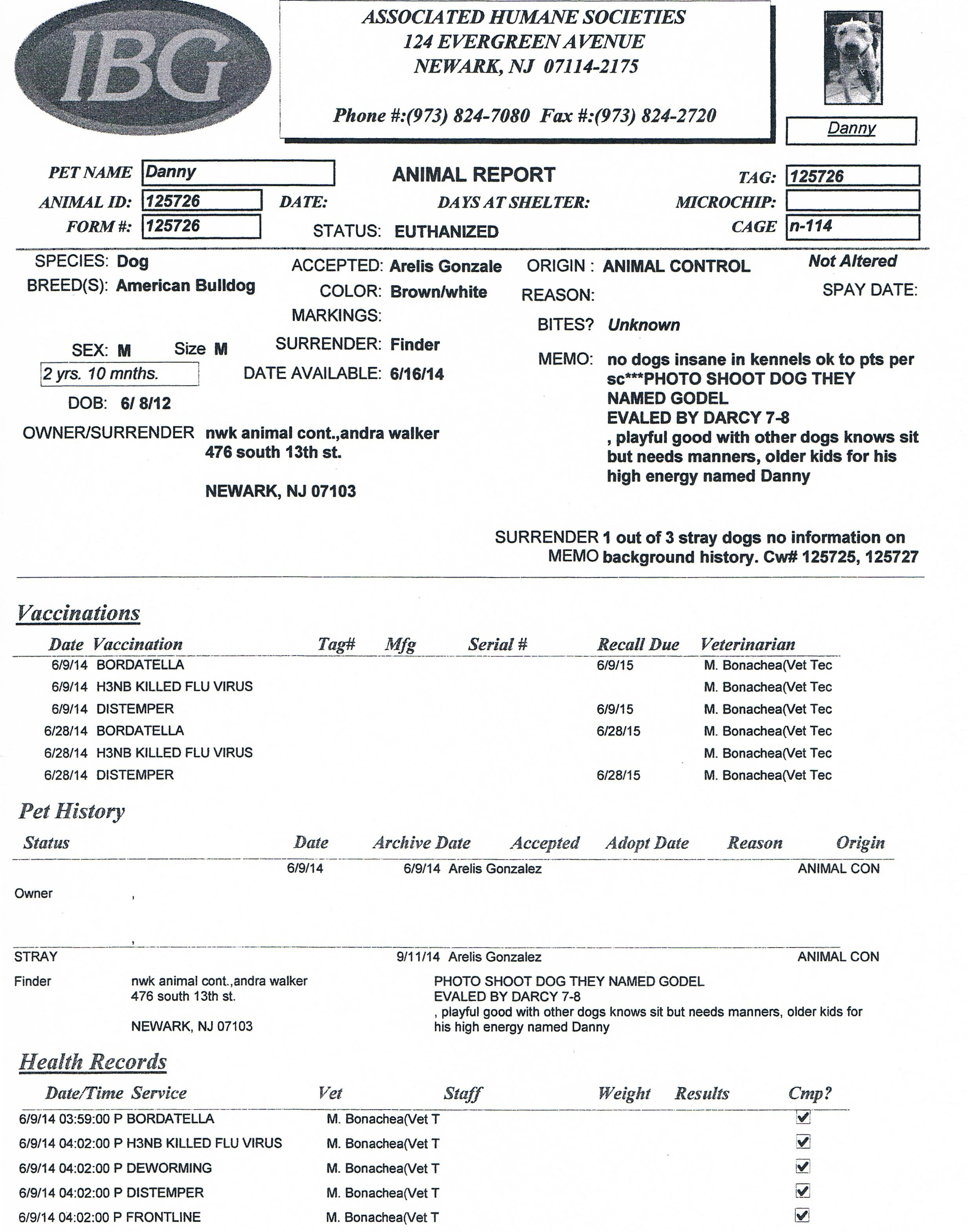
Danny was a nearly 3 year old American Bulldog. He had a good evaluation stating he was “playful”, “good with other dogs”, “knows sit”, and “needs manners.” In other words, Danny was a big playful puppy. In addition, his record states he was a “photo shoot dog.” Just over two months after Danny’s evaluation, AHS-Newark killed Danny and justified it by stating “no dogs” and “insane in kennels.” Once again the record mentions no actions to provide any enrichment to Danny. It doesn’t take a rocket scientist to determine that a high energy dog needs stimulation and exercise. Also, the record provides no details on Danny’s alleged dog aggression which is contradicted by his behavioral evaluation. Even more disturbing, AHS-Newark killed one of the few dogs in this data set with an evaluation (less than 10% of dogs and virtually no cats had an evaluation) and included in a photo shoot. If AHS-Newark kills dogs in the spotlight, what chance do the vast majority of animals that are never seen or heard have?

ID 125726 Part 1

ID 125726 Part 2

AHS-Newark’s practice of killing massive numbers of dogs for aggression related issues clearly needs to stop. While some dogs coming into a shelter are a serious threat to people and their problems will not satisfactorily respond to rehabilitation efforts, well-run animal control shelters typically find 5% or fewer of dogs fall into this category. In this data set, AHS-Newark killed 26% of their dogs for aggression related issues plus a number of others for dog aggression. As a result, AHS-Newark is unfairly labeling dogs as aggressive.

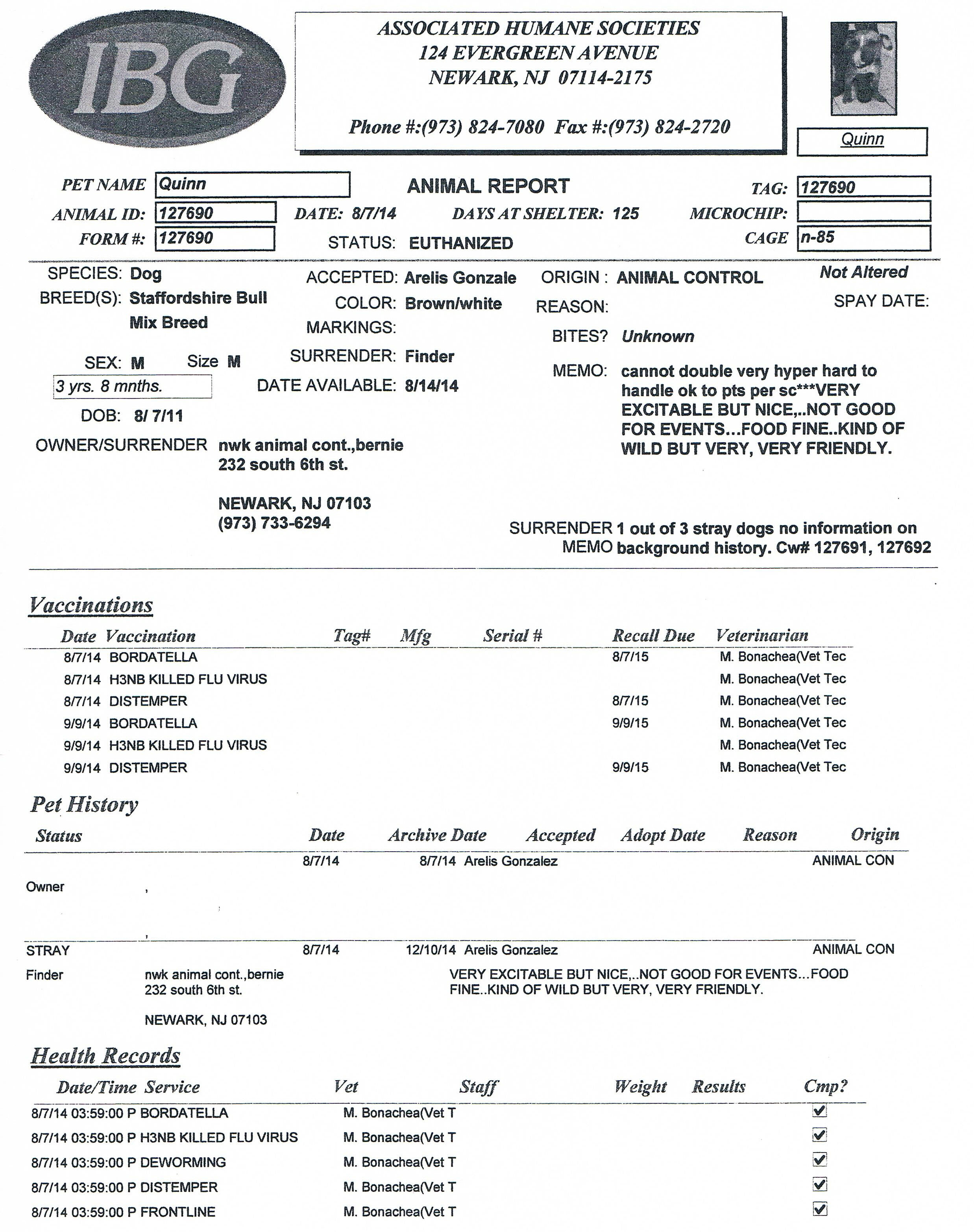
AHS-Newark also killed dogs due to lack of space. Qunn’s intake and disposition record described him as “very excitable, but nice” and “kind of wild, but very, very friendly.” Despite this, AHS-Newark killed Quinn for not being able to place him with another dog in a kennel and him being “hyper” and “hard to handle.” The record provides no evidence that AHS gave Quinn any exercise let alone enrichment. Furthermore, AHS-Newark killed Quinn during December which is typically one of the lowest intake months for shelters. Even worse, AHS-Newark killed Quinn for lack of space less than two months before Scott Crawford bragged about his shelter’s large capacity.

ID127690 Killed Pt 1

ID127690 Killed (2)

Red was a 16 month old dog surrendered to Newark Animal Control by his owner. After just 8 days, AHS-Newark killed him for having a cold and the isolation area being full and for allegedly not being able to house him with other dogs. The intake and disposition record provides no evidence AHS-Newark gave any specific treatment for his URI other than a canine flu vaccine upon intake. AHS-Newark killed Red due to a lack of space just two and half months before Scott Crawford boasted about his shelter’s ability to house lots of animals.

ID130711

Rambo was a “friendly stray dog” who was killed due to overcrowding. AHS-Newark identified the owner and apparently talked with her. For whatever reason, the owner did not reclaim the animal. AHS-Newark killed Rambo in December, one of the lowest intake months for most shelters, due to “no dogs”, “no response” to the letter to his owner and the main kennel being full. Once again Scott Crawford decided to kill a “friendly” dog due to lack of space just two months prior to him bragging about the large amount of animals his shelter could hold.

ID129821

AHS-Newark also killed many dogs for no documented reason. Pamtera was apparently abandoned in an apartment. AHS-Newark often publicizes these types of cases in fundraising appeals. After 11 days, AHS-Newark killed Pamtera for no reason other than it being “ok to pts per kp.”

ID130032

Dog ID# 130078, like most of the animals I reviewed records for, had no name. She was a 6 year old and 5 month old small terrier mix. After just 8 days, AHS-Newark killed her once again for no reason other than being “ok to pts per kp.” Even worse, this record did not state how AHS-Newark killed Dog ID# 130078.

ID 130078

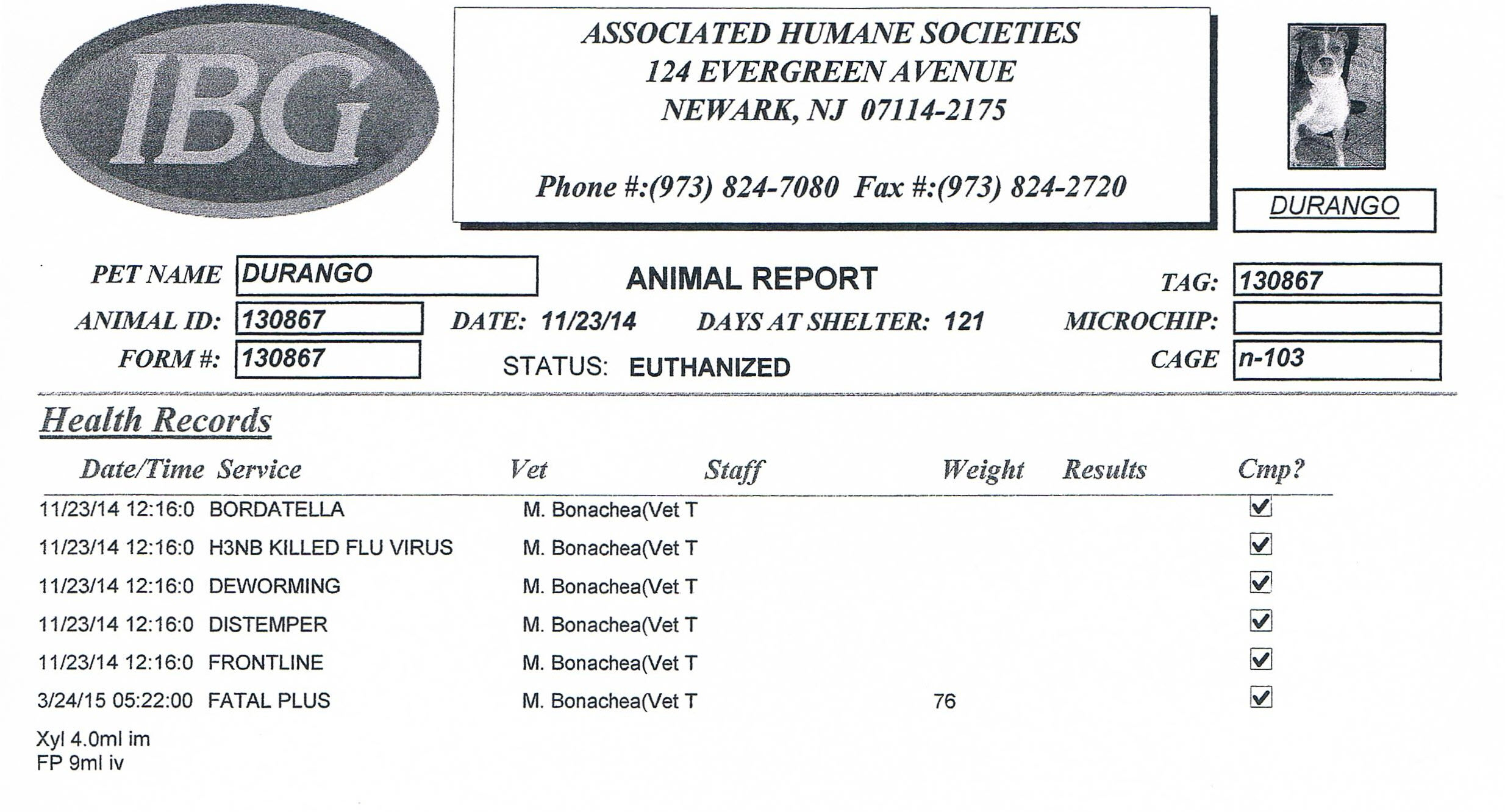
Durango’s evaluation described him as “sweet and affectionate”, “very focused and loving towards all people, but he doesn’t like other dogs”, “genuinely loved to give and get attention” and “a handsome boy with knockout gorgeous eyes.” Furthermore, his intake and disposition record states in bold and in caps “Humane News – February”, “Petfinder”, “Facebook”, “Do Not PTS.” In other words Durango was a fantastic dog and was one of the few dogs AHS-Newark intended to promote. Despite all of these great things going for him, AHS-Newark killed Durango for no reason according to this record.

ID130867

ID 130867

AHS Hands Animals Over to a Rescue Subsequently Convicted for Animal Cruelty

AHS-Newark has a difficult adoption process in my experience. Typically, AHS-Newark makes people visit the shelter multiple times to adopt an animal. Often, this process can take a number of days. As a result of these policies, animals stay too long at the facility and this increases the chance the shelter will kill animals due to lack of space.

Gabriel Ganter (formerly Gabriel Palacios) was recently convicted of animal cruelty. Ms. Ganter ran Pit Bull Kisses rescue out of Newark until she moved to Dumont. On May 13, 2015, the Bergen County SPCA raided her Dumont home and found dead dogs in garbage bags, a live dog and starved cat on chains without proper shelter (warning: the photos in this link are deeply disturbing). Furthermore, one official stated the conditions insider her house were “horrid.” Ultimately, Gabriel Ganter pleaded guilty to not providing necessary care to animals this month.

Gabriel Ganter’s Pit Bull Kisses Rescue rescued the most animals of any organization in this data set. Pit Bull Kisses rescued 16 of the 35 dogs and cats rescued in the records I reviewed. In all fairness, many people in the animal welfare community were duped by Gabriel Ganter. However, Ms. Ganter began acting erratically in the summer of 2014 and AHS-Newark should have known this. Sadly, AHS-Newark still allowed Pit Bull Kisses to rescue the following dog and cat after this point:

PBKR D1

PBKR D2

PBKR C

We can only hope this unnamed dog and cat went to other foster homes rather than Gabriel Ganter’s house of horrors.

AHS Fails Newark’s Stray Animals

The sheer amount of killing is mind boggling. Nearly 1,300 dogs and cats just from the City of Newark lost their lives after arriving at AHS-Newark in 2014. Furthermore, that number most likely would be higher if I obtained the records of the over 200 missing animals not provided to me. To put it another way, around 4 dogs and cats just from the City of Newark lose their lives at AHS-Newark on average each day of the entire year. 84% of the dogs and cats in this data set who came into AHS-Newark in 2014 and had outcomes lost their lives. For these animals, AHS-Newark is a slaughterhouse rather than a shelter.

The underlying records I examined reveal no substantial effort to end this pet extermination project. Massive numbers of animals get sick with treatable illnesses and AHS-Newark still kills them. The records I reviewed did not indicate the shelter often seeks foster homes or even places many sick animals in isolation areas. Even worse, not only do animals typically not receive behavioral rehabilitation, but AHS-Newark seems to actively classify animals as aggressive to justify killing those creatures. Worst of all, AHS-Newark placed such a low value on the lives of these animals that shelter staff couldn’t even write complete sentences or even spell correctly on many of these records. When you can’t take the time to properly document the animal’s information on its record, what hope do we have that you will invest the time and energy into saving that dog or cat? Now, perhaps these records are inaccurate, but that raises even more questions? If your records are inaccurate, why should we believe anything you claim?

Clearly, AHS-Newark should never have contracted with additional municipalities when it already killed far too many animals. Frankly, AHS-Newark should have sought ways to reduce intake rather than deliberately bring in more animals in exchange for more animal control and sheltering contract fees. While all three AHS facilities have more than enough space to save its dogs and cats, AHS fails to enthusiastically implement proven programs and policies to perform at these levels. As such, AHS-Newark should have terminated rather than have added animal control and sheltering contracts.

Donors Must Hold AHS Accountable

Donors should demand AHS-Newark comprehensively adopt the no kill equation as countless other animal control shelters successfully have. Animal control shelters in Kansas City, Missouri, Austin, Texas, and Salt Lake City, Utah achieved no kill status and even save around 90% of their pit bull like dogs. Other animal control shelters in poor urban areas, such as in Washington, DC and Baltimore, Maryland, are close to achieving no kill. All of these animal control shelters take in more animals in total and on a per capita basis than AHS-Newark. Additionally, most of these shelters receive less revenue per animal than AHS. Thus, AHS-Newark should do great things.

At the end of the day, donors must wake up and demand AHS change its ways. Apparently, AHS thinks it can dupe its donors into thinking most of the animals it impounds from Newark are heroically rescued and sent to loving homes. Based on the records I reviewed, this absolutely is not the case. AHS must remove its entire senior leadership team, including Roseann Trezza, and replace them with people dedicated to comprehensively implementing the no kill equation. The good people donating to AHS clearly expect the organization to save its animals. It is time donors require AHS to use their hard earned money to save animals and not kill them for convenience and cost savings.

Racism in Rescue

Racism is one of the dirty little secrets in the sheltering and rescue community. From my experience, some people in the animal welfare community hide behind the claim of protecting animals to justify racist attitudes. Even worse, such attitudes result in more shelter killing.

Several incidents opened my eyes to the issue of racism in animal welfare. While I volunteered at an urban animal control shelter with a high kill rate, a fellow volunteer took several dogs to a Boys and Girls Club in the city the facility was located in. After the event, the volunteer felt great as a number of dogs received some very good applications from families who were minorities. Subsequently, the shelter denied every single application for no good reason. Another time I helped organize an adoption event for a different shelter, which had many dogs spending years at the facility, in a middle to upper middle class community where around 45% of the population is black or Hispanic. During the event we met many potential adopters and the pet store chain was going to allow us to hold adoption days every weekend. Subsequently, a high ranking person at the shelter told us that we would not return to the location because they “didn’t like the element.” After several failed attempts to get that person to explain what they meant by “element”, we were told to drop it and the decision was final. We’ve also helped organize an adoption event that is part of a street fair for several years in a nice section of a large city. Despite having lots of people going to this street fair year after year, we’ve had great difficulty getting many local rescues and shelters to attend. While these animal welfare groups never said it was due to the location, I no doubt believe this is the reason they did not attend. Thus, I’ve directly experienced overt racism in my volunteer experience at animal shelters.

Additionally, I’ve seen shelters and rescues belittle people in urban areas. For example, Associated Humane Societies Assistant Executive Director, Scott Crawford, shared a joke that people shouldn’t go to Newark, which is where his organization’s largest shelter is located, since its a “shadowy place.” Similarly, I’ve seen rescues call urban areas around shelters they pull animals from as “ghettos.” In fact, I’ve even seen some rescues express deep sorrow that animals at high kill shelters were returned to their owners in urban areas.

The sad incident of Quattro the cat also brought out some nasty racial tensions. Last year, a 12 year old, a 10 year old and a 6 year old boy stoned a cat to death in a horrific incident in Paterson. Local animal advocates were rightfully appalled. However, online comments became so racist and vulgar that the local newspaper had to delete many of them. The animal advocates demanded all 3 boys, including the 6 year old, be charged with animal cruelty. While I certainly agree with prosecuting the older boys, I find it hard to believe that a 6 year old, who was in the presence of 2 much older boys, should have had been charged with this crime.

Subsequently, local animal advocates held a rally for Quattro in Paterson and local residents clashed with the animal activists. While I certainly understand the motivations to hold the rally, I think it was counterproductive to animal welfare in Paterson. Paterson Animal Control kills hundreds of dogs each year at its shelter and acts in secrecy. Those very residents that clashed with animal welfare activists need to become advocates for the many animals being killed at the so called city shelter. Rightly or wrongly local residents equated the racist online comments with the animal welfare activists’ desire to charge all 3 children with animal cruelty. Additionally, the Paterson residents felt the animal activists were outsiders and were ignoring the very real issue of children being killed in the city. Clearly, this effort did not help many Paterson residents become sympathetic to the cause of animal welfare despite the organizers’ good intentions.

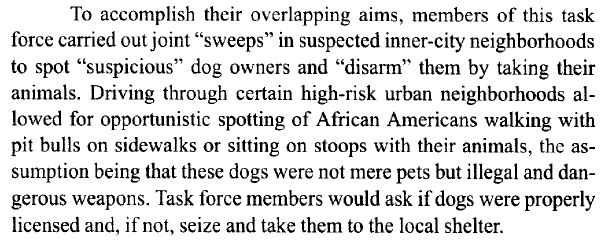
Humane organizations until fairly recently used to profile black pit bull owners and seize their dogs. In 2003, Sociologist Arnold Arluke published an article titled “Ethnozoology and the Future of Sociology,” in The International Journal of Sociology and Social Policy. The following extract from that article provides a frightening summary of this practice:

Seizing Black Pit Bull Owners dogs

Kim Wolf, who formerly worked at Animal Farm Foundation and currently runs an organization supporting inner city pet owners, rightfully explained that this practice led people in the inner city to distrust animal welfare organizations. After all, if humane organizations are seen as groups that will steal your family member and likely kill them in the process, then how can you expect people in inner cities to support animal shelters and rescues?

Racism may also happen unconsciously in ways we are not aware of. Research over the last two decades on implicit or unconscious bias has shown almost all people naturally discriminate in many ways. In fact, 20% of large companies in the United States even have training classes on this topic. Basically, our brains evolved to make split second decisions to help us avoid dangers. During prehistoric times, our brains needed biases to make these quick decisions, such as hiding from or attacking anything unfamiliar to us. In the modern world, these biases can have nasty effects, such as wrongly denying a qualified minority a job, a promotion or a shelter animal. The key thing is nearly every person has these biases and it does not mean everyone is a racist. However, people need to always step back and review their actions and try to uncover their natural biases that may have negative unintended consequences. For example, if a shelter or rescue refuses to adopt out an animal to a young black or Hispanic man from an urban area, is it for legitimate reasons or is it simply unconscious bias? Thus, shelters and rescues should become aware of their own natural biases and work to eliminate those that serve no legitimate purpose for animal welfare.

Racism’s Deadly Consequences for Homeless Animals

Rescues and shelters must increase their market share to end the killing of healthy and treatable animals. Approximately 17 million people in the country will acquire a dog or cat each year and would consider obtaining that animal from a shelter or rescue. Around 3 million dogs and cats are adopted while about 3 million of these animals are killed in shelters each year. If shelters can increase their market share from 3 million to 6 million of those 17 million potential homes, shelters will no longer kill healthy and treatable animals. Thus, shelters and rescues must persuade 35% of these 17 million people to choose to adopt.

Animal welfare organizations must make in-roads in under-served communities to increase market share to end the killing of healthy and treatable shelter animals. According to HSUS, 30% of dogs and cats in American homes came from a shelter or a rescue. On the other hand, in poor or under-served urban communities, which have very large minority populations, only 3% of owned dogs and cats came from shelters or rescues. 71% of people in these areas acquire their dogs from family, friends, neighbors or breeders. Furthermore, HSUS stated that they are seeing pet stores, which obtain puppies from cruelly bred puppy-mill dogs, market more aggressively to people in poor urban areas through things such as layaway plans. These facts suggest that a significant portion of the increased market share needed to end shelter killing must come from minority groups living in poor urban areas.

Increasing market share in poor under-served communities will raise spay/neuter rates and improve the welfare of pets. HSUS found 87% of dogs and cats in these areas were not altered and most pets had not seen a veterinarian. However, HSUS noted poor urban areas had no veterinarians, and even when present, these veterinarian offices were often far away and hard to reach for pet owners. If shelters adopt out dogs and cats to pet owners in under-served areas, these folks will have spayed/neutered rather than intact animals and the homeless pet population should decrease over time. Furthermore, shelters can build relationships with pet owners in poor urban areas through adoptions and can then help these folks access low-cost veterinary care. Thus, shelters and rescues can help end shelter killing and increase animal welfare by gaining market share in under-served communities.

Sadly, many shelters and rescues refuse to adopt out animals to people in under-served communities. A recent study obtained demographic data from people who adopted animals from shelters and pit bull rescues. Blacks adopted less than 1% of the dogs from the shelters and the pit bull rescues. Additionally, Hispanics only adopted 3% and less than 1% of the dogs from the shelters and the pit bull rescues. On the other hand, whites adopted 90% and 93% of the shelters’ and the pit bull rescues’ dogs. As a comparison, blacks, Hispanics and whites make up 13%, 17% and 63% of the country’s population. Less than 5% of the adopters did not attend college. Also, only 12% and 7% of the animal shelters’ and pit bull rescues’ adopters earned less than $30,000 a year. Thus, the study found few minorities, people with less education, and lower income people obtained pets from shelters and pit bull rescues.

Shelters and rescues need to abandon their fears and reach out to minorities and under-served communities to save lives. While I understand the concerns of shelters and rescues about placing animals in poor communities, I think these fears are grossly exaggerated. HSUS’s Pets for Life program has found people in under-served communities generally are viable adoption candidates. In fact, many people already do informal rescue by taking animals in from the streets. Additionally, HSUS has been able to persuade 74% of people they meet with intact animals in under-served communities to alter their pets and nearly 90% of these folks actually spay/neuter their dog or cat. Downtown Dog Rescue and Beyond Breed documented people lined up for hours to access free/true low-cost spay/neuter services. Certainly, adopters with less economic resources and education need more support, but that outreach already is needed. Like it or not, these folks will obtain a dog or cat from some source. If it is your shelter or rescue, you can then supply them with an altered and vaccinated animal. Perhaps more importantly, you will establish a relationship that can help provide education on pet ownership. Thus, shelters and rescues need to reach out to under-served communities and minorities to save lives and improve animal welfare.

Shelters and rescues need to take proactive steps to reduce racism and save lives. Animal welfare organizations should compare their percentage of minority adoptions and the percentage minorities comprise of the overall population in their areas and set goals to reduce the divergence in these numbers. In other words, if blacks and Hispanics make up 30% of the population in a shelter’s/rescue’s area, the shelter/rescue should strive to adopt out a roughly similar percentage of their animals to these racial groups. Of course, shelters and rescues should do this by reaching out to new adopters who can help the organization save lives. Even if shelters and rescues can’t achieve this perfect balance, there is no reason they can’t improve adoption numbers to minorities and/or those folks who live in under-served areas.

At the end of the day, shelters and rescues have to make a decision whether they want to end the killing of healthy and treatable animals. While a state with a relatively low per capita intake of homeless animals like New Jersey may not need to reach as many new adopters as other areas, we do need to do so if we want a no kill country. Based on the numbers above, our country needs to adopt out roughly 19 dogs and cats per 1,000 people to end the killing of healthy and treatable pets. This per capita adoption rate is towards the upper portion of the range of existing no kill animal control shelters. States with low intake like New Jersey not only need to take care of their own animals, but must help other states as well. We can save these animals, but will rescues and shelters abandon their racial and other biases to do so? Hopefully, the sheltering and rescue community chooses to save more lives and help ease racial tensions.

Associated Humane Societies Spends Exorbitant Amounts of Money on Lawyers

Courtesy of Barry Langdon-Lassagne

Courtesy of Barry Langdon-Lassagne

In my last blog, I detailed Associated Humane Societies’ history of conflicts. As you will see below, this combative behavior may also have severe financial consequences.

Outrageous Legal Expenditures Under Current AHS Leadership

High legal expenses are a sign of poor performance. Organizations may enter into litigation after failing to resolve conflicts amicably. Additionally, organizations may go to court if they conduct significant wrongdoings. In either case, this does not reflect well on an animal shelter. From an animal welfare organization perspective, money spent on legal fees means less resources are available to save animals and care for them.

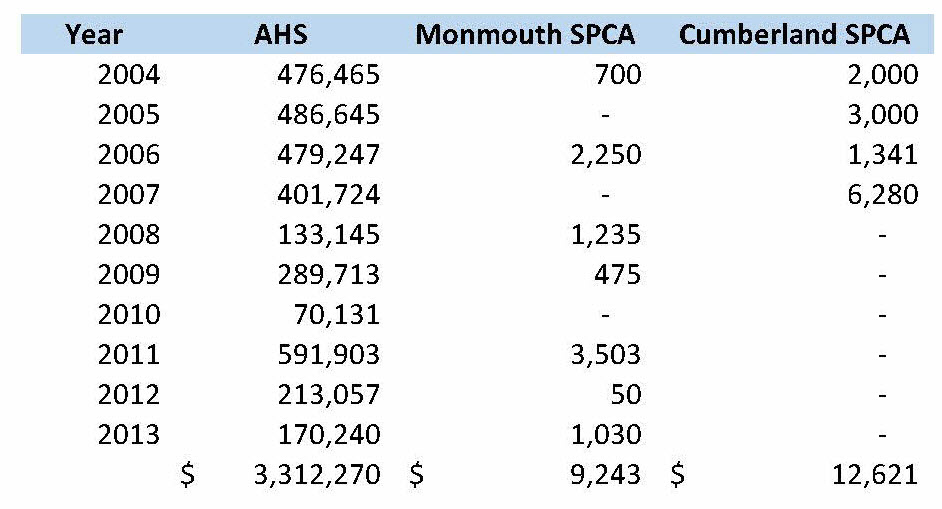
The table below details legal expenses incurred at Associated Humane Societies (“AHS”), Monmouth County SPCA and Cumberland County SPCA over the last decade since Roseann Trezza became AHS’s Executive Director. The two SPCAs are included for comparative purposes since animal welfare organizations could theoretically incur legal costs relating to cruelty cases. AHS incurred 358 and 262 times more legal costs than Monmouth County SPCA and Cumberland County SPCA. To put it another way, AHS spent around $3.3 million more on legal fees than the two SPCAs combined over the last decade.

AHS Legal Fees (3)

While we don’t know exactly what AHS’s legal bills relate to, we do know about some of their disputes during this time period. In 2005, AHS paid $138,057 to settle alleged violations of the State’s Consumer Fraud Act and Charitable Registration and Investigation Act relating to deceptive fundraising practices. In 2003, AHS adopted out a dog who subsequently killed its owner. The dog’s previous owner paid AHS a $205 fee to keep the dog under observation for ten days, then euthanize, and cremate it. AHS subsequently fired an employee who objected to the adoption. The employee’s lawsuit against AHS went on until at least 2007. From 2011 to 2013, AHS fought to take the emaciated pit bull, Patrick, away from the veterinarians who helped save his life. Thus, AHS had plenty of disputes over the last decade.

The Patrick case was particularly appalling. Literally, AHS tried to use the court system to remove Patrick from the only loving home he ever knew since Patrick had “trademark registration number 23699” and was a “very valuable brand for commercial exploitation and fundraising.” While we don’t know how much of the nearly $1 million of legal expenses AHS incurred from 2011-2013 were due to the Patrick case, even 1 cent would be too much to pay.

AHS’s Board of Trustees is a Disgrace

That State of New Jersey Commission of Investigation (“SCI”) report on AHS railed against the organization’s Board of Trustees. The SCI report argued AHS consistently failed to fulfill its role of properly overseeing the organization:

The Board constitutes an ineffectual body that has ignored the mission of AHS to care for the animals and has allowed Bernstein free reign to operate the organization as he pleases.

This report called out AHS’s longstanding practice of putting too many employees on its Board of Trustees. Currently, the BBB Wise Giving Alliance states no more than 10% of a board should be paid staff members or indirectly compensated people. Additionally, the BBB Wise Giving Alliance states organizations should not appoint compensated persons as the chairperson or treasurer.

Despite the SCI report’s criticism, AHS still places too many employees on its board. Rosenna Trezza, AHS’s Executive Director, and John Bergmann, Popcorn Park Executive Director, both serve on the board. Furthermore, AHS’s most recent Form 990 listed Roseann Trezza as President of the Board of Trustees in violation of the BBB Wise Giving Alliance guidance. Additionally, Dr. Adriana Hordynsky also appears to work for AHS and is not listed as an independent Board of Trustees member. Assuming Dr. Hordynsky is an AHS employee, 3 of 8 or 38% of AHS’s Board of Trustees members work for the organization. Thus, AHS’s Board of Trustees still includes too many employees.

AHS’s continued practice of loading its Board of Trustees with employees creates conflicts of interest. Will paid staff members vote for things that are best for the animals, but not for themselves? For example, the Board of Trustees could vote for polices that require more of staff members to save animals. Will those Board of Trustees members vote to add work for themselves? Additionally, will Board of Trustees members who work for Roseann Trezza vote against her? Even if these staff members had employee contracts, its not too hard to imagine ways their boss could make life difficult for them. Thus, AHS’s practice of stacking its Board of Trustees with employees creates huge conflicts of interests.

AHS Board of Trustee member Barbara Lathrop has served for far too long. While AHS lists Ms. Lathrop as “Independent”, I highly doubt that is the case in the real world. Ms. Lathrop has sat on the Board of Trustees since 1976, which included 27 years during the horrific reign of Lee Bernstein. Personally, I think someone who has served on a board for nearly 40 years must be part of the organization’s status quo. Additionally, I’ve noticed Barbara Lathrop defending AHS on social media and even going as far to repeat verbatim AHS’s claim that the volunteers were to blame for AHS suspending the Tinton Falls volunteer program. In fact, in 2001 AHS’s auditors stated the organization should rotate its board members:

We believe that when the terms of certain Board members expire, the Organization should consider bringing in new Board members. This provides the Organization the opportunity to obtain the insights of new members. This would also allow the Organization to develop and further enhance their fundraising efforts and strategies by exposing the Organization to new contacts and ideas.

Two other AHS Board of Trustees members may also potentially have conflicts of interest. If Lynette Bono is the person named Lynn Bono in this article, this Board of Trustees member would be a former employee. This would be consistent with AHS’s past practices described in the SCI report. While a former employee may not have the perverse incentives of a current staff member, it is possible her perspective could be skewed towards management based on her past experience. Assuming Justin Rand is the same person as the Popcorn Park volunteer with the same name, this could also create a conflict of interest if Mr. Rand still volunteers at the shelter. For example, will a volunteer be willing to vote against the Executive Director and Board of Trustees member at an organization known for banning volunteers? Thus, as many as 6 of of AHS’s 8 Board of Trustees members may potentially have conflicts of interest.

While five of AHS’s current Board of Trustees members cannot be blamed for decisions made before their arrival over the last two years, AHS’s board has had a similar structure since 2003. For example, Roseann Trezza, John Bergmann and Barbara Lathrop all served on AHS’s Board of Trustees during the period the legal expenses in the table above were incurred. Thus, AHS’s dysfunctional board clearly allowed this wasteful spending on lawyers.

Donors and Contracting Municipalities Need to Open Their Eyes

Donors and municipalities contracting with AHS should be alarmed at these figures. AHS could have used this $3.3 million to help build a new shelter or at least significantly upgrade its existing outdated facilities in Newark and Tinton Falls. Alternatively, AHS could have spent more on rehabilitating animals both physically and mentally that were eventually killed. Instead, AHS wasted this money on lawyers.

As a donor and a taxpayer, you need to ask yourself how do you want your money spent? Should a significant portion of the money you provide an organization through philanthropic and tax dollars go to the animals or to lawyers? If an organization is so combative that it cannot settle its disputes amicably, what does that say about its compassion and empathy towards the thousands of animals that come through its doors each year? The time has come for AHS to remove and replace all of its senior management and Board of Trustees members with competent and compassionate people. If AHS chooses not to do so, donors and taxpayers should send their money to an organization that will do the right things for their animals.

Associated Humane Societies’ History of Conflicts

Recently, Associated Humane Societies made headlines after it banned volunteers from its Tinton Falls shelter. On Saturday, April 11 I saw a number of social media posts about AHS banning all of its volunteers. On the next day, which ironically fell on the eve of National Volunteer Appreciation Week, the Associated Humane Popcorn Park Facebook page announced AHS suspended the Tinton Falls programs due to alleged misdeeds by the Tinton Falls volunteers. The banned volunteers responded and disputed the shelter’s allegations. While I am not close enough to the situation to comment on the validity of both sides claims, I think looking at AHS’s history of disputes is quite revealing.

Corrupt Start to the Modern AHS Era

Lee Bernstein, who served as AHS’s Executive Director from 1969 to 2003, used highly unethical tactics to raise money for AHS and himself. Bernstein, who was a Newark City Councilman and AHS Board of Trustees member, voted to significantly increase the animal control contract fee Newark paid to AHS in 1968. After this fact became known, Mr. Bernstein faced a recall election to remove him from the Newark City Council. On the day before another Newark City Council resolution in 1969 to increase the fees paid to AHS again, Bernstein told the AHS Board that the new Newark contract was contingent on AHS hiring him as Executive Director for 5 years and paying him a specific salary if Bernstein lost his recall election. Newark residents subsequently booted the corrupt Bernstein from office in the recall election and Bernstein became AHS’s Executive Director.

The City of Newark later won a lawsuit against AHS to render the contract null and void. The judge’s ruling included the following statement:

In the light of the foregoing, the Court is satisfied that the contract of March 25, 1969 had its genesis in a corrupt understanding by which Lee Bernstein would receive employment and be supplied with a regular source of income, in the event that his political tenure (and income) were terminated by the recall election of June 1969. A corrupt understanding that undoubtedly was conceived in the mind of Mr. Bernstein, but to which the other members of the Board of Trustees of the defendant Humane Societies, nevertheless, gave their prior approval and assent.

Ultimately, Lee Bernstein was sentenced to jail for four months relating to this matter. Thus, AHS’s modern history had a corrupt beginning.

Horrific Treatment of Animals During Lee Bernstein Era

In 2003, the State of New Jersey Commission of Investigation (“SCI”) issued a scathing report on AHS. Some of the report’s key findings were as follows:

  • AHS raised massive amounts of money and failed to use enough of it to properly care for its animals
  • Shelters were mismanaged and ruled by then Executive Director, Lee Bernstein, with an iron fist
  • Ineffective oversight by AHS’s Board of Trustees

The SCI report summarized the history under Lee Bernstein as follows:

The history of AHS’s shelter operation has been dominated by deplorable kennel conditions, inhumane treatment of animals by workers, mismanagement and nonexistent or inadequate medical care. The problems were neither singular nor occasional.The accounts and descriptions provided by members of the public and former and current staff members, including veterinarians, paint a bleak picture of shelter life. The reality for the animals belied AHS’s propaganda that its “sole purpose” has been “the care and welfare of animals” and that it has “a high adoption rate.”

One example of Lee Bernstein’s cruelty was when he ordered a veterinarian to use only one needle per animal. Apparently, Bernstein thought the 5 cents savings per animal was more important than the pain an animal endured from being stabbed multiple times with a dull needle:

Bernstein reacted by issuing a memorandum to the veterinarian that “effective immediately, use only ONE needle per animal. . . .

In a responding memorandum, the veterinarian countered that the needles “are not especially high quality to begin with, become much more dull [with one or two passages through a vial’s rubber stopper] and, therefore, more painful to the animal upon injection.” She asserted, “According to you, the cost is $0.03-$0.04 per animal for an additional needle (plus probably at most $0.01 for medical waste disposal) – a bargain for an organization concerned about animal welfare.” She noted that “some shelter personnel are not especially adept at administering injections and a dull needle make[s] the job harder on everyone” and cited a recent complaint by a woman “who was appalled by her cat being stabbed four times before the vaccine was successfully administered at the shelter.” During this timeframe, AHS realized profits in excess of $1 million and had cash and investment balances valued at more than $8 million.

The SCI report stated Bernstein was a firm believer of survival of the fittest when it came to spending money on veterinary care:

His philosophy was that the strong ones would survive and the others would not. Assistant Director Terry Clark also expressed disapproval of her treating shelter animals. In an apparent attempt to dissuade her, Clark stated in one conversation that Bernstein’s remedy would be to euthanize any shelter animals that he finds in the clinic.

While some may say this report is old news, AHS’s current Executive Director, Roseann Trezza, worked at AHS and served on the AHS Board of Trustees for three decades prior to the release of the SCI report. In fact, she was the Assistant Executive Director when the report was released. Popcorn Park Director, John Bergmann, also worked at AHS and was a Board of Trustees member during some of the time period covered by this report. Similarly, AHS Board of Trustees member and Treasurer, Barbara Lathrop, also had been with AHS for 27 years prior to the release of the SCI report. Thus, many people in AHS’s current leadership worked at AHS for many years during the horrible Lee Bernstein era.

Additionally, the SCI report alleged Roseann Trezza helped Bernstein implement his don’t treat the shelter animals plan:

In addition, Dr. Binkowski’s practice of returning animals under treatment to the shelter with instructions to the worker to administer certain medications was thwarted when Trezza issued a memorandum, dated March 9, 1994, to the front office and kennel staff that she was assigning one individual in the front office to “be responsible for dispensing the medication [and that n]o medications are to be held or given out by the kennel staff.” According to Dr. Binkowski, this rule effectively deprived many, if not most of the animals of their medications because the front office employee had numerous other responsibilities and administering to the shelter animals was not her primary assignment.

Finally, Roseann Trezza showed her true colors when AHS published a glowing memorial article on Lee Bernstein in a 2008 issue of the Humane News. Remarkably, AHS made no mention of Lee Bernstein’s egregious acts towards the shelter animals detailed in the SCI report.

Two years after the SCI report was published, AHS paid $138,057 to settle alleged violations of the State’s Consumer Fraud Act and Charitable Registration and Investigation Act. Unfortunately, the settlement agreement only mandated a two year monitoring program to ensure AHS’s compliance.

History of Conflicts with Shelter Veterinarians in SCI Report

The SCI report detailed recurring conflicts between AHS and its veterinarians over the care provided to animals at the organization’s Newark, Tinton Falls and Popcorn Park shelters. The striking thing about these conflicts was the consistency in the accounts from various veterinarians. The following statements by one AHS-Newark veterinarian summarized the theme of all these accounts well:

After you received my letter of resignation, you asked me what it would take to get me to sign a contract. One of the main reasons I am resigning is because insufficient resources are allocated for basic needs – housing, food, and medical well-being of the shelter animals and the operation of the Medical Department. As a result, it is my professional judgment that minimal standards of care are not being met and that delivery of medical care to animals is sorely lacking to the point that animals are suffering. Indeed, I am becoming increasingly alarmed at the level of care provided by AHS which I think is often below the minimal standard of humane care provided by state anti-cruelty laws. Also, I am concerned that AHS is acting negligently toward animal owners and the public that it is supposed to serve. I should state that I have many examples in addition to ones described below which I will discuss with you or any interested party.

Frankly, any animal welfare organization that repeatedly fights with its own veterinarians to provide less care to its animals should get out of the animal sheltering business.

AHS also responded in a defiant tone to the SCI report. The organization did state it would try to improve, accepted Lee Bernstein’s resignation and appointed Roseann Trezza as the new Executive Director. However, AHS also wrote the report was “replete with outdated information, pervasive exaggeration, factual embellishments, and intellectually impossible conclusions.” Thus, I did not leave with a warm fuzzy feeling that AHS was going to become a hunky dory organization.

AHS Throws a Concerned Employee Under the Bus

AHS fired an employee shortly after he raised concerns about a dog that eventually killed an adopter according to court documents. The employee expressed reservations about AHS’s and Roseann Trezza’s decision to adopt out a dog with a serious bite history. The dog’s previous owner paid AHS a $205 fee to keep the dog under observation for ten days, then euthanize, and cremate it. The dog killed the adopter nine days after the adoption in an attack that was eerily similar to the one on the previous owner. After hearing this news, the employee told other workers that he knew this would happen. Two weeks later AHS fired the employee under Roseann Trezza’s orders per the court documents.

AHS allowed another employee to continue working at the organization after he was charged with altering records related to the case. Several months after the dog killed the adopter, Burlington County authorities brought charges against AHS-Newark’s shelter manager at the time, Denton Infield, for allegedly deleting portions of the dog’s records indicating prior vicious behavior. Despite this act, AHS not only continued to employ Mr. Infield for years after this incident, but allowed him to represent the shelter in a number of media interviews.

While I don’t think AHS thought this dog could have killed this woman, the organization’s treatment of the two employees speaks volumes about AHS. The employee who correctly pointed out the issue was fired while the staff member who was charged with tampering with evidence stayed on in a prominent role with AHS. Evidently, loyalty is more important than doing the right thing at AHS.

AHS Fights Against Proposed Improvements from the Animal Welfare Task Force

After the SCI report on AHS and an earlier one on the the state’s SPCAs, Governor McGreevey formed the Animal Welfare Task Force to improve animal welfare in New Jersey. The Animal Welfare Task Force Report made the following recommendations:

  • Update animal cruelty laws
  • Replace the NJ SPCA with specially trained police officers to enforce animal cruelty laws
  • Use low cost financing to build more animal shelters
  • Implement progressive animal shelter policies
  • Make TNR legal and encourage its practice
  • Increase quality and quantity of animal shelter inspections
  • Improve training and oversight of animal control officers

While anyone seriously concerned about animals would enthusiastically support this report, Roseann Trezza came out strongly against a preliminary version. Specifically, Roseann Trezza seemed to parrot PETA, which kills almost all of its shelter animals, with this frightening quote:

“What they want is obviously unrealistic,” said Roseann Trezza, executive director of the Associated Humane Societies, the largest private animal shelter operation in the state with three shelters and a zoo. “In a perfect world, we wouldn’t have to euthanize any animal. But in reality, people do not want to adopt many animals we find and the job of animal protectors is not to merely prolong life, but to relieve suffering,” said Trezza.

To make matters worse, Roseann Trezza appeared to fight against the recommendation to make TNR legal and the preferred practice for dealing with feral cats:

Trezza recited a litany of New Jersey cases––familiar to ANIMAL PEOPLE––involving cat colony caretakers who worked without backups, then died, fell ill, or moved, leaving unfed cats behind.

While I don’t know if AHS opposed TNR for financial or philosophical reasons, the end result was the Animal Welfare Task Force recommendation for TNR never was adopted statewide.

AHS Fights With New Jersey Department of Health Inspectors

New Jersey Department of Health inspectors found horrific problems at AHS in 2009. While I could write an entire series of blogs on these inspection reports, the photos below summarize the conditions very well:

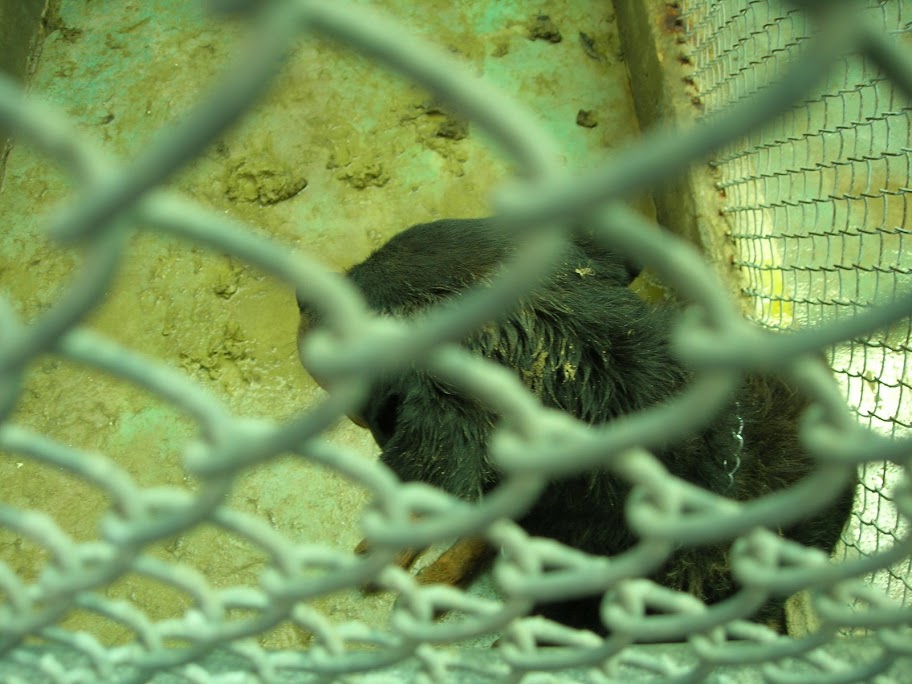
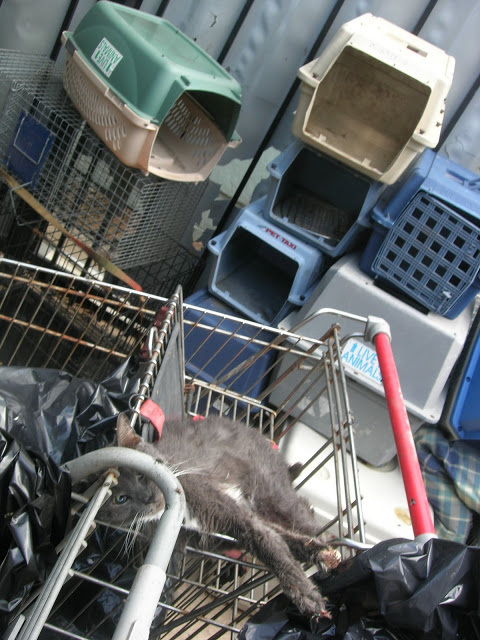
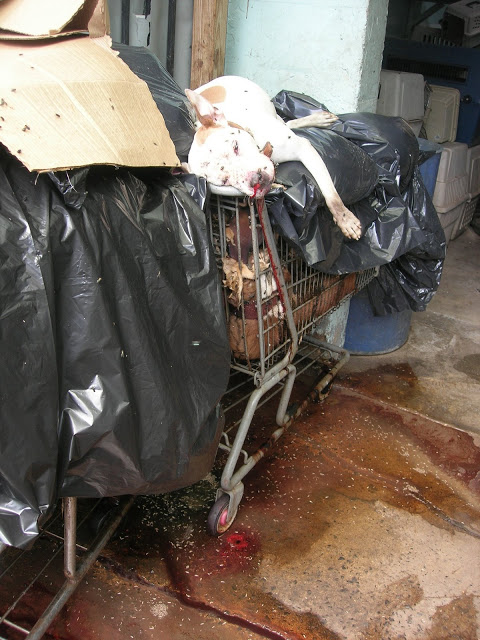
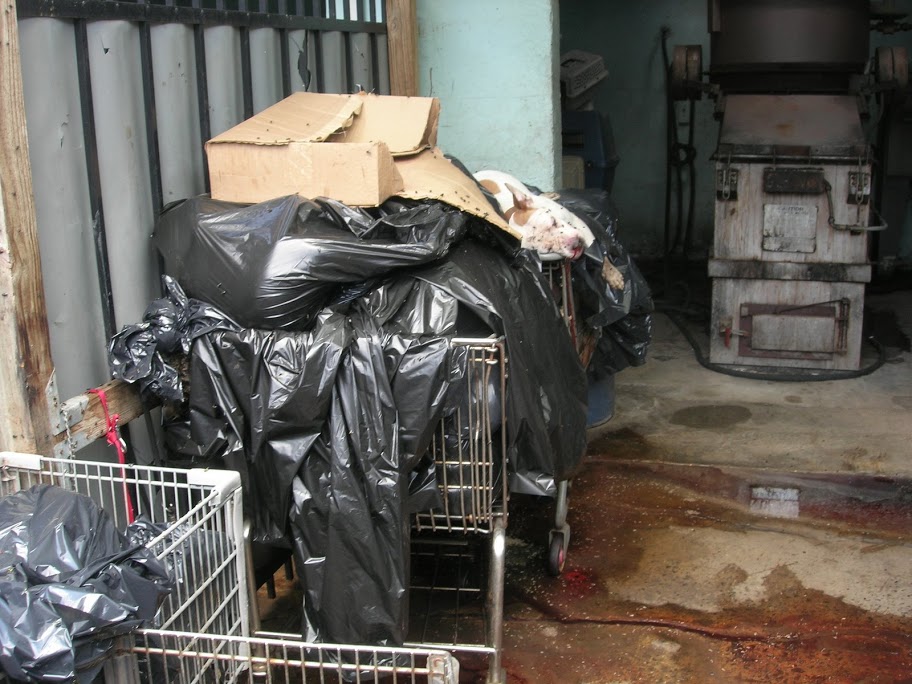
6 Puppy with wounded ears 13 Dogs in feces 14 Dog covered in feces 15 Dogs in dirty kennel 21 Dead animals in shopping cart 24 Closeup of Mange Dog 40 Dead Cat That Was Found in Colony Room 43 Dead Dogs in Shopping Carts. Blood. Maggots 44 Severe Fly And Maggot Infestation

AHS complained the inspectors were just too hard on them. In an interview with NBC New York, Denton Infield, who was charged with tampering with evidence in the dog killing an adopter case six years earlier, basically said dogs are going to poop at night and you can’t prevent them from wallowing in it. Mr. Infield went on to say poor AHS contracts with dozens of municipalities and might close due to potential fines. Ironically, New Jersey animal shelter regulations only allow fines of up to $50 per offense. During that year AHS had a $1.5 million profit and over $10 million in net assets. Clearly, Mr. Infield and AHS were full of it.

Sadly, the New Jersey Department of Health continued to find significant issues during another inspection in 2011. The inspection report noted dogs housed in kennels with a collapsed roof and workers throwing damaged roof material directly over these dogs. Additionally the report stated outdoor drains were in severe disrepair, no isolation areas for sick large dogs existed, automatic dog feeders were filthy, dogs were exposed to contaminated water and chemicals during the cleaning process, and some animals were not receiving prompt medical care.

The following photos were taken during the 2011 inspection:

AHS 2011 Insepction Sick Rottie AHS 2011 Inspection Cakes on Food 2 AHS 2011 Inspection Dog Near Feces in Drain AHS 2011 Inspection Dog Under Roof Construction AHS 2011 Inspection Smeared Feces

Outrageous Fight with Veterinarians and Animal Welfare Activists for Patrick

In 2011, AHS helped rescue an incredibly emaciated pit bull named Patrick. The dog was found in a garbage chute by workers in an apartment building and was rushed to AHS. To AHS’s credit, the shelter’s veterinarian stabilized Patrick and then sent him to a New Jersey veterinary hospital for intensive treatment. After bonding with Patrick, the veterinarians that ran the animal hospital wanted to adopt Patrick.

Instead of celebrating the fact that the severely abused dog finally had a loving home, AHS filed a lawsuit to take Patrick back. The lawsuit stated Patrick was “trademark registration number 23699” and was a “very valuable brand for commercial exploitation and fundraising.” Unsurprisingly, the animal welfare community was outraged by this action. Luckily, AHS ultimately lost the case after a judge awarded custody to the veterinarians who cared for Patrick.

Vicious Fights with Cory Booker

AHS fought with Cory Booker during the Senator’s tenure as Newark’s mayor. In 2011, the former Mayor announced his intention to build a new no kill shelter in Newark. Instead of rejoicing that AHS may have to kill fewer animals with another shelter in the city, AHS trotted out Denton Infield and spewed out all sorts of nonsense about no kill shelters. This nonsense seemed eerily similar to what PETA, which kills almost all of the shelter animals it takes in, says about no kill shelters. Ironically, AHS stated that Cory Booker should give the money he raised to AHS. Newark’s Deputy Mayor at the time, Adam Zipkin, rightfully called AHS on this BS, and cited no kill animal control shelters in Reno, Nevada, Tompkins County, New York, Charlottesville, Virginia, Marquette, Michigan, Berkeley, California, and Austin, Texas to prove Newark can be a no kill community.

AHS again fought with Cory Booker in 2013. This time AHS sent out Scott Crawford who complained former Mayor Booker was “belittling us and causing us problems.” After all, how dare the Mayor question the record of the high kill shelter with such a sordid history in his own city? Deputy Mayor Zipkin stated the city intended to build a new no kill shelter “due to our extreme dissatisfaction with the level of care at the existing AHS facility – and because far too many of the animals are unnecessarily killed there each year by AHS.” Thus, AHS could not get along with the popular mayor of the city where the organization’s largest shelter is.

Repeated Fights with Volunteers

AHS-Tinton Falls banned its volunteers in 1998 after the volunteers complained about poor shelter conditions. When complaints to AHS and the New Jersey Department of Health resulted in no meaningful actions, one volunteer reached out to her Assemblywoman on the matter. Subsequently, the NJ SPCA was contacted and around a week or so later AHS ended its volunteer program at the shelter for “insurance reasons.” At the time, Lee Bernstein said the volunteers complained about shelter conditions because they were just bitter about being banned. The volunteers were ultimately proven right after the SCI report came out citing the deplorable conditions at AHS’s shelters.

AHS-Newark’s relationship with volunteers running two separate “Friends” pages ended in recent years. In 2013, AHS banned the volunteers running the “Friends of Newark NJ Animal Shelter” Facebook page which currently has over 6,700 fans. At the time, the page primarily focused on saving the shelter’s dogs. In 2012, the last full year this page supported the shelter, AHS-Newark reported 15% of its dogs were killed, died, went missing or were unaccounted for. In 2013, after these volunteers were banned, 38% of AHS-Newark’s dogs were killed, died, went missing or were unaccounted for. Subsequent to the banning of these volunteers, another volunteer formed a Facebook page called the “Friends of Associated Humane Society – Newark.” However, the volunteer parted ways with AHS on less than friendly terms in 2014. Thus, AHS has a history of fighting with and banning the very volunteers giving their all to help the organization’s animals.

History Repeats Itself

To be fair, AHS has improved since the Lee Bernstein era. The SCI report did detail Roseann Trezza fighting with Lee Bernstein at times. For example, Roseann Trezza advocated for sending more animals to rescues.

However, AHS has a very long way to go. The organization’s kill rate is still way too high based on recent data. Furthermore, the three AHS shelters only adopted out 14-39 percent and 6-44 percent of cats and dogs that AHS should adopt out based on my recent analyses of the organization’s performance.

At the end of the day, I firmly believe the banned volunteers side of the story verses AHS’s version. This organization’s history of conflict and highly questionable activities is consistent with them banning volunteers for nefarious reasons. George Santayana stated:

“Those who fail to learn from history are doomed to repeat it”

Unfortunately with AHS’s history, fighting with volunteers and other animal advocates is par for the course. Until AHS’s senior leadership is replaced with competent and compassionate people, AHS’s history of not doing right by the animals will continue.

Potential Impact of Large Scale Shelter-Neuter-Return in New Jersey

In my last blog, I analyzed how New Jersey shelters can save the cats coming into their facilities. How would these results change if all New Jersey animal control shelters implemented large scale shelter-neuter-return (“SNR”) programs? Could these programs save municipalities money? What would be the potential lifesaving impact in New Jersey and beyond?

California Shelter-Neuter-Return Program Significantly Reduces Cat Intake and Killing

San Jose, California has offered a low cost spay-neuter program for owned and feral cats since 1994. Under the program, people use a voucher to get any owned or feral cat spayed/neutered, vaccinated, and microchipped for $25. In other words, the city practiced a traditional subsidized trap-neuter-return (“TNR”) program. The public trapped cats, brought them to clinics for spay/neuter surgery, and subsequently released the cats back to their habitats. Despite this program, the local animal control shelter, San Jose Animal Care and Services, still killed over 70% of its adult cats.

San Jose Animal Care and Services implemented a SNR program several years ago. Based on a 2005 survey, 93% of owned cats were altered while just 5.5% of fed community cats were spayed/neutered. As a result of these findings, the city implemented a SNR program to better target the community cat population that continued to breed. Healthy feral and some fearful cats were impounded by the shelter, altered, vaccinated, microchipped, ear tipped for identification purposes and returned to the location where these cats were found. Shelter personnel impounded the cats, performed the veterinary work, and volunteers returned the cats to their habitats. Friendly, shy and some fearful cats did not enter the SNR program (i.e. shy and and fearful cats were sent to rescue or rehabilitated by the shelter).

San Jose Animal Care and Services’ SNR program drastically reduced the facility’s cat intake and killing after starting this initiative. The scientific journal, PeerJ, published a study that documented a decrease in San Jose Animal Care and Services’ cat intake of 29% over the four year study. Additionally, the shelter’s cat kill rate dropped from over 70% to 23% in four years. Furthermore, dead cats found on the streets decreased by 20% over the period presumably due to a smaller cat population resulting from the SNR program. Additionally, the number of cats euthanized for Upper Respiratory Infections (“URI”) at the shelter decreased by 99% over the four year study. Thus, the SNR program significantly reduced cat intake, cat killing and the outdoor cat population.

SNR Program Would Dramatically Increase Life Saving in New Jersey

In order estimate the impacts from implementing similar SNR programs in New Jersey, I used my cat Life Saving Model. As discussed in more detail in my prior blog on how New Jersey animal shelters are performing with their cats, the Life Saving Model computes each shelter’s targeted number of animal outcomes, such as euthanasia, animals sent to rescue, adoptions, and animals rescued from other shelters, based on each facility’s reported capacity and past cat intake. To estimate the impact of a well-run SNR program, I reduced each animal control shelter’s cat intake and owner reclaims by 29% (i.e. the decrease in San Jose Animal Care and Services cat intake). Cat intake and owner reclaims were not reduced at facilities without animal control contracts. The 29% decrease in cat intake assumption is reasonable given San Jose’s preexisting TNR program was likely as or more effective than most New Jersey programs (i.e. San Jose’s $25 low cost spay/neuter fee is lower than the amount New Jersey TNR caretakers typically pay for spay/neuter).

The table below compares the Life Saving Model’s targeted outcomes for the entire New Jersey shelter system based on the most recent number of cat impounds and projected cat intake after implementing a well-run SNR program. The targeted community or New Jersey cat intake decreased by 13,456 cats or 27%. Notably, the targeted number of New Jersey cats euthanized also decreased by 27% due to fewer cats coming into shelters. Additionally, the reduction in cat intake also significantly reduced the targeted number of cats sent to rescue by 6,594 cats or 54%. The extra capacity freed up from reduced New Jersey cat intake would allow shelters to rescue and adopt out at least another 13,777 more cats from out of state shelters or New Jersey’s streets. As a result, well-run SNR programs could significantly increase lifesaving in New Jersey.

NJ Shelter Cats Model for Blog SNR Summary

SNR Significantly Reduces the Number of Cats Needing Rescue from Animal Control Shelters

SNR would allow many space constrained animal control shelters to rely much less on rescues to save their cats. The table below compares the targeted number of cats needing to go to rescues with and without a large scale SNR program at the state’s animal control shelters. Shelters having the largest decreases in cats needing rescue as a result of implementing a large scale SNR program along with their most recently reported cat kill rates (counting cats who died, went missing and were unaccounted for as killed) are as follows:

  • Camden County Animal Shelter – 1,223 fewer cats needing rescue; current kill rate: 67%
  • Gloucester County Animal Shelter – 998 fewer cats needing rescue; current kill rate: 82%
  • Atlantic County Animal Shelter – 882 fewer cats needing rescue; current kill rate: 83%
  • Cumberland County SPCA – 681 fewer cats needing rescue; current kill rate: 72%

Thus, SNR significantly reduces the need for animal control shelters to rely on rescues and rescue oriented shelters.

NJ Shelter Cats Model for Blog SNR s2r

NJ Shelter Cats Model for Blog SNR s2r (2)

SNR Greatly Expands the Ability of New Jersey Animal Shelters to Rescue Cats

SNR would significantly increase the ability of New Jersey animal shelters to save more cats from other facilities and the streets. The table below compares the targeted number of cats shelters should rescue with and without a large scale SNR program at the state’s animal control shelters. The following shelters would be able to increase their targeted number of rescued cats the most:

  • Associated Humane Societies – Newark – 630 additional cats could be rescued
  • Bergen County Animal Shelter – 442 additional cats could be rescued
  • Cumberland County SPCA – 441 additional cats could be rescued
  • Monmouth SPCA – 437 additional cats could be rescued
  • Liberty Humane Society – 397 additional cats could be rescued
  • Associated Humane Societies – Tinton Falls – 346 additional cats could be rescued

Thus, many animal control shelters could not only save their feral cats, but rescue many additional friendly cats as well.

Re

Re (2)

Large Scale and Targeted SNR or TNR Programs Could Reduce Cat Intake Even More in Some Urban Areas

The Veterinary Journal published a study recently detailing the results of a large scale and targeted TNR program. The Alachua County, Florida animal control shelter increased the scale of its existing TNR program in one urban zip code where many of the shelter’s cats came from. Specifically, sterilizations increased from 4-10 cats/1,000 people to 57-64 cats/1,000 people in the target area while an adjacent area (i.e. the non-target area) maintained its sterilization rate of 8-12 cats/1,000 people. This high sterilization rate is important given altering a large percentage of the overall community cat population is critical to reducing the number of outdoor cats. Significant community outreach efforts were conducted, such as mailing information about the program to residents and businesses 5 times over the two year study, volunteers going door to door explaining the program, and TNR program administrators helping solve community cat nuisance problems. After 2 years, shelter intake decreased by 66% in the target area and only 12% in the adjacent non-target region. As a result, we can attribute the 54% (66%-12%) excess decrease in shelter intake as the net impact of this program.

Urban New Jersey animal shelters may be able to reduce their cat intake even further based on the experience in Alachua County, Florida. While some of the decreased shelter cat intake in this one zip code relative to San Jose may have been due to Alachua County spaying/neutering and releasing friendly cats in addition to feral cats, the significantly higher sterilization rate of community cats (57-64 cats/1,000 people in Alachua County verses ~2.5 cats/1,000 residents in San Jose) no doubt played a significant role. In addition to not breeding, sterilized cats tend to roam and fight each other less resulting in fewer nuisance complaints. Fewer nuisance complaints leads to shelters impounding less cats. Certainly, a TNR program at this large of a scale is expensive, but running such a program in a small area, such as single zip code with a large intact cat population, is realistic. Thus, urban New Jersey animal shelters may be able to reduce their cat intake by even more than the tables above suggest.

Large scale SNR and TNR programs are significantly more effective than traditional TNR programs. In the case of many TNR programs, a few volunteers capture cats for the program. Often, animal control shelters still impound feral cats outside of official colonies or just leave unaltered feral cats in the community. The SNR program in San Jose is more effective as ACOs capture feral cats who subsequently are spayed/neutered, vaccinated and returned to their outdoor homes. Similarly, the Alachua County TNR program used massive community outreach to sterilize and vaccinate more of the community’s cats. As a result, large scale SNR and TNR programs alter a greater percentage of the community cat population which ultimately results in reduced outdoor cat populations that are easier for people to live with.

Large Scale SNR/TNR Makes Complete Sense for Municipalities

Municipalities will save significant amounts of money over the long term from implementing large scale SNR programs. Assuming 20% of the cats impounded at New Jersey shelters are feral, that works out to 1.1 cats per 1,000 New Jersey residents. Multiplying 1.1 feral cats by the estimated cost of $72 to perform SNR on a feral cat gives us a cost of $79.20 per 1,000 resident or 7.9 cents per person. Now, let’s assume the average New Jersey community pays $3 per capita for animal control and sheltering. If we assume 50% of these costs are for animal control services and cats make up 2/3 of of these animal control calls (cats make up 66% of stray animals taken in by New Jersey shelters), then a 29% reduction in cat intake would result in a 28.7 cent per resident reduction in animal control costs. The animal control savings of 28.7 cents per residents is nearly four times greater than the 7.9 cent cost to run a SNR program. Furthermore, Maddie’s Fund’s Financial Management Tool estimates it costs around $40 to provide care to adult feral cats/kittens and kill them after the 7 day hold period. Based on New Jersey animal shelters taking in roughly 5.5 cats per 1,000 residents on average, the 29% reduction in cat intake would result in cat sheltering cost savings of 6.4 cents/resident. In other words, taxpayers would save a net 27.2 cents per resident as a result of implementing San Jose’s SNR program. These cost savings exclude likely lower sheltering costs relating to less disease from lower cat intake and increased donations/volunteer services due to lower kill rates. Thus, implementing SNR is a no-brainer from a taxpayer perspective.

SNR also reduces nuisance complaints in the community. Smaller community cat populations are less likely to cause problems. Additionally, altered cats are far less likely to roam long distances in search of mates, and don’t get into loud fights over mating or territory which bother people. Furthermore, the reduction in shelter intake will allow ACOs to respond more quickly to animal control calls for nuisance complaints. Thus, SNR would result in fewer complaints about community cats to local officials over the long-term.

SNR programs are growing in popularity. Unsurprisingly, several other animal control shelters near San Jose also implemented similar SNR programs and experienced similar reductions in cat intake. Clearly, nearby communities are incentivized or pressured to do better when their neighbors do great things. Furthermore, similar successful programs were implemented in Los Angeles, California, Albuquerque, New Mexico, San Antonio, Texas, and the Atlanta, Georgia area. In Albuquerque, cat intake and killing decreased by 39% and 86% after just two years. Thus, large scale and targeted SNR and TNR programs are a major innovation in animal welfare.

Shelters and municipalities need to get behind SNR. SNR will clearly save the lives of countless feral cats, but will also indirectly save many more cats through increased space opening up at shelters and a reduction in disease outbreaks. It is time shelter leaders, the Animal Welfare Federation of New Jersey, and of course the public come together and demand these programs be put into place. We have the evidence and the argument behind us. Now is the time to fight for what is right.

Cat Report Cards for New Jersey Animal Shelters

Cats are losing their lives at an alarming rate in New Jersey animal shelters. Approximately 23,000-24,000 cats or nearly half of the cats coming into New Jersey animal shelters in 2013 were killed, died or went missing. This blog explores the reasons why this tragedy is occurring and whether we can end the massacre. Additionally, I’ll try and answer the question whether shelters need to resort to neutering and releasing healthy friendly cats or not impounding these cats at all to avoid killing cats in shelters.

Model Assesses New Jersey Animal Shelters’ Life Saving Performance

In order to assess how good of a job New Jersey animal shelters are doing, I’ve developed an analysis I call the “Life Saving Model.” While shelter performance is dependent on many variables, such as finances, facility design, local laws, etc., the most critical factor impacting potential life saving is physical space. As a result, my analysis focuses on making the best use of space to save the maximum number of New Jersey cats.

The Life Saving Model measures the number of local animals a shelter should adopt out, rescue from other facilities, send to rescues or other shelters and euthanize to achieve no kill level save rates. The targeted outcomes take into account each facility’s physical capacity and the number of cats the organization receives from its community (i.e. strays, owner surrenders, cruelty cases). I assume a target euthanasia rate, take the number of cats actually returned to owners and then estimate how many community cats a shelter should adopt out. To the extent space runs out, I then calculate how many cats must be sent to rescue. If the shelter has excess space after properly serving its local community, the facility uses that room to rescue and adopt out cats from nearby areas. The targeted results calculated from this model are compared to the actual results from each shelter below.

The Life Saving Model requires a more complex analysis for cats than dogs in New Jersey. Generally speaking, New Jersey animal shelters receive few litters of young puppies who are vulnerable to disease. On the other hand, local shelters receive lots of young kittens, particularly during the April to October kitten season. These young kittens are highly vulnerable to disease and those without mothers require bottle feeding every 1-2 hours. Therefore, these kittens should not be held in a traditional shelter setting and instead need to go to foster homes or a kitten nursery at or outside of the shelter. During the months outside of kitten season (i.e. November – March), my model assumes shelters with enough physical space will be able to place young kittens into their volunteers’ foster homes and/or in a kitten nursery run by the animal shelter. In kitten season with many young animals coming in, I assume a certain percentage of the cat intake will need to go to rescues or other shelters. For shelters who rescue cats, I assume a small percentage of the cats are young kittens who are hopelessly suffering and will require humane euthanasia. Thus, my Life Saving Model is a bit more complicated than the analysis I did for dogs.

To read specific details and assumptions used in the model, please see the Appendix at the end of this blog.

Another complexity in this analysis are feral cats. In an ideal world, shelters would practice trap-neuter-return (TNR) or shelter-neuter-return (SNR) for feral cats only. In TNR, the public or a third party typically does the work and the shelter doesn’t take in feral cats. In the variant of SNR I support, the shelter would take in feral cats, neuter them and release them back to where they were found. Unfortunately, many municipalities prohibit these programs and shelters in these places generally catch and kill feral cats.

Ideally, I would perform two analyses as follows:

  1. Modeling a large scale and targeted TNR program by reducing cat intake at shelters needing to implement TNR or improve their existing TNR programs
  2. Estimating the number of truly feral cats taken in and counting these cats as killed

The first analysis assumes TNR could be implemented and would result in fewer New Jersey cats for shelters to place. In my next blog, I will estimate the impact of a high volume targeted spay/neuter program. Generally speaking, this analysis requires many animal control shelters to adopt out more cats, send fewer cats to rescue, and rescue more cats from other shelters due to the extra shelter space resulting from lower local cat intake. In other words, this analysis would require shelters to achieve higher performance targets.

The second analysis assumes local laws cannot be changed and shelters are stuck receiving unadoptable feral cats. Unfortunately, I do not have the data to calculate the percentage of truly feral cats received at each New Jersey animal shelter. Based on an analysis of Michigan animal shelter data, Nathan Winograd estimated at least 6% of cat intake at Michigan animal shelters are truly feral cats. Similarly, Wisconsin’s Clark County Humane Society 2014 cat statistics show feral cats who were trapped, vaccinated and returned to the community made up 7% of cat outcomes. Based on these numbers and the success of barn cat programs in Pflugerville, Texas and the Maryville, Tennessee area, barn cat programs should be able to save most feral cats in similar communities. On the other hand, California’s Orange County Animal Care reported approximately 24% of the cats it took in during 2012, which was before it practiced TNR, were feral and euthanized. However, I suspect at least some of these cats were fearful rather than truly feral and could have been socialized and eventually adopted out.

My model assumes shelters are doing the proper thing and practicing TNR and placing the reasonable number of feral cats received as barn cats. Obviously, many shelters do take in a good number of feral cats due to poor laws or misguided policies. As a result, the number of New Jersey cats killed may be higher than my model predicts for some shelters.

My model’s results using total cat intake rather than assuming a larger percentage of feral cats will not be too much different for the targeted adoption and euthanasia rate metrics. The Life Saving Model assumes euthanized cats stay at shelters for 8 days (i.e. euthanized immediately after the 7 day hold period). Many shelters will have a lot of extra space free up if more cats are feral and killed since the net impact will be moving local cats from adopted (assumed length of stay of 42 days) to killed (assumed length of stay of only 8 days). This creates extra space that my model assumes shelters use to rescue and adopt out cats from other places. For example, if I assume New Jersey animal shelters have a local cat kill rate of 30% as opposed to 8% due to more feral cats, total cat adoptions (New Jersey plus other states) will only be 2% lower and the kill rate would only rise from 7% to 16% for the New Jersey shelter system. A few space constrained shelters with high feral cat intake would have a significant increase in the targeted number of cats euthanized and a decrease in cats needing rescue due to cats moving from sent to rescue (assumed length of stay of 8 days) to euthanized (assumed length of stay of 8 days). However, on a statewide basis, shelters with excess capacity would partially offset this increase in the kill rate by rescuing and adopting out cats from shelters outside of New Jersey. Thus, the difference between my model’s assumed and actual feral cat intake will not have too much of an impact on the targeted cat adoption number and kill rate.

The following analysis assumes shelters receive a reasonable number of truly feral cats. As a result, shelters can adopt out these cats through a barn cat program. While I realize some shelters do receive greater numbers of truly feral cats, the purpose of this analysis is to examine whether New Jersey animal shelters can handle the number of cats received.

New Jersey Animal Shelters Contain Enough Space to Save Most of New Jersey’s Healthy and Treatable Cats and Many More from Other States

New Jersey’s animal shelter system has enough space to save most of the state’s healthy and treatable cats. The table below details the targeted numbers of cat outcomes the New Jersey animal shelter system should achieve. Out of the 49,163 New Jersey cats coming into the state’s animal shelters in 2013, 31,641 and 12,195 cats should have been adopted out and sent to other shelters/rescues by the facilities originally taking the cats in. However, other New Jersey animal shelters had enough capacity to rescue 37,736 cats or three times the number of cats needing rescue from space constrained facilities. Unfortunately, some of the cats needing rescue, such as very young kittens, should not go to a shelter and still must go to either a kitten nursery or foster homes. That being said, many adult cats are in fact killed in New Jersey animal shelters and many facilities with excess space could save these cats.

New Jersey animal shelters have enough excess space to save many cats from out of state as well. Specifically, New Jersey animal shelters had enough physical capacity to rescue and adopt out at least 25,541 cats from out of state shelters or New Jersey’s streets after achieving a greater than 90% live release rate for cats coming into the state’s animal shelters. In reality, the New Jersey shelter system could rescue more than 25,541 cats from out of state shelters or from New Jersey’s streets given the 25,541 figure assumes all cats needing rescue from space constrained New Jersey shelters are sent to other New Jersey shelters as opposed to rescue groups. As explained above, some of the cats needing rescue from New Jersey shelters with a shortage of space are young kittens which should not go into most animal shelters. To put this number into perspective, New Jersey animal shelters contain enough space to make both New York City and Philadelphia no kill cities for cats and increase those cities’ cat live release rates to 92% as follows (per 2014 data):

  • New York City – 2,366 additional cats need saving
  • Philadelphia – 6,171 additional cats need saving

Certainly, some New Jersey animal shelters do pull some cats from New York City and Philadelphia animal control shelters. Even if I assumed all of the out of state cats rescued by New Jersey animal shelters came from New York City and Philadelphia, that number is only 8% of the number that New Jersey shelters could rescue from New York City and Philadelphia animal control shelters. While some of these cats from New York City and Philadelphia animal control shelters are young kittens which should not go into a normal animal shelter, many other cats could go to New Jersey animal shelters and be adopted out. As a result, the additional number of cats New Jersey animal shelters could save from New York City and Philadelphia is not much lower than the figures above. Thus, New Jersey animal shelters could make New Jersey a no kill state for cats and help other states reach that goal as well.

These adoption goals are quite achievable when comparing the performance of well-run animal control shelters across the country. New Jersey animal shelters would only need to adopt out 7.6 cats per 1,000 people in the state (4.9 cats per 1,000 people if no cats rescued from out of state and all rescued cats were rescued by other New Jersey animal shelters and adopted out). As a comparison, recent per capita cat adoption numbers from several high performing no kill open admission shelters are as follows:

  • Charlottesville-Albemarle SPCA (Charlottesville, Virginia area) – 14.2 cats per 1,000 people
  • Nevada Humane Society (Reno, Nevada area) – 9.9 cats per 1,000 people
  • Williamson County Animal Shelter (Williamson County, Texas area): 9.5 cats per 1,000 people
  • Longmont Humane Society (Longmont, Colorado area) – 8.2 cats per 1,000 people

Thus, many communities are already adopting out significantly more cats than the number I target for New Jersey animal shelters.

Additionally, the adoption target, 7.6 cats per 1,000 people, I set out for New Jersey animal shelters is only slightly higher than the state of Colorado’s per capita cat adoption rate of 6.5 cats per 1,000 people. Given Colorado still has some regressive animal shelters and only a 79% live release rate for cats, Colorado’s per capita cat adoption rate can increase. Thus, the cat adoption targets I laid out for New Jersey animal shelters are quite achievable.

Summary

Cat Deaths Vary Widely at New Jersey Animal Shelters

The goal of any properly managed animal shelter is to save all of its healthy and treatable animals. In some cases, such as selective admission rescue oriented shelters, it is pretty easy to not kill animals. In addition, other animal shelters with easy to service animal control contracts (i.e. few animals impounded) can avoid unnecessary killing due to having lots of extra space. As a result, some shelters may have an easier time than others in preventing killing at their shelters.

The table below compares the targeted and actual number of cats euthanized/killed, and who died or went missing. In order to better compare the targeted and actual numbers, I only calculated the target number (8% euthanasia/death rate) based on the number of cat outcomes at each shelter. The Life Saving Model also targets a 5% euthanasia rate for additional cats rescued, but this would overstate the total targeted number of cats euthanized in this comparison. In other words, the targeted number of euthanized cats would be higher due to more cats being rescued as opposed to having a high kill rate. All cats missing are assumed “dead” based on the assumption they died or went to a very bad place. Shelters having less and more than the targeted amount of cat deaths are highlighted in green and red in the table below.

The overall results show too many cats are unnecessarily losing their lives at New Jersey animal shelters. Based on the assumptions above, 18,877 savable cats lost their lives or went missing at New Jersey animal shelters in 2013. If I only count shelters where actual deaths exceeded the targeted deaths, the number of savable cats who lost their lives rises to 19,078. Obviously, some of these cats are truly feral who require TNR or placement as barn cats, but surely many others could be adopted out. Thus, New Jersey’s shelter system is failing its cats.

Several animal shelters in South Jersey and elsewhere account for a large percentage of the savable cats unnecessarily losing their lives. Specifically, Atlantic County Animal Shelter, Burlington County Animal Shelter, Camden County Animal Shelter, Cumberland County Animal Shelter and Gloucester County Animal Shelter account for 9,707 of the or 51% of the 19,078 cats needlessly losing their lives. Associated Humane Societies three shelters had 2,059 cats unnecessarily lose their lives. Northern Ocean County Animal Facility and Southern Ocean Animal Facility had 1,594 cats lose their lives needlessly in 2013. Bergen County Animal Shelter, which happens to serve many towns in one of the country’s wealthiest counties, had 649 cats unnecessarily lose their lives in 2013. Collectively, these 11 shelters are 11% of the state’s shelters and account for 14,009 or 73% of the cats needlessly losing their lives.

Rescue oriented shelters generally had fewer cats lose their lives than targeted. While saving large numbers of cats is what we all want, some of these shelters may have achieved this result by taking in easier cats. Austin Pets Alive, which is a rescue oriented shelter in Texas, has developed some of the most innovative cat programs and only had a cat live release rate of 93% in 2013. This was due to Austin Pets Alive taking in many cats requiring significant treatment, such as neonatal kittens, from the city animal control shelter. As a result, some of the rescue oriented shelters with significantly fewer cats euthanized than targeted may have avoided taking in many of the more difficult cases.

Several animal control shelters euthanized fewer cats than the number targeted. Denville Animal Shelter, Ewing Animal Shelter, Byram Township Animal Shelter and Wayne Animal Shelter prove municipal animal shelters can avoid killing healthy and treatable cats. Furthermore, Perth Amboy Animal Shelter shows even a poorly funded shelter serving an area with a high poverty rate can avoid killing healthy and treatable cats. Mercerville Animal Hospital, which only reported data from 2012, also euthanized far fewer cats than targeted at its shelter. This shelter had an animal control contract for the first seven months of the year. While St. Huberts – Madison outperformed its targeted euthanasia number, St. Huberts – North Branch underperformed by a greater amount. Humane Society of Ocean County also euthanized far fewer cats than targeted. While Jersey Animal Coalition and John Bukowski Animal Shelter (Bloomfield) reported fewer than targeted cats losing their lives, I do not trust these organizations numbers due to the turmoil at these shelters during this time.
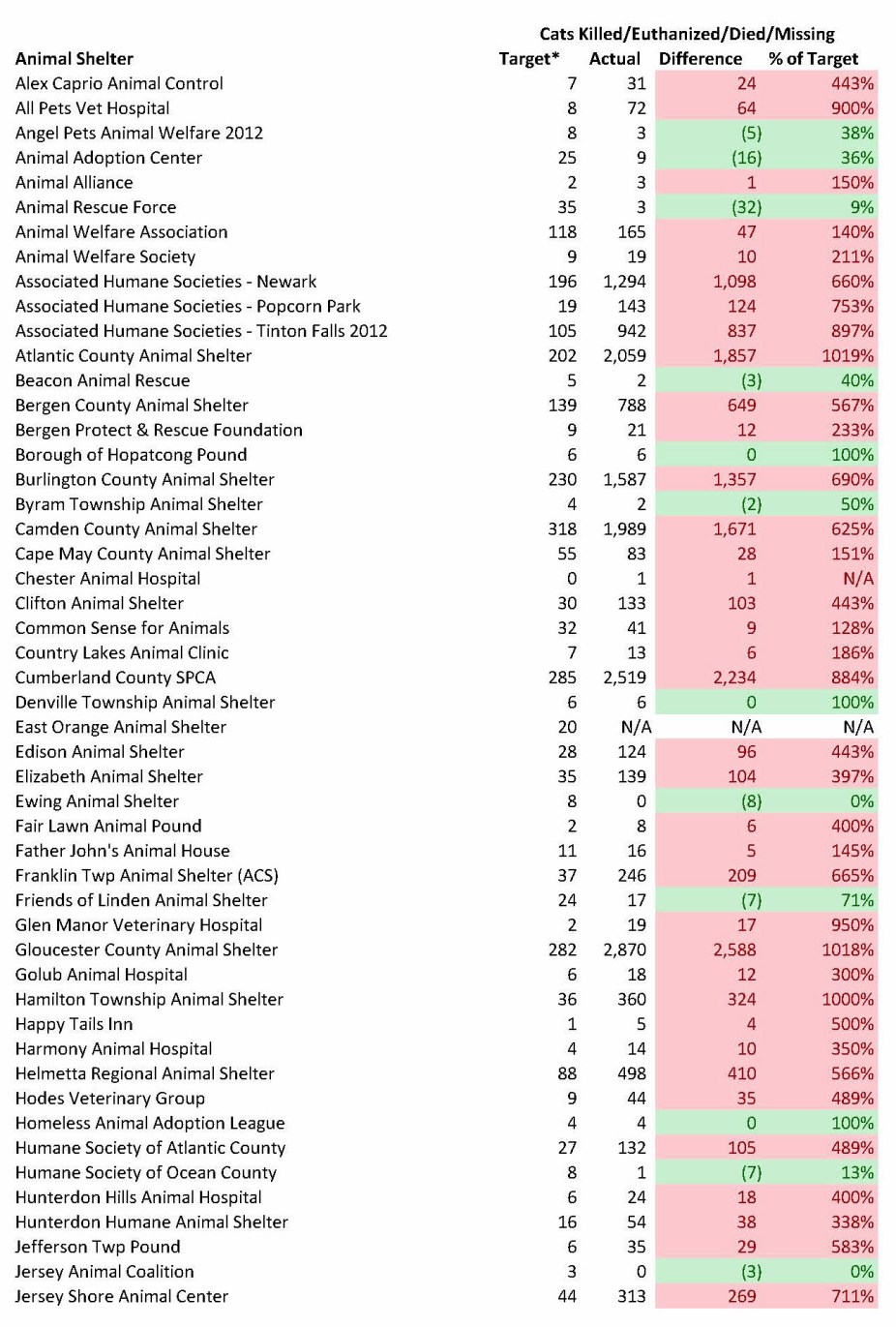
Euthana

Euthana (2)

Euthana (3)

Space Constrained Facilities Not Receiving Enough Support from Rescues and Other Animal Shelters

Some animal shelters will require more support from rescues and animal shelters with excess space than others. If a shelter has relatively high intake and very limited space, it will need more help than other shelters. While sending animals to rescues is a good thing, we do want shelters most needing rescue support to receive that help given rescues have limited resources. The table below compares the number of cats a shelter should transfer to other organizations per the model and the number of cats actually sent to other animal welfare groups. Shelters marked in green are receiving less than the expected rescue support while facilities marked in red are receiving too much rescue help.

Overall, New Jersey shelters are not receiving enough help from other animal welfare organizations. While the overall number of cats rescued was about 37% of the amount needed for the state as a whole, the actual number was 28% since many cats were rescued from facilities which did not require so much rescue assistance. Only 18 out of the 84 facilities received the required rescue support. In other words, only 21% of the animal shelters needing rescue support received the amount these facilities require.

We truly need to understand the reasons for this rescue shortfall. While poor data collection (i.e. shelters classifying rescues as adoptions) may explain part of this rescue deficit, the large size of this number points to other causes as well. For example, New Jersey shelters received 89% of their dog rescue needs, but only 37% of their cat rescue requirements. Certainly, some of these cats are feral and not candidates for most rescues. However, many other cats surely are home-able. Many high kill facilities may not reach out to rescues for cats, such as during kitten season, as much as they do for dogs. This data supports the need for the Companion Animal Protection Act (“CAPA”), which requires shelters to contact rescues and other facilities at least two business days before killing animals. On the other hand, shelters with excess capacity may not be doing their part to save cats from space constrained facilities.

Several shelters received too much rescue help. Rescues may want to help these organizations due to rescue friendly policies. Alternatively, these shelters may be relying too heavily on rescues to save their animals. Shelters receiving the most extra rescue help were as follows:

  • Toms River Animal Facility – 327 more cats transferred than necessary
  • Cape May County Animal Shelter – 201 more cats transferred than necessary
  • Passaic Animal Shelter – 106 more cats transferred than necessary
  • Paterson Animal Control – 88 more cats transferred than necessary (estimated due to the shelter’s incorrect reporting of rescues as adoptions)

While Cape May County Animal Shelter is known as a progressive shelter, the other facilities are not good in my opinion. Local activists have campaigned to remove Toms River Animal Facility’s Shelter Director, Jim Bowen. Passaic Animal Shelter has no volunteer program or even a social media page. Paterson Animal Control also has no volunteer program, no social media page or even a website with animals for adoption. Thus, many shelters receiving greater than expected rescue support seem to do little more than allow rescues to save the day.

On the other hand, many space constrained shelters received far less rescue help than needed. Facilities receiving the lowest amount of rescue support in relation to their needs were as follows:

  • Camden County Animal Shelter – 1,875 fewer cats transferred than necessary
  • Gloucester County Animal Shelter – 1,499 fewer cats transferred than necessary
  • Atlantic County Animal Shelter – 1,437 fewer cats transferred than necessary
  • Vorhees Animal Orphanage – 470 fewer cats transferred than necessary
  • Northern Ocean Animal Facility – 427 fewer cats transferred than necessary

The million dollar question is why do these shelters receive very little rescue help? As you will see below, Vorhees Animal Orphanage adopts out many cats and is doing a good job. On the other hand, Gloucester County Animal Shelter pursues an aggressive catch and kill policy for feral cats and allegedly killed kittens within 3 days of arriving at the shelter per this letter to a local newspaper. Northern Ocean Animal Facility failed to send even a single cat to a rescue which indicates either poor rescue outreach or an error in its reported numbers. As a result, shelters receiving too little rescue help may or may not be doing their part to get that assistance.

Rescue groups and shelters with extra space should pull cats from kill shelters with the highest rescue “target” numbers and deficits in the table below. One exception is Associated Humane Societies – Newark given Associated Humane Societies two other facilities have more than enough room to help the Newark location. If shelters not needing rescue support get that extra help, these shelters will not take the steps necessary to properly run their facilities. As a result of enabling poorly performing shelters and not pulling cats from truly space constrained facilities, rescuing cats from shelters with enough space leads to less lifesaving.

Shelters receiving less than needed rescue support should also examine their own policies and performance. Are the shelter’s operating processes allowing too many animals to get sick and therefore discouraging organizations to rescue their animals due to subsequent medical costs? Does the shelter actively reach out to rescues/other shelters and treat them with respect? Does the shelter make it convenient for other organizations to pull their animals?

Given killing animals for space is intolerable, the space-constrained shelters need to expand their effective cat capacity. These facilities could use extra space in their buildings to house cats on a short-term basis. These shelters can enter into arrangements with local veterinarians and local pet stores to house and adopt out some cats. Furthermore, shelters can create or expand foster programs to increase the number of cats cared for. Additionally, creating a pet owner surrender prevention program and an appointment system for owners willing to delay surrendering their cats could free up space in these shelters. Finally, space-constrained shelters with multiple animal control contracts should terminate some of these arrangements to bring their capacity for care in line with the number of cats they take in. As a result, space constrained shelters still need to take active steps to reduce killing rather than simply solely relying on rescue support.

stre

Rs (2)

stre (3)

Most New Jersey Animal Shelters Fail to Come Close to Reaching Their Cat Adoption Potential

We can assess each shelter’s contribution to making New Jersey and nearby areas no kill. While a shelter may be able to avoid killing healthy and treatable animals, it still may not live up to its potential for adopting out cats. On the other hand, a space constrained shelter may kill healthy and treatable cats, but still do a good job adopting animals out.

The table below compares the number of cats from New Jersey and nearby states each animal shelter should adopt out with the estimated number of cats actually adopted out.

High kill shelters with very limited space as well as rescue oriented organizations may look better than they actually are. For example, the model assumes the mix of cats facilities are adopting out are the same as the types of cats these groups take in. However, if these shelters only adopt out a very small number of cats due to limited physical capacity, the cats adopted out may be highly adoptable ones with much shorter lengths of stay compared to the majority of cats these facilities impound. Similarly, many rescue oriented shelters likely pull much easier to adopt cats than the bulk of cats needing to get rescued from local facilities. Thus, the results from shelters with very limited capacity and rescue oriented organizations may look better than they actually are.

Few organizations reached or exceeded their adoption targets. Specifically, only 6 out of 101 shelters met the cat adoption goals computed by the Life Saving Model. Thus, the overwhelming number of New Jersey animal shelters need to step up their adoption efforts.

Two rescue oriented shelters exceeded their adoption targets. Animal Welfare Association had the most impressive results by far. This facility adopted out nearly 3 times the number of cats targeted by the Life Saving Model. Based on the the types of cats currently available for adoption and the cat death rate of 11%, Animal Welfare Association does not seem to just take in highly sought after cats. Animal Welfare Association has reasonable normal adoption fees of $95 for kittens and $65 for adult cats, but runs reduced and no adoption fee promotions as well. Animal Welfare Association also waives fees for certain cats who may take longer to adopt out, such as cats who are older or have behavioral or health issues. Furthermore, the shelter’s “Best Friends” program allows people who adopt a cat to pay just $25 for a second cat who is 1 year or older. Additionally, Animal Welfare Association uses an open adoption process focused on properly matching animals and people rather than an overly judgmental procedure based on black and white rules. To aid its open adoptions process, Animal Welfare Association uses the ASPCA’s Feline-ality program. Animal Welfare Association’s adoption rate increased by 20% and its cat length of stay decreased by 23 days after the shelter implemented the Feline-ality program. Finally, Animal Welfare Association installed perches in their cat enclosures to provide cats more vertical space which keeps the cats happier and more adoptable. Animal Rescue Force also exceeded its adoption targets and a key part of its success is using three different adoption sites, two of which are not in a traditional setting. Thus, Animal Welfare Association and Animal Rescue Force used a variety of strategies to exceed their cat adoption targets.

Several animal control shelters also exceeded their adoption targets. Camden County Animal Shelter adopted out more animals than expected. This shelter’s normal cat adoption fees are reasonable and the organization also uses four different Petsmart locations and one Petco store to adopt out cats. However, the shelter can likely further increase its cat adoptions if it abandons its cumbersome adoption process and uses an open adoptions process like Animal Welfare Association’s Feline-ality program. Vorhees Animal Orphanage also exceeded its adoption goal. Vorhees Animal Orphanage’s operating hours include weekday evenings and weekends which allows working people to adopt. This shelter’s normal adoption fees are quite reasonable. For example, cats at the shelter for 6 months or longer are $30, senior cats are $50, adult cats are $65, kittens are $100 and both senior citizens and military personnel receive a 25% discount on adoption fees. Additionally, Vorhees Animal Orphanage adopts cats out at one Petco store and two PetValu locations. Mercerville Animal Hospital also exceeded its adoption target in 2012 (no statistics reported in 2013) and had an animal control contract for the first seven months of the year. A rescue group, Animals in Distress, runs the adoption program. The shelter has a reasonable $75 adoption fee, which includes testing for Feline leukemia and immunodeficiency virus (“FIV”). Additionally, the shelter adopts animals out during weekday evenings which is convenient for working people and the cats are kept in an environment which provides lots of stimulation. Harmony Animal Hospital also exceeded its adoption target and charges no adoption fee. Thus, several animal control shelters exceeded their cat adoption goals and therefore prove these adoption targets are achievable.

Rescues should focus on pulling animals from Camden County Animal Shelter and Vorhees Animal Orphanage. Both these shelters have high cat death rates and their need for rescues greatly exceeds the amount of animals actually pulled from these organizations. While some of these cats may be feral and therefore not adoptable, many other cats surely could be rescued from the two shelters. Given these shelters are adopting animals out at a good rate, rescues and other other shelters should help these facilities out by pulling more cats from Camden County Animal Shelter and Vorhees Animal Orphanage.

Some municipal animal control shelters may be doing a better job with cats than the numbers below indicate. In some cases, municipalities may frown on government run shelters using taxpayer funds to rescue cats from elsewhere. For example, Perth Amboy Animal Shelter had a significant adoption shortfall, but only used a small percentage of its cat capacity. In other words, it is quite likely this shelter adopted out its cats quite quickly, but failed to meet its adoption target due to not using enough of its space. This shelter saved 93% of its cats compared to the previous shelter management’s reported live release rate of just 42%. Similarly, this shelter adopted out more than 10 times as many cats in 2013 than the previous management did a few years before. My suggestion to shelters like Perth Amboy Animal Shelter is to find ways to use more of your facility’s capacity to expand your lifesaving work to other areas. For example, these shelters should consider taking in animals from other shelters for a fee or even contracting with other municipalities.

Many shelters with the ability to help other local shelters fail to do so. New Jersey animal shelters have the potential to rescue and adopt out more than 3.5 times as many cats as the number of cats unnecessarily dying in the state’s animal shelters. Approximately 20-50% (depending on how capacity used for the year is estimated) of the adoption shortfall is due to shelters not using their existing capacity to adopt out their own cats or rescue cats from space constrained nearby facilities. The other 50-80% of the adoption shortfall is due to shelters not adopting out animals as quickly as these organizations should. Thus, New Jersey animal shelters fail to even come close to their adoption potential.

Associated Humane Societies performance is particularly disappointing. Specifically, Associated Humane Societies has the physical capacity to significantly reduce the killing of healthy and treatable cats. Associated Humane Societies adoption shortfall of 6,555 cats is 34% of the 19,078 cats unnecessarily losing their lives in New Jersey animal shelters. Associated Humane Societies has the funding to reach these adoption targets as the organization took in over $8 million of revenue last year. This works out to nearly $500 of revenue per dog and cat I project the shelter should take in per my Life Saving Model. As a comparison, Nevada Humane Society, KC Pet Project, and Upper Peninsula Animal Welfare Society, which are no kill open admission shelters, took in only $254-$415 of revenue per dog and cat. Activists wanting to increase life saving in New Jersey should focus on changing Associated Humane Societies’ policies given the lifesaving potential of this organization.

Several other shelters had significant adoption shortfalls. Bergen County Animal Shelter’s adoption shortfall of 1,929 cats is quite disappointing. Bergen County is among the top 1% of the nation’s wealthiest counties and received $430 of funding per dog and cat I project the shelter should take in based on direct support from Bergen County. If the revenue from the local charity that helps the shelter is counted, the funding increases to $483 per dog and cat the shelter should take in. Helmetta Regional Animal Shelter’s and Montclair Township Animal Shelter’s adoption shortfalls of 2,084 and 1,323 cats are not surprising given the widely documented problems at these facilities during this time. Cumberland County SPCA’s adoption shortfall of 2,045 cats is consistent with its overly restrictive adoption process. Thus, many shelters with the ability to adopt out many cats are failing to do so.

cat adoption

cat adoption (2)

cata adoption 3 (3)

Shelters Fail to Use Excess Space to Save Cats

To further examine New Jersey animal shelters’ performance in saving homeless cats, I compared the targeted number of cats each shelter should pull from nearby shelters to the number actually rescued from local facilities. I assume all cats rescued from out of state came from nearby areas, such as Philadelphia and New York City. While some of the out of state rescued cats may have comes from far away areas, I believe this is a small number and does not significantly impact the results.

Virtually all New Jersey animal shelters are failing to rescue the number of cats they should. 98 of the 102 shelters should rescue some cats from other local shelters. In fact, 64 of the 98 shelters with targeted excess capacity failed to rescue even a single cat from other animal shelters. Of the 98 shelters with the space to rescue cats from nearby shelters, only Animal Welfare Association met or exceeded its cat rescue target. Thus, nearly all New Jersey animal shelters with targeted excess capacity are failing to do their share in ending the killing of healthy and treatable cats.

Rescues cats

Rescues cats (2)

Rescues cats (3)

TNR Is Essential, But Should Not Be An Excuse to Do Nothing

TNR must be instituted to end the killing of healthy and treatable cats. While many shelters may potentially come close to or reach a 90% live release rate, feral cats may still be killed. Simply put, New Jersey cannot become a no kill state without TNR becoming the law of the land. The Companion Animal Protection Act (“CAPA”) prevents shelters and municipalities from taking actions to hinder TNR, such as banning feral cat colony caretakers from feeding cats and lending traps out to the public for catching and killing feral cats. Even without an explicit law allowing TNR, the New Jersey Department of Health should encourage municipalities to implement TNR by changing its neutral stance on TNR to an endorsement of the practice. Furthermore, shelters, especially private facilities with animal control contracts, should refuse to take feral cats from places where TNR is prohibited and the shelter cannot place these feral cats as barn cats or send these animals to reputable sanctuaries per recommendations of many national animal welfare groups.

Shelters should not use anti-feral cat laws as an excuse for failing to institute innovative programs. Too many times shelters blame anti-feral cat ordinances for their outrageously high cat kill rates. However, my analysis proves cats are not dying in New Jersey’s shelter system due to too many cats coming into the state’s shelter system. While TNR certainly would reduce cat intake and make saving lives easier, our state’s shelter system has more than enough space to handle the number of cats that come in. Shelters need to implement key programs, such as foster care, high volume adoptions, and vaccination upon intake. Additionally, shelters need to stay open weeknights and weekends when working people can adopt. Similarly, shelters should use innovative marketing, customer friendly open adoption processes, multiple off-site adoption locations, and frequent discounted adoption promotions to quickly move cats into good homes. Thus, anti-TNR ordinances do not prevent shelters from implementing other life saving policies.

Shelters Do Not Need to Leave Friendly Cats on the Street

Shelters do not need to neuter and release friendly cats or refuse to take these cats in given enough capacity exists within the New Jersey shelter system. In 2013, a group of animal welfare leaders, which included the Humane Society of the United States (“HSUS”) and the ASPCA, prepared a white paper stating a shelter should not impound cats if those cats or other cats in the shelter would subsequently be killed. The evidence supporting this policy, such as cats being more likely to find homes on the street than in traditional shelters, is quite strong. However, my analysis shows the entire New Jersey shelter system does have enough space to handle friendly cats. While certain shelters are space constrained and could benefit from refusing to admit healthy and friendly cats, other shelters in the state have more than enough capacity to step in and find these cats homes. Thus, New Jersey shelters do not need to resort to refusing to take in friendly cats or neutering and releasing friendly cats to avoid killing cats provided these shelters work together and follow best practices.

Kitten Nurseries and Ringworm Wards Key to Saving Vulnerable Cats

Orphaned kittens are typically automatically killed in traditional animal shelters due to the time commitment required to care for these animals. Unweaned kittens require bottle feeding as frequently as every 1-2 hours. As a result, kittens not placed into foster care are typically killed in most animal shelters.

Kitten nurseries or bottle baby wards radically increase the save rate for orphaned kittens still requiring milk. While foster care and rescue programs can save unweaned kittens, kitten nurseries are more efficient and make the job easier. Austin Animal Services, which is the animal control shelter in Austin, Texas, killed 1,200 plus kittens a year before Austin Pets Alive created a bottle baby program. Volunteers work in two hour shifts to feed and care for the kittens. Additionally, nursing mothers are pulled from the city shelter and used to help nurse highly vulnerable young kittens who are orphaned. Kittens are put on antibiotics and treated for fleas and worms immediately to help prevent complications from transitioning from breast milk to formula. Austin Pets Alive has pulled as many as 2,000 kittens a year from the city shelter and saved nearly 90% of these kittens in recent years through this bottle baby program. Best Friends created a kitten nursery in South Salt Lake City, Utah and saved 1,372 kittens from Salt Lake City area shelters. Similarly, several Jacksonville, Florida animal welfare groups created a nursery program called “Kitten University” which was “on track” to saving 1,400 kittens last year. Thus, kitten nursery programs can save young and vulnerable kittens.

Ringworm ward programs easily save cats with this skin fungus. In traditional animal shelters, cats with ringworm are killed due to the risk that other animals and humans will catch this skin fungus. Austin Pets Alive created a specific “Ringworm Ward” program to treat and adopt out these cats. These cats are treated both topically and orally in an isolated area. After the cats are no longer contagious, the cats are sent to foster homes to complete their treatment and regrow their hair. Austin Pets Alive uses steeply discounted adoption fees of only $15 along with catchy slogans like “Adopt a Fun Guy (Fungi)”, “Lord of the Ringworm”, and “Hairy(less) Potter” to quickly place these cats and open up space for additional cats with ringworm. 100% of cats entering this program are saved. Thus, shelters can save cats with ringworm.

Regional kitten nurseries and ringworm wards are the practical solution to saving these vulnerable cats. Given the New Jersey shelter systems has significant excess capacity to care for cats, certain shelters should convert some of that excess space for use as kitten nurseries and ringworm wards. Creating regional centers to care for unweaned kittens and cats with ringworm would allow the programs to run at a large enough scale to work efficiently. Shelters, such as Associated Humane Societies -Popcorn Park, Monmouth SPCA, and St. Huberts – Madison appear to have the space and financial resources to implement these programs. Furthermore, the Animal Welfare Federation of New Jersey (“AWFNJ”) should take the steps needed to create kitten nurseries and ringworm wards in regional centers throughout the state. Surely, the AWFNJ has the connections to convince key decision makers to implement these programs and obtain any necessary funding. Thus, New Jersey shelter leaders must immediately take the steps needed to save the large numbers of treatable kittens and cats with ringworm in our state’s shelters.

Results Require New Jersey Animal Shelters to Take Action

The findings from this analysis mandate New Jersey animal shelters change their ways. While TNR remains a significant issue, most shelters are clearly not taking steps to save large numbers of healthy and treatable cats. Many shelters are not vaccinating upon intake, charging excessive adoption fees, making it too difficult to adopt, not being open when working people can go to shelters, leaving cat enclosures empty, and not using barn cat, foster care, kitten nursery and ringworm ward programs. Simply put, too many shelters are not doing what it takes to save lives. With nearly half of all cats entering New Jersey’s shelters dying or going missing, our state’s shelters are failing their cats.

New Jersey shelters have a cat crisis and it is time for the killing to stop. We have the information and even the blueprints from numerous communities which stopped killing and started saving their cats. It is time the excuses ended and action begins. The public is fed up with the killing and demands shelters save their animals. Our state’s animal welfare organizations need to get on board the lifesaving wagon or risk getting run over by it. Which will they choose?

Appendix Life Saving Model Assumptions

The Life Saving Model utilizes the following basic animal shelter population equations to calculate the targeted cat outcomes for each facility:

Daily capacity or population = Daily animal intake x average length of stay

Average length of stay = Daily capacity or population/daily intake

Each shelter’s community cat intake (i.e. owner surrenders, strays, cruelty cases), number of cats returned to owners, and maximum cat capacity were taken from its 2013 “Shelter/Pound Annual Report” submitted to the New Jersey Department of Health. 2012 “Shelter/Pound Annual Reports” were used for shelters failing to submit reports in 2013. East Orange Animal Shelter’s 2013 data was obtained from a local news article due to the shelter failing to submit any “Shelter/Pound Annual Reports.” Unfortunately, 2014 data will not be available until Fall 2015.

This data was then used as follows:

  • Community cat intake and cats returned to owners were initially estimated for each month by dividing the annual figures by 12. In order to take into account the extra space in low intake months and reduced space in high intake months, we multiply that number by each month’s percentage of the average month. For example, assume 240 cats were taken in during the year and the average month equals 20 cats (240/12). In July, the cat intake is 120% higher than the average month and we therefore multiply 20 cats by 1.2 to equal 24 cats. If 120 cats were returned to owners during the year, the estimated number of cats returned to owners in July would equal 12 cats (120/12 = 10; 10*1.2). The monthly intake percentages were based off 2013 cat intake data on the New York Animal Care & Control web site.
  • The estimated number of community cats returned to owners each month are then assumed to stay 5 days on average at shelters based on data from other shelters across the country.
  • The number of community cats euthanized (including animals who died or are missing) is set to equal 8% of intake. 8% is a reasonable standard euthanasia rate to use given other open admission animal shelters, such as Austin Animal Services, equal or exceed this target and New Jersey’s much lower per capita cat intake makes it easier to save lives. The average length of stay for euthanized cats is assumed to equal 8 days. I assume these cats have severe and untreatable health issues and are euthanized immediately after their required 7 day hold period.
  • The average length of stay used for adopted community cats was 42 days. This estimate was roughly halfway between the average cat length of stay figures for a number of no kill animal control shelters. For example, the average length of stay for cats in recent years was 14.6 days at Texas’s Williamson County Animal Shelter, less than 18 days at Nevada Humane Society, 21 days at Colorado’s Longmont Humane Society, 33 days (32 for cats and 34 for kittens) at New Hampshire SPCA, 35 days at Montana’s Flathead County Animal Shelter, 41 days at Colorado’s Ark Valley Humane Society, and 61 days for adopted cats only at New York’s Tompkins County SPCA. While the average length of stay of adopted cats at these shelters other than Tompkins County SPCA may have been slightly higher since this data is for all cats and not just those adopted, the difference is not likely significant given adoptions represent most of the outcomes at these shelters. Unfortunately, I was not able to break down the adoption length of stay figures by age or breed for New Jersey’s shelters like I did in my analysis on dogs due to a lack of detailed cat intake data at New Jersey animal shelters. Upon reviewing cats up for adoption at several New Jersey animal control shelters and a few of the high performing facilities above, I did not see any significant differences in types of cats taken in. In the future, I hope to refine this analysis further.
  • The average length of stay used for community cats adopted out from rescue oriented shelters was 30 days. Rescue oriented animal shelters typically carefully select animals taken into their shelters. Based on the San Francisco’s SPCA’s 21 day and Tony La Russa’s Animal Rescue Foundation’s 23 day average length of stay figures reported a number of years ago, I used a shorter length of stay for community cats adopted from New Jersey animal shelters without animal control contracts. I chose 30 days as a conservative estimate.
  • Cats transferred to rescue or other facilities are assumed to stay at shelters 8 days on average based on the assumption strays can’t be released until the 7 day hold period elapses.
  • Community cats not returned to owners or euthanized are initially assumed as adopted for each month outside of kitten season (i.e. November-March). However, if the calculated length of stay exceeds the shelter’s required length of stay, cats are moved from adoption (i.e. with a longer length of stay) to rescue (i.e. shorter length of stay) until the calculated length of stay each month approximately equals the required length of stay.
  • During kitten season (April-October), animal control shelters are assumed to send a certain percentage of cats to rescue even if they have excess space. Due to the large numbers of kittens coming into shelters during these months, I assume shelters will not be able to place all of them into foster homes or a kitten nursery at this time. As a result, I assume animal control shelters will send 10% of their annual community cat intake to rescues based on the shelters’ estimated relative cat intake each month. For example, if a shelter took 100 cats in during the year and August made up 50% of the total cat intake from April to November, 5 cats would go to rescue in August (i.e. 100*10% = 10 cats; 10*50% = 5 cats). I used 10% based off the rescue percentage of cat intake in 2014 at Kansas City’s KC Pet Project. KC Pet Project is a no kill open admission shelter with an inadequate facility and is a good comparison for some of our state’s run down shelters. Shelters requiring rescue support due to space constraints are assumed to send these additional cats to rescues during kittens season.
  • Shelters are not expected to use the excess space created by fosters taking kittens to rescue and adopt out additional cats. This is based on the assumption that the kittens will return to shelters once old enough to safely stay at the facilities.
  • Required length of stay = Shelter’s reported capacity/adjusted daily intake for the month. Adjusted daily intake for month = Adjusted monthly intake per first bullet above/the number of days in the month.
  • Shelters with excess capacity are assumed to use the extra space to rescue and adopt out cats from other New Jersey animal shelters. Given some of these cats will be young and highly vulnerable kittens, I assume 5% of these rescues will be euthanized for humane reasons. I used 5% based off Austin Pets Alive’s and Austin Humane Society’s weighted average cat euthanasia rate in 2013. These two shelters pull many cats from Austin Animal Services, which is the city’s animal control shelter, and their cat euthanasia rate is a reasonable proxy for the percentage of hopelessly suffering cats rescued from animal control shelters. To the extent all healthy and treatable New Jersey animal shelter cats are saved, I assume additional cats are pulled from nearby states. The average length of stay for rescued and adopted cats is the same as the cats taken in by animal control shelters (i.e. 42 days). Similarly, I used 8 days as the average length of stay for rescued and euthanized cats from other shelters.
  • Each month’s targeted outcomes are added to determine how many cats New Jersey animal shelters should adopt out, send to rescue and rescue from other nearby animal shelters.
  • The Life Saving Model assumes shelters can adopt out animals outside their service territory. New Jersey is the most densely populated state in the nation and shelters can easily adopt out cats to people outside their service area. For example, people from outside the service territory of New Jersey shelters adopt animals from these facilities and at off-site adoption locations. Based on this assumption, shelters with a lot of capacity relative to the population in their service area have higher targeted per capita adoption rates (i.e. based on the population in their service area). However, these shelters can easily adopt out animals to people outside the area they take animals from.

New Jersey Animal Shelters’ Report Cards for Dogs

report-card

In my last blog, I disclosed New Jersey’s depressing animal shelter statistics. This blog explains why so many dogs are losing their lives in the state’s animal shelters and whether these facilities can end the killing.

Successful organizations set measurable goals and regularly monitor their performance. Examples include financial budgets, customer and employee satisfaction surveys, and product reliability metrics. Unfortunately, many animal shelters for far too long have failed to set lifesaving goals and standards. Municipalities, donors and volunteers need to know where their resources will be best utilized. Time and money are scarce resources and people should allocate these assets to organizations who will best utilize them. As a result, animal shelters need to set goals and hold their leadership and staff accountable for achieving these objectives.

Model Assesses New Jersey Animal Shelters’ Life Saving Performance

In order to assess how good of a job New Jersey animal shelters are doing, I’ve developed an analysis I call the “Life Saving Model.” While shelter performance is dependent on many variables, such as finances, facility design, local laws, etc., the most critical factor impacting potential life saving is physical space. Without having enough physical space, a shelter might not have enough time to find loving homes for its animals. Shelters can overcome financial limitations through creative fundraising or recruiting more volunteers. Similarly, organizations can save their dogs despite having run down facilities if these groups enthusiastically implement policies to get animals into loving homes quickly. As a result, my analysis focuses on making the best use of space to save the maximum number of New Jersey dogs.

The Life Saving Model measures the number of local animals a shelter should adopt out, rescue from other facilities, send to rescues or other shelters, and euthanize. The targeted outcomes take into account each facility’s physical capacity and the number and types of dogs the organization receives from its community (i.e. strays, owner surrenders, cruelty/bite cases). I assume a target euthanasia rate, take the number of dogs actually returned to owners and then estimate how many community dogs a shelter should adopt out. To the extent space runs out, I then calculate how many dogs must be sent to rescue. If the shelter has excess space after properly serving its local community, the facility uses that room to rescue and adopt out dogs from nearby areas. The targeted results calculated from this model are compared to the actual or estimated actual results from each shelter below.

To read specific details and assumptions used in the model, please see the Appendix at the end of this blog.

New Jersey Animal Shelters Contain Enough Space to Save All of New Jersey’s Dogs and Many More from Other States

New Jersey’s animals shelter system has enough space to save all of the state’s healthy and treatable dogs. The table below details the targeted numbers of dog outcomes the New Jersey animal shelter system should achieve. Out of the 27,929 New Jersey dogs coming into the state’s animal shelters in 2013, 13,714 and 3,317 dogs should have been adopted out and sent to other shelters/rescues by the facilities originally taking the dogs in. However, other New Jersey animal shelters had more than enough capacity to rescue the 3,317 dogs from space constrained facilities. Thus, New Jersey animal shelters should be able to able to adopt out every single healthy and treatable dog taken in from the state and not require any support from rescue organizations without physical facilities.

New Jersey animal shelters have enough excess space to save many dogs from out of state as well. Specifically, New Jersey animal shelters had enough physical capacity to rescue and adopt out 12,352 dogs from out of state after achieving a 95% live release rate for New Jersey dogs. To put this number into perspective, New Jersey animal shelters could make both New York City and Philadelphia no kill cities for dogs and increase those cities’ dog live release rates to 95% as follows:

  • New York City – 1,771 additional dogs need saving
  • Philadelphia – 2,937 additional dogs need saving

Additionally, New Jersey animal shelters could save another 7,644 dogs from other locations outside of the state. Of course, some New Jersey animal shelters do pull some dogs from New York City and Philadelphia animal control shelters. However, most of these dogs are likely easy to adopt and therefore have short lengths of stay. As a result, the additional number of dogs New Jersey animal shelters could save from New York City, Philadelphia and elsewhere is probably not much lower than the figure above. Thus, New Jersey animal shelters could make New Jersey a no kill state for dogs as well as many other places.

These adoption goals are quite achievable when comparing the performance of well-run animal control shelters across the country. New Jersey animal shelters would only need to adopt out 3.30 dogs per 1,000 people in the state (1.91 dogs if no dogs rescued from out of state). As a comparison, recent per capita dog adoption numbers from several high performing no kill open admission shelters are as follows:

  • Nevada Humane Society (Reno, Nevada area) – 8.5 dogs per 1,000 people
  • Charlottesville-Albemarle SPCA (Charlottesville, Virginia area) – 9.0 dogs per 1,000 people
  • Longmont Humane Society (Longmont, Colorado area) – 9.1 dogs per 1,000 people

Thus, many communities are already adopting out nearly three times as many dogs as the goal set for New Jersey animal shelters.

Some naysayers may claim New Jersey would have a more difficult time due to the state’s shelters taking in many pit bulls. However, this is a myth. My model estimates New Jersey animal shelters would need to adopt out roughly 0.70 pit bulls per 1,000 people to save 95% of New Jersey’s dogs. Our shelters would only need to adopt out 1.81 pit bulls per 1,000 people if New Jersey shelters also rescued and adopted out the targeted number of pit bulls from other states. As a comparison, I estimate Longmont Humane Society adopts out 2.14 pit bulls per 1,000 people based on its per capita pit bull intake and the percentage dog adoptions are of total outcomes at the shelter. Furthermore, the pit bull adoption targets are even more reasonable given the model assumes there are roughly 2/3 less dogs to compete with in the adoption market in New Jersey than these other locations.

NJ Shelter Model 2013 (Local Targets 2)

Animal Deaths Vary Widely at New Jersey Animal Shelters

The goal of any properly managed animal shelter is to save all of its healthy and treatable animals. In some cases, such as selective admission rescue oriented shelters, it is pretty easy to not kill animals. In addition, other animal shelters with easy to service animal control contracts (i.e. few animals impounded, most strays quickly returned to owners) can avoid unnecessary killing due to having lots of extra space. As a result, some shelters may have an easier time than others in preventing killing at their shelters.

The table below compares the targeted number of community dogs (strays, owner surrenders, cruelty/bite cases) euthanized and the estimated actual local dogs euthanized/killed, and who died or went missing. Consistent with the Life Saving Model’s assumptions, the estimated actual dogs euthanized/killed/died/missing figure assumes these dogs came from the local community. All dogs missing are assumed “dead” based on the assumption they died or went to a very bad place. Shelters having less and more than the targeted amount of dog deaths are highlighted in green and red in the table below.

Surprisingly, several rescue oriented shelters’ death totals exceeded the targeted numbers. While this number may be higher if some rescued dogs are euthanized/killed (i.e. targeted number assumes no rescued dogs are), this may possibly point to overly strict temperament testing at these facilities. In the case of St. Huberts – Madison, which has a total dog death rate of 4% (i.e. percentage of all dogs taken in and not just community dogs), the total death rate may be artificially depressed by easy to adopt transported dogs. For Humane Society of Atlantic County, which has no animal control contracts, the total dog death rate of 24% is shockingly high for a rescue oriented shelter and raises serious questions about how life and death decisions are made by this organization. Other rescue oriented shelters, such as Ramapo-Bergen Animal Refuge and Common Sense for Animals, have significantly fewer deaths than targeted. The aforementioned shelters take a similar percentage of their dog intake from other shelters:

  • Ramapo-Bergen Animal Refuge – 67%
  • Common Sense for Animals – 63%
  • Humane Society of Atlantic County – 67%
  • St. Huberts – Madison – 69%

Thus, I find it difficult to believe St. Huberts – Madison’s and Humane Society of Atlantic County’s larger than expected number of dogs dying or gone missing is due to them rescuing a large percentage of their dogs from other shelters.

The largest number of dogs unnecessarily dying occurred at a relatively small number of shelters. Specifically, 12 out of 98 or 12% of the shelters accounted for 83% of the 3,603 unnecessary dog deaths. Shelters with the greatest number unnecessary dog deaths are as follows:

  • Associated Humane Societies – Newark (553)
  • Camden County Animal Shelter (386)
  • Cumberland County SPCA (346)
  • Gloucester County Animal Shelter (310)
  • Paterson Animal Control (276)
  • Trenton Animal Shelter (220)

Furthermore, if additional unaccounted for dogs discussed in my previous blog are counted in the death totals, the number of unnecessary dogs deaths rises from 3,603 to 4,731 statewide. Associated Humane Societies – Newark’s number of unnecessary deaths jumps from 553 to 805 dogs assuming these additional unaccounted for dogs died.

NJ Shelter Model 2013 for Blog (kill)

NJ Shelter Model 2013 for Blog (kill) (2)

NJ Shelter Model 2013 for Blog (kill) (3)

Space Constrained Facilities Not Receiving Enough Support from Rescues and Other Animal Shelters

Some animal shelters will require more support from rescues and animal shelters with excess space than others. If a shelter has relatively high intake, very limited space, and few stray dogs returned to owners, it will need more help than other shelters. The table below compares the number of dogs a shelter should transfer to other organizations per the model and the number of dogs actually sent to other animal welfare groups. Shelters marked in green are receiving less than the expected rescue support while facilities marked in red are receiving too much rescue help.

Overall, New Jersey shelters are not receiving enough help from other animal welfare organizations. While the overall number of dogs rescued was only about 11%-12% lower than needed, the actual number was higher since many dogs were rescued from facilities who did not need any rescue assistance. Only 16 out of the 102 facilities require any rescue support. In other words, 86 of the 102 animal shelters in the state should not need rescues or other shelters to pull any dogs. As a result, 1,756 dogs were not rescued from shelters who truly need that support and instead were pulled from shelters not requiring this help.

Shelters hogging up the most rescue resources were as follows:

  • Associated Humane Societies – Newark – 276 more dogs transferred than necessary
  • Burlington County Animal Shelter – 112 more dogs transferred than necessary
  • Humane Society of Atlantic County – 112 more dogs transferred than necessary
  • Cumberland County SPCA – 111 more dogs transferred than necessary

On the other hand, many space constrained shelters received far less rescue help than needed. Facilities who received the lowest amount of rescue support in relation to their needs were as follows:

  • Liberty Humane Society – 377 fewer dogs transferred than necessary
  • Trenton Animal Shelter – 252 fewer dogs transferred than necessary
  • Camden County Animal Shelter – 220 fewer dogs transferred than necessary
  • Elizabeth Animal Shelter – 209 fewer dogs transferred than necessary
  • Paterson Animal Control – 194 fewer dogs transferred than necessary

Unsurprisingly, these shelters had some of the highest dog death rates during the year.

Rescue groups and shelters with extra space should pull dogs from kill shelters with the highest rescue “target” numbers and deficits in the table below. If shelters not needing rescue support get that extra help, these shelters will not take the steps necessary to properly run their facilities. As a result of enabling poorly performing shelters and not pulling dogs from truly space constrained facilities, rescuing dogs from shelters with enough space leads to less lifesaving.

Shelters receiving less than needed rescue support should also examine their own policies and performance. Are the shelter’s operating processes allowing too many animals to get sick and therefore discouraging organizations to rescue their animals due to subsequent medical costs? Does the shelter actively reach out to rescues/other shelters and treat them with respect? Does the shelter make it convenient for other organizations to pull their animals?

Given killing animals for space is intolerable, the space-constrained shelters need to expand their effective dog capacity. These facilities could use extra space in their buildings to house dogs on a short-term basis. These shelters can enter into arrangements with local veterinarians to house and adopt out some dogs. Furthermore, shelters can create or expand foster programs to increase the number of dogs cared for. Additionally, creating a pet owner surrender prevention program and making serious efforts to return lost dogs to owners could free up space in these shelters. Finally, space-constrained shelters with multiple animal control contracts should terminate some of these arrangements to bring their capacity for care in line with the number of dogs they take in. As a result, space constrained shelters still need to take active steps to reduce killing rather than simply solely relying on rescue support.

NJ Shelter Model 2013 for Blog (killed)

NJ Shelter Model 2013 for Blog (killed) (2)

NJ Shelter Model 2013 for Blog (killed) (3)

Most New Jersey Animal Shelters Fail to Come Close to Reaching Their Local Dog Adoption Potential

We can assess each shelter’s contribution to making New Jersey and nearby areas no kill. While a shelter may be able to avoid killing healthy and treatable animals, it still may not live up to its potential for adopting out local dogs. On the other hand, a space constrained shelter may kill healthy and treatable dogs, but still do a good job adopting animals out.

The table below compares the number of dogs from New Jersey and nearby states each animal shelter should adopt out with the estimated number of local dogs actually adopted out.

Shelters with very limited space and high kill rates as well as rescue oriented organizations may look better than they actually are. For example, the model assumes the mix of dogs facilities are adopting out are the same as the types of dogs these groups take in. However, if these shelters only adopt out a very small number of dogs due to limited physical capacity, the dogs adopted out may be highly adoptable ones with much shorter lengths of stay compared to the majority of dogs these facilities impound. Similarly, many rescue oriented shelters likely pull much easier to adopt dogs than the bulk of dogs needing to get rescued from local facilities. Thus, the results from shelters with very limited capacity and rescue oriented organizations may look better than they actually are.

Few organizations reached or exceeded their adoption targets. Specifically, only 7 out of 102 shelters met the adoptions goals computed by the Life Saving Model. 2 of the 7 facilities reaching the adoption targets (Denville Township Animal Shelter and Warren Animal Hospital) had very few animals to place. Thus, the overwhelming number of New Jersey animal shelters need to step up their adoption efforts.

Several shelters exceeded their adoption targets. Old Bridge Animal Shelter had the most impressive results by far. This facility adopted out nearly 4 times the number of dogs targeted by the Life Saving Model and only euthanized 1% of all their dogs who had outcomes. Surprisingly, Livingston Animal Shelter adopted out the targeted number of dogs despite having a run down facility with limited adoption hours. The facility may have accomplished this by having a caring animal control officer who could place a relatively small number of dogs. Beacon Animal Rescue also exceeded its adoption target. While this organization is a rescue oriented group, the shelter appears to help more than easy to adopt dogs as pit bull type dogs currently make up about half of their dogs up for adoption. Perth Amboy Animal Shelter also deserves credit for nearly reaching its adoption target while only 3% of its dogs were euthanized. Only a few years before, 25% of Perth Amboy Animal Shelter’s dogs were killed by the prior shelter management.

Liberty Humane Society and Trenton Animal Shelter also exceeded their targeted number of local dog adoptions. These two facilities are space constrained shelters with high kill rates and the dogs they adopted out potentially may have been more adoptable than the bulk of their dogs. In the case of Liberty Humane Society, I’ve anecdotally observed them adopting out a large percentage of pit bulls and believe they are doing a good job on dog adoptions. Either way, both Liberty Humane Society and Trenton Animal Shelter are performing better than many other similar facilities and rescues/other shelters should support these organizations by pulling more dogs from Liberty Humane Society and Trenton Animal Shelter.

Many shelters with the ability to help other local shelters fail to do so. New Jersey animal shelters have the potential to rescue and adopt out nearly 5 times as many dogs as the number of dogs unnecessarily dying in the state’s animal shelters. Approximately 40% of the adoption shortfall is due to shelters not using their existing capacity to adopt out their own dogs or rescue dogs from space constrained nearby facilities. The other 60% of the adoption shortfall is due to shelters not adopting out animals as quickly as these organizations should. Thus, New Jersey animal shelters fail to even come close to their adoption potential.

Associated Humane Societies performance is particularly disappointing. Specifically, Associated Humane Societies has the physical capacity to end the killing of all healthy and treatable dogs in New Jersey. Associated Humane Societies adoption shortfall of 5,453 dogs significantly exceeds the 3,603 dogs unnecessarily losing their lives in New Jersey animal shelters. Even if all three Associated Humane Societies’ shelters used just 50% of their reported dog capacity, the organization could reduce the number of dogs unnecessarily dying in New Jersey animal shelters by nearly half per my model. Furthermore, Associated Humane Societies may put an additional strain on New Jersey’s animal welfare system by sending dogs to other facilities and rescues in the state when Associated Humane Societies has more than enough capacity to handle its dogs. Associated Humane Societies has the funding to reach these adoption targets as the organization took in nearly $9 million of revenue last year. This works out to over $450 of revenue per dog and cat I project the shelter should take in per my Life Saving Model. As a comparison, Nevada Humane Society, KC Pet Project, and Upper Peninsula Animal Welfare Society, which are no kill open admission shelters, took in only $225-$415 of revenue per dog and cat. Activists wanting to increase life saving in New Jersey should focus on changing Associated Humane Societies’ policies given the lifesaving potential of this organization.

Shelters transporting dogs from out of state also significantly failed to achieve their adoption targets for New Jersey dogs. In fact, shelters rescuing dogs from out of state facilities have a New Jersey dog adoption shortfall exceeding the number of New Jersey dogs unnecessarily dying in our state’s shelters. Not surprisingly many of these facilities’ total adoptions including transported dogs exceeded the local dog adoption targets as most transported dogs are easier to adopt. These transporting shelters’ local adoption performance is even worse considering most of these organizations likely take in much more adoptable local dogs than my model targets. In addition, the revenues these transporting shelters bring in from adoption fees and dramatic fundraising stories likely divert funding from New Jersey animal control shelters. Thus, it is quite clear most transporting shelters are not doing their part in helping New Jersey’s homeless dogs.

NJ Shelter Model 2013 for Blog (Loc adop)

NJ Shelter Model 2013 for Blog (Loc adop) (2)

NJ Shelter Model 2013 for Blog (Loc adop) (3)

Shelters Fail to Use Excess Space to Save Local Dogs

To further examine New Jersey animal shelters’ performance in saving the state’s homeless dogs, I compared the targeted number of dogs each shelter should pull from nearby shelters and compared it to the number actually rescued from local facilities. I assume all reported out of state rescued dogs came from southern or other far away states. While some of the out of state rescued dogs may have comes from nearby areas, I believe this is a small number and does not significantly impact the results.

Virtually all New Jersey animal shelters are failing to rescue the number of local dogs they should. 89 of the 102 shelters should rescue some dogs from other local shelters. In fact, 55 of the 89 shelters with targeted excess capacity failed to rescue even a single dog from a New Jersey animal shelter. Of the 89 shelters with the space to rescue dogs from nearby shelters, only Beacon Animal Rescue met or exceeded its local dog rescue target. While Animal Alliance and Ramapo-Bergen Animal Refuge appear to come close to their targeted local rescues, this is most likely due to these organizations pulling relatively few pit bulls. 80% of the targeted rescues are pit bulls while Animal Alliance and Ramapo-Bergen Animal Refuge only appear to have pit bulls representing around 20% of their dogs currently up for adoption. Thus, nearly all New Jersey animal shelters with targeted excess capacity are failing to do their share in ending the killing of local healthy and treatable dogs.

Shelters can overcome challenges in rescuing dogs from outside their service area. In some cases, municipalities may frown on government run shelters using taxpayer funds to rescue dogs from elsewhere. However, shelter directors at these facilities can encourage individuals to form a non-profit or raise money on their own to pay for these rescued dogs. Additionally, shelters with limited capacity or even some of the well-off private shelters could contribute funding for each dog rescued. For example, Maddie’s Fund paid an approximate $160 subsidy to rescues pulling dogs from New York Animal Care & Control. Similarly, private shelters with excess space, but limited financial resources, could expand their fundraising efforts to save more local dogs. Thus, perceived obstacles to rescuing local dogs can and should be overcome.

NJ Shelter Model 2013 for Blog (Rescued)

NJ Shelter Model 2013 for Blog (Rescued) (2)

NJ Shelter Model 2013 for Blog (Rescued) (3)

New Jersey Animal Shelters Need to Form Life-Saving Coalitions

The improper allocation of space within the state’s animal shelter system requires organizations to form coalitions. While putting a competent and compassionate director in every shelter would likely be even more effective, that will likely take time to do. No kill coalitions between animal control facilities and selective admission shelters have been used in places, such as Portland, Oregon, Reno, Nevada, Jacksonville, Florida and Austin, Texas to radically increase life saving. Maddie’s Fund, which has supported using coalitions for over a decade, has many resources for organizations seeking to collaborate with each other. Thus, New Jersey animal shelters need to formally work together, develop quantifiable and measurable goals (such as the targeted outcomes in this blog), and hold each organization accountable for meeting these goals.

Sobering Results Require Shelter Leaders to Critically Examine Themselves

New Jersey animal shelters’ dismal performance is even worse considering I used conservative assumptions. Organizations were not expected to return additional lost dogs to owners despite room for significant improvement. The targeted adoption lengths of stay ranged from 34-40 days for dogs taken in from the local community and 44 days for dogs rescued from other local shelters. However, some no kill open admission shelters adopt dogs out much more quickly. For example, I estimate dogs only take about 15 days to get adopted at Williamson County Animal Shelter in Texas based on their operating data and total average length of stay. Similarly, some no kill open admission shelters, such as Greenhill Humane Society and KC Pet Project, adopt out their pit bulls in much less time than the benchmark shelters used in this analysis. 50 days was used in my model, but Greenhill Humane Society’s and KC Pet Project’s (estimated) corresponding figures are around 40 days and 19 days. Additionally, creating successful pet retention and targeted spay/neuter programs could reduce local intake and allow shelters to rescue more dogs from elsewhere. Thus, New Jersey animal shelters could save significantly more animals than the targeted numbers I computed.

Shelters should examine the reasons why their adoption numbers fall far short of these benchmarks. In some cases, shelters, such as Woodbridge Animal Shelter, need to expand the hours they are open for adoptions. Many shelters should switch from an overly judgmental adoption process based on black and white rules to a conversational one focused on educating the adopter. Organizations will need to radically increase their off-site events and do same day adoptions. Similarly, many shelters must reduce adoption fees and run frequent promotions. Executive Directors should monitor the latest life-saving programs on Maddie’s Fund’s, ASPCA Pro’s, and the Best Friends National Conference’s web sites and put some of these policies into place. Shelter management teams will need to ensure their facilities are clean and customers are treated with respect (this can be measured by encouraging the public to complete surveys). Thus, poorly performing shelters need to stop making excuses and do what it takes to reach their adoption potential.

Shelters truly wishing to save lives should be ecstatic with the results from this analysis. The organizations have the potential to save far more lives than they ever thought were possible. Will the leaders of these facilities take the initiative to improve their performance as anyone with a job outside of animal sheltering would do? Thousands of lives depend on the answer to this question.

We should support shelters financially and with our precious free time who answer this question correctly. Ralph Marston said:

Don’t lower your expectations to meet your performance. Raise your performance to meet your expectations. Expect the best of yourself, and then do what is necessary to make it a reality.

We can turn New Jersey, New York City and Philadelphia into no kill communities. It is time we give our money and volunteer efforts to organizations who raise their performance to help us reach that goal. To do otherwise, would betray all the animals whose lives are on the line.

Appendix – Life Saving Model Assumptions

The Life Saving Model utilizes the following basic animal shelter population equations to calculate the targeted dog outcomes for each facility:

Daily capacity or population = Daily animal intake x average length of stay

Average length of stay = Daily capacity or population/daily intake

Each shelter’s community dog intake (i.e. owner surrenders, strays, cruelty bite cases), number of dogs returned to owners, and maximum dog capacity were taken from its 2013 “Shelter/Pound Annual Report” submitted to the Office of Animal Welfare. Unfortunately, 2014 data will not be available until Fall 2015.

This data was then used as follows:

  • Community dog intake and dogs returned to owners were initially estimated for each month by dividing the annual figures by 12. In order to take into account the extra space in low intake months and reduced space in high intake months, we multiply that number by each month’s percentage of the average month. For example, assume 240 dogs were taken in during the year and the average month equals 20 dogs (240/12). In July, the dog intake is 120% higher than the average month and we therefore multiply 20 dogs by 1.2 to equal 24 dogs. If 120 dogs were returned to owners during the year, the estimated number of dogs returned to owners in July would equal 12 dogs (120/12 = 10; 10*1.2). The monthly intake percentages were based off 2013 dog intake data on the New York Animal Care & Control web site.
  • The estimated number of community dogs returned to owners each month are then assumed to stay 5 days on average at shelters based on data from other shelters across the country. If anything, this estimate is conservative (i.e. average length of stay for dogs returned to owners may be less than 5 days and therefore frees up more shelter space for adoptions) based on some shelters returning the bulk of their dogs to owners within 3 days.
  • The number of community dogs euthanized (including animals who died or are missing) is set to equal 5% of intake. 5% is a reasonable standard euthanasia rate for shelters in New Jersey to meet given few vulnerable stray puppies (i.e. who could die or require euthanasia) arrive in the state’s animal shelters. The average length of stay for euthanized dogs is assumed to equal 14.5 days. Half of dogs are assumed euthanized for untreatable aggression towards people and 21 days is the time estimated to make that determination. The other half of dogs are assumed euthanized for severe and untreatable health issues and I estimate these dogs are euthanized after 8 days (subsequent to the end of the stray and owner surrender hold periods).
  • Adopted dogs are assumed to stay at shelters for varying lengths of time. Adoption length of stay was based on data from a study in the Journal of Applied Animal Welfare and the figures used are located in a prior blog on pit bull adoption. The data primarily comes from Tompkins County SPCA during a time it saved over 90% of its dogs. This was a fairly conservative data set to use as other no kill open admission shelters’ average length of stay are substantially shorter. Specifically, the following assumptions were made:
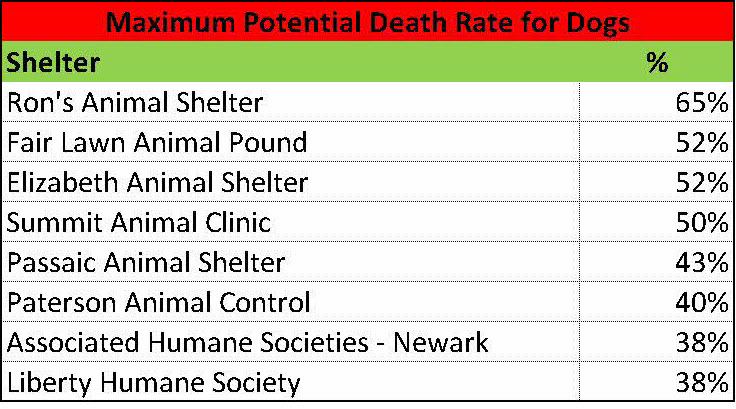
    1. 80% and 20% of each communities dogs (including pit bulls) were adults 1 year and older and under 1 year.
    2. Pit bulls were assumed to comprise 50%, 35% and 25% of community dog intake at poor, middle/upper middle class, and wealthy area animal control shelters. While some shelters may have pit bulls comprising more than 50% of their shelter dog population at a given time, this is due to pit bulls longer average length of stay. For example, a shelter with pit bulls making up 50% of their dog intake and pit bulls having an average length of stay three times longer than other dogs will have pit bulls constituting 75% of the dog population. Shelters without animal control contracts were assumed to only have pit bulls make up 10% of their community dogs (i.e. strays and owner surrenders) based on most of these shelters’ highly selective admission practices.
    3. Pit bull length of stay was taken directly from the Journal of Applied Animal Welfare study. The average lengths of stay for other breeds from this study were averaged and used for dogs other than pit bulls in the analysis
  • Dogs transferred to rescue or other facilities are assumed to stay at shelters 8 days on average based on the assumption strays can’t be released until the 7 day hold period elapses.
  • Community dogs not returned to owners or euthanized are initially assumed as adopted for each month. However, if the calculated length of stay exceeds the shelter’s required length of stay, dogs are moved from adoption (i.e. with a longer length of stay) to rescue (i.e. shorter length of stay) until the calculated length of stay each month approximately equals the required length of stay.
  • Required length of stay = Shelter’s reported capacity/adjusted daily intake for the month. Adjusted daily intake for month = Adjusted monthly intake per first bullet above/the number of days in the month.
  • Shelters with excess capacity are assumed to use the extra space to rescue and adopt out dogs from other New Jersey animal shelters. To the extent all healthy and treatable New Jersey animal shelter dogs are saved, I assume additional dogs are pulled from nearby states with similar types of dogs. I assume all rescued dogs will not be killed since the transferring and receiving shelters should evaluate these dogs’ behavior. Based on pit bull type dogs having longer lengths of stay at shelters, I assume 80% of dogs rescued from local animal shelters are pit bulls and 20% are non-pit bulls. 80% and 20% of pit bull and non-pit bull type dogs are considered 1 year and older and under 1 year. The average length of stay for rescued pit bulls and other dogs are the same as above.
  • Each month’s targeted outcomes are added to determine how many local dogs New Jersey animal shelters should adopt out, send to rescue, rescue from other nearby animal shelters and euthanize.

New Jersey Animal Shelter Statistics Are Far Worse Than Previously Thought

Photo of discarded dead animals from a 2009 Office of Animal Welfare inspection report of Associated Humane Societies – Newark. The Executive Director at the time is still in charge of this shelter today.


Most New Jersey animal shelters voluntarily report detailed data to state authorities. Last August, I shared New Jersey’s animal shelters summary statistics on my Facebook page. Each year, the New Jersey Department of Health’s Office of Animal Welfare requests each licensed animal shelter in the state to submit animal shelter data for the previous year. Animal shelters voluntarily submit this data in the “Shelter/Pound Annual Report.” The Office of Animal Welfare takes these Shelter/Pound Annual Reports and compiles the number of dogs, cats and other animals impounded, redeemed, adopted and euthanized to prepare its Animal Intake and Disposition report. However, the Shelter/Pound Annual Reports include additional information on how animals were impounded (i.e. strays, owner surrenders, rescued from in-state facilities, rescued from out of state shelters, and cruelty/bite cases) and disposed of (i.e. returned to owner, adopted, sent to rescue/another shelter, and died/missing). Additionally, the Shelter/Pound Annual Reports include the number of animals in shelters at the beginning and end of the year as well as the maximum number of animals facilities can hold. Thus, the Shelter/Pound Annual Reports include very important data not found in the Office of Animal Welfare’s summary report.

I compiled the data from these reports and analyze the results in this blog. 2013 statistics for each New Jersey animal shelter are listed at this link.

Garbage Data Raises Serious Questions About New Jersey Animal Shelters’ Statistics

Several animal shelters, which reported statistics in prior years, failed to submit data in 2013. Specifically, Summit Animal Clinic in Union City, Associated Humane Societies – Tinton Falls, Mercerville Animal Hospital and Angel Pets Animal Welfare in Woodbridge disclosed this data in 2012, but did not do so in 2013. Additionally, East Orange Animal Shelter has never submitted Shelter/Pound Annual Reports to the state, but did share limited data with The Record newspaper. These shelters failure to disclose data raises serious questions. For example, are they trying to hide embarrassing statistics from the public? I’ve included these shelters’ 2012 data, and in the case of East Orange, its limited 2013 data in my analysis. Also, I performed my analysis without these shelters as well. Unless indicated below, I’ve included these shelters’ data in the analysis under the assumption the statistics would be similar if submitted to the Office of Animal Welfare in 2013.

Most New Jersey animal shelters do not properly account for their animals. Simple math dictates the number of animals at a facility at the beginning of the year, plus all animals coming in during the year, less all animals leaving for the period, should equal the number of animals a shelter has at the end of the year. Stunningly, 69 out of 100 shelters reporting these dog statistics and 71 out of 98 facilities submitting this cat data failed to get this right. This raises serious questions about the accuracy of these shelters’ reported statistics. Even worse, 54 of the 69 shelters with flawed dog statistics and 46 of the 71 facilities with incorrect cat statistics should have had more animals at the end of the year then reported. While these errors could have been due to incorrect counts of the number of animals at facilities, the more likely answer is many outcomes, such as animals killed, dying, or gone missing, were not recorded. Given 71% of the errors were due to shelters having less rather than more animals on hand at the end of the year than they should have had lends credence to the theory that errors were mostly due to shelters failing to account for various outcomes. To put it another way, 3,231 cats and dogs should have had outcomes reported and did not. Thus, there is the potential that as many as 3,231 additional dogs and cats were killed, died or went missing from New Jersey animal shelters than were reported in the last year.

Shelters may have failed to classify animals adopted out and sent to rescue properly. Both Paterson Animal Control and Elizabeth Animal Shelter reported no animals were sent to rescues and all dogs and cats leaving their facilities alive were owner reclaims or adoptions. However, rescues I know who work closely with these two facilities told me both shelters rarely adopt animals directly to the public. This makes sense as neither shelter advertized animals for adoption (i.e. no adoption web site or social medial pages) in 2013. One has to wonder how many other facilities failed to properly classify adoptions and rescues properly. This data is very important as it provides details on the burden rescues and other shelters are taking from these facilities.

We need better oversight of New Jersey animal shelters’ data reporting. Currently, these statistics are voluntarily reported and most shelters are not taking this seriously. For example, I noticed a large number of reports were submitted many months after the end of the year. This data should be easy to compile since facilities can utilize animal shelter software programs, some of which are free, to do this task. Furthermore, New Jersey animal shelter laws mandate facilities maintain much of the raw data found in the Shelter/Pound Annual Report. Unfortunately, Office of Animal Welfare inspections routinely find shelters do not properly keep records on animals. We need to make the Shelter/Pound Annual Report mandatory for animal shelters along with serious penalties for significant errors (especially if deliberate). In order for animal shelters to take data reporting seriously, we may also need to require audits of these reports. Thus, these results show we need stronger laws and the Office of Animal Welfare to play a greater role in ensuring reported animal shelter statistics are in fact accurate.

Despite the errors in these reports, the data provided still reveals important information.

More Animals Losing Their Lives in New Jersey Animal Shelters Than Previously Believed

The more detailed data in the Shelter/Pound Annual Reports allows one to more critically examine the percentage of locally impounded animals dying in New Jersey’s animal shelters. The following table summarizes my analysis of the kill/death rate calculated from the Office of Animal Welfare’s summary report and the data reported in the Shelter/Pound Annual Reports.

Totals

The Animal Intake and Disposition report prepared by the Office of Animal Welfare only allows one to calculate the number of animals killed as a percentage of total animals impounded or intake. I prefer calculating the kill rate as a percentage of outcomes rather than intake as this metric directly compares positive and negative outcomes. Using intake depresses the kill rate since shelters can simply hold animals for a long time to the point of overcrowding. Calculating kill rate based on outcomes rather than intake increases the dog kill rate from 13.4% to 13.9% and the cat kill rate from 38.5% to 39.2%.

To calculate the statewide kill rate, we must also back out transfers from one New Jersey animal shelter to another state facility to avoid counting animals still in the state’s shelter system or registering two outcomes for the same animal (i.e. one New Jersey animal shelter transfers a dog or cat to another state facility who then adopts out the animal). This adjustment increases the dog kill rate from 13.9% to 14.5% and the cat kill rate from 39.2% to 40.8%.

In addition, we should increase the kill rate for animals dying or gone missing in shelters. I label this metric the death rate as these animals are likely dead or in a very bad situation. After making this adjustment, the dog death rate increases from 14.5% to 15.5% and the cat death rate rises from 40.8% to 46.8%.

Also, many shelters transport easy to adopt animals from out of state which artificially increases save rates. To properly calculate the percentage of New Jersey animals losing their lives, we need to adjust for transports. Unfortunately, shelters don’t break out their save rates by local and out of state animals. However, most likely nearly all of the out of state animals (primarily puppies and easy to adopt dogs) make it out of shelters alive. Therefore, I back out the number of out of state transports to estimate the local death rate. This adjustment increases the New Jersey dog death rate from 15.5% to 18.9% and the state cat death rate from 46.8% to 47.4%.

Also, I estimate a maximum local death rate by including the number of unaccounted for animals described in the section above. Making this adjustment increases the maximum potential New Jersey dog death rate from 18.9% to 22.1% and the maximum potential state cat death rate from 47.4% to 49.5%.

Finally, the maximum potential New Jersey cat death rate decreases slightly from 49.5% to 49.4% if I include the 2012 data from shelters who failed to report statistics in 2013 to the Office of Animal Welfare. Thus, the percentage of New Jersey animals losing their lives in our state’s animal shelters may be much higher than previously thought.

Death Rates Extremely High at a Number of New Jersey Animal Shelters

Dogs and cats are likely to lose their lives or go missing at a number of New Jersey animal shelters. Shelters with the highest death rates for dogs and cats are listed in the following tables:

NJ Shelter Rates Tables (6)

NJ Shelter Rates Tables (7)

Thus, both dogs and cats have a very good chance of leaving many New Jersey animal shelters dead rather than alive.

Many shelters fail to account for large numbers of their animals. As discussed above, a shelter’s number of animals at the end of the year should be calculated as follows:

Beginning number of animals + animals impounded – animals leaving the shelter

Unfortunately, a large number of shelters take in far more animals than they can explain where they went. Shelters having the highest numbers of unaccounted for dogs and cats are listed in the following tables:

NJ Shelter Rates Tables (8)

Unacct cats

Dog and cat death rates at many shelters may be even higher if these unaccounted for animals are counted as dead or missing. If we only consider animal shelters which don’t or rarely transport, facilities with the highest dog and cat death rates considering the unaccounted for animals described above are as follows:

NJ Shelter Rates Tables (2)

Max pot cats po

Thus, the plight of dogs and cats may be far worse in New Jersey animal shelters when we consider the unaccounted for animals.

Shelters Turn Their Backs on New Jersey’s Animals

New Jersey animal shelters rescue far more animals from out of state than other New Jersey animal shelters. Specifically, 5,676 dogs were transferred from out of state animal shelters compared to only 1,410 dogs taken in from other New Jersey animal shelters. While perhaps some shelters, such as Animal Alliance in Lambertville, take animals from nearby New York or Pennsylvania animal control shelters, the overwhelming majority of these dogs most certainly came from down south. In fact, New Jersey animal shelters transported more dogs from out of state than dogs who were killed in, died in or went missing from New Jersey animal shelters. This number does not include additional dogs transported in from out of state by rescues operating without a physical facility. Shelters transporting the most dogs from out of state were as follows:

NJ Shelter Rates Tables (5)

New Jersey animal shelters transported 642 cats from out of state while nearly 50% of cats in the state’s animal shelters were killed, died or went missing. Animal Welfare Association (280 cats received from out of state) and Mount Pleasant Animal Shelter (211 cats received from out of state) rescued more cats from out of state facilities than New Jersey animal shelters. In the case of Mount Pleasant Animal Shelter, the organization’s Executive Director told me these cats were rescued from New York Animal Care and Control. One can only hope the out of state cats rescued by other New Jersey animal shelters came from nearby New York and Pennsylvania facilities rather than from shelters far away down south.

Return to Owner Rates Better Than Average at Most Shelters

Return to owners (“RTO”) rates are one of the positive results from this analysis. Overall, the dog and cat RTO rates of 52% and 4% are approximately twice the national average. As I noted in my blog on reuniting lost pets with owners, return to owner rates are highly correlated with socioeconomic status. Wealthier people likely have more resources/knowledge to license and microchip their dogs. Similarly, people with greater incomes are more likely to afford reclaim fees or ransom payments to animal shelters. New Jersey’s RTO rates for dogs clearly fit this pattern with shelters serving wealthy towns returning most stray dogs to owners while urban shelters are only returning about one fifth of lost dogs to owners. Clearly, we need to help people in urban areas get microchips and ID tags on their dogs. Additionally, we need to create pet help desks at shelters in these cities to help people pay the reclaim fees, which are often mandated by the cities themselves, when necessary. The statewide cat reclaim rate, like figures from across the nation, is still very low and suggests shelters need to figure out better ways to get lost cats back to their families. New Jersey should allow shelters to transfer stray cats to rescues during the mandatory 7 day hold period since few are returned to owners at shelters. This would open up space to save more cats and reduce the chance of disease (i.e. cats spending less time in shelters are not as likely to get sick).

Shelters Leave Animal Enclosures Empty While Dogs and Cats Die

New Jersey animal shelters fail to use their space to save animals. Based on the average number of animals at all of New Jersey’s animal shelters at the beginning and the end of 2013, only 61% of dog and 66% of cat capacity was used. Given December is a low intake month, I also increased these populations to an average intake month. This adjustment only raised the dog and cat capacity utilization to 62% and 87%. These estimates likely overestimate the average capacity utilized as many facilities kill animals once they reach a certain population level. Many animal shelters with low kill rates failed to rescue animals with their excess space. Additionally, other shelters used little of their available space and still killed a large percentage of their animals. Some examples after increasing the population (and therefore capacity utilization) based on the adjustment discussed above are as follows:

NJ Shelter Rates Tables (11)

NJ Shelter Rates Tables (13)

Thus, many New Jersey animal shelters are killing dogs and cats despite having ample space to house these animals.

New Jersey’s animal shelters continue to fail the state’s animals. The state’s animal control facilities only impound 8.7 animals per 1,000 New Jersey residents. As a comparison, the average community in the country impounds anywhere from 14-30 animals per 1,000 residents based on estimates from Animal People Newspaper and the Humane Society of the United States. Despite New Jersey shelters impounding a fraction of the animals other no kill communities take in on a per capita basis, the state’s animal control facilities continue to kill and allow animals to die under their care. Even worse, many of these shelters can’t even properly keep track of how many animals leave their facilities dead or alive. Our state’s animals deserve far better treatment than this. Contact your local city council members and mayor and demand better from the animal shelter serving your community. We can do this so let’s get to work!

Role Model Shelter Saves Its Pit Bulls

DSC_0109

Earlier this year, I wrote a blog on how many progressive open admission animal shelters are saving all of their pit bull type dogs. One of these progressive facilities was Colorado’s Longmont Humane Society. Longmont Humane Society’s Executive Director, Elizabeth Smokowski, was kind enough to share some data with me showing how impressive this facility is.

Longmont Humane Society places all of its savable pit bulls in a very short period of time. Based on raw data provided to me, Longmont Humane Society saved 96% of its pit bull type dogs impounded in 2014 (through November 21). Additionally, pit bulls on average only stay at the shelter for 33 days. As a comparison, Longmont Humane Society saves 98% of its non-pit bull type dogs and non-pit bull type dogs stay on average around 9.5 days at the shelter. Both pit bull type dogs and other kinds of dogs are saved at rates far exceeding the typical 90% threshold required for no kill status. Thus, Longmont Humane Society does an amazing job for all of its dogs.

Longmont Humane Society impounds far more pit bull type dogs than New Jersey animal shelters. Through November 21, Longmont Humane Society impounded around 430 pit bull type dogs this year (483 annualized). This equates to 3.59 pit bull type dogs per 1,000 people in Longmont Humane Society’s service area. As a comparison, Associated Humane Societies – Newark, which many people believe impounds extraordinary numbers of pit bulls, only takes in 2.06 pit bull type dogs per 1,000 people in its service area assuming 50% of impounded dogs are pit bull type dogs. Thus, Longmont Humane Society impounds far more pit bull type dogs than New Jersey’s urban shelters “filled with pit bulls.”

Longmont Humane Society Performance with Pit Bull Type Dogs Dispels Many Excuses Shelters Use for Killing or Refusing to Rescue Pit Bull Type Dogs

Pit bull type dogs are adopted quickly at Longmont Humane Society. Assuming a similar percentage of pit bull type dogs and all dogs are returned to owners (i.e. 35.6% of all dogs with outcomes) and those dogs are returned to owners in 5 days on average (i.e. Longmont’s hold period policy), we can estimate pit bull type dogs take 48.5 days to get adopted. However, pit bull type dogs likely take less time to get adopted than 48.5 days due to fewer pit bull type dogs probably getting returned to owners. Restrictive landlord policies often force owners to surrender their pit bull type dogs to shelters and such dogs typically aren’t returned to owners. Furthermore, breed-specific legislation in nearby communities may also result in more owners surrendering their pit bulls. With such a high save rate, many dogs likely require physical and/or behavioral rehabilitation and Longmont Humane Society still successfully adopts its pit bull type dogs out quickly. Thus, Longmont Humane Society has a high pit bull live release rate and quickly adopts out its pit bull type dogs.

Longmont Humane Society has a high pit bull live release rate and quickly adopts its dogs out despite the shelter having lots of pit bulls. Many shelters argue they have to kill or can’t rescue pit bulls due to having too many pit bulls. Longmont Humane Society’s pit bulls and other breeds short lengths of stay prove this is a meritless claim. For example, we can estimate the percentage of pit bull type dogs in Longmont Humane Society’s shelter and foster care dog population by using pit bull and non-pit bull lengths of stay and standard shelter population equations. Based on this data, 45% of Longmont Humane Society’s dog population at the shelter and in foster care should be pit bull type dogs. Furthermore, the large number of pit bulls do not negatively impact adoptions of other breeds given the non-pit bulls length of stay only averages 9.5 days. Unlike many shelters who complain about too many pit bull type dogs coming in and being forced to kill or warehouse scores of them, Longmont Humane Society rolls up its sleeves and saves these dogs.

Winning Strategies Save at Risk Dogs

Longmont Humane Society actively tries to return lost dogs to their owners. Returning lost dogs to owners is often the quickest way to get stray dogs safely out of the shelter. While Longmont Humane Society does not disclose its return to owner rate (i.e. dogs returned to owners/stay dogs taken in), it likely has a high return to owner rate given 35.6% of all dogs received (i.e. strays and owner surrenders) are returned to owners. The shelter’s web site lists lost pets both at the shelter and found by private individuals in the community. The animals can be sorted by type of animal and/or sex to allow someone to quickly find their lost family member. Additionally, people can report lost pets electronically on the shelter’s web site which can help the shelter quickly match lost dogs with their families. Thus, Longmont Humane Society takes active measures to help families find their lost pets.

Longmont Humane Society makes huge efforts at rehabilitating dogs at the shelter and in the community. Amy Sadler instituted her Playing for Life program at Longmont Humane Society several years ago. This program uses playgroups to give shelter dogs much needed exercise, which reduces stress, and increases adoptability. Furthermore, the shelter has a world class behavioral rehabilitation program helping dogs overcome treatable issues and trains other shelters in these methods. All dogs adopted from Longmont Humane Society come with lifetime behavioral support from the people running this program. Even more impressive, Longmont Humane Society provides reasonably priced classes to the public to help their dogs become model canine citizens. For example, Longmont Humane Society only charges $10 for one hour supervised playgroups designed to socialize dogs. Additionally, the shelter also offers a free new adopter workshop for Longmont Humane Society adopters (adopters from other shelters only pay $10). Thus, Longmont Humane Society makes great efforts to help dogs become emotionally healthy and build strong community support.

The shelter put into place many other innovative programs to adopt animals into loving homes. Longmont Humane Society uses foster families to help animals become more healthy, both physically and mentally, and therefore adoptable. In 2013, 656 animals or around 19% of all animals taken in spent time in foster homes. Longmont Humane Society rightly adheres to breed-neutral policies at the shelter focusing on individual behavior rather than breed labels. Also, Longmont Humane Society walks dogs outside the shelter with “Adopt Me” vests and gives interested people information about adopting. The adoption section of Longmont Humane Society’s web site is very user-friendly and allows people to quickly sort dogs who are good with other dogs or cats. Finally, the shelter has 850 active volunteers who logged over 59,000 hours helping the shelter last year. Thus, Longmont Humane Society uses a variety of innovative programs to save lives of all types of dogs.

Longmont Humane Society is a goal oriented organization. The shelter has a strategic plan for 2012-2018 listed on their website laying out measurable goals with specific deadlines. For example, Longmont Humane Society is seeking to reduce its average length of stay for dogs from 18 days to 9 days and for cats from 28 days to 14 days while maintaining no kill level save rates by 2018. Frankly, most shelters would be ecstatic with the old lengths of stay and would sit on their laurels. However, Longmont Humane Society continues to improve and has made substantial progress towards achieving its goal by reducing its average length of stay for dogs from 18 days to 14 days and for cats from 28 days to 21 days in two years. Another goal, using a mobile outreach program to help adopt animals out to underserved communities by 2018, will likely significantly reduce average length of stay for pit bull type dogs even further. Longmont Humane Society also has a goal to maintain a 95% adopter satisfaction rating on surveys and another goal to measure customer satisfaction for other programs, such as training, by 2017. Finally, the shelter lays out specific goals for attracting the best employees and financial performance. This focus on excellence allowed the shelter to turn its financial performance around while it was in danger of bankruptcy and continue improving its service to the community. Thus, Longmont Humane Society’s success with pit bull type dogs is a function of a goal oriented organization focused on continuously improving.

Longmont Humane Society proves that focusing on excellence yields impressive achievements. For far too long, most shelters have not set standards or goals and unsurprisingly fail to save their animals. Longmont Humane Society saves its pit bull type dogs and places them quickly despite taking large numbers of these dogs in and facing a severe financial crisis. Shelters need to drop the excuses for killing pit bull type dogs and do the hard work necessary to save them. Ghandi once said “The true measure of any society can be found in how it treats its most vulnerable members.” Pit bulls are the most vulnerable dogs in shelters and we should judge shelters on how they treat these animals. We know these dogs can be saved. Will those with the power to save pit bull type dogs do so or will the killing and excuses continue to win out at most shelters?